Fusarium wilt of wheat is a disease caused by Fusarium fungi. In winter wheat, barley, and other grains, the infection causes significant yield and quality losses. Infection leads to slow germination and reduced germination. Some fungi produce toxic substances, making the grain unfit for human and animal consumption.
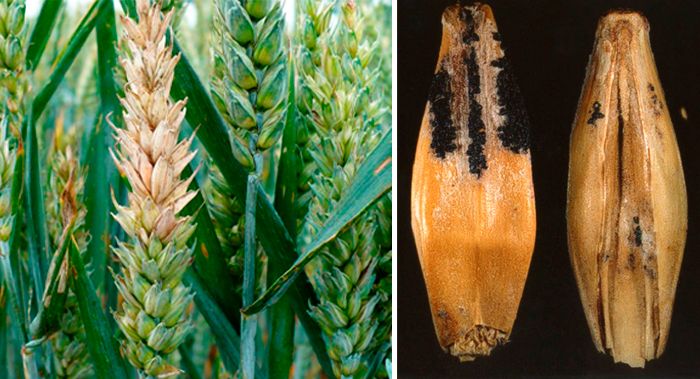
Symptoms of Fusarium wilt in cereal crops
The symptoms of Fusarium wilt vary depending on the type of fungi that cause the disease:
| View | Description |
| Cereal, Straw, Oat | Pinkish-red mycelium and spores. |
| Sporotrichaceae, Poaceae | Light pink sporulation on the spike scales. |
| Tricintum, Sporotrichaceae | Eye spot on the ear. |
You can tell if the grain is infected by the following signs:
- the seeds are weak, wrinkled, with a deep groove and pointed sides;
- the surface is colorless or slightly pinkish, does not shine;
- endosperm is loose, crumbly;
- poor vitreousness or loss of it;
- in the groove there is fungal mycelium in the form of a cobweb-like coating of a whitish or pinkish hue and conidia;
- the grain embryo is incompetent and dark in cross-section.
Even if grain appears healthy, if it is infected with fusarium, it should not be consumed or used for feed. It may contain mycotoxins. Therefore, storing the harvest is pointless; it must be destroyed.
Spread of infection
Infection with ascospores and conidia occurs during the growing season. The fungal mycelium overwinters in the soil on remaining plant parts. Fruiting bodies containing ascospores form on crop residue. These fruiting bodies infect the roots (Fusarium root rot) and stems during seed germination. Conidia form on infected lower foliage and straw. These are carried by the wind and during heavy rains to flowering ears (Fusarium head blight).
Plants are more susceptible to infection by fusarium at high air humidity and temperatures of +20…+25 °C.
Spores land on the anthers, through which they penetrate along with pollen. This creates a comfortable, nutrient-rich environment for the germination and development of fungi.
As a result, the grain, which has just begun to form, becomes infected, and fusarium rot or wilting develops.
The danger of fusarium wilt in cereals
Contaminated grain changes its chemical composition. Protein compounds decompose, and fiber and starch are destroyed. Gluten does not provide the necessary elasticity for the production of baked goods. As a result, flour products have a coarse, dark, and coarse-pored crumb.
Poisoning from grain containing mycotoxins causes vomiting, convulsions, and visual disturbances. These symptoms are typical of alcohol intoxication, which is why contaminated baked goods are commonly called "drunken bread."
Consuming infected grain can cause anemia, septic sore throat, and skin diseases. It is also unsuitable for animal feed, causing severe liver and kidney problems, reproductive problems, and skin necrosis.
Measures to combat fusarium wilt in cereals
It is recommended to carry out protective treatment with chemical fungicides before sowing.
This can be done in several ways:
| Methodology | Description |
| Dry | Sprinkling toxic substances with powder. The disadvantage is uneven distribution. |
| Semi-dry | Treatment with small amounts of liquid preparations (5-10 liters per 1 ton of seed). This prevents excessive moisture from being applied to the grain, eliminating the need for drying. Disadvantage: the use of specialized equipment. |
| Wet | Moisten the soil or spray with a fungicide followed by drying to prevent root (fusarium) rot. |
Spraying cereals during the growing season is also necessary. The most effective preparations are triazoles and benzimidazoles:
| Name of the drug | How to use | Consumption (l/ha) | Number of treatmentsOK |
| Avial | Irrigation in the phase of the last leaf, ear emergence or the beginning of heading. | 300 | 1 |
| Amistar Extra | Spraying at the stage of ear growth and before flowering. | 300 | 2 |
| Colfugo Super | Apply before sowing (10 l/t). Spray at the earing stage and before flowering. | 300 | 2 |
|
Prozaro |
It is used at the stage of the last leaf, ear emergence and before flowering. | 200-300 | 1-2 |
The most important thing to combat fusarium is not to waste time.
A two- to three-day delay reduces the effectiveness by 2 times.
Using biological products alone won't help with advanced fungal infections, but they can be used in addition to fungicides. This will increase the latter's effectiveness.
Biological preparations contain microbial strains that exhibit antagonistic activity against a specific pathogen. For the causative agent of fusarium, these are the fungi Trichoderma lignorum and the bacteria Pseudomonas fluorescens.
However, they cannot be used simultaneously with fungicides, so the only biological preparations remaining are those belonging to the pseudomonad group:
- Planriz. Used at the boot stage and at the beginning of flowering.
- Pseudobacterin-2. Irrigation in the phase of the last leaf and ear growth.
There are eco-technologies that make it possible to grow grain crops without pathologies using only biological preparations, without the use of chemicals:
- Perform pre-sowing treatment with a mixture of Trichodermin and Planriz.
- Repeat at the stage of sprouting and tillering.
- At the stage of tube emergence, spray again, adding Betsimide.
The following will help prevent the occurrence of fusarium on wheat:
- deep autumn plowing;
- timely removal of plant debris (this will prevent the development of
- most fungal diseases, including ophiobolous root rot);
- maintaining the distance between ears of corn when sowing;
- weed control.
Fusarium wilt of grain crops, including winter wheat and oats, is a serious problem for the agricultural industry. However, following certain rules during sowing and growing, as well as preventative treatment with specialized products, will significantly reduce the likelihood of its occurrence. It's easier to prevent any disease than to lose a harvest and spend time treating crops.