Tomatoes are a prime target for all sorts of infections and bacteria. Diseases are common among them. If left unchecked, you can easily lose your entire crop. But if you catch the infection early, it can be eradicated.
Content
- 1 Types of tomato diseases
- 2 Bacterial diseases of tomatoes with treatment and prevention in tables
- 3 Fungal diseases of tomatoes with treatment and prevention in tables
- 3.1 Late blight (phytophthora)
- 3.2 Cladosporiosis (brown or olive spot of tomatoes)
- 3.3 Anthracnose
- 3.4 Brown or dry spot (Alternaria or Macrosporiosis)
- 3.5 Cercospora leaf spot
- 3.6 Corking of tomato roots
- 3.7 Black leg of tomatoes (damping, lodging)
- 3.8 Fusarium rot of the root collar and roots
- 3.9 Fusarium root rot
- 3.10 Fusarium wilt
- 3.11 Gray leaf spot
- 3.12 White leaf spot (septoria)
- 3.13 Target spot
- 3.14 Wet rot of fruits (fruit rot)
- 3.15 Stem rot
- 3.16 Gray mold (botrytium spot)
- 3.17 White rot or sclerotinia
- 3.18 Phoma or Phoma rot
- 3.19 Southern sclerotium rot
- 3.20 Powdery mildew
- 3.21 Downy mildew or
- 3.22 Verticillium wilt
- 4 Viral diseases of tomatoes with treatment and prevention in tables
- 4.1 Mosaic (tomato tobacco mosaic)
- 4.2 Tomato leaf mottle (geminivirus, yellow mosaic)
- 4.3 Spotted wilt of tomatoes
- 4.4 Chlorotic (yellow) leaf curl
- 4.5 Top curl (beet top curl on tomato)
- 4.6 Aspermia
- 4.7 Alfalfa mosaic
- 4.8 Tobacco engraving
- 4.9 Bushy dwarfism of tomatoes
- 4.10 Double streak of tomato
- 4.11 Infectious chlorosis of tomato
- 4.12 Stolbur
- 5 Non-infectious diseases of tomatoes
- 6 Tomato pests as pathogens
- 7 Important: Disease-resistant tomato varieties: table with descriptions and photos
- 8 Tips from Top.tomathouse.com: How to Prevent Tomato Diseases
Types of tomato diseases
There are 5 types of diseases that can affect tomatoes:
- Bacterial lesions.
- Various forms of fungal infections.
- Viral infection.
- Non-communicable diseases.
- Diseases caused by insect pests.
In this article, we'll cover all the different types in more detail, as well as teach you how to recognize the infection and combat it properly.
Bacterial diseases of tomatoes with treatment and prevention in tables
Bacteria can only be combated at the preventative stage. If they are the cause of the disease, the bush will likely be beyond saving. If the bacteria manifest themselves during the active fruiting stage, you can try treating the tomato plant to harvest at least one crop and prevent the spread to other plants. Young, diseased plants are treated differently: they are pulled out of the ground and burned.
Bacteriosis (bacterial cancer)
Bacterial blight is caused by the insidious bacterium Clavibacter michiganensis. It enters the plant through microcracks, along with droplets of moisture remaining after watering. Another cause of bacterial proliferation is excessively high air humidity (above 60%). The infection quickly takes hold within the plant and infests the entire vascular system of the leaves and stems.
The lesions are divided into 2 types:
- Local ones that can be seen on the vegetative parts of the bush:
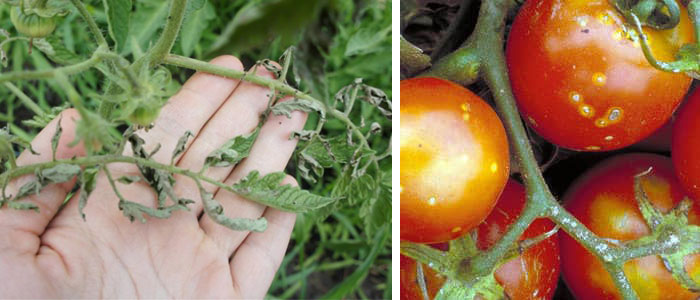
- Light spots, dotted with dark microcracks on the leaves.
- Small ulcers on the trunk;
- Yellow spots with light edges and darkening in the center on the fruits.
Bacteriosis also has a simpler name, “bird's eye,” due to the characteristic structure of the spots.
It spreads too quickly, affecting tomatoes from the roots to the tips of the leaves.
- Systemic, which are expressed in the wilting of the bush.
The edges and tips of the leaves begin to dry out first, the leaf curls up, and then the entire blade dries out. The stem becomes covered with small brown cracks, and the infected fruits become unusually soft. They turn yellow inside, and the seeds darken. The tomatoes grow crooked and lopsided.
It may be too late to save the plantings. In this case, it's essential to take care of the diseased plant's neighbors and treat them with antibacterial agents (Fitosporin or Fitolavin).
Treatment: table
| Prevention and/or folk methods, if possible | Medicines |
Preventative measures against bacterial diseases include seed preparation, soil disinfection, and crop rotation. Affected bushes must be destroyed. |
Buy seeds from reputable producers, as they often harbor bacteria. See packaging for processing instructions. If using seed from your own tomato plants, additional disinfection will be necessary. Soak the seeds in Fentiuram, TMTD, or Areparin for a couple of hours two weeks before planting. |
Bacterial wilt (southern sclerotial wilt)
Sclerotial wilt is caused by the bacterium Ralstonia solanacearum. This disease is also known as southern wilt because it is predominantly found only in warm regions of Russia, where temperatures remain consistently around 30 degrees Celsius throughout the season and air and soil humidity are quite high.
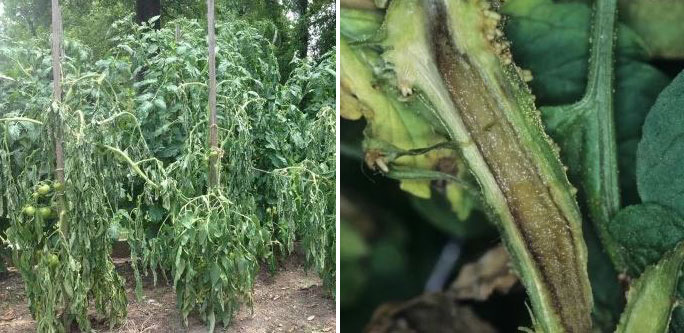
Note: This disease affects not only tomatoes but also virtually all other agricultural crops. The bacteria lives in the soil, so it primarily attacks plant roots.
The first sign of its activity is wilting of the leaves on the lower part of the stem. However, this progression is unusual, without chlorosis. This means that the leaf blades do not gradually turn yellow, but immediately wilt, with the leaves appearing to curl. Then, bacterial slime forms on the plantings, and cavities appear in the stems. The vascular system is damaged, after which the tomato plant dies. There is no cure for the disease; the only solution is to remove it from the garden bed and burn it, and treat the remaining plantings with Fitovlavin and disinfect the soil to prevent the spread of the infection.
Necrosis of the core
Pseudomonas corrugata is the cause of necrosis. The disease can begin at the seedling stage. Brownish-brown spots appear at the base of the stem, which crack, and the interior becomes hollow.
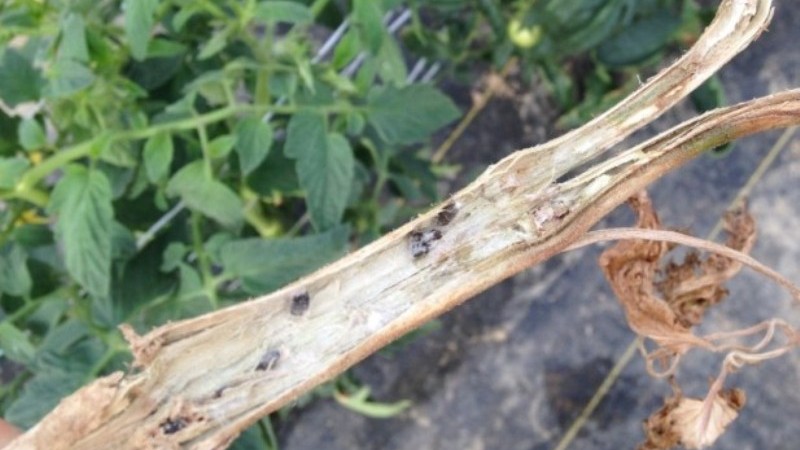
The leaf color lightens, becomes flaccid, and then dries up. Stem necrosis begins, with aerial roots appearing above the lesion, initially milky in color and then darkening. The stem itself becomes covered with longitudinal dark stripes.
This condition lasts no more than 20 days. If nothing is done, the planting will die.
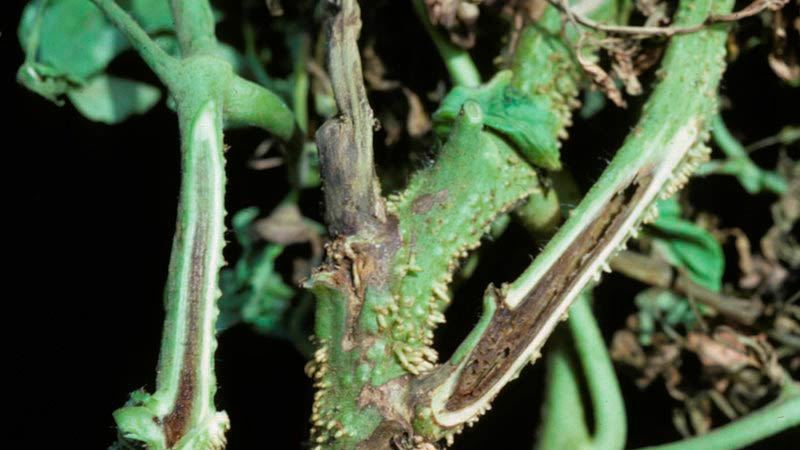
The infection is not treatable; a severely affected bush is destroyed and the soil is treated with a disinfectant.
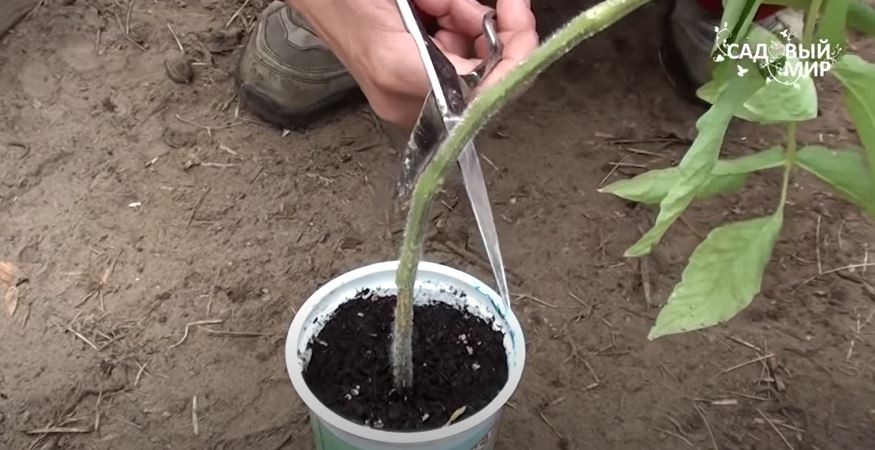
At the initial stage of this disease, seedlings can be saved by cutting off the lower affected stem and leaving the unaffected one with roots beginning to form, planting it in nutritious soil and adding two Gliocladin tablets, and watering.
| Prevention and/or folk methods, if possible | Medicines |
| They are used only as a preventative measure against the emergence and spread of bacteria. To create a disinfectant solution, dilute 10 g of potassium permanganate in 10 liters of water and thoroughly water the soil, ensuring the top 10-15 cm are moist. |
The germination sites of infected plants are thoroughly moistened with a special solution of Fitolavin at a rate of 20 ml per 10 liters of water. |
Bacterial leaf spot
The disease is caused by the bacterium Pseudomonas syringae pv. syringae. It is not as dangerous as other diseases and only appears when plant care is improper. If tomatoes are frozen, exposed to sudden temperature changes, or overwatered with cold water, they become vulnerable. The bacterium enters weakened plants through small cracks. Therefore, it is important to treat pinched areas with ash or another protective agent.
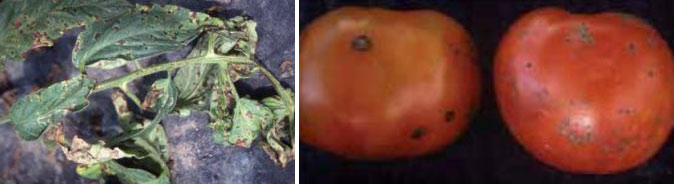
Bacterial spot is highly treatable. However, many gardeners ignore it because it doesn't affect fruiting, doesn't spoil the harvest, and doesn't cause crop death. The key is to avoid mistaking the bacteria for other, more dangerous microorganisms and remain vigilant.
Bacterial spot (mottle) of tomato fruits
The pathogen (Pseudomonas syringae pv. tomato) can persist in the soil for a long time, as well as in the remains of infected plants that were discarded rather than burned. It develops rapidly. Initially, small spots with light edges appear on the leaves; these quickly increase in size and merge into one. The leaf blade dies. The stem and fruit become covered in black lesions, which also progress very quickly. Tomatoes that have been exposed to cold, for example, after improper watering with well water, are most susceptible to the disease.
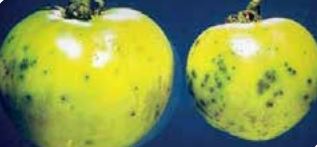
Important! The bacteria thrives on water, so it most often reaches plants through droplets of moisture. It's crucial to stop spraying if you discover an infected bush.
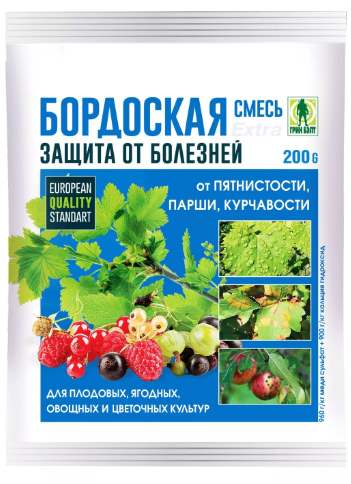
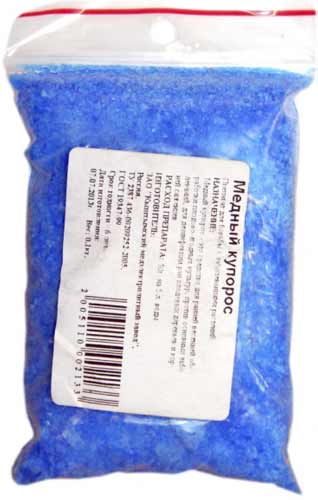
It's impossible to completely cure tomatoes, but you can contain the spread of spotting and slow its progression. To do this, water with Bordeaux mixture or copper sulfate. This will not only slow down the pest's activity but also help protect neighboring plants.
To prevent disease, preventative measures are taken before planting: seeds are treated and the soil is disinfected. At the end of the season, the beds are dug over, and all plant debris is removed.
Please note! Leaf spots caused by bacterial leaf spot, discussed above, can be larger than those caused by bacterial fruit spot.
Black (bacterial) spot
Pathogens: Xanthomonas euvesicatoria, X. vesicatoria, X. perforans, X. gardneri. They live in the soil, carried there by dug-up plant debris. They can often also infect seeds. If the seeds are not treated before planting, the plant will inevitably become infected. They are spread from tomato tomato tomato by droplets of water, so it is important not to spray the area where the infected plant is located, and to thoroughly treat cuts and side shoots, as these are the most vulnerable.
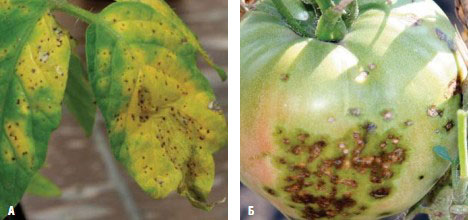
The presence of the bacteria can be recognized by small, water-soaked, black spots with a yellowish border. They appear not only on leaves but also on all other vegetative parts. Their shape can vary greatly. With each passing day, the affected area increases, the spots merge, the leaves die, and the fruit becomes covered with small, black, water-soaked bumps, where active decay of the flesh is taking place. Initially, the border is dark, but gradually becomes green and dry.
The disease is incurable. In the early stages, you can try to contain its spread, but it's best not to take any risks. The safest course of action is to burn the affected tomato.
Treatment: table
| Prevention and/or folk methods, if possible | Medicines |
| As a preventative measure after the end of the season, thoroughly remove all plant debris from the garden bed, dig it over, and spray it with a disinfectant solution. The interior surfaces of the greenhouse should also be disinfected. Before sowing, the seeds should be prepared and disinfected in advance. |
Small areas of bacterial blight affected by the bacteria are sprayed with special fungicides. Bordeaux mixture or copper sulfate are suitable for this purpose. Before planting, seeds are soaked in Fentiuram or TMTD. Young seedlings can be treated with copper-containing compounds. |
Fungal diseases of tomatoes with treatment and prevention in tables
Fungi of all kinds are considered the most resilient parasites. They are immune to time, temperature fluctuations, and humidity fluctuations. They can remain in the soil for a long time, biding their time. Therefore, soil disinfection is particularly important in the fight against this pest.
Late blight (phytophthora)
This common and frequently occurring disease is caused by several fungi: Phytophthora nicotianae var. parasitica, P. capsici, P. drechsleri.
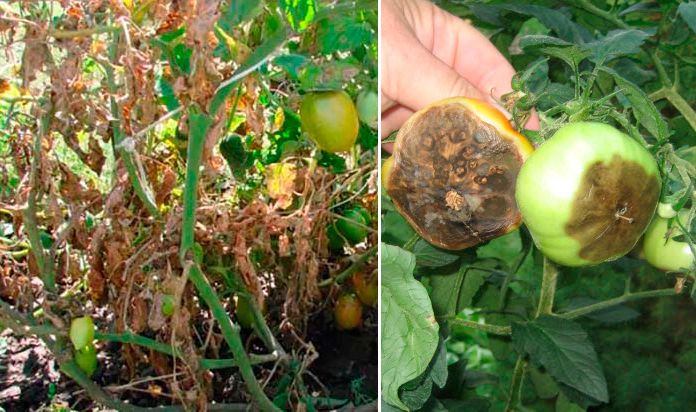
Spores can survive in the soil for a long time, even during frosts. However, as soon as humidity levels rise and watering becomes more abundant, they begin to attack the plants. Fruits are most affected, while the disease rarely manifests on leaves and stems.
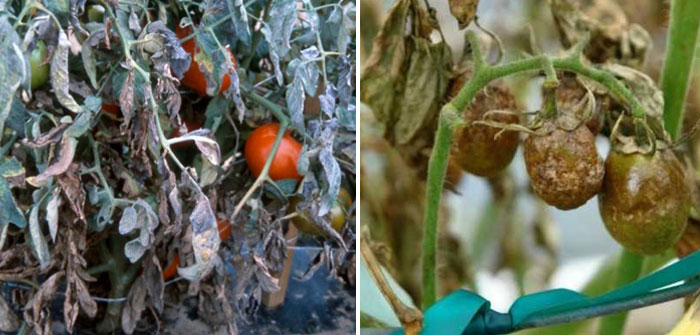
Late blight has visible signs that can be used to identify it. Dark, blurry spots begin to appear on tomatoes. They grow rapidly and soon merge into a single spot. The fruit darkens and becomes soft. At the same time, the leaves begin to turn white, a white coating can be seen on the underside, and dark spots appear on the tops.
To prevent fungus, it is necessary to follow watering rules, not plant potatoes and tomatoes together, and remove infected bushes and plant debris at the end of the season.
Treatment: table
| Prevention and/or folk methods, if possible | Medicines |
As a preventative measure against fungal growth, plants can be sprayed five times per season with a solution of HOM fungicide (40 g per 10 liters). This should be done in dry weather; the product washes away quickly. Furthermore, it doesn't accumulate in plants or soil, making it safe and non-toxic. The effect lasts no more than 14 days. |
Caution! Late blight spreads not only within a single crop but also easily to nearby potatoes, cucumbers, and eggplants. Therefore, preventative treatments are carried out simultaneously. |
More details about late blight and tomato varieties resistant to this disease Read on our website.
Cladosporiosis (brown or olive spot of tomatoes)
The fungus Fulvia fulva (synonym: Cladosporium fulvum), which causes the disease, has a huge number of subspecies. All of them are extremely resilient and can easily overwinter in the garden, even at low temperatures.
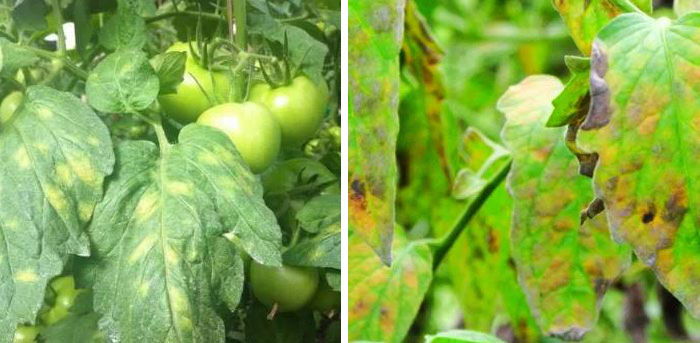
Like many other fungi, it thrives in moisture and begins to reproduce during temperature fluctuations and heavy watering, most often in July. It is most active during the flowering and fruiting periods of tomatoes.
The lower leaves become infected first, after which the fungus creeps up the stem. Water droplets from sprinkling and spraying are the main "vehicle" for the infection. The more water you water, the faster it will destroy the plant. If diseased bushes appear in a garden bed, even if they are successfully treated, the soil and the inside of the greenhouse will need to be disinfected and the garden bed dug over.
Regular ventilation and lowering air humidity will help slow the spread of the disease. Fungus thrives when humidity approaches 90% and the thermometer rises above 24°C (75°F).
A sign of the disease is the appearance of small, round, yellow spots on the leaves. The underside of the leaf blade becomes covered with spores, which resemble a velvety coating. Eventually, the spots spread, merge, and the leaf dies. The fruit and trunk may not be attacked at all, but due to the lack of foliage, they also begin to wither. As soon as you notice spores on the leaves, you must begin treatment immediately, otherwise, all the plants will soon become infected. In the early stages, it is possible to save the plant, but if the infestation is widespread, the tomato plant should be dug up and burned. It is no longer possible to save the tomato plant, but the remaining tomatoes can easily become infected.
Treatment: table
| Prevention and/or folk methods, if possible | Medicines |
Traditional methods help only in the early stages of the disease; they cannot completely cure the affected bush.
|
|
More details about Cladospariosis and tomato varieties resistant to this disease Read on our website.
Anthracnose
More commonly known as copperhead, it is caused by the spores of the fungi Colletotrichum coccodes, C. dematium, C. gloeosporioides, and other species. The fungi become active in warm weather and high humidity. They most often thrive in highly acidic soils deficient in potassium and phosphorus. The main source of spores are the remains of diseased bushes and infected seeds.
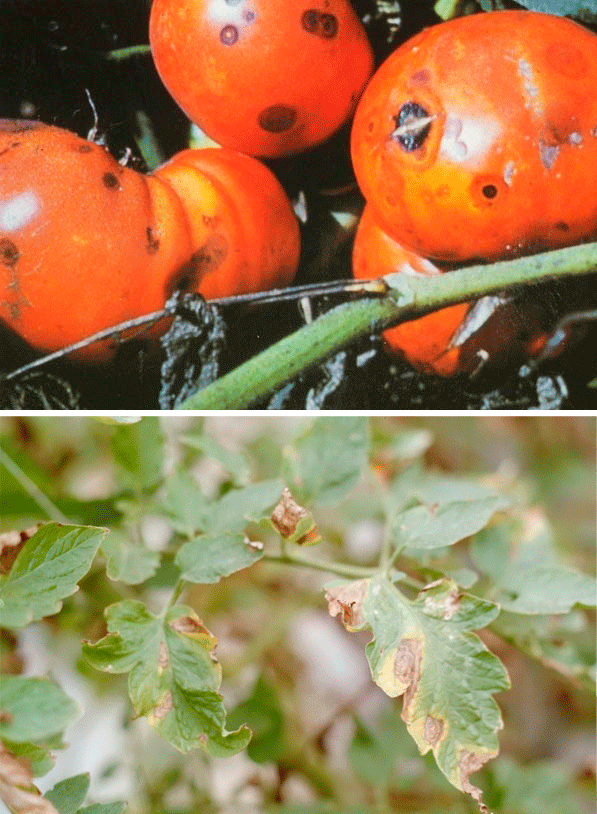
Important! If anthracnose is diagnosed in greenhouse crops, it is necessary to disinfect not only the soil but also the aisles between the beds and the interior surfaces of the greenhouse or hothouse.
The fungus spreads quickly, affecting all vegetative parts of plants. Leaves are the first to be affected, developing small reddish-brown spots bordered by yellow. Later, these spots darken and rot.
As for fruits, the fungus attacks only those that are very close to the ground or even touching the ground. These tomatoes develop crater-like spots that quickly turn black.
In the case of the stem, all damage occurs to the root system, but due to the death of leaf blades and fruits, it can also wither and begin to wither, new ovaries immediately fall off, others do not form.
If left untreated, the disease inevitably leads to plant death and the spread of infection to neighboring plants. However, this type of fungus is not pathogenic, so if detected early, it can be treated. Fungicides can help save the bushes; they should be applied immediately as soon as the first signs of anthracnose appear. If any bushes are destroyed, the soil beneath them should be thoroughly disinfected.
Treatment: table
| Prevention and/or folk methods, if possible | Medicines |
Experienced gardeners recommend purchasing a couple of solutions from the pharmacy to save tomatoes:
|
Antifungal agents typically have adverse effects on human and animal health. Therefore, treatment should only be carried out with careful observation of all safety precautions.
It's important to remember that fungi quickly adapt to the chemicals used to combat them. For effective treatment, it's necessary to change or alternate the products. · |
Brown or dry spot (Alternaria or Macrosporiosis)
The cause of the appearance is the fungus Alternaria solani Sorauer.
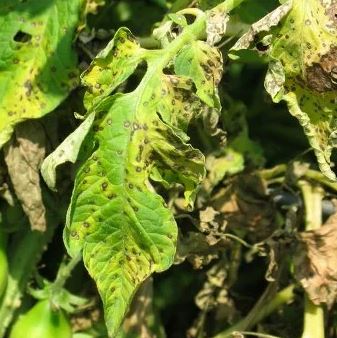
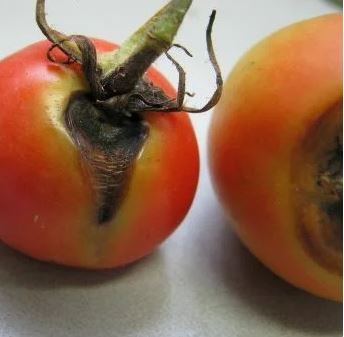
The disease affects all vegetative parts of the plant and begins to develop if watering rules are not followed and air humidity is high. The fungus lives in plant debris, as well as on the walls and ceiling inside a greenhouse or hothouse. Its spores are carried by water droplets during sprinkling or irrigation.
It all begins with damage to the lower leaves, where brown, round spots appear. These gradually become larger and eventually merge into one. The same thing happens on the stems and shoots. The fruit becomes covered with slightly sunken, dark spots, the surface of which has a velvety texture due to the presence of spores. The bush eventually dries up and dies, and the harvest rots.
Treatment: table
| Prevention and/or folk methods, if possible | Medicines |
There are no folk remedies for treating fungus; timely prevention is necessary:
|
|
If treatment does not help, you need to completely destroy the bush and do not forget about timely prevention.
Cercospora leaf spot
Pseudocercospora fuligena fungal spores begin to spread when the outside air experiences consistently high temperatures and high humidity. This process typically occurs in the first half of summer. It is carried by wind and moisture droplets. It can also be introduced into the soil by poorly washed garden tools.
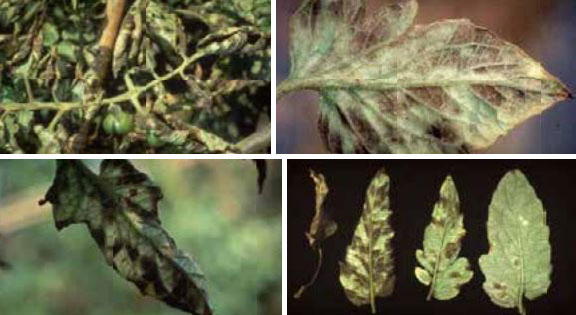
Another common name for this disease is black mold. This is due to the appearance of a dark, velvety coating on the affected areas. This is the manifestation of fungal spores. The disease begins to spread from the top of the bush. The leaves become covered with yellow spots that gradually darken and increase in size.
If treatment and prevention are not carried out in a timely manner, the fungus will quickly spread throughout the vegetative parts of the tomato plant and the bush will die very soon.
Treatment: table
| Prevention and/or folk methods, if possible | Medicines |
As preventive methods it is necessary to use:
|
In the fight against fungus, treatment of plantings with fungicides (Quadris, Ordan, Topaz and others) has proven highly effective. |
Corking of tomato roots
The causative agent of root fever, as this fungus is also known, is Pyrenochaeta lycopersici. It's nicknamed so for a reason, as it primarily attacks the root system of tomato plants. Damage to the root system causes changes in the appearance of the plants: they wilt, growth stops, and leaves fall off.
It all begins with small, young roots becoming covered in brown spots. These then begin to grow, taking on a cork-like texture. The fungus spreads to smaller roots, disrupting the plant's nutrition and respiration. If the fungus is not eradicated, the plants will quickly die.
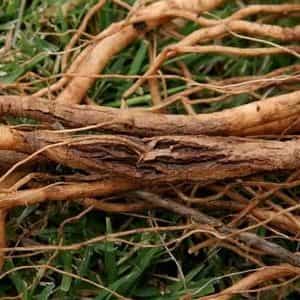
It's very easy to infect a tomato with root fever: just pick up an infected tool, be it a rake, a hoe, or a mattock. Even if you remove and burn the diseased tomato, the fungal spores will continue to live in the soil for a long time. Moreover, the disease affects not only tomatoes but many other garden crops as well.
The best conditions for active fungal development are weather with high humidity and air temperatures around 20 degrees Celsius.
Treatment: table
| Prevention and/or folk methods, if possible | Medicines |
A good preventative measure against the disease is seed treatment and pre-plant soil disinfection. If you notice fungus beginning to develop on your plants, you must take immediate action:
This will help slow down the spread of the fungus and minimize its harmful effects. |
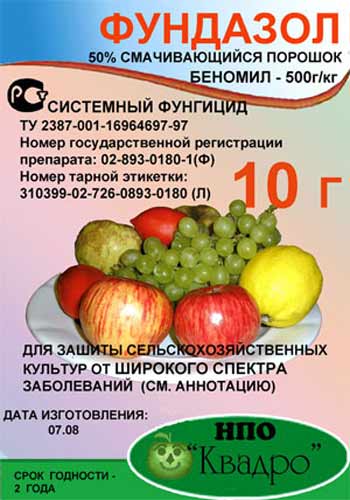
If the infestation is not too extensive, diseased bushes are treated with Fundazol. If the plantings are heavily infested, they are dug up and burned, and the soil and greenhouse are treated. |
Black leg of tomatoes (damping, lodging)
This disease is every gardener's nightmare. Unfortunately, it's common in tomatoes. It's caused by fungi of the genus Pythium and genus Phytophthora. These fungi can survive in the soil and feed on organic matter until the soil is depleted. After this, they move on to the tomato roots. The most favorable conditions for development and reproduction are high humidity and constant temperature fluctuations. The risk of developing the disease is increased by overly dense plantings, high soil compaction, and dirty gardening tools. The fungus is most often found on greenhouse tomatoes or young seedlings (it can be noticed when transplanting).
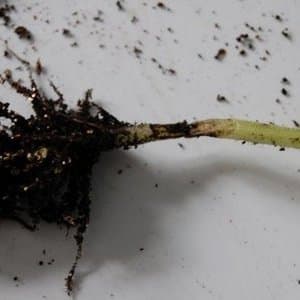
The disease is not treatable; the diseased bush must be immediately removed from the garden bed and burned before it infects all the neighboring plants.
The main symptom of the disease is softening of the tissue at the base of the tomato plant stem. Rotten spots appear there, gradually moving up the stem. Vegetative parts of the plant immediately wilt and fall off.
Note: Seeds often carry the disease; they rot during the germination and soaking stages.
Treatment
There are no cures; the only way to protect your plants is through prevention. Seeds and soil should be pre-treated before sowing, seedlings should be planted at the correct distance from each other to prevent them from growing too close together as they mature, the soil in the bed should be regularly loosened, and watering should be moderate.
Fusarium rot of the root collar and roots
The disease is caused by the bacterium Fusarium oxysporum f. sp. radicis-lycopersici.
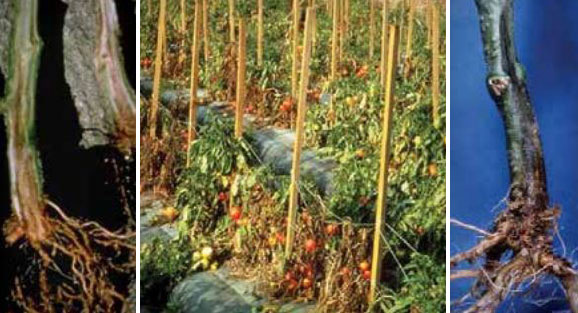
The disease initially manifests itself in older leaves, which begin to wilt for no apparent reason. This occurs when the first tomatoes appear on the bushes. After some time, the young leaves are also affected, and the bush withers and dies. The disease can be identified by examining the base of the stem. The root system turns brown, and above 20 cm from the ground, the central stem takes on a dark color due to the infection of the entire vascular system of the tomato plant. If the air humidity is too high, the damaged areas become covered with fungal spores.
The fungus is very tenacious; it can remain in the soil for several years and be carried around the site by garden tools, dripping water, and organic debris. It becomes active with abundant watering and cool air temperatures (around 20 degrees Celsius). It enters the plant through the roots and microcracks at the base of the stem.
Treatment
First of all, it's necessary to carry out preventative soil treatment before planting. To avoid this problem, it's best to initially select seeds resistant to this type of rot. If you notice the first signs of fungus, you can try to save the planting by treating it with a fungicide solution, such as Fiosporin or Topaz.
Fusarium root rot
The disease is caused by Fusarium solani (teleomorph: Nectria haematococca).
In the early stages of the disease, it can easily be confused with late blight. Chlorotic spots appear on the leaves, and tissue necrosis develops between the veins. After some time, the spots spread, merge into one larger spot, and the leaf dies and falls off. The root system is also affected. The taproot becomes covered in reddish-brown spots, the vascular system is damaged, and the stem darkens locally and begins to rot at the base.
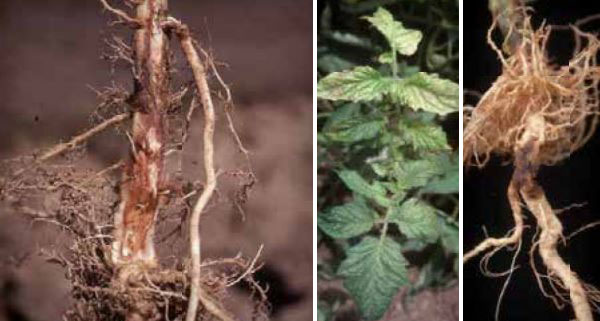
The fungus survives in the soil for up to three years. Unlike other species, it tolerates both moderate temperatures and heat of 27 degrees Celsius. It enters the plant through microcracks and mechanical damage found on tomato roots.
Treatment
Preventative measures begin long before planting tomatoes. If the bed already contains infected crops, at least a four-field crop rotation is required, which involves planting crops resistant to the fungus. To prevent the disease from developing in the bed or at the first signs of its appearance, treat the crops with fungicides (Fitosporin, Topaz, and others).
Fusarium wilt
The causative agent of the disease is Fusarium oxysporum f. sp. Lycopersici.
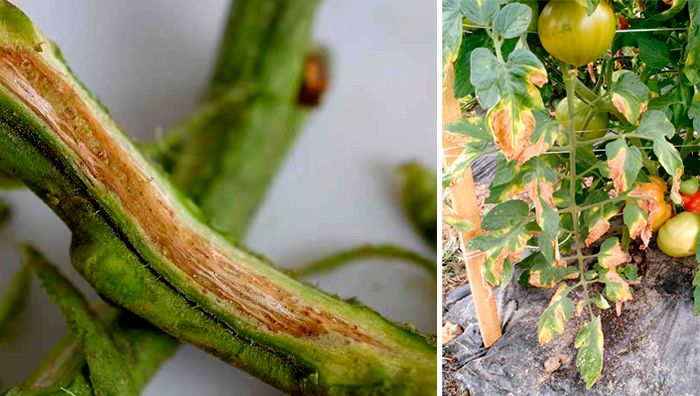
The disease can manifest itself at various stages of tomato growth. Young seedlings often die before they have time to mature. More mature plants begin to lag in growth and wither, with a sharp yellowing of the vegetative parts of the bush. Moreover, affected leaves do not fall off but remain hanging on the stem, giving the plantings a "yellow flag" appearance. The main symptom of the disease is tissue changes at the cut site of lateral shoots. This occurs due to damage to the vascular system, resulting in the appearance of reddish-brown spots. The disease progresses rapidly from the roots to the crown.
The fungus can easily survive in the soil for up to three years, spreading from one garden bed to another through water and plant debris. It can also be carried by humans using garden tools. Spores enter the plant through microcracks in the roots, which can occur due to injuries sustained during tillage. The disease progresses more rapidly at high temperatures (above 28 degrees Celsius). Its development is often triggered by excessive use of fertilizers containing high concentrations of nitrogen, phosphorus, and other micronutrients.
Struggle
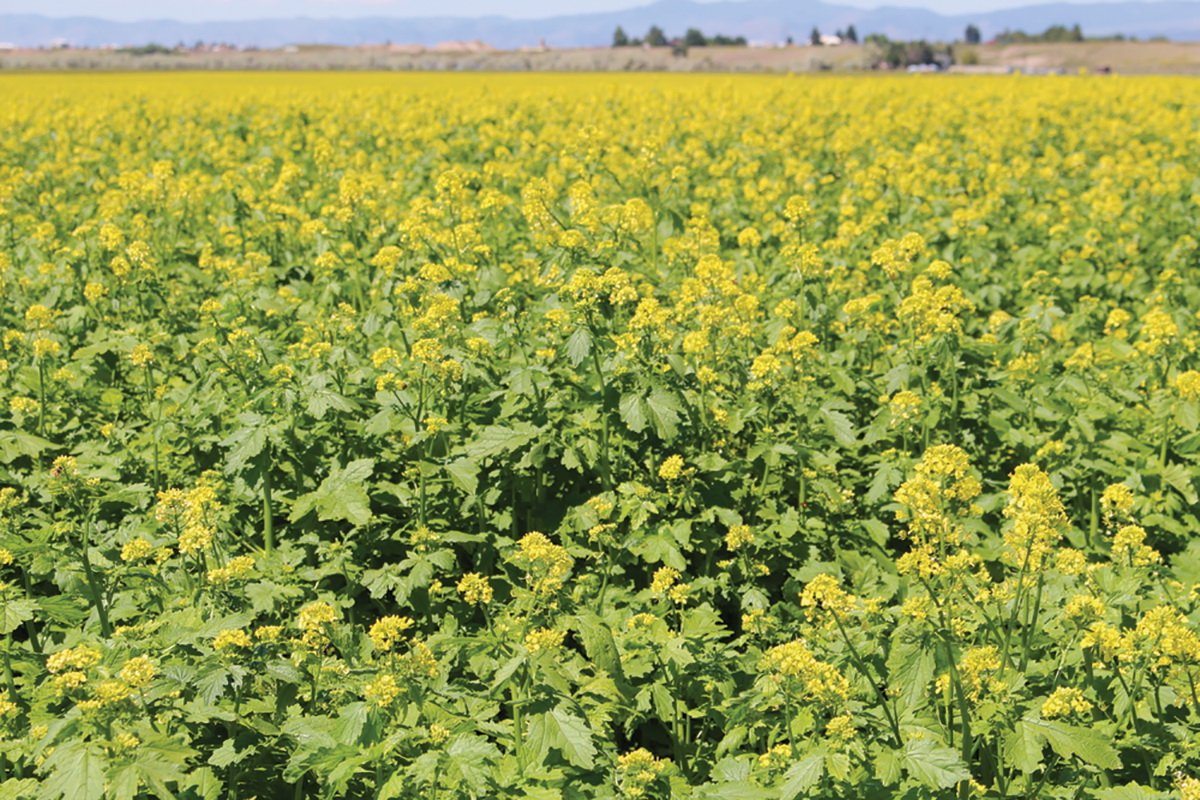
To protect your plants from disease, it's recommended to sow the bed with green manure (mustard, peas, rye, etc.) at the end of the season. In the fall, plow the soil to encourage the development of saprotrophic organisms. These organisms inhibit the development of many fungal parasites by suppressing their activity. Choose varieties that claim resistance to fungal diseases. Gardeners recommend planting hybrid tomatoes: Raisa F1, Silhouette F1, Grodena F1, Bobcat F1, etc.
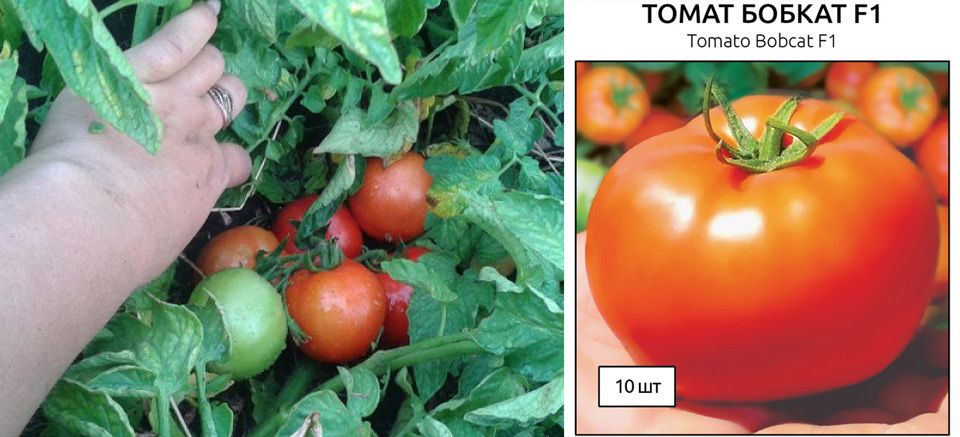
Read more about this disease, its treatment and resistant varieties on our website..
Gray leaf spot
Several fungal species cause this disease: Stemphylium solani, S. lycopersici (synonym: S. fl oridanum), and S. botryosum f. sp. lycopersici. These fungi are not particularly aggressive or dangerous and are not pathogens for tomatoes. Therefore, the disease is easily treated at an early stage.
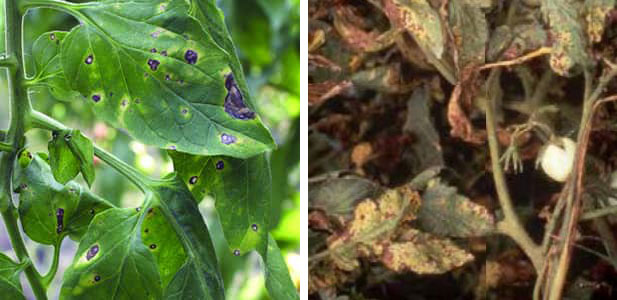
The spores attack only the leaf blades, leaving the rest of the plant's vegetative parts unaffected. However, if no action is taken to eliminate the disease, all the leaves will eventually fall off, and the stems will begin to wilt and wither. The tomatoes will die.
Gray spotting on leaves can be detected by detailed examination based on the following signs:
- The plate becomes covered with small dark spots.
- Over time, they become larger and acquire a gray tint.
- Their surface dries out and becomes covered with cracks.
When the spots grow so large that they merge into one, the leaf will fall.
The fungus lives in the soil and on weeds. It is carried from bush to bush by water droplets or a gust of wind.
The fungus has no particular weather preferences; it can manifest itself both in a lack of watering and in its excess, in both hot and cool weather.
Treatment
You can get rid of the disease by treating the plantings with a fungicide, for example, Fitosporin.
White leaf spot (septoria)
Another name for this disease that occurs in tomatoes is septoria leaf spot. It is caused by the spores of the fungus Septoria lycopersici. It is non-pathogenic. Septoria leaf spot can only lead to plant death if it becomes too severe. It spreads very quickly if not addressed. The fungus attacks the leaves, causing them to drop prematurely.

The peak period for the disease is from mid-July to the end of August. The weather is favorable for fungal growth: humidity is high, temperatures are still warm, but there are significant day-night fluctuations.
The disease manifests itself by small gray-white spots with dark edges appearing here and there on the lower leaves. The fungus then spreads upward, infecting the stems and petioles, causing the affected leaves to turn brown and fall off.
Treatment: table
| Prevention and/or folk methods, if possible | Medicines |
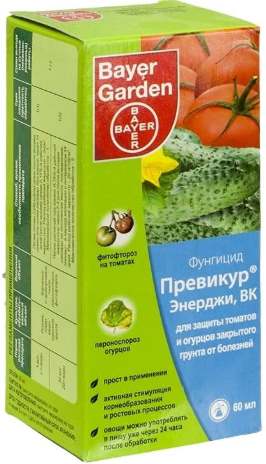
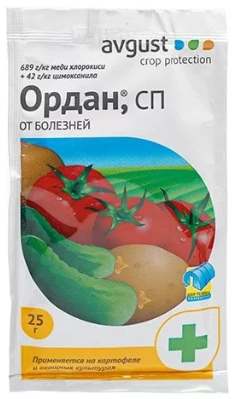
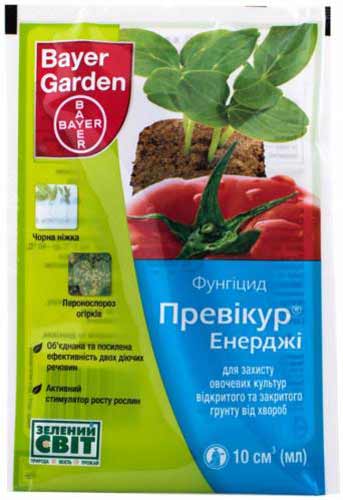
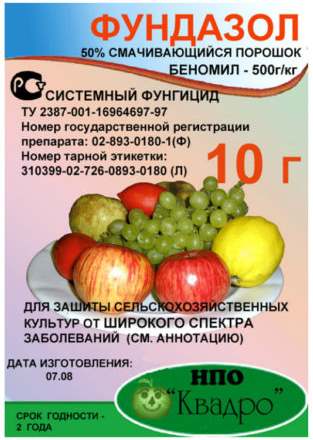
| The only available way to prevent the development of the disease is to pick off the infected leaves. | The affected bush should be treated with any fungicide (Previkur, Fundazol, Ordan, and others). Copper-containing products (Horus, HOM, Zineb, and others) can be used as a preventative measure. |
Target spot
When air temperatures become consistently high and humidity levels rise, the fungus Corynespora cassiicola thrives. It can enter the soil through plant debris, seeds, or dirty tools. It spreads to tomatoes via wind and water droplets.
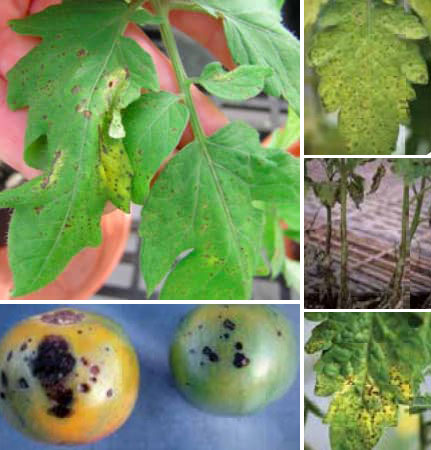
Spotting is difficult to treat, but if caught early, before the fungus reaches the central stem, the plantings can still be saved. It starts with the lower leaves, which become covered with small spots, more like dots. They grow very quickly and then merge into one huge spot. The leaf immediately dies and falls off. The worst case scenario for a tomato plant is when the fungus attacks the main stem.
The fruits also suffer from a fungus that creates sporulation islands on their surface. Brown spots form on the tomatoes, developing into ulcers. Such vegetables are no longer edible.
Treatment: table
| Prevention and/or folk methods, if possible | Medicines |
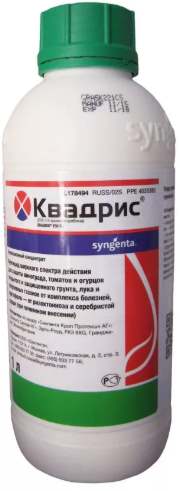
| Preventive work consists of pre-soaking the seeds to disinfect them, as well as following all the rules for caring for the crop, especially regarding temperature and humidity. | Target spot cannot be controlled with conventional fungicides used to kill other types of fungi. Therefore, it is necessary to additionally purchase a biofungicide, such as Quadris. |
Wet rot of fruits (fruit rot)
This type of rot exclusively affects tomato fruits. Along with moisture, the fungus penetrates the plant through microcracks on its surface. Peak activity occurs during the fruiting period, from mid-July to early August. The fungus thrives in high humidity and warm air.
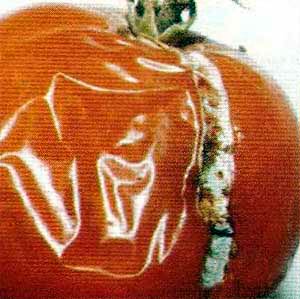
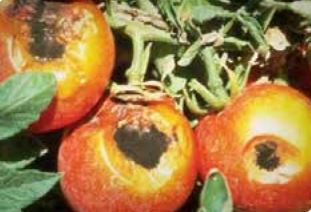
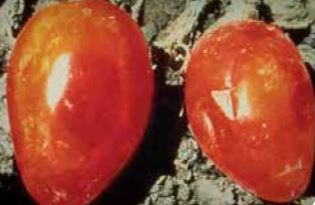
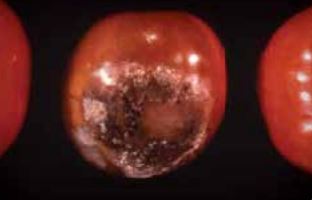
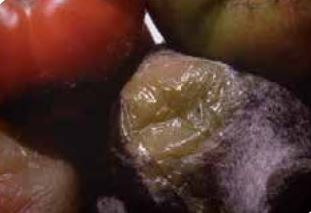
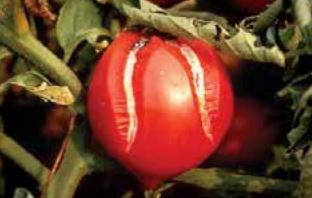
The infection can be detected even with a cursory inspection of the fruit. They become covered with spots, the appearance of which depends on the type of rot:
- Soft bacterial rot: yellowing, slimy yellow and brown spots. Pathogen: Erwinia carotovora subsp. carotovora.
- Black rot: deep black ulcers and a jackdaw-shaped crack near the stalk. Pathogens: Alternaria alternata and Stemphylium species.
- Pythium rot: water-soaked spots that may be fluffy. Caused by species of the genus Pythium.
- Rhizoctonia rot: typically develops on ground-tomato plants and appears as crusty spots that quickly develop into weeping ulcers and blistering lesions. Caused by Rhizoctonia solani.
- Soft rot: The spots spread quickly, revealing clearly visible black spots with a white coating, and the fruit itself develops an unpleasant rotten odor. Pathogen: Rhizopus stolonifer.
- Sour rot: elongated spots resembling cracks with a white coating extending from the stem toward the fruit; an unpleasant rotten odor is present. Pathogen: Geotrichum candidum.
This disease is unique in that it attacks only the crop, which can easily be lost if action is not taken promptly. Eating tomatoes infected with the fungus is strictly prohibited; the spores penetrate deep into the flesh and can remain there even when the visible rotten parts are cut off.
Important! Eating tomatoes affected by fungal rot can cause food poisoning and indigestion.
Treatment
Fruit rot cannot be cured; it is permissible to remove infected tomatoes to allow the remaining fruit to ripen. However, if the infestation is extensive, the entire plant must be removed and burned. To prevent the fungus, follow all necessary care procedures: loosening the soil, pinching off shoots, fertilizing, and tying. Follow watering guidelines and regulate humidity in hotbeds and greenhouses, and avoid planting tomatoes too close together.
Stem rot
The fungus Didymella lycopersici causes stem rot in tomatoes. It can spread to crops from fragments of old infected plants left in the soil. Spores are carried by water droplets. Moderately warm but rainy weather favors the spread and development of the disease.
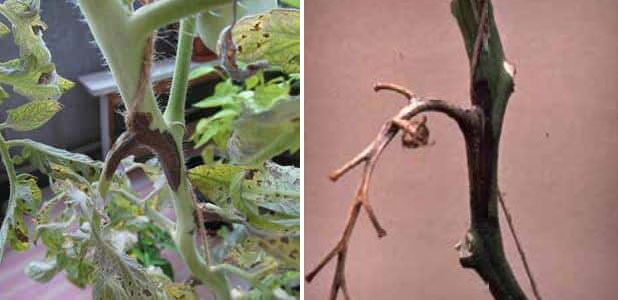
The risk of infection also increases if the soil lacks nitrogen and phosphorus. Mature plantings are most susceptible to this type of rot. Damage begins on the stems, but leaves are also affected. Dark-colored ulcers begin to appear on the trunk of the bush, their area and number steadily increasing. In advanced cases, the rot spreads to the fruit, where irregular, concentric, circular spots appear on the surface. The same phenomenon occurs on the leaves.
Treatment
Tomatoes can be treated at the initial stage of the disease if the central stem is not severely damaged. Treating the plantings with fungicides will help. Regularly inspect the leaves for signs of disease spread. If the disease cannot be contained, the plant should be removed and burned.
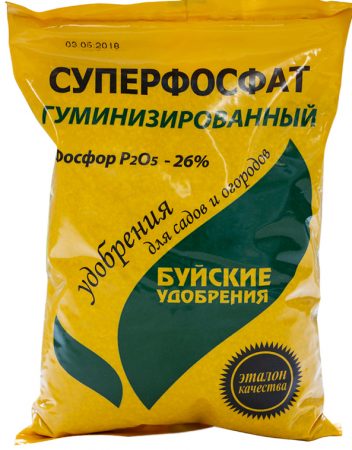
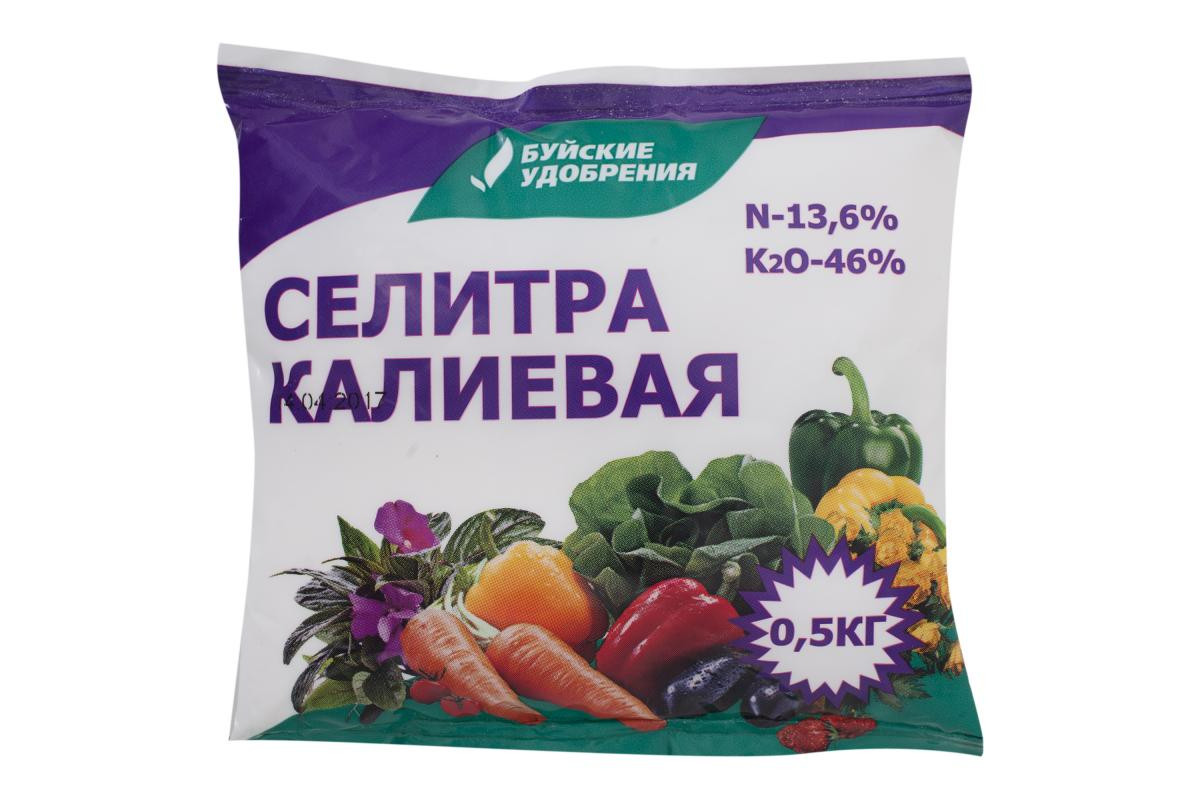
As a preventative measure, you can fertilize tomatoes with a solution of 10 liters of water, 40 g of superphosphate, and 30 g of potassium. Regular hilling is recommended.
Gray mold (botrytium spot)
The fungus Botrytis cinerea is present in almost every garden plot; it's not particularly dangerous and is easily treated. It becomes active when dense plantings prevent air circulation between bushes, and the weather is cool and humid.
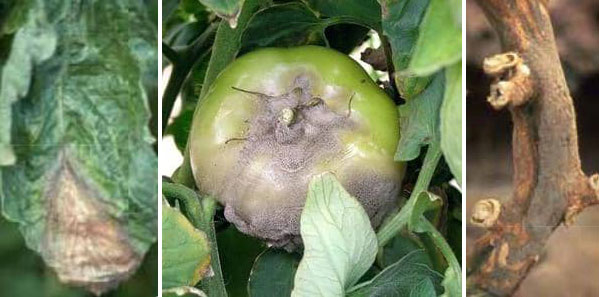
The fungus most often appears on the leaves, causing a fluffy, grayish, dust-like coating to form. It enters the leaf blade along with the liquid through microscopic wounds and cracks. If the stem is infected, the infection will spread to the fruit itself, which will become covered in gray-brown spots. The most dangerous situation for the plant is when the fungus takes up residence on the central stem. This can lead to the death of the entire plant if not detected and treated promptly.
Interesting. Gray mold stops growing as soon as the air temperature rises. But the spots and damage remain.
Even though the fruit has been infected, it's perfectly edible. Gray mold can be removed from part of the tomato; it doesn't affect its taste in any way.
Treatment
If you notice signs of gray mold, remove the affected parts of the plant. In a greenhouse, you can artificially raise the temperature inside the structure. No special preventative measures are required, other than following the rules for caring for tomatoes. If they are planted at the correct distance, watered regularly, the roots are not overwatered, and fallen leaves are removed from the bed promptly, the rot will not manifest itself. Some gardeners spray the plants with Fitosporin or Bordeaux mixture. These enhance the tomato's immunity.
White rot or sclerotinia
The fungi Sclerotinia sclerotiorum and Sclerotinia minor cause sclerotial root rot, as this disease is also known. It becomes active in damp, chilly weather, when the air humidity rises and the soil becomes wet. However, this fungus thrives even in cooler weather.
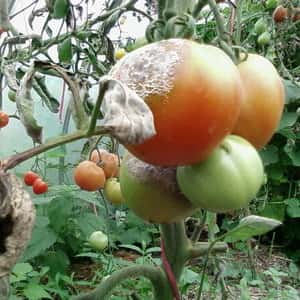
The main cause of the disease is the sap of a diseased plant spilling onto gardening tools that haven't been properly washed. Spores penetrate the soil and then penetrate into the bush through microcracks.
Infections can be seen on all vegetative parts of the tomato plant, but the most dangerous is when rot appears on the stem. It concentrates at the base, where moldy spots appear. Initially, the wound becomes wet and covered with a layer of white mold, and after some time, sclerotia appear, which look like small black beads. Consequently, the lower part of the stem becomes so soaked that it can no longer support itself and breaks. The fungus can also be seen on the fruit itself as gray spots that later turn white.
This insidious fungus can persist for several years in the soil where infected crops grew. Therefore, simply removing and burning the diseased plant isn't enough; the bed must then be thoroughly watered several times with a disinfectant solution.
Treatment
In the early stages, white rot can be treated by spraying with fungicides and fumigating the soil. However, gardeners prefer not to take risks and promptly remove diseased plants to prevent them from infecting neighboring plants. Afterwards, the soil is disinfected.
Phoma or Phoma rot
The disease, commonly known as brown rot, is caused by spores of the fungus Phoma destructiva. It is very common among tomatoes, and is found in virtually every corner of our country.
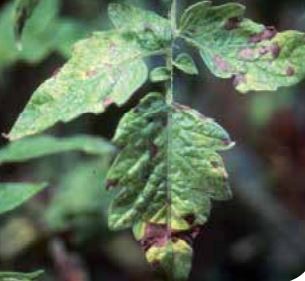
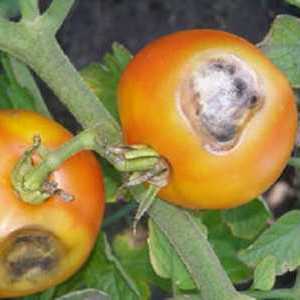
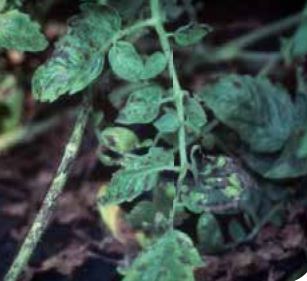
In early summer, fungal conidia begin to mature in the infected soil. They are carried by insects, rain, or wind throughout the area. They enter the plant through microcracks. Cuts and pinching sites are considered particularly vulnerable.
Note: Tomatoes grown in soil with minimal phosphorus and nitrogen are susceptible to Phoma blight. This affects the plantings' resistance to the pest.
You can detect fungus by the following signs:
- Leaves and shoots may darken, and small dark spots begin to appear.
- The calyx of the fruit is covered with black spots of a relatively large size.
The higher the humidity, the faster pycnidia will appear in areas where fungi accumulate and the plant will die.
Treatment: table
| Prevention and/or folk methods, if possible | Medicines |
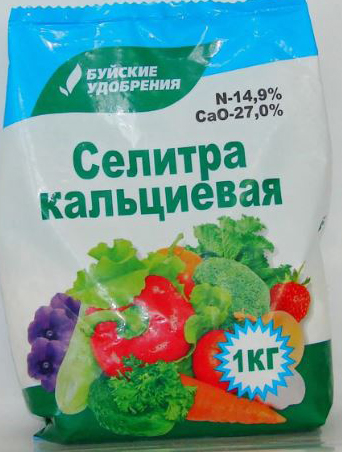
| If fungus is regularly active in your garden, buy hybrid varieties (F1) with high resistance (such as Bogema, Spartak, Opera, Virtuoz, and others). Follow all tomato care guidelines (proper watering, fertilizing, spacing between plants, etc.). | Calcium nitrate will help to cope with fungus. |
Southern sclerotium rot
This disease is caused by the fungus Sclerotium rolfsii. It causes damping-off of seedlings and also causes fruit and stem rot.
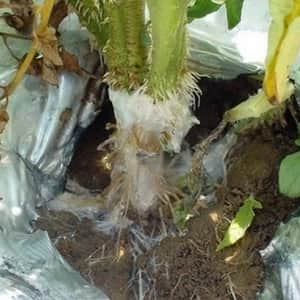
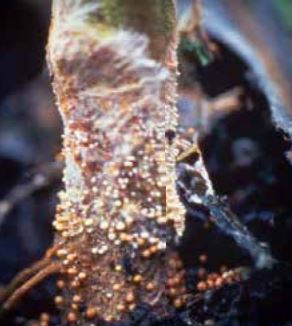
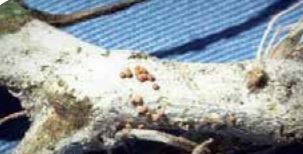
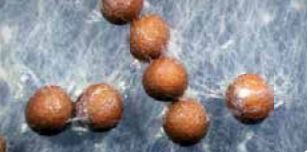
The following symptoms will help identify this type of fungus:
- Dark spots appear at the base of the stem.
- Within a few days they spread over almost its entire surface.
- Root rot occurs.
- If the humidity increases, white areas of sporulation appear.
- Dark yellow sclerotia are formed.
- Slightly sunken yellowish spots appear on tomatoes located close to the stem.
The effect of the fungus ultimately results in the death of plants.
The peak of the disease occurs from mid- to late summer. This fungus thrives best in southern regions, where daytime temperatures rarely drop below 30 degrees Celsius and humidity remains quite high. These conditions are ideal for sclerotial rot.
Treatment
Curing the plant is very difficult; treatment with fungicides and insecticides will only help in the very early stages of the disease. The most effective measures are preventative ones, which include proper tomato care and preliminary soil preparation.
Powdery mildew
The disease is caused by two fungal species: Oidium neolycopersicum and Leveillula taurica. There is no difference in their symptoms or treatment, the only difference being their preferred habitat. One fungus prefers the outer surface of the leaf, while the other prefers the inner surface.
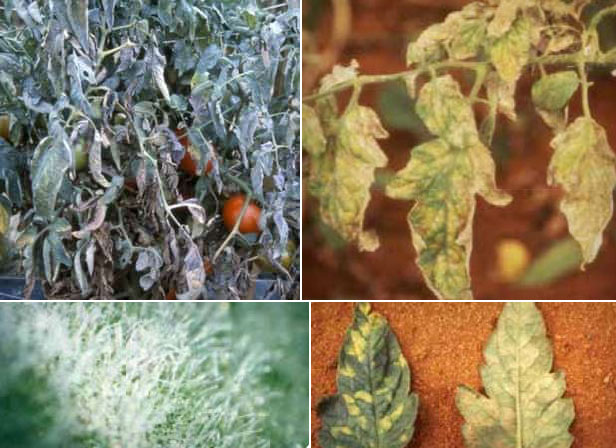
Powdery mildew can be recognized by other signs:
- Areas without pigment appear on the leaves.
- The spots grow and fruiting bodies of fungi appear on them.
- The sporulation zones expand, after which the leaf blade darkens and falls off.
If the disease is in an advanced stage, the fungus moves from the leaves to the stems. The stems begin to rot, and everything above the affected area dies.
The fungus most often appears in greenhouse crops. Almost all the leaves fall off, and the bushes die. However, the harvest itself remains untouched and can be safely harvested and ripened.
Like other fungal organisms, this type of rot thrives in warm weather and high humidity. However, its main difference is that it retains the ability to reproduce even in very low humidity.
Treatment: table
| Prevention and/or folk methods, if possible | Medicines |
|
Spraying with any fungicide (Strobi, Kumulus, Privent, Jet, Topaz, and others) will help cure this type of rot. This should be done as soon as you notice the first signs of the disease on the bushes. It is not recommended to use the same drug too often, as it causes addiction, which reduces the effectiveness of the treatment. |
Downy mildew or
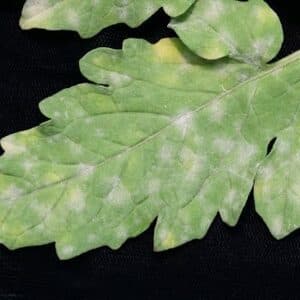
The disease is caused by the fungus Peronospora destructor. It spreads through virtually any known means: through tools, organic matter in the soil, wind, or droplets of moisture.
It reproduces well in conditions of excessively dense tomato planting, moderate temperature and high air humidity.
The fungus primarily attacks the leaves, which develop a pattern of light-colored spots with blurred edges scattered across the surface. The leaf blade begins to deform and dry out. Overall tomato growth is significantly slowed. However, the initial stages of downy mildew are sluggish, so the fungus often goes unnoticed.
The longer it remains in the bush, the more difficult it is to eradicate. It takes a long time to adapt, but then acts quickly. Its insidiousness lies in the fact that it poses a threat not only to tomatoes but also to several other popular crops: cucumbers, zucchini, onions, and so on.
Treatment: table
| Prevention and/or folk methods, if possible | Medicines |
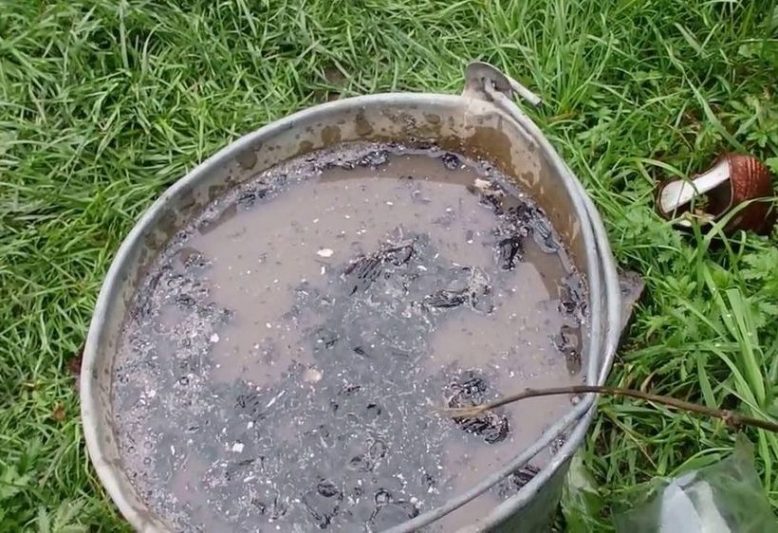
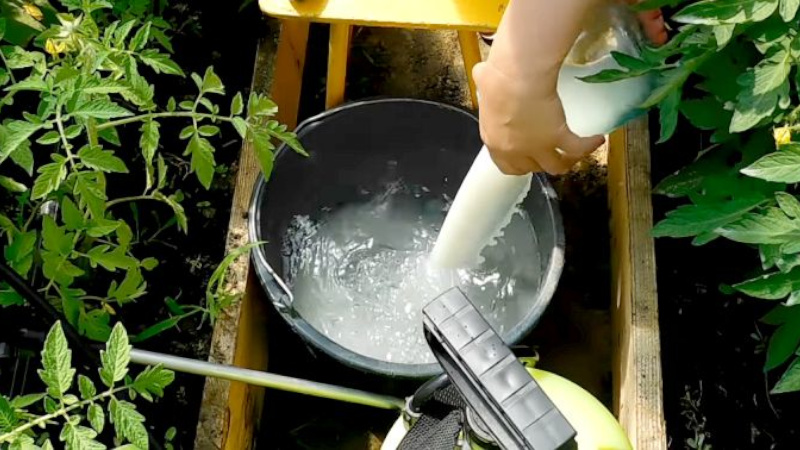
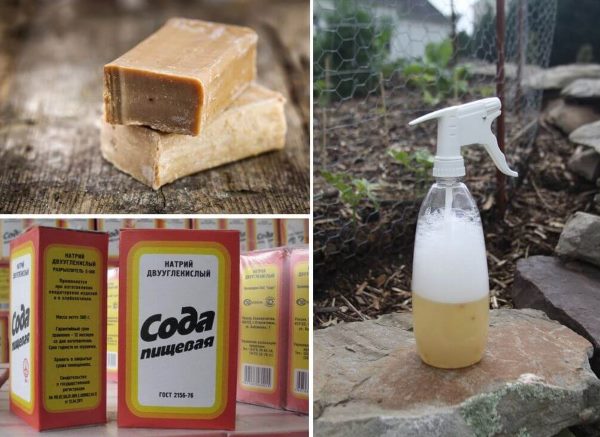
| To combat powdery mildew, gardeners recommend using solutions of ash, whey, or baking soda. It's also important to purchase only resistant hybrid tomato varieties, such as Firebird F1, Vologda F1, Alaska F1, and others. | Treatment is effective only in the early stages of the disease. Colloidal sulfur or fungicides such as Strobi, Topaz, and ThiovitJet are used to kill the fungus. |
Verticillium wilt
Verticillium wilt, also known as verticillium wilt, is caused by the fungi Verticillium albo-atrum and Verticillium dahliae. This infection is widespread in the northern regions of Russia.
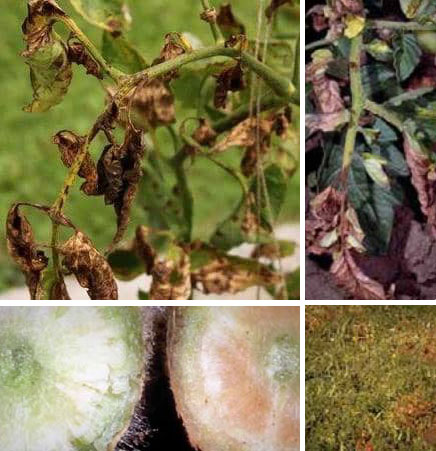
The fungus's reproduction and life cycle are independent of air temperature, as it attacks plants through the soil, penetrating directly into the roots. This is why it thrives even in areas with unfavorable temperatures and humidity.
The lower leaves begin to change—they begin to turn yellow and wilt. The upper leaves also become deformed, curling but retaining their color. External signs of the fungus can also be seen on the roots, where tissue necrosis develops. The plant withers and dies. Verticillium wilt most often affects young, newly planted plants with delicate roots.
Treatment
The disease is incurable, as it begins at the roots. Affected tomatoes should be dug up and burned, and the soil should be thoroughly sprayed with a disinfectant solution, preferably more than once. All remaining plantings should be urgently treated with fungicides, as the fungus spreads too quickly.
Even thorough soil disinfection doesn't guarantee that all fungal spores are destroyed. They can survive in the soil for up to 15 years, waiting for the right moment. Therefore, only varieties resistant to this type of fungus should be planted in such a bed.
Viral diseases of tomatoes with treatment and prevention in tables
Viral diseases are perhaps the most annoying scourge of tomatoes. The problem is that they are incurable. They are carried by various insects, so it's crucial to combat them in your garden, even if you think the bugs aren't bothersome. Viruses are also dangerous because they spread very quickly; a single plant can destroy an entire planting. That's why it's so important to immediately dig up and burn the tomato plants at the first sign of disease.
To prevent insect colonies from trampling your garden beds, you need to promptly remove the weeds that attract them.
Mosaic (tomato tobacco mosaic)
Tomato mosaic virus can be introduced into the garden by aphids or thrips. It can also be transmitted from other crops, such as peppers or potatoes.
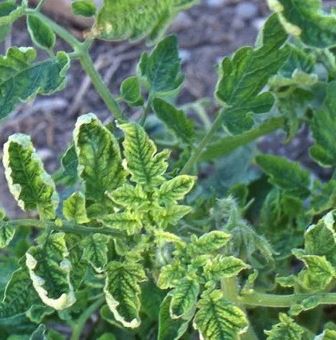
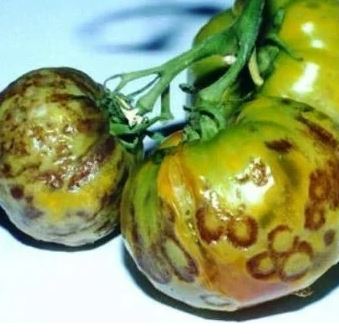
According to gardening statistics, mosaic disease affects 20% of all tomato plants worldwide. It enters the plant through small microcracks.
Signs of infection can be detected on all vegetative parts:
- The leaves become covered with spots that are either very light or, conversely, too dark in color.
- The stems become covered with areas where the tissue is affected by necrotic processes.
- Although fruits are rarely affected by the virus, if it progresses, their flesh turns brown and ripens unevenly.
As a result of the virus's impact, crop yields and planting volumes are greatly reduced.
Treatment: table
| Prevention and/or folk methods, if possible | Medicines |
At the initial stages of the disease, you can try treatment with one of these compounds:
|
Treating tomatoes with Farmayod-3 (0.05% concentration) will help stop the disease. |
Tomato leaf mottle (geminivirus, yellow mosaic)
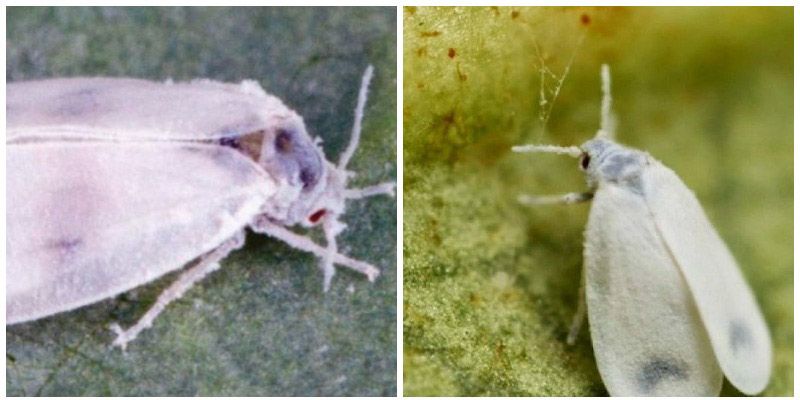
The virus is transmitted by whiteflies. If there are too many of these insects, an epidemic can occur, resulting in the destruction of the entire crop.
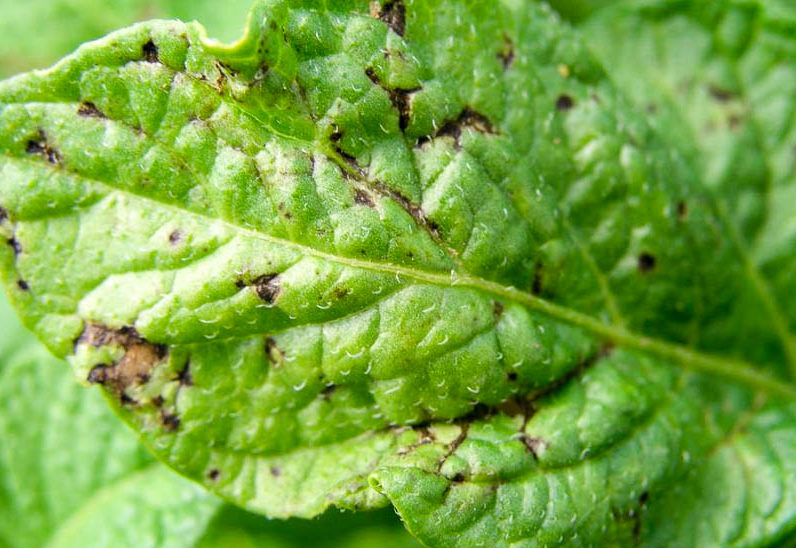
Young plants, recently planted, exhibit the least resistance to the virus. They grow very slowly and appear unattractive. Leaves turn yellow, curl, and may develop spots. Infected plants are inferior to their neighbors in every way: they produce few ovaries, bloom poorly, and the tomatoes grow small.
The disease spreads very quickly, especially if there are a lot of weeds growing in and around the garden bed.
Treatment
First, destroy the insect colony, preferably before they lay eggs. The tomatoes themselves should be treated with insecticides, and the garden bed and walkways should be thoroughly weeded.
Spotted wilt of tomatoes
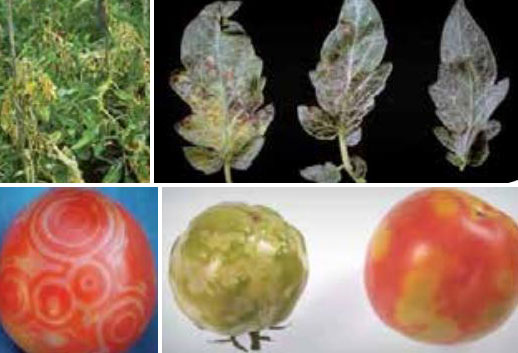
The disease has the following symptoms:
- In the early stages, the leaves become covered with light orange spots.
- After some time, their color darkens.
- The tips of the leaf blade begin to die off.
- The plant is starting to wilt.
- Longitudinal stripes appear on the stems.
- Seams covered with multi-colored circles appear on the fruits.
While other viruses are transmitted from tomato to tomato, here infection occurs mostly only from weeds.
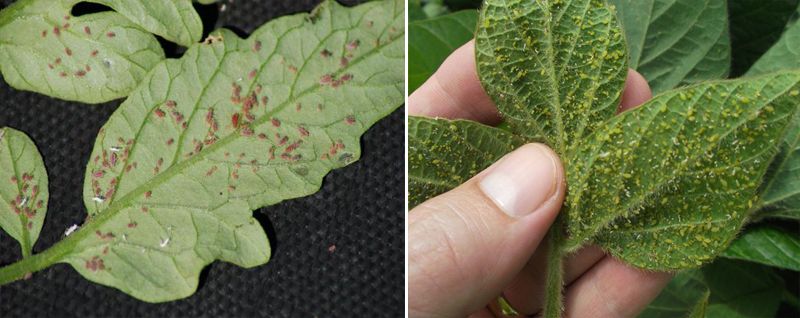
If the disease is not noticed in time, necrosis will begin to develop and the tomato will die.
Treatment
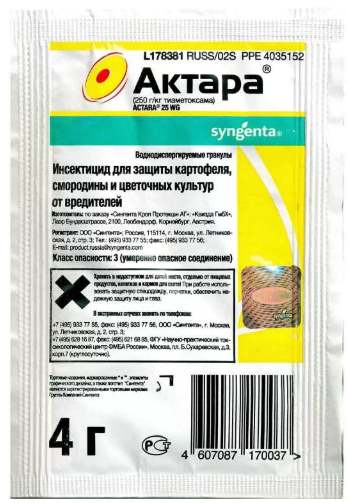
The first step is to combat the insects that spread the disease. To do this, treat the tomatoes with insecticides, such as Aktara. If the disease has already begun, killing the thrips won't save the plant; the plant must be destroyed.
Chlorotic (yellow) leaf curl
The disease is spread by the familiar whitefly, which flies from bush to bush. Therefore, the virus spreads through crops quite quickly.
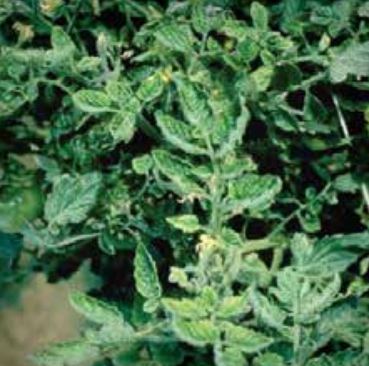
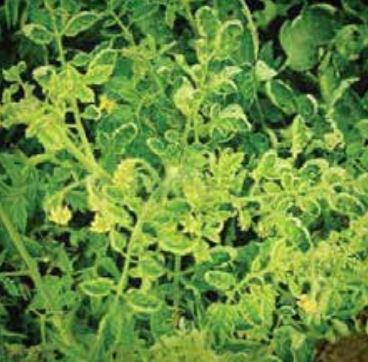
The first obvious signs of the disease are deformed leaves that curl, appearing like curls. They feel wrinkled to the touch, and their color is much lighter than expected.
During flowering and fruit set, curl can cause the most damage. New fruit sets fail to appear, and those already present develop very slowly. Furthermore, the bush itself stands out from the surrounding garden bed with its modest size and curly crown.

Note: The virus often causes tomato plants to drop all their buds. Don't expect a harvest from such a plant.
Treatment: table
| Prevention and/or folk methods, if possible | Medicines |
|
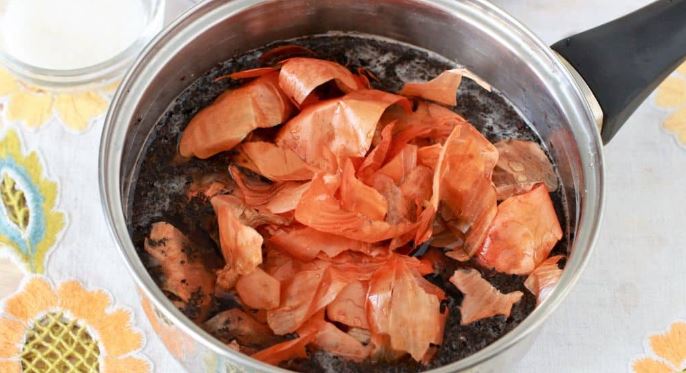
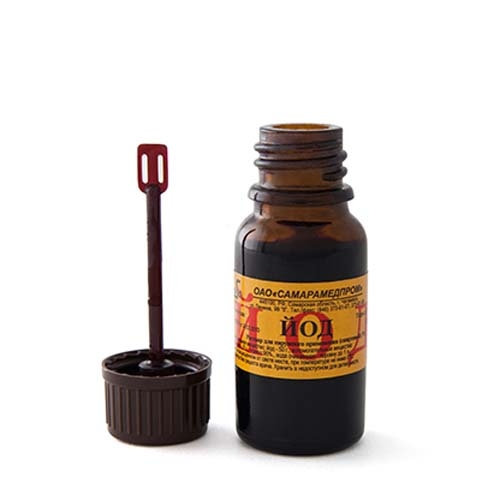
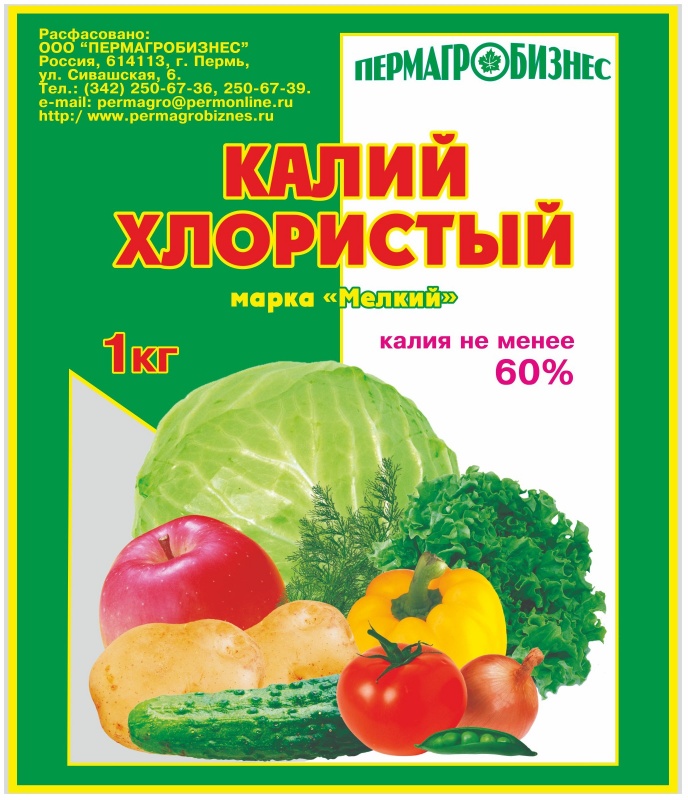
To prevent the virus from spreading, you can use a decoction of the peels of 4 onions and 3 liters of water. Once it reaches room temperature, add 5 drops of iodine and spray the seedlings. The soil where the bushes affected by the virus grew must be treated with a solution of potassium (10 g) and water (10 l). |
Curling can only be cured quickly with chemicals. Spray the plants with a solution of copper sulfate or Bordeaux mixture (1%). This is done weekly. Water the soil in the bed with a solution of the preparation, diluted at a rate of 0.5 cups per 10 liters. This amount is enough for 4 square meters. |
All remaining plantings should be treated with a weak solution of potassium permanganate as a preventative measure, carefully inspecting the plantings for whiteflies. If you spot even one insect, all tomato plants should be treated with insecticides.
Top curl (beet top curl on tomato)
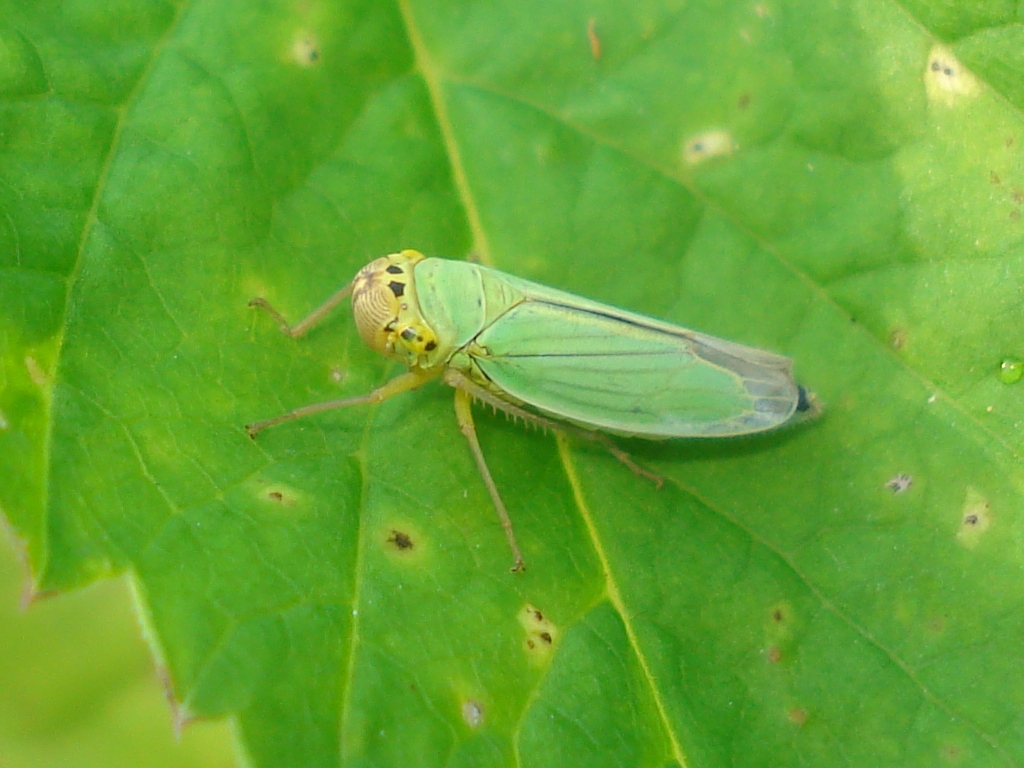
Leafhoppers are the virus carriers. The disease is easily recognized by the curled (twisted) apical leaves.
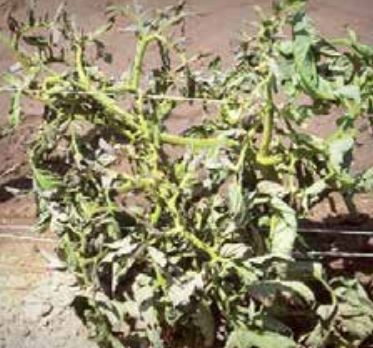
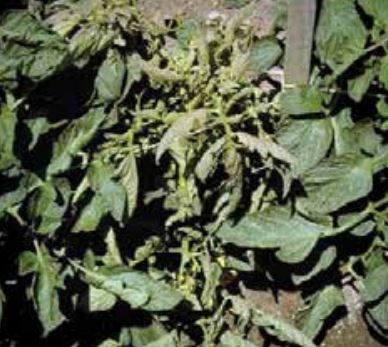
The virus also has a number of additional symptoms:
- Sickly appearance of plants.
- Thickened leaves.
- The veins acquire a purple hue, and the plate itself becomes light yellow.
- The number of fruits is small, they develop slowly, and have a pale color.
The virus cannot spread from tomato to tomato; other crops, such as beets, are often the source of infection.
Treatment
Carefully inspect the tomato bed for leafhoppers. If a colony is found, destroy it. Do the same in the beet bed.
Aspermia
The disease manifests itself primarily in changes in the leaf structure, which resembles corrugated paper in appearance. Its color fades, and bizarre patterns appear on the leaf. These tomatoes grow poorly, wither, and produce little fruit. The tomatoes that grow on them are very small in size.
Alfalfa mosaic
A very common virus in Russia, carried by aphids.
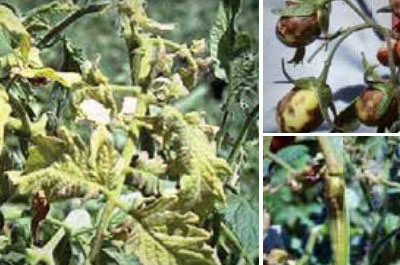
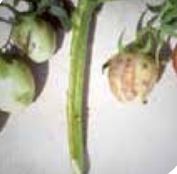
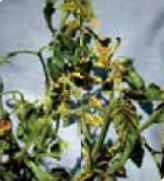
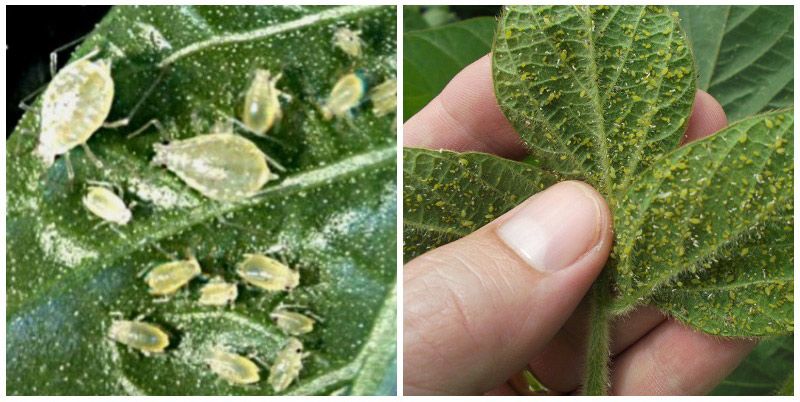
The disease manifests itself in the following way.
- Large yellow spots begin to appear on the leaves.
- Necrosis develops between the veins and the color of the tissue changes.
- Sometimes the color of the stem changes and it turns brown.
- Dark ulcers form on the fruits.
In the early stages of the disease, lesions can only be seen on young leaves. Gardeners often overlook this fact. But they should. The disease progresses quickly, spreading to the stems and fruits, making the latter unfit for consumption.
Information: Tomatoes grown near alfalfa fields are most often affected.
Treatment
To stop the spread of the virus, it's necessary to eliminate any aphids and ants present in the garden, as they often migrate together. As a preventative measure, you can treat the bushes with insecticides.
Tobacco engraving
In our country, the virus is not as common as, for example, in South America. It is transmitted by aphids.
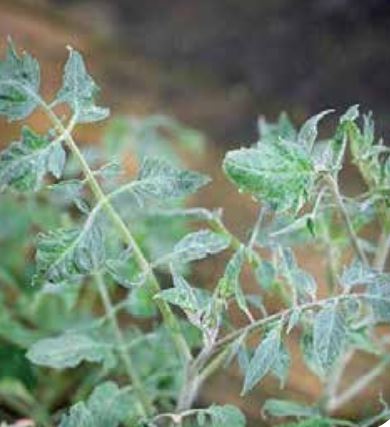
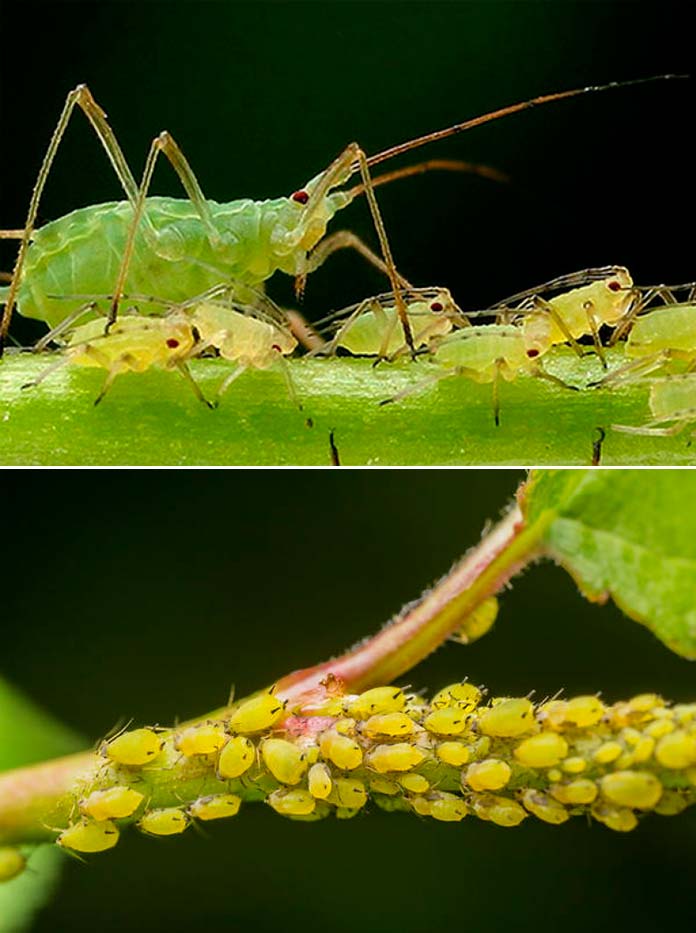
At first, dark spots begin to appear on the leaves. Simultaneously, the leaf blade may become deformed. Fruits also suffer from the virus, becoming weak, small, pale in color, and distorted in shape. The disease is most dangerous when it appears on young plantings. In such cases, containing its spread is extremely difficult; the only option is to destroy the bush and cultivate the soil to save the crop of neighboring tomatoes.
Treatment
This is precisely the case when prevention is better than cure. The virus is very insidious and difficult to get rid of. As a preventative measure, avoid placing tomatoes next to peppers. Also, keep a close eye out for ants in the garden. As a rule, where there are ants, there are aphids.
Bushy dwarfism of tomatoes
The disease is rare in Russia, but is common in Central America, North Africa, the British Isles, and Argentina. The vector has yet to be identified. The virus enters the plant via droplets of moisture through microscopic cracks and wounds. Young tomatoes are most susceptible. In this case, treatment is futile; the only option is to dig them up and burn them.
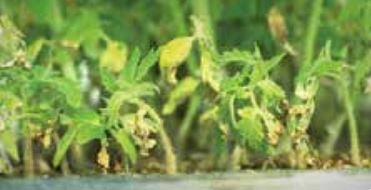
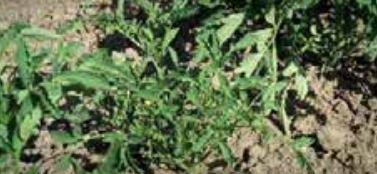
Moreover, even after removing the bush and cultivating the soil, the infection can persist in the deeper layers for years. Therefore, it's also not recommended to plant crops in this area for at least the next 2-3 years, to avoid losing the entire harvest again.
Symptoms of bushy dwarfism include:
- Light stripes on the leaves.
- Softening of the trunk without visible rot.
- Absence or limited number of lateral shoots.
- Small number of leaves.
Double streak of tomato
When two viruses, TomatoMosaicVirus and PotatoVirusX, come together, this disease occurs.
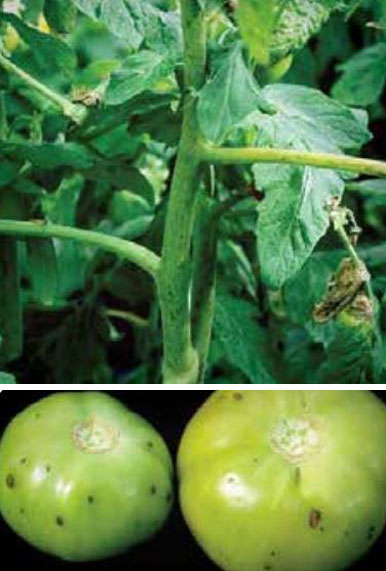
It can be recognized by several symptoms:
- The leaves curl towards the ground.
- The stem and petioles become covered with ulcers.
- Signs of progressive necrosis appear on the fruits.
Once the virus infects the stem, saving the plantings is impossible. On the leaves, the existing spots quickly expand and merge into one, after which they fall off.
The disease is found in virtually every region of the country, and is spread from plant to plant through dirty gardening tools or even work clothes. It enters plants through droplets of moisture during rain or irrigation.
Note: This disease only develops when two viruses are present simultaneously.
Treatment
Carefully clean gardening tools to prevent the spread of the virus. Never use the same tool on different crops, especially potatoes and tomatoes. If they are planted close together, plant a row of another crop between them.
Infectious chlorosis of tomato
This disease plagues gardeners in the southwestern United States, but is very rare in our country. It is transmitted by the already familiar whitefly.
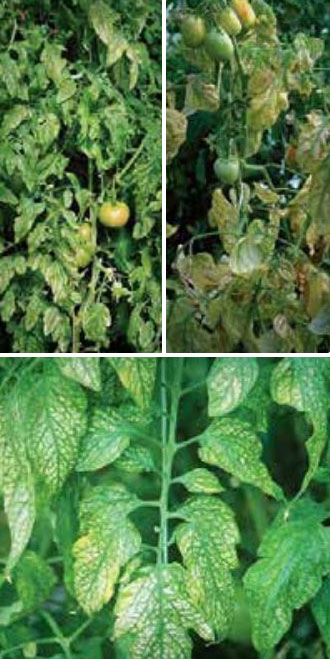
Initially, the infection begins on the lower leaves. Irregular yellow spots appear on both sides of the leaf blade, while the veins remain intact. The virus then progresses and moves up the plant, infecting new leaves. Eventually, all of them wilt and fall off. Tomatoes grown in greenhouses are most often affected by the disease.
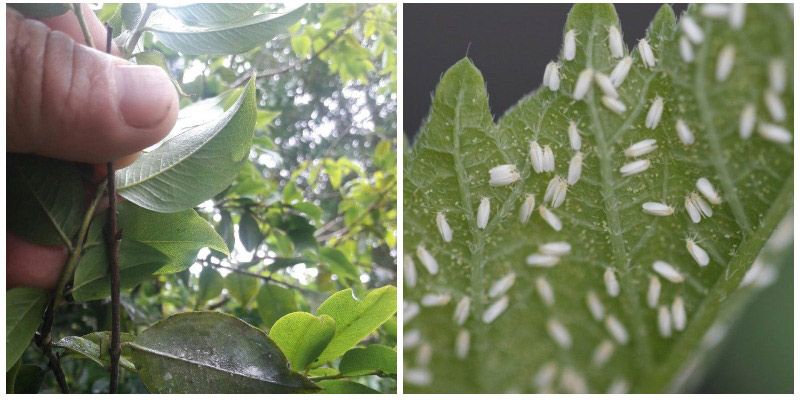
Only an insect can infect a planting; the virus does not live on clothing or tools.
Treatment
It's impossible to cure the disease when a large portion of the plant's vegetative part is affected. However, in the early stages, its spread can be stopped by destroying the whitefly colony. There's no other way.
Stolbur
The causative agent is Tomato stolbur phytoplasma.
One of the most dangerous diseases, a virus is an intracellular parasite mycoplasma; symptoms appear on tomatoes in May-June.
The insidious infection can be identified by the following signs:
- The peduncle greatly increases in size.
- The buds become too large, the flowers are sterile and either discolored or green in color.
- The leaves begin to curl, pinkish spots appear, then at the top they become smaller, become chlorotic, acquiring a purple tint, the tips dry out, the color of the blade turns yellow.
- The fruits on the affected plant are hard, tasteless, have reduced-sized seed chambers, low sugar content, and the seeds are shriveled or absent altogether, growing deformed.
- There are no seeds in the seed chambers.
- The stems and roots turn brown.
- The vascular system becomes stiff.
Fortunately, the disease occurs extremely rarely, but if the fruits are infected, eating them is strictly prohibited.
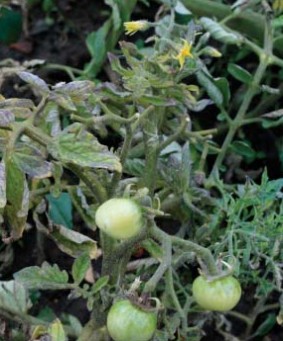
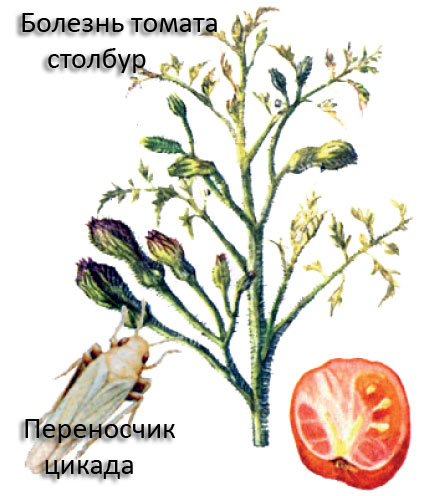
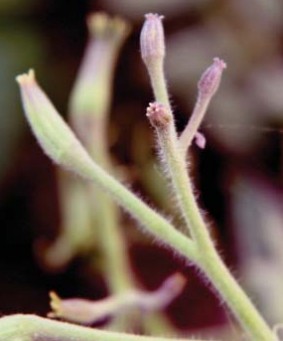
The infection is carried by ticks, piercing-sucking insects, and nematodes. The main vectors in southern regions with consistently warm weather are leafhoppers, which overwinter on the roots of perennials such as field bindweed, thistle, and milkweed. Given that they are attracted to weeds, their spread is very widespread, and eradicating them completely is virtually impossible.
The main danger of stolbur is that it lives in the roots. From there, it quickly spreads throughout the entire plant, making treating the root system virtually impossible.
| Prevention and/or folk methods, if possible | Medicines |
| It is necessary to destroy perennial weeds near the beds, in greenhouses and around them. To boost immunity, you need to feed them with organic and complex mineral fertilizers. |
Control pathogen vectors (leafhoppers, whiteflies, aphids, and cotton bollworms) using Fitoverm. Plants should also be treated with tetracycline antibiotics (such as Fitoverm) every two weeks. It is advisable to use Fitoverm and Fitoverm as a tank mix. Insecticide treatments should begin when seedlings are planted, and antibiotic sprays should be applied at the beginning of flowering, but no more than two or three times. Subsequently, other treatments should be applied, such as Farmayod (0.05%) or Bordeaux mixture. |
Non-infectious diseases of tomatoes
Often, tomato diseases are caused not by viruses or infections, but by violations of basic care rules. Furthermore, the seeds selected for sowing may already contain genetic defects, resulting in poor growth and a low yield. All such diseases are considered non-infectious and are easily treated if care is adjusted promptly.
Autogenous necrosis or "Golden spot"
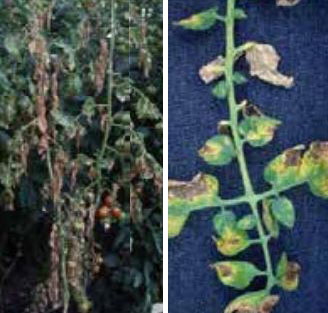
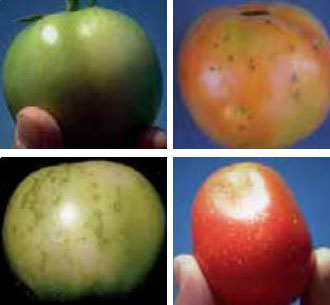
The root of the disease lies in the genetic predisposition of the seeds. They are already programmed to produce poor fruit quality. These symptoms are most pronounced in hot weather, when still-green tomatoes on the vine begin to develop translucent spots. Over time, these spots expand in size, and their color turns brown. Typically, by the time tomatoes are fully ripened, the skin becomes woody in place.
Treatment
This disease is impossible to predict. The only way to protect your crops from it is to choose the right seeds. It's best to buy from a reputable producer and choose hybrid tomatoes. This type of necrosis cannot be cured.
Blossom end rot
This disease often comes as a real surprise to gardeners. It can only be detected by cutting open the fruit, which reveals not juicy flesh but dark rot.
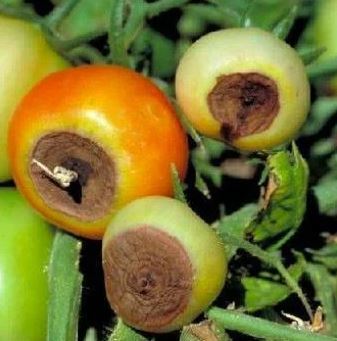
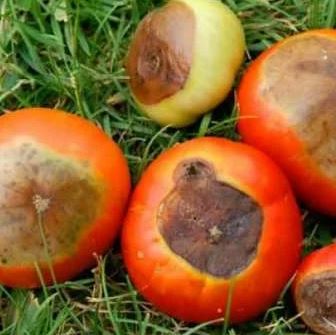
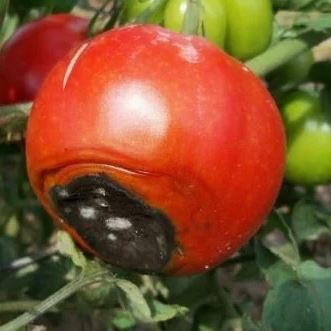
Sometimes, external symptoms can also be seen on the bushes themselves. Carefully inspect the base of the stem. A sure sign of blossom-end rot is the presence of brown spots there. Over time, these spots turn black, become dry, and feel compressed.
The main cause of the disease is bad weather; rot can also appear due to poor care of the plantings.

Treatment: table
| Prevention and/or folk methods, if possible | Medicines |
| Gardeners recommend treating diseases with an ash solution. To prepare it, use only wood ash (2 cups), pour it into a liter of hot water, and let it steep for half an hour until it cools completely. The resulting substrate is poured into a ten-liter bucket of water before use. About a liter of the solution is needed per plant. It should be poured carefully, in a slow stream, under the roots of the tomato plants. If you need to treat the leaves locally, add grated laundry soap (50 g). This will ensure the product adheres to the leaf blade. |
The fastest way to get rid of the disease is with the help of special remedies:
|
Leaf swelling
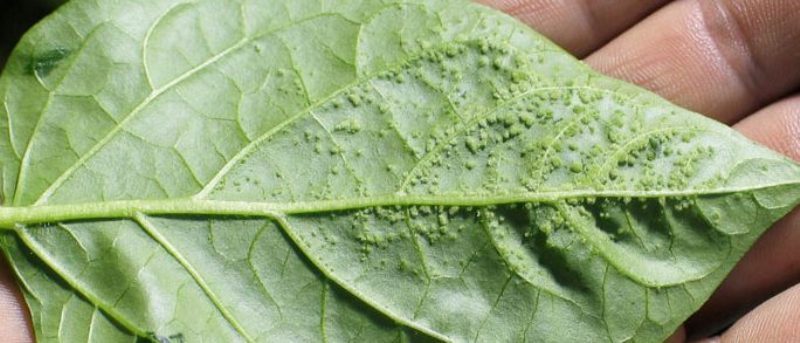
When tomatoes are watered too frequently and too heavily, small bumps begin to appear on both sides of the leaves. Some gardeners mistakenly consider them a sign of pests, but in fact, these green warts are inflamed roots. This condition is also commonly called dropsy due to the cause of its appearance. It's important to remember that overly wet soil puts pressure on the roots, disrupting the normal transport of nutrients to the vegetative parts of the plant.
Disease prevention involves increasing watering and reducing the amount of liquid used. It's also important to loosen the bed to allow moisture to evaporate better, preventing stagnation. The greenhouse and hotbed should be ventilated, and if the bushes are too densely planted, it's advisable to thin them out.
Dry rot of tomato fruits
The disease is most often noticed on the plant in midsummer, when the fruit is actively ripening. The danger comes from a small, voracious insect called the tomato stink bug. It enters the plant from weeds, heads straight for the tomatoes, and begins feeding voraciously, leaving small punctures in the skin and sucking out the nourishing juices. A spot appears near the stink bug's bites, which grows along with the fruit. Affected tomatoes will never fully ripen. This is all due to a specific enzyme found in the stink bug's saliva.
If you don't start fighting the pest promptly, it will quickly infest your entire planting and deprive you of your harvest. It feeds selectively, focusing on the freshest and tastiest tomatoes, so only a portion of the fruit on a single plant may be damaged.
Important! Tomatoes containing traces of mites should no longer be eaten.
Treatment
There is only one surefire way to combat insects: treat your plants with insecticides.
Edema, swelling, sunburn
The causes of diseases are unfavorable weather conditions and violations of tomato care rules.
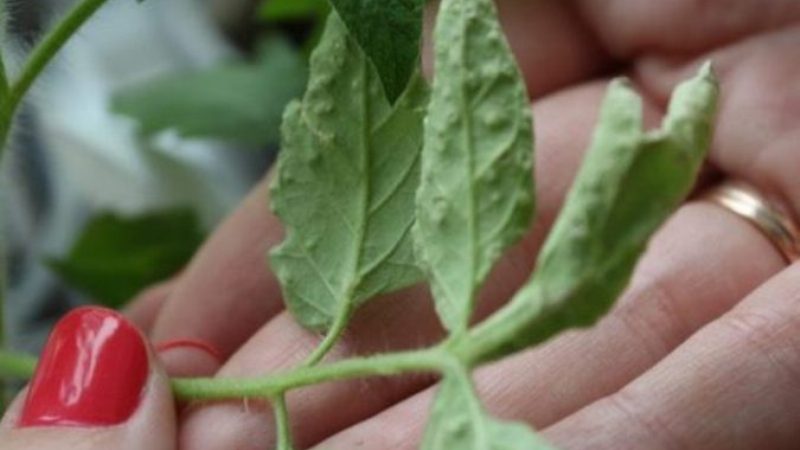
Signs of the development of this disease can be seen on all vegetative parts of the bush:
- With dropsy, the leaf blade is affected; on both sides it becomes covered with small thickenings that resemble warts.
- Swelling can be seen in the fruits, which have practically no seeds or pulp, and their structure is loose.
- Sunburn causes ulcers to appear on bushes. These ulcers act as a breeding ground for various infections, which can easily enter the bush through the affected area. If not detected promptly, the ulcer may later turn black and rot.
Treatment
Diseases themselves aren't serious pathogens and can be prevented by following proper growing practices. However, if a plant is exposed to one of these attacks, its resistance to pests and infections is greatly reduced. Open wounds attract fungus, and the overall immunity of the plantings is weakened. Therefore, it's best to prevent diseases before they appear. To do this, regularly loosen the soil; well-ventilated soil will prevent tomatoes from developing dropsy. Proper watering, done in the morning or evening, will help prevent sunburn.
Internal browning
It's sometimes called uneven ripening due to the external symptoms. Tomatoes become covered with dark bumps or spots, lack color and weight, and have an irregular shape. The infection also penetrates the inside of the tomatoes, creating dark spots that will no longer ripen.
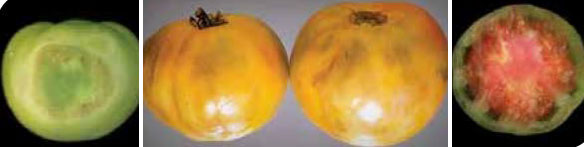
Experts couldn't pinpoint the exact cause of the browning, so it's believed to be due to a combination of care violations. For example, weak bushes were planted in poorly prepared soil, which was then underwatered, and the temperature regime was constantly violated.
Important! If tomatoes have turned brown, they should be thrown out. They are no longer suitable for eating or canning.
Treatment
To prevent the disease, it is recommended to follow all tomato growing guidelines. To reduce the risk of its occurrence, purchase resistant varieties; treatments have not yet been developed.
Micronutrient Deficiency Chart
If there is a deficiency of nutrients in the soil, this becomes clear from the external signs of the plants.
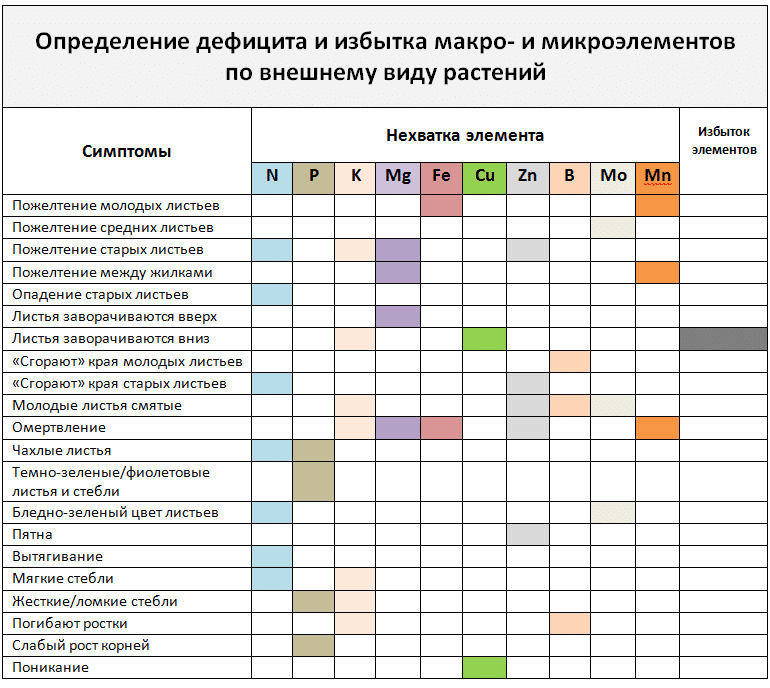
You can determine exactly which element your tomatoes are lacking using the table below:
| Element | Signs of deficiency |
| Nitrogen N |
Tomatoes grow slowly, stems are thin, the color of the leaves becomes lighter, and large leaves wither ahead of schedule.
|
| Zinc
Zn |
The leaf blade becomes thicker, orange chlorotic spots appear on it, and over time it becomes deformed and twists, sometimes into a spiral.
|
| Phosphorus
P |
The bush is growing too slowly, the leaves are paler than usual, and their undersides are turning reddish. The plants are aging earlier than expected.
|
| Molybdenum
Mo |
The older the bush, the more leaves with dried, dead tips appear on it.
|
| Potassium
K |
Ulcers appear on the plates, similar to burn symptoms, and they become covered with chlorosis spots.
|
| Manganese
Mn |
The leaf blade shows signs of chlorosis, wilts and falls off.
|
| Calcium
Ca |
Rotten marks appear on the upper fruits.
|
| Iron
Fe |
Young leaves become chlorotic and fall off.
|
| Magnesium
Mg |
The leaves are affected by chlorosis, and necrosis develops between the veins.
|
| Bor
B |
The tips of old leaves begin to dry out and die off rapidly, and the fruits become covered with corky spots.
|
| Sulfur
S |
The petioles acquire a purple color, and the color of the leaf blade fades.
|
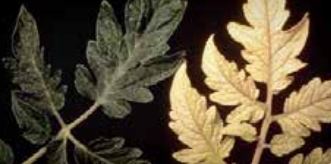
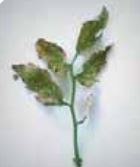
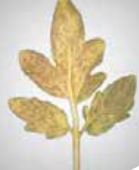
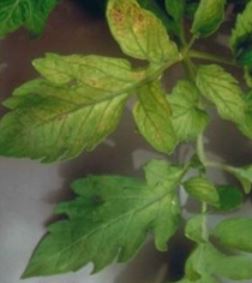
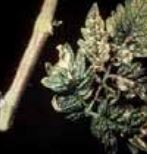
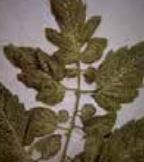
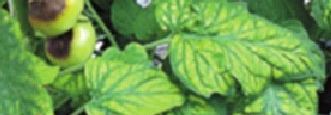
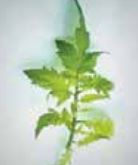
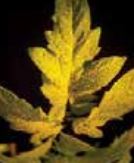
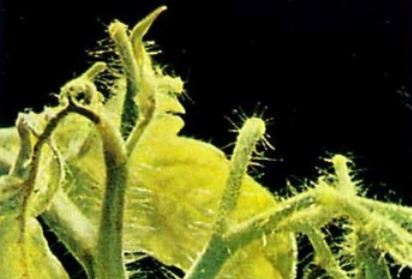
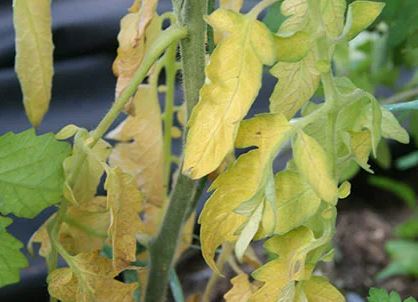
Every soil contains its own set of micronutrients. Some are present in higher concentrations, while others are present in lower concentrations. To properly fertilize, you need to understand the soil type in your garden bed. Gardeners actively use recommended nitrogen fertilizers, but if your soil contains sufficient amounts, there's no need to blindly follow fertilizing recommendations. If your plants show signs of nutrient deficiency, they need to be replenished. Furthermore, it's important to water properly (before fertilizing) and regularly loosen the soil to ensure the essential nutrients are easily absorbed by the roots and delivered to the plant.
But this type of damage is not critical; the tomatoes are not infected and can be canned or eaten.
Treatment
If you've pinpointed the exact nutrient your tomatoes are lacking, treating them is simple: simply add fertilizer to the soil. Do this before watering thoroughly to prevent moisture from washing the tomatoes out of the bed.
Chemical damage
This type of damage occurs to the plant if the recommended proportions for diluting the chemicals used to treat the plantings were violated.
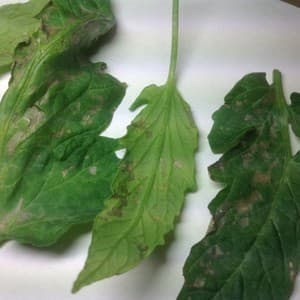
There is a risk of burning tomatoes at every stage of their cultivation.
Herbicides can work in two ways:
- Contact, when damage occurs where the substance has come into contact with.
- Systemic, in which the entire bush suffers, regardless of which part of it was damaged.
When a plant is exposed to excessively high concentrations of the chemical, burns appear in the form of dark or yellow spots that gradually expand, causing leaves to fall off and the plant to wither. This damage is especially dangerous if the treatment was carried out during the day during periods of maximum solar activity. Typically, the affected plant cannot be saved.
Treatment
If the burn is minor, you can try removing the damaged part of the bush and watering the bed. However, a severely damaged bush will not recover. Preventative measures include strictly following all recommendations on the chemical packaging.
Fruit cracking
Gardeners may often encounter the problem of their fruits becoming covered in cracks.
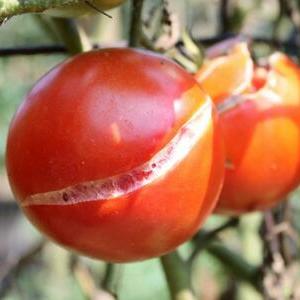
The reason for this phenomenon lies in the violation of care rules:
- There is too much nitrogen in the soil.
- The air temperature is low.
- Large differences in day and night temperatures.
- Watering is uneven.
- The pinching procedure rules were violated.
- There are not enough nutrients in the soil or, on the contrary, there are too many.
Cracks themselves don't affect the taste of the tomato. Such fruit won't keep for long; it should be eaten first. However, cracked wounds are dangerous because they can allow infections and bacteria to enter the tomato. Don't keep such a tomato on the vine; remove it and let it ripen, perhaps on a windowsill. The disease cannot be cured; if cracks are present, the worst that can happen is scarring. It's much easier to prevent the problem by following all the proper growing practices.
Tomato pests as pathogens
Tomatoes are loved not only by humans but also by many insects. Some come to feast on the leaves, while others even make the bush their permanent home. The problem is that these pests carry numerous viruses and bacteria they pick up from the soil and weeds. They infect the plants and skillfully spread the disease from one plant to another, expanding the affected area. Therefore, it is crucial to spot these uninvited guests early and make every effort to drive them away.
Nematode
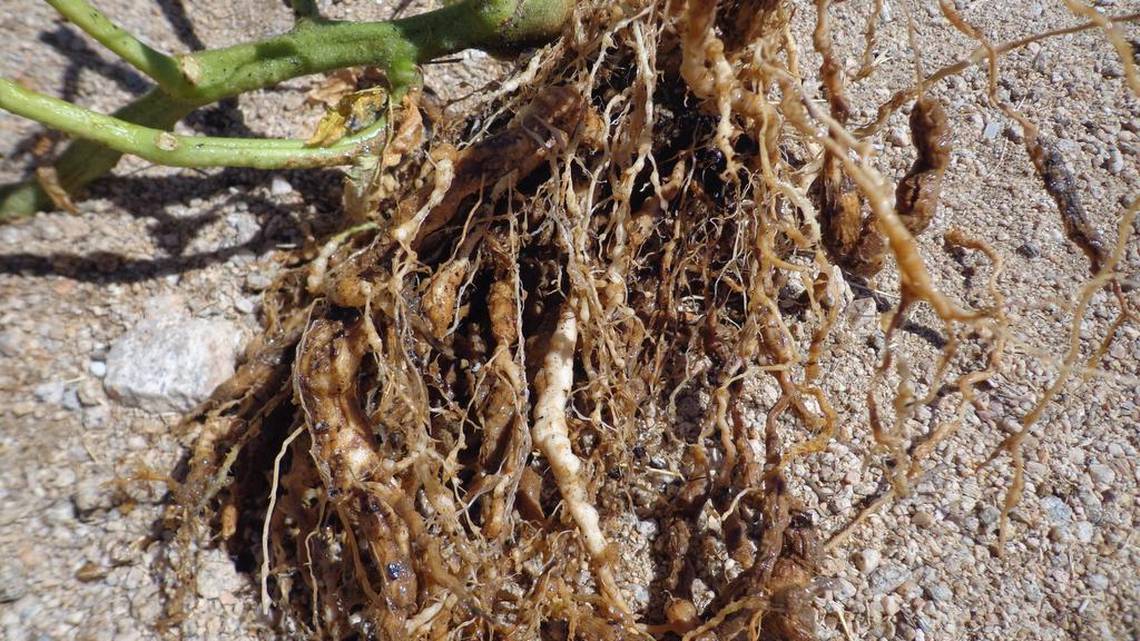
These small, round worms have taken a liking to the delicate root system. Feeding on its juices, they significantly weaken the plant's immunity and disrupt its metabolism. Tomatoes quickly become diseased and wilt. Furthermore, nematodes often carry dangerous infections and viruses that are incurable.
How to fight
The infected plant must be immediately treated with one of the special agents (Fitoverm P, Karbofos, Nematophagin) until the worms are completely destroyed.
Slugs and snails
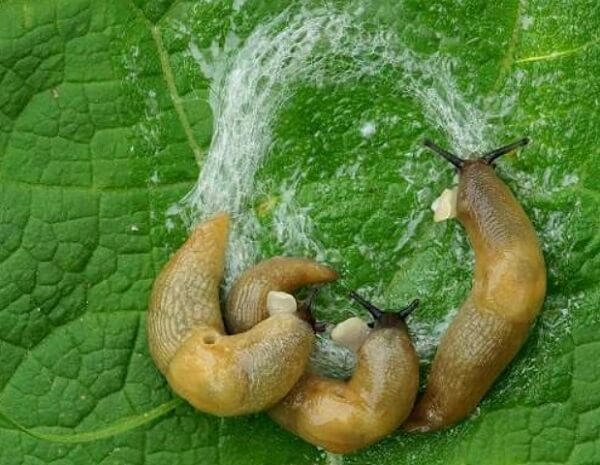
Slugs are considered one of the most dangerous pests for tomatoes. Sometimes they travel in entire colonies, devouring everything in their path. Another problem is that they carry a huge number of fungal infections on their bodies. When they eat tomatoes, all of them end up inside the plants. If the pest isn't detected in time, you can lose your entire crop, as these voracious creatures will devour every leaf on the plants.
How to fight
Gardeners swear by mustard, pepper, or garlic infusions as effective folk remedies for pest control. Slugs dislike these odors. But if this doesn't work, more effective measures are needed. Chemical pesticides like Ulicid and Grom can help exterminate the pests.
Aphid
Aphids enter a greenhouse (made of polycarbonate or any other material) along with ants, so it's crucial to eradicate all anthills from the beds and surrounding areas. These insects are small but have tenacious jaws. A single aphid is unlikely to cause damage to tomatoes, but they live exclusively in colonies and feed on plant sap. As a result, the plants begin to lose vigor, the leaves become deformed, and chlorosis develops.
How to fight
Folk remedies for killing aphids include treating leaves with a soap solution or ammonia. Alatar, Fitoverm, and Fufanon are considered the most effective chemicals.
Ants
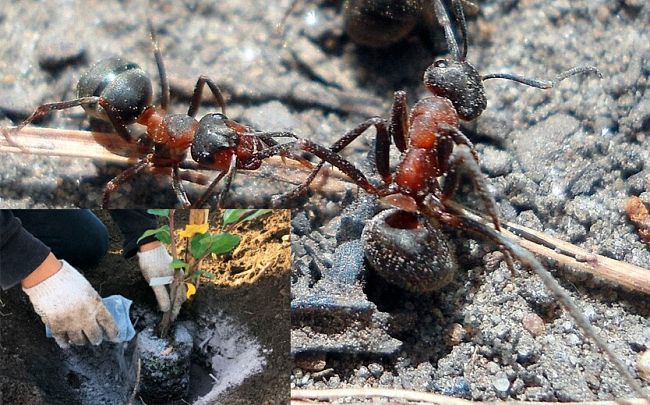
Ants don't feed on tomatoes, but they travel with aphids, which produce nutrients for them. Furthermore, they specifically seek out suitable habitats to provide the aphids with something to eat. Furthermore, an anthill in a garden bed can damage the roots, leaving them vulnerable to infection and fungus.
How to fight
To get rid of ants, you can use special products, such as Ant Eater, or sprinkle ash in their habitat.
Whitefly
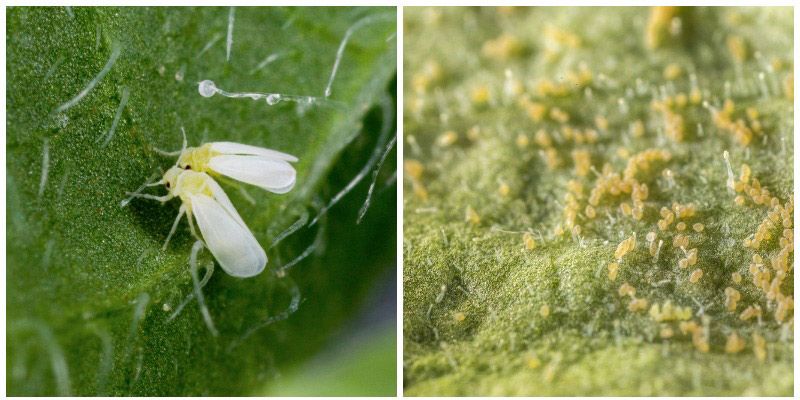
These flying insects pose the greatest danger to crops. Adult whiteflies carry a huge number of viruses and infections, spreading them from tomato to tomato. Larvae, laid on the underside of leaves, begin actively devouring plant tissue and feeding on its sap.
How to fight
Only strong products, such as Iskra, Biotlin, or Tanrek, will help combat whiteflies. Folk remedies are ineffective. When treating, pay special attention to the undersides of leaves, where the insect larvae most often reside.
Whiteflies quickly become accustomed to the chemicals used to kill them, so you should not use just one product; they must be alternated.
Important! Carefully check the leaves for whiteflies, as they cause irreparable damage to plants.
Thrips
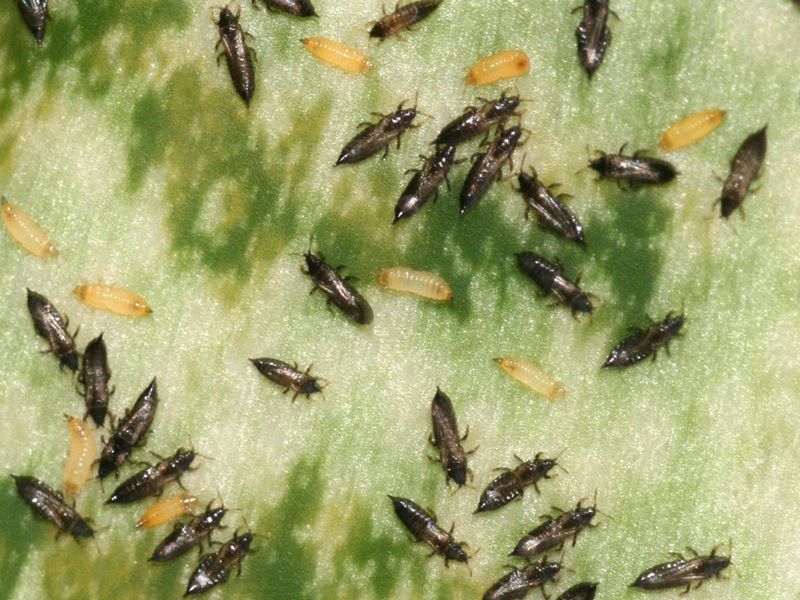
Thrips have a very short lifespan, only about three weeks. But they reproduce so quickly that they can instantly infect a plant. Their main danger is that they carry viruses, which cause a disease called spotted wilt.
How to fight
As soon as you notice these tiny pests on your tomatoes, you need to begin treating them immediately. Insecticides such as Aktara, Biotlin, or Alatar will help kill thrips.
Leafhoppers
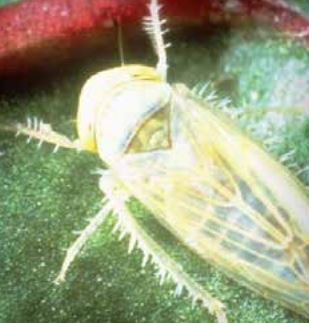
The presence of leafhoppers is fraught with danger, as they are the causative agents of dangerous diseases such as stolbur and leaf curl. They also colonize bushes, burrowing tunnels into them, and begin actively devouring tissue and laying eggs.
How to fight
Only strong chemicals, such as Tanrek, Accord, or Aktara, can destroy leafhoppers and their eggs.
Important: Disease-resistant tomato varieties: table with descriptions and photos
The key to a good harvest is choosing the right tomato variety and seed producer. Among the producers, the Rostovsky Seed Center of the Poisk company has a proven track record. Partner company, agricultural company Aelita, Gavrish and others.
The table shows several varieties of tomatoes that are resistant to major diseases.
| Name of the variety | Description |
| Charisma F1
|
It tolerates temperature fluctuations well. It is resistant to mosaic, as well as fungal diseases such as fusarium and cladosporiosis. This high-yielding variety produces round, uniformly red fruits that can weigh up to 170 g, yielding 6-7 kg of tomatoes per bush per season. |
| Vologda F1
|
The variety ripens mid-season, yielding up to 5 kg of tomatoes per season. The fruits grow on clusters, have a uniform shape, and weigh 100 g. The variety is resistant to mosaic, fusarium, and cladosporiosis. It is grown in a greenhouse. |
| Ural F1
|
Ripening time is average, fruits are large, weighing up to 350 g. The bush has a single central stem. Plants are resistant to tobacco mosaic and fungal diseases such as cladosporiosis and fusarium. It tolerates low temperatures well. It is suitable for greenhouse planting. |
| Semko 18 F1
|
An early, self-pollinating variety, suitable for growing outdoors and in greenhouses without additional heating. The number of side shoots and leaves is limited, resulting in a very compact bush. The tomatoes are round and uniformly colored, with no green spots near the stem. Each fruit weighs up to 140 g, and a single plant can produce up to 8 kg of tomatoes per season when grown outdoors and up to 14 kg when grown in a greenhouse. The tomatoes are suitable for eating and canning. The plant is easy to care for and is resistant to blossom-end rot, mosaic, fungal Alternaria, and fruit cracking. |
| Firebird F1
|
Suitable for both greenhouse and open-ground cultivation, it can produce fruit even in the absence of direct sunlight. It is resistant to Alternaria blight and mosaic virus, and tolerates cold snaps and temperature fluctuations well. It requires pinching and staking. The fruits grow in clusters, are yellow due to their high beta-carotene content, and weigh approximately 150 g. It begins bearing fruit early. |
| Alaska F1
|
Suitable for any growing conditions, even indoors, it ripens early. The bush is short, less than 70 cm. It requires no training and bears fruit early. The tomatoes grow small, weighing only 90 g. Each bush produces about 2 kg of fruit per season. The hybrid tolerates cold weather and temperature fluctuations well, and is resistant to mosaic disease, as well as fungal diseases such as cladosporiosis and fusarium. |
| Lelya F1
|
The bush is small, ripening time is average, but the fruiting period is long. The tomatoes are round and flattened, each weighing up to 150 g, and grow on a truss. Due to its resistance to temperature fluctuations and cold, the variety is virtually immune to fungal attack, and has good immunity and hardiness. |
| Gardener
|
The ripening period is relatively early and the variety is highly resistant to extreme weather conditions. The fruits are quite large, weighing up to 250 g, with sweet and juicy flesh. They are well suited for canning and have a long shelf life. |
| Ultra-early
|
As the name suggests, ripe tomatoes delight you very quickly, appearing in just 75 days. The tomatoes ripen small, round, and weigh around 100 g. Each bush yields up to 5 kg of fruit. The variety is resistant to fungus. The fruits are ideal for pickling; their skins do not crack when scalded. |
| Arctic Rose
|
This early-ripening variety produces pinkish fruits weighing around 200g. The bush itself is not tall, but still requires staking to support the weight of the harvest. It requires little care. The tomatoes ripen almost simultaneously, making them ideal for pickling. |
| Beam
|
Mid-early. After just 100 days, elongated orange fruits, better known as "plum," appear. The bush itself is quite undemanding, growing to just 75 cm. |
| Resonance
|
Tolerates heat and drought well. Resistant to most known fungi. Mid-early. Fruits are smooth, round, and juicy. They can weigh up to 250 g. |
| Bohemia F1
|
Resistant to the most common tomato diseases, it's suitable for both greenhouse and outdoor cultivation. The fruits form in clusters, each holding up to five tomatoes at a time. Each bush produces approximately 6 kg of round tomatoes weighing up to 150 g per season. |
| F1 Blitz
|
The variety ripens early, producing the first fruits after just 75 days. They are small, weighing 100 g. The variety is resistant to diseases such as necrosis, tobacco mosaic, fusarium, and septoria. It can be grown not only in a greenhouse, but also in open ground. |
| Opera F1
|
It ripens early; according to gardeners, the first fruits can be harvested as early as three months after germination. The stems reach 1 m in length and require staking. It is planted only in greenhouses. It is resistant to white spot, leaf spot, necrosis, late blight, and tobacco mosaic. |
| Spartak F1
|
The hybrid's fruits ripen slowly, and it's a late-ripening variety. The tomatoes are bright red and round. Each fruit weighs up to 200 g. The plant is resistant to fusarium wilt, blackleg, cladosporiosis, and mosaic. |
| Virtuoso F1
|
Grown in a greenhouse, the low-growing bush produces up to 7 kg of tomatoes per season. The hybrid tolerates changes in temperature, humidity, and lighting well. It is virtually immune to root rot, blackleg, cladosporiosis, fusarium, and mosaic. |
| The Lazy Man's Miracle
|
It can be grown in open ground and greenhouses, even in northern regions. The bush is low-growing and produces up to 8-9 kg of tomatoes per season. It is resistant to low temperatures, shade-tolerant, and requires little watering. Due to its early maturity, it is resistant to late blight. It does not require pinching or staking. |
| Sovereign F1
|
Early. Resistant to stolbur, TMV, Alternaria, and Fusarium wilt. Due to its early maturity, it is resistant to late blight. No pinching or staking is required. |

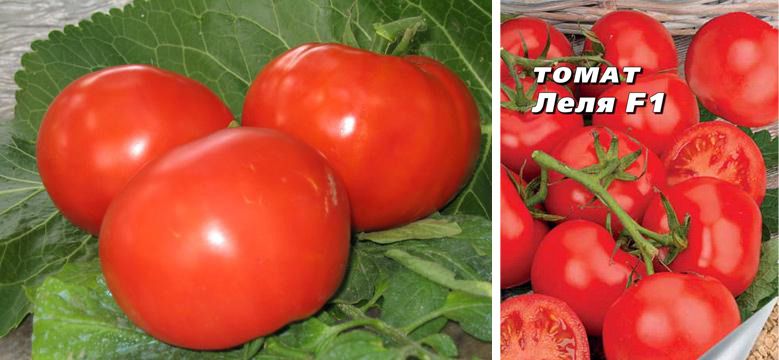
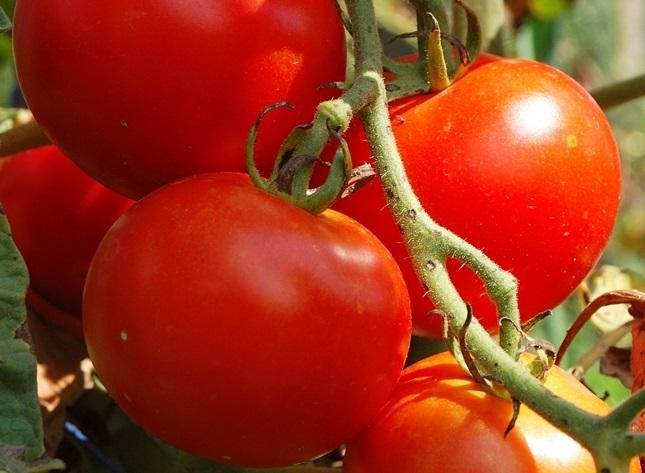
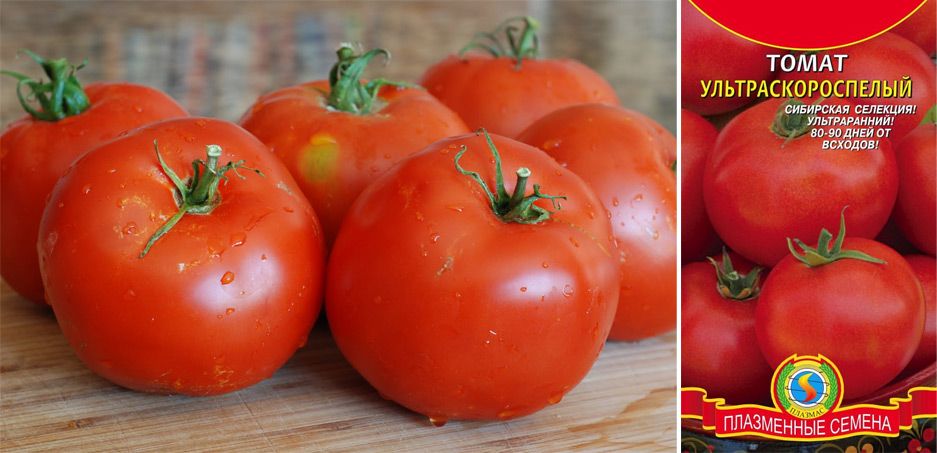
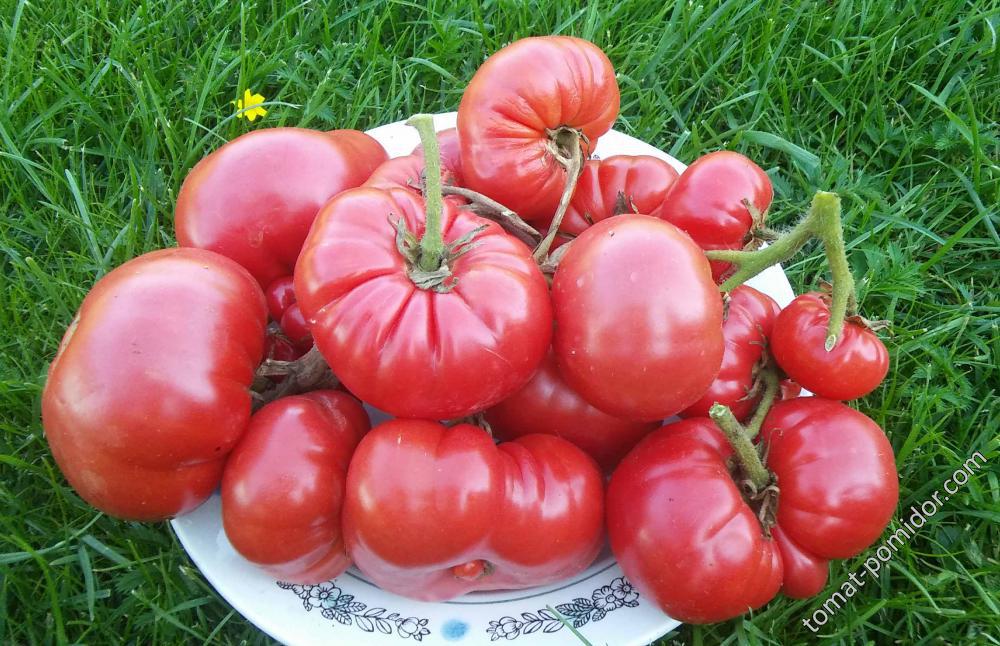
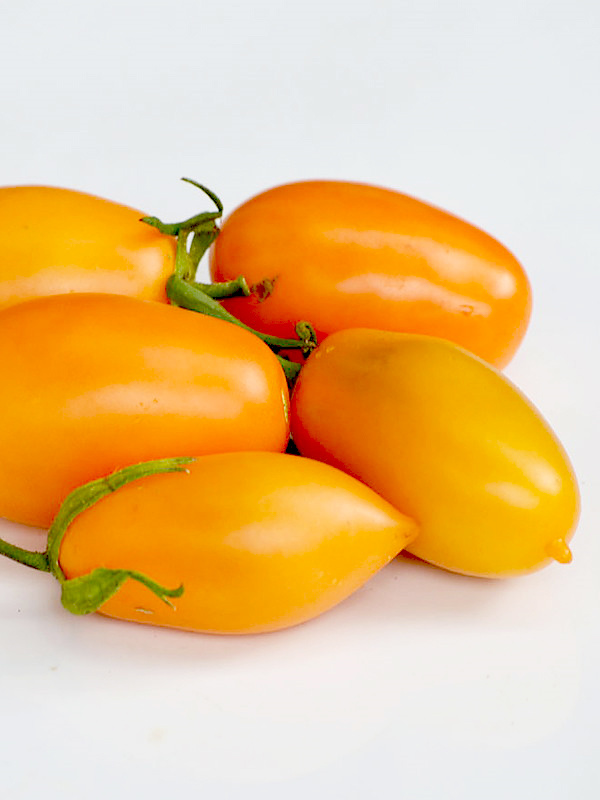
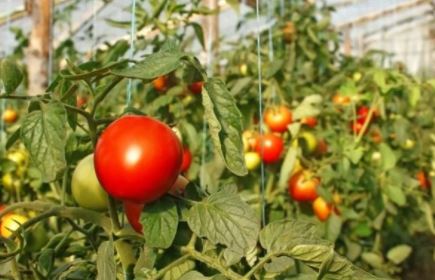
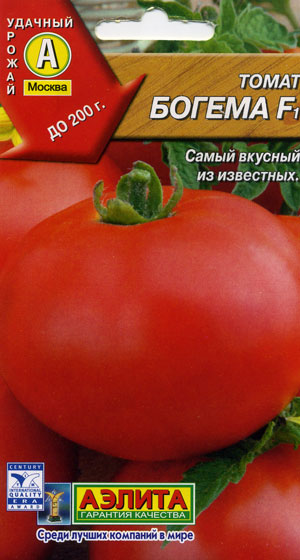
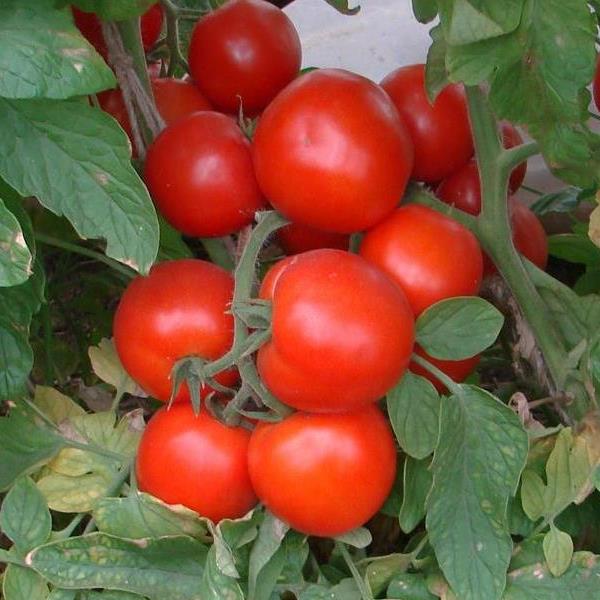




We recommend the article about growing tomatoes on a balcony.
Tips from Top.tomathouse.com: How to Prevent Tomato Diseases
Tomato diseases are much easier to prevent than to cure. Our portal http://top.tomathouse.com recommends:
- If the region's weather conditions are variable and the soil isn't particularly fertile or rich, disease prevention efforts should begin as early as seed preparation. To strengthen the seed's immune system, soak it for an hour in a solution of Fitolavin at a rate of 2 ml per 100 ml. A 1% solution of permanganate or copper sulfate can be used instead.
- Choose only resistant tomato varieties for planting.
- Pay special attention to the surrounding area. Potato crops are the most common source of tomato infestation. Planting tomatoes near eggplants and peppers is also not recommended.
- The soil in the garden bed must be disinfected with a solution of Baikal-EM or 1% potassium permanganate.
- Proper care increases the plant’s immunity and resistance to diseases.
- Gardening tools should be washed after each use, especially if working with different crops. For disinfection, use Ecocid-S (50 g), diluted in 5 liters of water.
- The soil must be periodically fertilized with phosphorus and potassium, and the plantings must also be sprayed with immunomodulatory preparations.