The Golden Fleece tomato is widely used by gardeners across the country. It boasts strong immunity, excellent yields, and versatile fruit.
Content
- 1 Characteristics of the Golden Fleece tomato variety in a table
- 2 The history of the Golden Fleece tomato variety
- 3 A detailed description of the Golden Fleece tomato variety
- 4 Advantages and disadvantages of the Golden Fleece tomato variety
- 5 Growing the Golden Fleece tomato variety
- 6 Harvesting, using and storing the Golden Fleece tomato variety
- 7 Comparison of the Golden Fleece tomato variety with other varieties in the table
- 8 Gardeners' reviews of the Golden Fleece tomato variety
Characteristics of the Golden Fleece tomato variety in a table
The table below shows the main distinguishing characteristics of the Golden Fleece tomato variety.
| Characteristic | Description |
| Description | Determinate tomato variety with early maturity |
| Ripening period | From 85 to 98 days |
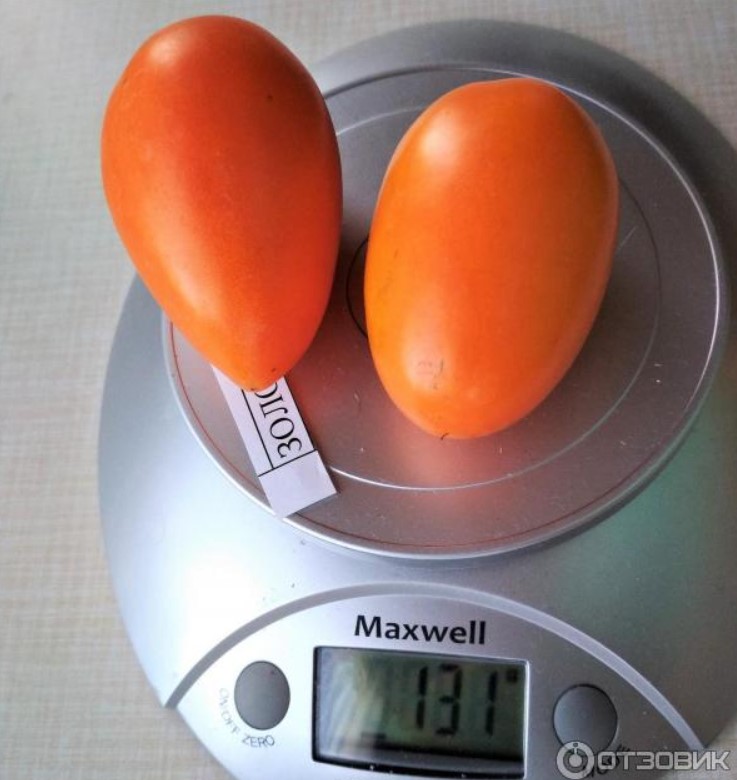
| Fruit weight | From 90 to 100 g. |
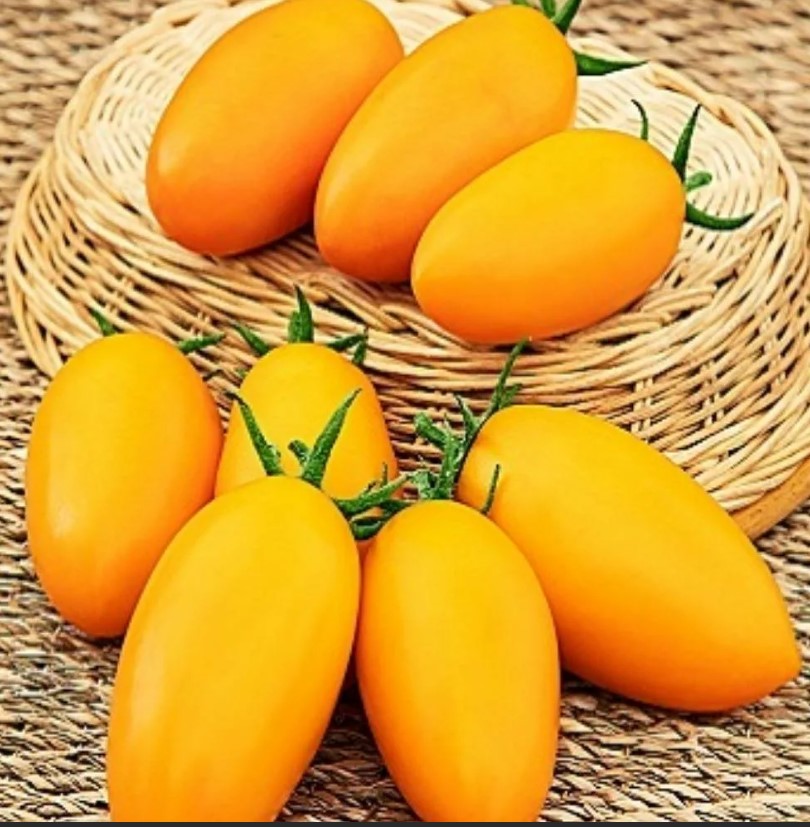
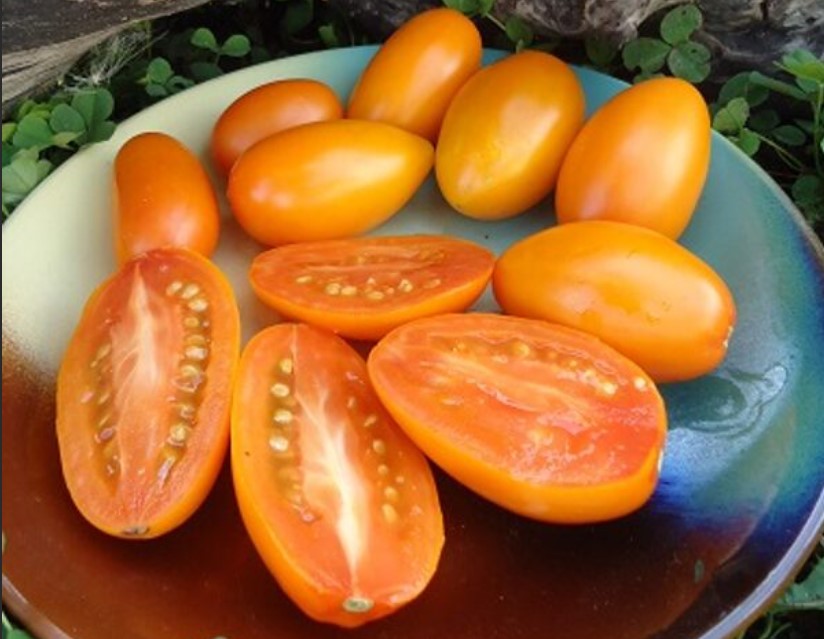
| Description of the fruit | The fruits are ovoid, yellow in color, with firm, juicy flesh containing 2-3 seed chambers. The skin is thick and resistant to cracking. |
| Taste | Sweet and sour |
| Productivity | Up to 10 kg per 1 sq.m. |
| Usage | General purpose |
| Preferred growing regions | Northern, Northwestern, Central, Volga-Vyatka, Central Black Earth Region, North Caucasian, Middle Volga, Lower Volga, Ural, West Siberian, East Siberian, Far Eastern |
| Disease resistance | It has excellent immunity and is rarely even susceptible to late blight. |
| Agricultural technology | Suitable for both greenhouse and outdoor cultivation, it requires staking and training. |
| 2008 | |
| Country of origin | Ognev V. V., Maksimov S. V., Klimenko N. N., Kostenko A. N. (Agrofirm Poisk LLC) |
Photo gallery of the Golden Fleece tomato variety
The history of the Golden Fleece tomato variety
The Zolotoe Runo tomato was conceived by specialists from the Poisk agricultural firm as a variety with excellent immunity and tasty fruit. After a series of breeding efforts, they succeeded in achieving excellent characteristics, and in 2008, the tomato was officially recognized and added to the register.
A detailed description of the Golden Fleece tomato variety
The Golden Fleece tomato plant is compact, producing versatile yellow fruits. A more detailed description of this variety is provided below.
Characteristics of the bush
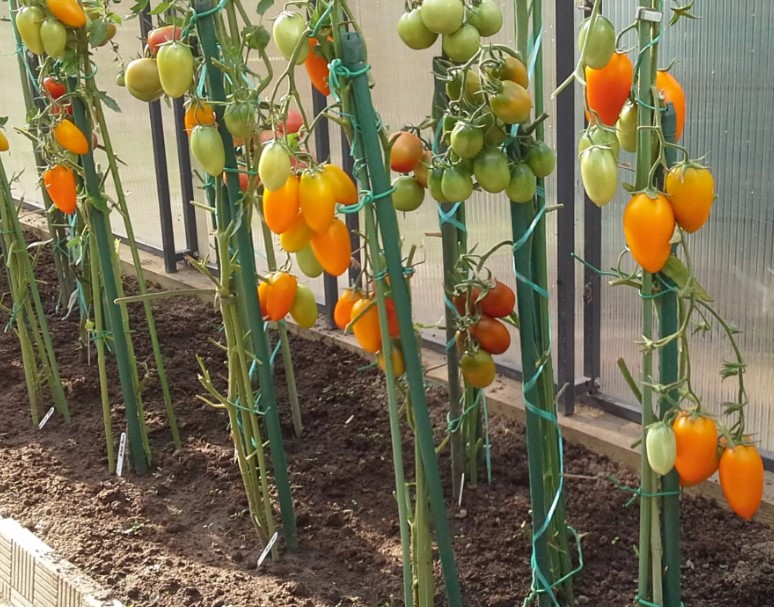
The bushes are determinate and self-limiting. The shoots are vigorous, 40 to 60 cm tall, and require no pinching or staking. The leaves are medium-sized and fairly abundant.
Inflorescences begin to form after more than 7 leaves have appeared on the bushes.
Fruit characteristics
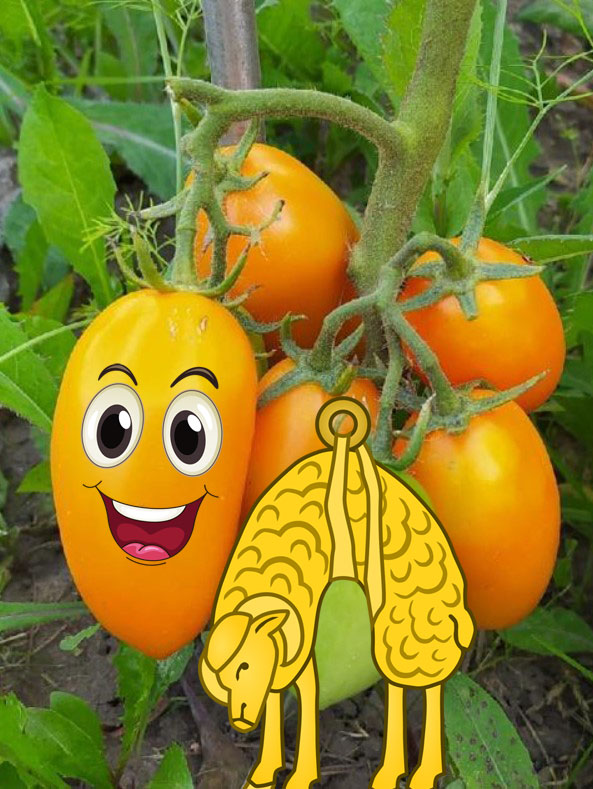
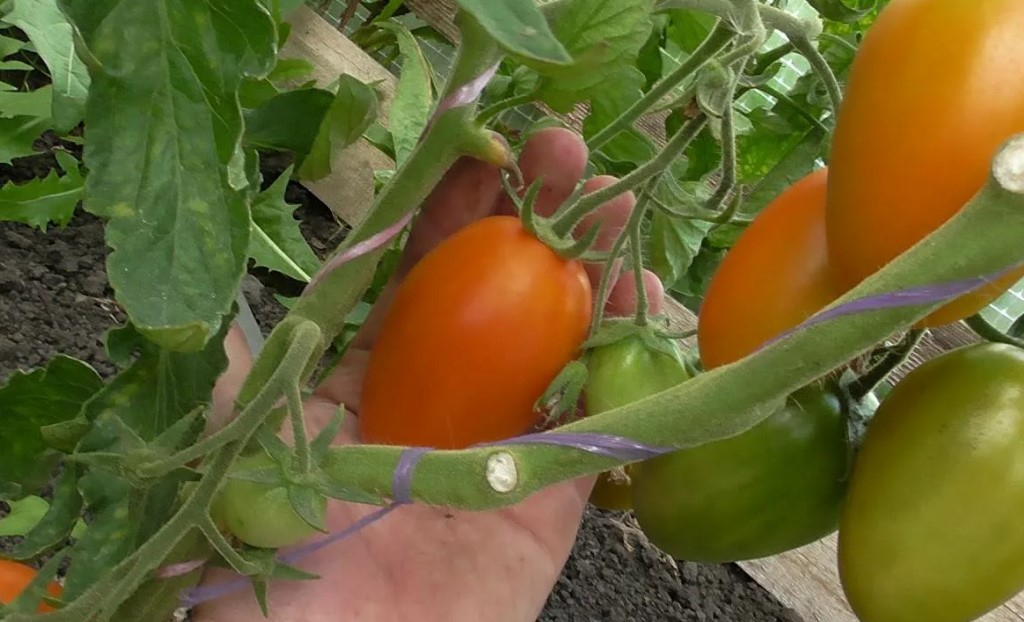
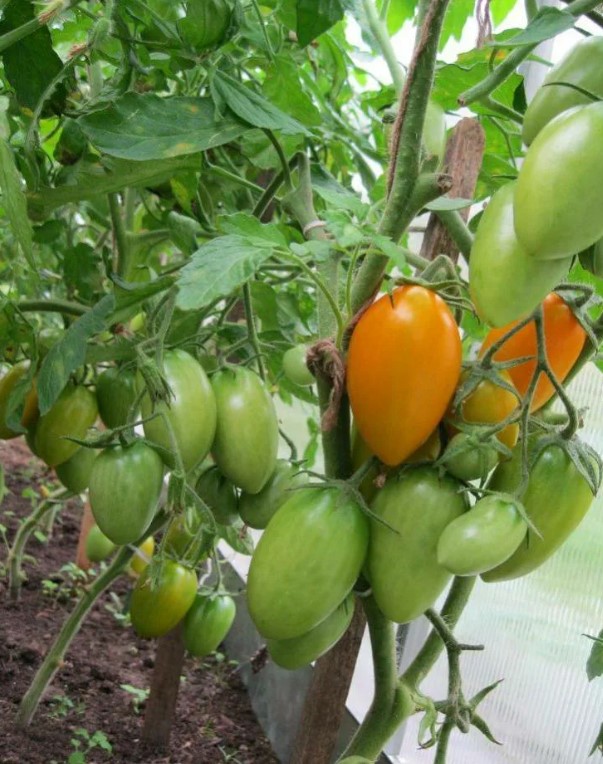
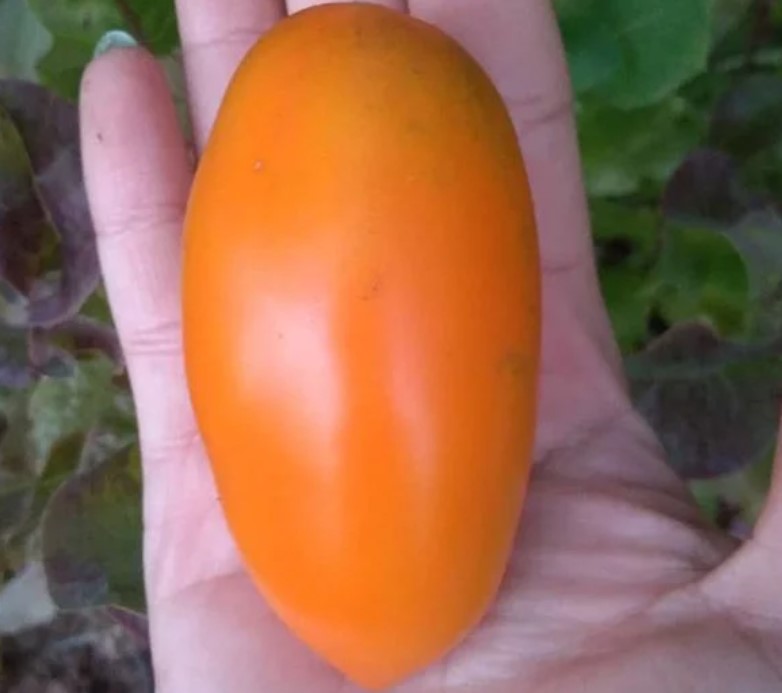
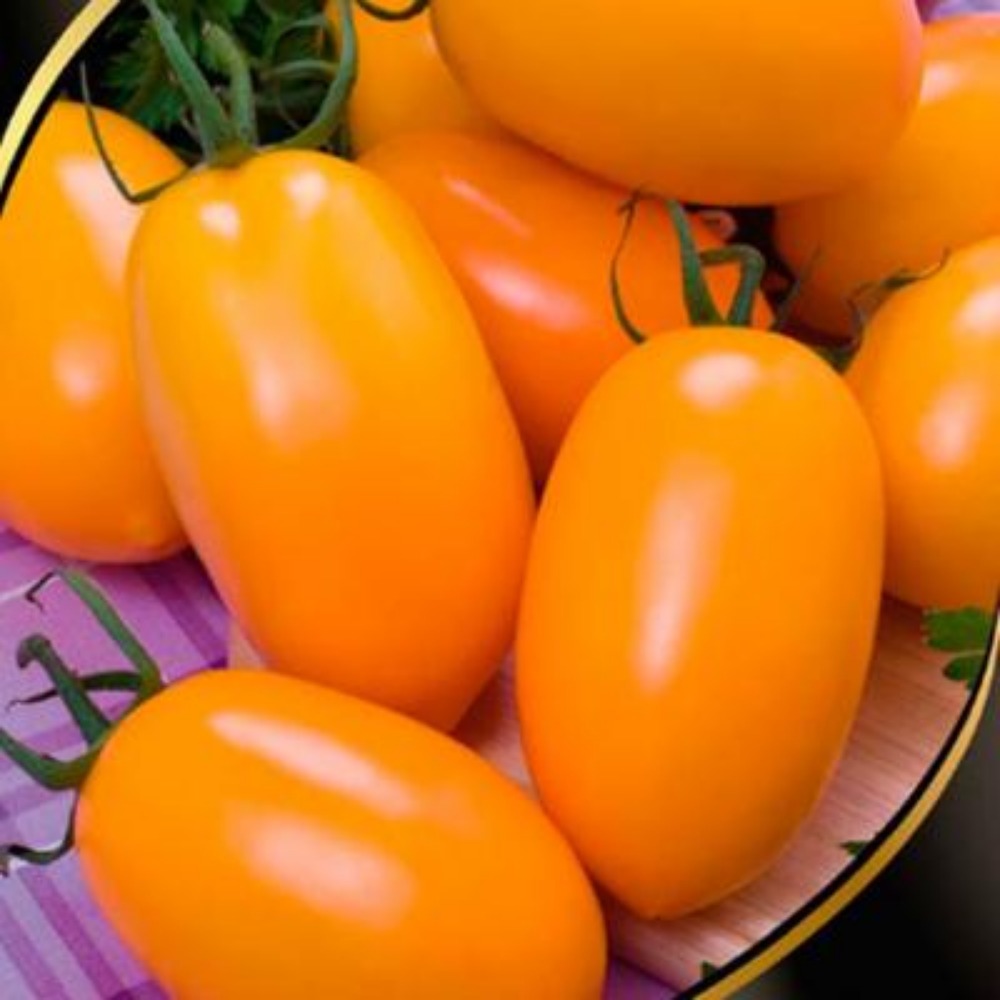
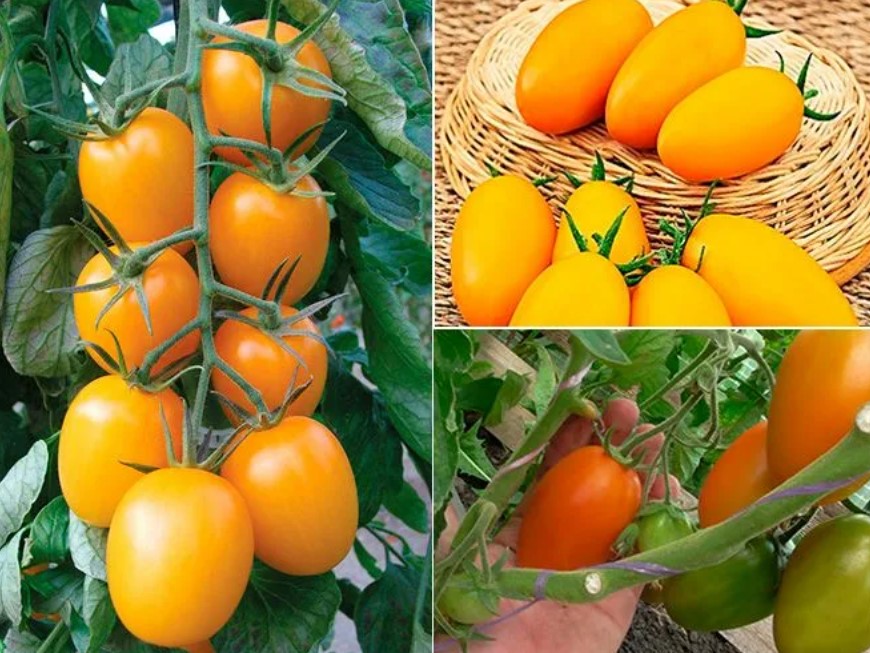
The fruits can be ovoid or even slightly elongated, more reminiscent of a pepper. The color ranges from greenish to yellow. Weight varies from 90 to 100 g. The flesh is dense and juicy, containing 2-3 seed chambers. The skin is glossy and very dense, so the tomatoes rarely crack on the vine and transport well.
The taste is pleasant, sweetish with a slight sourness.
Ripening time and yield
The Golden Fleece tomato variety is distinguished by its early ripening period, with the fruits ripening on the vine just 85 days after the first shoots emerge. With proper cultivation practices, up to 10 kg of ripe tomatoes can be harvested per square meter.
Resistance to diseases and pests
Breeders promote the Golden Fleece tomato as a plant with strong immunity and rarely susceptible to disease. However, if care is not provided correctly, it can be susceptible to late blight or various types of rot. Therefore, it is recommended to spray the plants with Bordeaux mixture or a phytosporin solution three times per season, at 10-day intervals.
Colorado potato beetles are a common pest in open ground. They are best collected by hand, removing not only adults but also their larvae from the bushes.
Whiteflies, a moth-like butterfly that reproduces at an astonishing rate in greenhouses, are considered a dangerous pest in greenhouses. Controlling them is extremely difficult; plants require foliar treatment, often requiring specialized insecticides.
Advantages and disadvantages of the Golden Fleece tomato variety
The table below lists the main advantages and disadvantages of the Golden Fleece tomato variety.
| Advantages | Flaws |
|
|
Growing the Golden Fleece tomato variety
The Golden Fleece tomato is not a hybrid; you can collect the seeds yourself. Plants are planted using seedlings in both greenhouses and open ground.
Sowing seeds and growing seedlings
You can purchase Golden Fleece tomato seeds at any specialty store, but some gardeners save a few large fruits for propagation at the end of the season and collect the seeds themselves for planting. These seeds require pre-planting preparation:
- The strongest and densest seeds are selected.
- They are dipped in a weak solution of potassium permanganate for 15 minutes.
- Dry and treat with a growth stimulator.
Many gardeners strongly recommend sprouting tomatoes before planting them in soil. It's very easy to do:
- Take a saucer with a damp cloth placed on it.
- The seeds are placed on top of the fabric and covered with a piece of fabric.
- The saucer is placed in a warm place for 24 hours.
Germination will help the plantings adapt more quickly and speed up the seedling germination process.
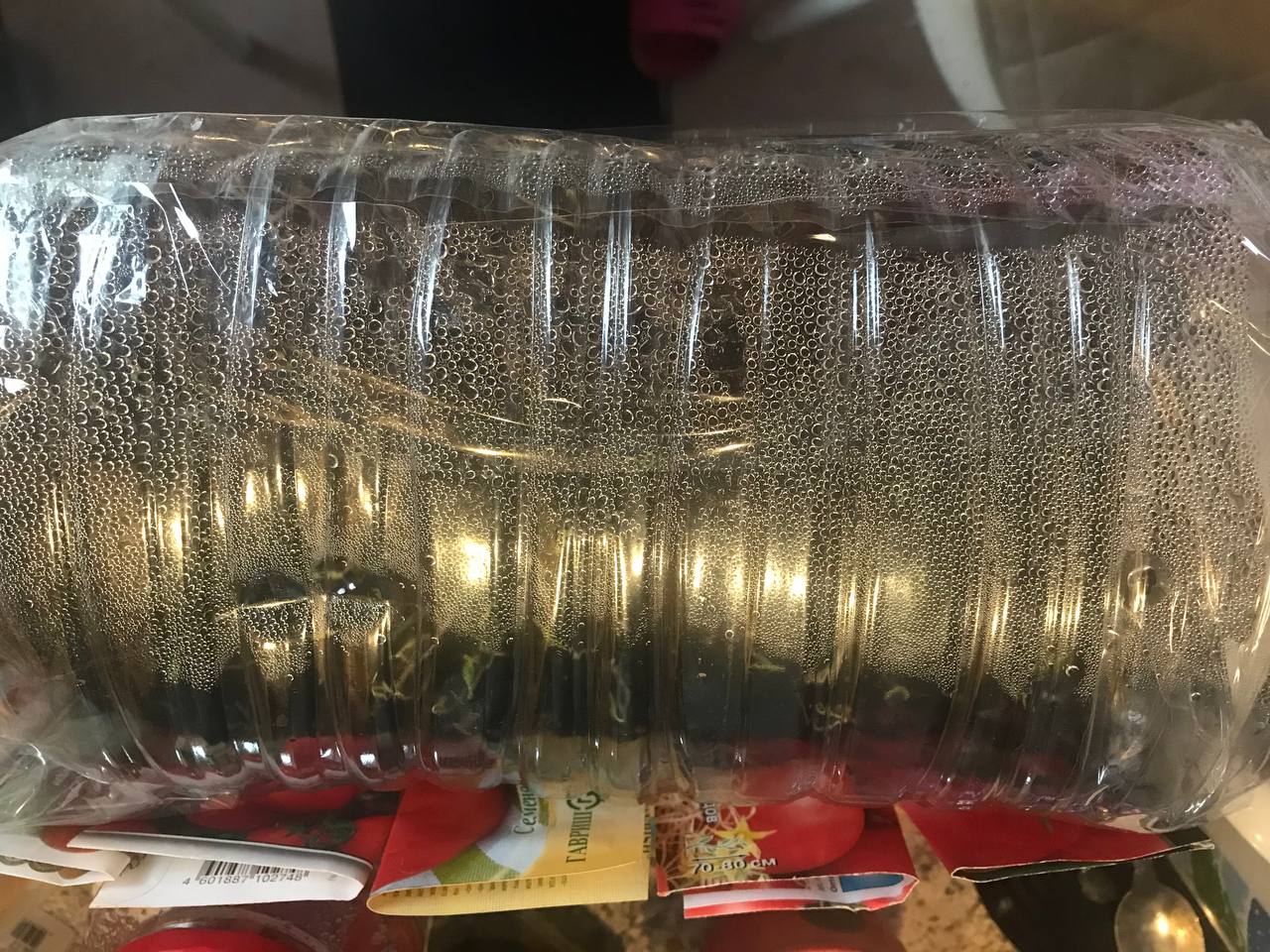
A box, the bottom of a bottle, or peat cups, which are very convenient to use, can be used as a container for seedlings.
The soil for tomatoes should be light and nutritious, so it is best to use a store-bought mixture, but you can make it yourself from the following ingredients:
- 2 parts garden soil,
- 1 part sand,
- 1 part peat or humus.
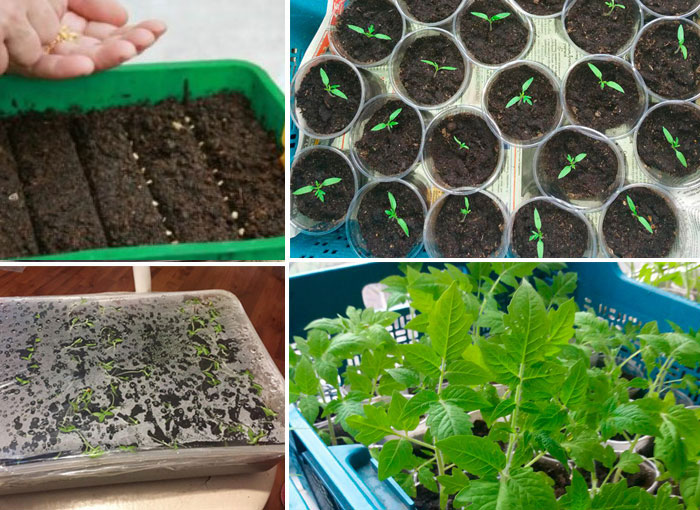
Fill the selected container with soil, stopping 2 cm below the rim. Make furrows at the top, preferably no more than 1 cm deep. Place tomato seeds in the furrows, spaced 3 cm apart, cover with soil, and water using a spray bottle or syringe.
Planting in the ground
Tomatoes are planted in the ground when the soil has warmed to 12 degrees Celsius and the threat of night frost has passed. The exact date will vary by region. Two weeks before planting, harden off the seedlings by placing them outside for two hours at a time, then gradually increasing this time to 10-12 hours.
In the fall, the soil in the garden bed is dug up together with manure; in the spring, when it is dug up again, humus and superphosphates are added to it.
Next, dig 20 cm deep holes, staggering them for ease of maintenance. It's recommended to leave 60-70 cm between rows and 50-60 cm between plantings.
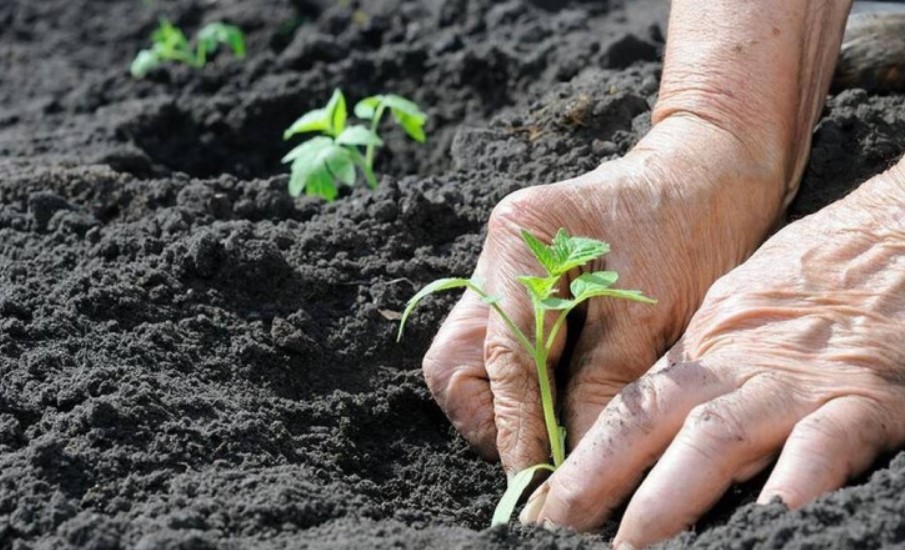
Plant one bush in each hole, carefully spread the roots, and cover with soil. The final step is watering with warm water. If necessary, cover the plantings with spunbond.
Care
The Golden Fleece tomato is quite unpretentious in care.
- After transplanting it to a permanent location, it is recommended to mulch the surface of the bed to protect the roots from cold and heat.
- It's recommended to water tomatoes in the evening 1-2 times a week, depending on weather conditions and growing method. Outdoors, you should focus on the amount of rainfall, while in a greenhouse, you should consider the indoor temperature. If the weather is excessively hot, increase the frequency of watering. A drip system is the most convenient, as it delivers maximum moisture to each plant.
- To prevent the appearance of pests, plantings are sprayed with Bordeaux mixture or phytosporin solution three times per season at intervals of 10-14 days.
- Periodically, it is necessary to weed and loosen the soil around tomatoes to improve aeration and reduce the risk of pests, which are very fond of weeds.
Harvesting, using and storing the Golden Fleece tomato variety
Golden Fleece tomatoes ripen in just 85 days from the first shoots appearing. Initially green, the tomatoes turn yellow, indicating ripeness. Due to their thick skin, the tomatoes rarely crack on the vine, making them excellent for storage and transportation.
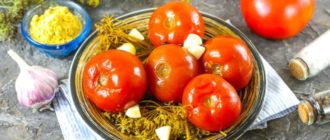
The cultivators claim the variety is versatile. The tomatoes can be eaten fresh, added to salads, or used in main courses. The fruits are also suitable for pickling and canning whole.
Comparison of the Golden Fleece tomato variety with other varieties in the table
Please note! How can you easily convert centners/ha to kg/sq.m? Simply divide by 100! For example, the Abakansky Pink tomato yields 400 centners of marketable fruit per hectare. This equals 4 kg per square meter. It's that simple! Also, keep in mind that typically no more than 3-4 plants are planted per square meter. This way, you can calculate the yield per plant.
| Variety | Ripening period (number of days from full germination to ripening)
Yield of commercial fruits |
Brief description | Fetus |
| The Golden Fleece | 98 days 600 c/ha (greenhouse and under film) |
An early-ripening determinate variety for open ground and greenhouses. Suitable for salads and whole-fruit canning. | Ovoid, smooth, medium density, yellow, 90-100 g. Good taste. |
| Banana legs | 80-85 days (greenhouse), 90-100 (open ground)
1780 c/ha |
An early-ripening indeterminate variety for open ground and greenhouses. Suitable for salads. | Cylindrical, dense, slightly ribbed, yellow, 80-100 g. Good taste. |
| De Barao orange | 110-130 days
1000-1200 c/ha |
Grows well in open ground. In cooler regions, it can be planted in unheated greenhouses. This indeterminate, late-ripening variety grows up to 200 cm. It requires staking and training. It is suitable for salads and all types of canning. | The fruits are small, ovoid, with smooth, glossy skin. The flesh and skin are orange, weighing 120 g. The flavor is excellent. |
| Gigolo (Gigolo) | 98-104 days
900-1200 c/ha |
A mid-season, determinate, standard variety for open ground and greenhouses. Requires staking and training. Suitable for salads, stuffing, and canning. | Oddly shaped, reminiscent of a sausage, muted red, 125 g. Good taste. |
| Golden Königsberg | 115-120 days 860 c/ha |
An indeterminate mid-late variety for both open and closed ground. Requires staking and shaping. Salad-type. Marketability: 56% (Novosibirsk Region). Heat-resistant. | Cylindrical, slightly ribbed, orange, medium density, 191 g. Excellent taste. |
| Midas | 105-115 days
700-1000 c/ha |
A mid-season indeterminate variety for open ground and greenhouses. Suitable for salads, canning, and drying. | Pear-shaped, smooth, orange, 60-80 g. Good taste. |
| Minusinsk glasses | 110-112 days
Up to 1200 c/ha |
A mid-season indeterminate variety for greenhouses. Suitable for salads, canning, and processing into tomato products. | Oval, smooth, orange, pink or red, up to 400 g. Good taste. |
| Siberian bananas | 105-110 days
Up to 1500 c/ha |
A mid-season semi-determinate variety for open ground and greenhouses. Suitable for salads and canning. | Banana-shaped, smooth, yellow, 150-180 g. Good to excellent taste. |
| Siberian miracle | 110-115 days The yield of commercial fruits under film covers is 10 kg/sq.m. |
A mid-season indeterminate variety for open ground and greenhouses. Requires staking and shaping. Suitable for salads. | Ovoid, smooth, medium density, red, 150-200 g. Good taste. |
| Wonder of the World | 120 days
550-620 c/ha |
A late-ripening indeterminate variety for open ground. Requires staking and shaping. Suitable for salads and pickling. | Obovate, slightly ribbed, yellow, 80 g. Good taste. |
Gardeners' reviews of the Golden Fleece tomato variety
A very undemanding variety, rarely gets sick, but the flavor isn't particularly memorable. While they're average-sized when fresh, they hold their shape well when canned and look beautiful in the jar.
Good day to the readers of my review!
Of all the tomato varieties I grow, I consider the orange ones to be my favorite. These varieties typically have a higher sugar content and are therefore sweeter in taste.
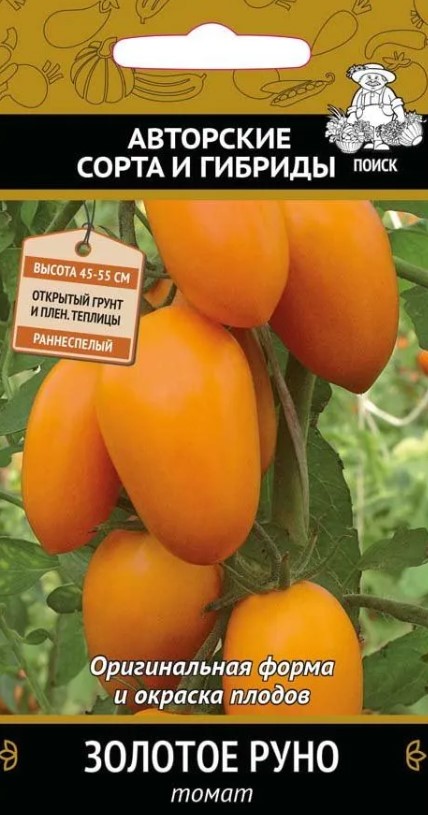
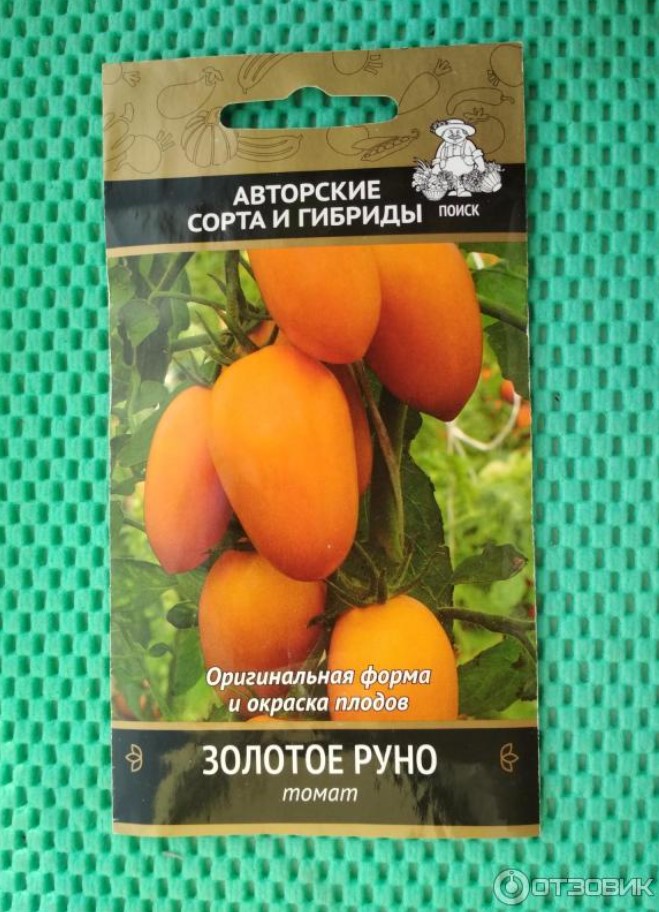
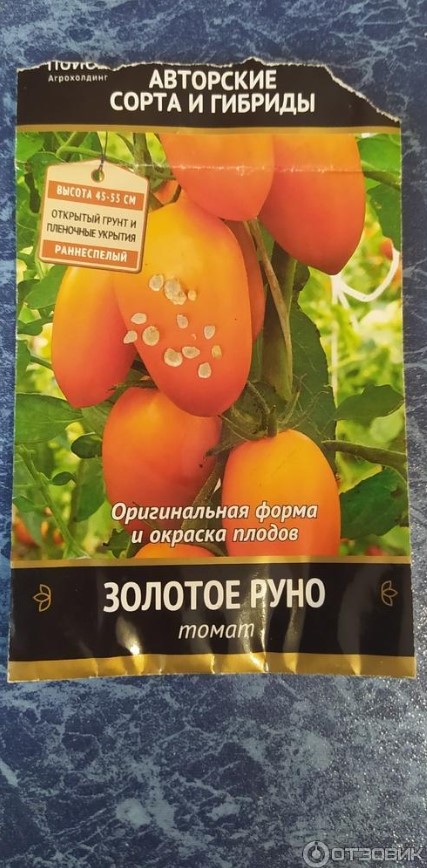
I came across a package of tomato seeds in the store. Search "Golden Fleece"
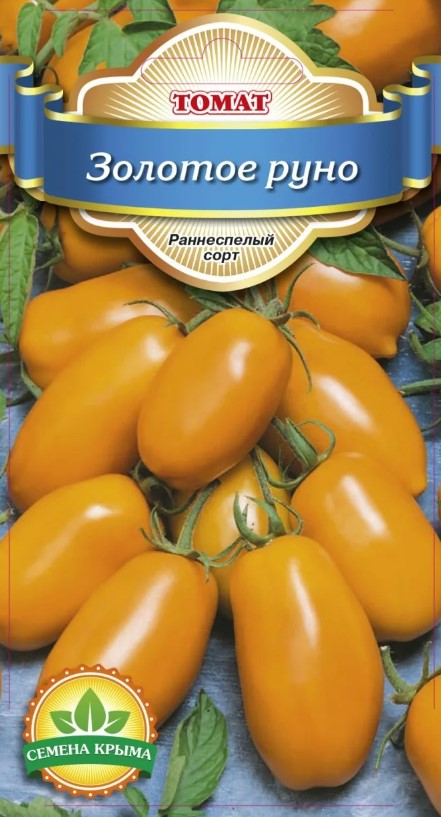
How can such an image with brightly colored, gracefully shaped fruits not attract attention?
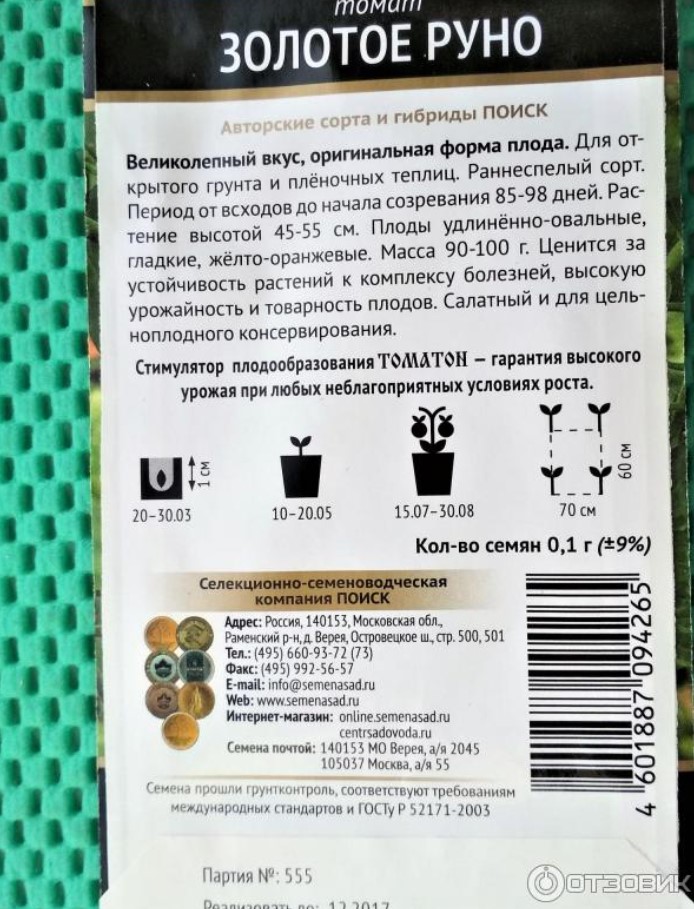
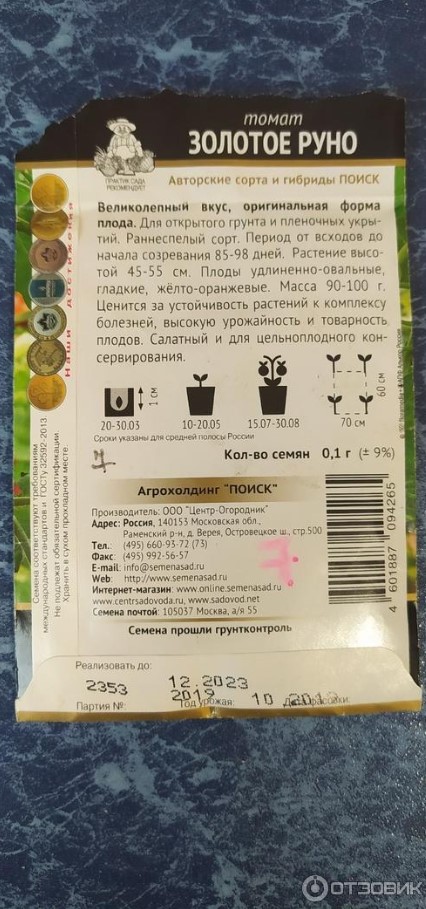
The characteristics, growing conditions, manufacturer's information and expiration date are described in detail.
Even though they were supposed to be used by December 2017, I actually missed the deadline by two years, but the germination rate was excellent. Of course, this was preceded by pre-treating the seeds with Epin, my go-to growth regulator.
I intended them for growing outdoors, where they were moved at the end of May. I covered them for a couple of weeks to protect them from frost and other adverse weather conditions, until they were fully established.
They tolerated the transplant well, the bushes grew, and in mid-June I removed the cover.
To my dismay, in the middle of a hot summer, there was a squall with large hail, which caused damage to a significant number of bushes.
But this variety survived, perhaps due to the compact form of the bush.
The bushes grew to a height of about 70 centimeters, with closely spaced clusters of five fruits each. The bush was literally covered with tomatoes, which are disease-resistant.
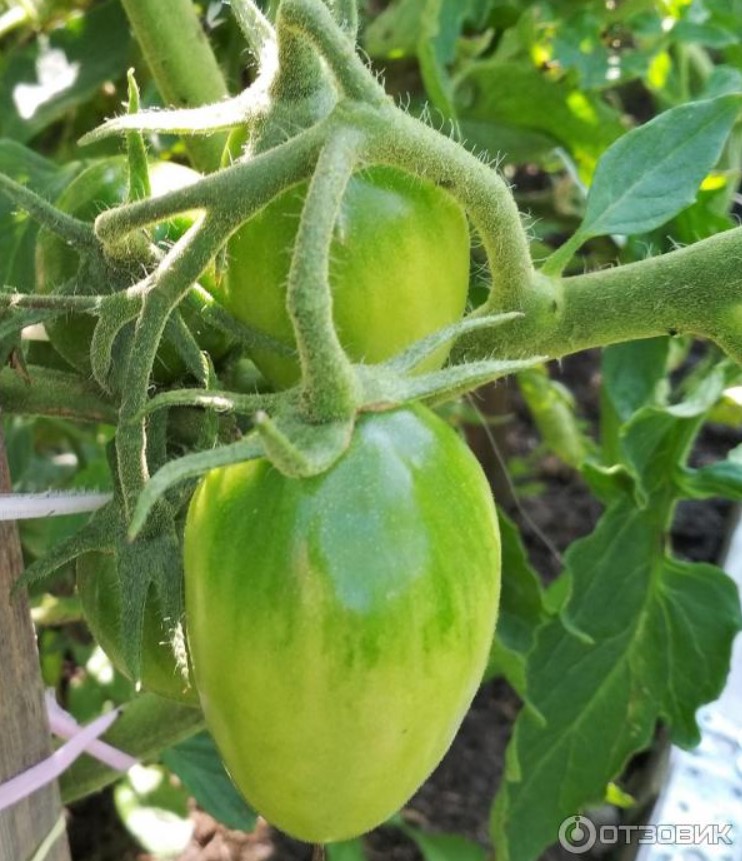
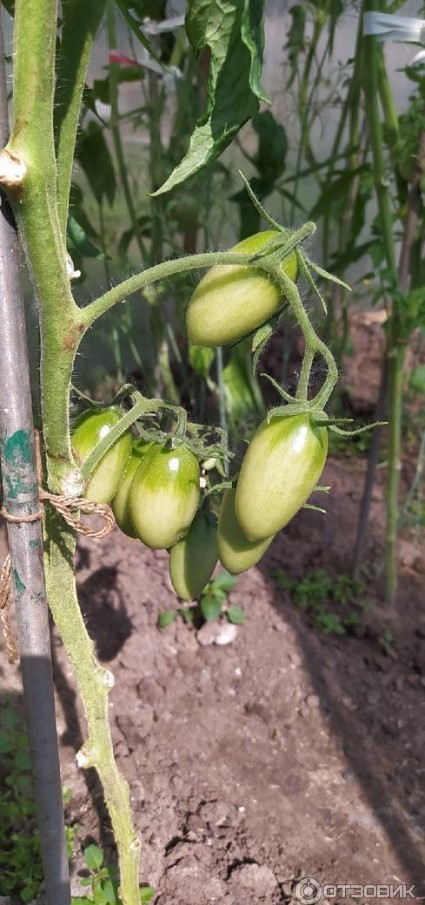
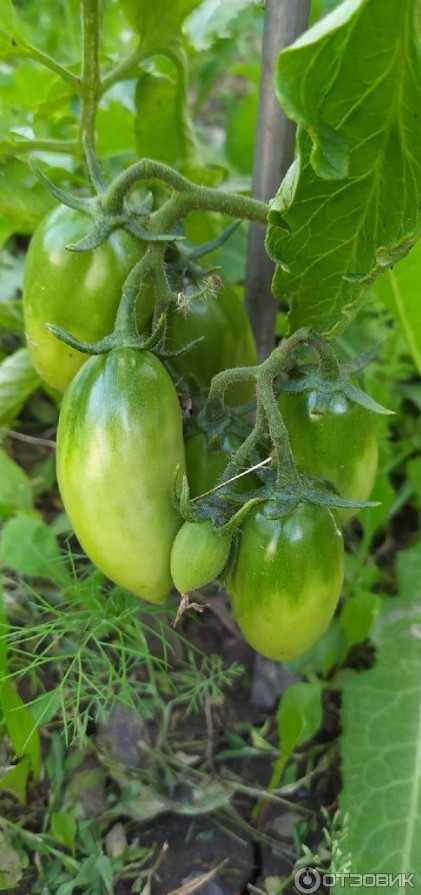
The fruits are cream-shaped with a pointed tip; when green, there is a dark spot near the stalk.
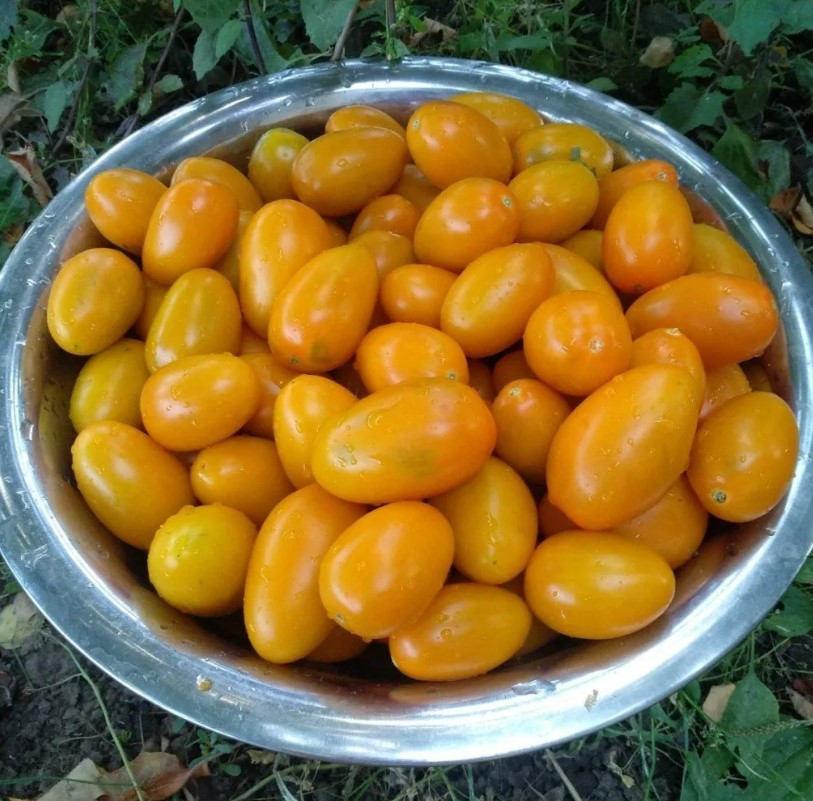
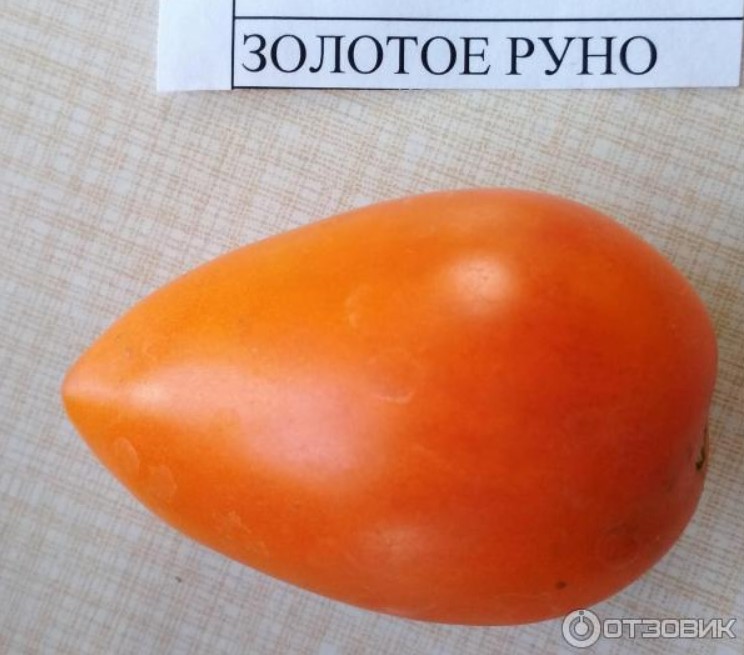
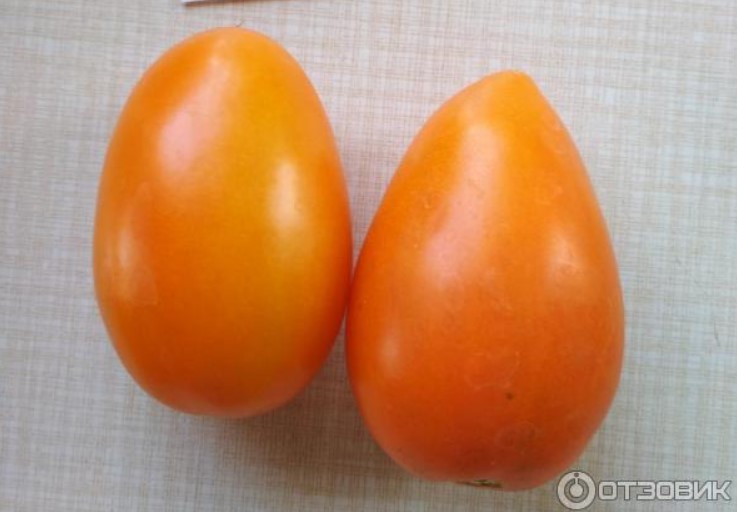
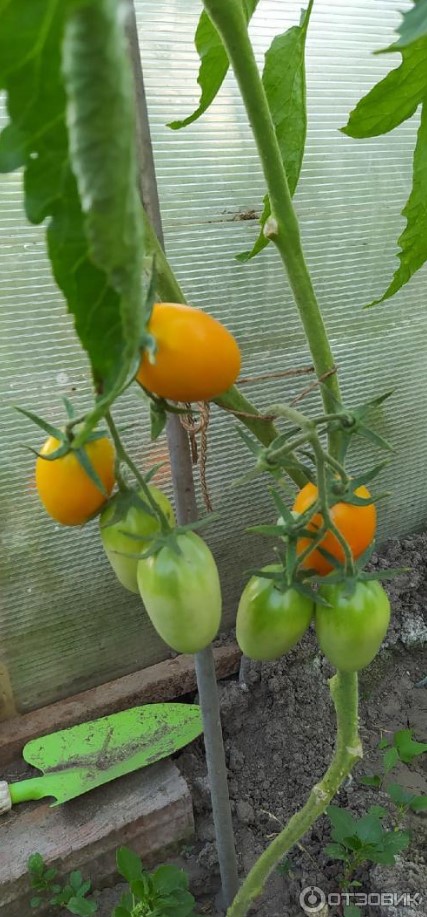
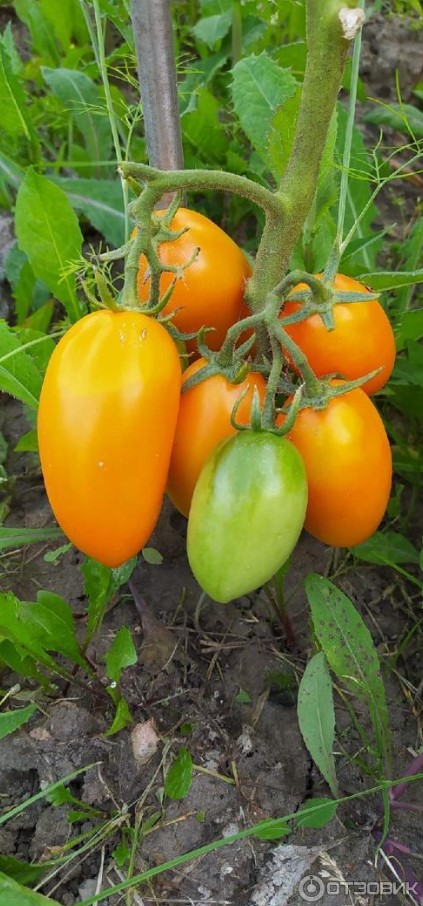
When ripe, they are uniformly colored, bright orange. They were the first to ripen; I discovered ripe fruits by accident while watering. The skin is shiny, thin, and resistant to cracking when canned whole.
All the fruits are virtually identical in shape and weight, with only a slightly rounded tip. The flavor is sweet, the flesh is tender and juicy, and not watery. Ripe tomatoes store well, and even when picked green, they ripen beautifully without losing their flavor. They belong to the category of tomatoes that can be picked and enjoyed whole.
The return in color suggests placing them in a sunny place, which is what I allocated for them.
They weigh 65-70 grams on average. Their size and shape allow them to be arranged compactly in a jar for pickling. I love pickling tomatoes of different colors in one jar; it looks beautiful and appetizing, and it's nice to get a bright greeting from summer in the winter.
I didn’t find any disadvantages at all, so only advantages.
+ excellent germination;
+ high yield;
+ sweet taste;
+ beautiful view;
+ early ripening;
+ price.
I recommend it, good choice and harvest to you!
Every year I add a new tomato variety to my collection. This time, I'll tell you about tomato seeds from the Poisk agroholding "Golden Fleece."
There are quite a lot of seeds in the packet, so I've placed some on the packaging for clarity. They're medium-sized, not too big or too small. The seedlings have a good germination rate; all 10 of my 10 seeds sprouted.
The manufacturer included fairly comprehensive and clear instructions on the back, so there's nothing more to add. Everything fits the description.
I plant some of the seedlings in a greenhouse (in early May), and some outside after May 25, when frost is no longer expected.
Unfortunately, I only have photos from the greenhouse, but this variety also performed well outdoors.
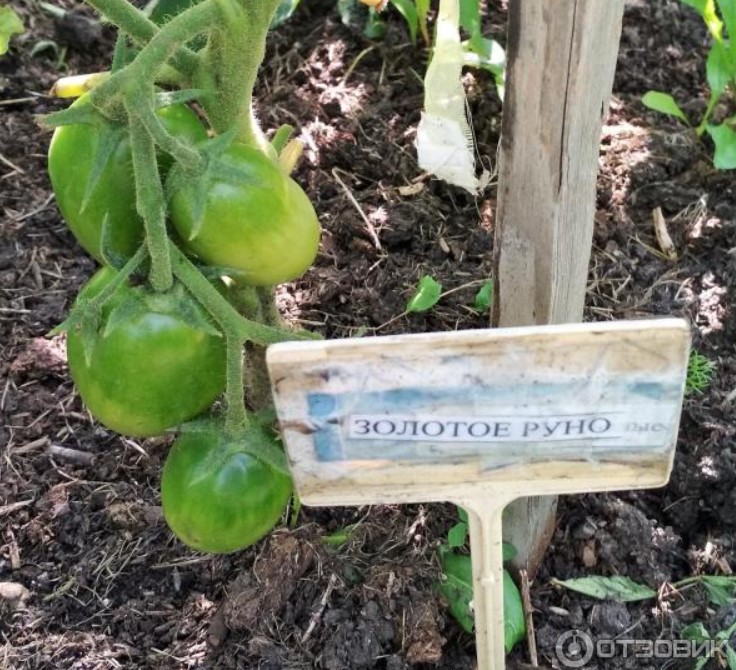
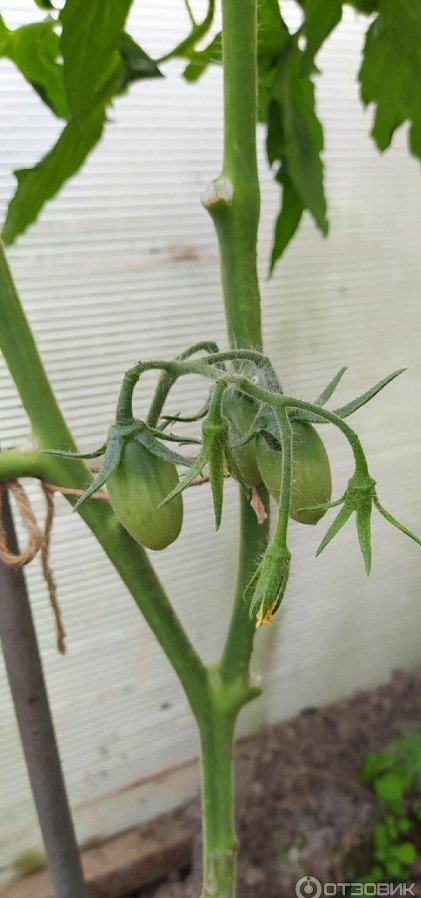
Here is a photo from 13.06, where dense ovaries are visible.
And for comparison, here's a photo of the fruits after 11 days, i.e., June 24. Several branches form on one bush, each with approximately 8-10 tomatoes.
In the photo from 06.07 (below) the fruits of the shape stated by the manufacturer have already formed.
A week later (photo from July 11), you can already sample the harvest. While the lower branches are maturing, the upper ones begin to emerge and bloom.
The manufacturer did not deceive, the fruits turned out just like on the packaging (my photo from July 26).
We liked the Golden Fleece variety both fresh and for canning.
Moderately sweet and sour. The fruit didn't spoil outside. In the fall, I picked the unripe green fruit, so they ripened to orange and ripeness in the warmth of the house.I bought this particular packet of seeds in 2020, and I've been enjoying this vegetable for two years now. Unfortunately, store prices are sky-high these days. But if you buy Zolotoe Runo seeds, I assure you, this variety won't disappoint.
I first bought "Golden Fleece" tomato seeds in 2010 or 2011, and I've been growing these tomatoes for years. For me, this variety is one of the easiest.
But when I planted it for the first time, I encountered unexpected circumstances. And these surprises were waiting for me in the mature plant itself. It revealed all the shortcomings of my agricultural practices.
The seeds come in this company's traditional packet. The packaging features fairly realistic images of the fruits you'll grow. The back contains a fairly good description of the variety and growing techniques. But that's enough if you've grown this variety at least once.
The manufacturer claims the variety is early ripening, with a ripening period of 85-98 days. You might think that's when the tomatoes will be ripe. In fact, this is the beginning of ripening, the so-called technical maturity. At best, the tomatoes will be yellow-green. Full ripeness will take another week or two.
And another problem. If you don't keep an eye on the tomatoes, they can become overripe and fall from the vines onto the ground. Right here on the packaging, you can read that the bush grows to 45-55 cm. This is true, but only under ideal conditions. It seems to me that this variety is the most sun-loving of all the tomatoes I know.
Even if you planted your seedlings outdoors in a well-lit spot and they became very dense, your tomatoes will grow to 70-90 cm. To prevent this, it's best to plant them at least 60 cm apart. This will also improve the size of the fruit. Even in a greenhouse, where the polycarbonate or glass is starting to cloud, tomatoes can grow to 90-120 cm. To prevent this, you'll need supplemental lighting or simply accept the reality.
The manufacturer's packaging states that the tomatoes weigh 90-100 grams. But that's the ideal. In reality, the tomatoes grow to weigh 50-70 grams. But I've managed to achieve this ideal. To achieve this, I plant the seedlings in humus-rich soil. I add compost and wood ash. I also add the same fertilizer to each hole.
Fertilizing is crucial. My first feeding always coincides with the flowering of the first cluster, even if the seedlings are still in pots. The second, when the ovaries begin to set. This is how you can get the 90-100 grams per tomato promised by the manufacturer.
Don't forget about watering. Although this variety isn't considered particularly demanding, I always keep the soil under these tomatoes moist.
And perhaps the last condition that must be met. I plant the seeds directly in large five-liter jars and add a stake. I plant the mature seedlings in the ground with this stake already in place. The plant has a fairly thick trunk, and at first glance, it seems like it doesn't need staking. However, the plant ripens its fruit at a rapid rate. This results in quite a heavy weight, and the trunk simply can't support it and collapses. Inserting a stake at this time would damage the root system, which would negatively impact fruit development.
I deliberately didn't say anything about planting the seeds, as this variety requires a standard approach and there are no secrets. I've always found seeds with a nearly 100% germination rate. They germinate easily in a damp cloth, and when planted and covered with soil to a depth of no more than 1 cm, they germinate within five days. There are no secrets here; everything follows a standard pattern.
It's fairly easy to calculate when to plant seedlings: subtract 105-110 days from the desired time for the first tomatoes to appear. This is the time until they are fully ripe, plus five days for germination.
The tomatoes themselves are a bright yellow-orange color. They're plum-shaped, sometimes with a rounded tip. They taste sweet and juicy. True, they produce very little juice and are practically useless for canning. But they're very pleasant to eat. They're great in salads. And if you can them assorted, they're simply a sight to behold. In winter, it's a real treat to open a jar of yellow and red tomatoes and green cucumbers. Moreover, this variety has a fairly strong yet thin skin. These tomatoes practically never crack during canning.
I really like this tomato variety. Juicy and beautiful, and not only that, they're easy to grow; they'll never leave you without a harvest. I highly recommend them. Time flies, and soon the first seeds of the new crop will be available for purchase. And I'll be planting my own seeds. This isn't a hybrid, but a varietal tomato, and collecting your own seeds is quite easy.
From me to the seeds and the producer, a solid five and yes.
What's summer without tomatoes and cucumbers? As an avid gardener, I plant my plot from top to bottom. Choosing seeds always requires careful consideration. When choosing seeds, I always check the expiration date and the appearance of the packaging. This time, the seedlings turned out well (thick, purple stems). The transplanting process went smoothly. The most important thing is not to overwater our tomatoes, otherwise they start to crack. The plant itself is about 100 centimeters tall. But despite all the difficulties, the salads made with the "Golden Fleece" tomato variety turned out excellent (juicy and appetizing), and the whole family devoured them.