The Siberian Bananas tomato variety gets its name from its unusually shaped, yellowish-orange fruits. They hang on the tree in such a way that from a distance they resemble bananas. The flavor is excellent, and cultivation techniques are not overly complex.
Content
- 1 Table with characteristics of the Siberian Banana tomato variety
- 2 Photo gallery of the Siberian Bananas tomato variety:
- 3 The origin of the Siberian Banana tomato variety
- 4 A detailed description of the Siberian Banana tomato variety, its pros and cons
- 5 Advantages and disadvantages of the Siberian Banana tomato variety
- 6 Growing the Siberian Banana tomato variety
- 7 Resistance of the Siberian Bananas tomato variety to diseases and pests
- 8 Collection, use and storage
- 9 Comparison of the Siberian Bananas tomato variety with other varieties in the table
- 10 Gardeners' reviews of the Siberian Banana tomato variety
Table with characteristics of the Siberian Banana tomato variety
| Characteristic | Description |
| Description | A mid-early semi-determinate tomato with tall shoots. Suitable for greenhouse and outdoor cultivation. |
| Ripening period | 105-110 days |
| Fruit weight | 140-180 g |
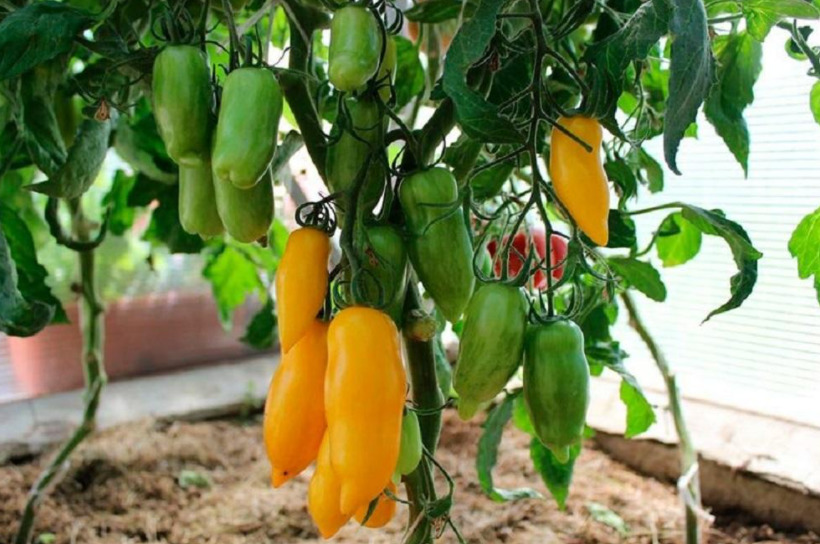
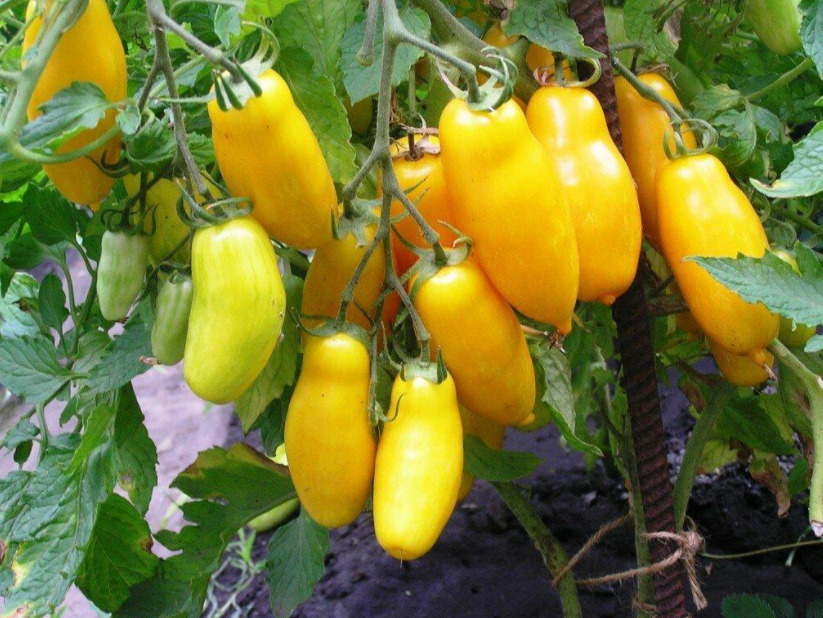
| Description of the fruit | The fruits are large, elongated oval, smooth, and even. They are yellow in color. A single cluster can contain 8 to 10 tomatoes. The skin is thin but holds its shape well. |
| Productivity | Up to 15 kg per square meter |
| Usage | They are used in salads and other dishes, and are also dried and cured. Small fruits can be used for whole-fruit canning. |
| Preferred growing regions | The variety is intended for cultivation in all regions of the country. |
| Disease resistance | It has strong immunity and is resistant even to late blight. |
| Agricultural technology | Needs shaping and tying |
| Not included | |
| Country of origin | Agrofirm "Siberian Garden" |
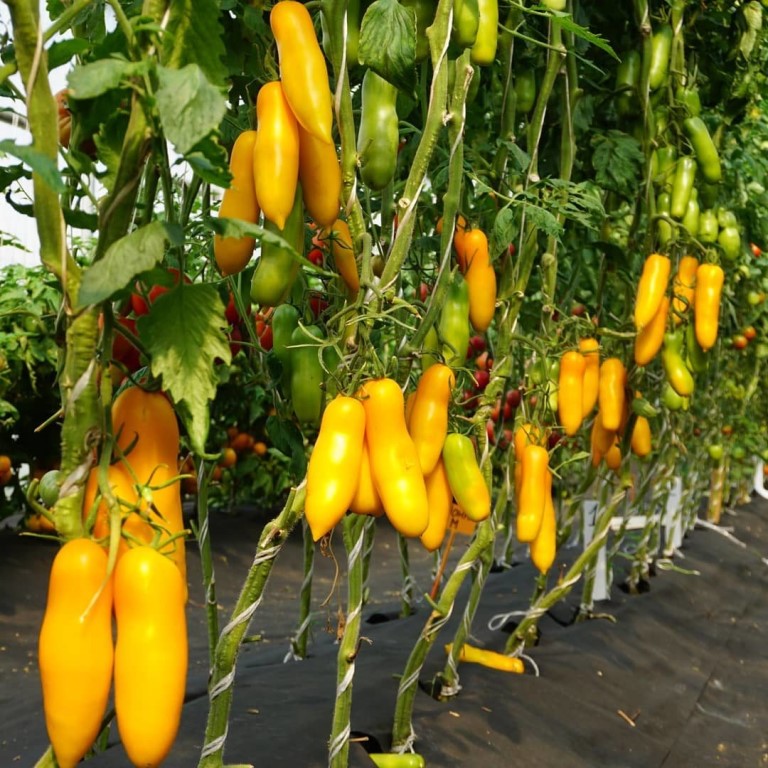
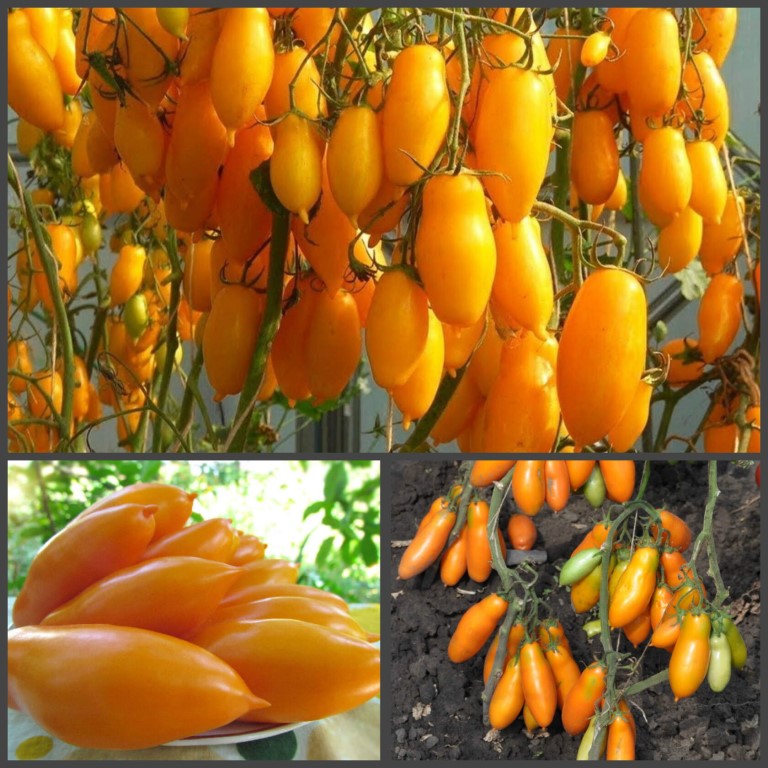
Photo gallery of the Siberian Bananas tomato variety:
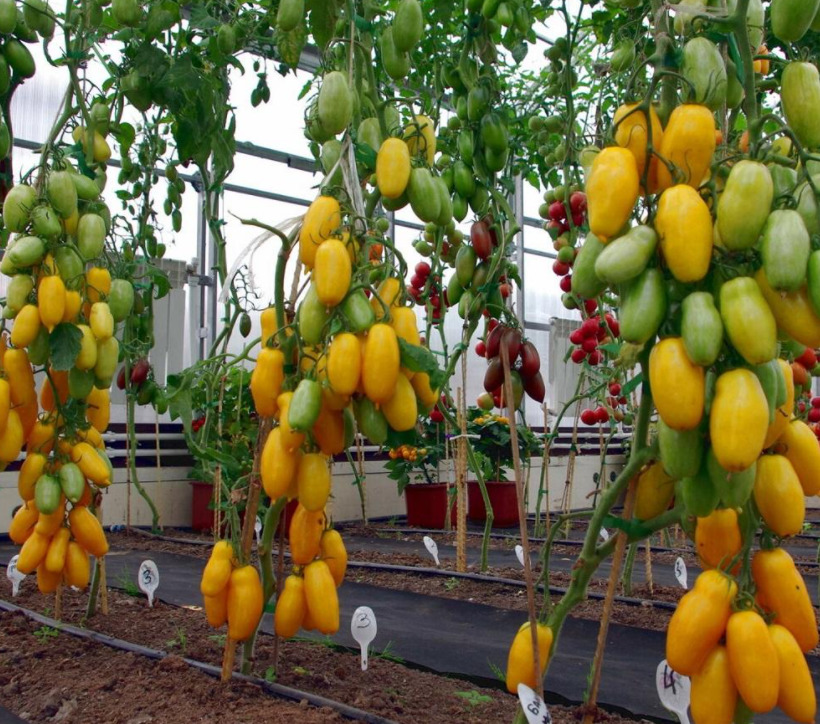
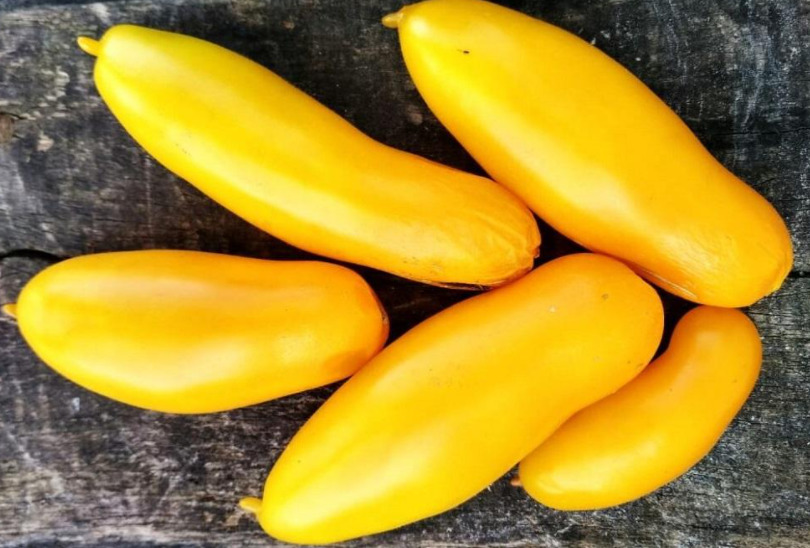
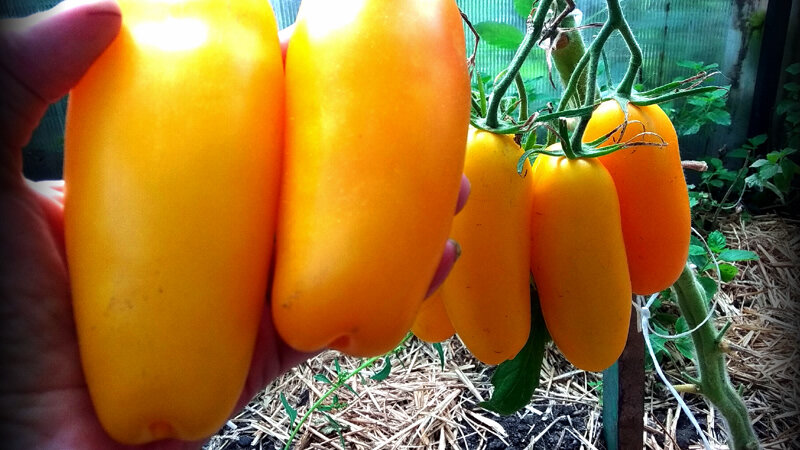
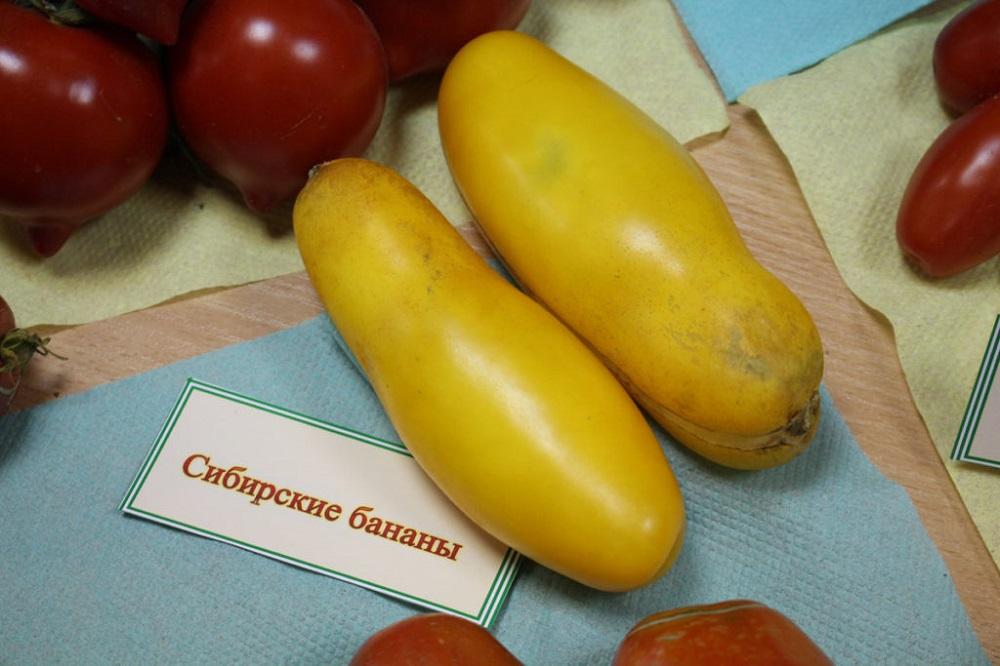
The origin of the Siberian Banana tomato variety
The Siberian Banana variety was developed by breeders at the Siberian Garden agricultural firm. This tomato was intended for greenhouse cultivation in the harsh Siberian conditions. However, as it was developed, it became clear that it thrives in any region, even producing excellent yields and excellent flavor in open ground in the south.
A detailed description of the Siberian Banana tomato variety, its pros and cons
A distinctive feature of Siberian bananas are their elongated, neon-yellow fruits, which not only delight with their taste but also decorate any garden bed.
Bushes
This variety is considered tall, with shoots reaching up to 180 cm. When grown outdoors, this figure may be slightly lower.
The leaves are medium-sized and have little foliage. As the tomatoes mature, remove excess foliage, starting from the bottom. This will allow the plant to direct nutrients solely to ripening tomatoes.
The bush is formed by 1-2 shoots. The more shoots, the smaller the harvest will be. The bushes also need to be tied up, otherwise they will easily break under the weight of the tomatoes.
Fruit
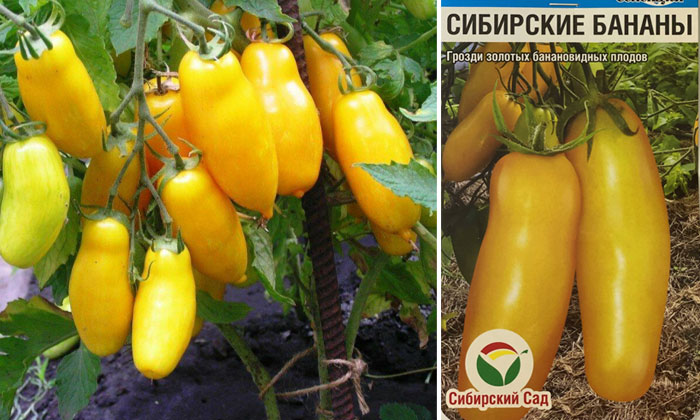
The fruits of Siberian bananas deserve special attention. They are oval, elongated, bright yellow, with a very thin, translucent skin that, despite this, is quite dense and holds its shape well. The flesh is juicy, and there are not too many seeds inside.
Tomatoes are ideal for dietary nutrition; they have a sweet taste with a subtle sourness.
The weight varies from 150 to 180 g, but on the lower tiers individual specimens can weigh about 230 g.
The brushes are voluminous, each one forming 7 to 10 bananas at a time.
Productivity
Siberian bananas are known for their high yields. When grown properly, they can yield up to 18 kg of tomatoes per square meter.
Ripening time
This tomato is considered mid-early. From germination to harvest, it takes 105 to 110 days.
Advantages and disadvantages of the Siberian Banana tomato variety
Siberian bananas have many advantages and minor disadvantages, which are listed in the table below.
| Advantages | Flaws |
|
|
Growing the Siberian Banana tomato variety
Siberian bananas require little effort from gardeners to grow. To obtain an excellent harvest, simply follow basic farming practices.
Sowing seeds and growing seedlings
Seed sowing begins approximately 65 days before the planned planting date. This varies by region: in the south, gardeners begin work in February, while in the north, it can't begin until mid-March.
It is best to purchase planting material from a trusted manufacturer, as many unoriginal "banana" counterfeits have appeared recently.
If the packaging does not indicate that the seeds have undergone pre-sale preparation, you will need to do this yourself.
First, the seeds need to be disinfected. To do this, they are immersed in a weak solution of potassium permanganate for 20 minutes. Next, they are treated with a stimulating solution, such as Epin. Finally, the seeds are wrapped in a damp cloth and placed in a warm place for a couple of days to germinate. Not all gardeners perform this procedure, but that's a shame. Experience shows that sprouted seeds have a better germination rate and stronger immunity.
You can use store-bought soil intended for tomato and pepper seedlings. However, if you have sand, soil, humus, and peat on hand, you can create your own potting mix by mixing all of these ingredients in equal proportions.
Fill a seedling box or container halfway with soil. Next, make 1-cm-deep furrows and sprinkle the seeds into them. Sprinkle the seeds with a little salt, spray with room-temperature water, and cover with plastic wrap or glass.
In this condition, the tomatoes will remain in a warm place until the seedlings emerge. Periodically, check the greenhouse for condensation and water them when the soil is completely dry.
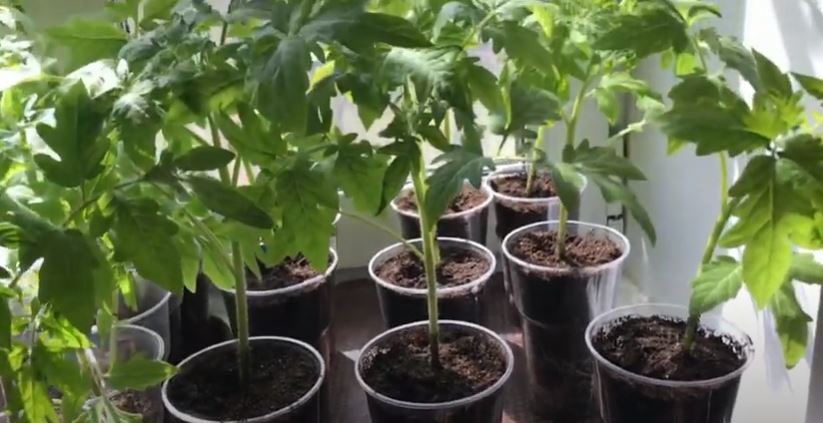
When the sprouts begin to touch the roof, remove the film and move the container to a cooler location (20–22°C). Once 2–3 full-fledged leaves appear, transplant the seedlings into individual containers.
5-7 days before transplanting into the garden bed, the hardening procedure begins, during which the seedlings are placed outside during the day, first for 1-2 hours, and later for the entire day.
Planting in the ground
Planting should take place at an optimal soil temperature (14…16°C). Some gardeners warm the soil in advance by covering it with dark plastic.
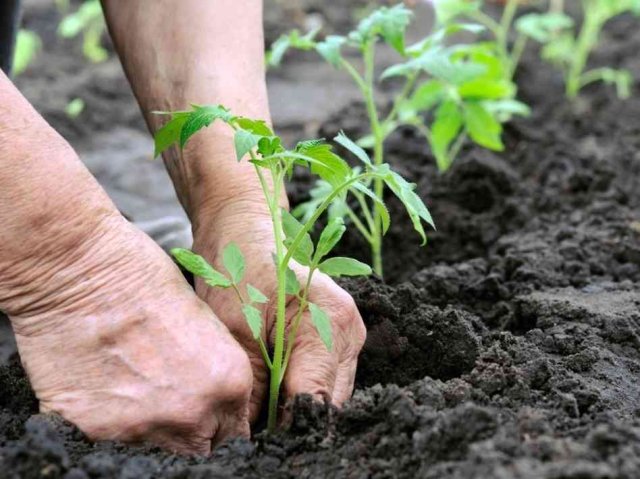
Ideally, the soil should be prepared in the fall. In the spring, the bed is dug over and holes no more than 25-30 cm deep are made 40 cm apart. When planting, a handful of compost and onion peels can be added to each hole.
It is recommended to leave a distance of 60-70 cm between rows. After planting, it is advisable to mulch the surface of the bed with sawdust, straw, or any other suitable material.
Care, watering and fertilizing
The Siberian Banana tomato doesn't require any special care. It tolerates temperature fluctuations and moisture deficits well.
To ensure juicy, sweet fruits, water the tomatoes a couple of times a week at a rate of 2-3 liters per plant. During flowering and ripening, increase the amount of water to 5 liters per plant, and increase the frequency depending on weather conditions. In hot weather, tomatoes may need to be watered daily, especially in southern regions. Therefore, it's worth considering installing drip irrigation in the garden.
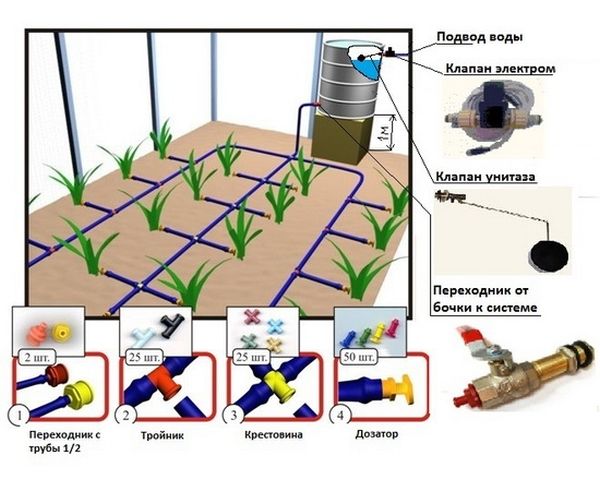
Read more about drip irrigation in the articleDIY Drip Irrigation for a Greenhouse + Review of Ready-Made Systems
To prevent diseases, spray with Bordeaux mixture or a Fitosporin solution. If the soil is poor, you can add complex mineral fertilizers or a mullein infusion. However, Siberian bananas grow well without additional fertilizers.
To facilitate rooting and ensure adequate oxygen supply, loosening and weeding are carried out. Furthermore, removing weeds is an excellent preventative measure against insect pests.
Resistance of the Siberian Bananas tomato variety to diseases and pests
Siberian bananas are known for their strong immunity. They rarely even suffer from late blight. However, preventative measures are still necessary, so spraying the plants with Fitosporin every two weeks is recommended.
Collection, use and storage
The harvest ripens in 105-110 days from germination. Despite their thin skin, tomatoes can hang on the vine for a long time without cracking or spoiling. In suitable conditions, such as in the refrigerator, tomatoes can be stored for several weeks.
Tomatoes can be used for eating fresh, for preparing various dishes, drying or curing.
Individual specimens are suitable for whole-fruit canning, as they are easy to place in jars due to their oblong shape.
Comparison of the Siberian Bananas tomato variety with other varieties in the table
Please note! How can you easily convert centners/ha to kg/sq.m? Simply divide by 100! For example, the Abakansky Pink tomato yields 400 centners of marketable fruit per hectare. This equals 4 kg per square meter. It's that simple! Also, keep in mind that typically no more than 3-4 plants are planted per square meter. This way, you can calculate the yield per plant.
| Variety | Ripening period (number of days from full germination to ripening)
Yield of commercial fruits |
Brief description | Fetus |
| Siberian bananas | 105-110 days Up to 1500 c/ha |
A mid-season semi-determinate variety for open ground and greenhouses. Suitable for salads and canning. | Banana-shaped, smooth, yellow, 150-180 g. Good to excellent taste. |
| Banana legs | 80-85 days (greenhouse), 90-100 (open ground)
1780 c/ha |
An early-ripening indeterminate variety for open ground and greenhouses. Suitable for salads. | Cylindrical, dense, slightly ribbed, yellow, 80-100 g. Good taste. |
| Siberian Shan'gi | 100-110 days
The yield of commercial fruits in open ground was 5.6 kg/sq.m. |
A mid-season determinate variety for open ground and greenhouses. Suitable for salads. | Flat-round, medium density, slightly ribbed, raspberry, 157 g. Excellent taste. |
| Siberian miracle | 110-115 days
The yield of commercial fruits under film covers is 10 kg/sq.m. |
A mid-season indeterminate variety for open ground and greenhouses. Requires staking and shaping. Suitable for salads. | Ovoid, smooth, medium density, red, 150-200 g. Good taste. |
| Siberian Troika | about 120 days 600 c/ha |
A mid-season determinate variety for open ground. Suitable for salads and canning, including whole-fruit preserves. Heat-resistant. | Cylindrical with a spout, smooth, dense, red, 80-100 g (up to 200 g). Excellent taste. |
| Valentina | 97-98 days
345-439 c/ha |
An early-ripening, determinate, non-standard variety for open ground. Requires staking and pinching. Suitable for salads and whole-fruit canning. Marketability is 94-97%. Drought-resistant. | Medium size, smooth, elongated-oval, red-orange, 82-86 g. Good taste. |
| Goldfish | about 120 days
870 c/ha |
A mid-season indeterminate variety for open ground and greenhouses. Requires staking and training. Suitable for salads and whole-fruit canning. | Cylindrical, smooth, orange, 90 g. Good flavor. The fruit has a high carotene content. |
| Moon fountain | 100-105 days
420-490 c/ha (greenhouse and under film) |
An early-ripening indeterminate variety for greenhouses. Suitable for salads. | Cylindrical, dense, slightly ribbed, creamy, 12-17 g. Good taste. |
| Minusinsk glasses | 110-112 days Up to 1200 c/ha |
A mid-season indeterminate variety for greenhouses. Suitable for salads, canning, and processing into tomato products. | Oval, smooth, orange, pink or red, up to 400 g. Good taste. |
| Southern tan | 110-120 days
1380 c/ha (greenhouse and under film) |
A mid-season indeterminate variety for open ground and greenhouses. Requires staking and shaping. Suitable for salads. | Cylindrical, smooth, medium density, orange, 211 g. Excellent taste. |
Gardeners' reviews of the Siberian Banana tomato variety
Gardeners have highly praised the Siberian Tomato variety, praising its excellent taste, versatility, and generous yield. Some reviews report that the tomatoes fall off the vine. However, most consumers report that the bananas remain on the vine for a long time until fully ripe.
Tomato Siberian bananas.
Clusters of golden, banana-shaped fruits. A mid-season variety with neon-yellow fruits of a rare banana shape. This high-yielding, delicious grape variety will impress most gardeners.
This semi-determinate plant, up to 1.8 m tall, produces minimal side shoots. It produces excellent fruit both in greenhouses and in open ground. A cluster produces up to nine tomatoes, up to 15 cm long. The fruits are firm, smooth, few-seeded, and golden-honey in color, weighing 150-180 g.

In terms of yield and shape, it's very similar to Banana Legs, only slightly later and much tastier. Excellent in salads, not just for pickling like Banana Legs. This variety has become a permanent fixture. It's also slightly larger than the legs.