
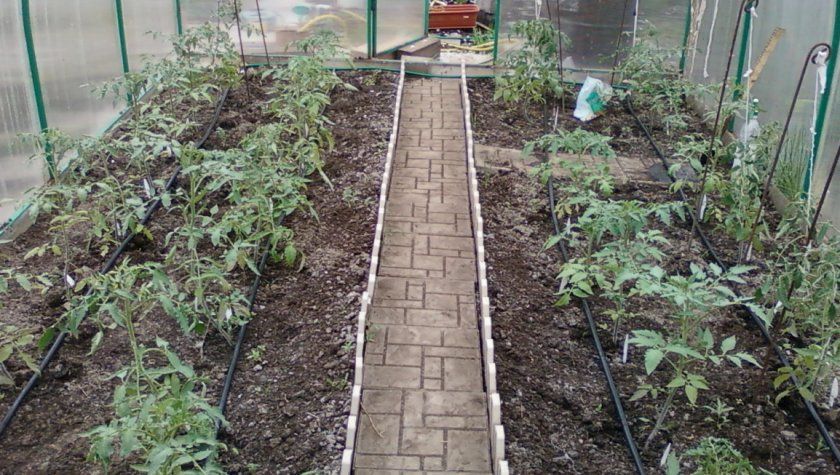
By installing drip irrigation in a greenhouse, outdoor garden, or even at home, you can stop watering your plants by hand. That's why any gardener and flower grower would love to have one. You can also make a drip irrigation system for a greenhouse yourself. In this article, we'll explain and show you how. Finally, we'll discuss ready-made systems that operate from a water supply or a water tank.
Content
- 1 Assembling a drip irrigation system yourself
- 2 Calculation of irrigation time and volume of supplied liquid
- 3 DIY drip irrigation system using plastic bottles
- 4 Automation of drip irrigation
- 5 DIY drip irrigation for indoor plants
- 6 Review of ready-made drip irrigation systems
- 7 How to choose a ready-made drip irrigation system
- 8 Advantages and disadvantages of drip systems
- 9 Types of drip irrigation
- 10 Types of IVs
- 11 Planting plants with drip irrigation
Assembling a drip irrigation system yourself
It is not difficult to make a homemade drip irrigation system.
You need to follow these steps step by step:
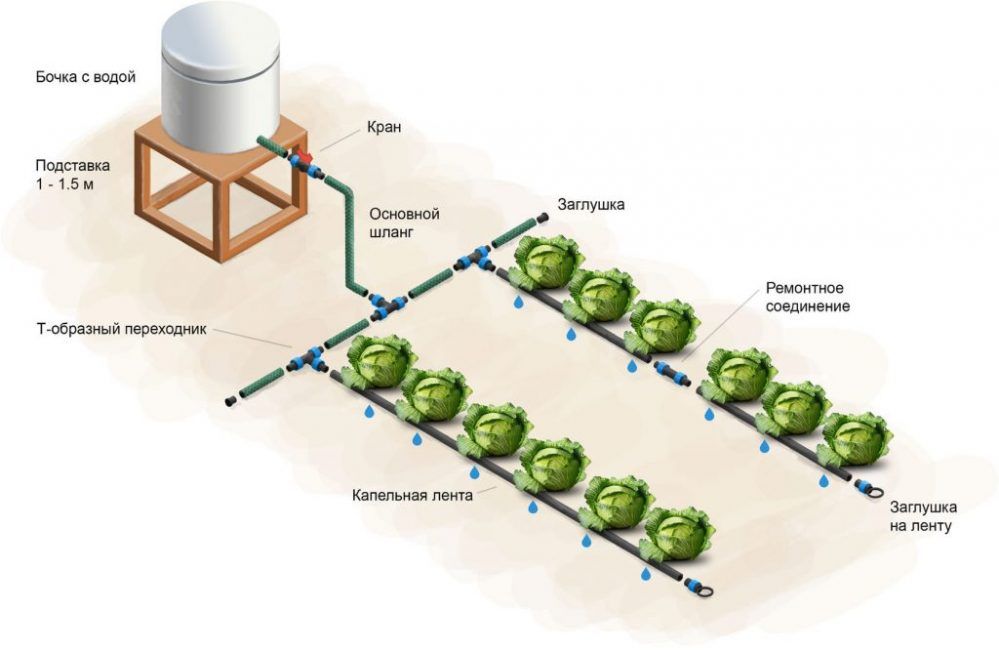
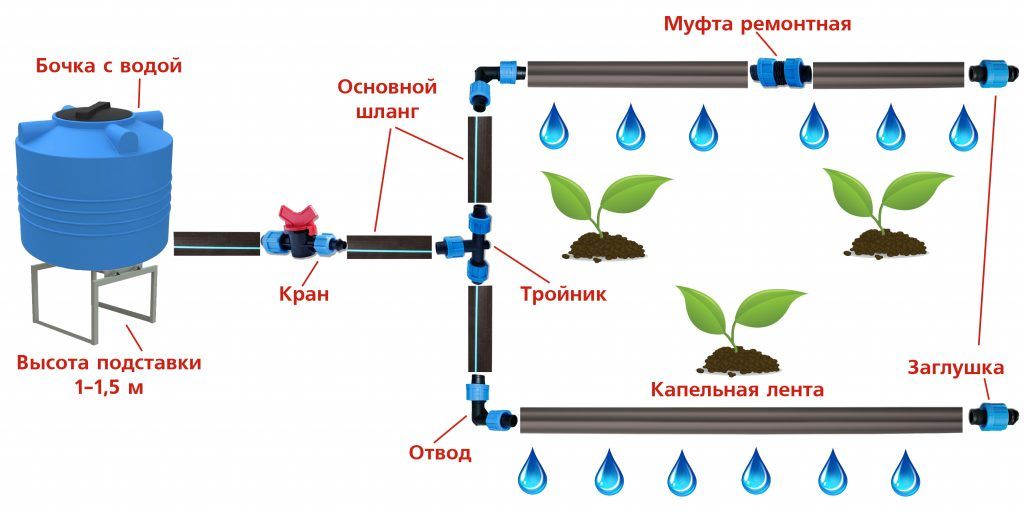
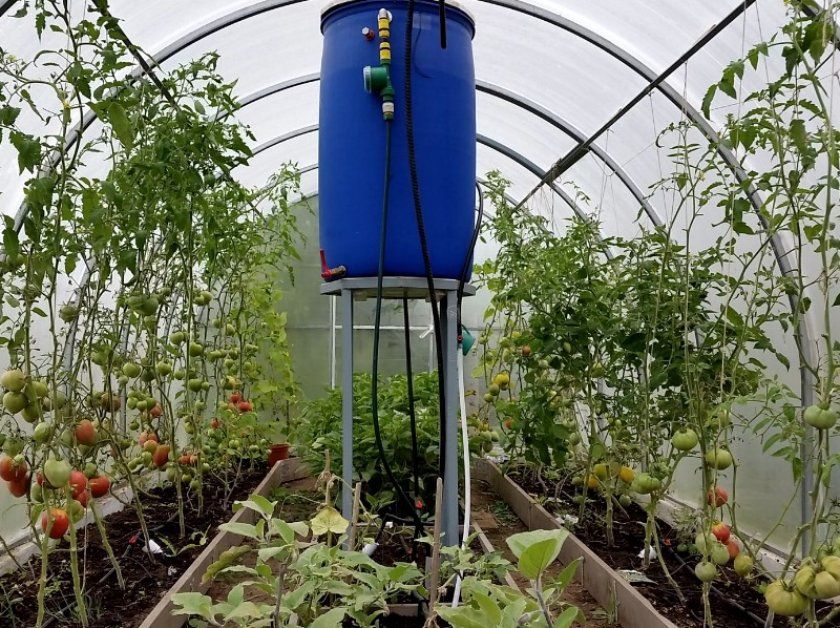
- The barrel (up to 200 liters) is raised up to 2 meters above the ground. Holes are made in the lid to allow air to enter. If there is no lid, cover it with gauze to protect it from insects and dirt.
- A hole is drilled near the bottom, a tap-tip is installed and a hose is connected.
- The main lines are installed at a slight incline—about 5 cm per meter. Additional stakes are used for this purpose.
- Pipes (hoses) are not made long—it's better to build several systems. They are laid out carefully, without being dragged or pulled.
- Ensure precise pipe connections by placing them in a vice before cutting. Seal with tow or fum tape. All connecting elements fit very tightly.
- The holes are made small (no larger than 2 mm). An awl or nail will do for the hose, and a drill for PVC pipes. Inserting pieces of wire will allow water to drain through them.
- In purchased devices there are colored marks - they are located upwards.
- The main hose is secured with a clamp. The lines are flushed to prevent clogs, and a wooden plug is inserted.
- They check that the water reaches each dripper and the soil is moistened evenly.
Calculation of irrigation time and volume of supplied liquid
The system design allows for calculating water flow and tank volume. Example calculations:
- highways - 15 m;
- between nozzles - 20 cm;
- the required number of droppers is 1500/20=75 pcs.;
- consumption of one is 2 liters per hour;
- all nozzles - 2*75=150 l;
- barrel size - 150.
A long system will require a larger capacity, so several devices are usually made.
Individual watering times are calculated for each plant. A device that uses 2 liters per hour includes:
- cucumbers - for 60 minutes;
- tomatoes - 45 min;
- cabbage - 75 min.
DIY drip irrigation system using plastic bottles
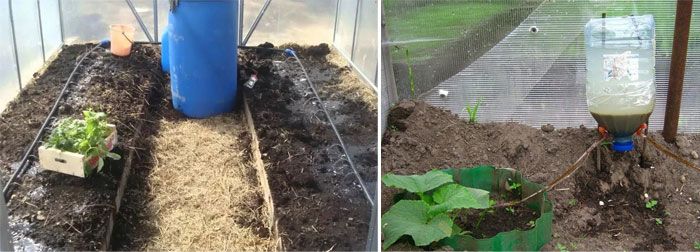
For a small area, the simplest system made from ordinary plastic bottles will do.
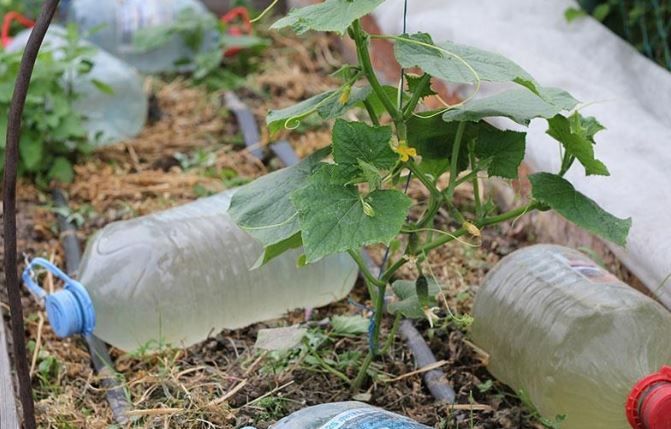
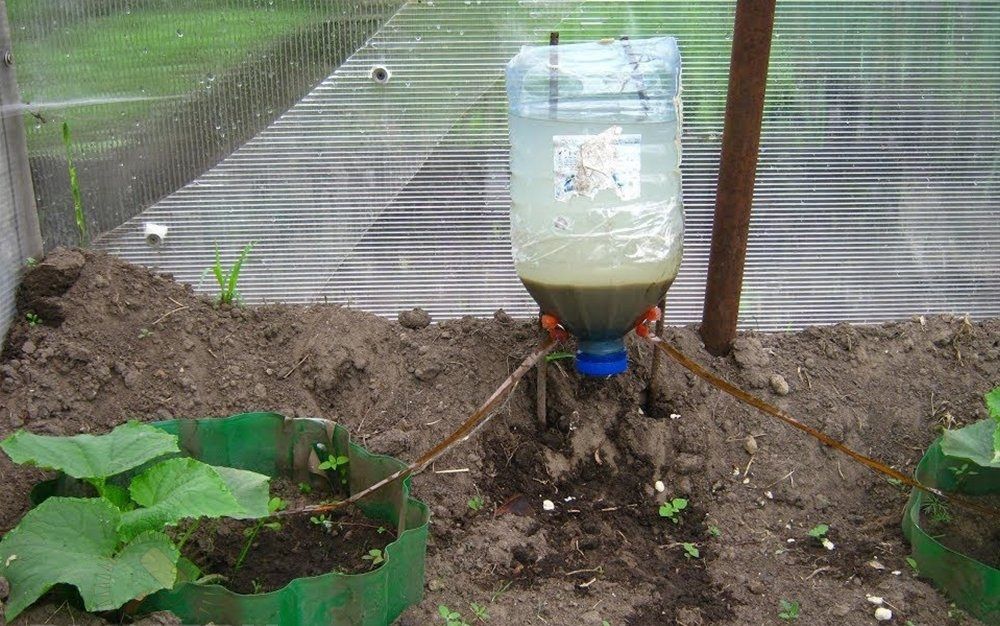
They are hung on a peg with the neck down, and a narrow tube or simply a ballpoint pen refill is inserted into it. A hole for air to escape is essential.
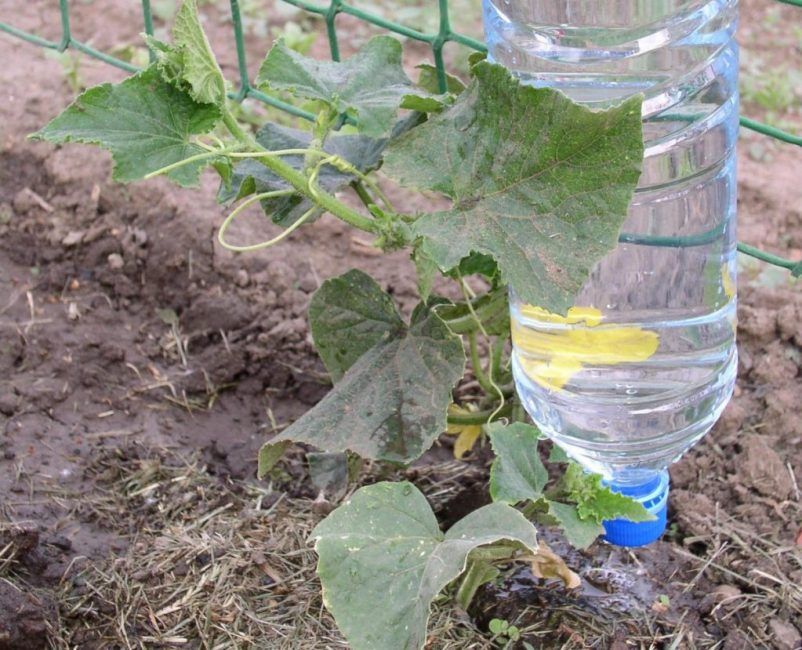
The second option is to drill holes in the bottom. It's important to consider the soil type and its ability to absorb moisture, as this determines the number of holes:
- sandy - 8;
- clay -12.
They're small enough to prevent the liquid from leaking out too quickly. You can make them with a needle.
A simple option is subsurface watering: the bottle is buried in the ground, leaving the neck above the surface. As the water level drops, more is added. The advantage of this method is that there's no crust on the surface to loosen. For example, in a greenhouse, one tomato plant will need only 1 liter of water for 7 days.
Holes quickly become clogged if the soil contains clay. To prevent this:
- put on regular nylon tights on the part of the container with holes;
- They make a small drainage by placing burlap or grass in the hole before burying it.
This is a good idea for people who are often away. The bottle is placed in the ground at an angle of 30-45° to reduce the water pressure and the rate of its use.
Automation of drip irrigation
A drip irrigation system can be automated so that it automatically turns on at a specific time, without human intervention. This is accomplished using a special device called a controller (or timer).
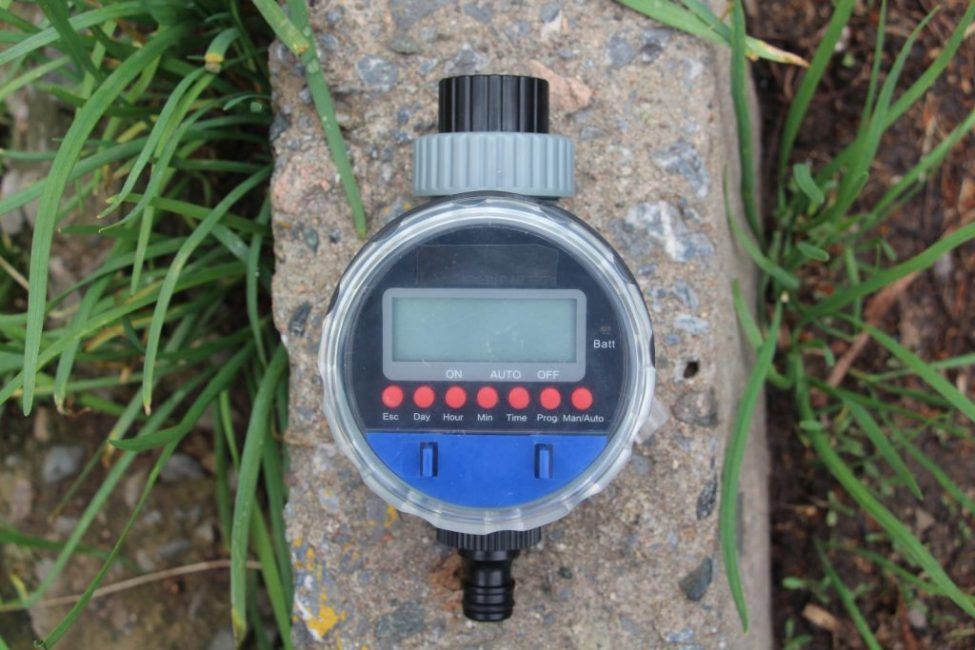
The controller, which has fittings on both ends, is inserted into the drip irrigation system. It can also be used to control water intake when connected to a pump.
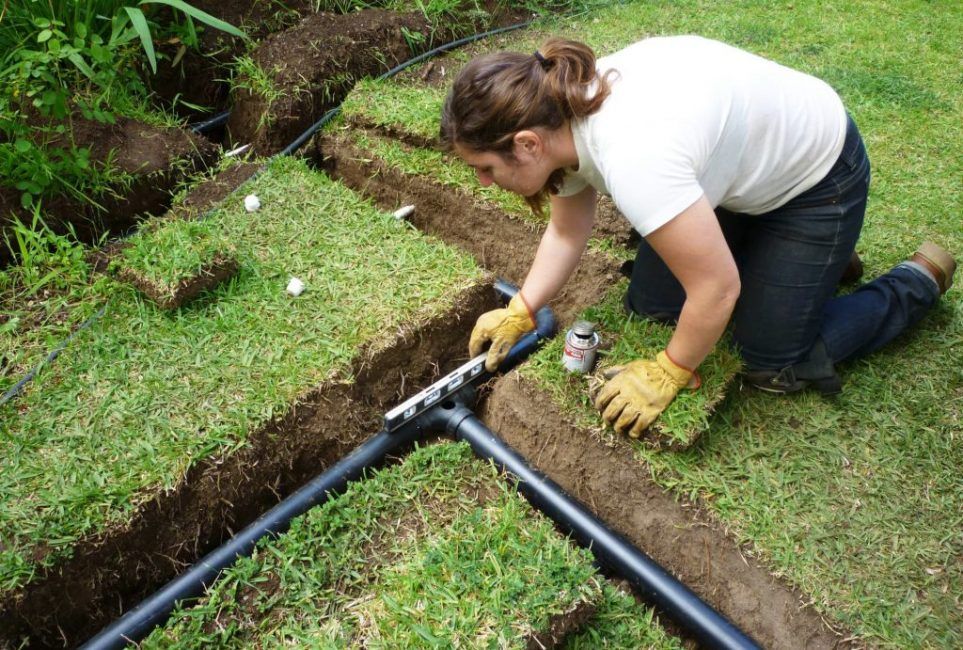
It is possible to install underground irrigation - this drip irrigation is distinguished by the laying of the pipeline, which is placed at a depth.
DIY drip irrigation for indoor plants
When you're away for an extended period, a drip irrigation system can be useful for houseplants. You can choose one at the store. For example, there's a special polymer that retains and then releases liquid.
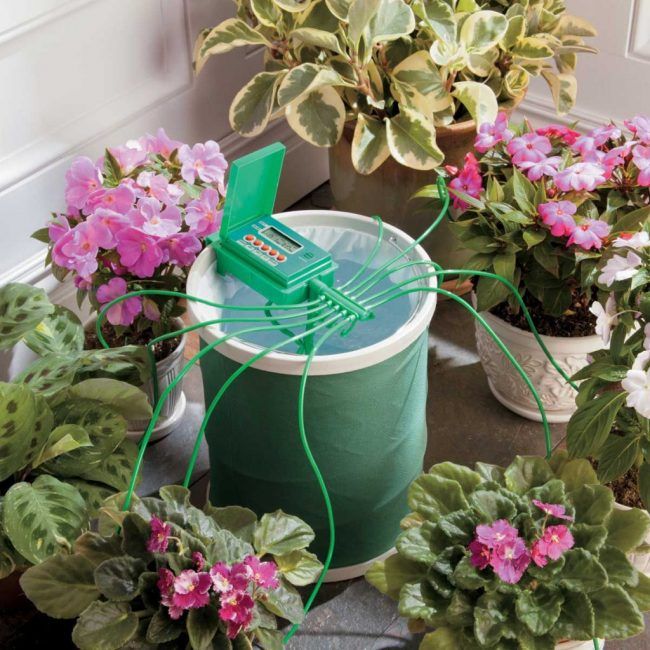
But you can also make your own drip irrigation system for indoor plants. Here are a few simple ideas:
Take a plastic bottle and attach a dropper and silicone tubing. Close the end and poke holes along the entire length.
Wick watering: A container of water is placed next to the pot. A wick is dipped into the container with one end and buried in the soil with the other. This method is suitable for porous soil. It is not suitable for tall plants, as their roots are large and the water received will be insufficient.
Be sure to check the operation of the system and the rate of water consumption before leaving.
Review of ready-made drip irrigation systems
Many gardeners prefer to build their own drip irrigation system, but this is generally only suitable for smaller plantings. It's much more reliable and convenient to purchase a ready-made drip irrigation system that will last for years.
We offer an overview of the most popular systems to help you decide on the model and configuration.
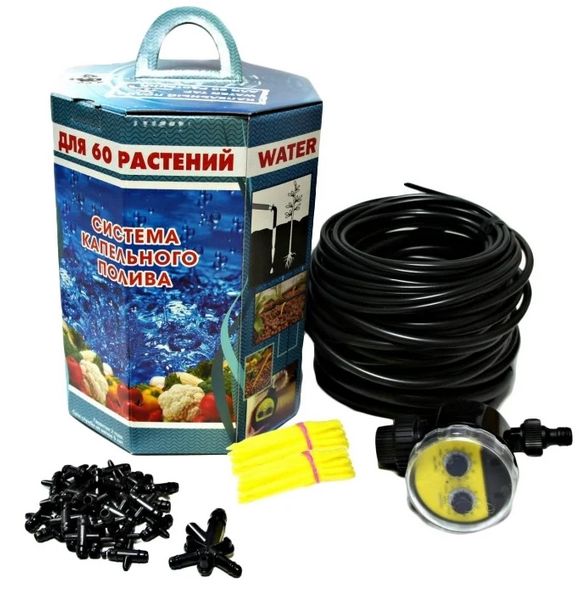
"Bug"
The system takes its name from the beetle's appearance—a long hose-like body and multiple dripper arms arranged symmetrically. The manufacturer offers two types of systems, designed specifically for greenhouses and hothouses.
You'll have to assemble the structure yourself, using an awl to make holes in the main hose where the drippers will be inserted. However, doing this without additional lubrication is quite challenging.
Each kit includes a special filter that prevents soil and sand from clogging the irrigation holes, but the timer is purchased separately and costs 2,186 rubles with a discount on the store's official website.
The "Zhuk" system is available for both water intake from fixed tanks and from the mains. The system operates well even at low pressure. The tank-mounted system comes with a transparent tube that allows you to monitor the water level in the tank.
The manufacturer offers a choice of systems for 20, 30, and 60 plants, but, as practice shows, even the Beetle 30 is too small even for a classic greenhouse, and we will not even consider the 20, although its price on the official website is only 623 rubles.
Many gardeners note that the quality of the plastic leaves much to be desired, with leaks at the connections and the timer having to be hidden in plastic to prevent water from getting inside. The kit also includes plugs that allow you to adjust the water flow direction and perform selective watering, as well as a nipple that allows you to connect the system to virtually any container you'll use as a water source. The water storage tank should be 1-2 meters above ground level.
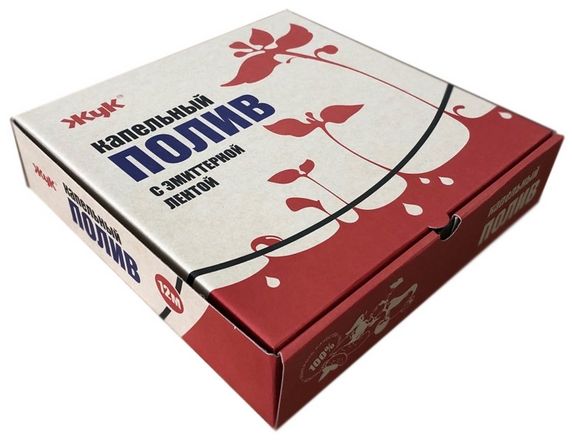
Drip irrigation system "ZHUK" with emitter tape There are 12 and 24 meters. Let's look at them in more detail in the table.
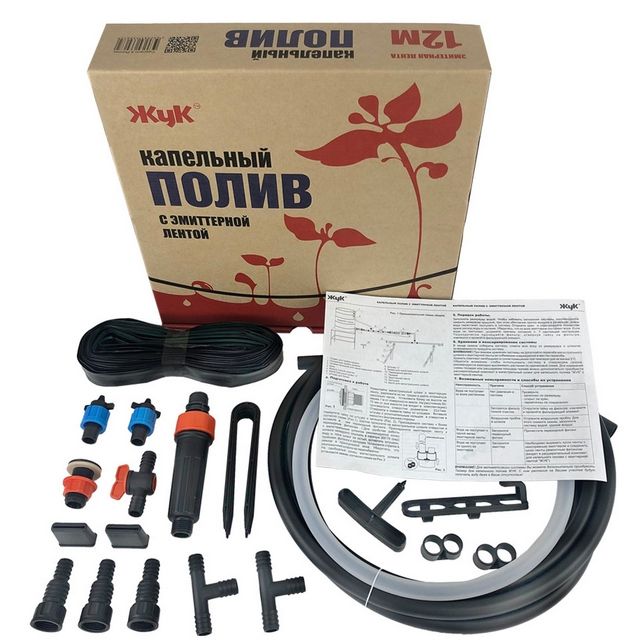
These types are suitable for beginners, their size is a bit small.
| System type | 12 meters | 24 meters | |
| Equipment | Main hose, m. | 4 | 6 |
| Connection nipple to tank, pcs. | 1 | ||
| Nipple 1/2-3/4, pcs. | 3 | ||
| Large tee, pcs. | 2 | ||
| Transparent level tube, m. | 1 | ||
| Suspension for level tube, pcs. | 1 | ||
| Clamp for main hose, pcs. | 2 | ||
| Awl, pcs. | 1 | ||
| Fine filter, pcs. | 1 | ||
| Crane, pcs. | 1 | ||
| Clamp for main hose, pcs. | 4 | 8 | |
| Emitter tape, m. | 12 | 24 | |
| Starting fitting, pcs. | 2 | 4 | |
| Drip tape plug, pcs. | 2 | 4 | |
| Working pressure in the system | 0.1 - 1 atm | ||
| Thickness of the emitter tape walls | 0.15 mm | ||
| Distance between emitters | 30 cm | ||
| Water consumption per emitter | 1.6 l/h | ||
| Price, RUB | 691 | 913 | |
Now let's look at Beetle systems from the water supply:
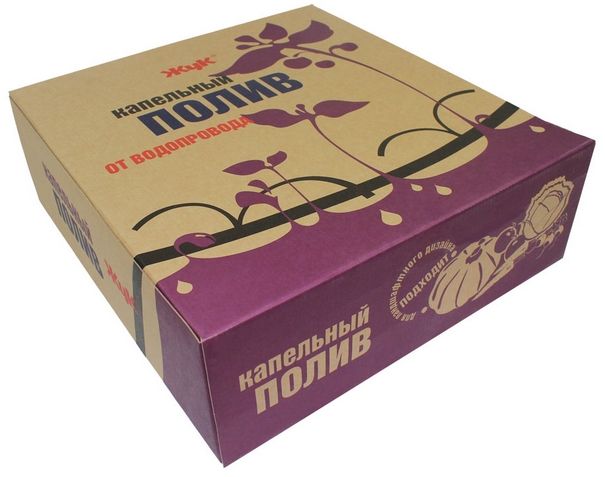
| System type | 30 plants | 60 plants | |
| Equipment | Main hose, m. | 9 | 18 |
| Microtube, pcs. | 30 | 60 | |
| Collet tee 1/2, pcs. | 1 | ||
| Collet chuck 1/2, pcs. | 3 | ||
| Collet corner 1/2, pcs. | 2 | ||
| Compensated drip, pcs. | 31 | 61 | |
| Arrow with clamp, pcs. | 30 | 60 | |
| Fine filter, pcs. | 1 | ||
| Clamp for main hose, pcs. | 2 | ||
| Clamp for main hose, pcs. | 8 | 16 | |
| Awl for main hose, pcs. | 1 | ||
| Irrigation area (sq.m.) | 6 | 18 | |
| Price, RUB | 1370 | 1923 | |
| Price with timer, RUB. | 3389 | 3942 | |
Now let's look at systems, which work from capacity:
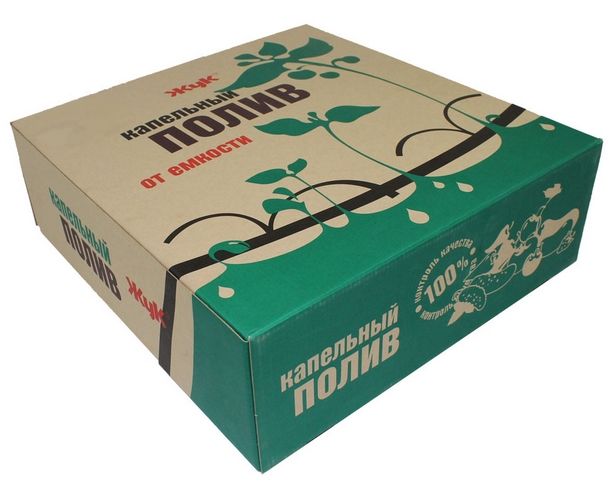
| System type | 30 plants | 60 plants | |
| Equipment | Connection nipple to tank, pcs. | 1 | |
| Main hose, m. | 9 | 18 | |
| Transparent level tube, m. | 1 | ||
| Suspension for level tube, pcs. | 1 | ||
| Supply hose 40 cm, pcs. | 30 | 60 | |
| Droppers, pcs. | 30 | 60 | |
| Small tee, pcs. | 15 | 30 | |
| Crane, pcs. | 1 | 3 | |
| Corner for main hose, pcs. | 2 | 3 | |
| Large tee, pcs. | 2 | 3 | |
| Plug for main hose, pcs. | 2 | 3 | |
| Clamp for main hose, pcs. | 16 | 18 | |
| Awl for main hose, pcs. | 1 | ||
| 1/2″ nipple (for connection to tank), pcs. | 1 | ||
| 3/4 nipple (for filter mounting), pcs. | 2 | ||
| Fine filter, pcs. | 1 | ||
| Irrigation area (sq.m.) | 6 | 18 | |
| Price, RUB | 1231 | 1785 | |
| Price with timer, RUB. | 3251 | 3804 | |
Watch the video about the product:
Both types, from a water supply and a tank, have the same advantages and disadvantages:
| Advantages | Easy installation, including mounts for securing the central hose to the ground. Clear instructions, sufficient quantity of all components. The system is expandable without limitation. |
| Flaws | A timer is included in the kit for an additional fee, costing approximately 2,000 rubles. Inserting the droppers into the tube requires additional lubrication. The material is not of the highest quality. |
For those summer residents who find the number of elements in the kit insufficient as they use it, the manufacturer suggests purchasing Expansion kit for drip irrigation from a tank and from a water supply Beetle 20 plants. The only thing to consider is that when expanding the drip irrigation system, the water tank must be raised even higher, since the load on it has become greater (in the case of using a tank-based system).
Overview of the two types in tables:
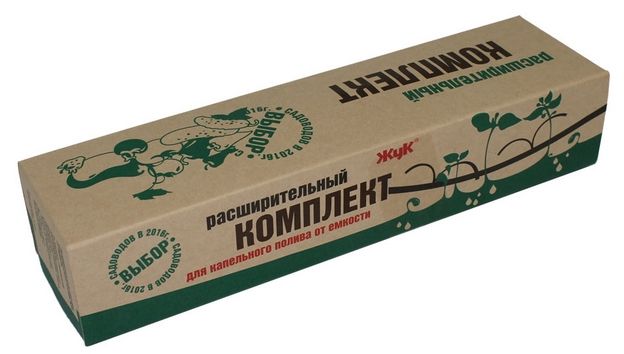
| Type of expander | From capacityAnd | |
| Equipment | Supply hose 40 cm, pcs. | 20 |
| Droppers, pcs. | 20 | |
| Small tee, pcs. | 10 | |
| Crane, pcs. | 3 | |
| Corner for main hose, pcs. | 5 | |
| Large tee, pcs. | 5 | |
| Plug for main hose, pcs. | 5 | |
| Clamp for main hose, pcs. | 20 | |
| Corner for main hose, pcs. | 2 | |
| Large tee, pcs. | 2 | |
| Plug for main hose, pcs. | 2 | |
| Clamp for main hose, pcs. | 18 | |
| Type of droppers | IV drips | |
| Water consumption of the dripper | 4 l/h | |
| Working pressure in the system | From 0.1 to 0.2 atm. | |
| Price, RUB | 443 | |
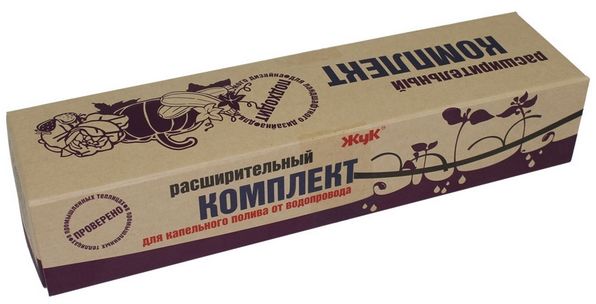
| Type of expander | From the water supply | |
| Equipment | Microtube, pcs. | 20 |
| Arrow with clamp, pcs. | 20 | |
| Compensated dripper 4 l/h, pcs. | 20 | |
| Collet tee 1/2, pcs. | 1 | |
| Collet angle, pcs. | 1 | |
| Clamp for main hose, pcs. | 2 | |
| Ground pressure, pcs. | 8 | |
| Type of droppers | Dr.Drop Compensated IVs | |
| Water consumption of the dripper | 4 l/h | |
| Working pressure in the system | From 1 to 4 atm. | |
| Price, RUB | 623 | |
You can also purchase separately:
- Main hose 20 m. – 567 rub.
- Coupling coupling 1/2 — 1/2 – 40 rub.
- Collet corner 1/2 – 43 rub.
- Collet tee 1/2 - 1/2 - 1/2 - 63 rub.
- Watering filter – 239 rubles.
- Barrel nipple – 87 rubles.
- Clamps for main hose (2 pcs.) – 54 RUR.
- Clamps for main hose (4 pcs.) – 21 rub.
- Awl for main hose (1 pc.) – 53 RUR.
- Drip irrigation arrows from a container (10 pcs.) – 110 rubles.
- Large tee for drip irrigation from a 1/2″ container (5 pcs. per pack) – 59 rubles.
- Supply hoses for drip irrigation from a container (4 m in a coil) – 176 rubles.
- Corner for drip irrigation from a 1/2″ container (5 pcs. per pack) – 53 rubles.
- Small tees for drip irrigation from a container (5 pcs. per package) – 26 rubles.
- Set of 1/2-3/4 nozzles for watering from a container (2 pcs. per package) – 54 rubles.
- Drip irrigation tap for a container (1 piece per package) – 87 rubles.
- Compensated drippers for drip irrigation from a water supply (10 pcs. per package) – 365 rubles.
- Arrow with clamp for drip irrigation from a water supply system (10 pcs. per package) – 130 rubles.
- Microtube for drip irrigation from a water supply system (10 pcs. per pack) – 143 rubles.
Website: firma-tsikl.rf
AquaDusya
The Belarusian manufacturer offers two versions of the universal "AkvaDusya" drip irrigation system: for 50 and 60 plants. There are kits without automatic controls, and there are automatic systems that allow you to forget about watering your garden beds for the season. All automatic components are battery-powered, so there's no need to worry about power surges.
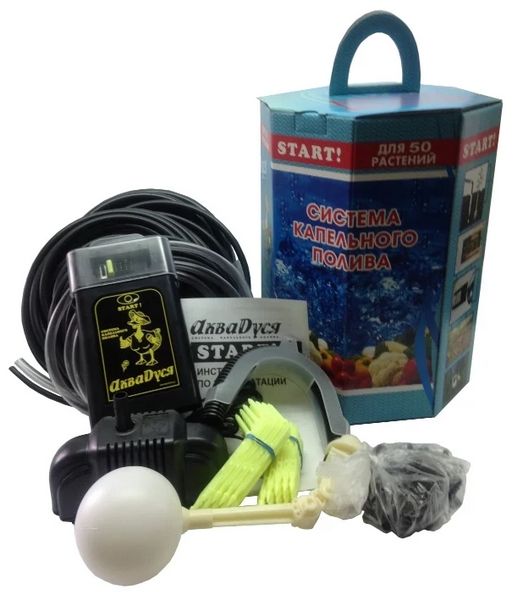
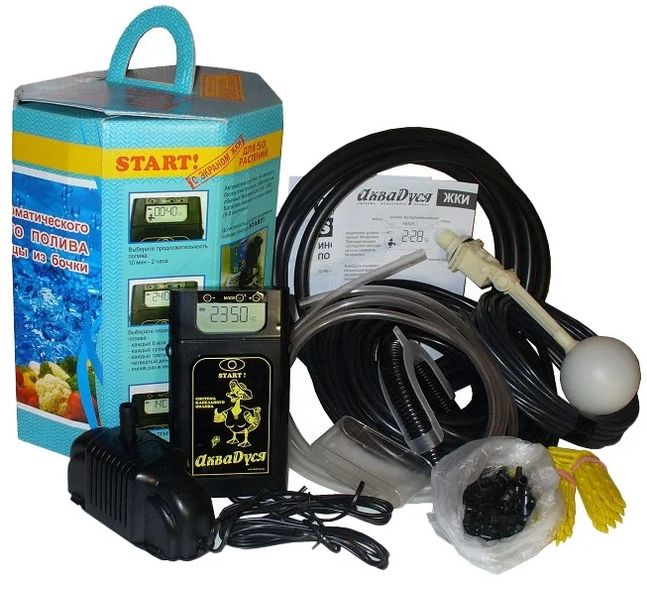
The kit is quite complete. All you need to do is select the barrel and raise it 20 cm from the ground for the Start +50 and 3 m for the AquaDusya WATER TAP. The main advantage of the system, noted by all users, is its long service life and the reliability of its components.
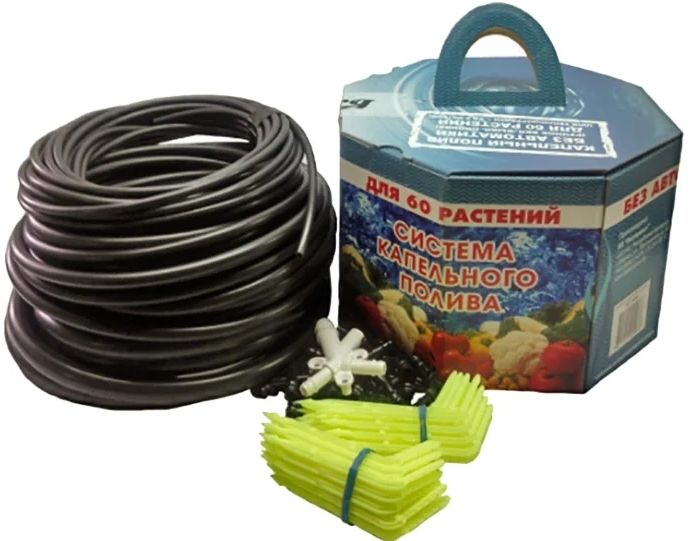
| System type | Start +50 | Start LCD | AquaDusya +60 | AquaDusya WATER TAR | |
| Hose length, m. | 15 | 12 | 15 | ||
| Equipment | Hose 7/9 mm, m. | 2 | — | — | |
| Supply hose 7/9 mm, m. | 15 | 12 | 15 | ||
| Hose 12/15 mm, m. | 2.5 | 3 | — | — | |
| Hose 14/12 mm, m. | — | 3 | |||
| Hose 4/6 mm, m. | 10 | 12 | |||
| Droppers, pcs. | 50 | (compact) 60 | |||
| Large tee, pcs. | 1 | ||||
| Small tee, pcs. | 25 | 30 | |||
| Hose clamps, pcs. | 4 | — | — | ||
| Pump block, pcs. | 1 | — | — | ||
| Electronic starting device, pcs. | 1 | — | — | ||
| Corrugated protective tube, pcs. | 1 | — | — | ||
| Bracket, pcs. | 1 | — | — | ||
| Faucet timer, pcs. | — | — | 1 | ||
| Water intake | From the container | From a container, from a water supply | |||
| Irrigation area, sq.m. | 18 | 21 | |||
| Water consumption | 200 l/h | 125 l/h | — | — | |
| Timer | + | — | + | + | |
| Water flow regulator | + | — | — | — | |
| Connector for connection | + | + | + | + | |
| Watering mode | Every 6/12/24 hours, every 3, 4 days, once a week | — | Every 6/12/24 hours, every 3, 4 days, once a week | ||
| Lifting the container | 20 cm. | 2.5 m. | 3 m. | ||
| Water consumption per dripper | 4 liters | 2.5 liters | — | — | |
| Distance between holes | — | — | — | 40 mm. | |
| Maximum pressure | — | — | — | 4 bar | |
| Price, RUB | 5000 | 5500 | 1800 | 3100 | |
| Advantages | An automatic controller, reliable, designed for multiple plantings. They now offer a Start version for 70 plants, expandable to 100. | Budget price, long service life | You can set launch intervals by day or hour. The design is robust and can be used for underground installations. A more modern model, the Water Tap 2, has been released. | ||
| Flaws | There is no possibility to connect to the water supply, not enough hoses, price. | No automation, no connection to the water supply | There may not be enough hoses for a large area; you will have to purchase them additionally. | ||
The Origin of the CPC
The Samara drip irrigation system is designed to collect water from a tank or water supply. It includes drip tape and mounting fittings, while the more modern KPK 24K version is equipped with a controller for automatic irrigation, powered by three AA batteries. You can choose from 16 preset programs and place the drip tape either above or below the soil.
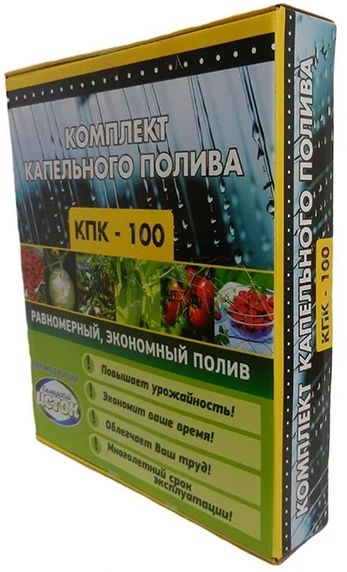
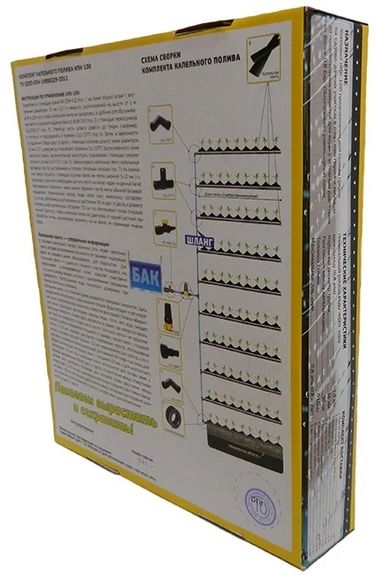
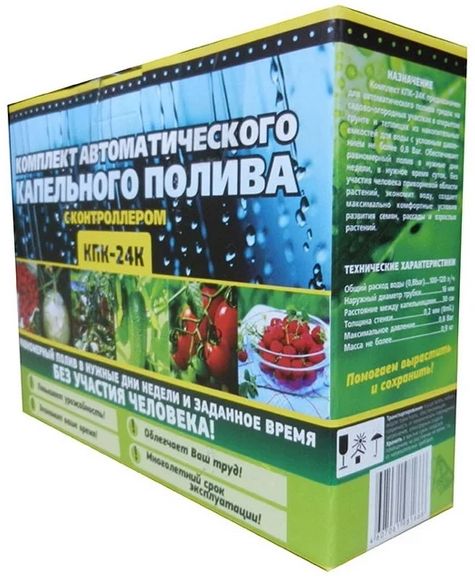
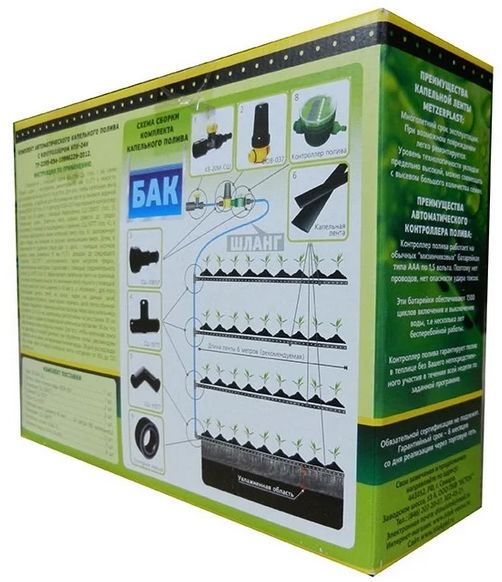
| System type | Istok KPK-100 | Istok KPK-24/24K | |
| Length of drip tape, m. | 100 | 25 | |
| Equipment | Water tap, pcs. | 1 | Tape, fittings, filter/controller |
| Reusable water purification filter, pcs. | 1 | — | |
| Adapters, pcs. | 4 | 2 | |
| Tees, pcs. | 9 | 3 | |
| Corners, pcs. | 2 | 1 | |
| Drip tape emitter type 16 mm, m. | 100 | 25 | |
| Retaining ring, pcs. | 11 | 4 | |
| Sealing ring | 1 | — | |
| Adapter, pcs. | — | 1 | |
| Irrigation controller, pcs. | — | 1 (only 24K) | |
| Water intake | From a container, water supply | From the container | |
| Irrigation area | 100 sq.m. | 25 sq.m. | |
| Watering range | — | 0.3 m | |
| Water consumption | 1.4 l/h | ||
| Distance between holes | 300 mm | ||
| Connector for connection | + | + | |
| Timer | — | + | |
| Lifting the container | Not less than 1 m. | 8 m. | |
| Maximum pressure | 0.8 atm. | ||
| Price, RUB | From 2000 | From 1000 | |
| Advantages | Large area, easy installation. | Affordable price, with the option to purchase a controller (approximately 2,000 rubles). Designed for 83 plants. | |
| Flaws | There is no possibility to connect to the water supply in the basic configuration. | ||
Water meter
A Dubna-based manufacturer offers two system options: Vodomerka-Eco (a budget-friendly irrigation option) and Vodomerka. The difference is that the latter has a battery-powered controller, allowing for automated system operation without human intervention.
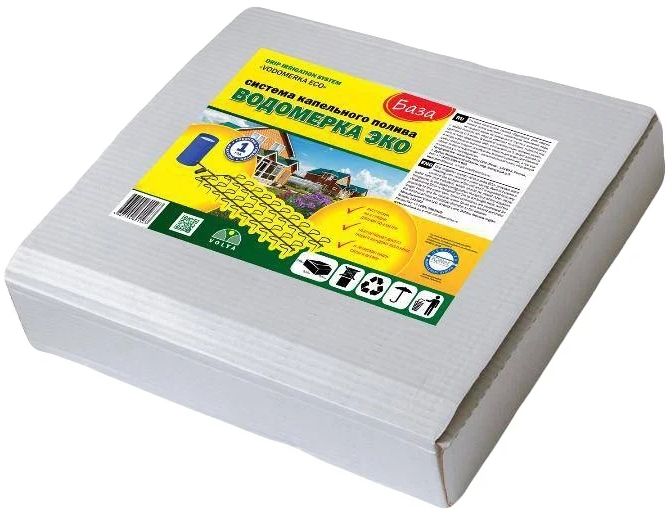
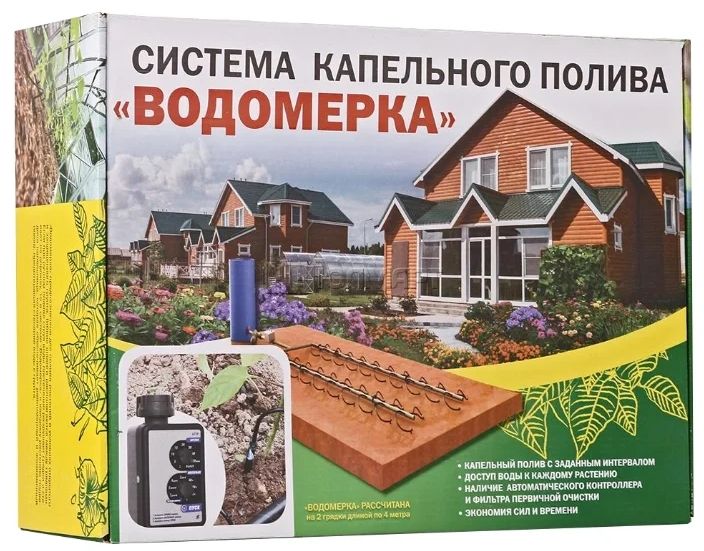
This design only works with a container; connection to a water supply is not possible. According to gardeners, the water barrel should be plastic for ease of installation. Raising the container approximately 50 cm above ground level is essential.
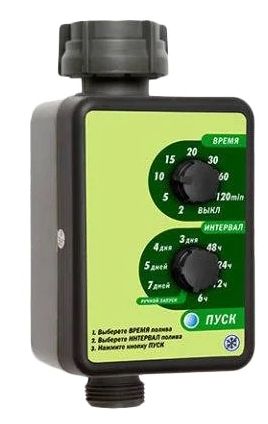
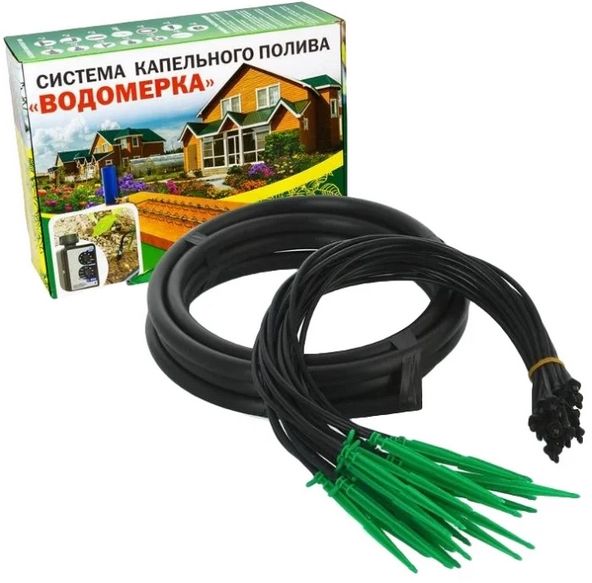
Another advantage of this system is the use of a ball valve rather than a diaphragm valve, allowing it to operate reliably at any pressure. If needed, the basic version can be supplemented with an extension kit, allowing for an additional 2 meters of garden bed.
| System type | Water strider | Water Strider-Eco | |
| Hose length, m. | 12 | 12 | |
| Equipment | Starting device, pcs. | 1 | — |
| Hose, m. | 12 | ||
| Crane, pcs. | 1 | ||
| Shaped connector, pcs. | 1 | — | |
| L-shaped connector, pcs. | 2 | — | |
| Connector, pcs. | 2 | The set is specified. | |
| Filter, pcs. | 1 | ||
| Hose pegs, pcs. | 4 | — | |
| Hole punch, pcs. | 1 | — | |
| Droppers, pcs. | 40 | ||
| Microtubes 50 cm, pcs. | — | 40 | |
| Water intake | From the container | From the container | |
| Irrigation area, sq.m. | 12 | 12 | |
| Maximum pressure | 1 bar | — | |
| Timer | + | — | |
| Connector for connection | + | + | |
| Watering time | 2-120 min | — | |
| Interval | 6 hours – 7 days | — | |
| Price, RUB | 3000 | 1300 | |
| Advantages | Automatic controller, reliability. | Budget price, long service life | |
| Flaws | There is no way to connect to the water supply, the cost is high, and the fittings only fit plastic barrels. | ||
"Signor Tomato"
The manufacturer, Krovstroy LLC, has developed several configuration options for the same "Signor Tomato" drip irrigation system.
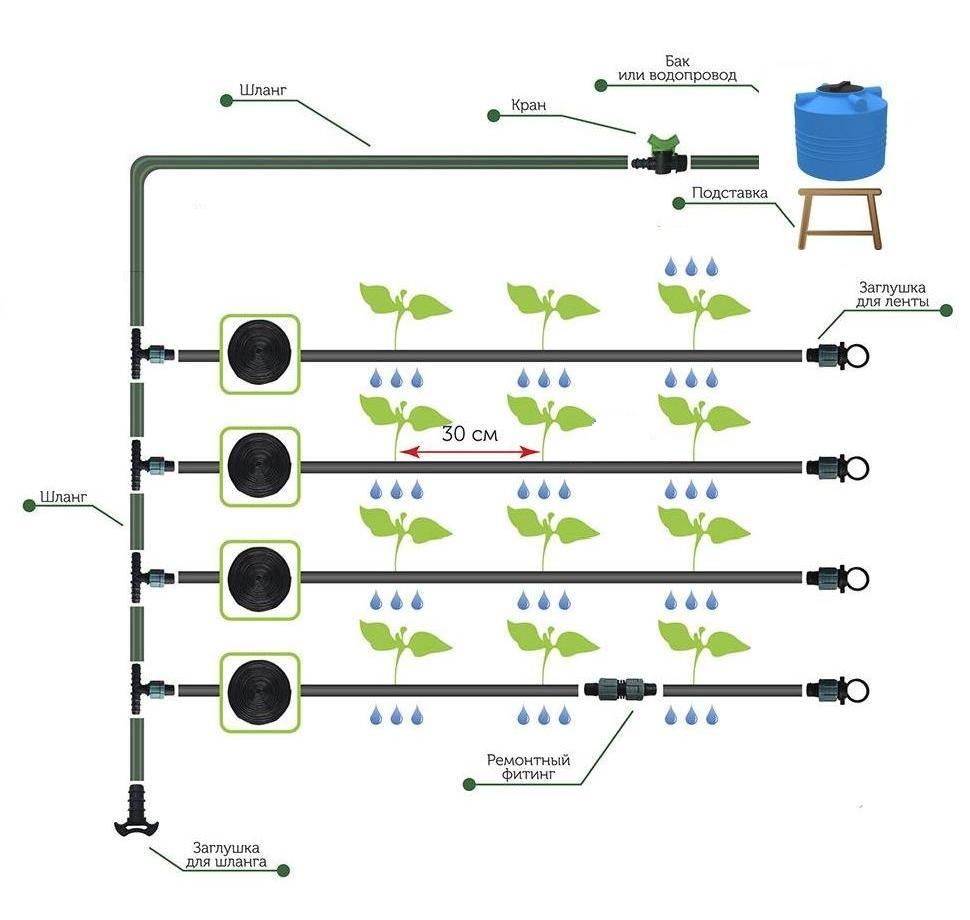
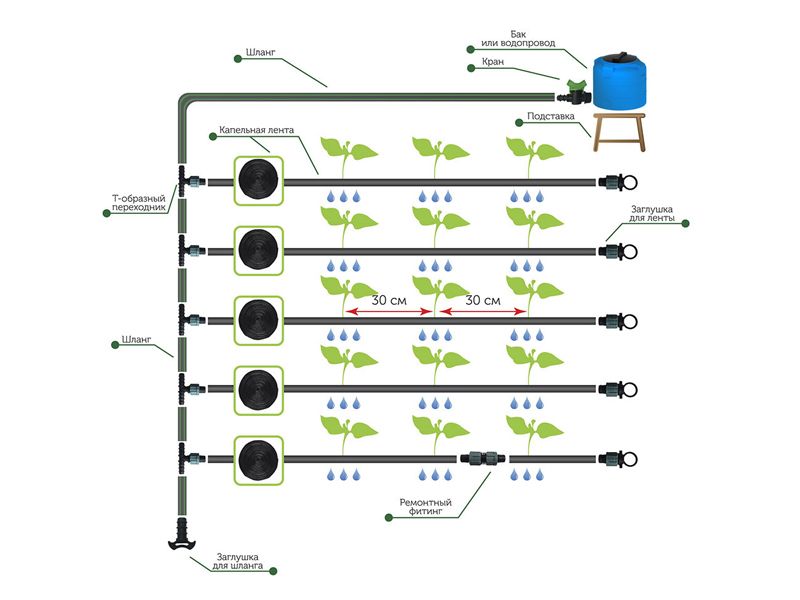
The simplest option is emitter tape and fittings. Lengths range from 24 to 100 meters. This system is attached to a raised barrel, and the tape itself is placed on the ground.
Another kit option includes, instead of tape, a drip line with hose splitters, suitable for 60 plants. A timer can be purchased separately.
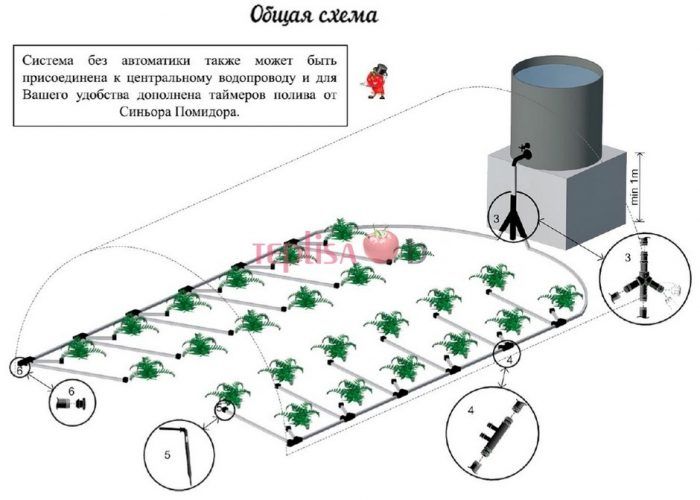
The most modern version of the "Signor Tomato" system to date is a fully automated, solar-powered drip irrigation system. It also comes with a submersible pump, eliminating the need to raise the water tank above ground level.
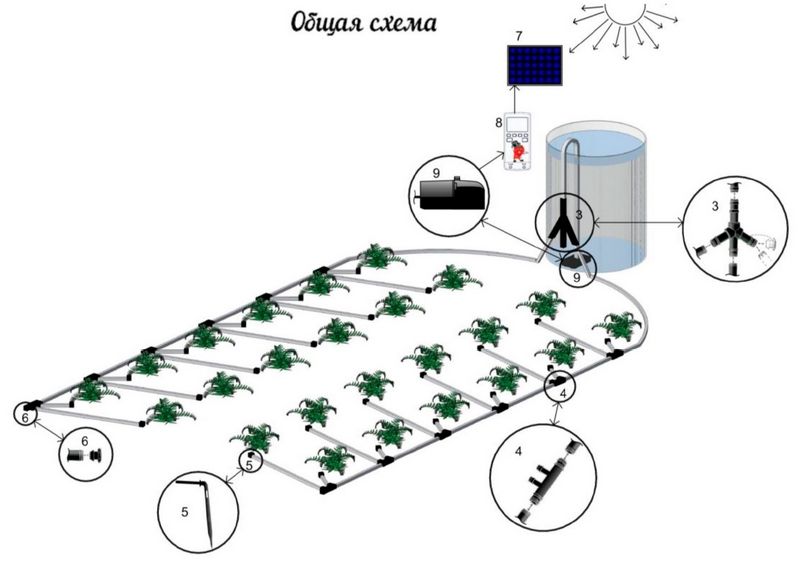
First, let's look at the types in the table. "Signor Tomato Eco":
| System type | 24 meters | 50 meters | 100 meters | |
| Emitter tape, m. | 24 | 50 | 100 | |
| Equipment | Emitter type tape | 1 | ||
| Tap | 1 | |||
| Tee for irrigation tape, pcs. | 4 | 5 | ||
| Tape plug, pcs. | 4 | 5 | ||
| Repair fitting, pcs. | 1 | 2 | ||
| Hose plug, pcs. | 1 | |||
| Water intake | From the container | From the container | — | |
| Price, RUB | From 650 | From 950 | From 1350 | |
| Advantages |
Easy to install. Budget price, long service life with proper care. |
|||
| Flaws | At the end of the season it requires washing and blowing out, and needs to be stored properly. | |||
Other more expensive options:
| System type | Signor Tomato 60 | Mr. Tomato Machine | |
| Equipment | Supply hose 7/9 mm, m. | 18 | |
| Hose for drippers 4/6 mm, m. | 12 | 17 | |
| Large branch pipe with plug, pcs. | 1 | ||
| Small splitter, pcs. | 3 | 30 | |
| IV drip, pcs. | 60 | ||
| Barrel insert, pcs. | 1 | — | |
| Adapter for cutting in, pcs. | 1 | — | |
| Plug for supply hose, pcs. | 3 | ||
| Solar battery | — | 1 | |
| Controller | — | 1 | |
| power unit | — | 1 | |
| Pump | — | 1 | |
| Price, RUB | 1600 | 5900 | |
| Advantages | Reliable design, long service life, and the option to purchase an additional timer | A completely autonomous system, powered by a solar panel and equipped with a pump. | |
| Flaws | Price | ||
Website: signor-pomidor.rf
"Drop"
This drip irrigation system consists of an emitter tape with a complex arrangement of drippers inside. It virtually eliminates clogging when watering from a container or water supply, but if you plan to draw water from a well, an additional filter will be required.
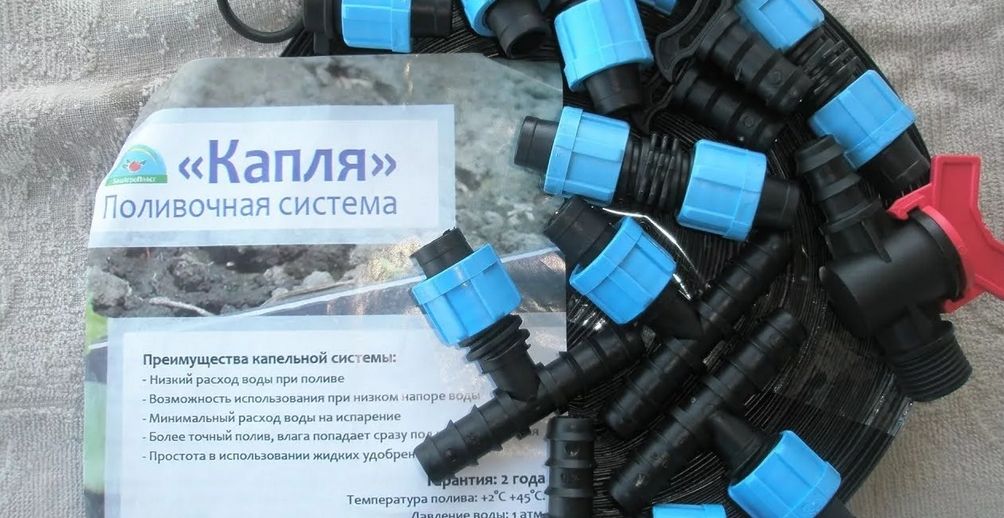
The "Drop" system is manually switched on and off, and the kit includes plugs that allow you to water only selected beds.
The system is additionally equipped with a function that allows adding fertilizers to the water to increase the yield of crops.
The manufacturer offers methods of connection both to the water supply and to a water collection tank.
| System type | Drop | |
| Length of tape | 50 m | |
| Equipment | Drip tape, m. | 50 |
| Tap with 1/2″ external thread for hose, pcs. | 1 | |
| Tees for garden tube and drip tape, pcs. | 4 | |
| Repair connection for drip tape, pcs. | 2 | |
| Plug for garden pipe/hose, pcs. | 1 | |
| Water intake | From a container, water supply, or well. | |
| Maximum pressure | 1 atm. | |
| Irrigation area | 25 sq.m. | |
| Price, RUB | 1399 | |
| Advantages | A variable water intake method, reliable design, easy installation, the ability to add fertilizer to water, and operation at low liquid pressure. | |
| Flaws | There is no controller or filter. | |
Website: bashagroplast.com
How to choose a ready-made drip irrigation system
Gardeners fall into two categories: those who live at their dacha permanently and those who visit only on weekends or less frequently. This fact should be taken into account when choosing a drip irrigation system. If you only get to your dacha a few times a month, consider an automated system, ensuring that the water intake tank automatically refills itself. The tank or barrel where the water enters the system should be located in full sun; freezing watering is harmful to the roots.
The distance between the holes should correspond to the distance between plantings in the greenhouse. A 30 cm spacing is considered optimal for crops commonly found in greenhouses.
The average drip rate for vegetable crops should be 1 to 1.5 liters of water per hour. For trees, this figure is at least double that.
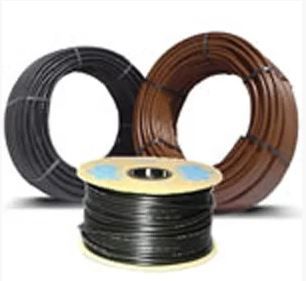
Manufacturers offer three main types of drip irrigation tapes:
- Slotted - inside it there is a branched channel that slows down the speed of water supply, which allows it to warm up evenly and not over-water the plants.
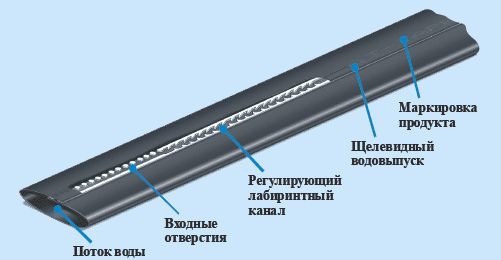
- Emitter tape – flattened drippers are embedded along its entire length. It is the most reliable type of tape available today.
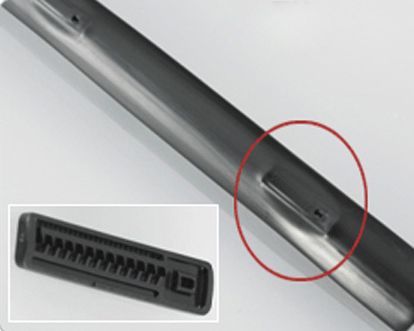
- Labyrinth - is practically never used in modern designs due to its unreliability and painstaking installation.
If a hose, rather than a tape, is used, drippers are used. We discussed the types above.
Advantages and disadvantages of drip systems
The original purpose of drip irrigation was to compensate for insufficient water for plant irrigation. This method was later found to be superior to traditional methods. The following advantages are noted:
- saving water resources - no consumption between rows;
- obtaining early harvests - the development period is reduced, the fruits ripen at the same time;
- saturation of the root system - slow flow of moisture ensures
- faster growth and more nutrients;
- reducing the possibility of soil over-watering - the risk of developing diseases (powdery mildew, various types of rot, black leg, etc.) is reduced;
- no burns on leaves - water goes straight to the roots;
- reduced weed numbers - no excess moisture;
- no risk of soil erosion - best aeration;
- increase in yield by 30-40%;
- application of mineral and organic fertilizers during irrigation.
At first, this system was installed only in greenhouses or hotbeds; later, it began to be used in open areas as well.
However, drip irrigation also has its disadvantages:
- Monitoring the watering system—incorrectly calculating water flow will result in excess moisture and plant death. Monitor the watering system's filling level. Install a timer to ensure automatic watering.
- Cleaning the holes—they become clogged due to their small diameter. Enlarging them is not recommended, as the water will spill out before reaching all the nozzles. A filter (a piece of foam rubber) installed at the beginning of the system is used; it can be removed and washed.
- The barrel and receiver-distributor must be covered to protect against debris and insects.
Types of drip irrigation
Here are some popular options for homemade drip irrigation:
A barrel pump is a tank with long hoses running from it. The tank is raised up to 2 meters above the ground, allowing the liquid to fill all the pipes and reach its intended destination.
Bottled - plastic containers. Small holes (1-3 mm) are made in the bottom, and liquid is added as needed.
Install close to plants.
Droppers - several pieces are fixed on a horizontal peg made of wood, metal or plastic.
The flow of water is regulated by a catheter directed under the root.
Plastic pipes are laid between the rows and connected to a reservoir or central water supply. Holes are drilled close to the stems.
Types of IVs
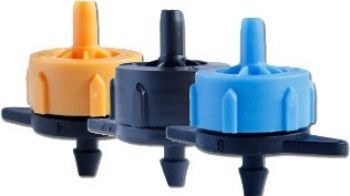
External drippers are specially designed devices for insertion into existing water lines. They terminate in small tubes that allow you to regulate the amount of water supplied.
There are three main groups of droppers, which differ in design.
Adjustable
With actual water consumption. It is installed according to the instructions.
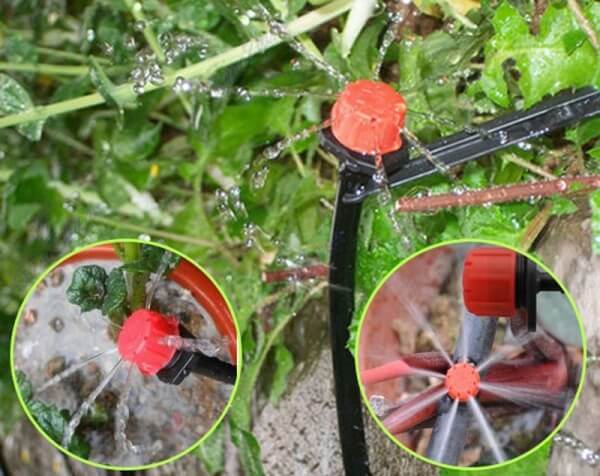
There are also unregulated ones.
Uncompensated
Less water is supplied at the end of the bed than at the beginning. Suitable for level terrain or areas with slight elevation changes.
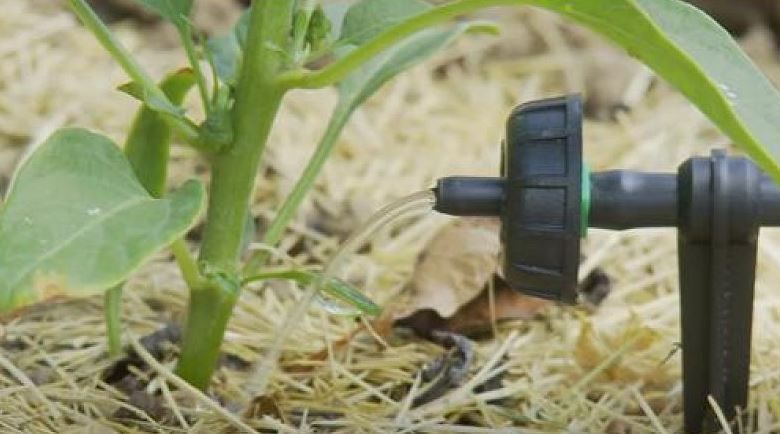
Compensated
They dispense liquid in measured doses (they have a membrane and valve). Ideal for use in areas with varying levels.
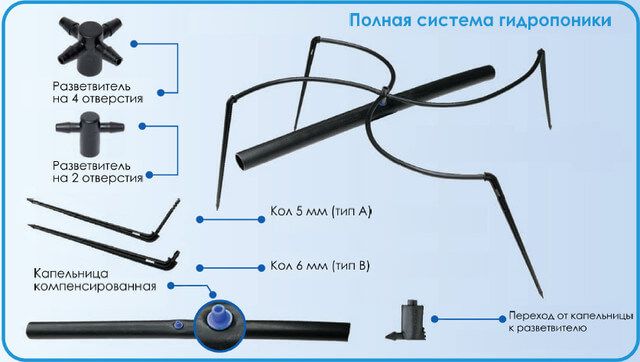
Droppers-spokes, arrows
This is a plastic tube shaped like a stand with channels for water to flow through. It's connected using adapters and branching connectors. Branching connectors are for multiple plants at once (spider).
Anti-drainage
Additionally, drippers can be designed with a non-draining design. Water remains in the system even when the supply is interrupted. This speeds up restarts, as there's no need to remove air.
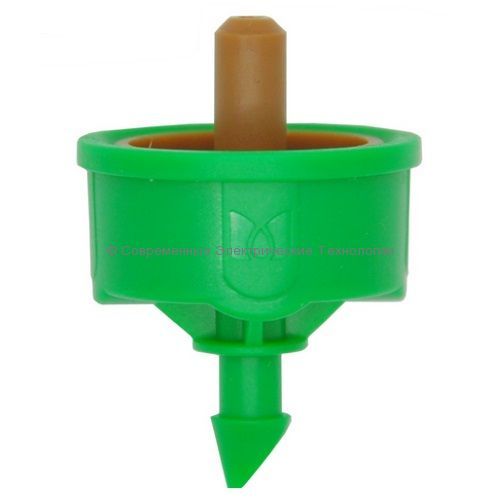
It must be disassemblable. Typically, the lid is removed for cleaning if clogged.
Planting plants with drip irrigation
The creation of a system begins with drawing up a planting plan - a drawing indicating the dimensions of the beds and the intervals between seedlings.
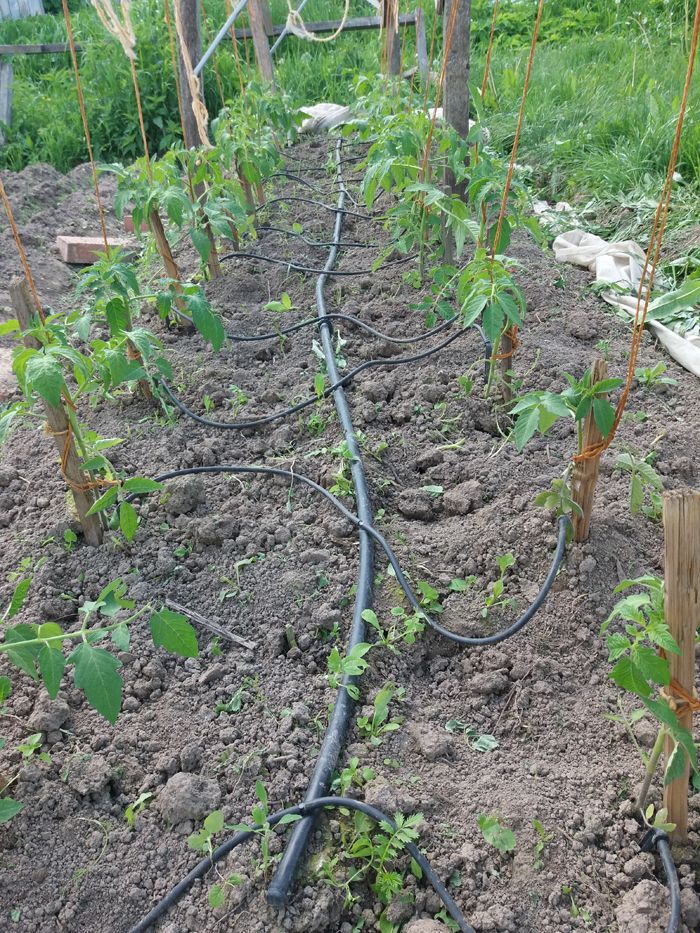
This allows you to take into account all the features, requirements for the amount of water and soil moisture, and calculate the required liquid consumption per day.
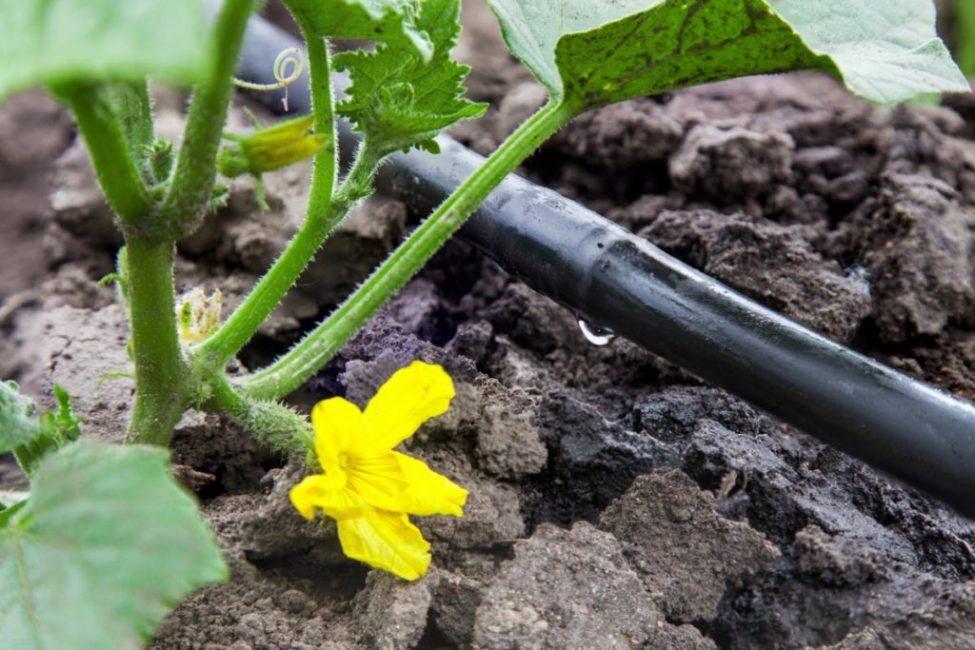
Some parameters are collected in the table:
| Plant | Amount of water per day, l | Distance between bushes, cm |
| tomatoes | 1.5 | 30 |
| cucumbers | 2 | 20 |
| cabbage | 2.5 | 40 |
Nozzles (sprayers) should be located near each plant.


Hello. I'm interested in the products and services on your website.
+7 916 489 35 03 . Alexey