In late spring, certain deviations from normal growth and development may be observed on coniferous trees, most commonly spruce and pine: yellowing and curling needles, and a white fluff covering buds and shoots on branches. This indicates the presence of pests called hermes, which pose a serious threat to the conifers.
What are Hermes?
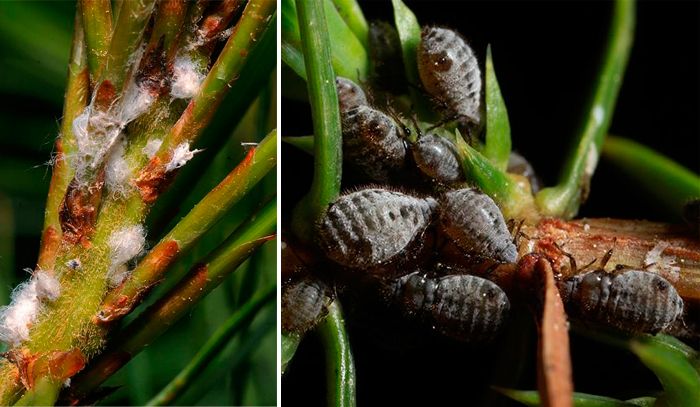
Hermes are very small insects, no more than 2 mm in size, also known as pine aphids. They resemble beetles in appearance. They have an elongated body that is green, brown, or black, and small antennae on their heads. These insects feed on the sap secreted by pine needles and young shoots, and the white fluff on the branches provides a secure shelter, facilitating the reproduction of the larvae.
In summer, coniferous trees infested with hermes become covered with galls – unhealthy growths resembling a pine cone, which actually serve to protect, nurture, and reproduce the larvae.
Symptoms of damage and main types of pests
Hermes are not a single species of harmful sucking insects, but an entire group. The only thing they have in common is that they belong to the order Homoptera and feast on the sap of coniferous trees.
Pests can be migratory, that is, they develop on two plants of different species, and they can also be non-migratory, they choose one species and live on it.
Another characteristic by which pests can be differentiated is their development cycle. Some species develop in one year, while others require as many as two years.
For example:
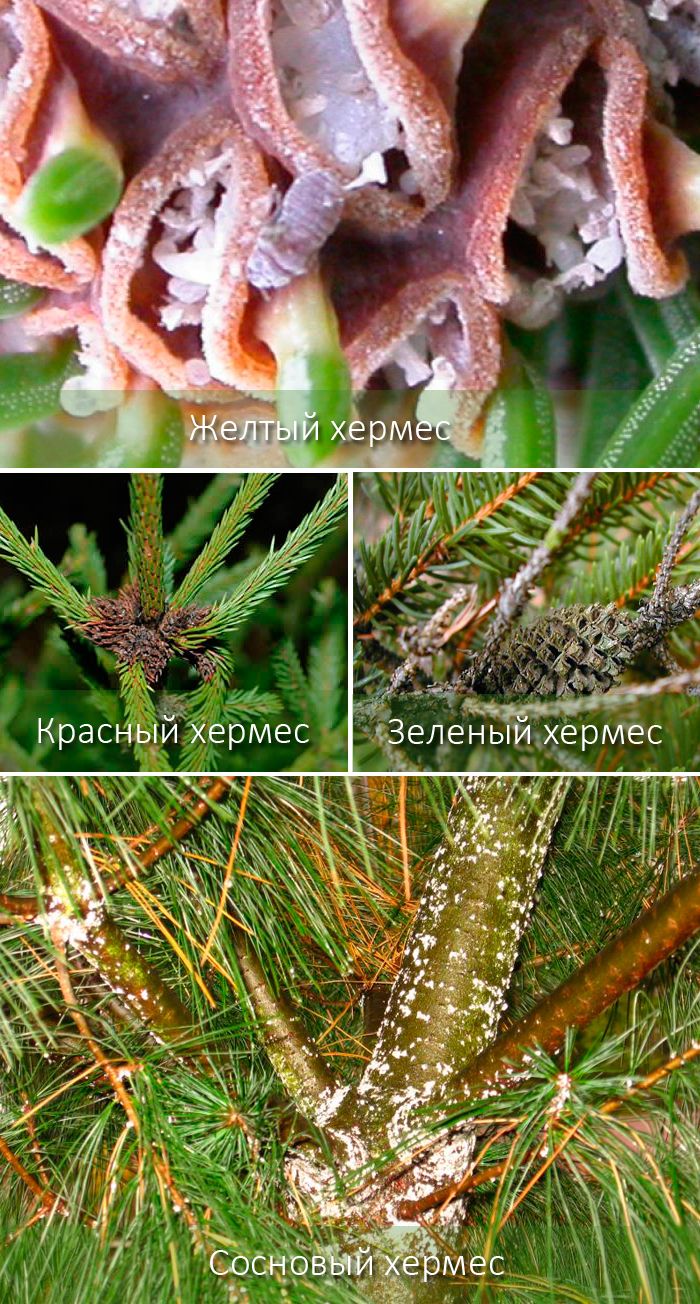
- Yellow hermes. Develops in a single season. Females feed on pine needle sap and, when laying eggs, form a huge gall, sometimes reaching 20 cm.
- The spruce-larch red hermes. Individuals are brown or black. It is a migratory species of conifer parasite, inhabiting spruce and pine trees. Its development period is two years.
- Spruce-larch green hermes. Individuals are mostly light shades of green. They develop over the course of a single season. The female green hermes forms galls in which the larvae develop. In the summer, they metamorphose into winged individuals and fly away to live and reproduce on larch trees. Therefore, this species is also migratory.
- Hermes scaly-leaved pine. A non-migratory species, developing over the course of one or two years.
- Spruce bark borer. These pests live only on spruce trees and do not migrate. They lack wings, live primarily in the bark of branches and trunks, and do not form galls.
Non-fertile females have a white fluffy coat on their bodies, resembling a cotton ball, while fertile females lack it. Hermes are related to aphids, whiteflies, mealybugs, and scale insects.
Despite the microscopic size of the pests, the symptoms of tree disease caused by their activity are visible to the naked eye.
After infestation, spruce trees' needles turn yellow and curl, and when the larvae and adults become too numerous, the needles begin to fall off and galls form. In pine trees, the pests cause crown thinning, sometimes resin leakage, and the tree may die.
Hermes on pine, cedar
The main symptom of a Siberian pine infestation with Hermes is the presence of white fluff on the plant. These white clumps cover shoots, twigs at the base of needles, and, if the pest infestation is severe, even the tree trunk. These fluffy clumps can easily indicate how long the tree has been infested.
Old fluff is very firmly glued to the wood and difficult to remove, but fresh white clumps are easily removed. If you rub them between your hands, you'll find brown spots on the skin—these are crushed larvae, which hide and protect themselves within their soft white shell.
Cedar disease following damage by cedar borers can lead to drying out and death. The needles gradually turn yellow, curl, and fall off. The shoots become smaller and lighter in color with each passing year. The tree's appearance can be used to determine whether it is dying.
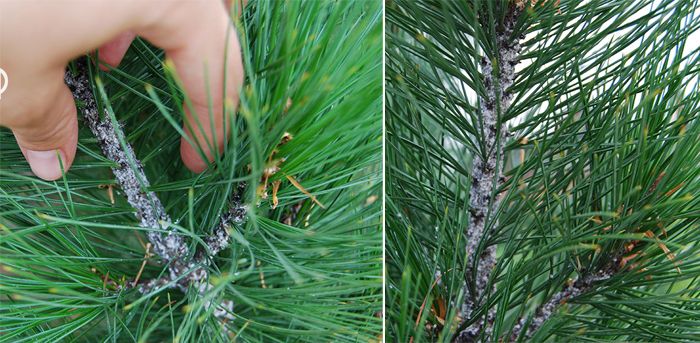
Cedars that grow in favorable soil can resist the disease for a very long time and recover completely within a few years, while trees growing in lowlands, overly wet soil and unfavorable climates often die because they do not have enough strength to fight the pest.
Hermes on fir and larch
The primary signs of sherry blight in fir and larch include a decline in their beauty. The fir's crown thins first, and the needles become reddish, sparse, dry, and untidy. The disease begins in the lower branches.
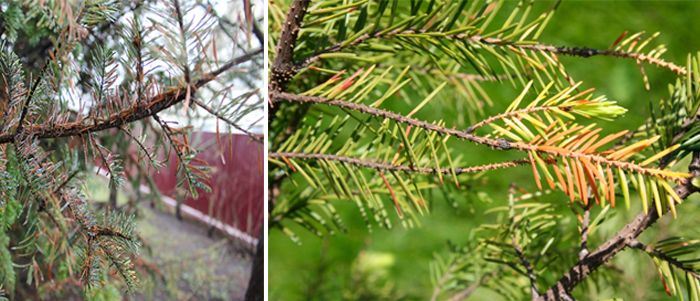
Also, upon close inspection, you can notice an unhealthy brown coating on the fir needles and in old shoots, which is where parasites first settle.
Unlike cedar, fir tree symptoms are harder to spot because they don't grow downy hairs, and yellowing branches can be caused by other infections. In this case, choosing the right treatment is crucial, as a mistake can only worsen the situation.
As for larch, it's safe to say it's less susceptible to diseases. Its needles are renewed annually, so pests are less likely to infest it. However, they're also harder to spot, as larch doesn't turn yellow, but remains green all summer. Nevertheless, if it grows near other conifers, it should still be inspected for insects, and if disease occurs, it should be treated along with the other trees.
Hermes on a spruce tree
The main symptom of spruce disease is the formation of irregular growths called galls on the shoots. These resemble spruce cones and provide a haven for the development of larvae. When an adult female spruce ...
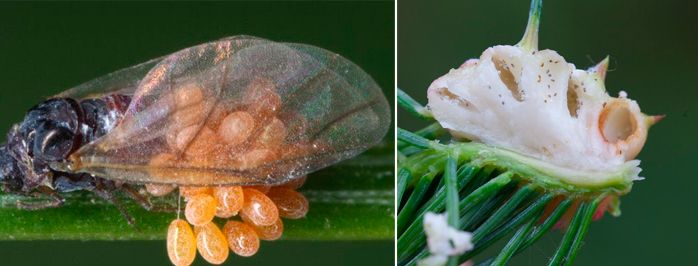
After the larvae leave the galls, these growths remain empty on the tree for a long time and gradually dry out.
Methods of prevention and control of hermes
To prevent insects from appearing on young seedlings during the first seasons or when planting, the following preventative measures should be followed:
- When purchasing a seedling, inspect it very carefully for small pests. It's best to avoid purchasing infested trees. If you do discover rhizomes on a seedling after purchase, be sure to remove them before planting, clean the seedling of any insects, and remove any galls.
- It is not recommended to plant the seedling in too wet soil, in windy and too bright areas, as well as close to paths where the soil is heavily compacted.
- It is necessary to plant crops in loose soil with the addition of fallen pine needles or peat (they serve as an excellent fertile fertilizer)
- After planting, the tree needs to be fed with special preparations that strengthen the root system (Radifarm, Kornevin)
- It is essential to use the product to maintain immunity at least three times after planting the seedling (the recommended interval between treatments is 2-3 weeks)
- It's very helpful to cover the soil around the trunk with pine bark. The thicker the mulch layer, the better.
- It's important to treat the trunk and crown of a young tree with special preparations—vitamins for conifers. These can be Reacom-Hvoya or Iovofert.
To protect mature, growing trees, there are also some pest control methods, which should be carried out in the spring (but no later than June), before the larvae have grown and left their shelters:
- If galls are found on spruce trees, they must be cut off and burned along with damaged shoots.
- Rinse the trunk and needles with strong water to remove insects. Repeat this procedure several times.
- Treat the spruce with a solution containing mineral oil (dilute in proportions of 200/300 ml per 10 liters of water, and spray the tree).
There are cases when all these methods do not bring the desired effect.
Then you'll have to resort to stronger chemicals that will definitely help get rid of this annoying pest. These include Komandor, Mospilan, Prestige, Caesar, etc. The products must be diluted and used according to the manufacturer's instructions. The frequency of treatment depends on the severity of the plant infestation.
It is recommended to use different drugs in turn for greater effectiveness.
This will not harm the plant, and the hermes will probably stop bothering the tree for quite a long time.
Growing conifers in your garden will bring aesthetic satisfaction and a constant sense of New Year's Eve if you properly care for your trees and perform preventative maintenance.