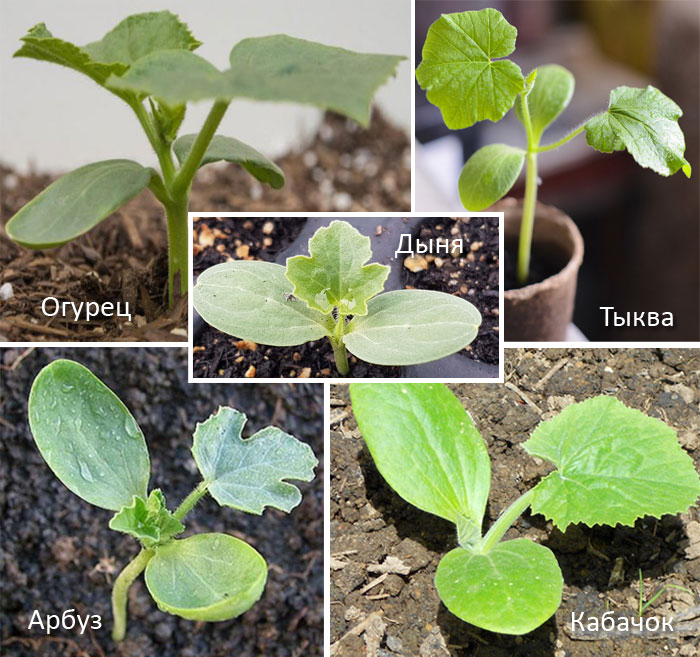
Beginning gardeners often confuse seedlings of melons, cucumbers, squash, pumpkins, and watermelons. All belong to the Cucurbitaceae family and share some similar characteristics, but they also have many distinctive features. Let's look at how to recognize them. We'll use melon seedlings as a starting point and compare them to other varieties.
Content
The difference between cucumber and melon seedlings
Young cucumber and melon plants look quite similar. It's easy to confuse the seedlings, especially for novice gardeners. Mistakes can occur not only when buying seedlings from an inattentive seller but also when growing them yourself. After all, cucumber and melon seeds are also similar. Therefore, always remember to label your seedlings and identify where they were planted.
By the shape of the leaves
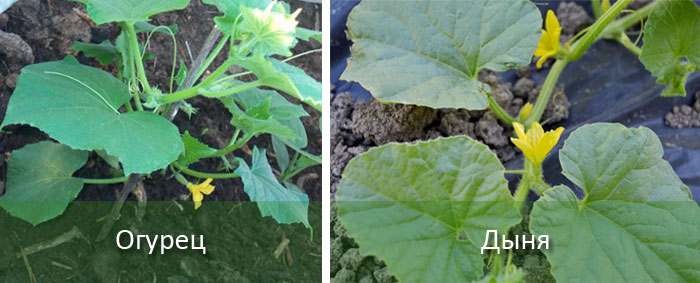
In fact, the leaves of these two crops have significant differences. If you look closely, even a novice gardener can easily spot them. Take a look at the foliage photo.
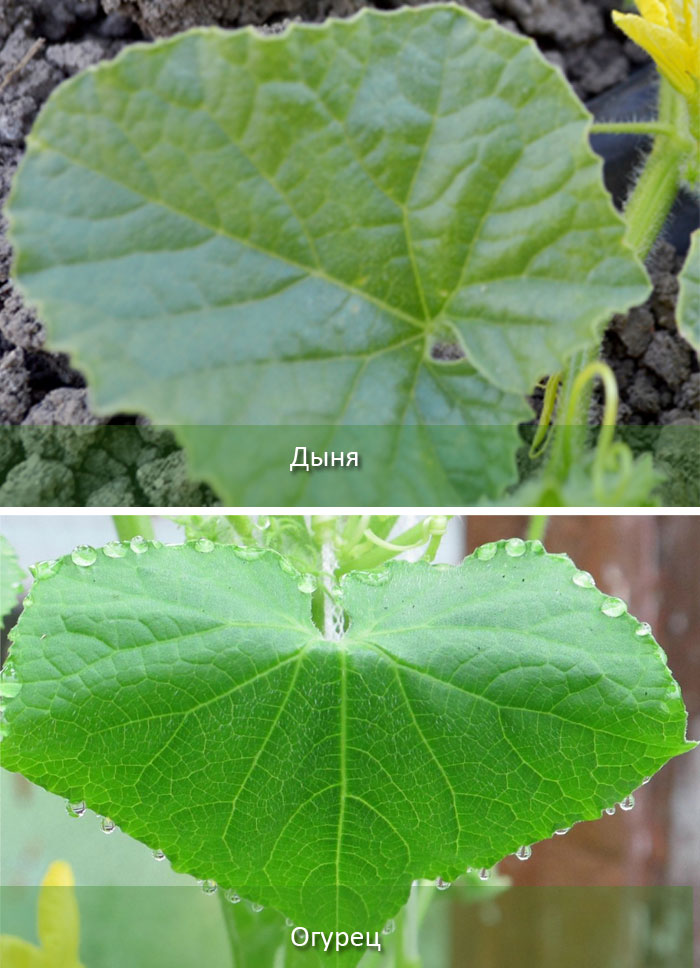
Cucumber leaves are elongated, bright green, and fleshy. There's a small notch at the edge where the main vein ends. The leaves are entire, pentagonal, and serrated. Melon leaves are rounded, much thinner than cucumber leaves. They feel very soft to the touch.
How to distinguish by smell
Cucumbers can also be distinguished from melons by their aroma. If you pick a leaf from the bush and crush it between your hands, a distinctive cucumber scent will emerge.
How to distinguish melon seedlings from zucchini and pumpkin
Beginner gardeners can easily confuse these crops, so let's talk about their differences.
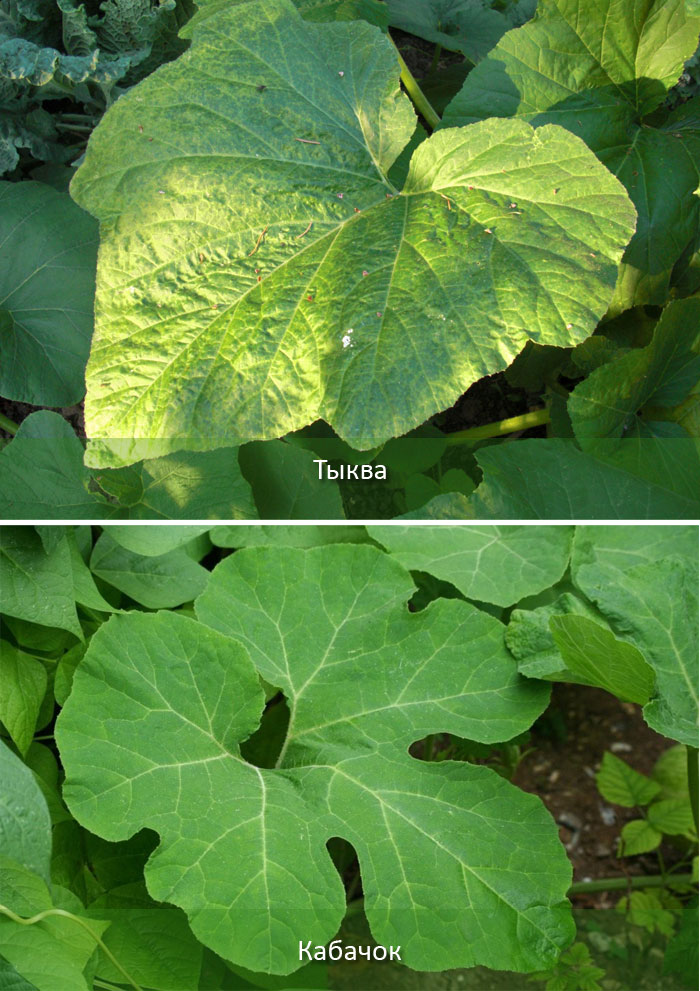
How to distinguish zucchini seedlings
The main difference is the aroma. Furthermore, zucchini sprouts can be distinguished from melon sprouts by their appearance.
- If you examine the bushes, you'll notice that the base of the first plant is thicker. Melons have tendrils with which they cling to the ground and neighboring bushes. Zucchini, on the other hand, form strong bushes without additional roots.
- Although the leaves are similar, melon leaves are a richer green, smooth, and glossy. They are rounded and quite large. Zucchini leaves are slightly smaller and oblong.
- Flowering begins at the same time. The flowers are yellowish and funnel-shaped. However, in melon, they are located on lateral shoots, while in zucchini, they grow in a bush, clustered in the center.
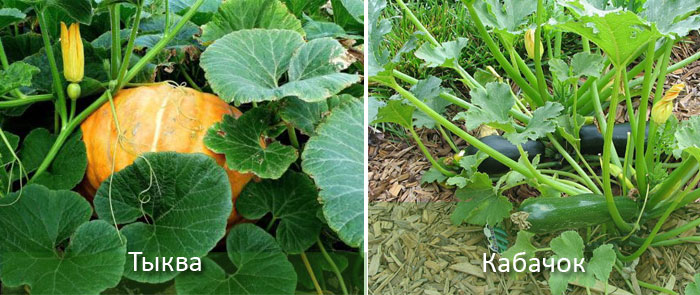
How to distinguish pumpkin seedlings
The difference can be identified by their characteristic smell. If you still can't tell the difference, you can compare the foliage of the plants. Pumpkin leaves are large, similar to burdock leaves, with distinct teeth around the perimeter. Melon leaves are smaller, with very fine teeth.
How to distinguish melon seedlings from watermelons
Experienced melon growers will tell you that the seedlings of these plants are simply impossible to confuse. However, as experience shows, newcomers to this field can still encounter such problems. Let's figure out how to distinguish young plants.
Foliage
Watermelon leaves are arranged alternately on elongated petioles. They are rough and hairy, triangular-ovate in shape. The base of the leaves is heart-shaped. They are very rough on both sides, a texture noticeable even on young leaves.
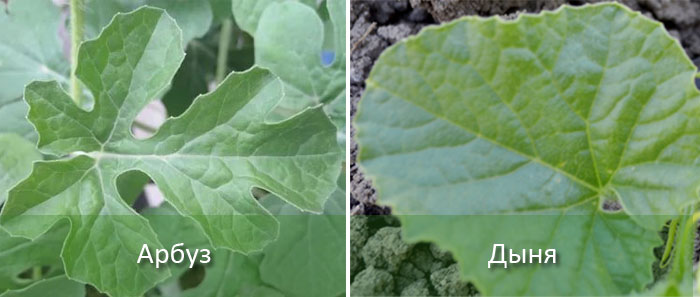
The second melon also has green leaves on long petioles. However, all of its leaves are five-lobed and heart-shaped. They are covered in hairs, but the hairs are much finer and softer.
Bloom
The first female flower in watermelon appears on the main stem (after nodes 5-6 in early varieties and 12-14 in late varieties). In melon, it appears on lateral shoots.
To summarize, it's fairly easy to distinguish seedlings by their leaves. Later, they can also be identified by their flowering characteristics.
Table of distinctive and similar characteristics of seedlings of different melon crops
Melon seedlings can also resemble young bushes of other plants. Below is a table with distinctive features and similarities between melons and other crops.
| View | Differences | Similarities |
| Cucumbers | Characteristic smell. There is a notch at the end of the central vein. The leaves are elongated. |
Pentagonal shape of leaves. Yellowish flowers of similar shape. |
| Zucchini | Smell. A more powerful bush. Dull, slightly matte, rough leaves. No antennae. The flowers are located in the center. |
Yellow flowers of the same appearance. Flowering at the same time. Pentalobate leaves. |
| Pumpkin | Characteristic smell. Larger leaves with pronounced teeth along the perimeter. |
Structure of bushes. Leaf shape. Bloom. |
| Watermelon | The leaves are heart-shaped at the base and triangular-ovate above, thick, and very rough. The color of the foliage is greener. Flowers in the central part of the bush. |
The bush has triangular-ovoid leaves. Leaves on elongated petioles. The flowers are yellowish, similar in shape, and appear at the same time. |
In summary, it's worth noting that melon seedlings do have significant differences. A novice gardener might initially have a hard time immediately identifying which plant is which, but with experience, they'll be able to do so at a glance.