A mysterious and unique member of the fungal kingdom is the "Bloody Tooth" mushroom, which got its name from its unusual appearance. It was first described in 1913, although it was discovered much earlier, as early as 1812. Interestingly, scientists still haven't fully studied its properties.
Appearance (description)
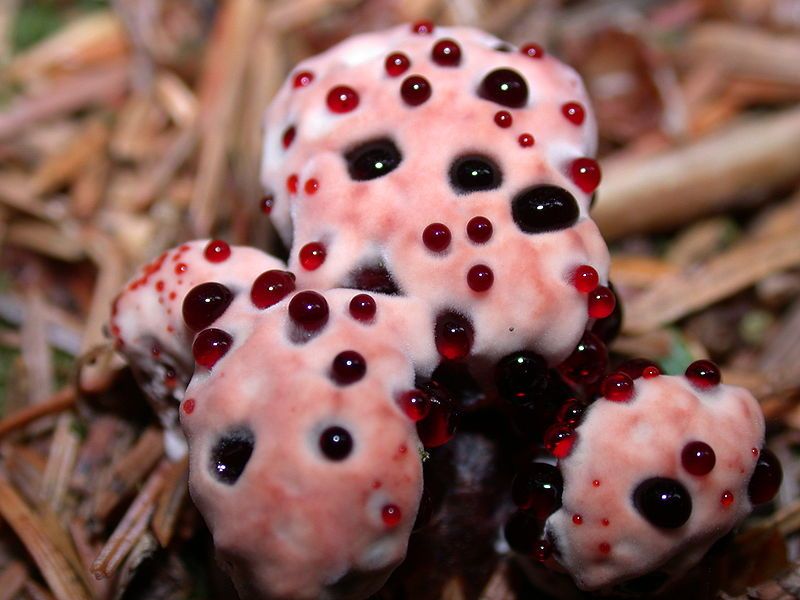
Some natural creatures on our planet are both surprising and terrifying. The unusual "bloody tooth" mushroom is one of them. It's found in coniferous forests across Europe and North America. It's hard to miss this mushroom, as its vibrant color immediately catches the eye.
The name "Hydnellum peckii" comes from the American mycologist Peck, who first discovered this species. The mushroom is medium-sized, with a cap slightly over 5 cm in diameter, resembling chewed gum with a subtle strawberry scent. The stem is about 2 cm tall. Bright blood-colored drops appear on the cap's surface, as if stained with the blood of a wounded animal. This red liquid is produced by the mushroom itself through its pores. "Hydnellum peckii" somewhat resembles a boletus with maple or currant juice spilled on it. The body is white and velvety, turning brown with age.
The main characteristic of the "bloody tooth" is its absorption of water from the soil and its feeding on small insects that accidentally fall into it. The word "tooth" in the name is no accident. As Hydnelum peckii matures, pointed structures appear along its edges.
Edible or not?
Hydnellum peckii belongs to the Agaricales order of mushrooms, but unlike champignons, it is not edible. The fruiting body does not contain any poison; the danger comes only from the pigment found in the cap (atromentin). Its toxicity is still being studied, and it is not yet known whether it is fatal to humans. The mushroom has a bitter taste, which it uses to repel people and animals.
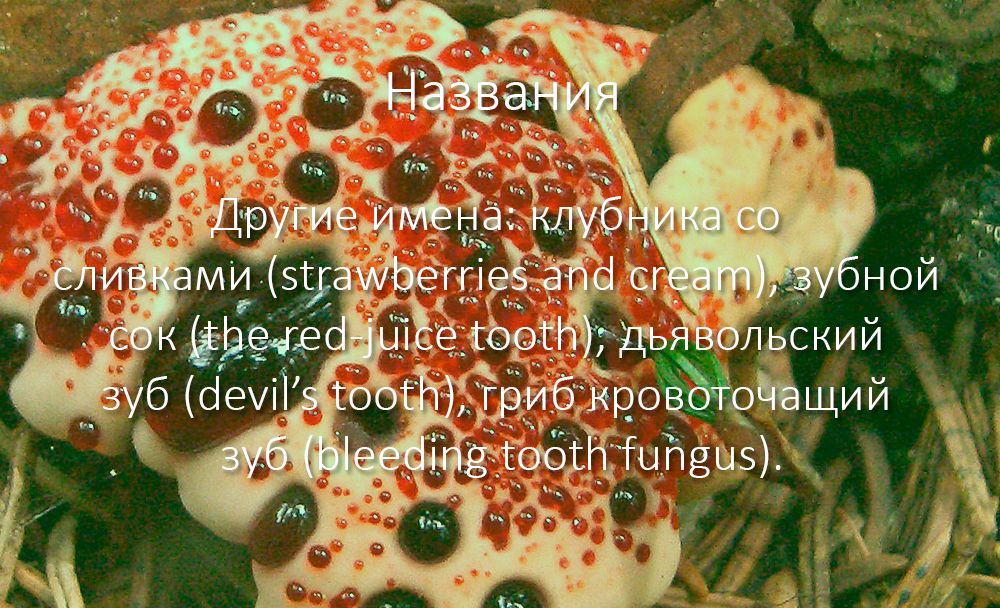
Where and when does the Bloody Tooth mushroom grow?
As mentioned above, this mushroom grows in the coniferous forests of Australia, Europe, and North America. In the Russian Federation, it is extremely rare and only seen in autumn, from September to November. Recently, it has been discovered in Iran, North Korea, and the Komi Republic.
Top.tomathouse.com: The healing properties of bloody tooth
During their studies, scientists discovered that the mushroom's juice contains a substance called atromentin, a specific anticoagulant. It can be used to prevent blood clots and improve blood clotting. It is also believed that using an alcohol-based tincture of the mushroom's bright, poisonous liquid helps heal bruises, as the latter has pronounced antibacterial properties.
Antromentin is not yet used in medical practice.
Some doctors hope that in the near future, a drug similar to penicillin, which was obtained from the mushroom of the same name, will be created based on the purple substance.
Similarities with other species
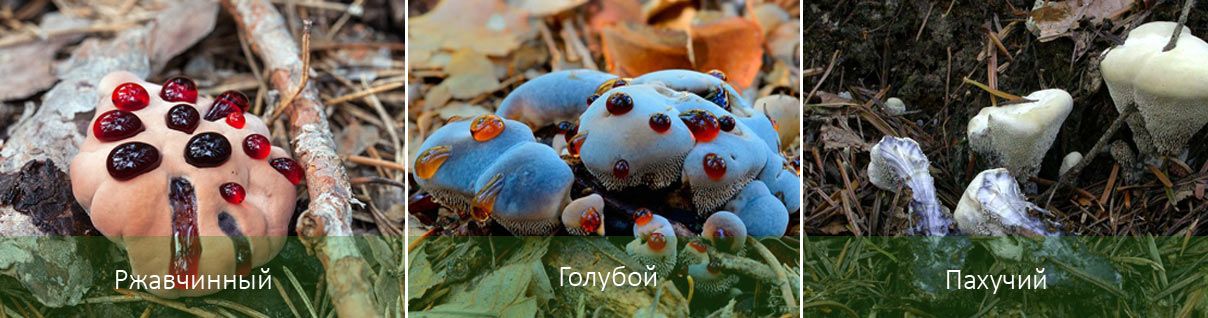
The mushroom has close relatives:
- Rust Hydnellum (Hydnellum ferrugineum). It can be easily distinguished from "bloody tooth" as it ages; the initially white body with liquid red droplets begins to resemble rust in hue.
- Blue Hydnellum (Hydnellum caeruleum) grows near white mosses in the forests of Northern Europe. Its flesh bears similar blood-tinged drops, and it is distinguished by its distinct blue color. As it ages, the center of the cap turns brown.
- Fragrant Hydnellum (Hydnellum suaveolens). The light-colored fruiting body with blue spines darkens with age and has a pungent odor. No red liquid is secreted.