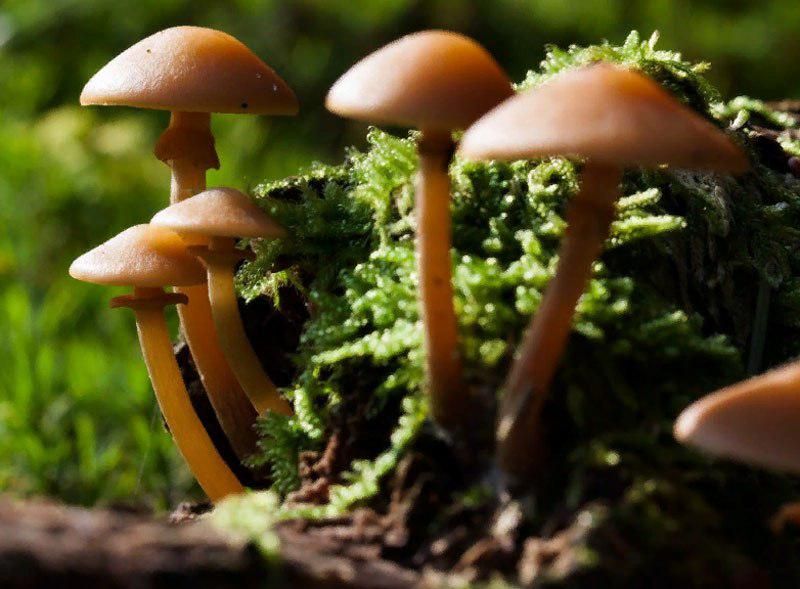
Belonging to the Strophariaceae family, summer honey mushrooms are classified as edible mushrooms. They are distinguished by their excellent flavor, and you can collect many of them without leaving your spot, as they are "family" mushrooms (they don't grow singly, but rather occur in large colonies). They are called summer mushrooms because they appear in the summer, in July and August.
Content
Description
| Parameter | Characteristic |
| hat |
|
| Skin | Mucous, darkens towards the edges. |
| Records | Young mushrooms are beige, while old ones are almost brown. |
| Pulp |
|
| Leg |
|
Dangerous Double
Summer honey mushrooms can be confused with similar mushrooms. The cost of this mistake can vary: in some cases, you might end up with an inedible dish, while in others, you might suffer serious poisoning. The worst thing to do is pick a Galerina marginata instead of an edible mushroom.
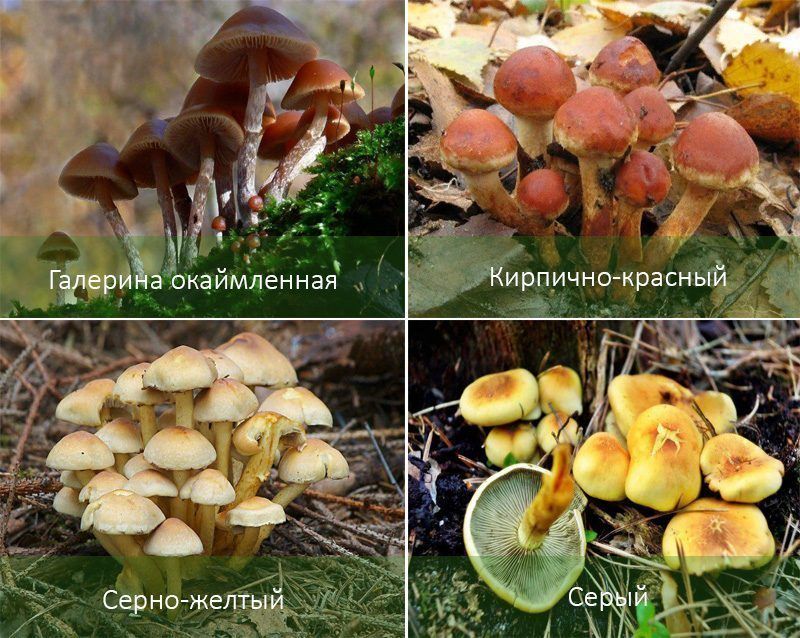
Galerina marginata
Galerina marginata is a deadly poisonous mushroom. It contains the same toxin (amanitin) as the death cap. It doesn't take effect immediately, but poisoning almost always ends tragically. It grows throughout coniferous forests from May until severe frosts. Galerina is not found on deciduous trees.
The reddish-brown cap, up to 4-5 cm in size, is conical and flattens with age, developing a tubercle in the center. In dry weather, the cap lightens, becoming pale yellow. The stem has a whitish coating.
| Parameter | Characteristic |
| At the honey fungus |
|
| At the gallery |
|
Honey mushrooms grow in clusters, while Galerina mushrooms grow singly or in groups of two or three. A single Galerina mushroom may grow among honey mushrooms, so special care is required when harvesting them.
Gray false honey fungus
The grey false honey fungus is found in deciduous forests; the cap has a greenish tint.
False honey fungus sulphureus
This mushroom has a sulfur-yellow cap that darkens to brown toward the center. The flesh is yellow and has an unpleasant odor. The stem is smooth, hollow, and lacks a cuff or scales. Two to six hours after eating, vomiting, confusion, and sweating begin. While not fatal, it is quite unpleasant.
Other doubles
There are several other mushrooms similar to honey mushrooms, but they are noticeably poisonous, including:
- Brick-red false honey fungus is not poisonous.
- Most of the scaly mushrooms, which are also often confused with honey mushrooms, are edible, but they look like rubber.
Where and when do summer honey mushrooms grow?
Summer honey mushrooms grow in damp deciduous or mixed forests. Their favorite places are rotten stumps, decayed wood, clearings near lakes, and in mountainous areas, they can be found on coniferous trees. The harvest is abundant and uniform.
This mushroom is also called the linden mushroom because it is most often found on linden trees. It's not uncommon to see huge colonies of up to a hundred mushrooms clinging to an old tree stump.
When looking for summer honey mushrooms, you shouldn't limit yourself to stumps; they can also be found near certain bushes, in meadows and forest edges.
They are found in temperate and warm latitudes almost everywhere, except in permafrost. In the south, they can bear fruit all year round, and in more northern regions, from April-May to October. The peak of the mushroom season occurs from mid-July through August.
How to collect summer honey mushrooms?
These mushrooms should be harvested by carefully cutting them with a knife, leaving the old ones behind. Avoid areas near fields, highways, and landfills. Like sponges, mushrooms absorb not only beneficial substances but also toxic ones: pesticides, heavy metals, including mercury, lead, and radioactive isotopes.
Avoid picking honey mushrooms in city parks or squares. It's best to stay at least a kilometer away from busy highways.
Benefits - composition, vitamins and microelements, calorie content
The energy value of 100 g of summer honey mushrooms is very low, only 17-22 kcal, so they are included in all kinds of diets and consumed during fasts.
Nutritional value of 100 g of fresh summer honey mushrooms:
- water 90 g;
- proteins 2.3 g;
- fats 1.1 g;
- carbohydrates 0.6 g;
- Dietary fiber 5.1 mg% (25.5 daily value).
Vitamins in 100 g:
- vitamin PP 10.3 mg% (53.5
- vitamin B1 0.11-1.45 mg% (31.2%);
- vitamin B2 0.2-0.4 mg% (22.7%);
- vitamin C 11.1 mg% (12.2%).
Minerals:
- potassium 400.0 mg% (16%);
- magnesium 20 mg% (5%);
- phosphorus 48 mg (6.0%);
- iron 0.78 mg (4.3%).
Microelements:
- copper 82-228 mcg% (16.1%);
- nickel 47.0 μg% (31.2%);
- zinc 650-1470 mcg% (9.1%);
- chromium 5.4-26.0 mcg% (31.7%).
Honey mushrooms improve heart function and metabolism and inhibit the development of cancer cells.
Contraindications
Contraindications for use are:
- acute gastritis, ulcer;
- cholecystitis;
- colitis;
- children under 7 years of age.
Consumption
Honey mushrooms are tasty and aromatic mushrooms, but it is important to remember that they can be stewed, fried, or added to soup only after pre-boiling for 20 minutes, or better yet, 40 minutes or even an hour.
especially if there is no certainty about the ecological virginity of the collection sites.
Directions for use:
- Pre-soak the mushrooms in water for half an hour, sort through them, and cut into pieces, removing any stale parts. Discard any wormy mushrooms.
- When boiling, drain off the first water with foam, fill the mushrooms with fresh water and continue cooking.
- Place the honey mushrooms in a colander, rinse under running water, then fry or add to salad, soup, or as a filling for pies and dumplings.
Honey mushrooms are pickled, salted, dried, and frozen for winter storage. When pickling, horseradish, oak bark, and marigold flowers are added to ensure the mushrooms are firm and slightly crunchy. They are only salted using the hot method.
Dried mushrooms retain all their nutrients, unlike pickled ones. They should be dried in a ventilated area, protected from direct sunlight and rain. Sliced mushrooms are laid out on trays covered with paper, remembering to stir and turn them occasionally. They can also be dried strung on strings.
Proper freezing is the best way to preserve all the nutrients.