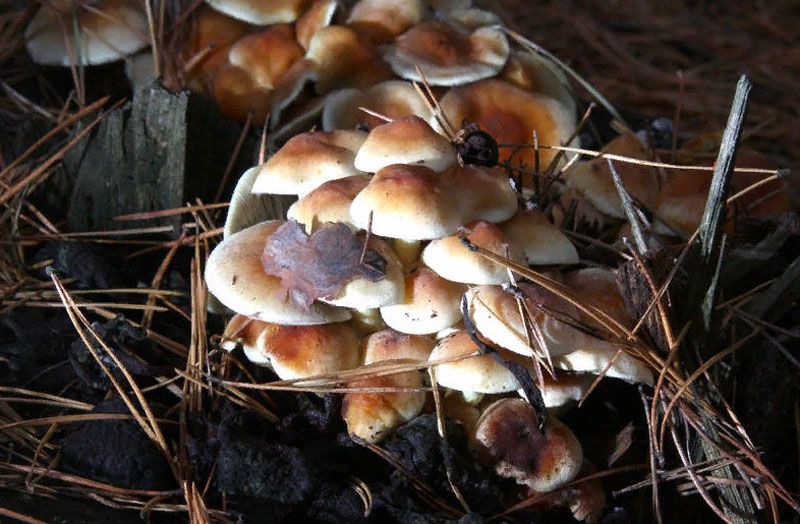
False honey mushrooms are a group of several different species that share a similar appearance to the true mushrooms. Not all of them are poisonous; some are conditionally edible.
Their main difference is the absence of a mushroom smell, but they can also be recognized by the absence of a ring on the stem, as well as by the wateriness of the edge of the cap in damp weather.
Types of false honey fungus
Actually, there are three types of false honey mushrooms:
- sulfur yellow,
- gray-plate
- brick red.
The first of them is poisonous, the rest are consumed after thorough boiling.
There are 3 more varieties of mushrooms that are often confused with honey mushrooms:
- the deadly poisonous Galerina marginata;
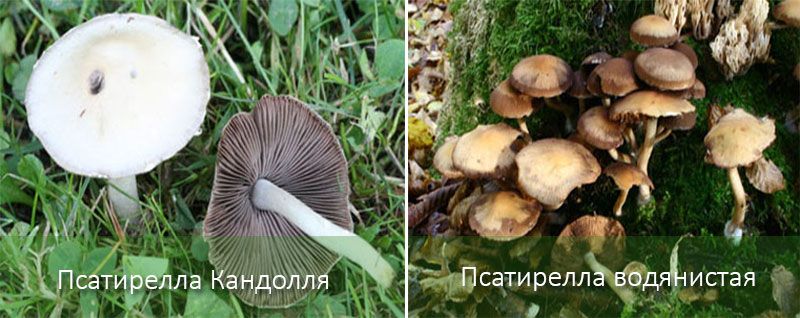
- conditionally edible Psathyrella candollei;
- Psatirella watery.
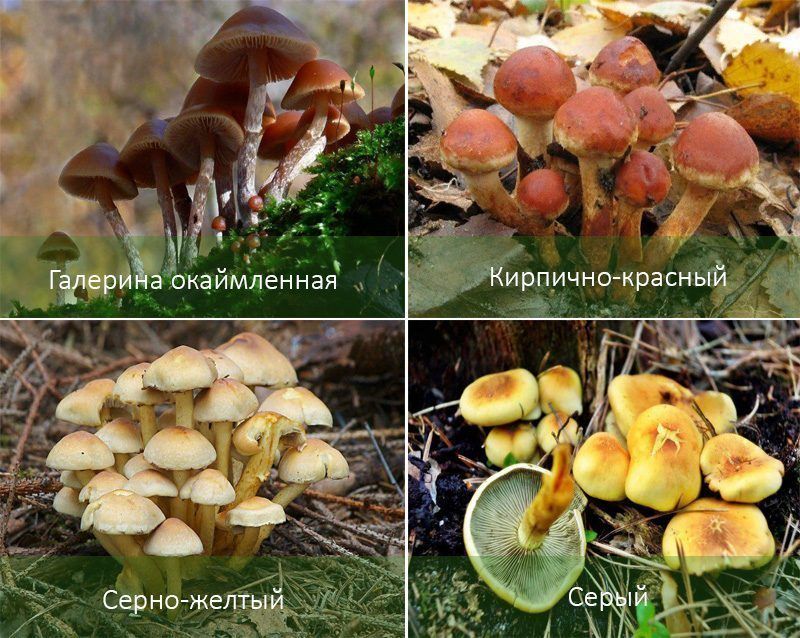
Inattentive mushroom pickers can pick them up, as both false and true mushrooms often grow side by side or on the same stump. Moreover, false mushrooms often grow in tightly packed clusters, fused at the base by their stalks, just like true mushrooms.
Galerina Marginata
| Family | Strophariaceae | |
| hat | Diameter, cm | 1.5-5 |
| Color | Awesome, redhead | |
| scales | None | |
| The youngsters are in good shape the old ones |
Cone-shaped | |
| Expanded | ||
| A bump in the center | The old ones | |
| Watery edge | At high humidity | |
| Smell | Mealy | |
| Records | Color | Awesome |
| Leg | Height, cm | Up to 9 |
| Thickness, cm | 0.15-0.8 | |
| Color | Beige, red | |
| Ring | Eat | |
| scales | Pressed | |
| Distinguishing features | Fibrous, hollow. Plaque underneath. | |
| Season | VII-XI | |
Contains the same poison, amanitin, as the death cap. It is found only near conifers, while true honey mushrooms grow in deciduous forests, although mixed willows can grow in mountainous areas. The poisonous Galerina smells like flour, not mushrooms. It grows primarily in clusters of 3-8 mushrooms or singly. Galerina is sometimes confused with the honey mushroom. It's important to note that the stem of the true mushroom doesn't have a ring, unlike the poisonous one.
To avoid poisoning, avoid picking honey mushrooms from spruce and other coniferous trees!
Sulphur-yellow false honey fungus (Hypholoma fasciculare)
| Family | Strophariaceae | |
| hat | Diameter, cm | 2-9 |
| Color | Sulphur yellow | |
| scales | No | |
| The youngsters are in good shape | Pointed | |
| The old ones | Disclosed | |
| A bump in the center | Eat | |
| Watery edge | No | |
| Smell | Inedible | |
| Records | Color | Awesome |
| Leg | Height, cm | Up to 10 |
| Thickness, cm | Up to 0.8 | |
| Color | Light yellow | |
| Ring | No | |
| scales | No | |
| Distinguishing features | Hollow, fibrous | |
| Season | VII-XI | |
These false honey mushrooms are found in large families of up to 50 fused stems.
The cap of young mushrooms is shaped like a bell, while that of older mushrooms resembles an open umbrella.
It differs from the real honey fungus by its yellow cap, inedible smell, and stem, which lacks a ring (all honey fungus except winter ones have one).
Brick-red false honey fungus (Hypholomalateritium)
| Family | Strophariaceae | |
| hat | Diameter, cm | Up to 9 |
| Color | Brick | |
| scales | Eat | |
| The youngsters are in good shape | Rounded or bell-shaped | |
| The old ones | Disclosed | |
| A bump in the center | The old ones | |
| Watery edge | In rainy weather | |
| Records | Color | From yellowish to lead-gray |
| Leg | Height, cm | Up to 10 |
| Thickness, cm | 1-2.5 | |
| Color | Bright yellow on top, brown on the bottom | |
| Ring | None or a thin stripe | |
| scales | Small, sharp | |
| Distinguishing features | Fibrous, becoming hollow with age | |
| Season | VIII-X | |
The mushroom is considered conditionally edible; to eat it, it must be boiled for at least 30-40 minutes and then drained.
In many countries, the brick-red false honey fungus is considered perfectly edible. In Russia, it is eaten in Chuvashia. If not sufficiently pre-cooked, it causes nausea, stomach and headaches, and vomiting.
These false honey mushrooms are often confused with autumn ones.The former can be distinguished by their reddish-brown cap and light yellow or beige flesh. True honey fungi always have a cuff on their stem, while false honey fungi lack one. They have an unpleasant odor, while the autumn ones smell like mushrooms.
Hypholoma capnoides
| Family | Strophariaceae | |
| hat | Diameter, cm | 1.5-8 |
| Color | Yellow, orange, brownish | |
| scales | No | |
| The youngsters are in good shape | Rounded | |
| The old ones | Outstretched | |
| A bump in the center | Eat | |
| Watery edge | No | |
| Smell | Dampness | |
| Records | Color | Yellowish, turning grey with age |
| Leg | Height, cm | 2-12 |
| Thickness, cm | 0.3-1 | |
| Color | Yellowish, reddish-brown below | |
| Ring | No | |
| scales | No | |
| Season | VIII-X | |
The gray-laminated false honey fungus is considered edible, but is only suitable for consumption after thorough boiling. It is also called the poppy mushroom because as it grows, its surface becomes covered with poppy-seed-sized specks. The edges of the cap are darker than the center. The flesh has a damp smell. These mushrooms can be found in windfalls and stumps, most often pine.
They differ from autumn honey mushrooms by the absence of a cuff on the stem and radial wrinkles on the cap, as well as the color of the gills.
Psathyrella candolleana
| Family | Psathyrellaceae | |
| hat | Diameter, cm | 2-10 |
| Color | Milky white, turns yellow in older ones | |
| scales | Small brownish, quickly disappearing as they grow | |
| Form | Cone-shaped | |
| A bump in the center | Eat | |
| Watery edge | No | |
| Smell | Absent or mushroom | |
| Records | Color | From milky to violet-gray and brown-brown |
| Leg | Height, cm | Up to 9 |
| Thickness, cm | 0.2-0.7 | |
| Color | Beige | |
| Ring | Absent | |
| scales | None | |
| Distinguishing features | Smooth, silky | |
| Season | VX | |
This mushroom is considered conditionally edible. Before cooking, it is boiled and then drained. Its popular name, "khriplyanka," refers to its very fragile, easily broken cap, covered with small scales that quickly disappear. It turns yellow with age.
It differs from ordinary honey mushrooms by the absence of smell in the pulp.
Psathyrella Piluliformis
| Family | Psathyrellaceae | |
| hat | Diameter, cm | 1.5-8 |
| Color | Brown, turning yellow towards the center | |
| scales | No | |
| Form | Bell-shaped, with grooves | |
| A bump in the center | Eat | |
| Watery edge | No | |
| Smell | No | |
| Records | Color | From light beige to brownish-black |
| Leg | Height, cm | 3-10 |
| Thickness, cm | 0.3-0.9 | |
| Color | Beige below, with a mealy coating on top | |
| Ring | Absent | |
| scales | Absent | |
| Distinguishing features | Smooth, silky, hollow inside | |
| Season | VX | |
Psathyrella is conditionally edible and can be eaten after boiling. In damp weather, droplets of watery liquid appear on the underside of the gills. The cap is dark brown, turning yellow with age, with the yellowing starting in the center and spreading toward the edges. It has a faint mushroom odor or none at all.
Top.tomathouse.com recommends: How to distinguish false honey mushrooms from edible ones?
| Indicators | Autumn honey fungus | Gray-laminated | Brick red | Sulphur yellow |
| Leg | Beige, with cuff | Light yellow, reddish-brown below, without a ring | Bright yellow on top, brown on the bottom, without a ring | Light yellow, without a ring |
| hat | Beige-pink | Yellow or brown | Brick red | Sulphur yellow |
| Records | Light brown | Gray | Gray | Yellow |
| Taste | Mushroom | Weak | Bittersweet | Bitter |
| Smell | Mushroom | Unpleasant | Unpleasant | Unpleasant |
| Reaction to contact with water | The edges of the cap become transparent | No | No | No |
| Edibility | Edible | Edible | Conditionally edible | Poisonous |
Poisoning by false honey mushrooms and first aid
Among the false honey fungi, only the false sulfur-yellow honey fungus and the deadly Galerina marginata are highly poisonous.
| Sulfur-yellow honey fungus poisoning | The first symptoms appear within 1.5 to 4 hours. These include vomiting, diarrhea, weakness, and tremors in the extremities. A cold sweat breaks out on the palms and soles of the feet. Poisoning from the sulfur-yellow honey fungus is rare, as a single mushroom can ruin an entire dish with its bitter taste. An ambulance should be called. Symptoms subside within a few days or within 24 hours if the dose was small. Before a doctor arrives, the stomach should be pumped by drinking a sufficient amount of water and inducing vomiting, followed by administration of activated charcoal. |
| Poisoning by brick-red false honey fungus | Approximately the same symptoms occur if it is not boiled for a sufficient time. |
| Bordered by Galerina | Contains amanitin, the poison of the death cap mushroom. A dozen amanitins is a lethal dose for a child. It causes severe and difficult-to-treat liver damage, with symptoms appearing 12 hours or more later, when it's too late to induce vomiting. Seek immediate medical attention. |