The autumn honey fungus, or true honey fungus (Armillaria mellea), is a species of mushroom in the genus Honey Fungus of the Physalacriaceae family. It is classified as a Category 3 edible mushroom.
Description
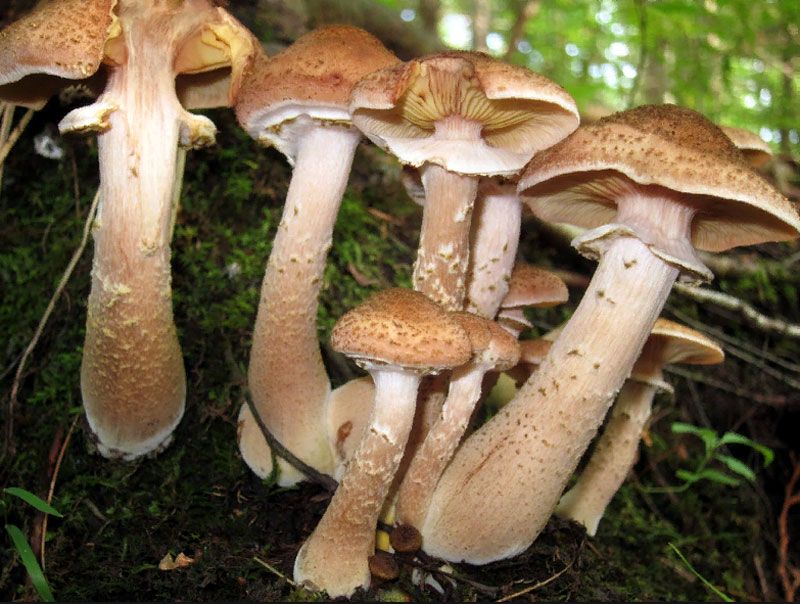
| hat | The diameter is up to 10-15 cm. The color depends on nearby trees and the weather, ranging from light brown to olive. The color darkens toward the center of the cap. Young mushrooms have caps covered with numerous scales, which almost disappear in older mushrooms. |
| Records | Relatively rare, from almost white to brown with a pink tint, often with brown spots. |
| Pulp | Fleshy, aromatic, light in colour, darkening with age. |
| Leg | Up to 12 cm tall and up to 2 cm thick, with a slightly yellowish tint. The stem always has a noticeable ring. |
When and where to collect autumn honey mushrooms?
Autumn honey mushrooms can be found in deciduous and mixed forests from the subtropics to northern regions, excluding permafrost. They often grow in clearings, appearing on stumps after 2-3 years.
Their favorite trees are birch, oak, linden, and poplar, but they also eat pine and spruce. These mushrooms are parasitic, meaning they usually grow on living trees, but they also thrive on rotten stumps.
Interestingly, if mushrooms grow on stumps, the mycelium glows at night. If you happen to come across such a stump, wait for warm weather with temperatures above 10 degrees Celsius a week after a good rain or dense September fog.
The first autumn honey mushrooms appear in July, and the last ones can be found in October, and in the southern regions even in November.
The yield is simply astounding. There are forests where, in a mushroom year, up to half a ton of these delicious mushrooms can be harvested from a single hectare. They grow in clusters. A single stump can hold up to a hundred mushrooms, often fused together by their stems.
Top.tomathouse.com warns: Dangerous lookalikes
By mistake, you might pick the scaly mushroom instead of the autumn honey mushroom, which has both its cap and stem covered in large scales. It's not poisonous, but it's not edible due to its tough, rubbery, and difficult-to-digest flesh, lacking any mushroom flavor.
Inexperienced mushroom pickers may pick sulphur-yellow, grey-plate, or red-brown false honey mushrooms instead of edible ones. In the latter two cases, nothing serious will happen. These mushrooms are conditionally edible, but it's best to avoid them.
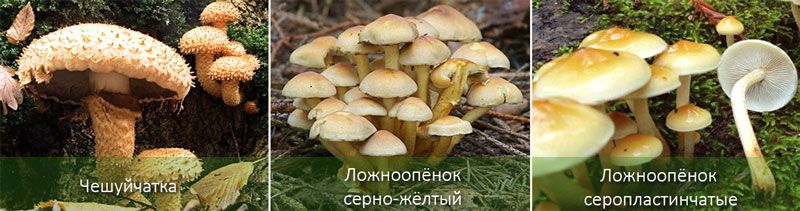
Sulfur-yellow false honey mushrooms are poisonous; if eaten, they can result in fainting and a hospital stay. Their flesh is a poisonous yellow with an unpleasant odor.
All false honey mushrooms lack a skirt on the stem, while true mushrooms always do. Another difference between some false mushrooms and edible autumn mushrooms is a smooth cap, devoid of scales. The gills should not be gray.
Caloric content, benefits and harms
| Caloric content | Small: only 22 kcal/100 g. This allows them to be included in the diet even on the strictest diets. |
| Belkov | Fresh mushrooms contain up to 2.2 g. It’s not much, but they contain all the essential amino acids. Since mushrooms are 90% water, after drying they contain more protein than meat. |
| Fats and carbohydrates | Not much – only 1.4% and 0.5% respectively. |
But honey mushrooms are simply a storehouse of minerals and microelements.
They contain potassium, phosphorus, magnesium, and iron. They also contain so much copper and zinc that you can meet your daily requirement by eating just 100 grams of these mushrooms.
Copper is involved in hematopoiesis, while zinc is beneficial for immunity and reproductive health. Vitamins C and E also help strengthen the body's resistance.
Vitamin B1, which honey mushrooms are particularly rich in, is beneficial for the nervous system. In many countries, medications containing these mushrooms are available in pharmacies for the treatment of cardiovascular and nervous system disorders. In Austria, honey mushroom powder is used as a mild laxative, and an ointment containing this mushroom extract is used to treat joint pain.
In Chinese medicine, the use of these mushrooms is much broader: the tincture is used as a tonic, and the powder is used for insomnia, convulsions, and neurasthenia.
After special processing, the mycelial cords, called rhizomorphs, are used to produce medications for gastritis and liver diseases, hypertension, and acute respiratory infections. This medicine is also prescribed after stroke.
Honey mushrooms contain substances that kill Staphylococcus aureus, which is resistant to many antibiotics. Their anticancer properties are also being studied. Their effectiveness against carcinoma and some other tumors has already been confirmed.
Only young mushrooms, untouched by insects, are used for medicinal purposes. There are no contraindications, except that those with stomach problems should eat them sparingly.
Poisoning from honey mushrooms is also common, especially when harvested after frost, if they haven't been boiled long enough. For all edible uses except drying, all mushrooms should be pre-boiled for 30-40 minutes.
Honey mushrooms are exceptionally tasty in soup, especially with beans, and as a side dish with boiled or fried potatoes. They can be pickled, salted, dried, and frozen for the winter.
Dried herbs are made into a powder, which is used as a seasoning, giving an incomparable taste and aroma to many dishes.