Perennial ryegrass belongs to the Poaceae family. It is used to create sports fields, professional football pitches, technical lawns, and more. It is also used for overseeding.
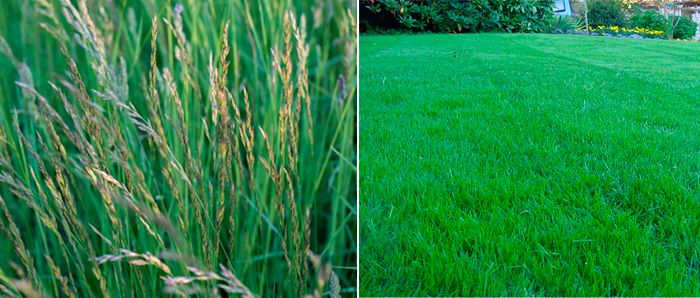
Description of ryegrass
Perennial ryegrass is a semi-high, loosely tufted grass. It forms a dense lawn (40-60 shoots per square meter) in its first season. Its root system is robust and well-branched. It forms a dense turf and holds soil well. It persists as a grass stand for 5-7 years.
The leaves are 10-20 cm long and 3-5 mm wide. The blades taper from the base to the tips. The upper surface of the leaves is moderately glossy, while the underside has a glassy sheen. The color ranges from dark emerald to light green. The veins are located along the entire blade and are clearly visible. There is a noticeable keel on the underside. The base is pinkish.
Ryegrass tolerates shade well and is resistant to trampling. It grows quickly and self-restores to the lawn after drought or partial mowing.
However, it doesn't tolerate frost or snowy winters well, which can cause bare spots in the lawn.
During prolonged cold spells, it may completely disappear from the grass stand. It tolerates fairly low temperatures (-16…18°C) if there is no snow cover.
Advantages and disadvantages
Ryegrass has the following advantages:
- ensures long service life of the lawn;
- resistant to trampling and high loads;
- grows quickly and retains its green color for a long time;
- tolerates dry weather and shade well;
- not afraid of regular mowing, grows evenly;
- effectively consolidates unstable soil (often used on roadsides, small slopes, etc.);
- The seeds are sold both without various additives and as part of herbal mixtures.
The most significant disadvantage for our climate conditions is that ryegrass does not tolerate frost well.
Due to the cold, the plant wears out quickly and retains its grass stand for less time than stated (3-4 years).
Another disadvantage is that the grass is demanding regarding the acidity level of the substrate and its nutritional value.
It doesn't tolerate excessive moisture well. Therefore, prolonged rainfall negatively impacts its decorative qualities.
Features of lawn care with ryegrass
Ryegrass should only be planted in fertile soil with a low pH. If the soil is highly acidic, add wood ash. It's also a good idea to plant it in a well-lit area.
Ryegrass care is fairly simple. It requires periodic mowing, clearing away debris, and regular watering (as the top layer of the substrate dries out). Fertilizing is sometimes necessary to promote growth.
Perennial ryegrass is widely used for lawns. It grows quickly, retains its freshness for a long time, and resists trampling. However, there is a significant drawback: the plant doesn't tolerate the climate of central Russia very well, so planting it isn't always advisable.