To maintain a beautiful lawn, you need not only regular mowing and watering, but also fertilization. As lawn grass is periodically replenished, it loses the nutrients that accumulate in the stems. For fertilization to be beneficial, it must be applied according to certain guidelines.
What substances are needed for fertilizing a lawn?
To nourish lawn flora, the following elements are necessary:
- nitrogen - accelerates growth, makes the color more saturated;
- phosphorus - helps accumulate nutrients, improves metabolic processes;
- Potassium - normalizes electrolyte balance, improves resistance to negative environmental influences.
Nutrient deficiencies can be easily identified visually.
A nitrogen deficiency causes grass to grow slowly, and bald spots may appear. Leaves lose their rich color and become pale. A phosphorus deficiency causes plants to become very brittle, with the foliage taking on a lilac tint. A calcium deficiency is indicated by foliar burn.
Both an excess of nutrients and a deficiency can harm plants. Therefore, it's important to follow the correct dosage when applying fertilizer.
Excessive nitrogen weakens grass, causing it to lose resistance to infections and pests. Plants quickly age and wilt. Excess phosphorus inhibits the absorption of other nutrients, causing grass to slow growth. Excess calcium burns the root system, potentially killing the plants.
To normalize the level of useful elements, you need to water the lawn frequently (at least 2-3 times a day).
Excess nutrients can trigger active growth of more aggressive plants (ryegrass, bentgrass).
This will negatively affect the decorative effect.
Fertilizer application according to seasons, rules
To ensure that nutrient mixtures are beneficial and not harmful, they must be applied correctly and at the correct dosage. It's best to apply fertilizer before heavy rainfall.
If no precipitation is expected and fertilizer needs to be applied urgently, the lawn must be watered generously.
Wait until the plants dry out, but the soil is still moist, then add organic matter and minerals.
If drought occurs within two days after fertilizing, you need to water again so that the substances reach the roots.
Fertilizing your lawn in spring, summer, and fall
Fertilizer components and application purposes vary depending on the time of year.
In spring, a comprehensive fertilizer containing nitrogen, calcium, and phosphorus is necessary for vigorous growth, better tillering, and vibrant foliage color. Applying this nutrient mixture will help the lawn recover from its winter dormancy. This fertilizer is applied after the snow has completely melted, when the ground has warmed up, but before the grass begins to grow.
Read more about spring lawn care and favorable dates for various tasks in the article.How to care for your lawn in spring: steps by month, favorable days for 2022.
In hot summer weather, plants use large amounts of nitrogen, so fertilizers containing this element are essential. This will support growth throughout the growing season. These fertilizers are applied after every second mowing of the lawn.
Autumn fertilization is essential to prepare plants for winter. This procedure is performed in the first ten days of October. The mixtures should contain plenty of phosphorus and calcium, which strengthen the roots and increase immunity to infections.
Seasonal application depending on the type of fertilizer
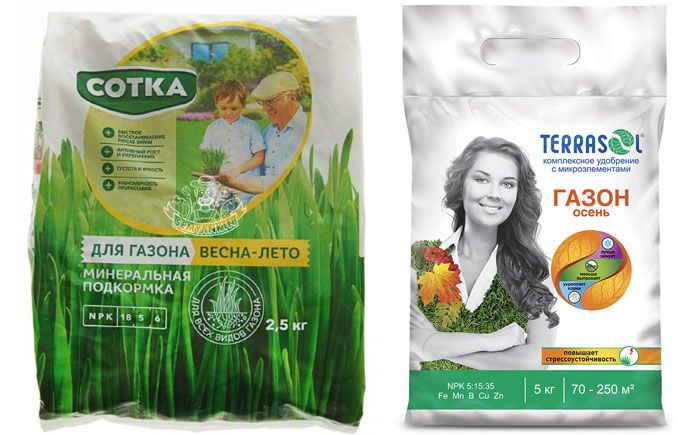
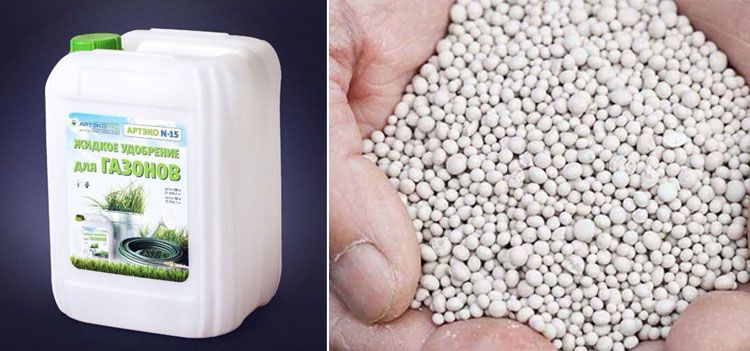
Fertilizers come in granular and liquid forms. The former is recommended for use in spring and fall.
Liquid preparations are best applied as a supplementary fertilizer in late spring or summer when the lawn has been damaged by frost, trampling, infections, or insects.
Liquid fertilizers should be diluted with water and then applied to the lawn. The nutrients are delivered directly to the roots, resulting in a quick effect. However, the results will be short-lived.
Regardless of the form of the preparation used, the following rules must be observed when feeding:
- pre-mow the lawn and clear it of debris;
- use preparations only on moist soil;
- After applying fertilizer, do not walk on the lawn for 24-48 hours;
- Do not carry out the manipulation in rain or drought, as the substances will not be delivered in full volume;
- strictly adhere to the dosage;
- Before the procedure, wear rubber gloves and wash your hands thoroughly after completing it.
If the area is small, dry fertilizer can be spread by hand. First, go over the area lengthwise, applying half the mixture, then crosswise, applying the remainder. It's important to distribute the fertilizer evenly. If the area is large, it's advisable to use a special spreader.
For an even application of liquid mixtures, you can use a watering can with a nozzle. For larger areas, pump sprinklers are recommended.
Lawn Fertilizer Manufacturers
The most effective nutritional mixtures from domestic and foreign manufacturers:
| Name | Country of origin | Application | Average cost (in rubles) |
| Aquarin "Lawn" | Russia | Dissolve in water and use in the dosage indicated in the instructions. | 300 per 1 kg. |
| Fertika (Kemira) | Each season has its own composition: "Spring," "Spring-summer," and "Fall." Application rates (grams/sq.m.): spring - 40-50; lawn creation - 100; when laying a lawn in autumn - 60-100; vegetation - 50-70. |
400 for 5 kg. | |
| Hundred square meters "Lawn" | Dosage (grams per square meter): vegetation - 50-70; when creating a lawn - 80-100; spring - 15-20. |
450 for 5 kg. | |
| Reasil | Dilute with water 1 to 100. Consumption rate: 3-10 l/sq.m. | 500 for 3 kg. | |
| BioVita with vermicompost | Used in dry and liquid form according to instructions. | 120 for 2.3 kg. | |
| Fasco | Suitable for all types of lawns during establishment and throughout the growing season. Follow the instructions. | 300 for 50 liters. | |
| Terrasol for lawns spring-summer | during the laying period - 10-20 kg per hundred square meters; during the growing season - 5-7 kg per hundred square meters. |
230 per 1 kg | |
| Bona Forte | Dilute with water in the proportions indicated in the instructions. Use for localized feeding or centralized irrigation. | 450 for 5 kg | |
| Russian lawns | 3 mixtures have been developed: for bookmarking; for the growing season; to prepare for winter dormancy. Use according to the annotation. |
600 for 2 kg. | |
| Autumn WMD | OJSC "Buisky Chemical Plant" Russia | Can be used both in autumn (late August-September) and spring (with the addition of nitrogen-containing compounds). In the former case, the rate is 20-30 g/sq.m. In the latter case, 100-150 g/sq.m. | 370 for 5 kg. |
| OMU "Gazonnoye" | Pre-sowing treatment: evenly distribute the fertilizer over the soil to a depth of 0.5 cm. Apply the next application no sooner than a couple of weeks later. Dose: 100-150 g/sq.m. Standard fertilizer: apply after pruning. Dose: 20-30 g/sq.m. |
700 for 10 kg. | |
| Complex mineral fertilizer | When creating - 50-60 g/sq.m. With normal fertilization - 15-20 g/sq.m (after pruning). |
120 per 1 kg. | |
| Green grove "Emerald Lawn" | Ukraine | Apply from April to September. Spread granules evenly over the lawn (25 g/sq.m). | 150 for 500 g. |
| Stimovit | Used for foliar feeding during drought: Dissolve 100 ml in 4 l of water. Spray the lawn (the volume is calculated for 100-125 sq.m). Repeat in a couple of weeks. |
50 for 500 ml | |
| Clean slate | Dilute one measuring spoon in 5-9 liters of water. Use 2-4 times per month. | 100 for 300 g. | |
| Novofert "Lawn Spring-Summer" | Methods of application: soil treatment; foliar feeding; spraying; processing of seed material. Observe the dosage indicated in the annotation. |
350 for 3 kg. | |
| Florovit | Poland | Apply in spring before the beginning of the growing season, in autumn from the end of August to the first of October (30-40 g/sq.m). | 270 per 1 kg. |
| Agrecol | A wide range of lawn products is available. Apply according to instructions. | The price depends on the mixture type and weight. For example, "Fast Carpet Effect" lawn fertilizer costs approximately 1,150 rubles per 5 kg. | |
| Target | Apply from April to September once a month 1 kg/40 sq.m (when fertilizing manually), 1 kg/50 sq.m (when using a spreader). | 500 for 4 kg. | |
| Long-lasting effect compound | Germany | Effective for 3 months. Scatter over the lawn (20 g/sq.m). | |
| ASB Greenworld | The fertilizer lasts for 3 months. A 3 kg package is suitable for 120 square meters. | 700 for 3 kg. | |
| Yara | Norway | Consumption rate: 20-30 g/sq.m. Re-treatment can be performed after a month. | 450 for 5 kg. |
| Pokon | Netherlands | Produced in granules. Spread over the surface (20 g/sq.m). | 950 for 900 g. |
DIY Lawn Fertilizers
You can make fertilizer from common nettles. It's important that they don't have seeds. Place about 1 kg of nettles in the bottom of a barrel and add 6-8 liters of settled water. Let the solution sit for 10 days, stirring it daily.
Before use, dilute the liquid with water in a ratio of 1 to 10 for watering, 1 to 20 for spraying.
By applying fertilizer regularly, consistently, and following all the rules for applying mixtures, you can achieve a healthy, beautiful, and vibrant lawn. It will be resistant to diseases and pests, as well as aggressive environmental influences and mechanical stress.