You can grow honey mushrooms at your dacha, at home, or in your garden. They won't lose their flavor or aroma if you follow the planting instructions.
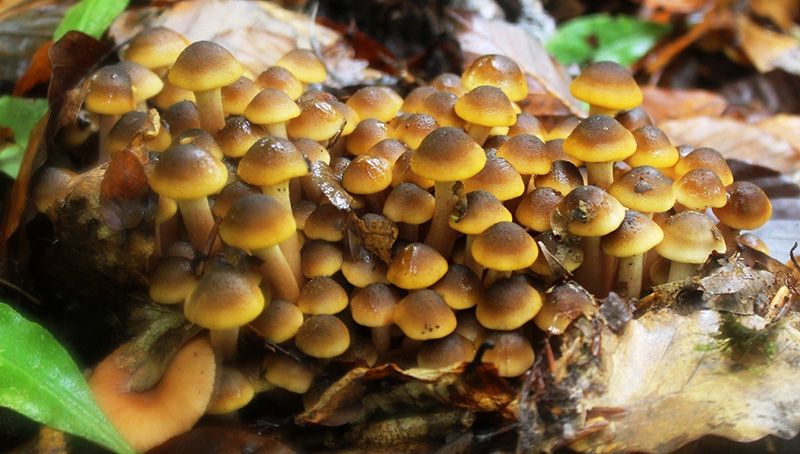
What kind of honey mushrooms can you grow yourself?
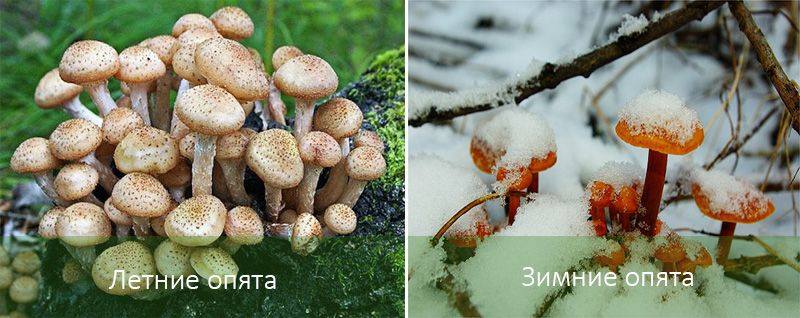
At home, people grow both summer and winter honey mushrooms. The former is usually preferred because it's less expensive and space-consuming. However, you can also grow summer mushrooms yourself, though you won't be able to do this on a windowsill; you'll need a space like a hangar or basement.
Seed material and technology for its production
Honey mushrooms are grown in two ways (depending on the seed material): either the fruiting body, i.e. old mushrooms, or mycelium.
First technology step by step:
- remove the caps (usually they have a circumference of about 8 cm, with a dark brown tone on the inside);
- the material is placed in a container with water and soaked for 24 hours (without rinsing or straining);
- the caps are crushed to a pulp;
- the resulting mixture is passed through gauze;
- the liquid is poured into a glass vessel and used for sowing;
- grooves are made in the wood of a stump or log and the resulting liquid is poured into them;
- The grooves are covered with sawdust.
The method of planting from such seed material can be used at any time of the year in a closed structure.
Mycelium is the mycelium from which honey mushrooms, champignons, and other mushrooms are grown. It can be found in the forest in autumn:
- the mycelium is divided into pieces 2*2 cm;
- holes are made on the sides of the hemp;
- pieces of mycelium are placed into the slots and covered with moss;
- the top of the holes are wrapped with polyethylene to create greenhouse conditions;
- when frost sets in, the mycelium is covered with coniferous branches;
- If the planting stump is located in an open area, it is protected from excess moisture: it is cleared of snow accumulation;
- Spruce branches, polyethylene and moss are removed in June for summer trees, and at the end of September for winter trees.
The advantage of growing from this material is that it can be kept outdoors.
Necessary conditions for growth
A home mycelium is built at home, in a basement, on a balcony, or in a garden.
- temperature from +10 to +25;
- humidity 70-80%;
- mushrooms do not tolerate bright light, they require semi-darkness;
- heating in winter, cooling in summer;
- ventilated room: ventilation or open windows.
Sanitary regulations must be observed to prevent mushrooms from becoming infected with diseases and insects. If you follow all the rules, there will be no problems growing them.
Methods of growing honey mushrooms
- on logs or stumps;
- in bags in the basement;
- in a greenhouse (suitable for summer residents);
- in three-liter jars.
Each mushroom picker can choose the most suitable and least expensive method for him.
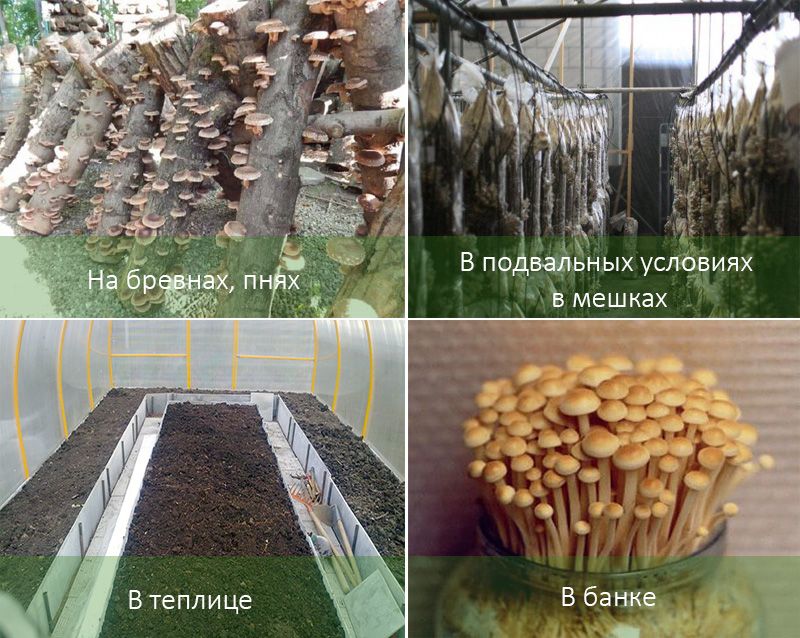
On the logs
The log should be damp, bark intact, but not rotted. If the material is dry, soak it in water for 2-3 days. Afterward, remove it and let the liquid drain.
There are three methods of mushroom cultivation:
- Dig grooves 1 centimeter deep and 4 centimeters long, spaced 10-12 centimeters apart. Insert the mycelium sticks into the grooves with clean hands. Wrap the top with plastic, poking several holes in it for air circulation. Move the log to a semi-dark place. The temperature should be 20 degrees Celsius, and the room should be humid. The mushrooms will begin to germinate in 3-4 weeks.
- Outdoors, in the shade, dig holes 15 cm deep. After watering, place sticks containing mushroom mycelium horizontally into the holes. To prevent snails from destroying the mushrooms, sprinkle the soil around the holes with wood ash. As soon as the soil dries, water it. In cold weather, cover the log with leaves.
- A log containing mushroom mycelium is placed in a barrel filled with soil. It is then placed on a balcony at a temperature of between 10 and 25 degrees Celsius.
It is better to plant mycelium in April-May or in August.
On the stumps
One of the simplest methods. Rotting tree stumps or logs are suitable for sowing.
Planting should be done in warm, but not extremely hot, weather. The mycelium is cut directly from the wood.
Growing honey mushrooms on stumps is easy. Dig grooves in the stumps and insert one- to two-centimeter-sized pieces of mycelium. Cover the grooves with sawdust. Water the surrounding soil.
The stump should be kept in a darkened room or outside in the shade. At home, it is kept in the basement or on the balcony, but away from direct sunlight.
In the greenhouse, basement
Stumps, logs, firewood, and blocks containing mycelium or spore-containing liquid are moistened and placed in a greenhouse. The wood is watered to prevent it from drying out. Honey mushrooms are grown in jars or bags in the greenhouse. The harvest appears from May to September.
It's recommended to use substrate blocks, either purchased from a store or made at home. Compost is used as a filler.
The material is placed in a damp area. Initially, it is covered with straw and regularly moistened. After a while, it is taken outside and buried.
When growing honey mushrooms in basements, it is recommended to use bags filled with sawdust for sowing.
Step-by-step instructions:
- A 2-5 liter bag is filled with 200-500 g of dried sawdust. The material is taken from pine or any deciduous trees (except oak).
- The growing medium consists of 30% barley, oats, pearl barley, buckwheat, or sunflower husks. A teaspoon of chalk is added to the substrate.
- All ingredients are mixed and placed in water for 60 minutes.
- In the same water they are sterilized for a quarter of an hour by boiling.
- Excess water is poured out and the mixture is placed in the oven on low heat for 20 minutes.
- The material must be moist and distributed in equal parts into well-dense polyethylene bags.
- The mycelium is divided into pieces of 20 g each and spread on top of the substrate with clean hands.
- Cover everything with cotton wool on top and tie the bag.
The basement temperature should be between 12 and 20 degrees Celsius. It should have good ventilation and heating during cold weather.
Don't touch the bags for a month. Bumps will appear inside them: these are future mushrooms. Untie the bags and remove the cotton wool. Honey mushrooms grow in the direction of the air flow. To keep their roots (stems) short, they require additional light.
Top.tomathouse.com recommends for beginners: how to grow honey mushrooms in a jar?
Even beginners can grow honey mushrooms in a jar. Place the container on a balcony or windowsill.
Step-by-step technology:
- The substrate is prepared from sawdust and bran (3 to 1). Sunflower husks, buckwheat husks, and crushed corn cobs are sometimes used instead.
- For 24 hours, the substrate is filled with water, squeezed out and lightly compacted.
- Next, place it in three-liter jars (1/2 full).
- Using a long stick (up to 2 centimeters in diameter), make indentations in the substrate down to the bottom.
- The jars and substrate are pasteurized to prevent mold from forming. To do this, they are placed in a pan of water and boiled for 60 minutes over low heat.
- When the contents of the containers cool to +24 degrees, they are closed with plastic lids in which 2 mm holes are made.
- The mycelium is introduced through these holes, usually using a syringe.
- The jars are placed in semi-darkness, at a temperature of +20, or better yet +24 degrees.
- Mushrooms begin to grow after four weeks. The first shoots appear after 15-20 days. Immediately after, the jar is moved to a north-facing window.
- When the mushrooms reach the lid, it is removed. The neck is wrapped with a strip of cardboard, creating a kind of collar.
- Mushrooms are always sprayed with water. As they ripen, they are trimmed and the stems pulled out. A new crop will appear in their place in two to three weeks.