Forest meat, as mushrooms are jokingly called. Their benefits are undeniable, but before heading into the forest, it's important to be knowledgeable about these unusual inhabitants. After all, along with edible mushrooms, there are also some that are dangerous.
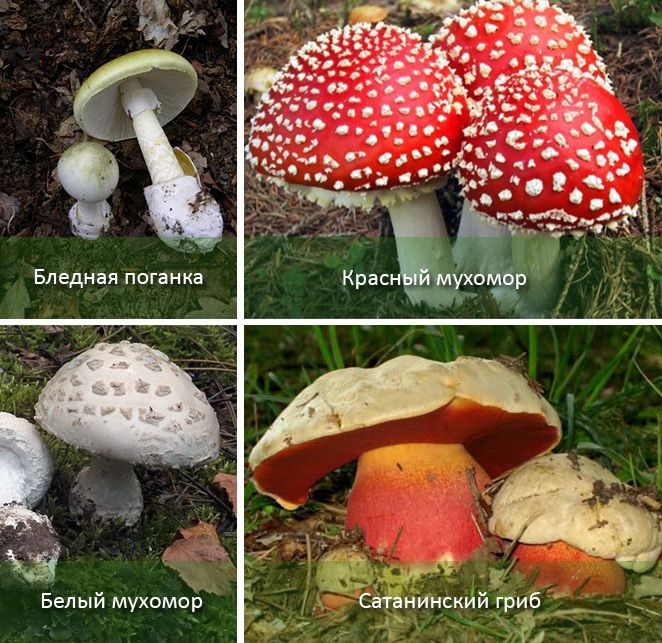
It is important to know their properties and differences in order to avoid harm to health.
Content
Groups of poisonous mushrooms
Mushrooms are divided into groups depending on the symptoms they cause:
- gastrointestinal tract intoxication;
- CNS damage;
- fatal outcome.
Description of dangerous mushrooms
It is important to know what poisonous mushrooms look like and to be able to distinguish them from the edible ones they often disguise themselves as.
Important! The photos in the table are clickable. Click to enlarge.
| Name | Description | Growing period and area | Similarity to edible and distinctive feature | Photo for distinction |
| Death cap | Cap: yellow-brown, pale green, or greenish-olive. Flat or slightly rounded, ovoid in young caps. Underneath are white gills. The stem is long, widened towards the base, and has a strong white ring on top. |
August - September.
Mixed, deciduous forests. Europe, Asia, North America, central Russia. |
Champignon, greenfinch. Plates under the cap: |
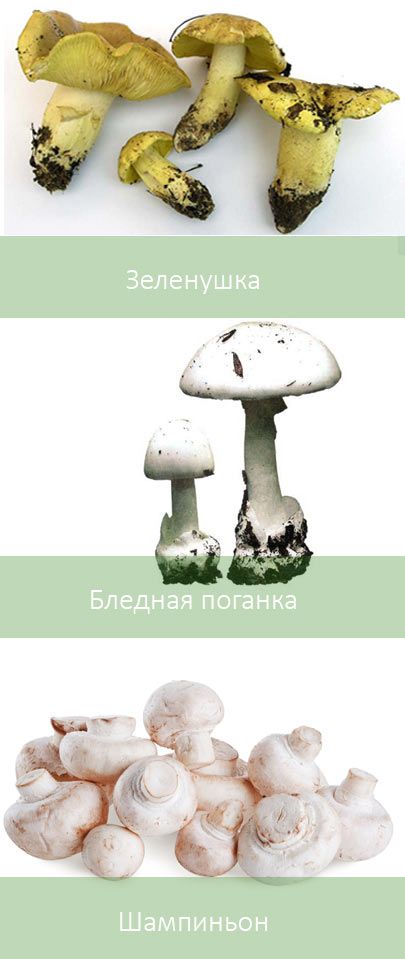 |
| Red fly agaric | Cap: Bright red, can be orange. Flat in adults, round in juveniles. The surface is covered with a scattering of white growths that wash away in rain.
The stem is long, white, fleshy, with a ring-shaped film at the top. |
August - October
Mixed forests, birches, spruces. The temperate climate of the Northern Hemisphere, Europe, Asia, Australia, and is widespread in Russia. |
Caesar's.
Cap, stem and gills: in Caesar's cap - smooth, yellow; in red cap - covered with white growths, white. |
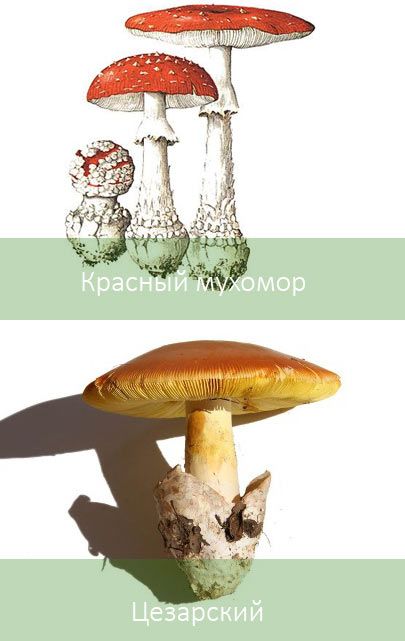 |
| White fly agaric | Color: white.
The cap is round in young plants, half-open in adults, up to 10 cm, with fine fringe on the edges. The stem resembles a fibrous cylinder, with a swollen base and a wide ring at the top. It has a chlorine smell. |
June - August.
Humid coniferous and deciduous forests. Warm regions of temperate climate. |
The float is grey.
Ring and unpleasant smell: the fly agaric has one, the float does not. |
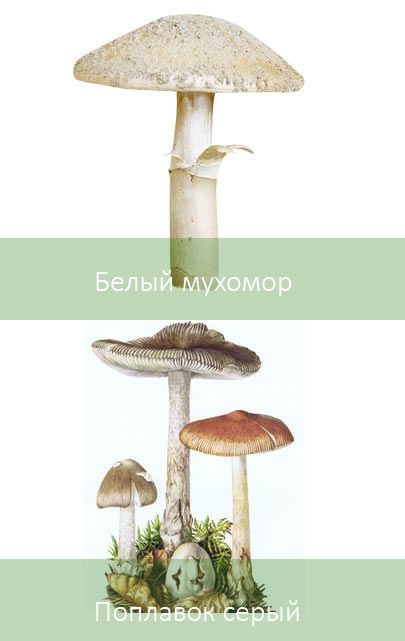 |
| Galerina marginata | The cap and stem are yellowish-brown, with a membranous ring present in young specimens. With age, the cap becomes flatter and darker. | June - October
Coniferous forests. Northern Hemisphere, continental Asia, Australia, Caucasus. |
Honey fungus, autumn and summer.
Galerina has a darker cap, without scales. |
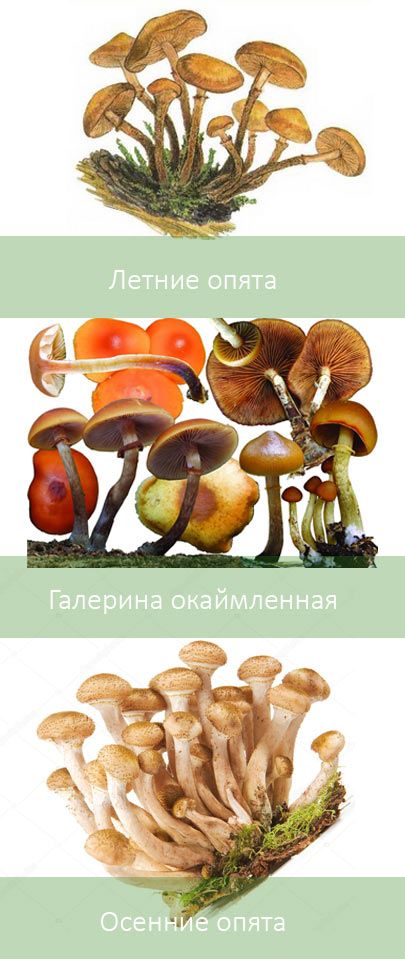 |
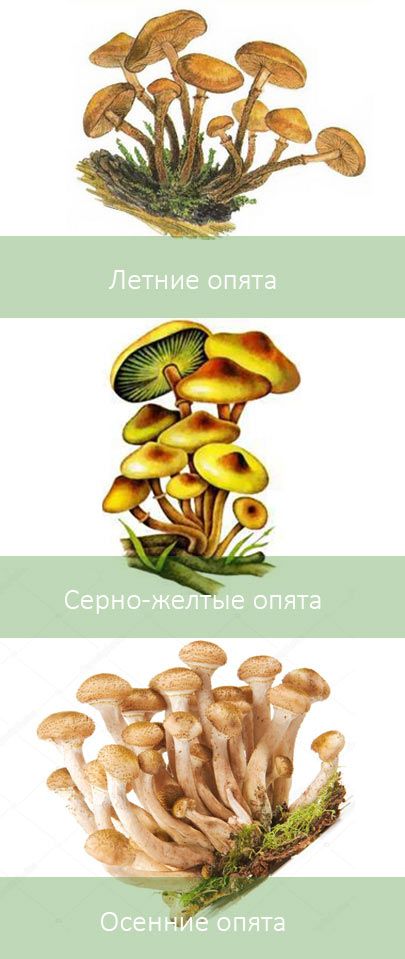
| Sulphur-yellow honey mushrooms | Caps: grayish-yellow, reddish in the center. Small in size (no more than 7 cm).
The stem is light, smooth, fibrous. The pulp is light yellow in color, the taste is bitter, and the smell is unpleasant. |
June - October. Large groups on rotten wood. Eurasia, North America, throughout Russia. |
Honey fungus autumn, winter, summer, grey-lamellar.
Edible - there is a ring-shaped film on the stem, the plates under the cap are always light-colored. Inedible - the plates are grey-yellow in colour, darkening over time, there is no film. |
 |
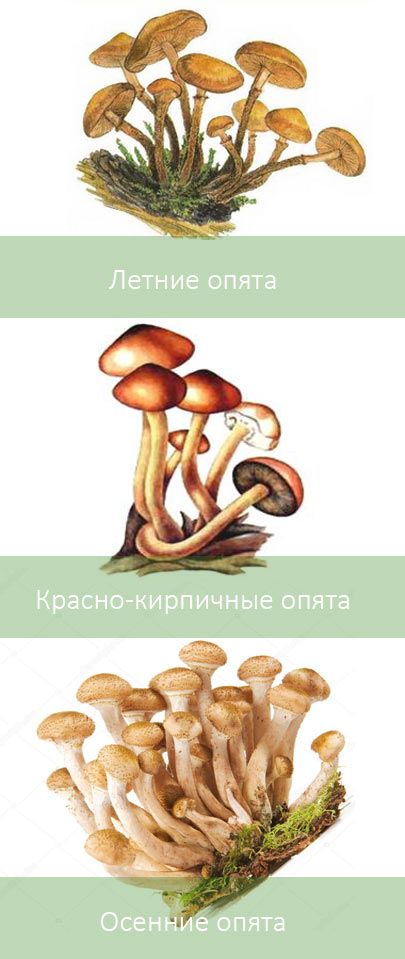
| Brick-red honey mushrooms | Cap: bright orange, brick-red. Hemispherical in shape, later flattening. Margins with whitish residual fibers. The stem is up to 10 cm long, yellow on top and brownish on the bottom. A ring is visible at the top. |
June - October.
Clustered groups on stumps and dead wood left over from deciduous trees. Eurasia, North America, throughout Russia. |
Honey fungus autumn, winter, summer.
Edible - there is a ring-shaped film on the stem, the plates under the cap (tubular layer) are always light. Inedible - the plates are white-pink, quickly turning dark brown with a purple tint, there is no film. |
 |
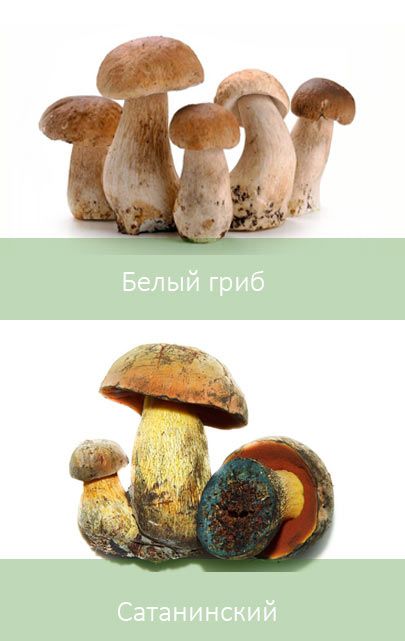
| Satanic | Cap: dirty white, fleshy consistency. The underside is yellow, turning red over time.
The stem is thick, resembling a barrel. The flesh is white, pink towards the base. The smell of young ones is pleasant, while that of adults is putrid. |
June - September. Deciduous forests with calcareous soil. Southern Europe, European part of Russia, Caucasus, Middle East. |
White.
Flesh: white in the white one; red when cut, then blue in the satanic one. |
 |
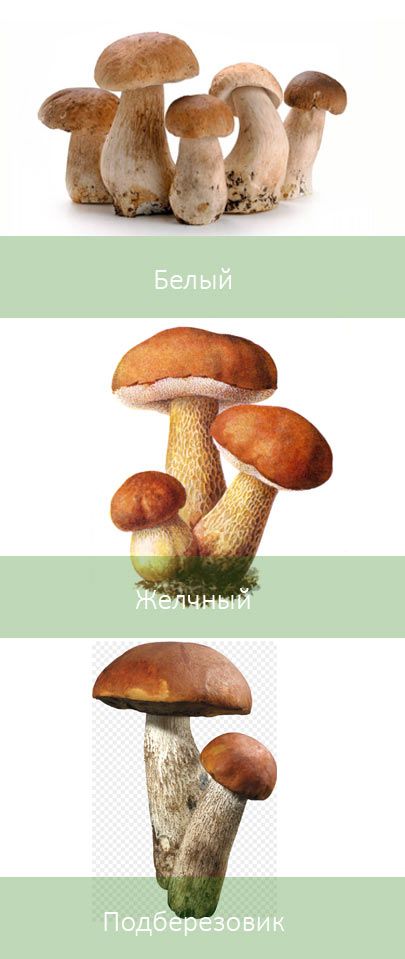
| Gallbladder | Cap: yellow, gray, rarely chestnut-brown, or yellow, light, or rarely dark brown. Hemispherical shape, flattening with age.
The stem is yellowish, with a mesh structure of dark brown stripes. The pulp is light-colored, turns red when cut, but sometimes does not change color, bitter, odorless. |
June - October.
Coniferous, deciduous forests. It grows in forested areas on all continents. |
White, birch boletus.
The mesh on the stem: in white it is lighter than the main one, in gall it is darker. |
 |
| Fiberglass | The cap is conical, with radial cracks and scales, earthy in color. The leg is whitish in color, reddish in adults. The plates are pale brown, brown. |
August - September.
Deciduous, coniferous forests. European part of Russia, Western Europe, Caucasus, East Asia, North America, North Africa. |
Champignon (only young). Ring on the stem: the champignon has one, the fiber mushroom does not. Colour of spore powder: for champignon it is dark brown-violet, for fiberwort it is yellow-brown. |
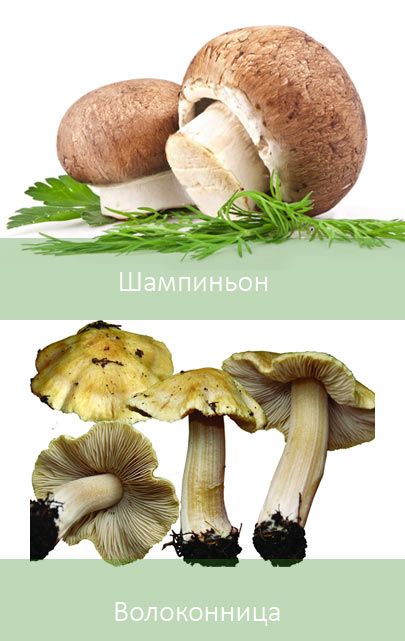 |
| Orange talker (false chanterelle) | Cap: orange-copper-red in color. Funnel-shaped with a smooth edge.
The stem tapers towards the base, up to 10 cm. The pulp is white-yellow, the smell is sweetish, unpleasant. |
July - October. Coniferous, small-leaved forests. European part of Russia, Siberia, Primorsky Krai. |
Fox.
Color, cap, stem, smell: chanterelle's cap is bright yellow, concave, smooth, with wavy edges, dense elastic consistency, pleasant smell; talker's cap is brighter, reaching red, smooth edges, hollow, thin, when broken it emits a white color, unpleasant smell. |
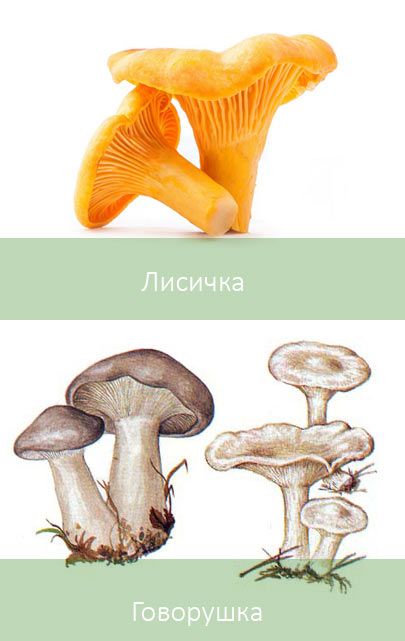 |
| Pepper | Cap: light brown to reddish-brown. Rounded-convex, flattening with age; up to 7 cm.
Stem: lighter in color than the stem. Cylindrical in shape, tapering toward the base. |
July - October. Coniferous pine forests, less often spruce, mixed, deciduous. Europe, the European part of Russia, the North Caucasus, Siberia, the Urals, the Far East, the island of Tasmania. |
Flywheel, butter.
Cap: edible ones are light brown, inedible ones they are darker, reddish. |
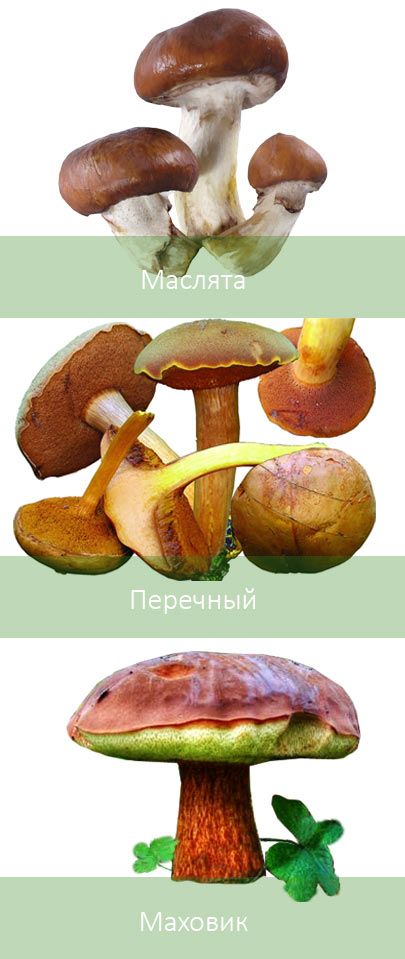 |
| Cortinaria splendens | Cap: grayish-greenish-yellow, with yellow-brown spots or a darker center. Initially hemispherical, it becomes convex with age, and mucus is present.
The plates are tightly pressed to the stem, yellow with a greenish or orange tint. |
August - September.
Coniferous and mixed forest. Europe, Penza region. |
Greenfinch.
The greenfinch's cap is more convex and does not have a yellow tint. |
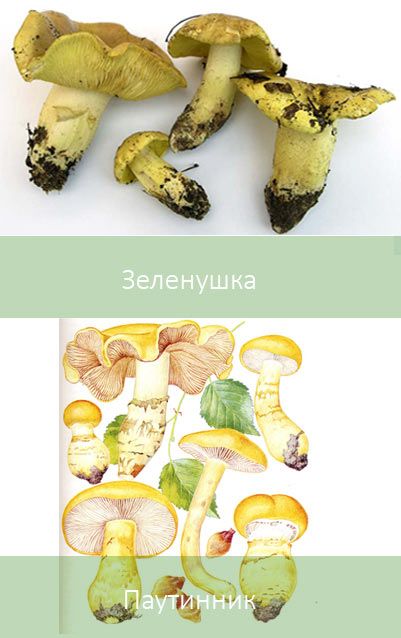 |
| Piglet | Cap: dirty yellow, grayish-brown. Flat, with rounded edges and a concave center, wavy at the edges.
The flesh is pink and quickly darkens when cut. |
July - October.
Deciduous, mixed, coniferous forests. Everywhere in forested areas. |
Milk mushrooms.
The flesh of the milk mushroom is light-colored and remains light-colored over time when cut. |
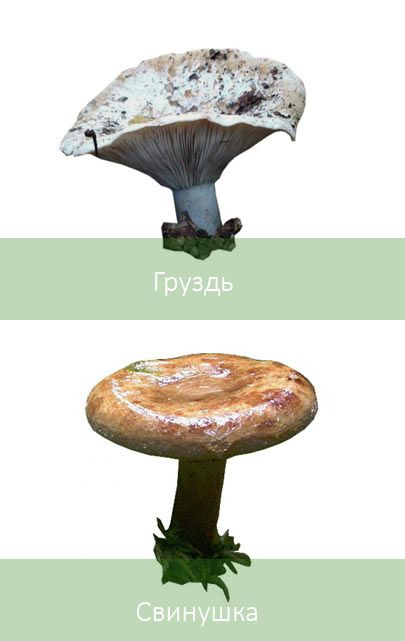 |
More information about poisonous mushrooms
There is some more information to keep in mind.
Death cap
The most dangerous species. Heat treatment does not destroy its toxic properties. Symptoms of poisoning do not appear until the second day and are usually fatal.
Even if a toadstool accidentally touches a good mushroom, its poison permeates it completely.
Red fly agaric
The fly agaric genus contains many non-poisonous species: the solitary, ovoid, and gray-pink. This variety is a deadly poisonous mushroom.
Satanic
This mushroom, so similar to the porcini mushroom, is even considered conditionally edible after prolonged soaking and cooking. However, some of the toxins it contains may remain, so it's best not to risk your health.
Galerina marginata
The mushroom was previously widespread only in mountainous areas, but is now increasingly spreading throughout central Russia.
Symptoms are similar to death cap poisoning. They only appear on the second day. Visible improvement may occur on the third day, but the destructive process continues. Never self-medicate.
You can also distinguish galerina from honey fungus by drying it. It will lose its color, unlike edible mushrooms.
Piglet
This mushroom was controversial until the 1980s. It is now considered dangerous. The toxin found in pig mushrooms gradually accumulates in the body, so its negative effects do not appear immediately.
Red-brick honey fungus
A mushroom that, like the pig mushroom, has generated much controversy. In Russia, it was reclassified from poisonous to conditionally edible. And in Europe and Canada, it's classified as edible.
Measures to avoid poisoning
If you have any concerns about mushrooms, there are two ways to prevent unpleasant consequences. You should do the following:
- Wash, boil for half an hour, drain, and rinse several more times, preferably under running water. Repeat two or three times. The toxins are removed with the decoction.
- Wash, cut, string, hang in a warm, ventilated area, and dry. Avoid hanging on radiators or stoves, as this will release the toxins.
These methods do not work on death cap.
Actions in case of poisoning
At the first symptoms of poisoning, you must call a doctor.
Before his arrival, first aid must be provided:
- Rinse the stomach: by drinking a large amount of water (more than a liter) or strong tea; by inducing vomiting (by pressing on the tongue as close to the root as possible).
- Lie down.
- If there is no diarrhea, take laxatives (1-2 g per 1 kg of weight).
- Drink activated charcoal (0.5-1 g per 1 kg).
- Place heating pads on your feet and stomach (to improve blood circulation).
Save the mushrooms for an accurate diagnosis.