Tomatoes are so popular that it's hard to imagine a garden without them. Numerous varieties are adapted to a variety of growing conditions. This poses the question for gardeners: how to fit all the plants into a limited space.
One method is growing upside down. Let's explore its essence, its convenience, and its pros and cons.
Content
An original way to grow tomatoes – upside down
It's difficult to determine who originated the idea. Some believe it was pioneered by Dutch scientists during their development of a technology for rapidly increasing the root mass of seedlings. Another theory is that American farmers were the initiators of this unusual method.
Russian amateur gardeners have adopted an unconventional approach. Craftsmen even construct special greenhouses where they house containers with upside-down bushes.
Pros and cons of the method
Many gardeners across the country have tried this unconventional tomato growing technique. Over the years, they've compiled a detailed list of the advantages and disadvantages of this technique, sometimes referred to as vertical farming.
The undeniable advantages include:
- Harvesting a decent harvest from small plots. The plantation is established above other crops. Strawberry beds are commonly used, as the berries' ripening times vary.
- Hanging gardens aren't just for the dacha. Urban balconies, loggias, and window openings are also suitable. You can even harvest year-round.
- Using the free space of greenhouses with low-growing crops.
- Save time and effort on fighting weeds, pests, and diseases. No need to hill up the bushes or remove side shoots—the trunk isn't strained by any number of ripening tomatoes. Overwatering and waterlogging are eliminated.
- There is no need to install various structures to tie up the stems.
Sometimes gardeners use hanging containers to zone their plots and disguise unsightly walls and fences. These "beds" are portable and can be moved around the property to create new compositions.
A drawback of this method is the more careful selection of varieties, due to the fact that tomatoes grow in a limited amount of soil. Other disadvantages include the need for more frequent watering and fertilizing.
Secrets of technology
A good harvest of upside-down tomatoes depends on strict adherence to the growing procedures. While these are generally no different from standard ones, a number of nuances are worth noting.
Selecting a variety
Choosing the right variety is paramount. Even a tried-and-true variety won't produce the desired results when grown upside down. Preference is given to tomatoes with slender, vine-like stems, which normally require support and staking.
Fruit size is also important. Small-fruited varieties and cherry tomatoes are best. Experienced gardeners recommend the following varieties and hybrids:
- Pearl;
- Red Hunter;
- Wagner Mirabelle;
- Ampelous F1;
- Black bunch;
- Roma;
- Arctic;
- Mascot.
Preparing containers
Sufficient volume is essential. 5-liter pots, plastic bottles, and buckets are recommended. For very small tomatoes, such as dwarf cherry tomatoes, 3-liter containers are acceptable.
The following requirements apply to containers:
- Material: food grade plastic; metal is not recommended due to its heavy weight.
- The presence of a lid that prevents premature drying of moisture.
- The diameter of the hole in the bottom is 3-5 cm. It is easy to make it yourself; simply turn the bottles upside down, cutting off the bottom.
- The handles should be able to support a load of 20 kg. For water containers, you can weave a kind of mesh from cords.
Lazy gardeners use special kits for growing plants upside down, sold in specialized stores.
Priming
Soil can be either purchased or prepared at home. In the former case, the best choice is a special tomato mix, which already contains all the nutrients necessary for growth and fruiting.
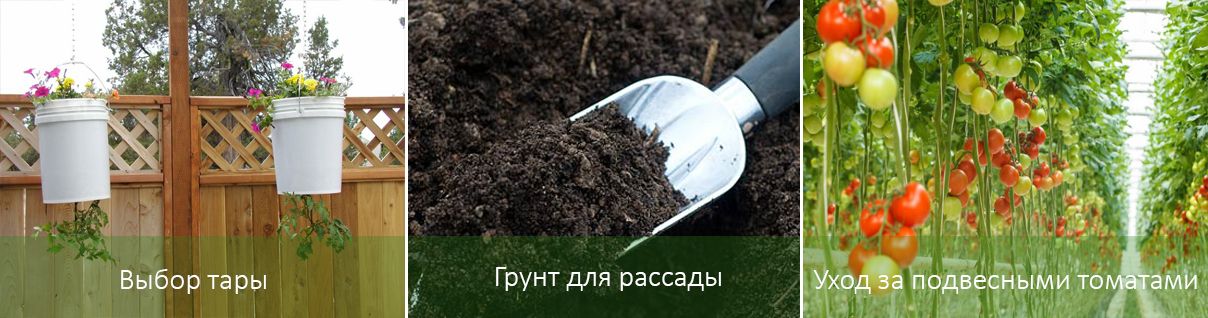
Prepare your own nutrient substrate from equal parts compost, peat, and humus. Add a tablespoon of superphosphate and ammonium nitrate to 10 liters of potting soil. Mix thoroughly.
Seedlings for the inverted method
Sowing seeds and growing seedlings are carried out according to standard methods. The work is significantly simplified by the fact that there is no need to diligently provide additional light for the seedlings. Proponents of the "inside-out" method claim that elongated stems are the key to a good harvest. All other steps are carried out according to the standard procedure.
Planting seedlings
It's easier to germinate seeds in peat pellets. The time to transplant seedlings to their permanent location is determined by their roots: when they completely envelop the root ball, they're ready to be transplanted. If they're in pellets, this moment is unavoidable.
There are two methods for planting seedlings. In the first, the container is first filled with potting soil, then turned over, and young plants are planted in the hole in the bottom. The pots can be turned over only once the tomatoes begin to grow.
In the second method, the container is already suspended. A seedling is carefully inserted into the hole in the bottom. Its roots are inside, and the stem and leaves are outside. Experienced gardeners recommend planting the seedlings 8-10 cm deep, so the tomato plants will more quickly establish themselves and begin flowering.
The next step is the retaining layer. This method uses sphagnum moss, a dense, thick fabric that allows both moisture and air to pass through, and mineral wool.
The third step is to carefully add the substrate, ensuring that the roots aren't crushed or broken. A layer of mulch is placed on top to prevent excessive moisture evaporation. It will also help maintain the soil's looseness. Hydroponic material is the best option.
The final step is to hang the containers in well-lit areas. Space them 15-20 cm apart to allow for adequate air circulation. Drafts are avoided. This option is ideal for placing upside-down containers in plastic bottles.
Upside down tomato supports
It's important to plan in advance where and how to hang the containers with tomato plants. A wide variety of objects and elements of garden structures can serve as supports for the pots:
- Tree branches providing light shade.
- Walls and fences, where strong hooks are first driven in.
- Crossbars suitable for heavy loads, for example, under the roof of a gazebo or terrace.
- Ladders and stepladders that have served their purpose are securely anchored in the ground.
- Flower trellises, pergolas, arches.
- Specially prepared wooden beams or metal pipes driven into the ground.
- Forged or cast flower stands look impressive, but they are an expensive pleasure that not everyone can afford.
The height of the supports should be such that it is convenient to water the suspended plants without using a stool or stepladder.
Caring for an aerial garden
Hanging beds are much easier to care for than traditional ones – there are no weeds, which means there is no need to weed them.
Hilling the stems is also unnecessary. Pest and disease control is kept to a minimum—preventative measures are sufficient to protect the bushes from their effects.
The most basic and sufficient care for upside-down tomatoes is watering and fertilizing. Irrigate every two days, or daily during extreme heat. Fertilize every 10-14 days. You can use ready-made fertilizers (such as Fertika or Agricola) according to the manufacturer's recommendations.
Periodically check the containers to see if the substrate has settled. If it has settled more than 2 cm, add more nutrient mixture.
Top.tomathouse.com warns: mistakes when growing tomatoes upside down
The technology for growing upside-down tomatoes doesn't seem complicated. However, potential mistakes can lead to crop losses. These occur when gardeners fail to recognize the difference between growing the crop in open ground and in a confined space.
Untimely watering. Potted plants have nowhere to get moisture from; their supply is limited. Therefore, container-grown plants are watered much more frequently. The daily water consumption per plant is approximately 5-8% of the root ball's volume.
The soil isn't covered with a mulch layer. Even under the cover, water evaporation is high, causing the soil to dry out. At the same time, the soil compacts, and the roots suffer from oxygen deprivation.
The lack of a retaining layer leads to soil leaching. Failure to follow a fertilizing schedule. Soil in pots depletes very quickly. Fertilizing is necessary for tomatoes even in open ground, but in pots it should be mandatory, at least once every two weeks.
It is unacceptable to use soil taken from beds where nightshades were grown for planting - in this case, diseases are difficult to avoid.