The genus Alocasia includes more than fifty evergreen plants ranging in height from 40 cm to 2 meters or more. They are common in tropical and subtropical zones (Asia, Australia, China, Taiwan, Malaysia, Central and South America). In our region, they are used to decorate both rooms and gardens. Other names include trefoil, arma, and weather plant.
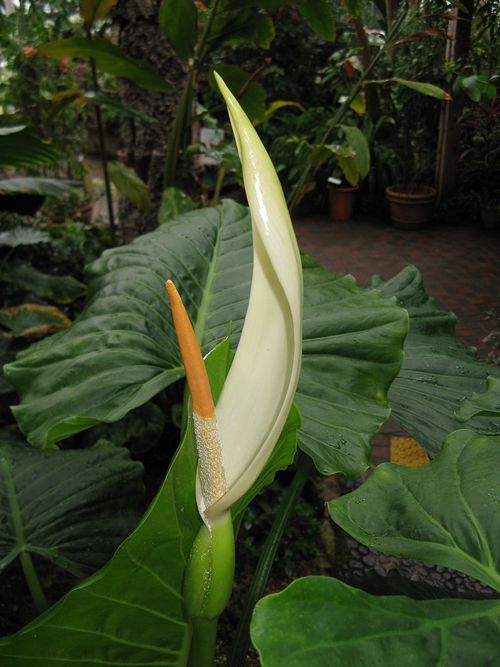
In its native habitat, alocasia grows in tropical forests, where during heavy rains, when there's excess moisture, the plant "weeps." Excess water is released through the leaves. Knowing that humidity rises before rain, alocasia leaves can be used to predict the weather. Houseplants "weep" when overwatered.
Folk beliefs and superstitions suggest that this plant is dangerous to keep in the home due to its toxicity. However, with proper care, this property will not cause any serious problems.
Description
The distinctive feature of this genus is its leaves. They are large (up to 50 cm), dense, oval, and pointed, with prominent veins on a glossy surface and numerous stomata (special breathing holes). Their shape often resembles a heart with textured edges and a pointed tip. The leaves are attached to a sturdy stem by succulent petioles. Their unique attachment to the short stem creates the impression that the stem is completely absent. This creates a striking green mass of decorative leaves.
One alocasia bush holds up to 8 leaves; after 9 leaves appear, the first ones die off and fall off.
Alocasia flowers are inconspicuous against the backdrop of their spectacular foliage. The inflorescence is a pink, white, yellowish, and green spadix. A yellow-green petal encircles it on one side. Indoors, the plant rarely blooms. It's best to remove immature inflorescences, as they drain the flower's energy, weakening it and stunting its growth. If the flower does bloom, you can expect exotic berries with seeds (up to 5 in each). The berries resemble a sea buckthorn branch.
Types
Popular varieties of Alocasia:
| View | Peculiarities |
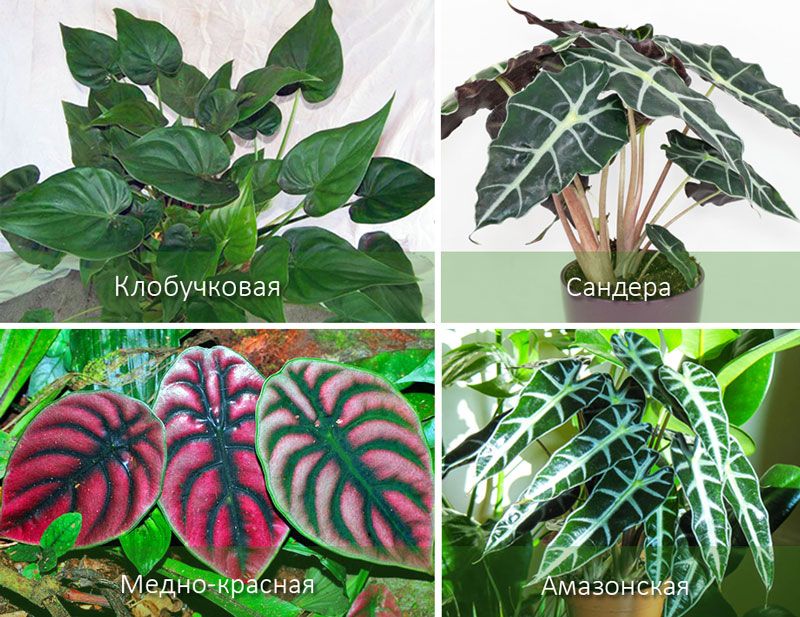
| Sander | Large, elongated, dark green leaves with bright white veins and a feathery margin. A distinctive feature is the metallic sheen and light lateral veins. |
| Polly | It is a Sander hybrid and blooms more frequently than other varieties. |
| Amazonian | A medium-tall variety (pinkish-green stems with dark veins, leaves up to 60 cm tall). The leaves are dark green, shield-shaped, with small notches and paired veins on the sides. |
| Copper-red | A small variety with oval, heart-shaped leaves. Distinguishing features include a reddish color. |
| Cowled | They reach one meter in height. The large leaves range in color from deep emerald to dark green. They also feature distinctive swellings at the petiole attachment. |
| Large-rhizome | The leaves are oval and heart-shaped. The veins at the base of the blade are clearly visible. This is a large variety, with a trunk reaching 2 meters. The fruits are bright red. This variety is called Alocasia variegata. Its leaves are smaller, variegated, and feature large white spots. |
| Fragrant (Aromatic) | A herbaceous species growing up to 1 m tall. It is distinguished by the different shapes of its old leaves (oval, elongated) and young ones (shield-shaped). It flowers extremely rarely. |
| Macrorhiza Stingray (variegated) | A large variety growing up to 2-3 meters in height. Ideal for greenhouses and conservatories. Vigorous, richly colored foliage with a rounded, heart-shaped form. |
| Black Velvet | True to its name, this variety's leaves are velvety black-burgundy. The shape is oval-shaped, and the flowers are pink. It blooms with proper care. |
| Lowe | The small trunk forms branches underground and reaches a height of 1 meter. The arrow-shaped or oval green leaves have pale stripes. The underside of the leaf is dark purple. |
| Venti | A large, cultivar of alocasia. The leaves are gray-green with a metallic sheen. The reverse side is dark red. Grows well in partial shade. |
| Dragon | It has light green, oval-heart-shaped leaves with wide, dark green veins. The unusual foliage resembles scales on a skin or the wings of a fantastical dragon. |
| Sander | It is distinguished by its picturesque arrow-shaped leaves, combining shades of green, bronze and purple with enlarged veins. |
| Calidora | The largest alocasia. A hybrid variety obtained by crossing the fragrant alocasia and gagaena. The leaves are huge, glossy, and a rich green. Grown in winter gardens and greenhouses. |
| Portodora | A new hybrid. Giant leaves with wavy, serrated edges are borne on purple/brown petioles. |
| Reginula | It is distinguished by glossy dark green leaves with an elongated tip. |
| Bambino | A hybrid of the Sander variety. Considered a miniature variety, its height does not exceed 40 cm. It has narrow leaves with a pointed tip. |
| Silver Bambino | A small, compact plant (up to 30-35 cm tall) with matte silvery leaves with light veins. The underside is dark red. |
Home care
Increased humidity is achieved by regularly misting the broad leaves (a couple of times a day). It's best to use soft water for this purpose, otherwise unsightly limescale stains will remain.
Care features by season:
| Parameter | Winter | Spring | Summer | Autumn |
| Air temperature | Not less than +18ºС. Limit sudden temperature changes during ventilation. | +21…+26ºС | ||
| Humidity | High | |||
| Watering | Irrigation once a week. | Water every 3 days. At high temperatures – daily. | ||
| Lighting | Adding artificial light for 1-2 hours (for varieties with variegated foliage). | Intensive for newly planted plants. For flowers with dark green leaves - light shading. Avoid exposure to direct sunlight. |
||
| Location | Southern direction | East/west facing windows. | ||
| Features of air | Eliminate drafts. Ventilate the room moderately. | |||
Watering
Watering features depending on the season:
| Season | Features of watering |
| Spring-autumn | Abundant. Root watering is combined with surface irrigation (several times a day). |
| Winter | Regular, average (do not allow the soil to dry out). |
Top dressing
During the active growth period (March-October), alocasia requires mineral fertilizer. Various commercial houseplant fertilizers are suitable. Add them to the water when watering twice a month.
Fertilizer table with application rates and application times:
| Top dressing | Quantity required | Period of contribution |
| Potassium sulfate | 10-15 g | Summer months |
| Superphosphate | 5-10 g | |
| Phosphorus flour | ||
| Urea | 15-20 g | Spring months/June |
| Ammonium sulfate | 10-15 g |
Planting, transplanting, propagation
Alocasias are repotted in ideal conditions once every four months. The procedure depends on whether the plant will be divided or not. If dividing the plant is necessary, remove the soil from the rhizome. If the goal is simply repotting, the soil ball is left in place.
You can propagate this tropical beauty:
- rhizome (similar to a tuber);
- cuttings;
- seeds.
The seeds are planted in the spring in sand and peat, buried 1 cm deep. The crops are then watered and covered with plastic film, creating a greenhouse effect. Seedlings appear in 18-22 days. Small sprouts are transplanted into individual containers. The familiar decorative foliage is only visible on year-old plants.
Soil, container for planting
The choice of pot depends on the size of the flower.
It is important that the container is deep and stable, with holes in the bottom.
The soil should be loose, slightly acidic, but rich in nutrients. The following soils are suitable:
- coniferous soil (consists of decomposing remains of needles), leaf soil (humus from leaves),
- peat,
- river sand.
Often, several components are combined. For seedlings older than three years, add nutritious compost mixed with soil (otherwise, the roots can burn). You can bring soil from the garden and add sand and compost to it. A simpler option is to purchase a ready-made mix for ornamental foliage plants.
In addition to the right soil, it's essential to ensure adequate drainage. Small pebbles, expanded clay, and crushed rock are excellent choices for this purpose. A drainage layer should be poured into the bottom of the container (at least ¼ of the total volume).
Diseases and pests
If not properly cared for, alocasia is susceptible to diseases and damage by flower pests.
| Disease/Pest | Manifestations | Cause/What to do about the pest? | Elimination measures |
| Root rot | Growth stops, leaves lose shape and fall off. | Incorrect watering regime. | Replanting, removing damaged tubers and roots, treating the remaining ones with a solution of copper sulfate (2 liters of water/1 teaspoon). |
| Aphid | Numerous small green/gray/orange (depending on the species) midges. Leaves appear dull, limp, and out of shape. | Pests are brought in with the soil or by “neighbors” on the windowsill, and they can also enter through open windows. | Spraying/treatment with insecticidal agents (Fitoverm: 4 ml/1 l), soap-oil solution (liquid soap/vegetable oil). |
| Scale insect | Unidentified brown and black bumps appear. Leaves turn yellow, fall off, and eventually die. | Scale insects suck out the sap of plants and are brought in with the soil. | Wash off the bugs with a soap solution using a soft brush, treat the leaves and soil with the insecticide Aktara (0.8 g/1 l of water). |
| Spider mite | Numerous white spots on the surface of the leaves, entangled in fine webbing. | The mite disrupts the proper nutrition of the affected plants. | Treat with Actellik (2 ml/2 l of water). |
| Mealybug | Microscopic insects that produce a white, slimy substance resembling cotton wool. | They suck out nutrients. | Remove pests and plaque with a soap solution or calendula tincture, spray with a soap solution (3 times at weekly intervals), treat with Akatar (3 times at weekly intervals). |
| Whitefly | Leaves lose their color saturation and wilt. A shiny coating (honeydew) forms on the plant—a byproduct of its vital activity. | These two-winged white pests resemble moths. Both adults and larvae feed on plant sap. | Treat with Confiform (0.1 ml/1 l of water), and additionally set out special glue traps (Pheromone, Bone Forte). |
Top.tomathouse.com recommends: Alocasia – a home healer
Chinese doctors have long believed that infusions made from the roots and stems of alocasia possess beneficial healing properties. Secret recipes help with joint pain (rheumatism, gout, osteochondrosis, polyarthritis), vascular diseases, hemorrhoids, varicose veins, and thyroid dysfunction. These remedies can be taken internally.
The juice also contains dangerous toxic substances—mercuric chloride, mercury, and cyanide. It's important to strictly adhere to the dosage when preparing medicinal remedies and take a few drops at a time.
The leaves are used to prepare remedies for toothache, tuberculosis, and pneumonia. The fourth yellow leaf on a long stalk is used for treatment. One leaf yields 0.5 liters of medicinal tincture.
Antibacterial preparations are prepared from essential substances that are effective against staphylococcus, streptococcus and intestinal infections.
An alcohol tincture of alocasia relieves irritation from mosquitoes and is used as a medicine for snake bites.
Traditional medicine recommends alocasia juice and ointments for tumors, including cancer. Official clinical studies have not demonstrated any reliable therapeutic properties. Therefore, before using alocasia-based home remedies, consult a doctor; there are contraindications.