The Alocasia genus comprises up to 100 species, varying in appearance and size. Most of them grow in the southern parts of Asia and the Pacific. These flowers were discovered and studied over a century ago and have since gained recognition among home gardeners. Among the most decorative species in this genus is the Polly cultivar.
Content
Description
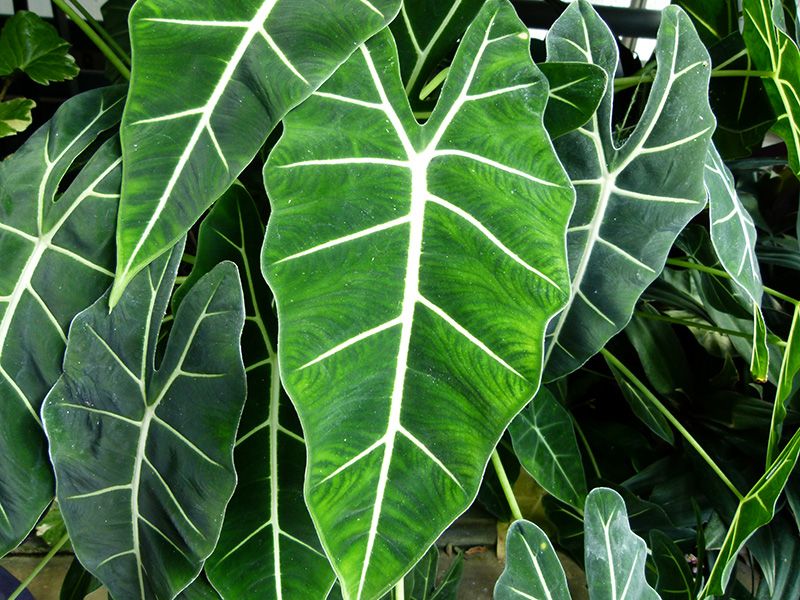
Alocasia polli is a hybrid of Alocasia sanderiana. It is a fairly tall evergreen shrub. In the wild, it can reach up to 2 meters. The indoor plant reaches 20 to 50 cm in height, reaching 70 cm in favorable conditions. Its main advantage is its relatively large leaves. Each bush can have around 30. As new leaves emerge, the old ones die off.
Distinctive features of the flower:
| Parts of the plant | Description |
| Leaves | Heart-shaped with serrated edges. Green with light veins, they shimmer with a metallic sheen in the sun. Up to 0.5 m long, up to 20 cm wide, on thick, short petioles. |
| Stem | Powerful, grows vertically. |
| Flowers | In rare cases, a mature bush may produce inflorescences in the form of cobs with white or pink flowers exuding a rich fragrance. After pollination, berries with seeds appear. |
| Root system | Relatively compact. |
| Hydrators | They are used to remove excess moisture. This is a special feature of this variety. |
Home care
Growing Alocasia polli at home is quite simple, you just need to follow a few rules.
Location, lighting
Alocasia polli prefers filtered light but dislikes direct sunlight. The ideal location for the plant is the east and west sides of an apartment or house, preferably without air conditioning. Shade may be needed in the south-facing area. Due to its large leaves, the bush will feel crowded on a windowsill. It's best to place it near a window, away from radiators.
In good light, the bush grows quickly and produces new foliage. In the shade, the leaves may turn black.
Soil, container for planting
This tropical flower thrives in loose, well-drained soil that is permeable to air and water. This soil mixture is easy to prepare:
- high-moor peat;
- soil from the garden;
- Orchid substrate.
To ensure that the roots have enough oxygen and the leaves are larger, you need a large pot.
Watering, air humidity, temperature
All Alocasias love water. Only settled, boiled, or distilled water is suitable.
Important! Irrigation water should not be warmer than 25 degrees Celsius.
It's important to keep the soil in the pot from drying out; overwatering is also unacceptable. After watering, remove any water from the tray. You can water again when the soil in the pot is dry. You can tell that the moisture has evaporated from the soil by the drooping leaves. During warmer months, water approximately every other day. In winter, water once or twice every seven days. During the breaks, loosen the soil to oxygenate it.
During hot weather, the plant should be regularly misted with water, and in winter, the leaves should be wiped with a soft, damp cloth. Use only warm, soft, settled water for misting.
The room where Alocasia polli grows should have a sufficiently high level of air humidity - above 65% at a temperature of +16 to +24 C.
In hot weather, as well as in winter when heating devices are on, you need to humidify the air in the flower area more often with a spray bottle or place a container of water nearby.
The appropriate temperature range varies depending on the season: from 22 to 24°C in summer; from 18°C in winter. This flower does not tolerate sudden temperature changes or drafts. Temperatures below 15°C are harmful, as they can damage the roots or, in summer, give a false signal that dormancy has begun.
Top dressing
It's recommended to feed alocasia year-round, using an appropriate fertilizer. During warmer months, add nitrogen and potassium through mineral and organic fertilizers once a month. During colder months, especially young plants, feed with phosphorus approximately every six weeks.
Bloom
Flowering of indoor Alocasia polli is extremely rare. Large flowers exhaust the plant, so it is recommended to cut off the flower stalks immediately before the perianth opens. Treat the cut areas with charcoal powder.
Transplantation, propagation
Young bushes are repotted once a year, while mature plants are repotted every three years. Transplantation is done by transshipment to avoid damaging the roots. The ideal time for this is the beginning of the growing season. At the same time as repotting, the rhizome is often divided to separate the offspring and young tubers.
The flower can be propagated:
- Seeds - plant in a generously watered substrate, water again.
- Seedlings - pick out twice, then plant in separate pots, remembering to water.
- Tubers, rhizomes, cuttings - cut off parts of the plant with a clean tool, plant in watered substrate, create a greenhouse.
Propagation by cuttings is best done during repotting. Place the container in a well-lit area with a temperature of at least 23°C (73°F). Remove the film during watering to allow the soil to ventilate, and remove it completely after the first leaves emerge.
Important! Wear gloves when handling the flower.
Diseases and pests
When unnatural changes in the appearance of Alocasia appear, it is necessary to determine the cause of the problem and take steps to eliminate it.
| Signs of the disease | Cause | Necessary actions |
| The leaves are spotted and drying out. | Lots of light. | Move to a less lit place. |
| Faded leaves. | Not enough light. | Place in a brighter place or use artificial lighting. |
| Leaves with brown spots. | Incorrect irrigation system, air is too dry. | Change the frequency or volume of watering and/or increase air humidity. |
| Black specks. | The effect of drafts. | Eliminate drafts. |
| The leaves dry up and fall off, there are drops of water on the leaves. | Roots rot due to waterlogged soil or excess moisture in the air. | Do not leave water in the tray; let the soil dry out before watering. |
| Yellow, drying leaves. | Hard irrigation water or low levels of nutrients in the soil, such as nitrogen. | Use soft water for irrigation or apply fertilizer. |
| The bush stops growing. | Not enough nitrogen. | Top dressing with urea solution. |
| During the flowering period the leaves fall. | There is a lack of nutrients in the soil, depletion. | Timely pruning of the flower stalk and fertilizing. |
| Wilted, not elastic leaves. | Incorrect watering: too much or not enough water. | Change the frequency of watering. |
| Unsuitable soil. | Change the soil composition or replant the bush. |
If not properly cared for, Polly is more vulnerable to pest attacks.
Pests and their control:
| Name | Signs | Necessary actions |
| Spider mite | Cobwebs and white dots on leaves. | Treat the leaves with actellikt diluted with water. |
| Scale insect | Small brown bumps on the plant. | Treatment with soap solution and a brush. |
| Whitefly | Shiny honeydew on a plant. | Treatment with a special solution of condiforom. |
| Aphid | Small grey, orange or green insects on the bush, plant deformation. | Treatment with a mixture of liquid soap, vegetable oil and water. |
Medicinal properties
Alocasia is an excellent air purifier. However, it's important to remember that all its parts are poisonous. Avoid contact of the sap with mucous membranes of people or animals.
The sap of plants in this genus has medicinal properties: it disinfects and heals wounds; in the form of a leaf tincture, it relieves joint and back pain, as well as itching from insect bites; it is useful for pneumonia, arthrosis, tuberculosis, and toothache; and the essential oils act as antimicrobials.
Caution! Alocasia sap is poisonous. Self-medication with it is dangerous.
Alocasia polli is a beautiful, vibrant plant. To enjoy its beauty, it needs proper care and comfortable conditions.