Araucaria is an evergreen, gymnospermous, coniferous plant belonging to the Araucariaceae family. It is native to Australia, the Americas, and New Guinea.
Description
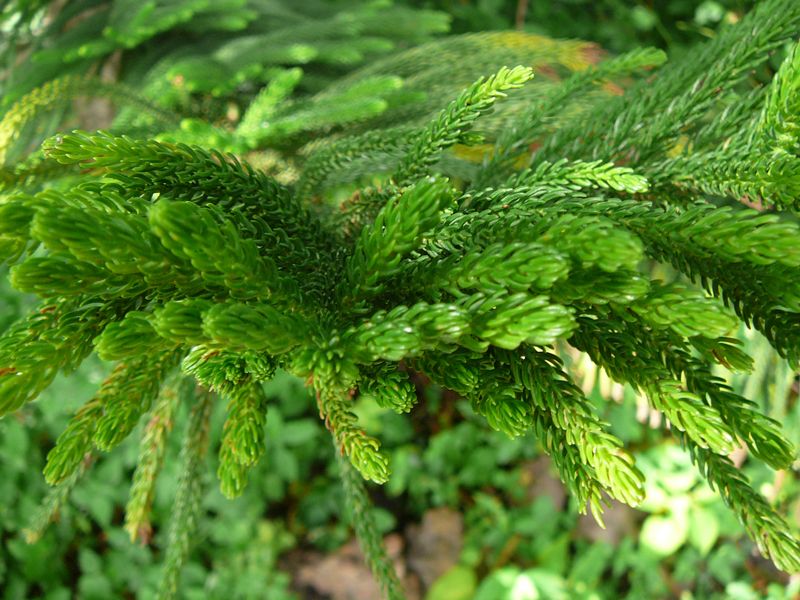
The araucaria is a fairly tall tree, with species reaching heights of up to 100 meters. The trunk is straight with thick, resinous bark. The coniferous leaves are flat and very stiff, arranged in a spiral on the branches.
The crown comes in two types: umbrella-shaped and spherical. Large cones are visible on the branches.
The tree is dioecious: male cones are elongated, while female cones are round.
Indoor types of Araucaria
Araucaria has several indoor species suitable for successful cultivation in an apartment.
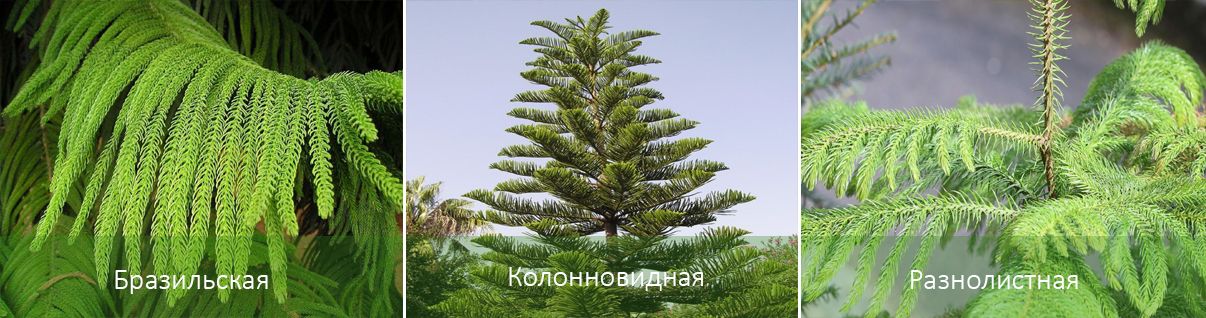
| View | Description |
| Brazilian (narrow-leaved) | The trunk is up to 60 cm tall, with upright branches. The needles are generously distributed and soft. The crown is quite lush. It purifies the air well. Price: about 1,500 rubles. |
| Columnar | A very tall tree, up to 50 m. The leaves are bright green, located on hanging branches, up to 5 cm long. |
| Araucaria heterophylla (Norfolk, Heterophyll) | A very tall tree, up to 70 m. The crown is pyramidal and narrow. The branches are very short. |
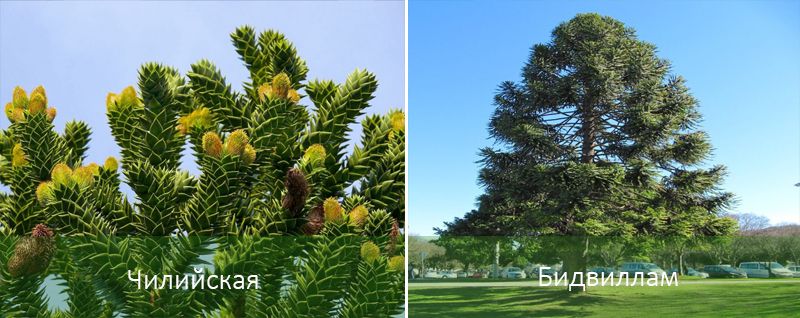
| Araucaria Chilean | Height up to 60 m, girth about 2 m. Branches are tightly pressed together with very stiff, dark green needle-like leaves. The crown is broadly pyramidal. |
| Araucaria Bidwillam (Bunia) | It has a broadly pyramidal shape and horizontally arranged branches. The needles are dark green, and the cones are quite large. While not a beautiful plant, it is very easy to maintain, making it a successful grower in Russia. |
Araucaria is often used in bonsai compositions. The plant undergoes extensive training and is reduced in size over decades, eventually resulting in a tree up to 30 cm tall.
Home care
Araucaria is native to southern countries and hot, very humid climates, but this doesn't mean you need to create tropical conditions indoors. When caring for it indoors, keep in mind that it prefers spacious rooms and fresh air.
Araucaria prefers a temperate climate with filtered light and cool, humid air. Young spruces are grown indoors; they don't tolerate bright light; in the wild, they grow in shade. Indoor species don't flower, producing only cones.
| Season/Parameter | Lighting/Location | Temperature | Humidity |
| Spring | Place in a location with diffused but bright light. Provide shade on the south side. | It should be cool, about +20°C. | High, more than 60%. Regularly spray or add expanded clay to the pot and keep it moist. |
| Summer | Growing on a balcony is suitable. Place in partial shade or a spot with filtered light. If possible, move it outside into the garden. | Doesn't tolerate heat. Optimal temperatures are between 21°C and 25°C. | Spray regularly. |
| Autumn | Partial shade or filtered light. On the north side, rotate the plant regularly to prevent it from growing lopsided. | Moderate – +20°C. | Maintain a high temperature, as dry air is harmful. Spray twice a day. |
| Winter | Bright and diffused light, or partial shade. | Protect from drafts. Not below +15°C. | Tall, requires frequent spraying. Place away from radiators. Spray morning and evening. |
| Season/Parameter | Watering | Top dressing |
| Spring | As the soil dries out, simply mist the plant with water if the soil is still damp. | Once every three weeks with special mixtures for conifers. |
| Summer | You shouldn't overwater the plant, but it's important to keep the soil moist. You can sprinkle expanded clay on top and keep it moist. | Mineral fertilizers once every 3 weeks. |
| Autumn | As the soil dries out. | Not needed. |
| Winter | Reduce. |
Choosing a pot, soil, replanting
The pot definitely needs to be large and roomy, preferably ceramic. It should have drainage holes. Drainage is essential to prevent root rot.
The soil should be fertile and loose, allowing air and nutrients to pass through. You can buy a ready-made potting mix or make your own.
Araucaria is unique in that it doesn't tolerate repotting. Young trees grow well in a single pot for up to six years, but mature plants need to be repotted once every four years. Planting is done in late spring.
Step by step procedure:
- Add drainage and soil to the pot.
- Remove the plant and plant it in a new pot with the root ball and sprinkle with soil.
- The roots must not be touched or disturbed, otherwise the spruce will die.
Pruning and shaping bonsai
Indoor varieties don't require pruning. Mature spruce trees can have their bare lower branches trimmed. To prevent diseases and infections, the plant should be treated with sulfur.
The formation of bonsai occurs as follows:
- To create an interesting composition, the araucaria's crown is trimmed in the spring. Excess branches that don't hold the desired shape are trimmed.
- In May, young shoots of the plant are pinched or pinched to shorten them.
- Using simple wire, shape the trunk and branches. This can be left for 3-4 months, then removed.
Reproduction
Araucaria propagation occurs in two ways:
- By seeds. Sow at home in soil with peat and humus. Water the soil and place in a warm place. The first shoots will appear in a few months.
- Cuttings. The top shoots of a large tree are suitable for propagation by cuttings. Plant in the spring. The cuttings are dried and treated with rooting agent. Then, they are planted in a mixture of peat and sand, warming the soil. Each cutting needs its own container, and all are covered with plastic wrap. Rooting takes about two months, after which they can be transplanted into a permanent pot.
Care errors and how to fix them
| Errors | Reasons | Elimination |
| The shoots are thin. | Low in nutrients. | During the period of active growth, feed with fertilizers. |
| The leaves fall, dry out and turn yellow. |
|
|
| The branches withered. |
|
|
| The tree does not grow. | Too much fertilizer and calcium in the feed. | Replant the plant in new soil and choose a different fertilizer. |
| The plant died. |
|
Avoid these factors. |
| The needles have turned black and the branches are drying up. | The root system is damaged. |
|
Diseases, pests and methods of control
| Pests/Diseases | Methods of control | Struggle | Prevention |
| Aphid | The leaves show puncture marks from insect bites as they feed on the sap of the Araucaria. | Spray with insecticides: Actellic, Intavir. | You can place Pelargonium nearby; its phytoncides will repel insects, and aphids can be washed off with water. |
| Mealybug | The flower withers, the branches droop. | Wash off insects with soapy water. | |
| Spider mite | The plant turns yellow and withers, and cobwebs are visible on the leaves. | Rinse the plant under the shower, wipe the leaves with a soapy solution. | |
| Chlorosis | Young shoots lose the richness of their leaf color, while mature shoots turn yellow. | Place the araucaria in a draft-free location, increase the room temperature, and water as soon as the soil dries out. Fertilize. | Avoid wind and waterlogging of the soil. |
Top.tomathouse.com informs: Araucaria – benefits or harm
The plant possesses powerful energy. It can awaken creativity and provoke people to activity. This effect can be both positive and negative. Araucaria enhances the energy in the home, regardless of its nature. It is believed that having the plant in the home activates its protective properties, bringing peace and tranquility to those living there.
Spruce is a beneficial tree that humidifies and purifies the air. People with hypertension should avoid keeping it in their home. While those with low blood pressure should keep it in their home, it shouldn't be placed in their rest room.