Asparagus (Latin: Asparagus), also known as asparagus, is a perennial rhizomatous herb, vine, or subshrub. It is native to warm climates in Africa, Asia, and South America.
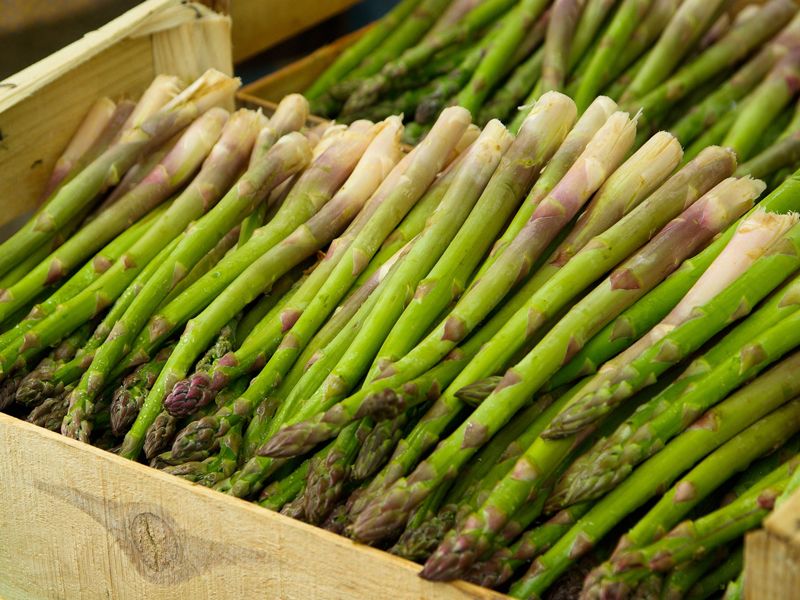
Some varieties of asparagus are edible, and some species have health benefits.
Description
The popularity of asparagus plants is due to their compact size and attractive appearance. They have a rich dark or light green color. Variegated specimens are occasionally found, but these are the exception.
Flexible shoots have numerous branches, giving the plant volume, and the cladonia branches, which act as leaves and resemble thin, graceful needles, give it a very elegant appearance. Furthermore, the plant has developed roots with powerful tubers, ensuring its resilience.
Asparagus plants bloom with beautiful, graceful white flowers. Rarely, they can be pinkish, beige, or metallic gray. This species produces flowers either solitary or in clusters, often pyramidal in shape. Mature shoots are capable of flowering and producing fruit—reddish or red-orange berries with black seeds.
The seed is brightly colored and round. The berries are inedible and, in fact, poisonous. Therefore, small children and animals should be kept away from the fruiting plant at home.
Otherwise, allergic reactions and poisoning are possible. If anyone in the family has a contraindication to contact with such allergens, it's best to avoid these varieties.
There are over two hundred subspecies of asparagus herbs and subshrubs worldwide. However, not all of them are suitable for growing indoors. For a home garden, it's best to choose proven varieties—the most beautiful ones, or those with delicacy or medicinal properties that provide health benefits.
Top 10 Asparagus Varieties for Growing at Home
| Variety | Peculiarities |
| Asparagus plumosus or Asparagus setaceus | A very branched specimen. The branches resemble spruce, and the shoots are edible, both raw and cooked. |
| Asparagus sprengeri (sprengeri), Asparagus densiflorus or densiflora (densiflorus) | An ornamental plant. Stems can grow up to one and a half meters. Tolerates pruning well. |
| Medioloides | It has no root bulbs. It is consumed fresh. It is also used as a raw material for the production of asparagine. |
| Sickle-tailed falcatus | An elegant-looking decorative vine that can be used to decorate various structures and interiors. |
| Racemose (racemosus) | The so-called "climbing" semi-shrub, long, "capturing" and decorating large spaces. |
| Common or pharmacy (officinalis) | It has vasodilatory, laxative, and diuretic properties. It is used in the production of related medications. |
| Asparagus meyerii (meyeri) | A luxurious curly plant, reaching half a meter in height and six meters in width. |
| Umbellatus (umbellatus), umbrella-shaped | This is a very beautiful, fluffy foliage that can be used to decorate a flower bouquet. It has decorative purposes. |
| The thinnest (benuissimus) | A very graceful variety with shoots up to one and a half meters tall. Creates a feeling of coziness and comfort. |
| Myriocladus | An ideal option if you have limited space but want to have unpretentious home greenery. |
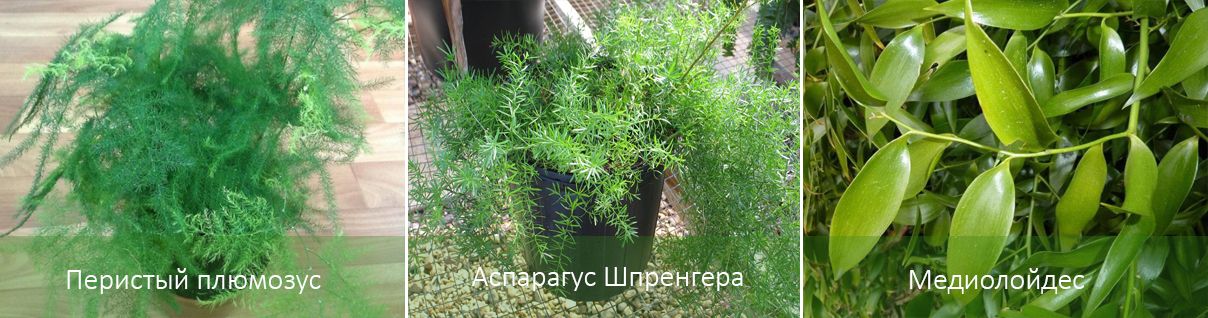
Sometimes certain varieties are confused with ferns—for example, Asparagus meyerii and Asparagus sprengerii. People try to associate them with certain omens and superstitions. However, they are not related to ferns. They should also not be confused with succulents—they are a separate species.
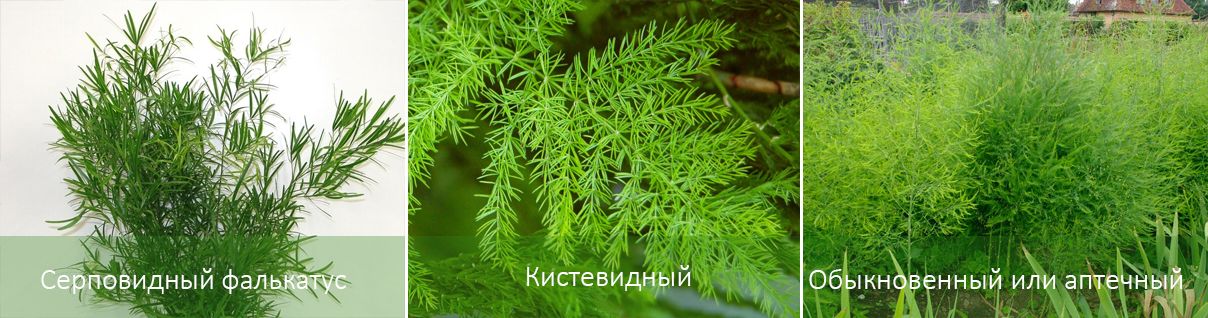
There's another interesting variety, Nanus asparagus, a cute miniature flower, the dwarf of its kind. However, it's a bit more demanding in terms of care, so we don't recommend planting it as a houseplant.
Caring for asparagus at home
Another factor that increases the popularity of asparagus plants is their ease of care at home. Almost all varieties require roughly the same watering, temperature, and humidity levels.
| Time of year | Illumination | Temperature conditions | Humidity mode |
| Spring/summer | It loves sunlight but is sensitive to sunburn. It can be placed on a windowsill without curtains if the window faces north (northeast, northwest). If the window faces west or east, cover the window with tulle. If it faces south, it's best to place the plant 1-2 meters from the window. | Maintain a temperature between 18 and 24°C, including through air conditioning. Avoid placing flowers in direct exposure to cold air. | Natural humidity is usually sufficient, but if it drops, place the plant pots on trays filled with wet stones. If water shortages are severe, misting and occasional showers are acceptable. |
| Winter/autumn | When the sun's rays aren't as intense and long-lasting, you can do without tulle curtains on the east and west sides. If the window faces south, you can move the potted plant to the windowsill. | The temperature should be maintained from +14 to +16°C. The exception is sickle-shaped Asparagus, it is resistant to deviations from this value. |
During the heating season, when humidity drops, regular misting with warm water is required. If the room temperature does not exceed 14°C, misting is not necessary. |
When choosing a lighting regime, remember the most important thing: direct sunlight is only acceptable early in the morning and late in the evening. At the same time, avoid placing asparagus in the shade, as this will negatively impact growth rates and their appearance.
Fertilizing and feeding are simple: each variety has its own recommendations, which should be followed. The only general rule is frequency. During the warm season, feeding is needed twice a month, and during the cold season, once a month.
They don't require pruning. In fact, the pruned portion may stop growing. Therefore, it is used primarily for medicinal purposes, or if the crown has grown so large that it overloads the stems with its weight.
Selecting a container, soil, replanting
The principles of repotting are roughly the same as for most houseplants and herbs. The new pot should be larger than the previous one, have adequate drainage, and use soil from a reputable source. Otherwise, there's a risk of infecting the roots with bacteria found in untested soil, especially from an open area.
Optimal soil mixtures:
- humus soil, leaf soil, coarse sand (1:1:0.5);
- turf, humus, leaf soil and sand (2:2:2:1).
It is desirable that the pH level be within the range of 5.5-7.0.
Asparagus should be replanted after watering, with a lump of soil and its native root system intact. Beforehand, you can (and should!) trim off any diseased or rotten tubers or tangled root shoots, if any. Treat the cut areas with crushed charcoal.
It's best to repot in the spring. Immediately after planting in a new vase or pot, avoid fertilizing and feeding, and avoid drafts, excessive sun, or, conversely, shade.
When planting for vertical gardening, for example in flowerpots, you can use trifern.
Flowering and dormant periods
The patterns here are roughly the same as for most herbs and subshrubs in our climate zone. Spring and summer are the time of activity, ripening, and flowering, while autumn and winter are relatively quiet. Relative because asparagus plants continue to grow even in winter, so simply reduce the intensity of feeding and fertilizing to once a month.
Pests, diseases
Like other crops, asparagus plants have their "enemies"—pests, insects, and infections. However, at home, the most common "enemy" is improper care. It's a good idea to familiarize yourself with the list of symptoms that should alert gardeners.
| Signs | Reasons | Prevention and treatment |
| It turns yellow and starts to crumble. | Too hot and dry. In winter, this can be due to a lack of light or vitamins. | Water on time, do not overwater, the soil should be moist, take care of vitamins and the presence of light. |
| The stem stretches out and turns pale. | Not enough light or too much nitrogen fertilizer. | Improve lighting, temporarily stop using nitrogen fertilizers. |
| There are brownish spots on the edges of the shoots. | Burn. | Remove from the sun - move away from the window, cover the window with tulle. |
| Grows slowly or does not grow at all. | Lack of fertilizers and nutrients. | Consult with specialists, fertilize and feed on time. |
| The cladodes of a plant outside are falling off. | The temperature outside is too low (maybe it has dropped sharply). | Bring it indoors (it’s better if the temperature there is up to +15°C) and cut off the top of the plant. |
| The shoots have drooped and are drying up. | Root rot due to excess water. | Remove from the pot, cut off rotten tubers, treat the soil and roots with the antifungal agent Gamair or Discorm. |
| Pronounced yellowness. | Insect pest scale insect. | Spray with Actellic (2 ml/1 l of water), wash off the scale insects under the shower. |
| The plant will suddenly turn yellow and wither. | A spider mite that feeds on the juices of stems, cladonia, etc. | Treatment of the initial stage is treatment with a solution of laundry soap; prevention is normal humidity in the room. |
| Discolored shoots, slow growth. | Thrips – due to over-dried air and over-watered soil. | Spray with Actellic or Decis insecticide. Normalize temperature and humidity. |
Reproduction
There are three main methods of reproduction practiced:
- seeds,
- by cuttings,
- division of the root.
The best way to propagate is usually up to the grower to decide.
Propagation by seeds:
- buy them in a store or get them through artificial pollination;
- soak for two days;
- bury it shallowly in the soil and cover with polyethylene or backclipm;
- keep for a month at t +20/+22°C;
- when seedlings appear, move them to sunlight;
- When they reach 10 cm in height, plant them in separate containers, round or square.
Propagation by cuttings:
- in spring, prepare shoots at least 15 cm long;
- plant the cuttings in wet sand, cover with polyethylene;
- allow to breathe and feed with water for a month;
- After the roots appear, transplant into a separate pot, a plastic one is fine.
Propagation by root division:
- when replanting, divide the root so that each piece has a young shoot;
- plant each separated section of the rhizome in a separate container;
- care for it like any other asparagus.
Top.tomathouse.com recommends: Asparagus is a healthy plant
All of the above is sufficient to draw a clear conclusion about the benefits of asparagus. In addition to the beauty, nutritional, and medicinal properties of certain species, this plant purifies the air, collecting dust from the air, preventing it from entering the lungs. It's a true blend of benefit, beauty, and health.