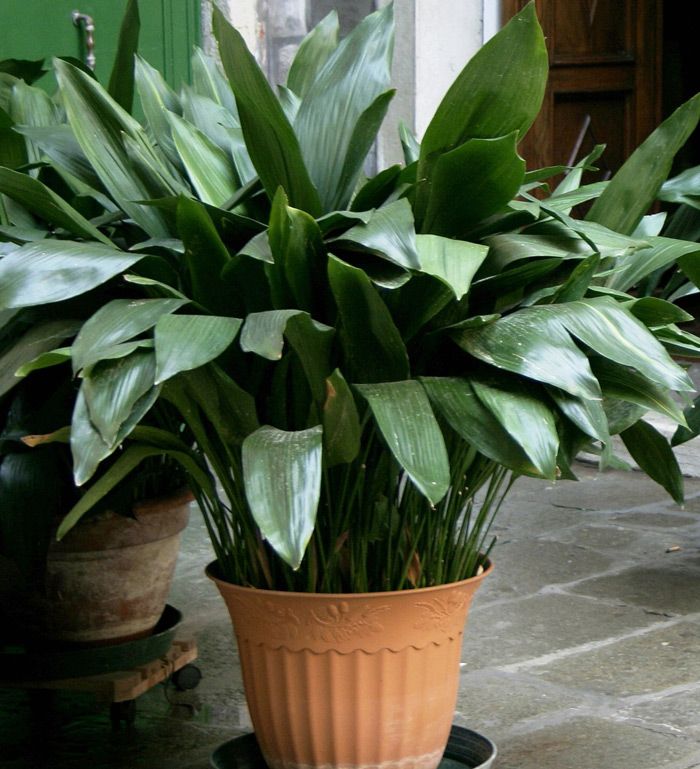
Aspidistra is a genus of plants in the Asparagus family, comprising eight species. It belongs to the order Asparagales, class monocotyledons. It is a perennial, stemless herbaceous plant with a developed root system and leaves approximately 55 cm tall. Aspidistra alta is popular as an indoor plant. It is characterized by very slow growth.
Description
Aspidistra is one of the most ancient plants. Its homeland is the tropical lands of East Asia. Descriptions of the plant can be found in writings dating back to the Wei Dynasty. It prefers shaded areas. Its long evolution has given it increased hardiness and high adaptability, which is why Aspidistra is sometimes called the "iron flower." The Iron Lady also has another name: "snake pointer" (or "aspidistra pointer," a "flower" that indicates a slithering snake). It is known by this nickname because of the leaves' ability to sway when they touch the bodies of reptiles. Another name, "Friendly Family," refers to its extensive root shoots.
Scientifically, the "large leaves" are actually shoots. The "true leaves" resemble scales and are needed by the aspidistra to ensure shoot germination.
Flowering indoors is a rarity. The flowers, with very short stems, are located on the rhizome, practically on the ground, and have no ornamental value. They bloom for only one day. In the wild, they bloom during monsoon rains, from January to March. Indoors, aspidistra can delight with flowers in winter, spring, or summer.
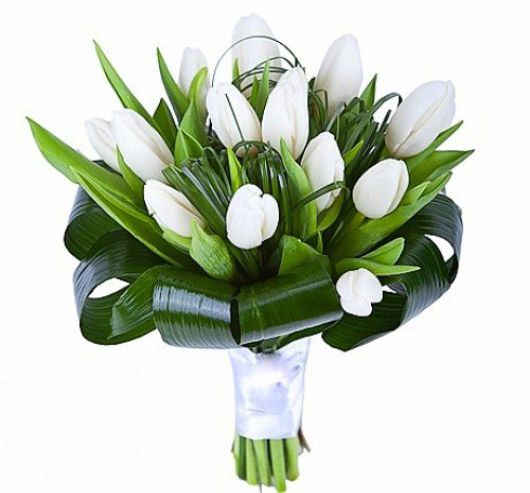
Florists often use aspidistra in wedding bouquets. Its broad, decorative leaves, which retain their attractiveness for a long time, are often used to wrap flowering plants that lack foliage. Bouquet arrangements are used to decorate bridal gowns, holiday photos, and reception halls. Special artificial textile ribbons imitating the texture of the aspidistra leaf are popular.
Prices vary widely. For example, the Elatior variety of Aspidistra ranges from 2,000 to 3,500 rubles.
Species for indoor growing
Having an aspidistra in your home is considered a good omen, as the plant enhances your character, protects you from gossip, and helps you resist harmful temptations. Like the acai palm, peace lily, or dieffenbachia, it carries exclusively positive energy.
In the wild, there are approximately 90-100 species of Aspidistra.
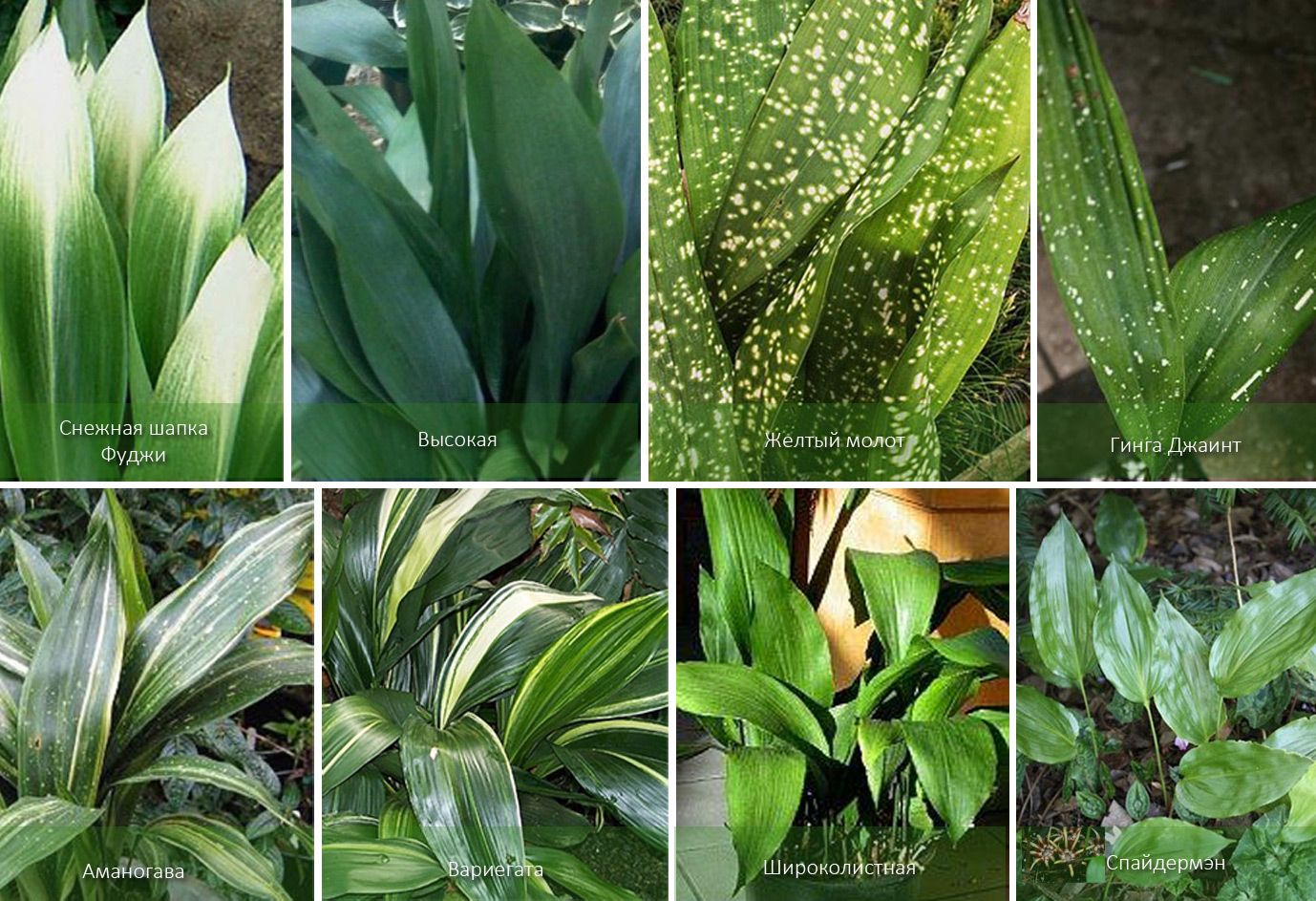
The following varieties have become widespread for indoor cultivation:
| Species name | Features of leaves | General description |
| Tall, Elatior | Large, dark green, glossy leaves form a dense crown resembling a waterfall. They resemble lily-of-the-valley leaves, measuring 50 x 15 cm. | The rhizome is snake-shaped. The flowers are brown-crimson or brown-yellow. The berry contains only one seed. |
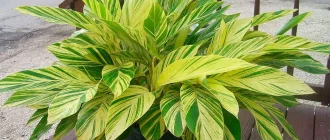
| Variegata | The surface is covered with white longitudinal stripes of varying widths. | The bush is small, no more than 50 cm. It requires careful care. |
| Milky Way | Large, dark green, covered with white dots and spots of no particular shape. | This is one of the best-known variegated varieties of Aspidistra. It is drought- and low-temperature-resistant. Flowering occurs in late winter to early spring. Flowers are single. |
| Amanogawa | In the center there are white dots, the edges are topped with wide yellow stripes. | Based on the Aspidistra Milky Way. |
| Fuji no main ("Snow Cap") | Wide, dark green, with lighter stripes along the sides, the top is adorned with a white cap, which, according to Japanese breeders, resembles the summit of the legendary Mount Fuji. | A large variety. White tips appear only on mature plants. |
| Ginga Giant | Large, spotted. | The most shade-loving variety. Frost-hardy. Tolerates temperatures down to -10°C. |
| Broadleaf | It has wide longitudinal white stripes. | A delicate crop. Blooms from February to March. |
| Yellow Hammer (Yellow Hammer) |
The greenery is decorated with an abundance of creamy yellow spots. | This is the most colorful species. |
| Oblanzefolia | Narrow green, width does not exceed 3 cm. | The plant is not tall, reaching no more than 60 cm. It blooms in early spring. The flowers are small and red. |
| Star of Nagano | Decorated with small yellow star-shaped spots. | It is renowned for its ability to bloom. It blooms brightly and profusely, producing reddish flowers. The typical season is February. |
| Spiderman | Small, without spots. | Its entire appearance resembles a spider. The petioles are web-like, and the purple flowers resemble arachnids. |
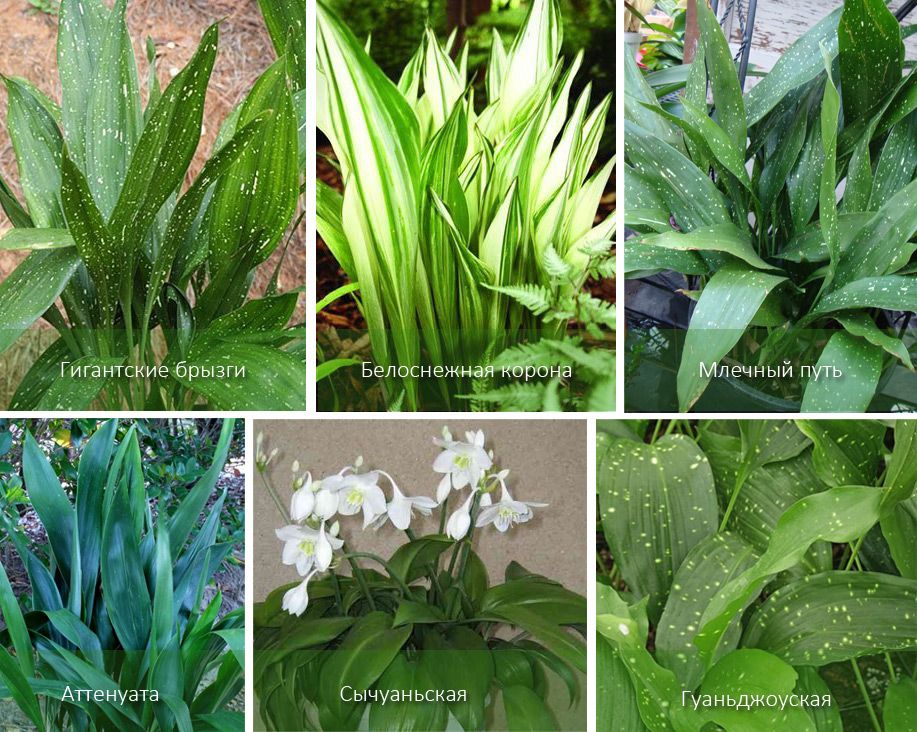
| Giant splashes | A distinctive feature is the presence of large greenish-yellow spots. | Bred in Taiwan. |
| Snow-white crown | Long, dark green, with wide white stripes | The pattern appears by the 3rd year of life. |
| Morning sun | As if “shaded” with narrow whitish-cream rays. | The plant's decorative value increases with age. A large pot is necessary for growth. |
| Sichuan | Green, monochromatic. | It blooms from January to March. The inflorescences resemble a bell with six petals. |
| Guangzhou | Dark green with yellow spots up to 20 cm long. | Blooms in May. The buds are purple or violet. |
| Large-flowered | Smooth, elliptical with contrasting spots. | The flowers are purple. They bloom in midsummer, rarely. The diameter of the open flower can reach 5 cm. |
| Attenuate | Inverse ovoid, dark green with slight inclusions. | The rhizome is creeping and requires little care. A small (3 cm) purple flower may appear in early summer. |
Indoor care
Home care involves following a few simple rules:
- The optimal place is in the back of the room.
- Acceptable temperature is +18…+25°С.
- Aspidistra does not like drafts.
- Withering and darkening leaves indicate hypothermia or sudden changes in air temperature.
- The plant does not tolerate dryness or excess moisture. It is believed that "underwatering is better than overwatering."
- It should be watered regularly using softened water (with reduced levels of chlorine and calcium ions).
- Spraying with clean water is helpful. Dust should be removed with a soft cloth or sponge.
- The best time for fertilizing is from April to October. General-purpose complex fertilizers have proven effective.
Seasonal plant care
| Season | Location/Lighting/Humidity | Temperature/Watering | Top dressing |
| Winter | Prefers shade, feels great away from windows, preferably on the north side. If light spots appear on the leaves, it means the plant needs sunlight and the lighting level needs to be increased. Wipe the leaves as they become dirty. Spray once a week. |
+16°С. Once a week. |
Not produced. |
| Spring | +18°С. Once every 6 days. |
Depending on the variety, from once every 2-3 weeks to once every 6-7 weeks. Use mineral fertilizers with a high nitrogen content. | |
| Summer | +20°С …+22°С. Once every 5 days. |
||
| Autumn | +18°С. Once every 6 days. |
Not produced. |
Choosing a pot, soil, planting, replanting
Aspidistra prefers light, fertile, slightly acidic or neutral soil. Leafy soil mixed with peat has these properties. You can create the optimal soil composition yourself by mixing river sand, turf, leaf mold, and manure humus in a ratio of 1:2:2:2.
Since the plant does not tolerate repotting well due to its delicate roots, it is recommended to do so only when necessary. This occurs when the plant's pot has truly become too small. The recommended time is mid-spring. It is best to repot only young plants, without removing the old soil from the roots. The new pot should be 4-5 cm larger in diameter than the old one. It is best to repot no more than once every 3-4 years, placing a thick layer of drainage material in the bottom.
Step by step, the transplant looks like this:
- A layer of soil is poured into the pot onto the drainage surface.
- To avoid damaging the roots, the plant is transplanted using the transshipment method; it is not recommended to destroy the root ball.
- Afterwards, the flower is covered with soil. Any accidentally damaged roots are sprinkled with charcoal.
- The roots should not be buried deep; the root collar should be left on the surface.
It's best to place the plant pot on a stand, not too high, to prevent the soil and roots from cooling. Sometimes, weaving baskets is used for this purpose.
Trimming
The plant requires periodic pruning of old and damaged leaves to prevent disease and maintain a healthy appearance. Leaves are cut off at the rootstock.
Pruning improves the overall condition of the aspidistra, maintains its attractiveness and stimulates the growth of new leaves.
Reproduction
Aspidistra reproduces by seeds, division of the bush and by means of leaves:
- Small, sessile flowers, shaped like pink or purple bells, are borne singly above the ground. Their diameter does not exceed 2.5 cm. After pollination, round fruits form, which, when fully ripe, produce seeds. The seed can be used to propagate the plant. With this propagation method, Aspidista will grow for many years. This method is used to develop new varieties.
- Dividing the bush is the most convenient method of propagation. To do this, in March, the rhizome is cut into rosettes, with 3-5 leaves per rosette. To prevent rot, the cut sections are sprinkled with charcoal and then planted in small pots. It is recommended to water them moderately for the first week at a temperature of 18-20°C. Propagation by division is prohibited for bushes with fewer than 8 leaves.
- To use a leaf for propagation, cut it, removing the petiole until it hardens at the base. Place the base of the leaf blade in a jar of water, cover with plastic wrap, and leave in a warm, bright place. After approximately 12-14 days, white roots will appear on the leaf. If the leaf begins to rot but roots have not yet appeared, trim off the rotted portion, change the water, and repeat the process. Root formation can be accelerated by adding a growth stimulant to the water. After this, the leaf can be planted in soil, covered with a transparent glass.
Mistakes in care, diseases, pests
| Problem | Reasons | Manifestations | Solutions |
| Root rot | Excess moisture, activation of the causative fungus. | Wilting and yellowing of leaves. Dark brown spots and a white, fluffy coating appear on the rhizome. | Removing diseased roots, treating wounds with ash, reducing watering, using soil drainage. |
| Red spider web mite |
Lack of moisture, attack of insect pests. | Browning of leaves, appearance of pale spots and cobwebs on the back of the leaves. | Weekly spraying with a soap solution or insecticides is recommended. Scale insects can be collected by hand (adult scale insects are highly resistant to insecticides). Increase the frequency of watering. |
| Palm scale insects | Yellowing and falling of leaves, the appearance of small insects on them, as well as brown spots on the underside along the veins. | ||
| Non-infectious chlorosis (disease) |
Irrigation with low quality water. | The leaves are starting to turn yellow. The green color is losing its vibrancy and becoming dull. Leaf turgor remains. | Top dressing with complex fertilizers and watering with clean water. |
| Infectious chlorosis | Plant damage by an infectious agent. | Rapid yellowing of leaves. | The disease is incurable. The plant is destroyed. |
| Sunburn | Exposure to direct sunlight. | The appearance of brown spots. | Moving the plant to a shaded area. |
| Lack of development | Lack of nitrogen fertilizers. | Extremely slow growth. | Application of nitrogen fertilizers to the soil. |
| Water shortage | Dry air against the background of high indoor temperatures. | Decreased marketability, wilting and yellowing of leaves, drying out of their tips. | Misting the plant, changing the watering frequency. Moving it to a cooler room. |
| Loss of color in leaves | Lack of light. | Paleness of leaves, loss of their characteristic color. | Increasing the intensity of diffused light illumination. |
| Excess fertilizer. | Selection of fertilizers and feeding frequency. | ||
| Excess moisture in the soil | Frequent watering | The leaves darken and become wilted. | Removing excess water from the tray, reducing the frequency of watering. |
| Aphid attack | Activation of insect pests. | Clusters of insects appear on young leaves, causing the leaves to lose shape and dry out. | Treating plants with insecticides, including preparations containing permethrin. |
| Leaf spot | Frequent watering, infection by a fungal pathogen. | The appearance of brown spots on the leaves surrounded by a yellow halo. | Removing diseased leaves, reducing the frequency of watering, using fungicidal preparations. |
Medicinal properties, application
The benefits of using aspidistra preparations are determined by the presence of bioactive substances in its juice. The alkaloids have bactericidal properties and stimulate blood flow, promoting the resorption of hematomas.
Medicinal decoctions are used to treat periodontitis, tonsillitis, cystitis, and gastrointestinal disorders. Chewing the plant's leaves is recommended for bleeding gums. The juice can quickly stop bleeding. It is also used to treat bruises and open wounds.
To avoid harm to health, the use of medicinal products based on it is recommended to be carried out under the supervision of the attending physician.