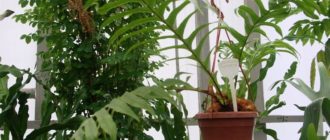
Asplenium is a perennial fern from the family Costenaceae. This herb is believed to have healing properties, particularly beneficial for the spleen, hence the name. Asplenium is Latin for "spleen."
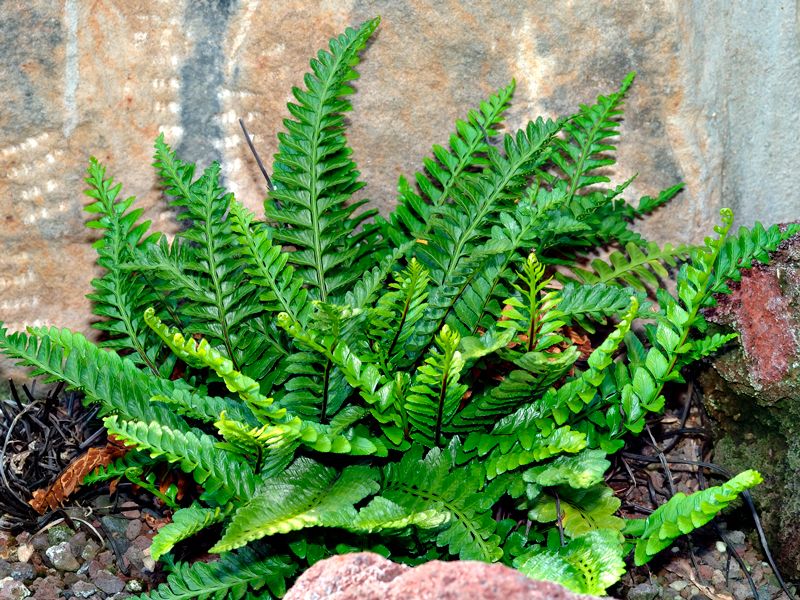
The plant's native land is South America and Asia. Today, the plant's other name, "scaly-sided fern," is also found in the Western Hemisphere. The second name comes from the resemblance of the fern's leaves to small stones. It grows in rocky areas and stony soil, and doesn't require fertile soil.
Description
The Aspleniaceae family, comprising approximately 500 species of ferns, is a perennial plant with a creeping, soft-scaled rhizome. The leaves are smooth, ordinary, and pinnately dissected. The sporangium (the organ that produces the spores needed for reproduction) is located at the base of the leaflets, on the free veins.
There are non-winter-hardy, winter-hardy, and deciduous varieties. Tropical species are grown indoors; they are beautiful and require little care.
Types
In our country, only a few varieties of the plant grow in open ground.
| View | Description |
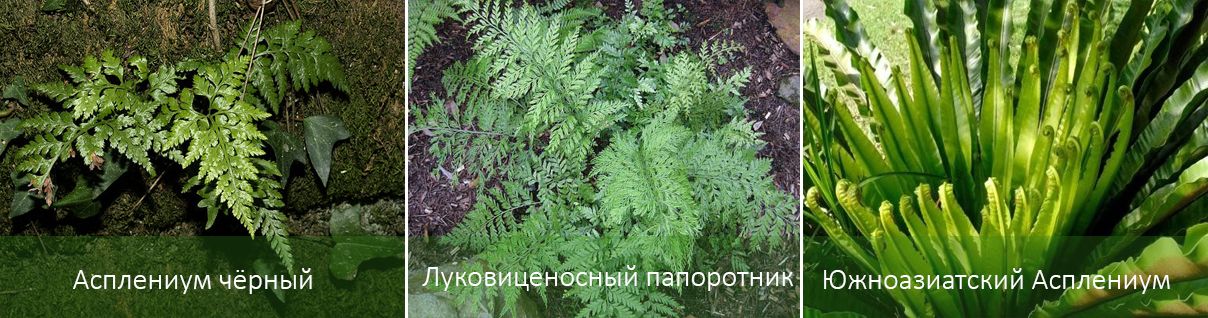
| Black Asplenium | It belongs to medicinal varieties; in Russia, it grows without shelter only in the South. |
| Viviparous or bulbous fern | It has beautiful dark green leaves with a pinnate dissection. The bulbiferum has bulblets at the ends. This viviparous fern grows well in moist soil; young shoots must be regularly separated from the mother stem, otherwise it will overwhelm them. It grows up to a meter in height. Another name is Parvati. |
| South Asian Asplenium | A very beautiful variety of Asplenium with dense green leaves. They have wavy edges and grow up to 25 cm long. A purple vein runs down the center of the leaf. |
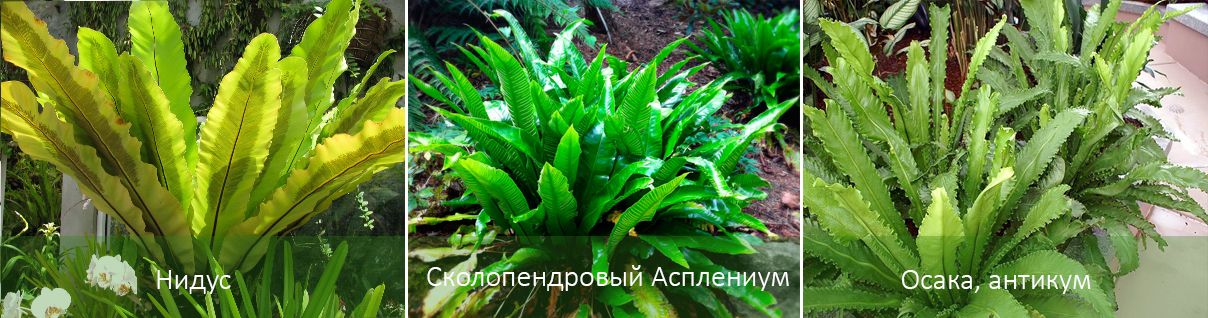
| Nesting Asplenium or Nidus | The leaves of the "bird's nest" are bright and glossy, up to 45 cm long, light green, sword-shaped, and wavy-edged. The rosette resembles a ladle. Another name is "Cobra." |
| Scolopendra Asplenium | An indoor fern with light green leaves and curly margins. Young plants grow with upright leaves, later taking on an arched shape. Commonly known as "centipede," the leaves should not be touched unnecessarily, as they are extremely sensitive. |
| Osaka, Antiquum | The rarest plant of the Aspleniaceae family, it is also called the tree-like plant. Its leaves grow vertically upward, and are bright, glossy, and light green. |
| Bottled Asplenum | It's quite demanding in terms of care, but can be grown in an aquarium. Its dark green, triangular leaves grow up to 14 cm in height. |
| Crispy | It requires little maintenance, with corrugated, bright green leaves that are incredibly shiny. Also known as Crispy Wave. |
| Leslie | A miniature species of fern, popular among gardeners. |
| Hairy Asplenium | A small scaly-leaved plant, up to 25 cm long. Its long, pinnate, light-green leaves are borne on dark-brown petioles. It prefers to grow on rocks and in areas with little soil. This species can be grown not only indoors but also in the garden. |
Caring for a Fern
The fern does not require careful care at home.
| Parameter | Conditions |
| Lighting/Location | The most important thing is to avoid placing the flower in direct sunlight. Otherwise, it will burn. The light should be softly diffused throughout the room. Shade slows the flower's growth. It's best to place the fern pot on an east-facing side. |
| Temperature | In winter the temperature should be +19 degrees, in summer from +21 to +25 degrees. |
| Watering | Water the fern as needed; don't allow the soil to dry out. It requires more frequent watering in summer, and vice versa in winter. The water should be soft. If the soil is too wet, the root system will rot. |
| Air humidity | It is advisable to maintain high humidity in the apartment; you can also place a container of water next to the pot. |
| Fertilizer | Supplemental feeding is necessary in the summer once every two weeks; special mineral fertilizers are available. In the fall, fertilizing should be stopped. It's a good idea to water the plant thoroughly before applying fertilizer. |
Selecting a container, soil, replanting
Once the quarantine period has passed, the asplenium should be repotted immediately into a separate container. Leave the root ball intact, lightly shaking off any excess soil.
Young plants will need to be repotted annually, preferably in the spring. Mature plants should be rejuvenated every two years. The pot should be larger than the previous one, but not too large, as the scaly-leaved plant won't appreciate it. The container should have holes.
Orchid potting soil is suitable. This mixture is easy to prepare yourself. The soil composition includes peat, sand, pine bark, humus, and charcoal.
Step-by-step transfer:
- Choose a pot with holes for air and add drainage to the bottom.
- Place the substrate on top, it should remain loose.
- Remove the sapling from the pot with a lump of soil on the roots and place it in another container. Remove the black roots first.
- Add a portion of the substrate on top and lightly compact it at the roots.
- Then water with slightly warm water and spray from a spray bottle.
- Place the pot in a dark place for a while.
Reproduction
Asplenium is a plant species that never flowers. The fern propagates using three main methods:
- Reproduction by buds occurs in viviparous ferns. The buds are located at the tips of the leaves, grow briefly on the flower, and then develop their own leaves and roots.
- Propagate a large, mature bush by dividing the rhizome.
- Propagating scaly-leaved spores is very difficult. Special equipment and a fair amount of time are required. Shoots emerge at temperatures between 20 and 25 degrees Celsius.
Errors and their correction
The fern is susceptible to various diseases.
| Error | Cause | Correction |
| Leaves are yellow, tips are brown. | Dry air. | Place an additional vessel with water near the container with the plant. |
| Brown spots appear on the leaves, they turn yellow and die. | - too much overheating; - insufficient watering; - wind and drafts. |
Water the flower well and remove it from the heater. |
| The leaves are dying. | The air is too dry, the soil is dry. | Follow all the rules for caring for asplenium. |
| There are burns on the leaves, they turn pale. | Bright sunlight. | Place away from the window in a dark place. |
| Poor growth, pale leaves. | Low in nutrients. | It is good to feed with fertilizers. |
Pests and their control
The leaves of the scaly-leaved plant are a favorite among pests. They are attacked by aphids, mealybugs, whiteflies, and spider mites. Washing the leaves with a soapy solution helps.
| Pest | Recognition | Treatment |
| Spider mite | White webbing and reddish spots appear on the leaves. | Spraying with insecticides. |
| Mealybug | The leaves become covered with white sticky fluff. | Remove pests with a damp cloth and spray the leaves with alcohol. |
| Aphid | The leaves curl into a tube and turn pale. | Treat with a special agent (Tanrek, Iskra, Aktara). |
| Whitefly | The leaves turn yellow and die. | Treat the leaves every three days with a solution containing permethrin. |
| Scale insect | Hard, dark brown spots. | Remove pests with a wet cloth and spray the plant with a special solution (Bankol, Bitoxibacillin). Repeat this process until the insects are completely gone. |
Top.tomathouse.com informs: the fern is a home amulet
Since ancient times, the fern has been considered a magical and mystical plant. It was believed that it could help find gold, and that the asplenium seed brought good luck.
There are a huge number of signs associated with the fern:
- The plant is believed to have a beneficial effect on the home environment, clearing the air of negative thoughts and restoring harmony to the apartment. The flower makes people kinder and more open to communication.
- Asplenium improves relationships between the older and younger generations. It promotes understanding between parents and children.
- It wards off evil spirits. The fern is considered a powerful amulet; if it wilts, it means the house has been cursed or hexed.
- Attracts money into the house.
- One of the bad omens is that the flower is an energy vampire. To neutralize the negative influence, place it near a television or computer.
- Causes illness. This theory is logically justified, as the owners may simply have an allergy to the plant. Furthermore, ferns absorb a lot of oxygen, especially at night, which can cause headaches in the morning. Therefore, they should not be placed in the bedroom.