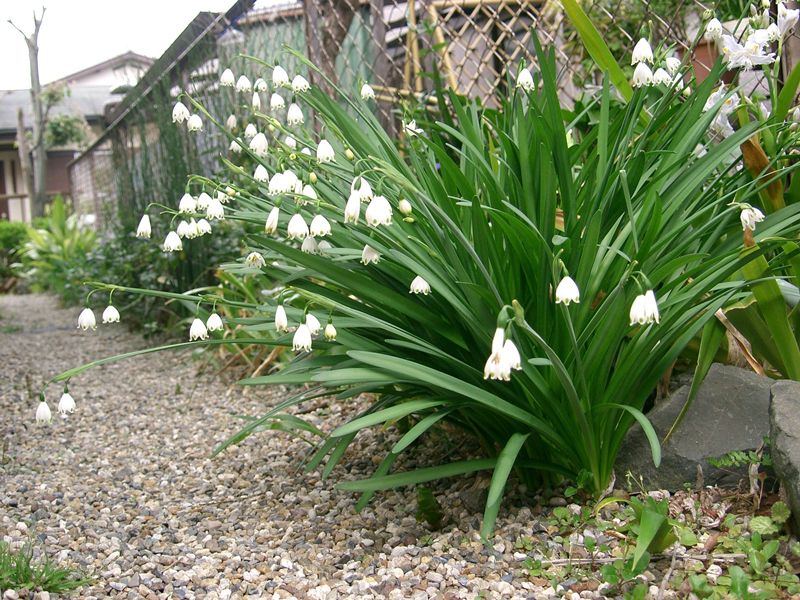
The white flower (Latin: leucojum aestivum) belongs to the Amaryllidaceae family. Its name is derived from two words—milk and violet. This is why its other name is white violet.
Content
Description of Leucojum
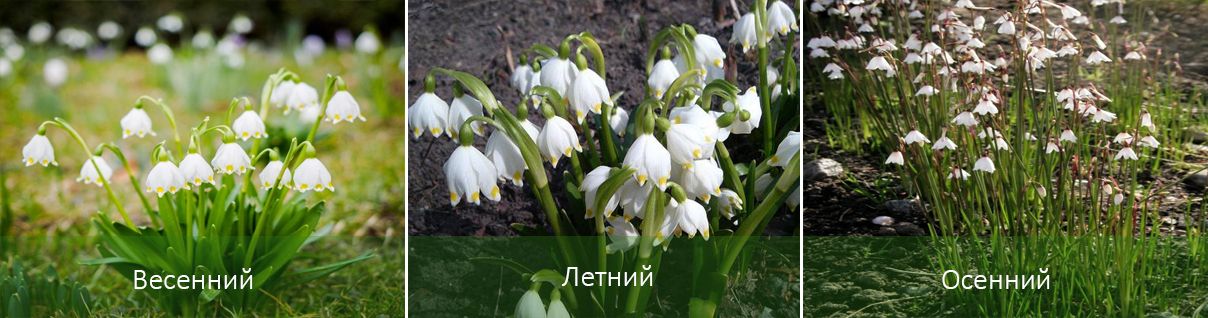
Leucojum is a herbaceous plant for open ground, common in central Europe, Iran, the Mediterranean, and Turkey. It is a perennial shrub up to 40 cm tall. The flowering period varies depending on the species. Spring Leucojum blooms in spring, summer Leucojum blooms in the second half of May, and autumn Leucojum blooms towards the end of summer. Therefore, if all three species are planted in a single flowerbed, flowering will last from April to September. The leaves are linear, appearing simultaneously with the buds. Flowers are solitary or gathered in umbels. They range in color from white to pink and reach 3 cm in length. After flowering, a fruit—a capsule containing seeds—forms. The root system consists of bulbs covered with brown scales.
The snowdrop is a neophyte plant, as it appeared in gardening relatively recently.
Types of Leucojum, photos
There are several species of snowdrops found in nature:
- spring;
- summer;
- autumn.
Based on the names, it is clear that they differ in the period of planting on the site and flowering time.
Spring white flower
It grows on forest edges, including in the Carpathian region. Leaves are up to 25 cm long, and the flower stalk is 30 cm. Inflorescences are single or paired, with a strong fragrance. The flowering period lasts 3-4 weeks in April. The best variety among spring white flowers is 'Carpathicum.'
Planting dates
Planting material (seeds) quickly lose their viability, so they are sown immediately after harvesting. The first flowers appear in the sixth or seventh year. Bulbs should also be stored promptly; they should be planted immediately after purchase. If the bulbs are from the garden, they are divided and replanted immediately after the leaves have dried. The best time is from mid-July to early autumn. Store-bought planting material should be planted no later than the second half of October to allow the plants time to establish roots.
Summer white flower
In natural conditions, the plant is found in meadows and on river banks in the Transcaucasus, Southern and Western Europe.
Unlike spring varieties, summer snowdrops are slightly larger, with leaves and flower stalks reaching 40 cm in height. The first inflorescences appear in the second half of May, forming umbels of up to 10 flowers. The most famous variety of summer snowdrop is Gravetti Giant.
Planting dates
The optimal period for planting is July–September. In warmer regions, planting continues until November.
For planting, select heavy bulbs with a dense structure and covered with scales. It's best if roots or small shoots have already appeared. It's important that the rhizome surface is free of mechanical damage and signs of mold. If the planting material will not be planted immediately after purchase, it can be stored in a plastic container filled with sawdust.
Autumn white flower
It blooms in the second half of summer. First, stems with inflorescences appear, and only towards the end of flowering do leaves emerge.
The bush grows to a height of only 12 cm. The difficulty lies in the fact that this variety is not frost-resistant, so these cultivars are not popular. However, some gardeners store the flower in special containers during the winter. Along with frost, excess moisture is detrimental to the autumn snowdrop, as in the wild, the plant is found only in sandy and rocky areas.
General conditions for growing all types
| Factor | Conditions |
| Bloom |
|
| Landing | Planting work, depending on the variety and type of plant, is carried out from July to September. |
| Lighting | Prefers partial shade. |
| Priming | Moist, drained, near water bodies. |
| Watering | In early spring, immediately after the snow melts, the plant doesn't need additional water. Use settled water, being careful not to let any drips fall on the flowers. |
| Top dressing | Liquid mineral complexes with a low nitrogen content are recommended, as this element promotes the formation of a dense crown, which is prone to fungal infections. Leucojum requires phosphorus (applied before flowering) and potassium (applied in the fall). |
| Reproduction | By dividing the bulbs every 5-7 years. Seed propagation is difficult and is rarely used. |
| Pests | Cutworms, caterpillars, rodents, nematodes, slugs. |
| Diseases | Gray mold, rust, fungal and viral diseases. |
If you want to propagate the plant as quickly as possible, plant the daughter bulblets shallowly—no deeper than the depth of the bulblet itself. This shallow planting stimulates root growth and rapid bush formation. It's best to select a sunny, weed-free flowerbed for planting the bulblets, then move the bulblet to a more suitable location.
The plant thrives best in a shaded area, near shrubs and ponds. The soil should be moist, but the flowerbed should be well-drained and regularly fertilized with humus.
Wintering
Spring and summer varieties of Leucojum thrive in the local climate and are frost-resistant. If the winter is expected to be moderately cold and snowy, the plant can be left uncovered. If the winter months are harsh and snowy, it's a good idea to cover the bushes with spruce branches in late November.
Top.tomathouse.com recommends: how to plant snowdrops
The planting scheme for this plant is no different from working with other bulbous flowers.
- dig up the area;
- add coarse sand (can be replaced with gravel);
- poor soil is fertilized with rotted manure;
- To reduce soil acidity, lime and peat are added.
The layer of soil covering the bulb varies from 50 mm to two diameters of the rhizome.
Diseases and pests of snowdrops
| Problem | Harm | Methods of control |
| Rodents | They damage the rhizome, as a result the root system rots and the plant dies. | The bulbs need to be dug up. Trim off any damaged areas and let them dry for at least 2 hours. The beds with the leucorrhoea should be planted 3 meters away from the mouse hole. |
| Cutworms, caterpillars | Butterflies and their caterpillars damage the bulbs. | The best way to control insects is to collect caterpillars in the fall while weeding the flowerbed. |
| Slugs | They appear on clay soils and damage the inflorescences and leaves of the plant. | When planting, the bulbs are sprinkled with sand or treated with a special insect repellent. |
| Nematode | A small worm that inhabits dead plant parts. It attacks the root system and leaves, causing yellow and red spots. | The bulbs are dug up and carefully inspected. Any affected bulbs should be discarded, while healthy ones should be soaked in water at 45°C. Bulbous plants should not be planted in the vacated bed for five years. |
| Viral diseases | Yellow and green spots appear on the leaves, the surface becomes bumpy, and the edges curl. | An infected plant should be discarded as quickly as possible to prevent it from infecting other plants. Viruses do not infect seeds, so seedlings collected from infected plants can be sown. |
| Fungal diseases | Black and brown spots appear on the surface of the leaves; sometimes the marks can be gray and fuzzy. Fungal infections occur in warm and humid weather. The infection spreads from the ground up, affecting the bush from the bottom up, eventually killing the entire plant. | Affected parts are cut off and burned. The remaining bush is treated with fungicides. It is important to strictly follow the instructions. |
| Chlorosis | A sign of the disease is yellow leaves. Possible causes:
|
The solution to the problem is selected based on the cause that triggered the development of the disease. |