What flowers can be planted in the fall? In fact, many are suitable for autumn growing. These include not only perennials but also annuals and biennials. It's believed that, having survived the winter, they bloom faster and grow better than their spring counterparts. In this article, we'll look at 60 different flowers that are suitable for planting from seeds and bulbs in the fall. We'll discuss their varieties, planting techniques, and care.
Content
- 1 The Pros and Cons of Fall Flower Planting
- 2 What perennial flowers are planted in the fall from seeds in open ground?
- 2.1 Aquilegia
- 2.2 Aconite (Aconitum)
- 2.3 Arabis
- 2.4 Bergenia
- 2.5 Ligularia
- 2.6 Gaillardia
- 2.7 Helenium
- 2.8 Heuchera
- 2.9 Gypsophila
- 2.10 Gentian (Gentiаna)
- 2.11 Delphinium
- 2.12 Doronicum
- 2.13 Carpathian bellflower (Campanula carpatica)
- 2.14 Saxifraga
- 2.15 Clematis
- 2.16 Lavender (Lavandula)
- 2.17 Lewisia
- 2.18 Flax (Linum usitatissimum)
- 2.19 Lychnis
- 2.20 Lupine
- 2.21 Perennial mallow (Malva)
- 2.22 Milkweed (Euphorbia)
- 2.23 Hellebore (Helleborus)
- 2.24 Leucanthemum or garden chamomile
- 2.25 Aubrieta
- 2.26 Primrose (Primula)
- 3 Annual and biennial flowers for planting from seeds in the fall
- 3.1 Annual aster or Chinese callistephus (Callistephus chinensis)
- 3.2 Alyssum
- 3.3 Marigolds (Tagetes)
- 3.4 Godetia
- 3.5 Iberis
- 3.6 Cosmos
- 3.7 Forget-me-not (Myosotis)
- 3.8 Turkish sweet (Dianthus barbatus)
- 3.9 Lavatera
- 3.10 Malva biennial
- 3.11 Daisy
- 3.12 Annual phlox (Drummondii)
- 3.13 California poppy (Eschscholzia californica)
- 3.14 Calendula
- 4 What bulbous flowers are planted in the fall?
- 5 Top.tomathouse.com reminds you: the peculiarities of autumn flower planting
- 6 Planting by division in autumn, the best flowers
The Pros and Cons of Fall Flower Planting
Planting flowers in the fall allows plants to adapt more quickly to new conditions, as this cycle is as close to the natural, genetically determined cycle as possible. Furthermore, the plants have a stronger immune system and are highly resistant to many diseases and pests.
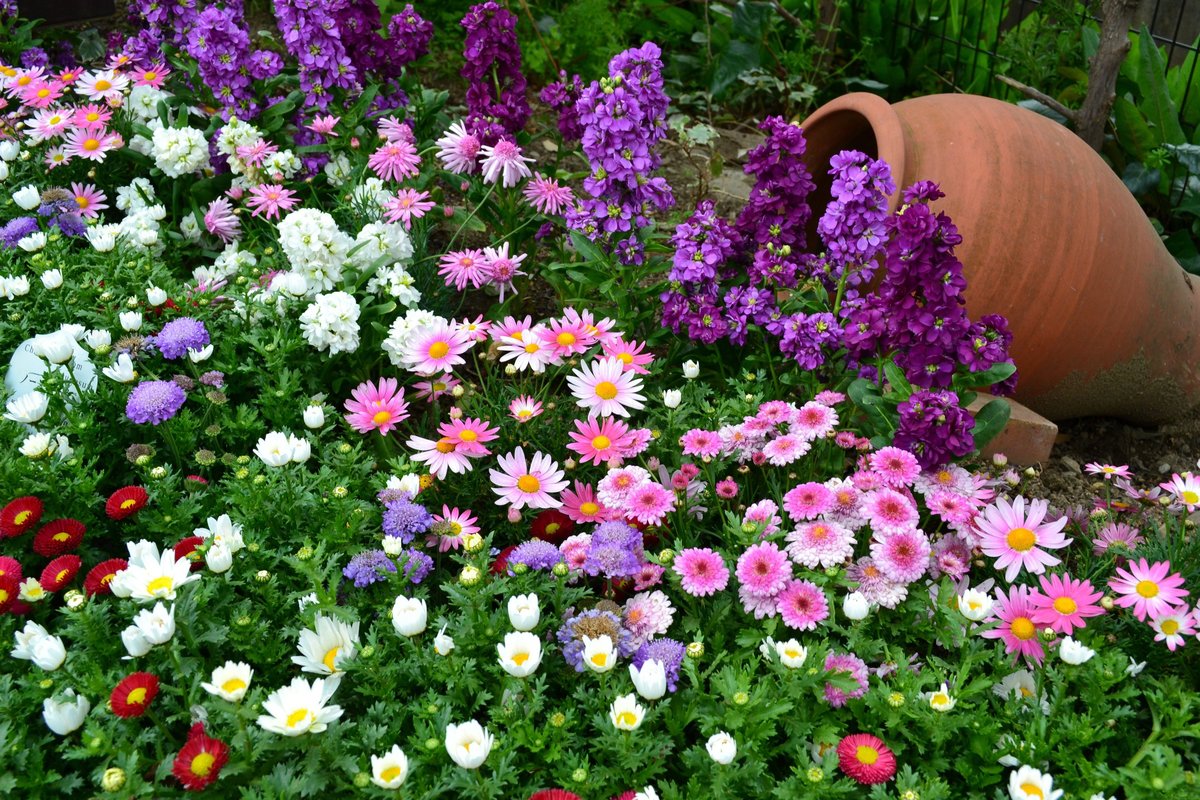
Perennials planted in the fall begin to sprout and bloom sooner in spring, as they've already established sufficient roots in the soil and undergone the hardening process. They better tolerate spring frosts, which are common in our country.
Another important point: gardeners have more free time in the fall. The harvest has already been gathered, so they can plan the placement of their future flowerbed, taking into account crop rotation rules.
We recommend: Lunar calendar for the gardener for 2023.
Fall planting has a significant drawback: if done too early, the flowers will quickly begin to grow, which will lead to their death when frost sets in. If they are planted too close to the soil surface, they can also be damaged by frost in severe frosts and little snow.
We recommend: Can asters be planted in the fall?.
What perennial flowers are planted in the fall from seeds in open ground?
We offer you the most popular flowers that can be planted in the open ground in the fall from seeds.
Which perennial flowers can be planted from seeds in the fall? We'll discuss this in this section. Keep in mind that perennial planting times vary depending on the warmer and colder regions of the country. This period typically begins in October and lasts until the end of November, and sometimes even into December. This should be when temperatures consistently fall below freezing.
However, some flowers are best planted only from seedlings or seeds in the summer or indoors, such as bergenia and biennial mallow. Read on for more details.
Aquilegia
This flower is a herbaceous perennial. There are about 100 species of this plant. They all share a thick taproot and petioles no more than 20 cm tall, covered with tricomplex leaves. Even when not in bloom, this plant will be a true highlight of your flowerbed.
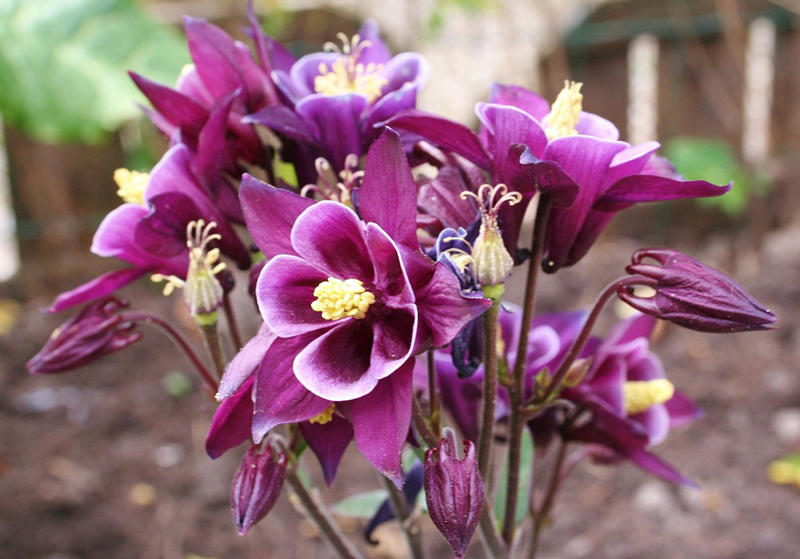
In mid-June to July, columbine flowers begin to appear, with either single or double petals. The perianth is double, and the coloring can vary. Removing spent flowers promptly before the seed pods appear will result in longer blooms.
Types and varieties
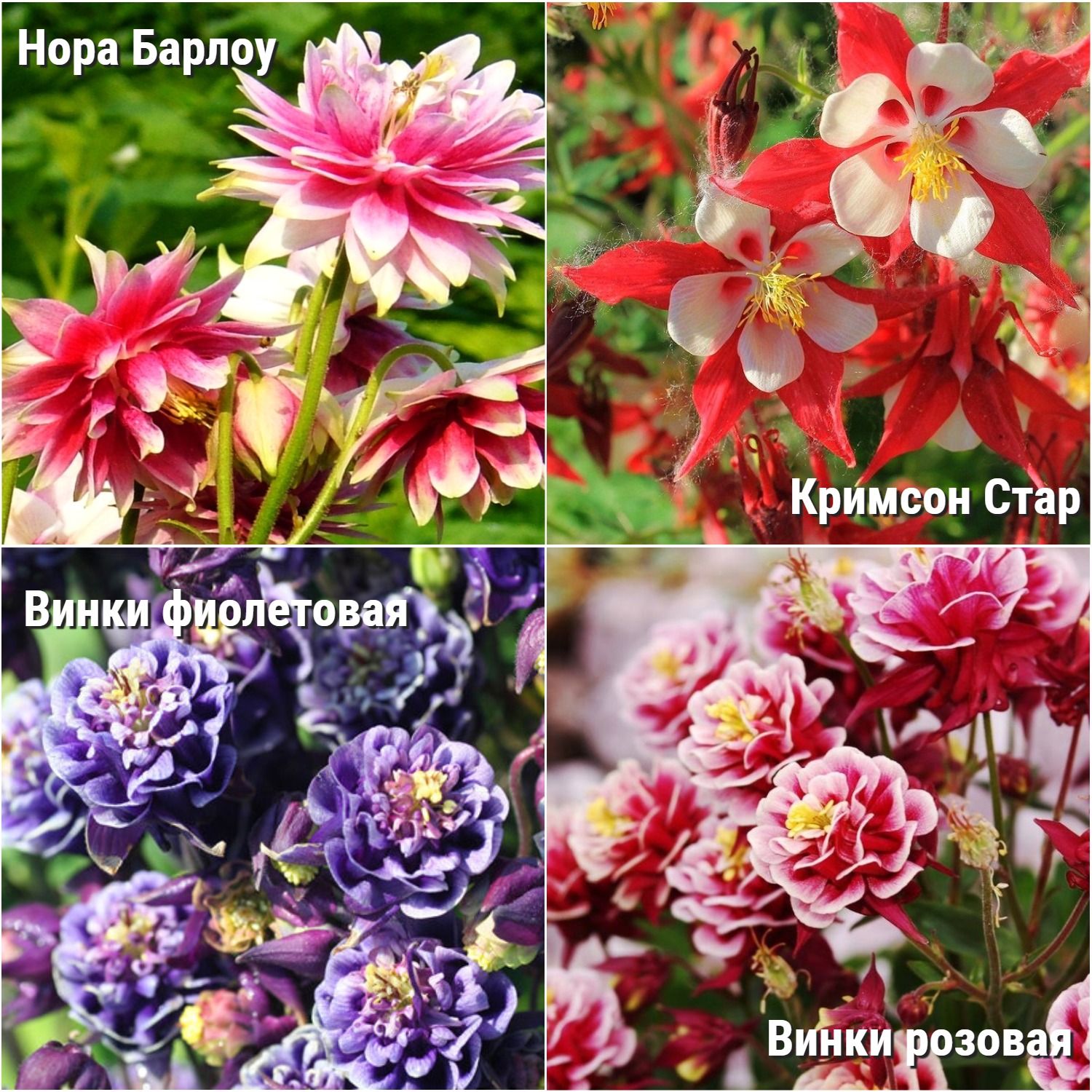
There are several of the most spectacular varieties of columbine:
- Winky – a low-growing bush with pink or purple-white flowers.
- Nora Barlow – pink flowers up to 8 cm in diameter are formed, the plant height is 70 cm.
- Crimson Star – large flowers, carmine-red with a white center, height up to 60 cm.
Landing
For best growth, seeds require hardening, so it's recommended to plant them in the fall. Sowing occurs when temperatures reach a stable range of -2 to -4°C.
It's best to plant them directly in a permanent bed; they don't transplant well. They prefer loose, humus-rich soil and grow well in partial shade. There's no need to plant the seeds deep; simply sprinkle them with a nutrient-rich mixture and cover with mulch.
Read a separate article about columbine, planting, care features, varieties.
Aconite (Aconitum)
Belonging to the buttercup family, it boasts over 300 varieties. The plant has tall shoots up to 2.4 m tall, which can even twine in some varieties. It prefers humus-rich, well-moistened soil. It is undemanding and can grow in shady areas. All parts of the plant are poisonous, but have medicinal properties.
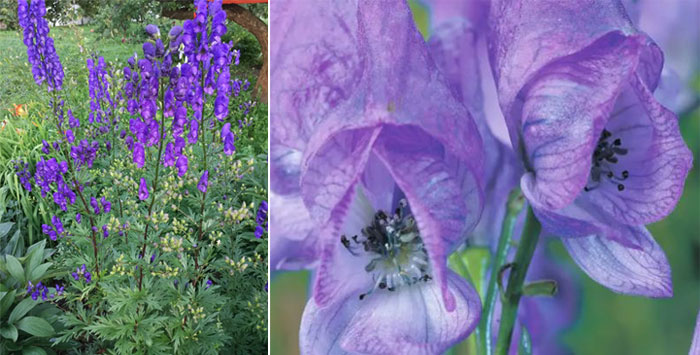
Aconite flowers have a shape unusual for buttercups: drooping hoods of blue or yellow. The buds begin to open in July and continue to bloom until August.
Varieties
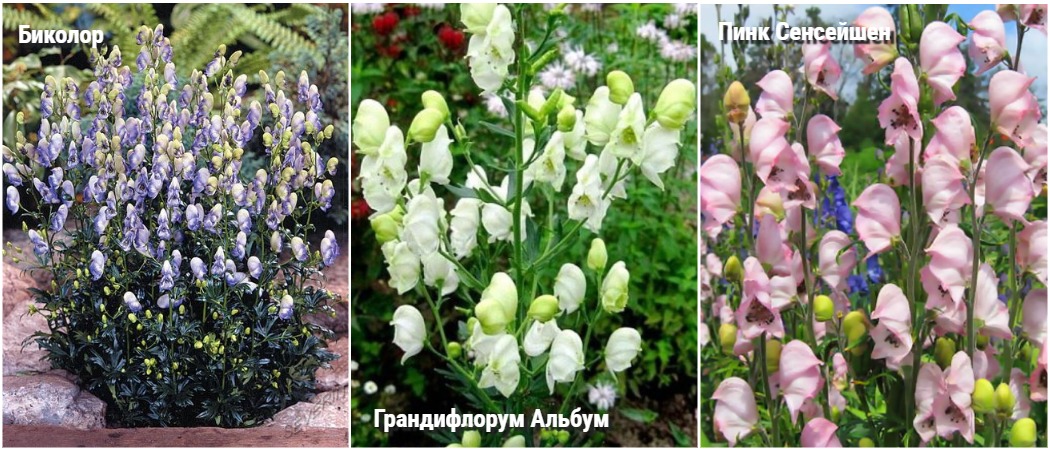
The most popular varieties were bred by breeders from Aconitum napellus:
- Bicolor – the bush is very tall and branched, the flowers are white with a blue border.
- Grandiflorum Album – long shoots are covered with white hoods.
- Pink Sensation – is distinguished by the pink color of its petals.
Landing
It's best to plant the seeds in shaded areas in October (the flower is frost-resistant). Aconitum grows poorly only in rocky and sandy soils, but clay soils can suffer from moisture, air, and nutrient deficiencies. In this case, it's best to prepare the bed in advance, ensuring drainage and air permeability. It does not tolerate excessive watering or stagnant water.
Arabis
Arabis, or rock cress, belongs to the Brassicaceae family and has about 100 varieties. It is distinguished by its beautiful, pubescent leaves, which can be oval, heart-shaped, or arrow-shaped. The stems are prostrate and root.
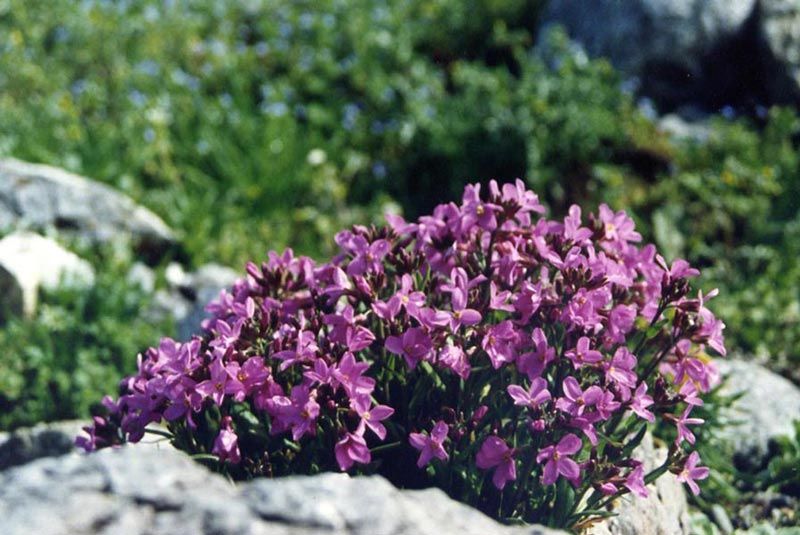
The inflorescences are racemose, and the flowers come in a wide variety of colors: pink, white, yellow, and purple. Some varieties have double petals.
Varieties
The most popular varieties are:
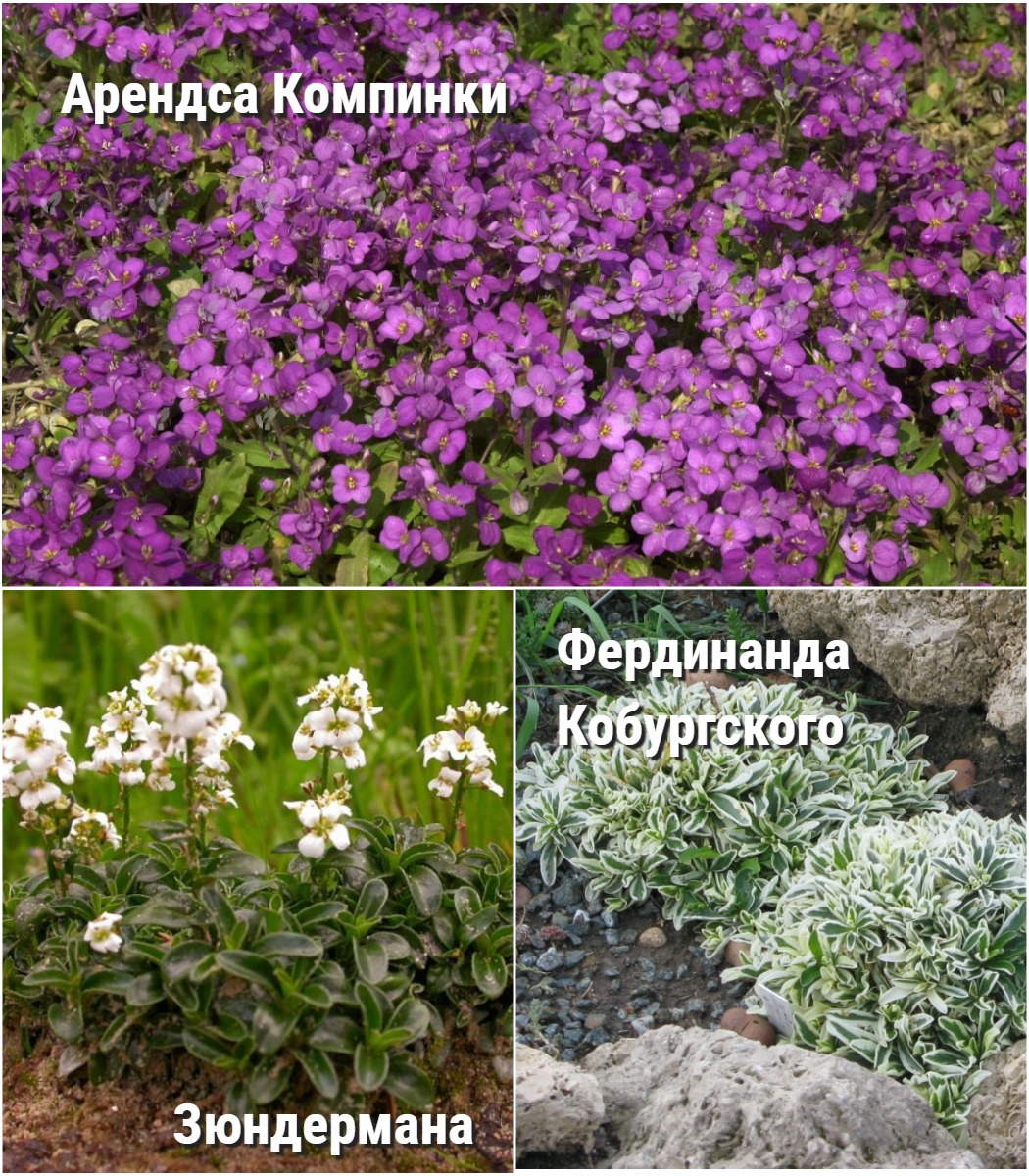
- Ferdinand of Coburg Variegata (ferdinandi-coburgii Variegata) – is a groundcover variety of Arabis, typically with dark green leaves edged in light. It grows to a height of 15 cm.
- Arendsa Kompinki (arendsii Compinkie) – is distinguished by its crimson flowers and a height of no more than 20 cm.
- Suendermannii – a groundcover perennial that grows up to 10 cm. It has beautiful, small, leathery leaves with a waxy sheen. It blooms in late spring to early summer with small, four-petaled white flowers.
Landing
Plant the seeds in October in a prepared flowerbed. The soil should be dry, loose, and sandy. If the soil in your area is too compact, add sand and expanded clay or fine crushed stone beforehand. Arabis will grow slightly slower in calcium-rich or acidic soil.
Read about it in a separate article Arabis and the rules for its planting and care.
Bergenia
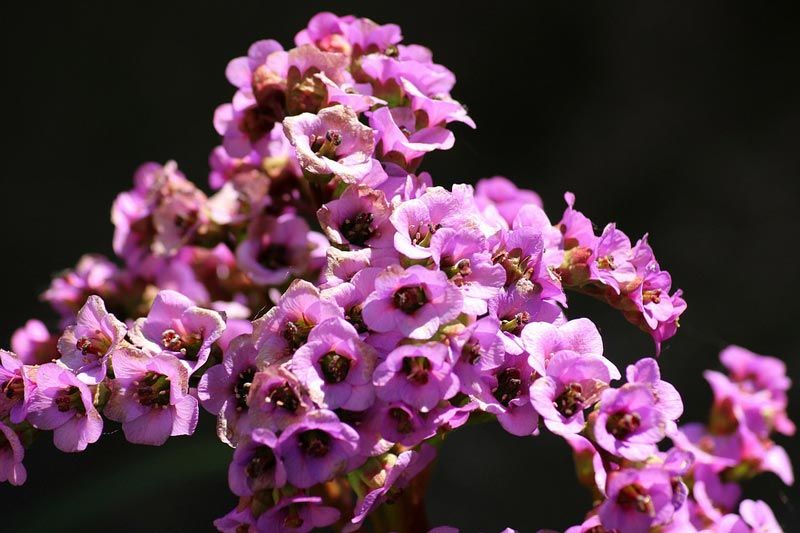
This perennial is distinguished by its large leaves, which acquire a reddish hue by early autumn. The stems grow up to 40 cm, and bell-shaped pinkish flowers appear at the top by the end of May.
Types and varieties
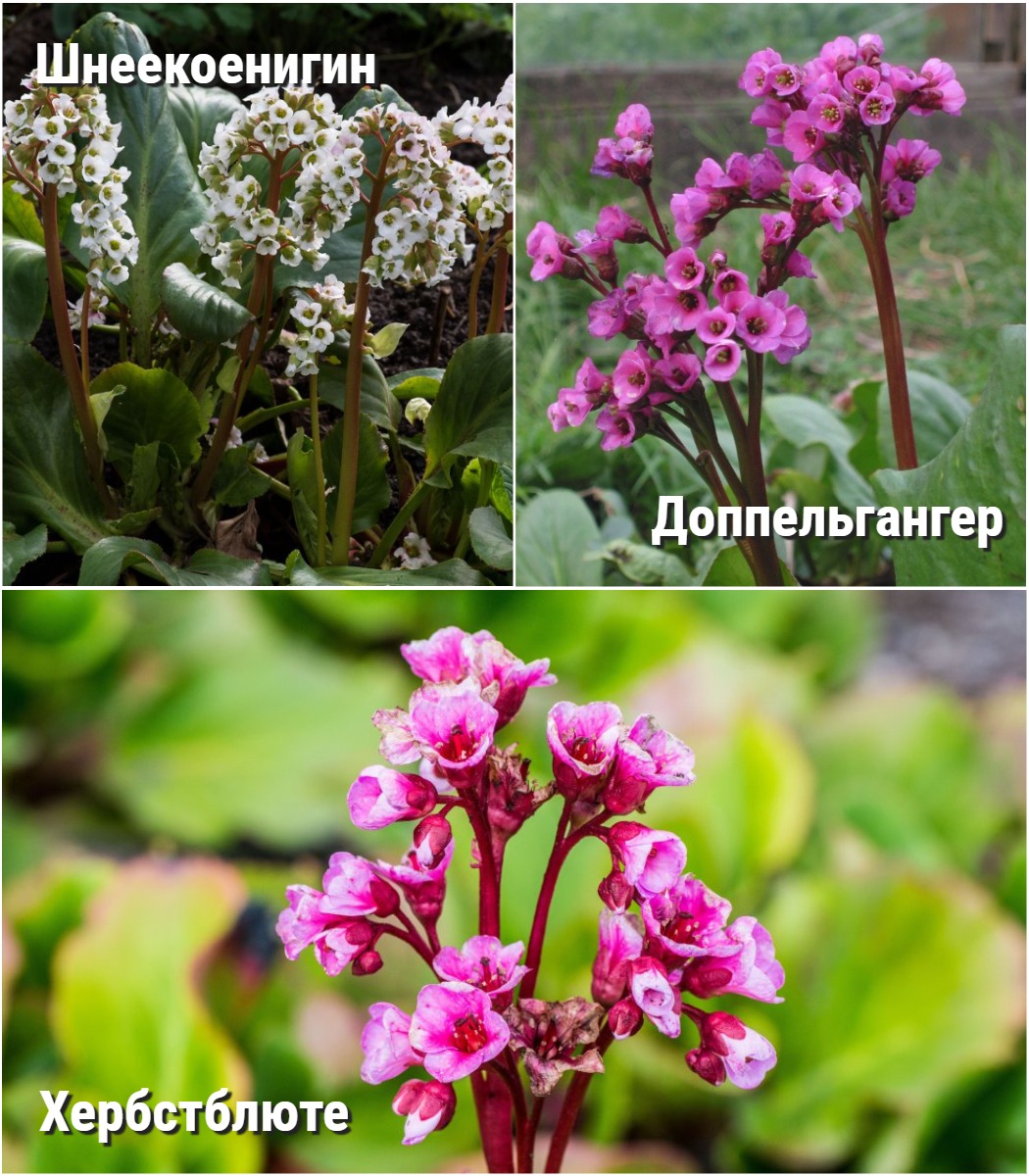
The most popular species is bergenia cordifoliaIt has a large number of varieties, including remontant ones that bloom again in the second half of the summer. Among them, the one that stands out for its particular decorative qualities is Doppelgänger, which has purple flowers, and Herbstblüte with rich pink inflorescence petals and green leaves throughout the growing season, like ShSchneekönigin.
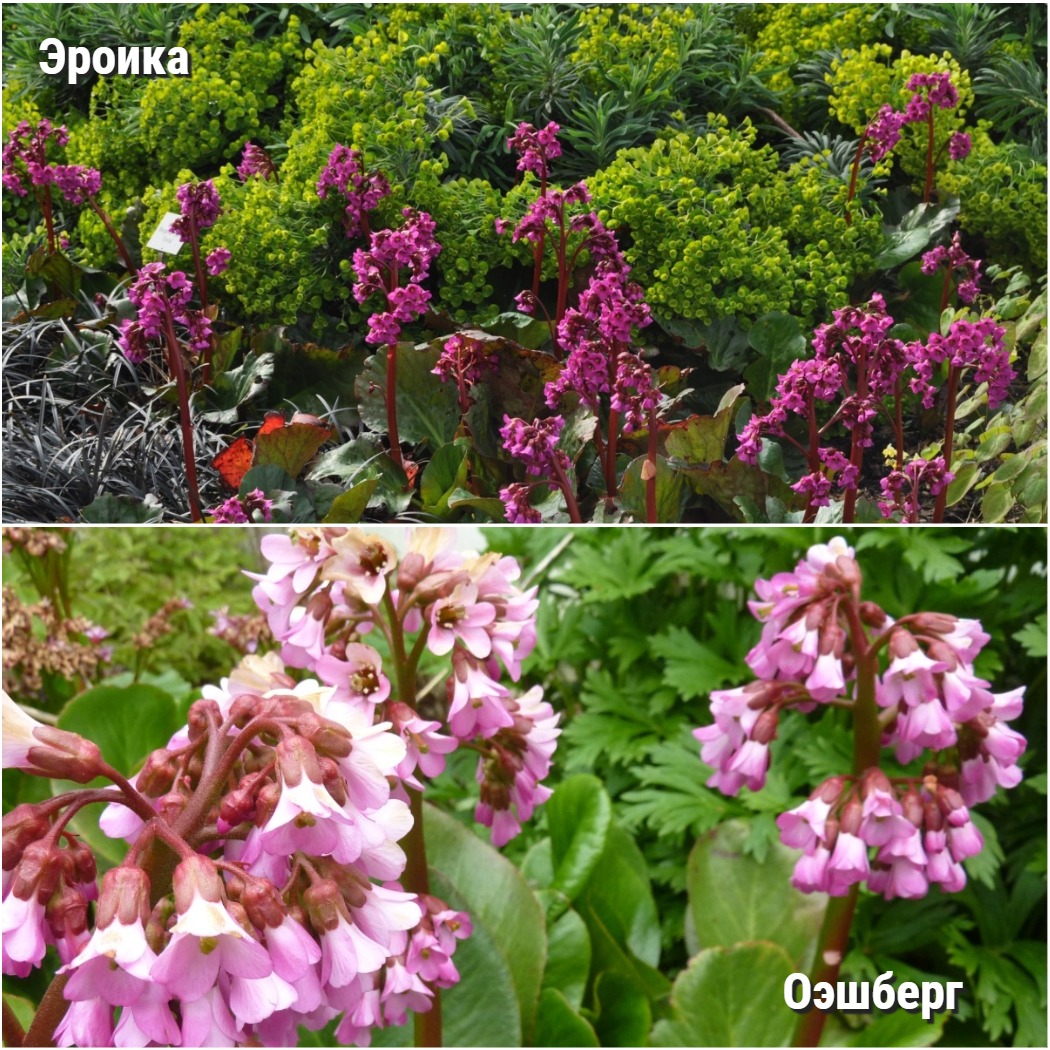
Important: Due to spring frosts, early bergenia flowers may not withstand temperature fluctuations and turn black. Therefore, in central Russia (including the Moscow region) and in northern latitudes, it is better to choose late-blooming varieties for planting, such as Eroica And Oeschberg with pinkish-red flowers.
Landing
Growing bergenia from seed isn't easy; it requires cold stratification. In spring, it requires stable temperatures without sudden fluctuations. The seedlings develop quite slowly, and the seeds themselves are very small. To achieve the best results, it's important to do some preparatory work:
- Before sowing, the seeds are treated with Fitosporin or any fungicide suitable for these purposes.
- Planting is done in a box. The soil should be balanced and loose, and the planting depth should not exceed 5 mm.
- The box is placed outdoors and covered with a layer of snow. This will allow the seeds to successfully undergo stratification.
When warm weather arrives in early March, the box is moved to a well-lit room for about a month, where the temperature is between 18 and 19°C. It's important to avoid leaving it in direct sunlight.
As soon as the first shoots appear, watering should be established. The soil should not be dry or overly wet. They grow very slowly. Once the stems reach 10 cm in height, they can be transplanted into separate pots. Flowering does not occur until the third or fourth year.
More interesting about Badane with description and photographs in a separate article.
Ligularia
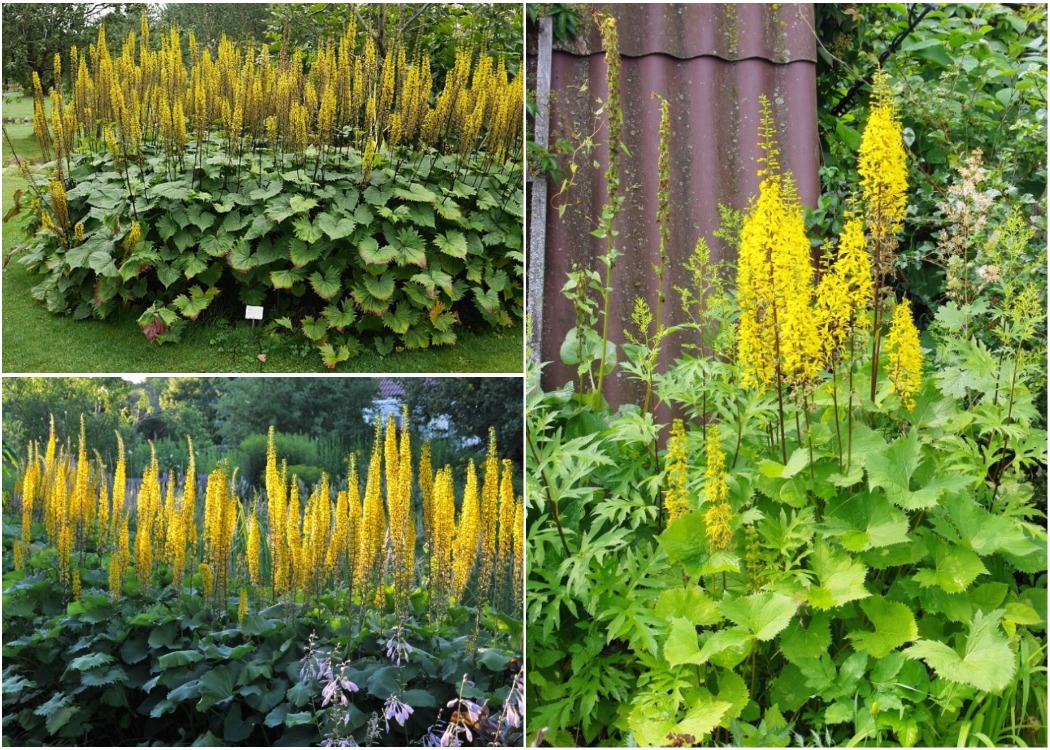
Ligularia belongs to the Asteraceae family and is distinguished by its gigantic leaves, which grow up to 60 cm, forming a basal rosette. Their shape depends on the variety chosen and can be kidney-shaped, palmately divided, oval, triangular, or palmate. The color is also strikingly diverse: all shades of green and even reddish-brown. Some varieties have leaves that are two-toned: purple underneath and green with a violet tint above.
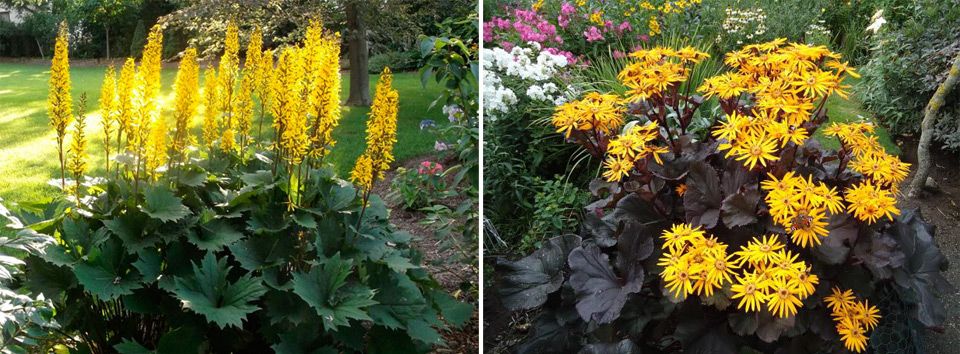
Abundant flowering lasts a long time, the color of the petals also depends on the variety.
Types and varieties
The varieties look very decorative. dentate Othello And Desdemona (Desdemona)The latter's leaves are purple-red-brown on the underside, while the upper side is light green with a subtle bronze sheen. Othello is characterized by a change in leaf color from purple-purple at the beginning of the season to dark green above and deep purple below as autumn approaches. Furthermore, the leaf blade has clearly visible purple veins. When held up to the light, a striking resemblance to the circulatory system can be seen. Flowering occurs in the second half of summer and continues into autumn.
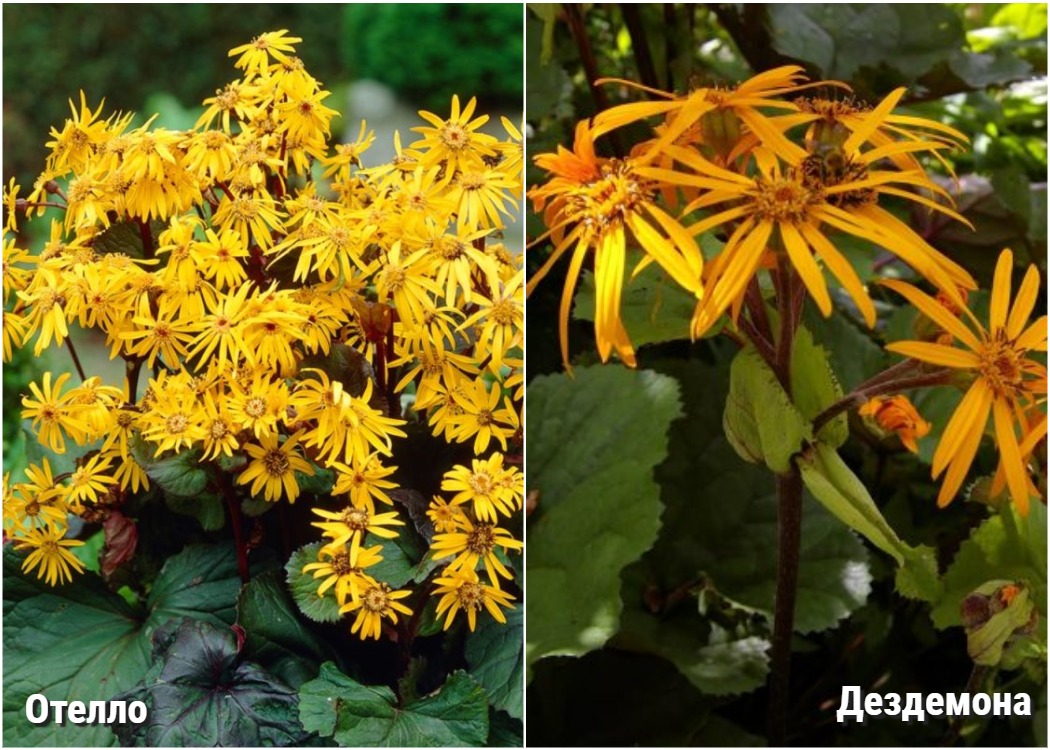
The serrated ligularia produces flower heads of yellow, orange, or gold, with petals resembling the teeth of asters or daisies. The plant's main advantage is its low light requirements—it thrives even in shady corners of the garden.
Ligularia Przewalski It has a lighter appearance due to its deeply dissected leaves. The flower stalks are covered with yellowish, elongated inflorescences that grow in a dense raceme. The first flowers bloom as early as late June and continue to appear on the bush until autumn.
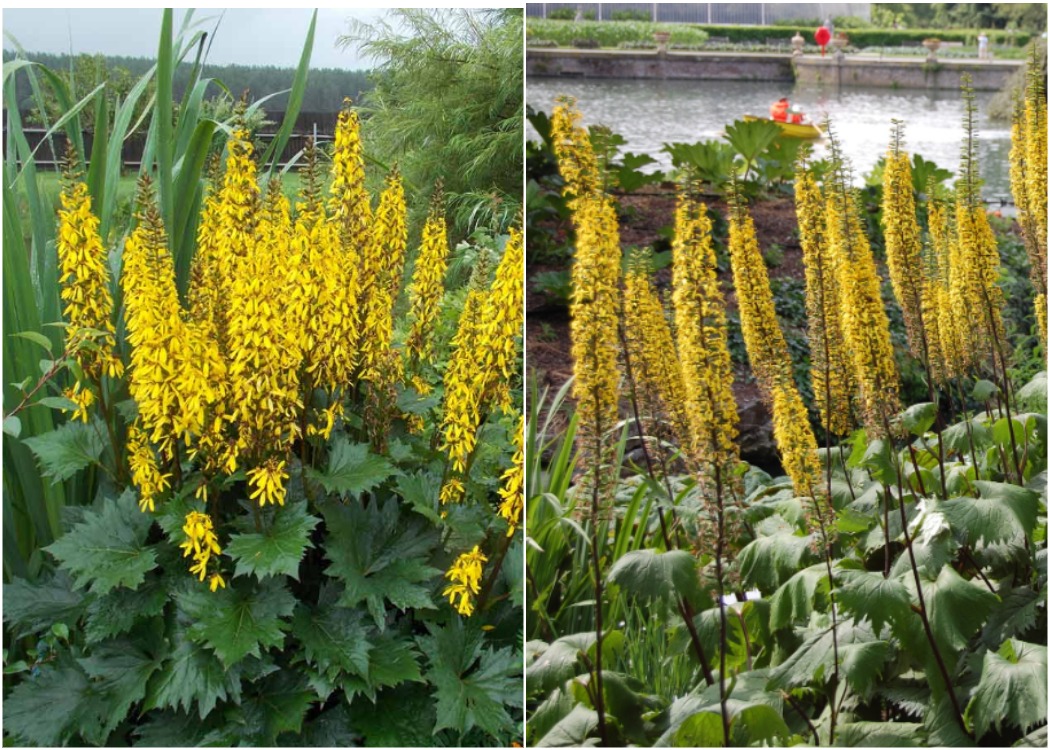
We also want to highlight the variety separately. narrow-headed (stenocephala) ligularia The RocketIt's sometimes referred to as Przewalski's lily. It grows over 2 meters tall, with very sturdy flower stalks and yellow flowers with delicate petals. Don't rush into pruning the bush at the end of the season—its leaves retain their decorative appeal for a long time, as they change color from green to purple-crimson.
Landing
Planting takes place in the fall, and sometimes even during the winter months. In some regions, this occurs in October-November, while in others, it may even take place in December. Don't plant the seeds more than 1 cm deep. When planting in the spring, ensure the soil is always sufficiently moist. Flowering occurs only in the fourth year.
The flower reproduces well by self-seeding.
Read about ligularia also in a separate article.
Gaillardia
Gaillardia belongs to the Asteraceae family and can be found as both annual and perennial flowers. There are approximately 20 species, including tall (up to 100 cm) and short (up to 35 cm). The latter are more popular among gardeners as they require little effort to tie or support.
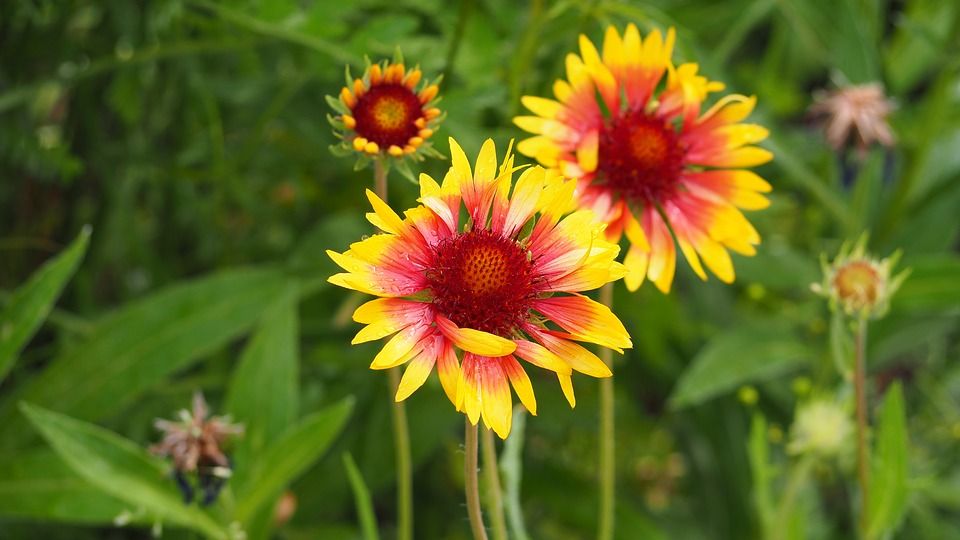
Flowering begins in mid-June and continues until the first frost. The plants are very undemanding, tolerating light frosts and even drought. It is not recommended to keep gaillardia in the same location for more than four years.
Types and varieties
View beautiful (pulchella) It is an annual plant and propagates by self-seeding. The bush is quite spreading, reaching a height of 50 cm. It blooms from early summer until November with a profusion of beautiful flowers.
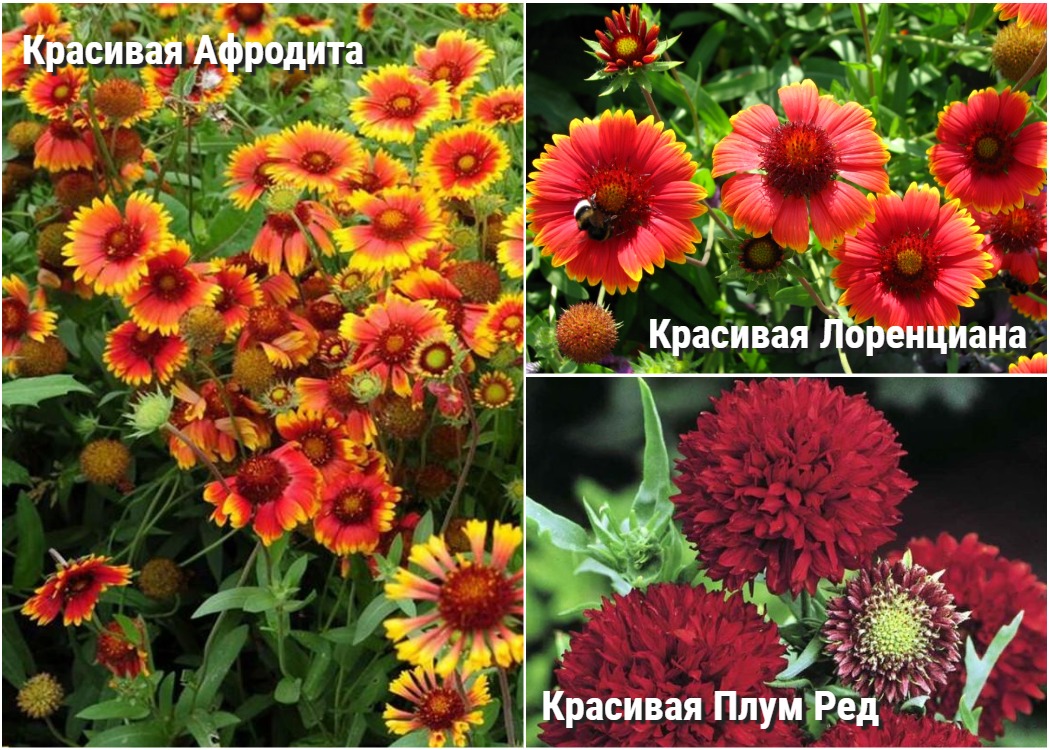
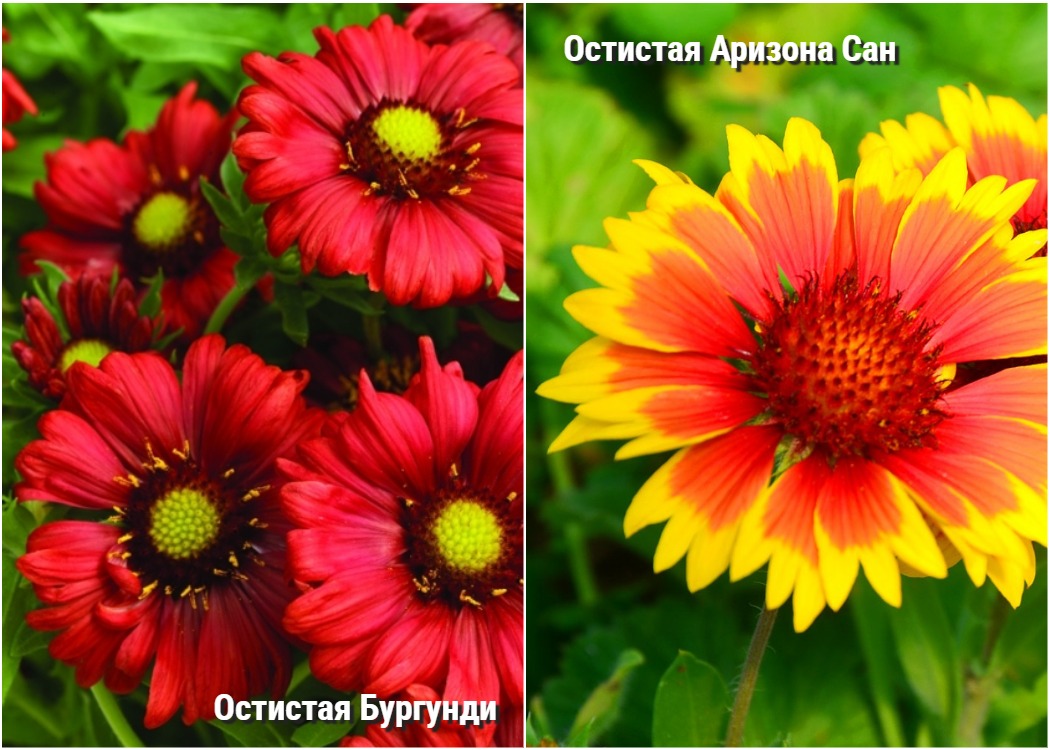
Aristata – a perennial plant growing up to 70 cm tall with lanceolate leaves. Flowering continues from June to September and produces lush inflorescences up to 12 cm in diameter. This species is often classified as the large-flowered or hybrid Gaillardia.
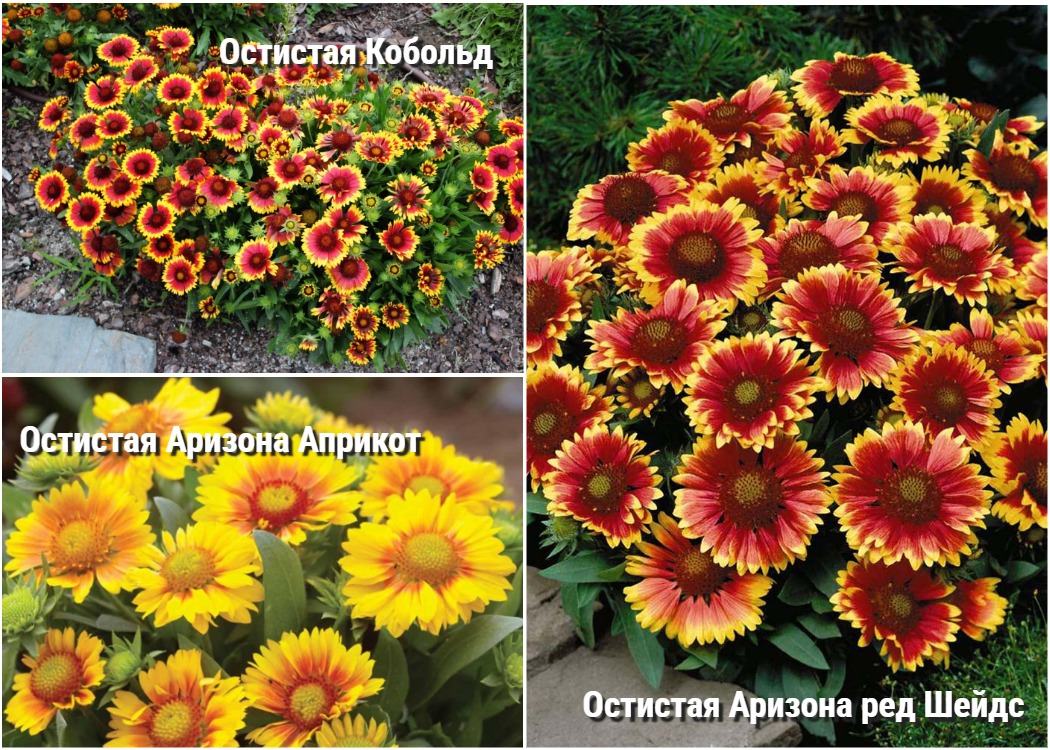
The color of the petals depends on the variety:
- Burgundy - burgundy.
- Arizona Sun, Kobold, Arizona Red Shades - red with yellow.
- Arizona Apricot - yellow.
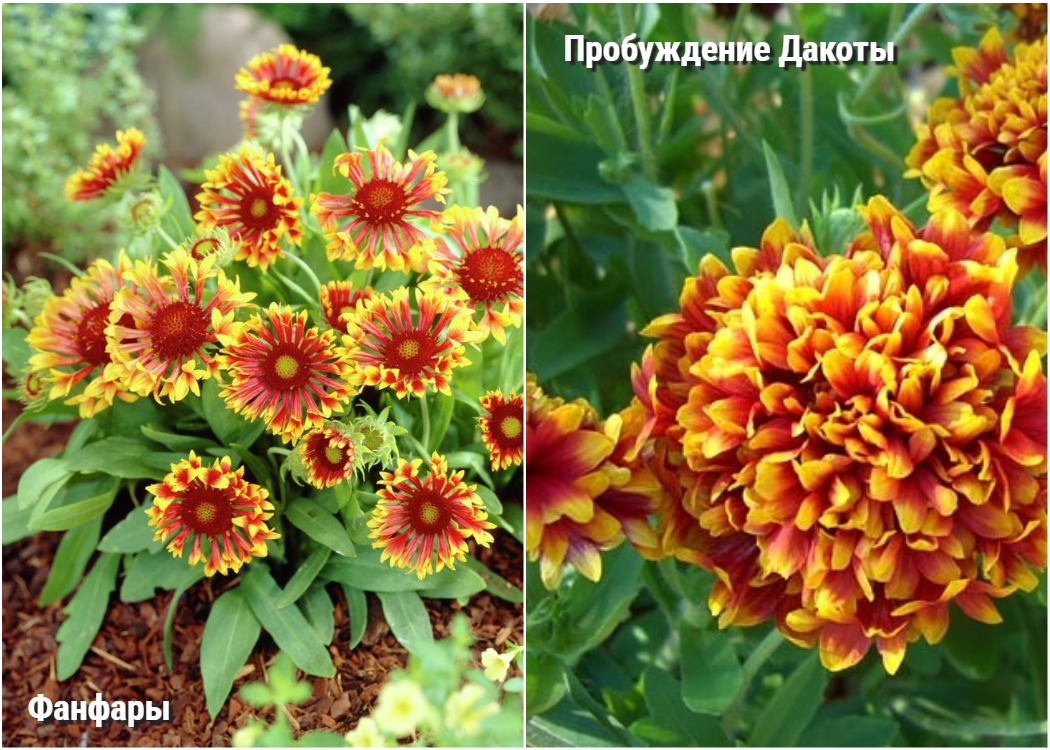
Hybrids have the most intricate flower shapes. Fanfares or Fanfare And Dakota Reveille.
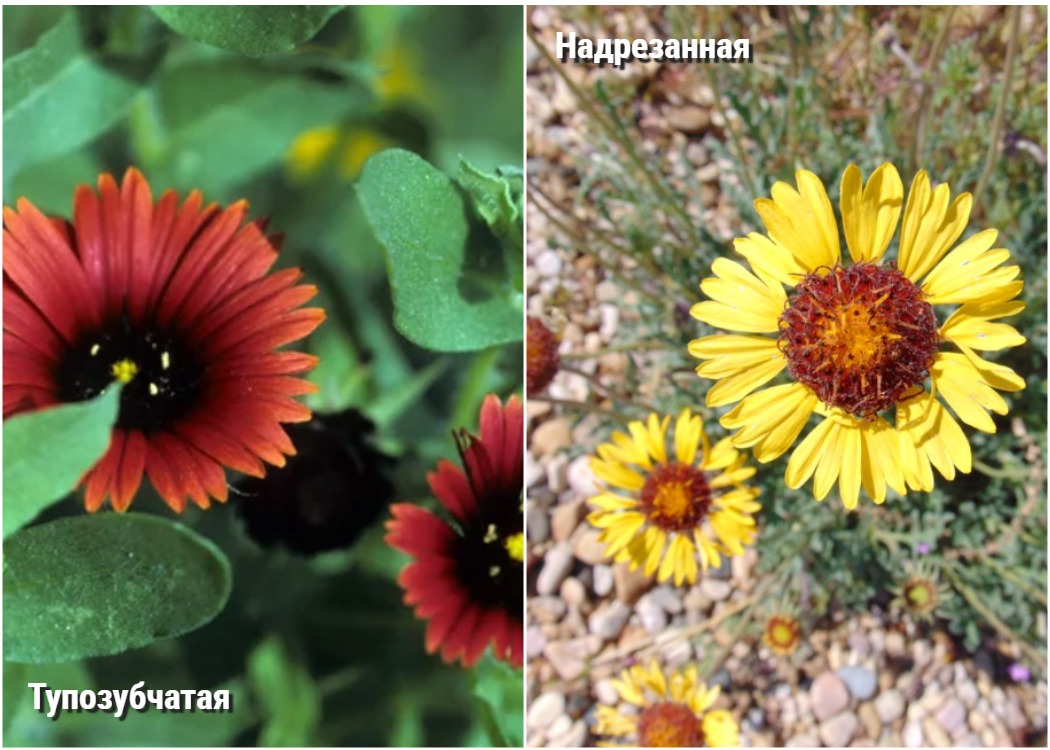
The most common ones are recognized as blunt-toothed (amblyodon) And pinnately incised (pinnatifida) Gaillardia, which grows primarily in the wild in Texas and northern Mexico.
Landing
Seeds can be sown directly into the soil starting in July. There's no need to plant them deep. Don't expect flowering in the first year; the plant needs to develop a rosette of 15 leaves before it has enough strength to form buds.
Seeds can be planted in the fall. Lightly sprinkle them with soil and cover them. In the spring, after the seedlings emerge and the weather becomes consistently warm, remove the covering. Young shoots need to be watered and weeded. Then, in the fall, the grown rosettes can be replanted.
Annuals are grown from seedlings, sown indoors approximately 20 weeks before transplanting into the ground, when the threat of frost has passed.
We recommend: o Gaillardia, planting features, care.
Helenium
Helenium can be either an annual or perennial plant. It is an herbaceous plant and, with proper care, can grow up to 170 cm. The upper portion of the bush is heavily branched. Leaves are located along their entire length and can be lanceolate or oblong, up to 7 cm in size. In perennials, the entire above-ground part dies off by winter, but new buds form within the roots, which will begin to grow in the spring.
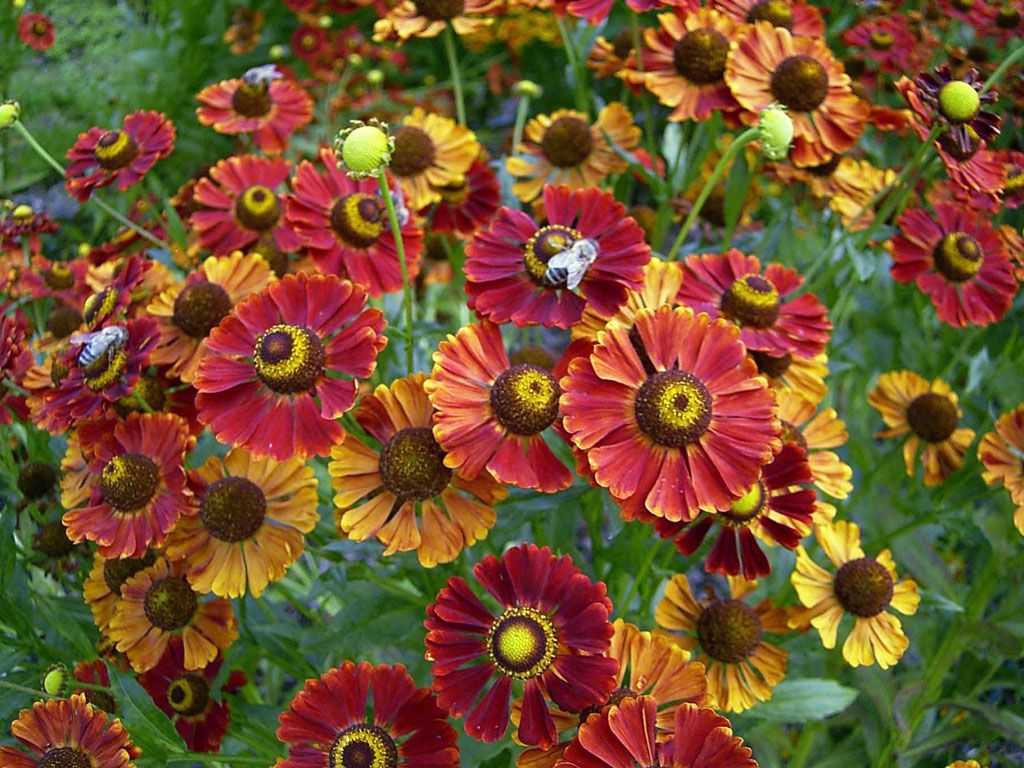
Flowering depends on the helenium variety. It typically begins in midsummer and lasts until September. The flowers resemble baskets, and can be orange, pink, red, yellow, or purple. In the fall, the seeds ripen within them.
Varieties
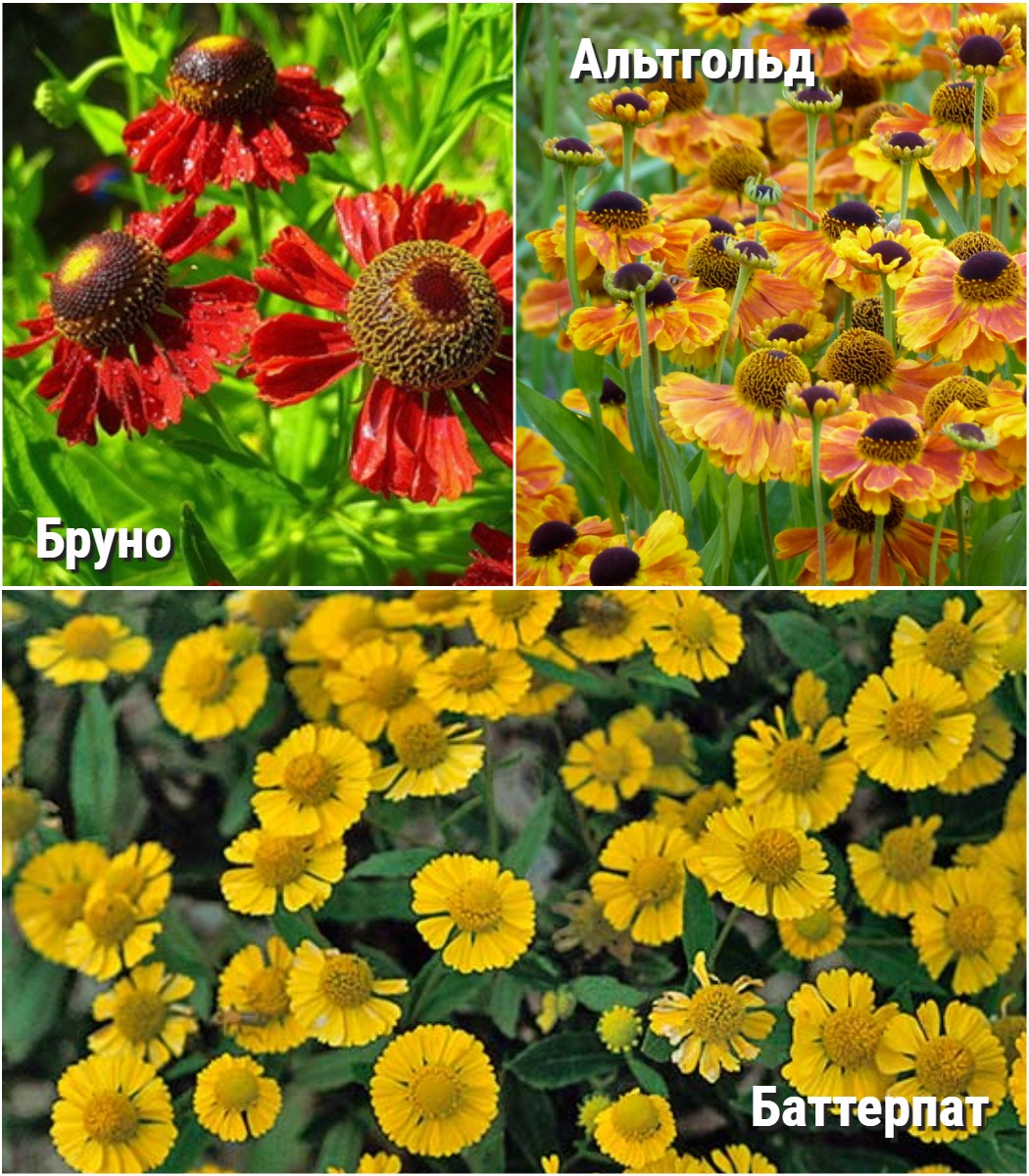
The best varieties autumn (autumnale) Helenium is considered to be:
- Altgold – grows up to 90 cm, covered with brownish-golden flowers up to 4 cm in size.
- Bruno – can reach 60 cm in height, blooms with baskets of red-brown color.
- Butterpat – can grow over 1 m and is covered with large golden flowers.
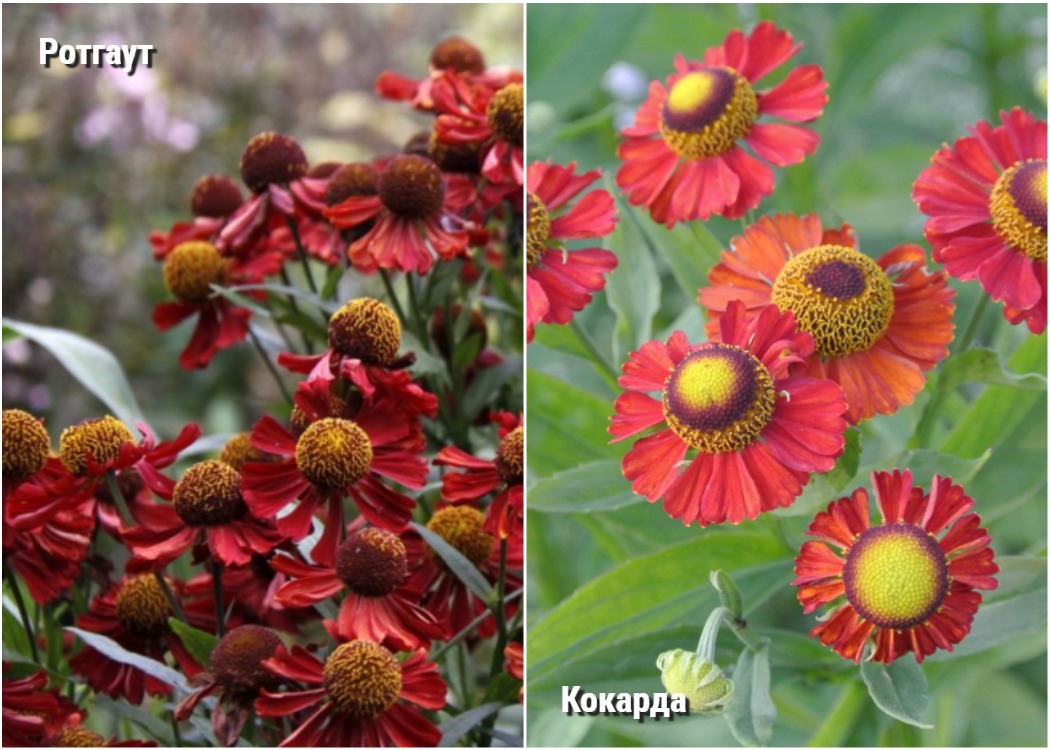
There are also several of the most common hybrid varieties of helenium:
- Rothaut – shoots stretch up to 120 cm, flowers have a yellowish-brown core and reddish-brown petals.
- Cockade – grows up to 1.2 m and blooms profusely with red-brown baskets with a yellowish core.
Landing
Autumn is the best time to plant helenium seeds directly into the ground. They will successfully undergo stratification over the winter and begin growing earlier in the spring.
Interesting articles about the flower:
Heuchera
This perennial belongs to the Saxifrage family and is a herbaceous plant without a distinct central stem. The petioles are approximately 35 cm long, and the leaves are basal, consisting of five fused lobes measuring approximately 5 x 10 cm.
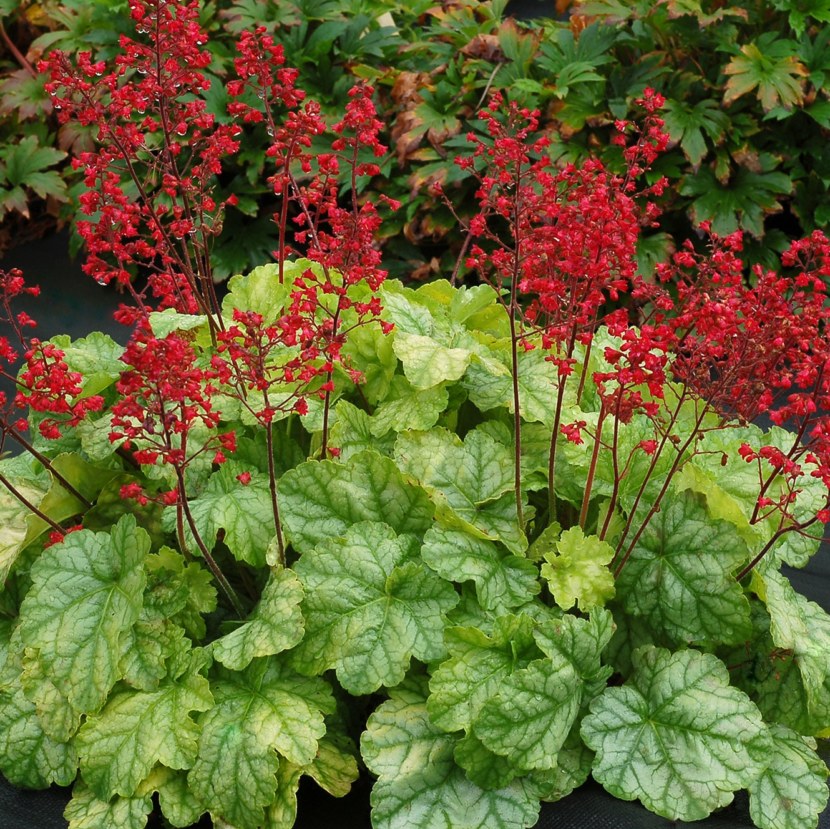
Heuchera flowers aren't the most flamboyant, but some species boast vibrant buds ranging from white to reddish hues. They don't grow singly, but in dense paniculate clusters.
Varieties
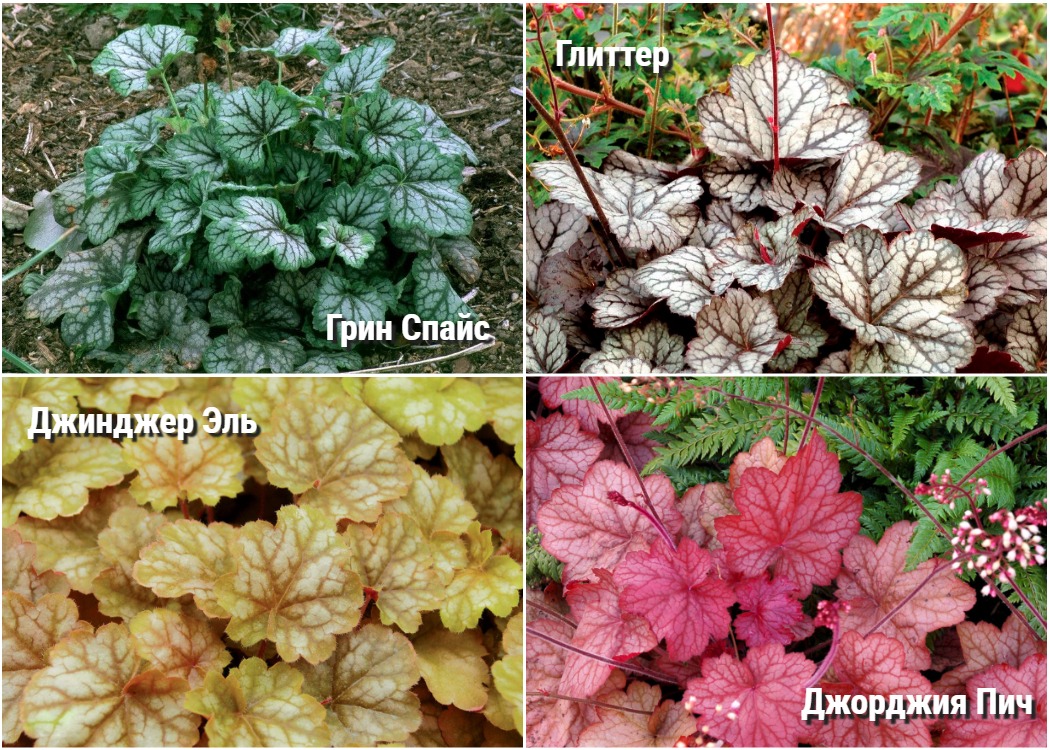
Today, there are approximately 400 varieties of heuchera, varying in leaf color and size. Here are some of the most beautiful:
- Green Spice From spring until almost the end of summer, it decorates the garden with its beautiful green leaves with a faint silvery tint. By the end of the season, it changes color to ochre-red.
- Glitter – is a hybrid of American and small-flowered heiress. It features two-toned leaves, purple on the inside and silvery-purple on the outside.
- Ginger Ale, which translates as "ginger ale" – the flowers were named for the unusual golden hue of their leaves, which is remarkably similar to ale. This variety doesn't like bright sunlight and grows better in shade. The soil should be fertile and well-drained. However, if drought occurs, the variety will tolerate it well.
- Georgia Peach – is perhaps one of the most undemanding varieties. It tolerates drought, rain, heat, or cold. Its appearance is very decorative. This heuchera changes foliage color several times during a single season. Initially, it is peach-colored with a silvery tint and dark red veins, then turns pinkish, and by the end of summer, it turns purple.
Landing
Heuchera seeds are very small, making them difficult to work with. Furthermore, their germination period is short. Experienced gardeners recommend planting the plants first in a box around March, with loose, slightly acidic soil and good drainage. There's no need to plant the seeds too deeply; lightly pressing them down with your finger is sufficient.
Gypsophila
Gypsophila is a herbaceous plant. It has a taproot that extends several dozen centimeters into the ground. It grows very quickly through lateral shoots, taking on a spherical shape. It can reach a height of 120 cm, but many varieties do not rise more than 10-20 cm from the ground and have groundcover shoots.
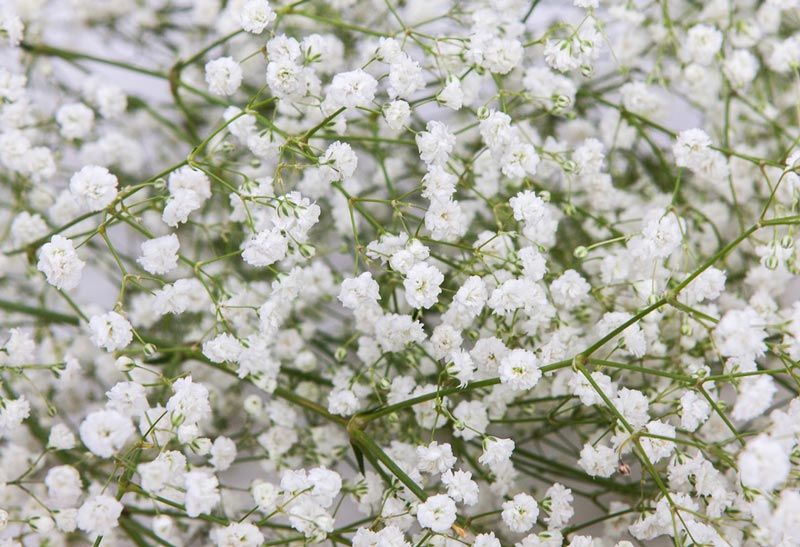
Leaves are virtually absent, and those that are present are dark greenish or even grayish. At the end of the first summer month, small inflorescences appear at the ends of the shoots, gathered into panicles. Seed pods form at the end of flowering.
Varieties
The genus Gypsophila includes approximately 150 species and over a dozen cultivars. These include both perennials and annuals.
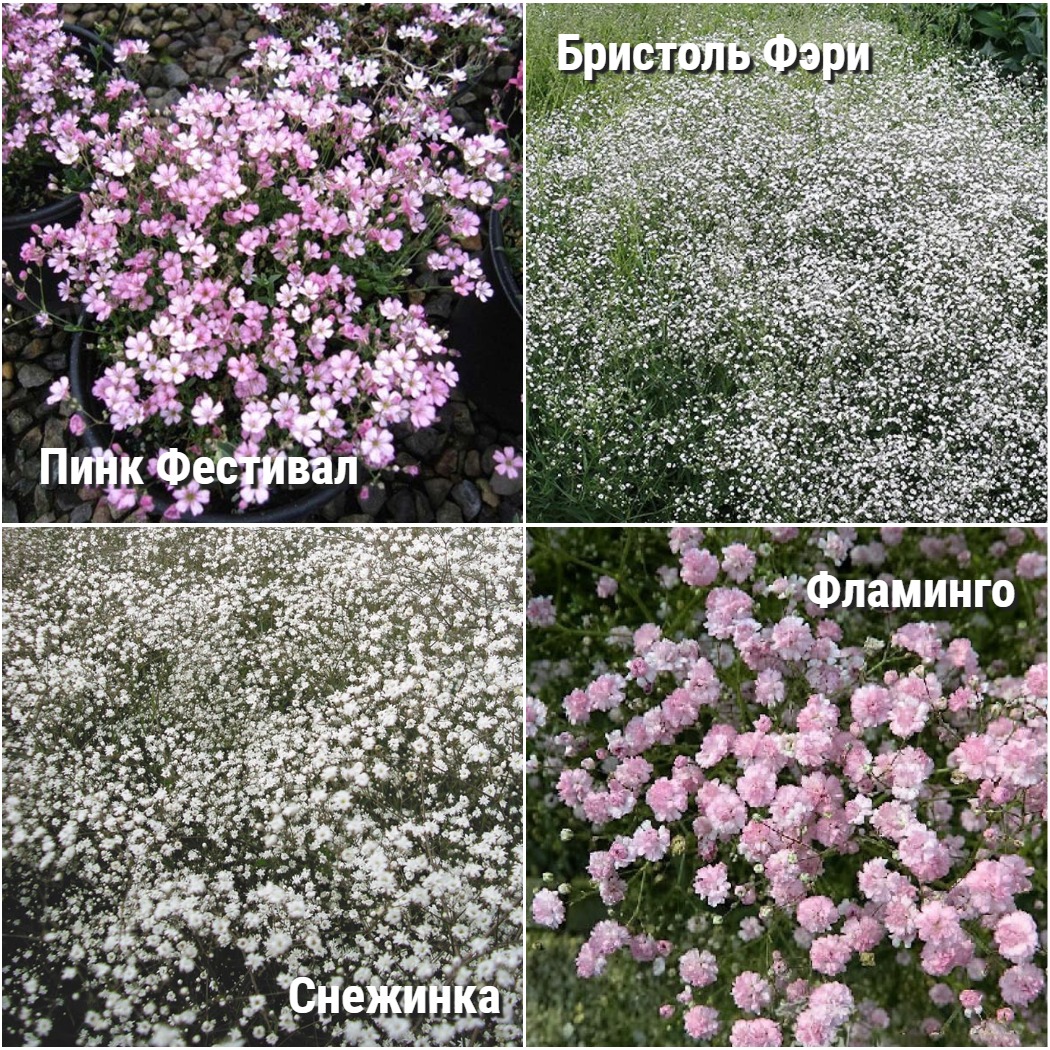
Perennial plants do not need annual renewal, for example, gypsophila paniculate (paniculata)It grows well, forming tall (up to 120 cm) bushes with pubescent gray-green bark and lanceolate leaves. Numerous small flowers up to 6 mm in diameter bloom at the ends of the shoots. Varieties of this species include:
- Pink Festival – an openwork cushion-shaped bush, 45 cm tall, with pearl-pink semi-double flowers.
- Flamingo – grows up to 75 cm, flowers are white, double.
- Bristol Fairy – grows in the shape of a ball, about 70 cm high, flowers are double, white.
- Snowflake – looks very beautiful. This dark green bush grows very densely, its diameter can reach up to 50 cm. In June, gypsophila is covered with fluffy, densely double white flowers, resembling snowflakes.
Landing
Gypsophila can be sown in the fall—October and November. Don't forget to mulch the bed. In the spring, in April or May, when the seedlings emerge and become a little stronger, they should be transplanted to their permanent location. Sowing can also be done in the spring—from mid-April to mid-May.

It's important to sow baby's breath directly into a permanent bed; it doesn't tolerate transplanting and may fail to establish in a new location. It grows very quickly, so bushes should be spaced well apart and planted at a rate of 2-3 gypsophilas per square meter.
The soil should be loose, sandy loam. If the soil in your area is too dense and heavy, you'll need to dilute it with sand and fine gravel. Gypsophila dislikes overwatering and stagnant water around the roots. Therefore, it rarely grows in marshy areas.
Read more about perennial gypsophilas and their care.
Gentian (Gentiаna)
There are approximately 400 varieties of these plants. They get their name from the glycosides they contain, which impart a bitter taste to some parts. This originates from ancient times, when everything growing in nature was tasted and used in folk medicine.
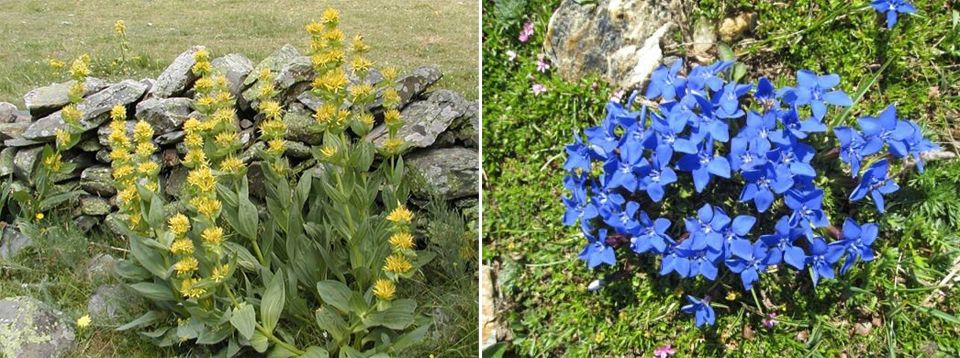
Gentians can be found in both temperate regions and northern latitudes. Some species thrive in high mountains and even in the tundra.
The height depends on the variety and ranges from 10 cm to 150 cm. The root system does not extend deep into the soil, consisting of thick, short rootlets. The leaves, located on a straight stem, have a pointed oval shape. Most varieties produce solitary flowers, but some species form clusters.
Gentian is often compared to bellflowers and even confused with them; these plants have similar-looking flowers of blue, light blue, yellow, white or purple.
Types and varieties
Gentian has a very wide variety of natural species and varieties, you can read more about them in the article about gentian (varieties, planting, care)
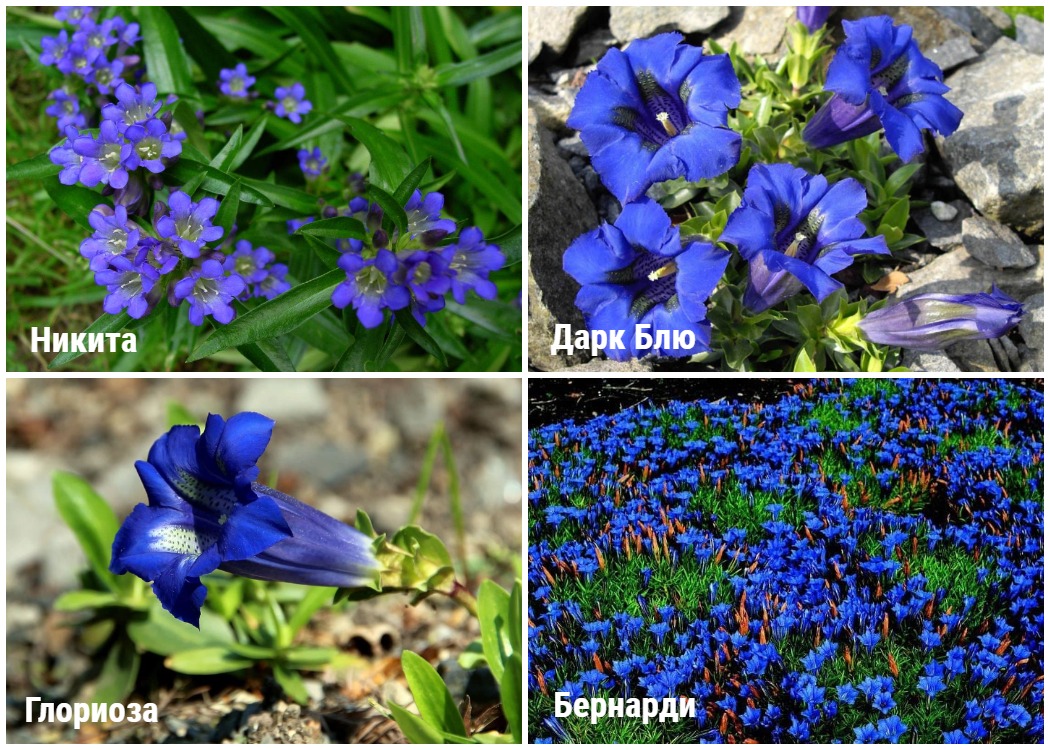
But today, thanks to the efforts of breeders, many hybrid gentian varieties have emerged. The most popular are:
- Nikita - with blue flowers;
- Bernardii – blooms with azure-blue single bells;
- Dark Blue – buds of a rich blue color, with black stripes inside the flower;
- Gloriosa - the same palette, only the internal inclusions are white.
Landing
Ideal for creating rock gardens, gentian is not very popular among gardeners, as it is quite difficult to grow from seed. For its proper growth, it requires prolonged cold stratification.
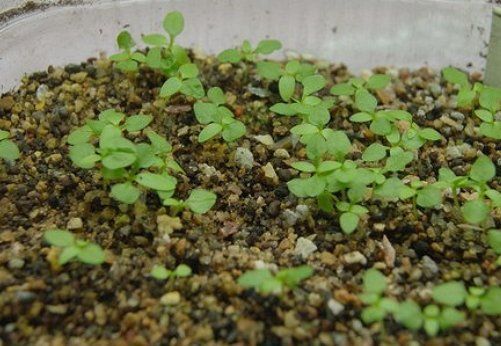
It's best to sow seeds in boxes. The soil should be loose. After planting, lightly cover the seeds with soil and bury the box in a shaded area outside. As spring approaches, it's important to ensure proper watering to keep the soil moist.
If you sow gentian in the fall, the first shoots will appear in late spring or early summer. Sometimes, they may not emerge for another year.
Delphinium
Delphiniums can be either annual or perennial. They reach a height of 3 meters, but some species don't exceed 10 cm. The stem is a tube with a hollow interior and fleshy edges. Branching is sparse, and pinching is used to encourage shoots to emerge.
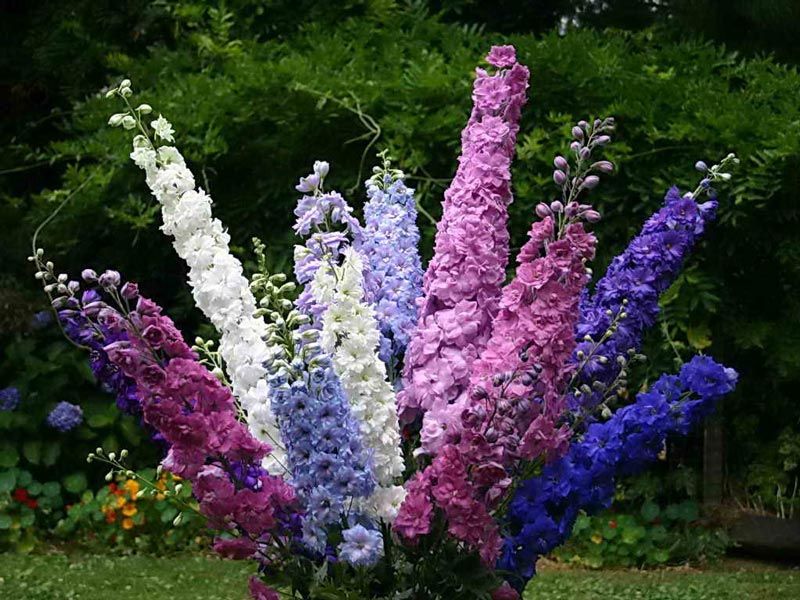
The arcuate leaves, dissected into oval segments, grow alternately. In late June, paniculate or pyramidal inflorescences appear at the tops of the stems. The flowering period, which lasts about three weeks, is often accompanied by a pleasant sweet aroma.
Varieties
For garden cultivation, hybrid varieties are used, which are derived from several species:
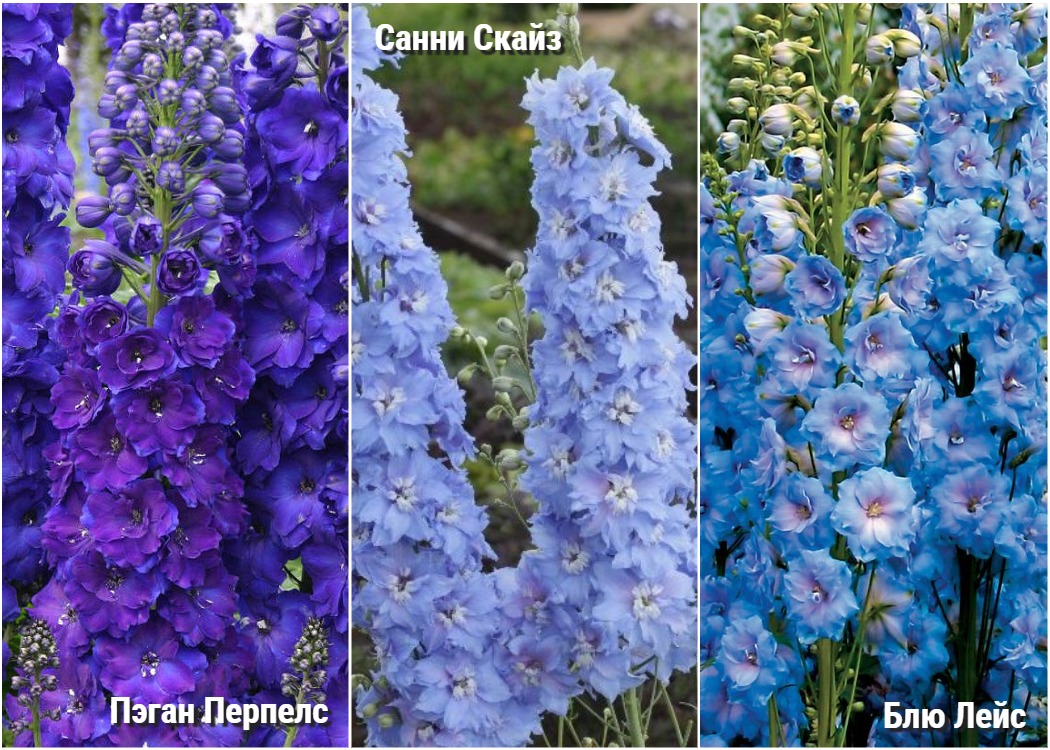
- New Zealand HybridsIt grows up to 200 cm and has beautiful flowers with double or semi-double petals. The best varieties are: Pagan Purples, Sunny Skies, Blue Lace.
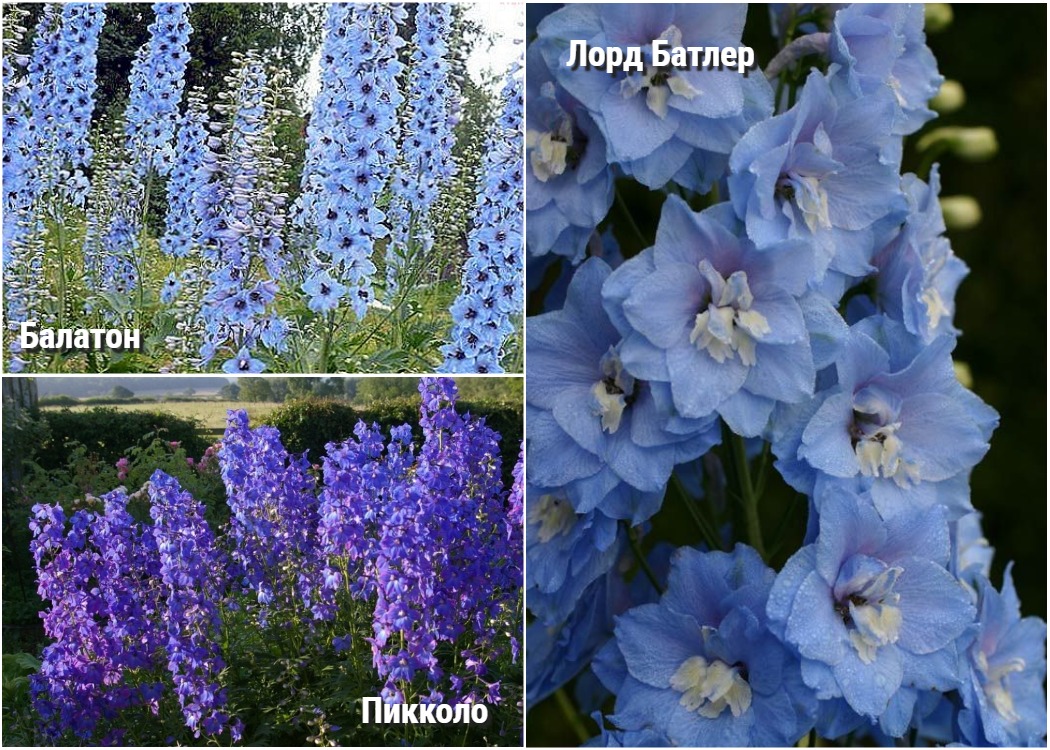
- Belladonna was one of the first to be bred by a group of plants distinguished by pyramidal inflorescences of blue or purple color. These include the varieties Piccolo, Balaton, Lord Butler.
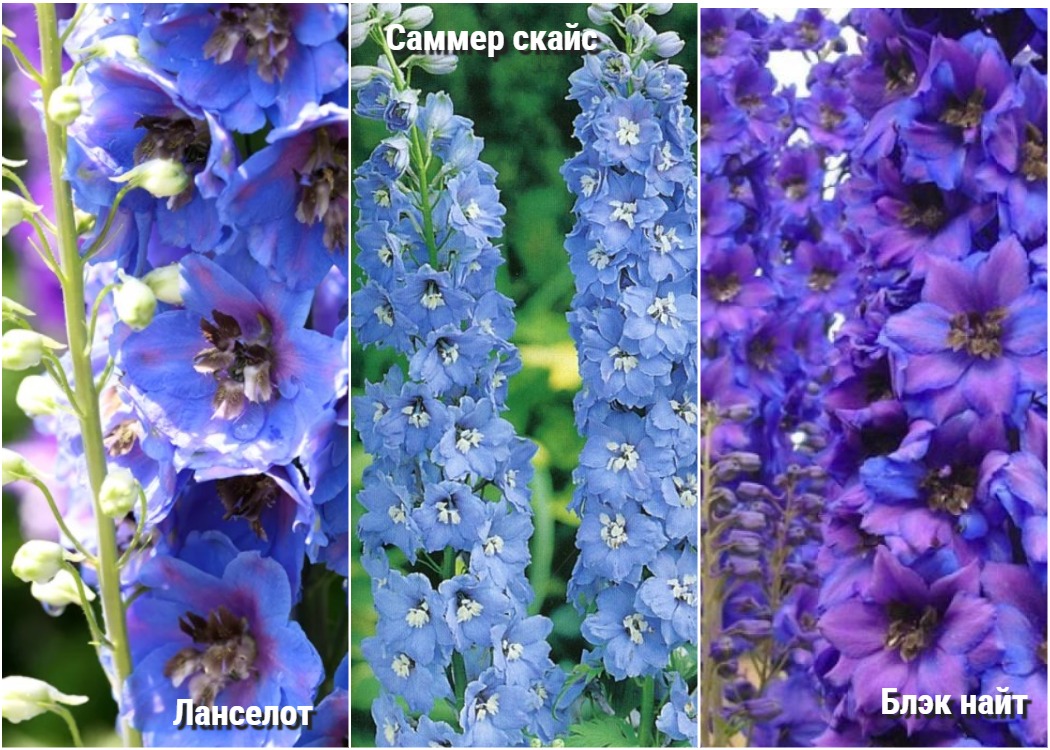
- PacificThis group appeared at the beginning of the last century and is characterized by very large flowers of various colors and a contrasting "eye". This group includes varieties Lancelot, Summer Skies, Black Night.
Landing
Getting seedlings from seeds and growing them into mature plants is no easy task. You can sow them before winter, in frozen ground, but be aware that the color may not be preserved; store-bought white or pink ones may turn blue or purple.
Before starting work, it is necessary to take into account a number of important factors:
- It is best to sow seeds before winter so that they undergo stratification.
- You can only work with fresh seeds. If you plan to use them only next year, you'll need to store them in the refrigerator.
- The soil must be loose and very light, otherwise the sprouts will not have enough strength to hatch.
Delphiniums should be planted precisely in the location where they will grow permanently. The site should be well-lit and protected from drafts and winds. There's no need to plant the seeds too deep; simply plant them 2-3 mm deep, cover with soil, and mulch for the winter.
Read more about delphinium.
Doronicum
Doronicum is a perennial herbaceous plant with over 40 varieties. Its shoots can grow up to 100 cm. Along their entire length, they are alternately covered with triangular, slightly elongated leaves. However, near the base, they are round or heart-shaped, forming a basal rosette. The vegetative parts are covered with a slight pubescence.
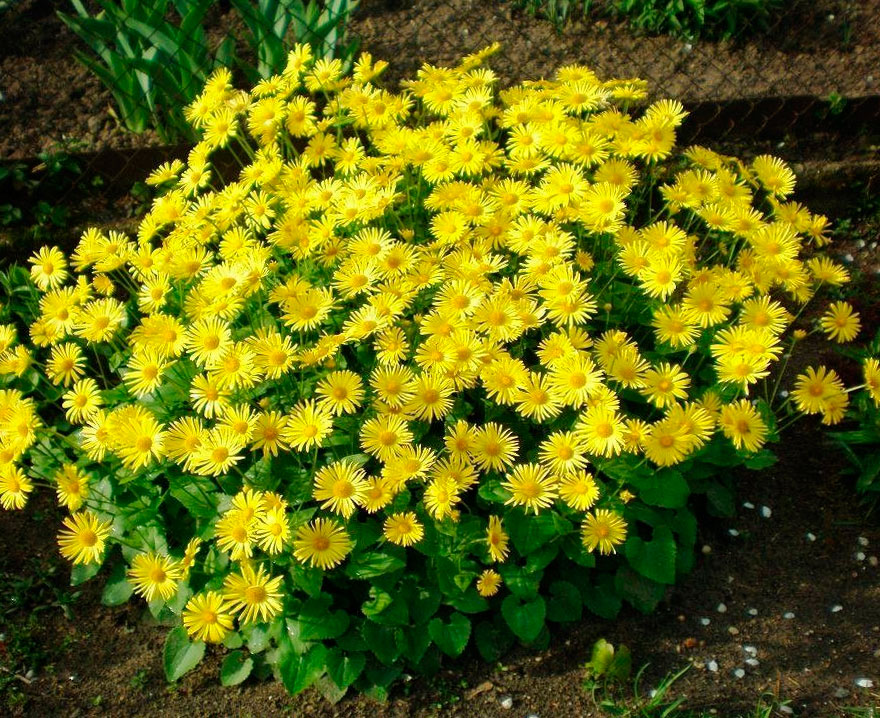
The buds bloom yellow as early as late March. Some varieties produce solitary buds, while others form clusters. After pollination, seed pods no more than 3 mm long are formed, which remain viable for up to two years.
Varieties
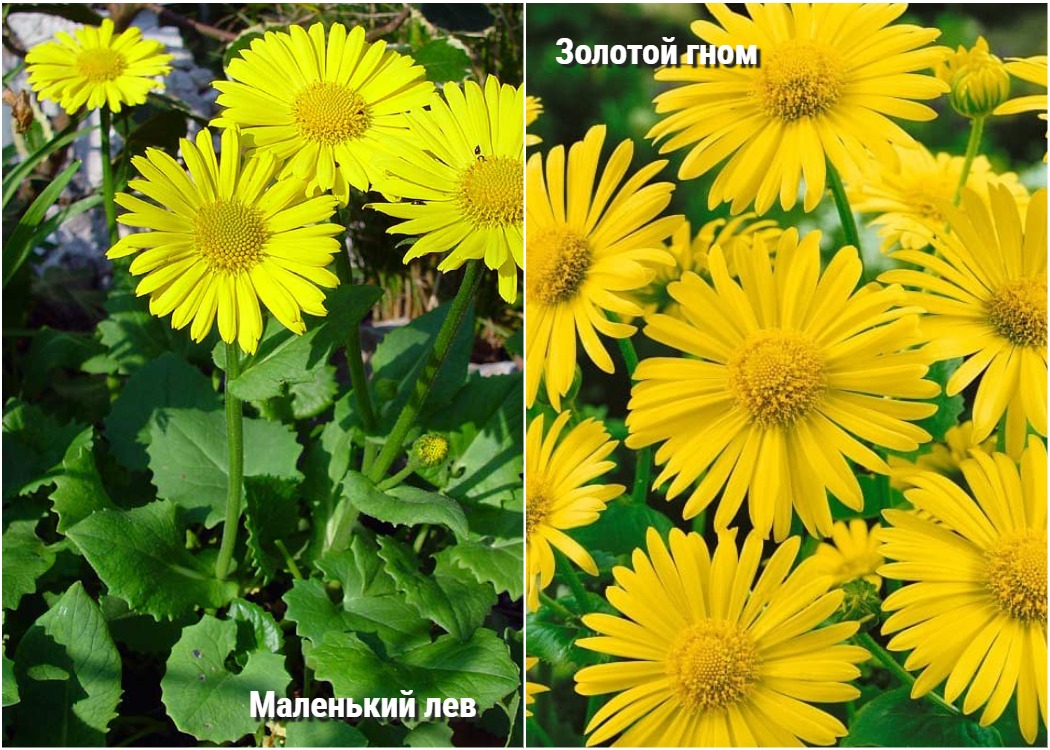
Doronicum varieties are more popular among gardeners. eastern (orientale)These include:
- Little Leo – a lush but compact plant up to 35 cm in height.
- Golden Gnome – grows only up to 15 cm, but blooms very early.
- Spring Beauty – reaches 45 cm in height, blooms with bright yellow flowers with double petals.
Landing
The seeds are sown in the soil in October. Doronicums prefer semi-shaded areas, but avoid planting them near trees. The soil should be loose and moist, but not stagnant. To ensure abundant flowering, prepare the bed in advance by digging the soil and manure to a depth of a bayonet. When planting, it's important to keep in mind that the bushes grow quite quickly, so it's not recommended to space them closer than 40 cm apart.
Carpathian bellflower (Campanula carpatica)
The Carpathian bellflower is a dwarf member of the Campanulaceae family. It naturally grows in the mountainous regions of Central Europe and the Carpathians, hence its name.
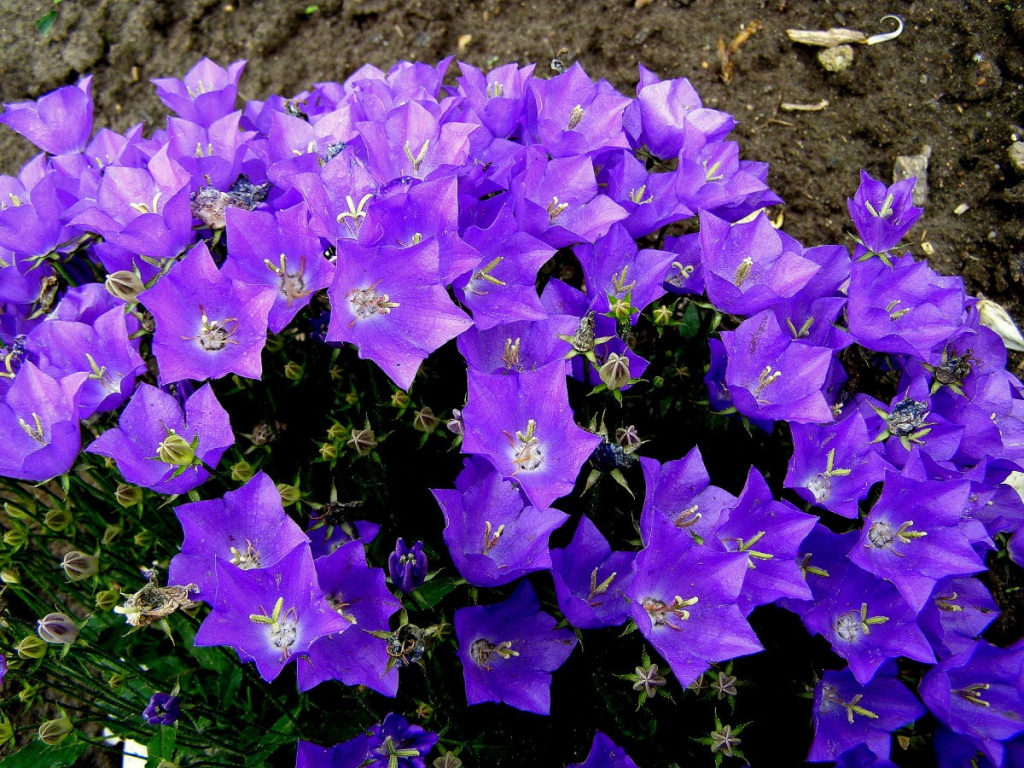
This herbaceous perennial grows up to 30 cm tall, with slender, branched stems and cup-shaped flowers up to 5 cm in diameter. Their color ranges from white to purple. The first buds open as early as June, and the flowering period is long and profuse. It culminates in the formation of a cylindrical seed capsule.
Varieties
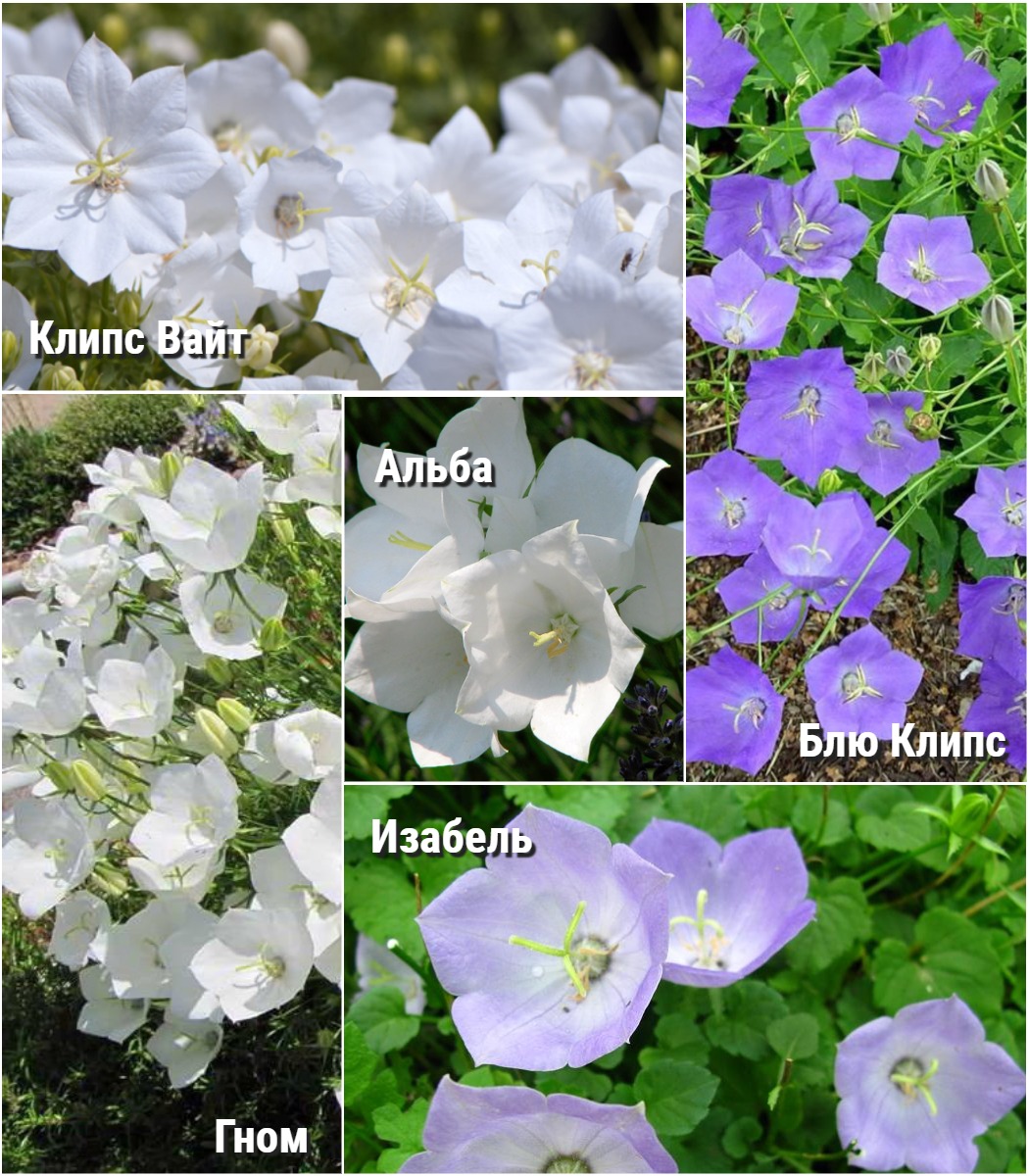
Carpathian bellflower comes in a wide variety, which are equally successful grown in gardens, indoors, and on balconies. For flowerbeds, it's best to choose compact varieties with abundant and long-lasting blooms. These include:
- Gnome – a mature bush takes on a rounded shape, the petals of the inflorescences are painted white or blue.
- Alba – blooms with beautiful white flowers.
- Celestine, Isabel – are characterized by very bright blue flowers.
- Clips White – another variety with snow-white flowers.
- Blue Clips – with purple flowers.
Landing
Carpathian bellflower is usually sown before winter in a well-lit area with drainage and low-acid soil.
The planting site is dug over beforehand, along with fertilizer. If the soil is too compact, sand and humus can be added. Ash or dolomite flour can help reduce acidity in cases of high acidity.
More about bell or campanula.
Saxifraga
These herbaceous perennials quickly spread out, forming dense turfs, reaching heights of 5 to 70 cm. Leaf shape varies by species and can be pinnate, oval, diamond-shaped, or heart-shaped. Their colors also vary. Additionally, the plant secretes a grayish, chalky coating that accumulates on the leaf blades.
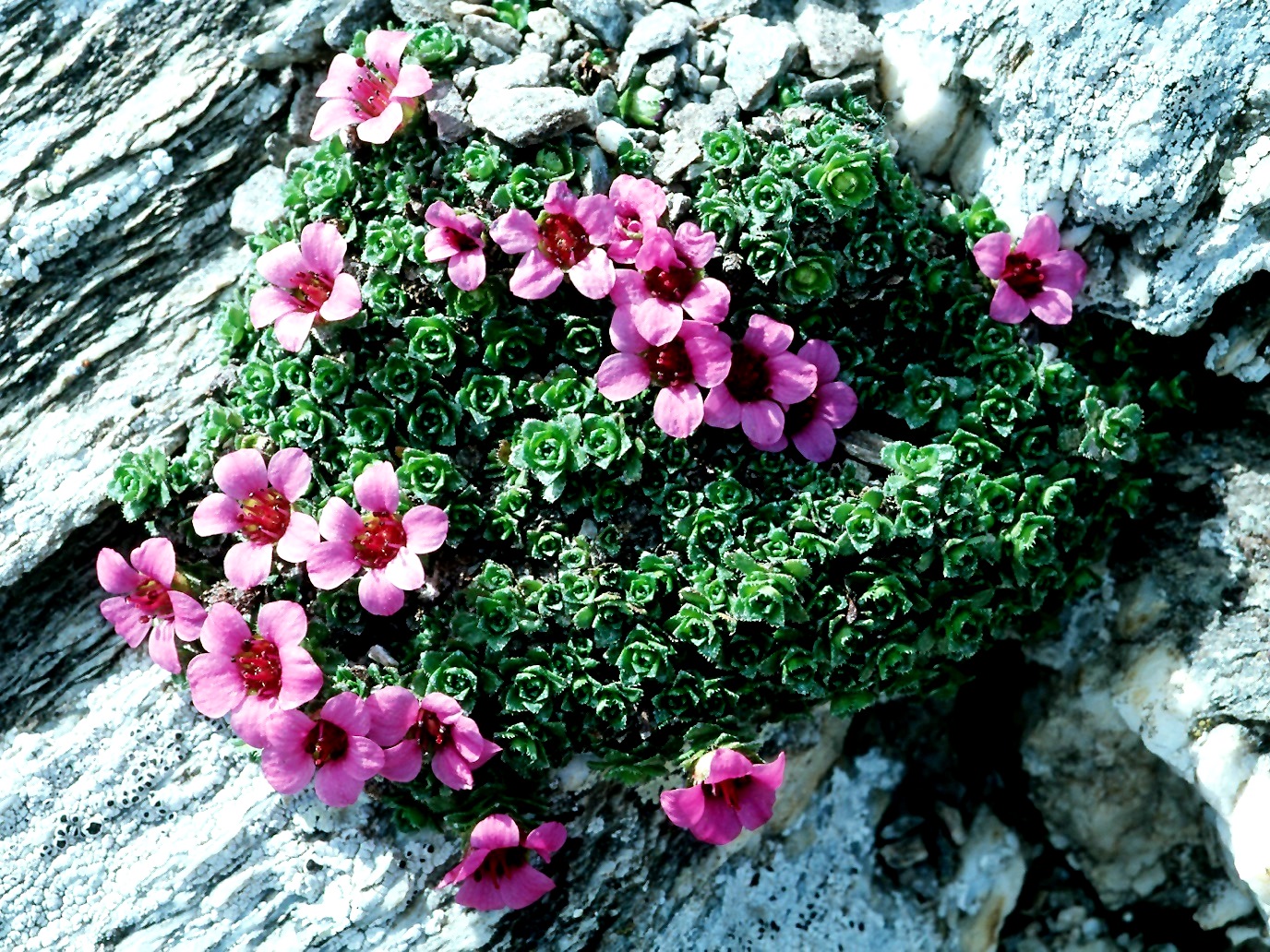
The flowers are not very large, they are yellow, white or pink and usually have five star-shaped petals.
Varieties
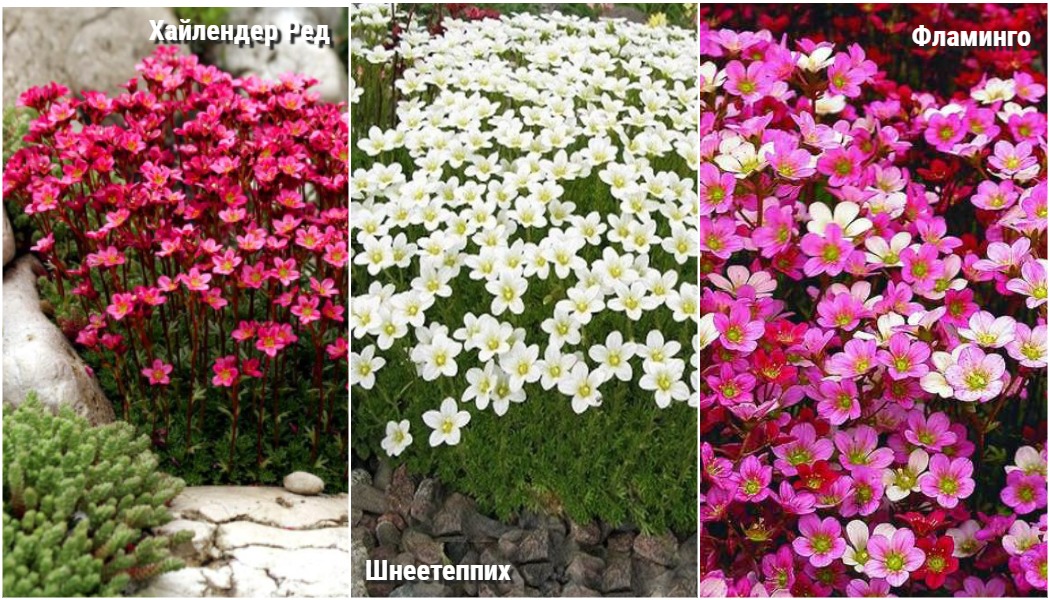
The most common type of saxifrage is Arends hybrid (rentals)It reaches no more than 20 cm in height and resembles semicircular, bright green cushions. The first buds open in late spring or early summer. There are several popular varieties:
- Blutenteppich – refers to low-growing (not higher than 15 cm), flowers are bright red.
- Schneeteppich – blooms white and does not rise higher than 20 cm from the ground.
- Flamingo – is distinguished by an unusual pinkish tint of flowers, and reaches a height of no more than 20 cm.
Landing
Saxifraga is sown in late October and November. When sowing, the seeds are not covered with soil, but sprinkled with sand.
As its name suggests, the plant prefers rocky soil. The key is to ensure good air and water permeability. Ideal for rock gardens, the rocks protect the roots from sunlight and help maintain optimal humidity.
Saxifraga is also quite common in regular flowerbeds. Proper drainage is essential for planting it. Gravel or expanded clay can be used to create this. Adding crushed stone and compost to the soil is also recommended.
In landscape design, saxifrage is often planted directly in tuff, a porous limestone. This not only allows for the creation of whimsical rock garden shapes but also retains moisture, reducing the frequency of watering.
More information about the types and varieties of saxifrage, as well as planting and care in different conditions, can be found in the article.Saxifraga: photos, 14 species, planting and care in open ground and at home.
Do not confuse this plant with medicinal Burnet saxifrage.
Clematis
This perennial has a wide variety of habits: lianon-like, herbaceous, prostrate, and erect. The shoots, up to 25 mm in diameter and covered with green bark, can have a round or ribbed surface. They grow up to 10 m in length.
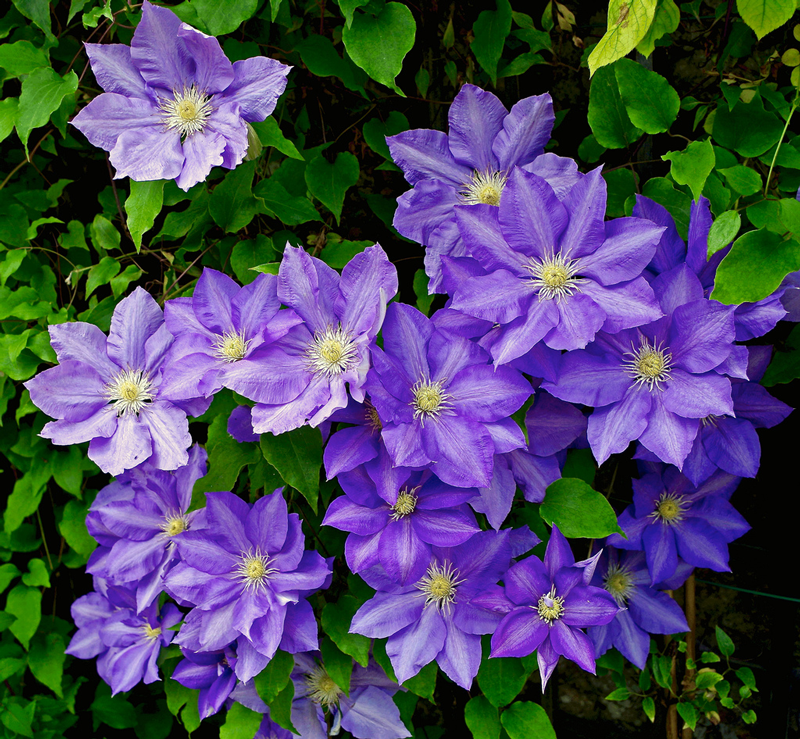
Paired leaves are located along the entire perimeter of the shoots; their shape can be pinnately dissected, entire, or palmate.
Flowering begins in spring and lasts for several weeks. Flowers come in shades of pink, yellow, blue, light blue, or red. The fragrance is unique, with notes of spicy spices, jasmine, and almond.
Varieties
There are approximately 300 varieties of clematis in nature, which in turn have a number of ornamental cultivars developed by breeders. They differ from each other in flower size, placement, color, and so on.
A very beautiful view is Jackman (Jackmanii)This group includes plants with branched shoots that grow up to 6 m. The pinnate leaves consist of 3-5 segments. Flowers can be any color, but not white. They develop in groups of up to 3 or grow singly; their diameter (with proper care) reaches 20 cm.
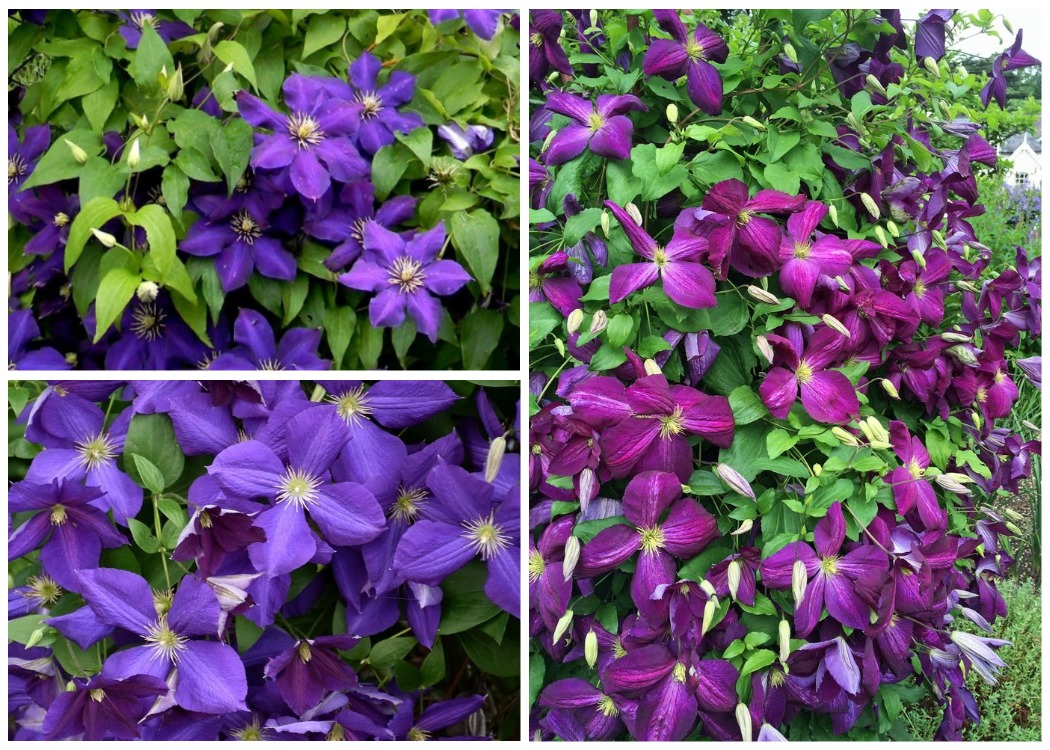
Bred varieties Jacqueman:
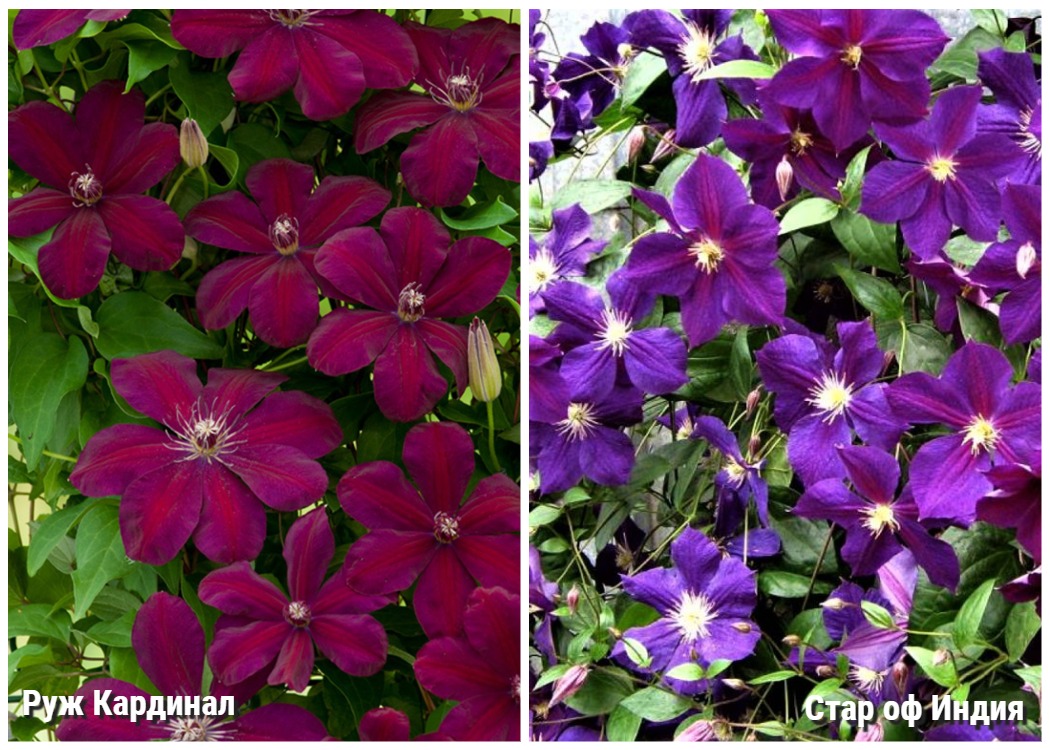
- Rouge Cardinal – grows up to 2.5 m, shoots are thin, flexible, covered along the entire length with trifoliate leaves and large purple flowers.
- Star of India – is distinguished by its 3 m height, oval foliage and bright purple flowers.
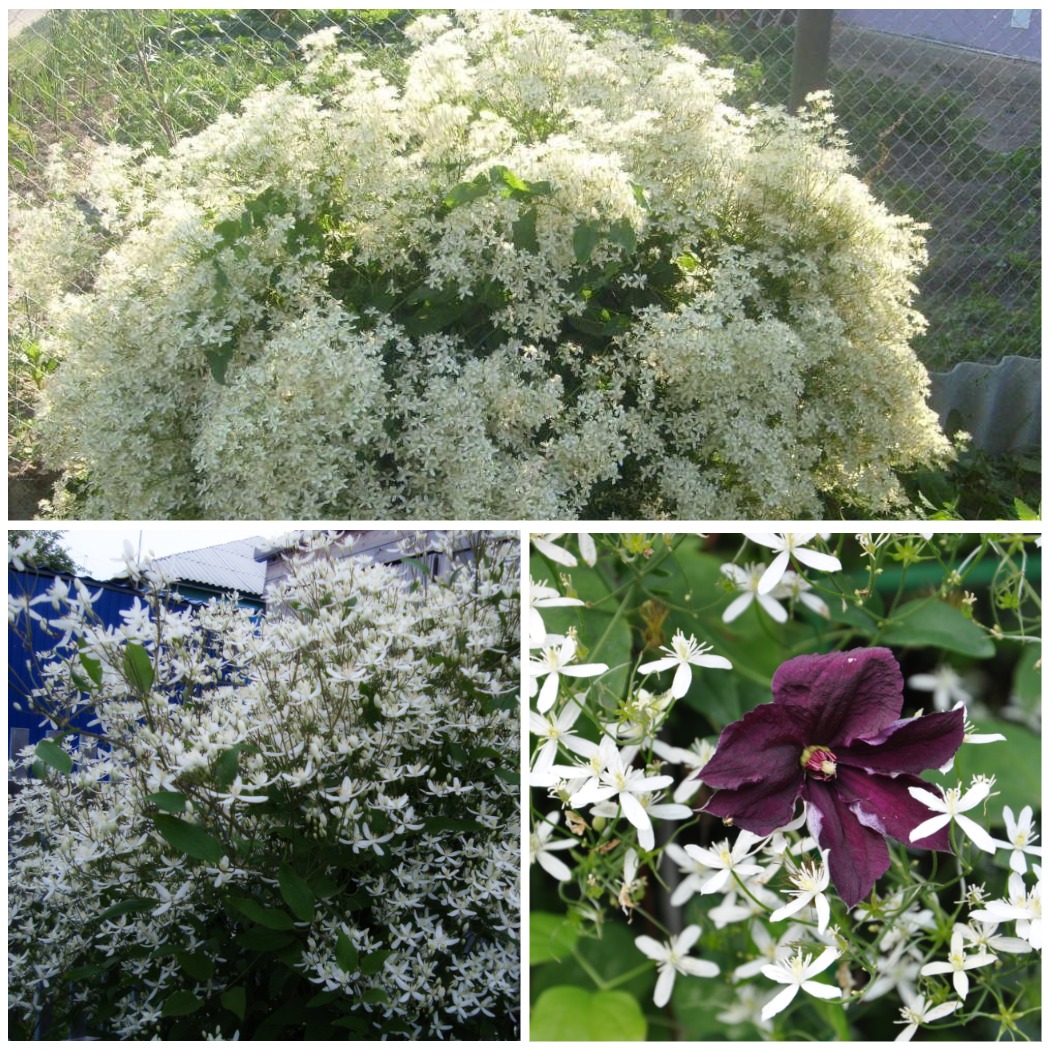
Another variety of clematis is burning (flammula)This is a beautiful vine growing up to 5 m tall with white flowers and odd-pinnate leaves. Flowering begins in mid-June and can last until August.
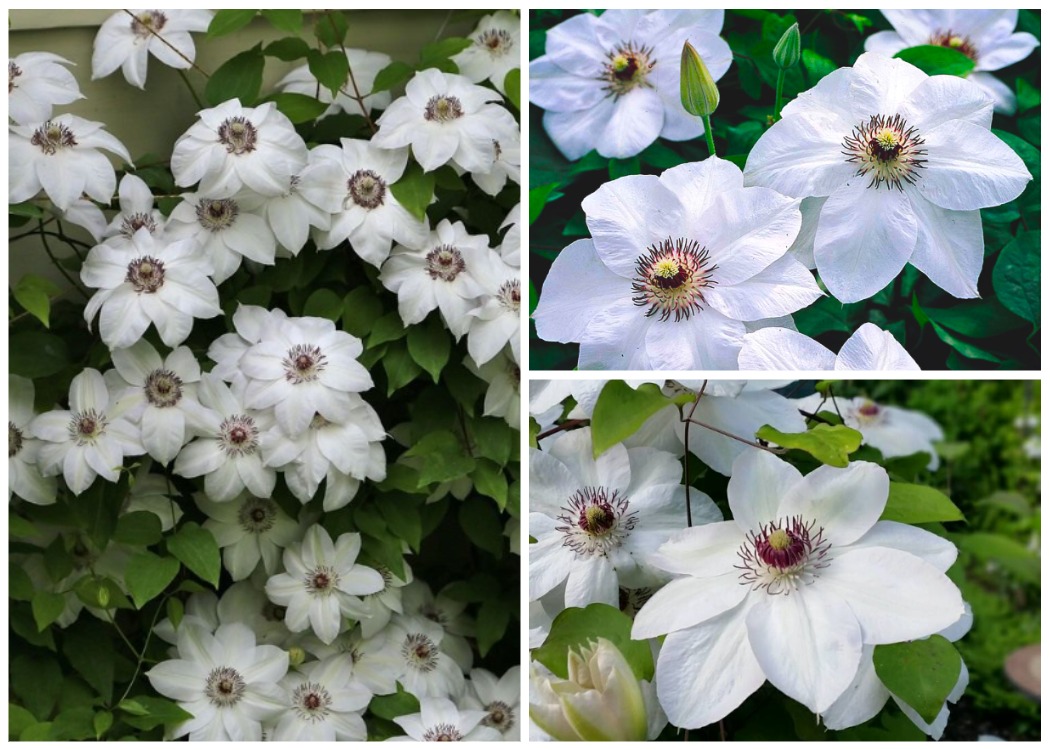
A hybrid variety can also be distinguished Miss Bateman, which blooms twice a year with white flowers with purple stamens.
Landing
Clematis can be easily grown from seeds, sown directly into open ground in the fall. They will successfully undergo stratification over the winter and develop a strong immune system by spring. However, in northern latitudes and some temperate regions, where frosts can sometimes reach very low temperatures, it's better to be on the safe side and plant only clematis seedlings that have been prepared at home.
The seeds must be fresh; it is permissible to use last year’s seed material if it was previously stored at a temperature not exceeding +23 °C.
Large seeds can be sown immediately after they are collected in the fall, medium ones – after the New Year holidays, small ones – at the end of March – beginning of April.
Clematis in open ground – read a separate article on our website.
Lavender (Lavandula)
This evergreen shrub is known for its unusual, narrow, grayish flowers crowning spike-like stems. The color can be blue or purple. Lavender bushes can sometimes reach a height of 2 meters.
Varieties
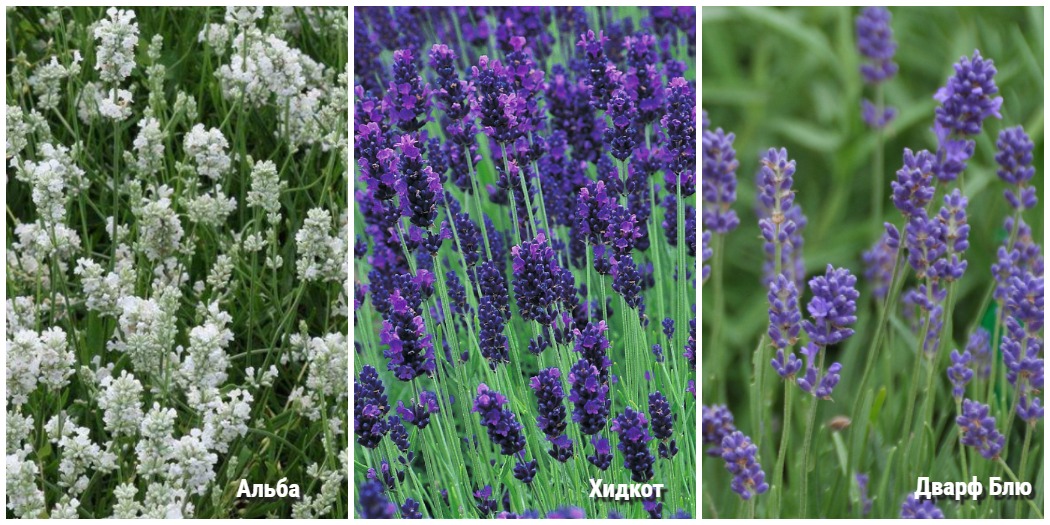
- Alba – grows up to 1 m, with very stiff vertical shoots with gray-green leaves and small white-green flowers. Flowering begins in June and can continue until late summer. It's an easy-to-care-for variety, loving light and warmth. When grown in cool climates, it needs to be covered for the winter.
- Hidcote – most often found in gardeners' flowerbeds. It is loved for its relatively compact size, reaching a height of no more than 40 cm, as well as for its characteristic large violet-blue inflorescences against a background of gray leaves, which will delight the eye all summer long.
- Dwarf Blue – is distinguished by its long flowering period from June to September. The leaves are gray-green, and the flowers are purple and relatively small. The shoots and leaves are gray and grow up to 40 cm. The variety grows well in calcareous and light soil and tolerates drought without problems.
Landing
Growing lavender from seed is no easy task. This easy-to-care-for plant is quite demanding in cultivation. If germination efforts fail, simply sow the seeds outdoors in the fall. Thanks to their ability to survive stratification, the seeds will survive. Without this procedure, they are unlikely to germinate. If you decide to sow until spring, be sure to refrigerate the container containing the seeds.
For outdoor growing, choose a dry location protected from winds. Avoid stagnant water, otherwise the lavender will die. Furthermore, it prefers fertile, loose soil with a low pH. If the pH exceeds the recommended level, add ash or lime to the flowerbed.
There's no need to plant the seeds too deeply. A distance of 4 cm from the soil surface is sufficient. It's recommended to lightly sprinkle the furrows with sand and apply mulch. As soon as snow falls, cover the seedlings with snow.
The first shoots will begin to emerge in mid-May to early June, but this may occur several weeks later. So don't rush to throw away the soil or dig it up.
Once the seedlings emerge, it's important to establish proper watering: the soil should be slightly moist, but not overwatered. It's best to water lavender more frequently, but with smaller amounts.
Do you want to grow lavender in your own garden?
Lewisia
This succulent perennial plant originated in North America, where it grows freely in the wild. In our climate, it is capricious and reacts sharply to insufficient or untimely care. It thrives only in warmer regions.
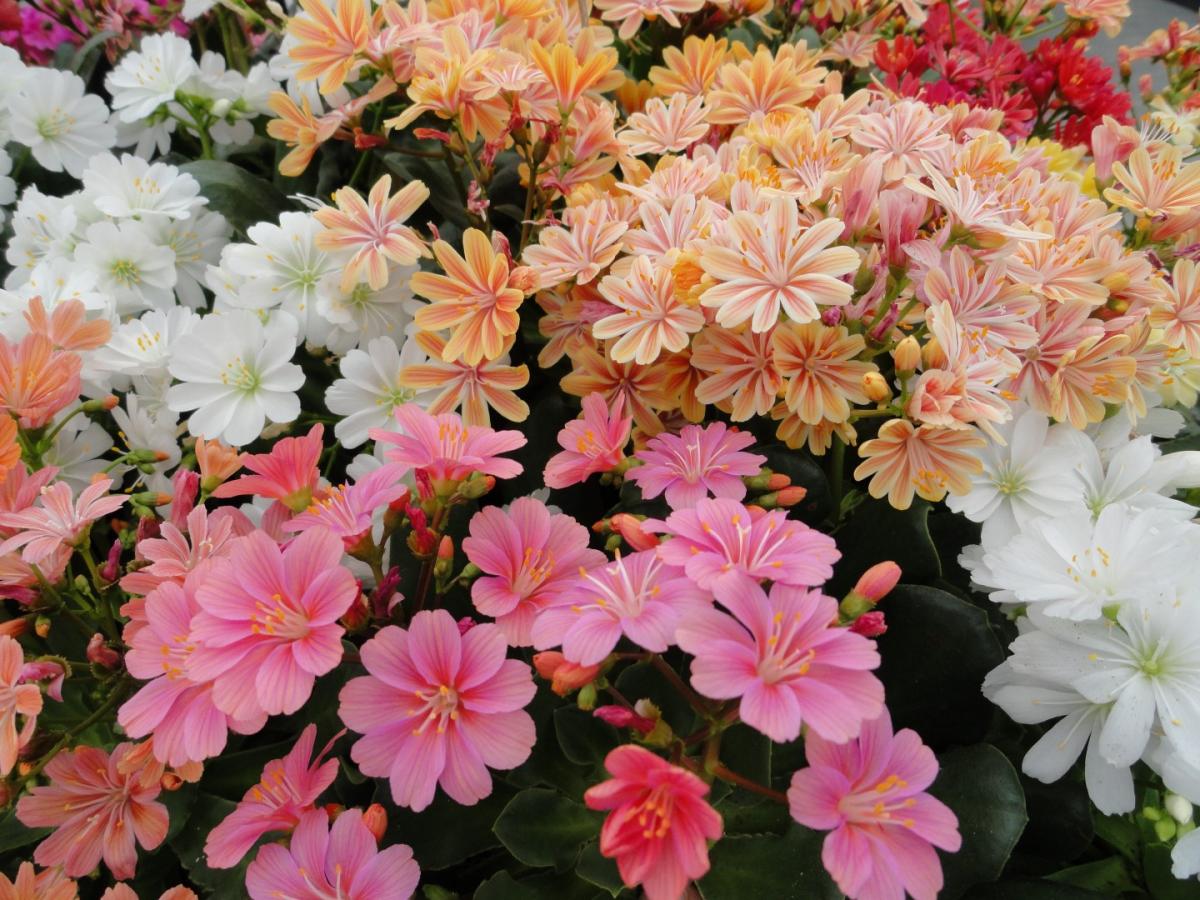
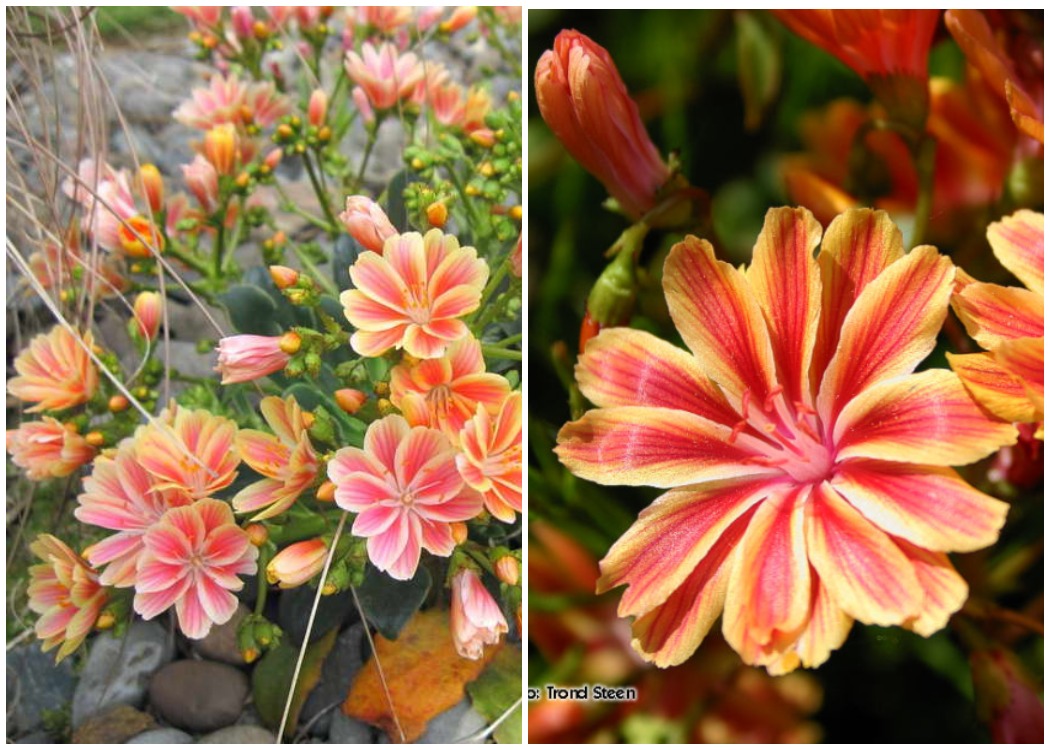
It grows up to 30 cm, begins blooming in late April-early May, and continues until the end of September. Even before that, Lewisia looks very attractive thanks to its beautiful bright green leaves. The buds come in a variety of shades: lilac, red, yellow, and pink.
Types and varieties
Among the most common decorative types of Lewisia are the following:
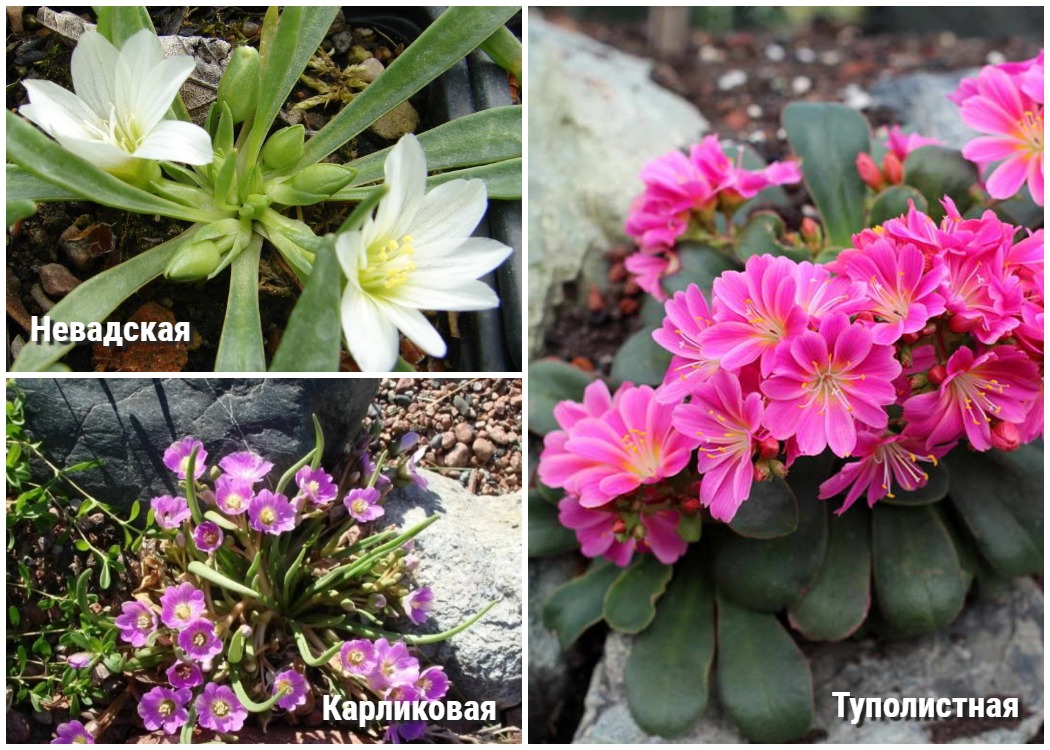
- blunt (cotyledon) – is distinguished by very bright colors;
- dwarf (pygmaea) – has compact dimensions and good endurance;
- Nevadensis - low with luxurious white flowers.
Less popular levises include:
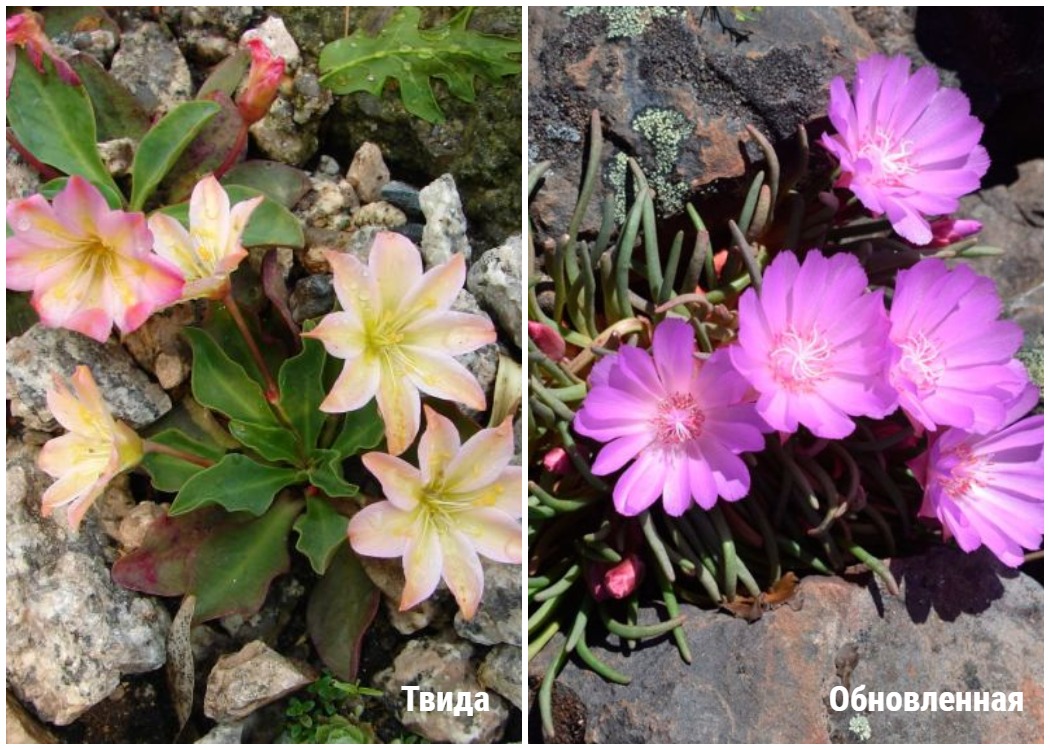
- Tweed (tweedyi);
- updated (rediviva).
When choosing suitable Lewisias for growing, experienced gardeners recommend choosing hybrid varieties. They are less demanding in care and bloom longer and more vibrantly. For example, Constellation (cotyledon) It takes root well and blooms with very beautiful flowers with orange-pink petals edged with white.
Landing
Lewisia seeds can be sown starting in the second half of October. The site should be sheltered from direct sunlight. Ideal locations for Lewisias are rock gardens located in the western or eastern part of the garden. The soil should be rocky or sandy, well-drained, and highly acidic. It is not recommended to plant the seeds more than 1 cm deep. Mulch the top of the plantings with dry peat. If successful, seedlings will appear as early as April, but flowering will not occur until the following season.
About the Lewisia flower on the website Top.tomathouse.com.
Flax (Linum usitatissimum)
Flax is a perennial plant, with shoots reaching 80 cm in height and varying in shape from upright to tapered at the base and bent. The leaves are small, up to 5 cm long, elongated, with serrated edges.
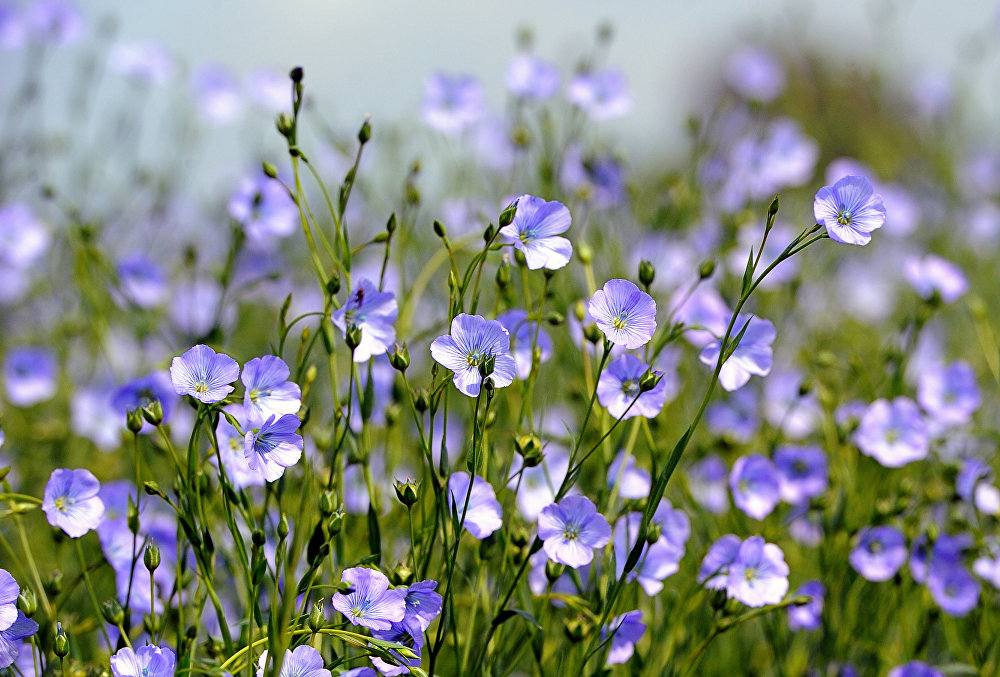
Flowers can be white or blue, they bloom in July and stop blooming in August.
Varieties
Flax is widely used in landscape design and is also grown for flower arrangements. Several varieties are suitable for these purposes:
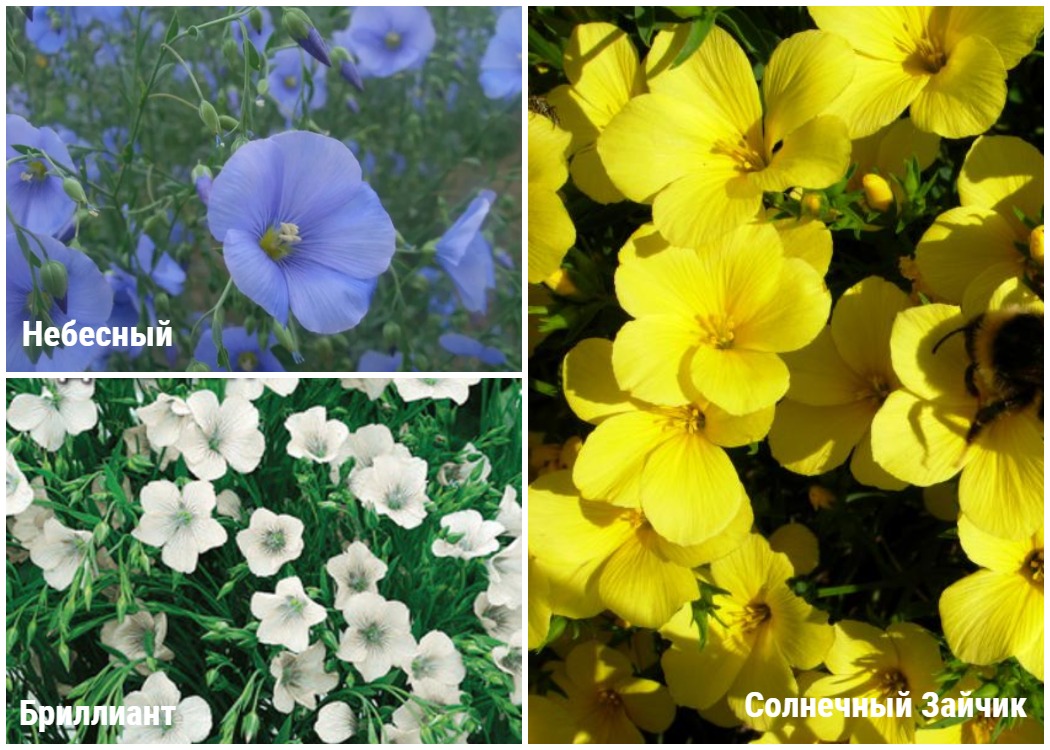
- Heavenly – begins blooming with small blue flowers the following year after the seeds are planted. The bush grows very compact, reaching a height of up to 50 cm. The variety is resistant to pests, diseases, and temperature fluctuations.
- Sunny bunny – is a small bush up to 20 cm tall with bright yellow flowers that decorate the garden all summer. It grows best in dry, loose soil in a well-lit area.
- Diamond – has elastic stems up to 35 cm tall, covered with white flowers that begin to bloom as early as June. It prefers well-lit flowerbeds with light soil.
Landing
Flax seeds are planted directly into open ground in the fall or spring. They are spread over the soil surface and sprayed with water, without digging into the soil. If necessary, flax can even be planted in the summer – it's relatively easy to grow.
Read more in the articleFlax: 90+ photos, 9 species and varieties of annual and perennial plants with descriptions, care, diseases, and gardener reviews.
Lychnis
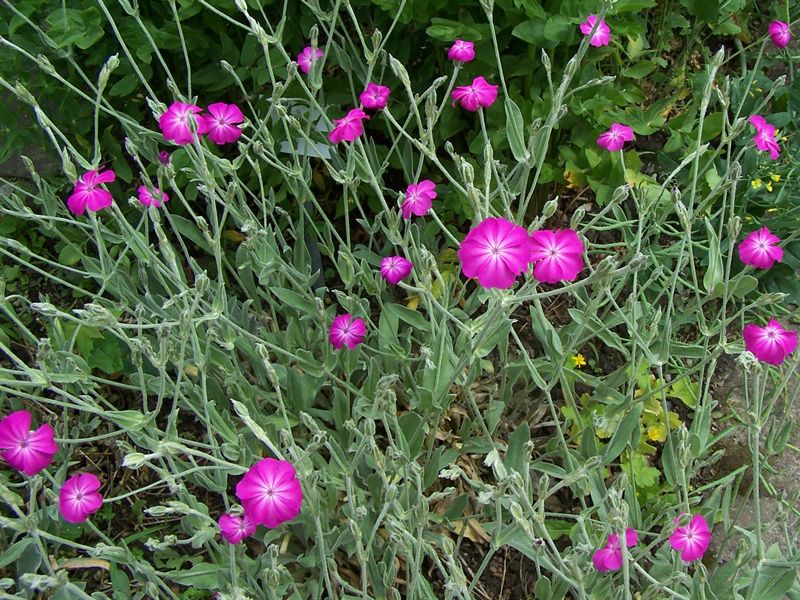
Lychnis is a medium-sized perennial, with shoots reaching 1 m in height. It grows well in the same location for up to 5 years. The leaves, rough on both sides, are shaped like a pointed oval. Flowers can be red, orange, white, yellowish, or pink.
Varieties
The following species are most common among florists:
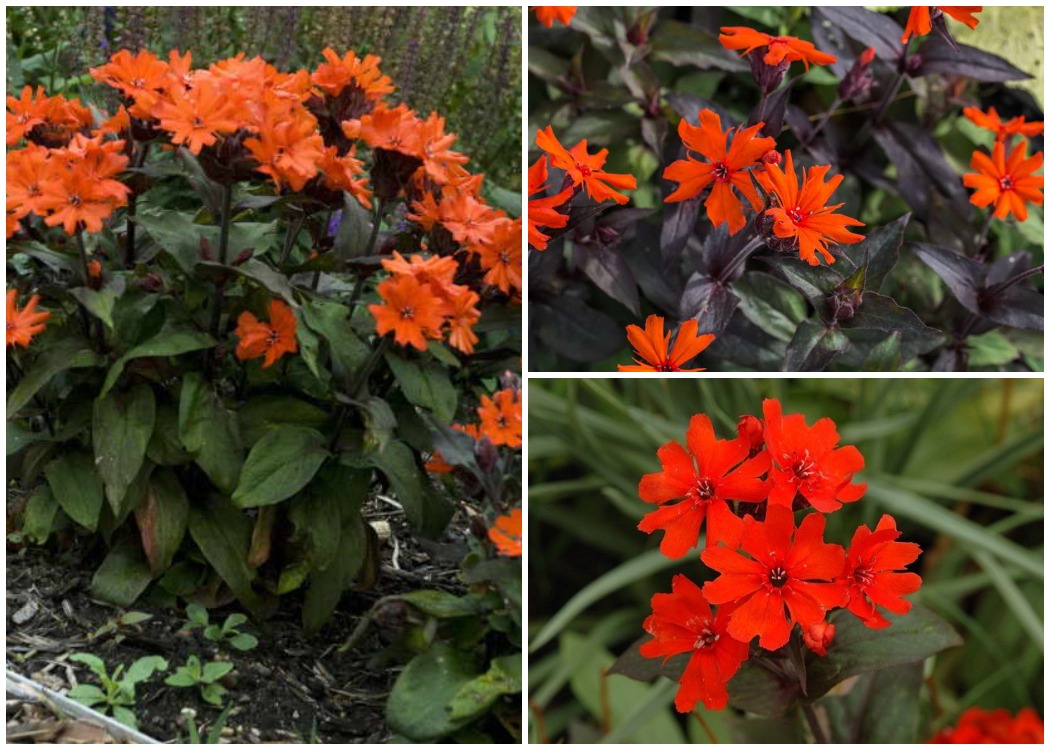
- Arkwright's (arkwrightii)The most famous variety of this group of lychnis is considered to be VesuviusIt is characterized by broad, heart-shaped leaves and orange-red flowers.
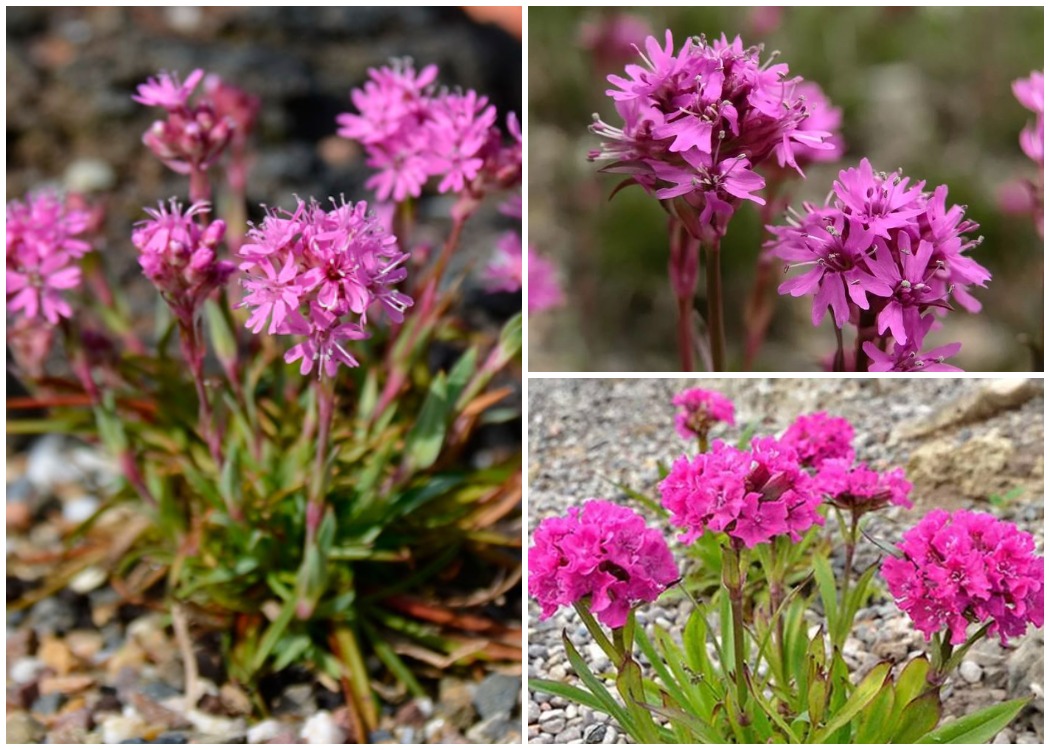
- Alpine (alpina)The most popular variety is Lara, which blooms with many pinkish flowers.
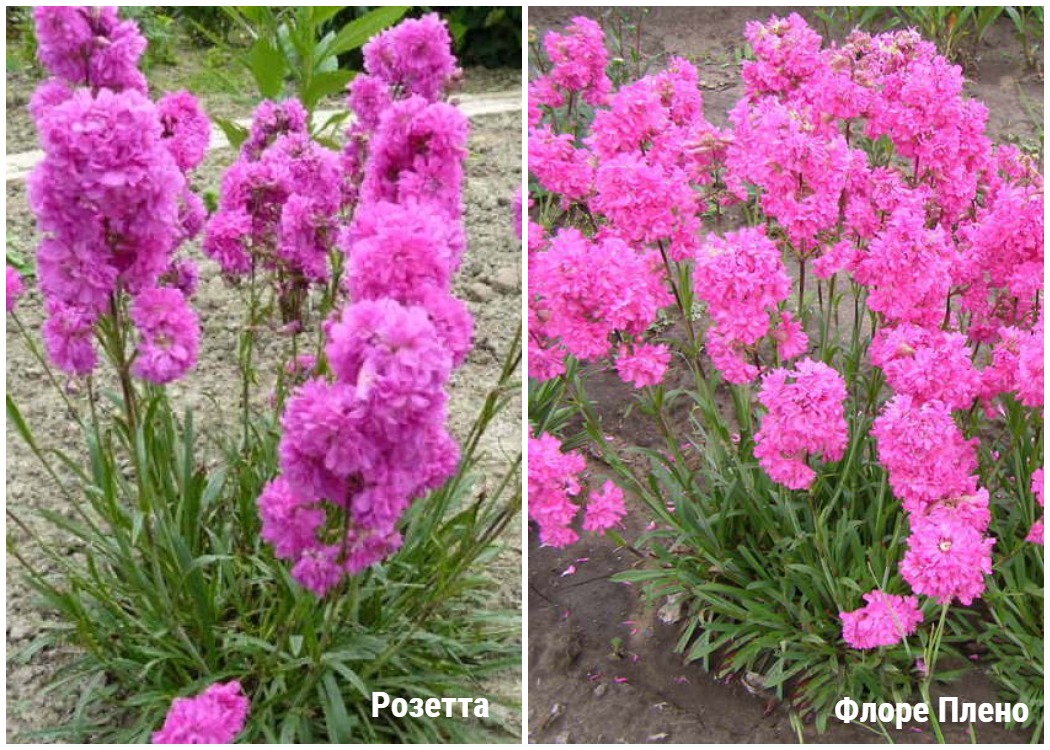
- viscaria (Viscaria vulgaris = Lychnis viscaria = Silene viscaria)Its most common varieties are Rosetta with beautiful double petals of raspberry hue and Flore Pleno, growing up to 30 cm and covered with purple double flowers 3 cm in diameter.
Landing
Lychnis propagates by seeds, which are sown outdoors in early spring or fall. In warm regions with a suitable climate, these plants will bloom the following season. However, in temperate climates and other less favorable latitudes, lychnis will not produce its first buds for at least a year. If you want to see results as soon as possible, you can try growing lychnis indoors in the spring and then transplanting it to a permanent garden bed when the weather warms up.
More about Lychnis, planting and care rules.
Lupine
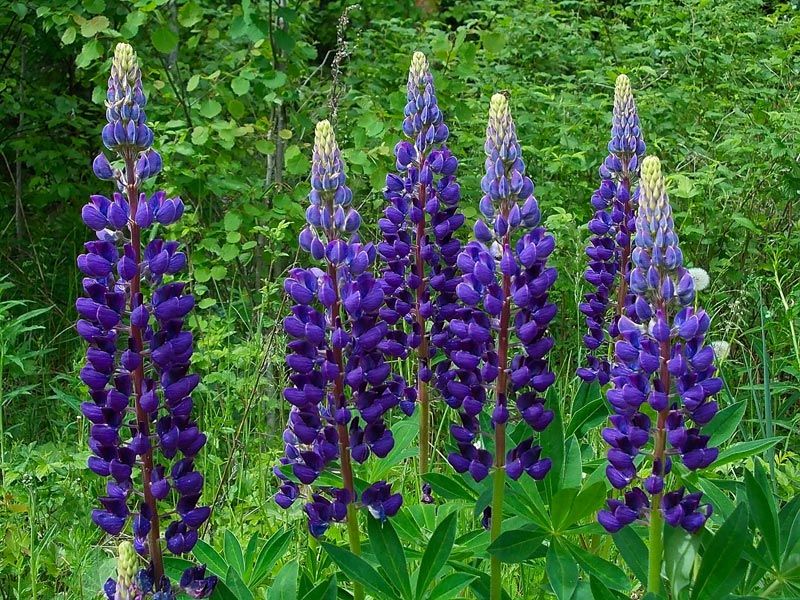
These perennials grow very quickly and are suitable for shady areas of the garden. The inflorescences are collected in a raceme, the color of which depends on the chosen variety.
Varieties
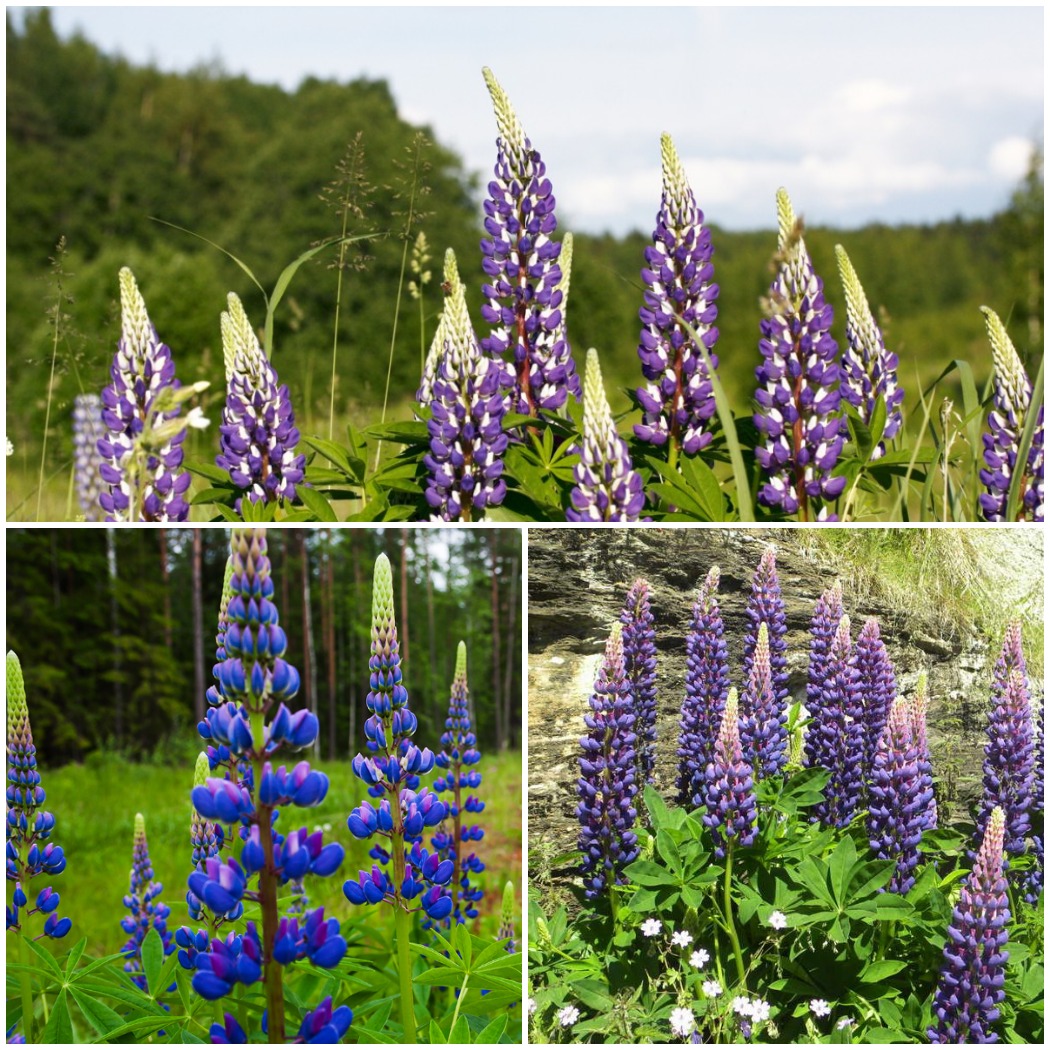
The most popular lupine, which is most often found in our flower beds, is the species polyphyllusIts natural range extends from Northern California to Alaska.
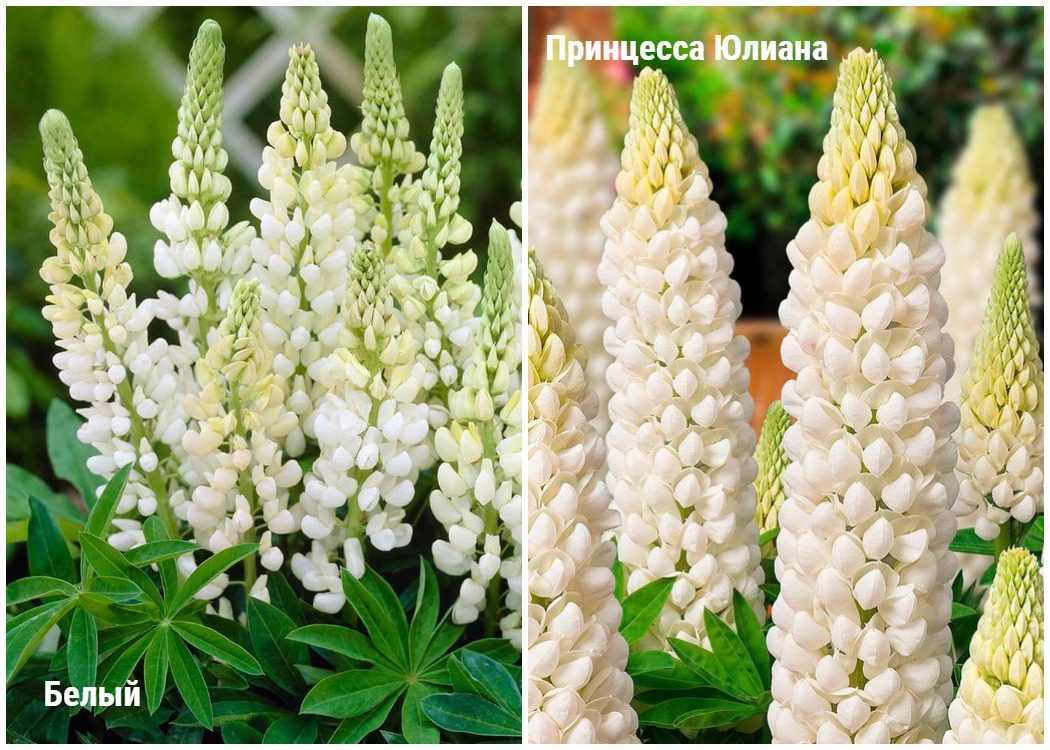
The area will be decorated with white flowers albus or white lupine, white and pink – variety Princess Juliana (Prinzess Juliana).
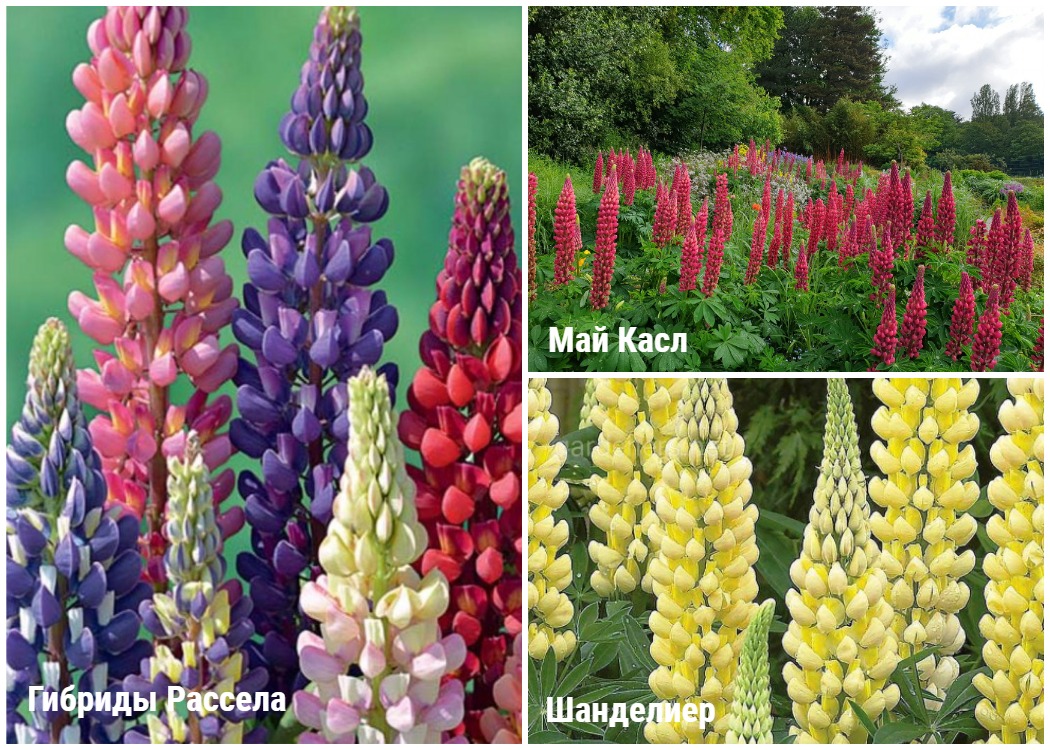
Purple and white flowers Russell hybrid CastellanThe Russell group also includes My Castle (Mein Schloss, My Castle) with red petals and Chandeliers (Chamdeliers, Kronleuchter) with delicate yellow inflorescences.
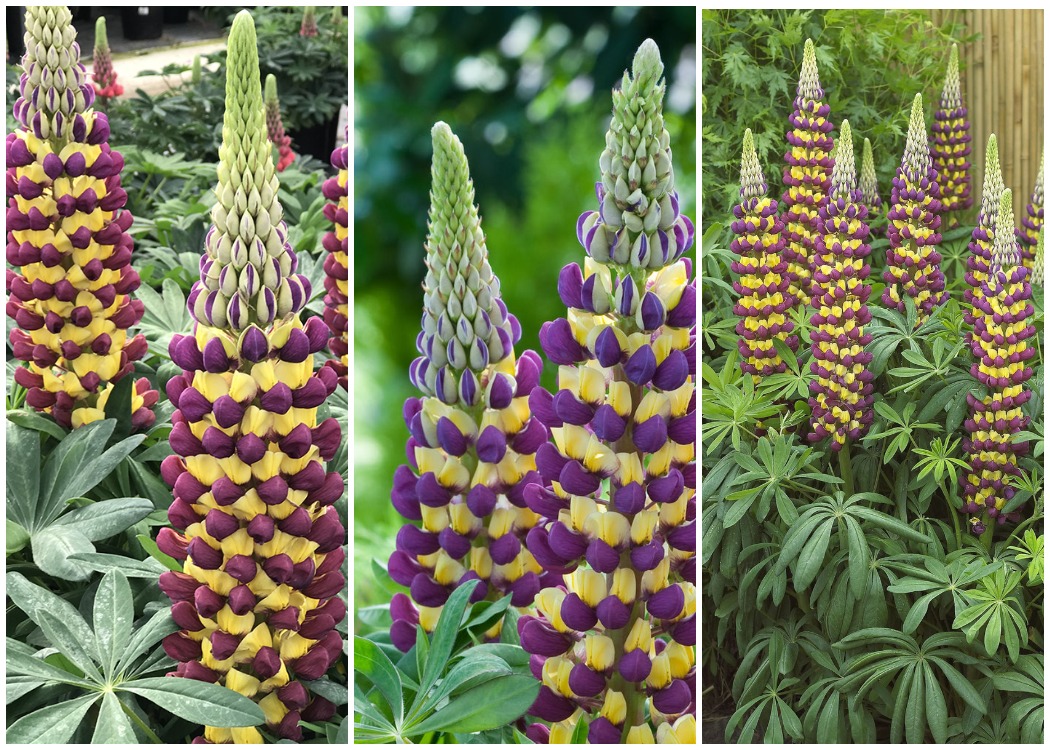
Among modern varieties, lovers of everything bright give preference Manhattan Lights, whose flowers are distinguished by a mix of yellow and purple-violet colors.
Landing
Annual lupines are ideal as green manure. After autumn planting, all seeds typically germinate very quickly.
It's best to plant them in their permanent location immediately, choosing areas with neutral soil and no groundwater. Don't plant lupines too close together; they grow quickly. The optimal distance is considered to be 25-30 cm.
More about lupine and caring for the flower on the website Top.tomathouse.com.
Perennial mallow (Malva)
This perennial herbaceous shrub has over 60 varieties, including evergreens. The shoots grow up to 2 meters and are slightly pubescent along their entire length. The leaves are quite large, with serrated edges. The flowers grow in spike-shaped inflorescences with double or semi-double petals in a variety of colors: yellow, burgundy, white, pink, and purple.
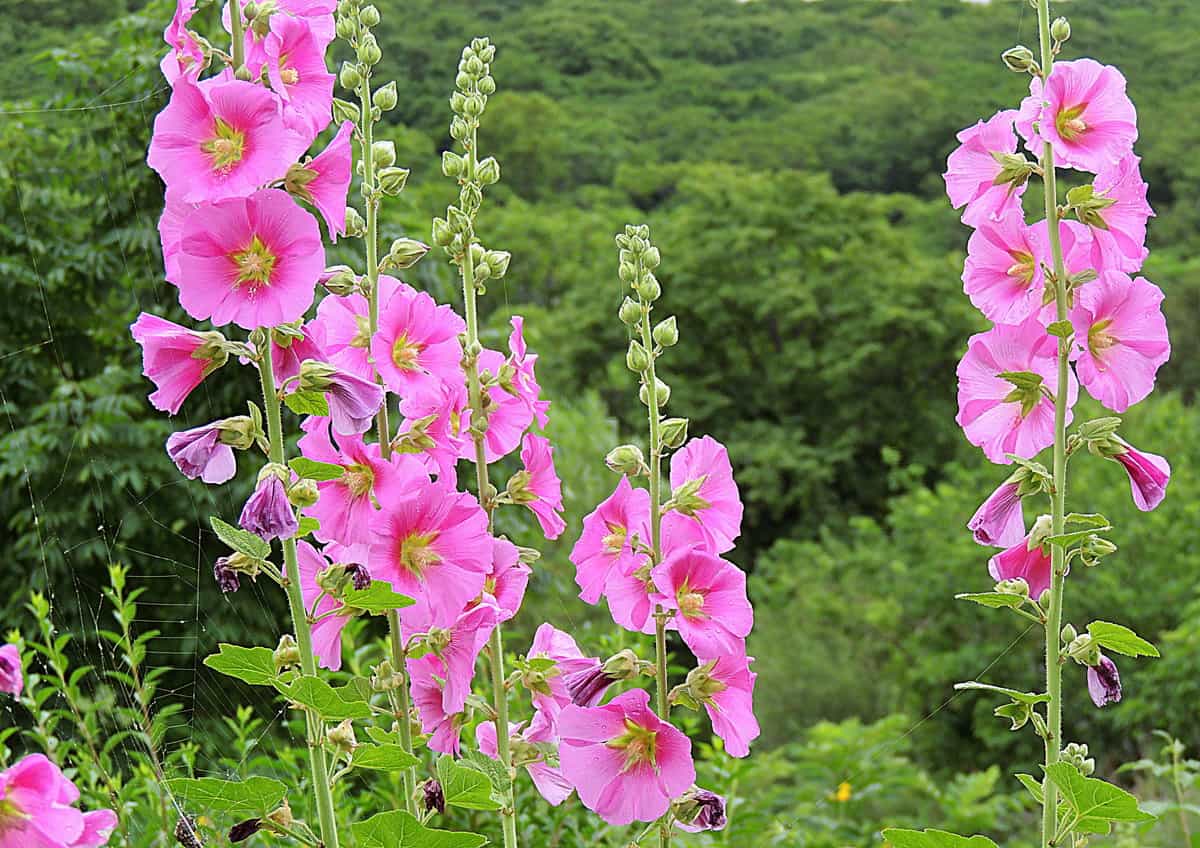
The first buds open by the end of June, and flowering lasts almost 2 months.
Varieties
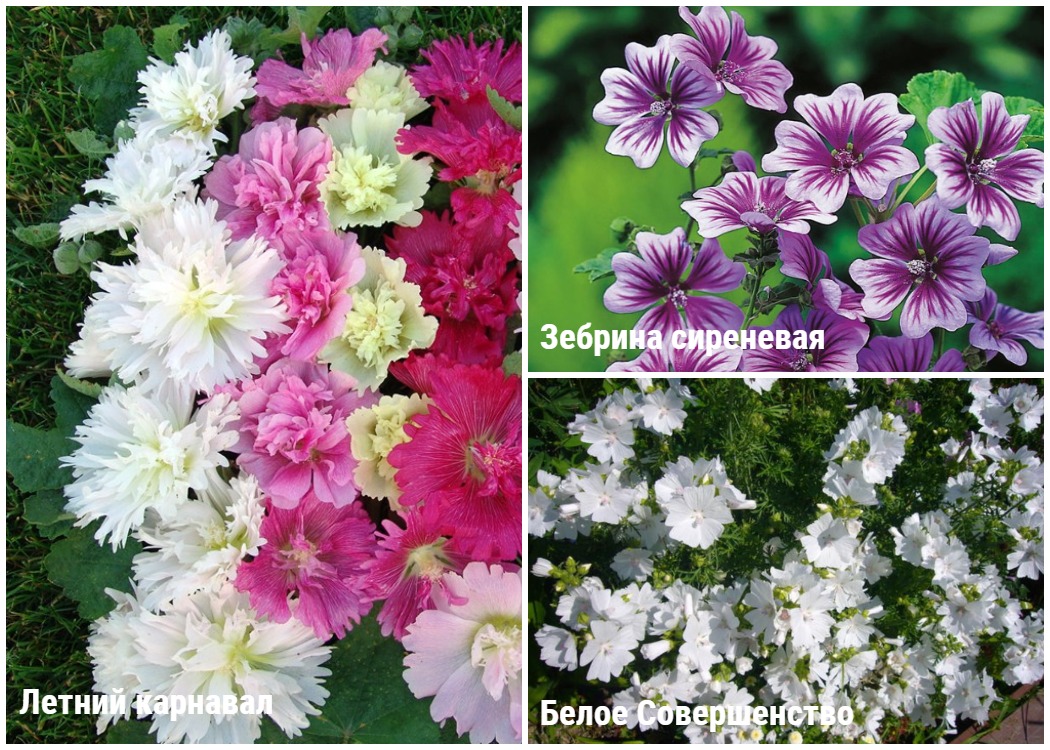
The most popular are perennial hybrid varieties of mallow with double flowers:
- Summer Carnival – widely used to create mixed borders and to decorate fences and walls. The plant reaches 1 m in height and begins blooming in the second half of summer. Cut flowers retain their attractiveness for a very long time and continue to open gradually.
- Zebrina lilac – most often used for group plantings, it can reach 1.2 m in height. The flowers are bright and colorful and have a long vase life.
- Muscat White Perfection – features large white flowers up to 5 cm in diameter. Used for bouquets. Height 50-60 cm.
Landing
Seeds can be planted in the soil in late fall, when cool weather sets in, or in spring, when the risk of night frosts has subsided. Place several seeds in each 3-cm diameter hole. They are then covered with soil, lightly compacted, watered (no need for watering when planting in the fall), and covered with plastic wrap. This is the only way the seeds will strengthen, swell, and gain the strength to germinate.
Read about mallow on our portal.
Milkweed (Euphorbia)
Another name for this plant is Euphorbia. Gardeners love it for its decorative appearance and abundant blooms.
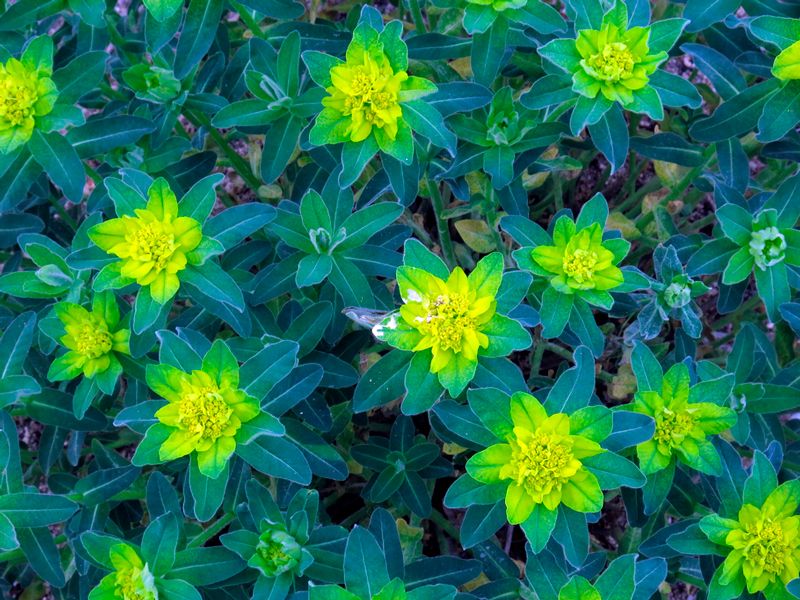
The bush reaches 70 cm in height and has a spherical shape. It grows well, sometimes reaching a diameter of 1.5 m. Each shoot ends in vibrant yellow or greenish inflorescences, resembling miniature bouquets.
Varieties
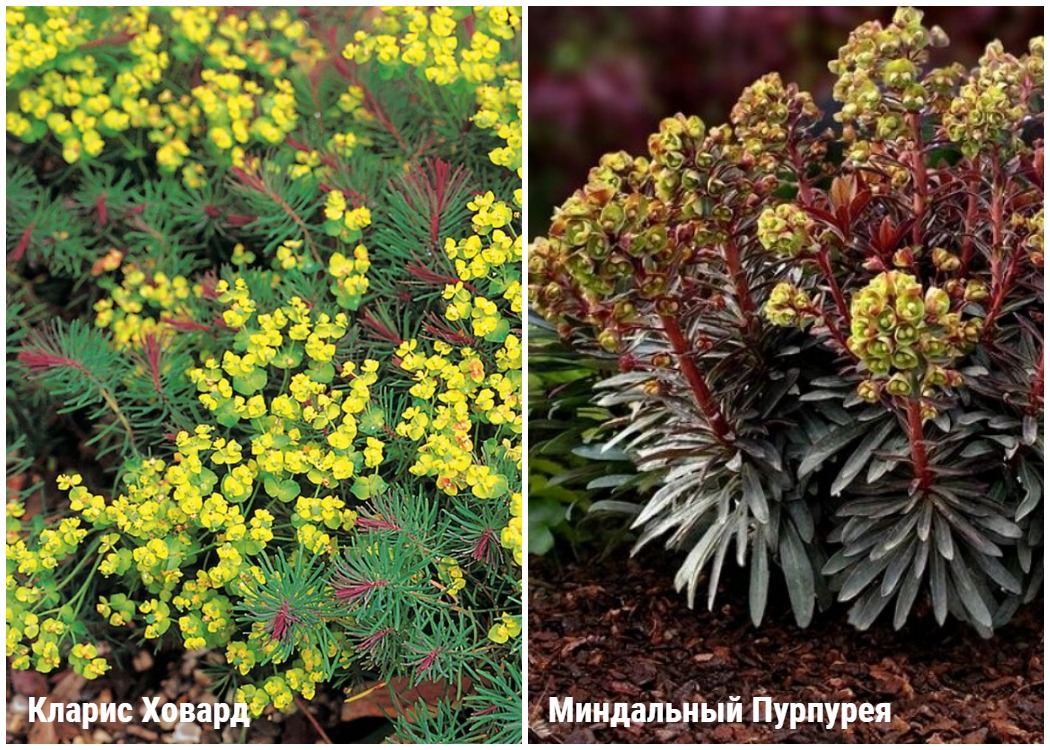
The most popular varieties of milkweed are:
- Clarice Howard – perennial height 30-35 cm, blooms from May to June; flowers are small, yellow-green.
- Almond Purpurea – 60-70 cm tall, this evergreen shrub with straight and numerous shoots spreads well and grows in one place for 5-6 years. It tolerates drought and low temperatures well.
Landing
Highly resistant varieties can be sown before winter, planting them 5 mm deep and covering them with a layer of mulch. Humus or sawdust are best for this purpose.
More useful information about growing milkweed.
Hellebore (Helleborus)
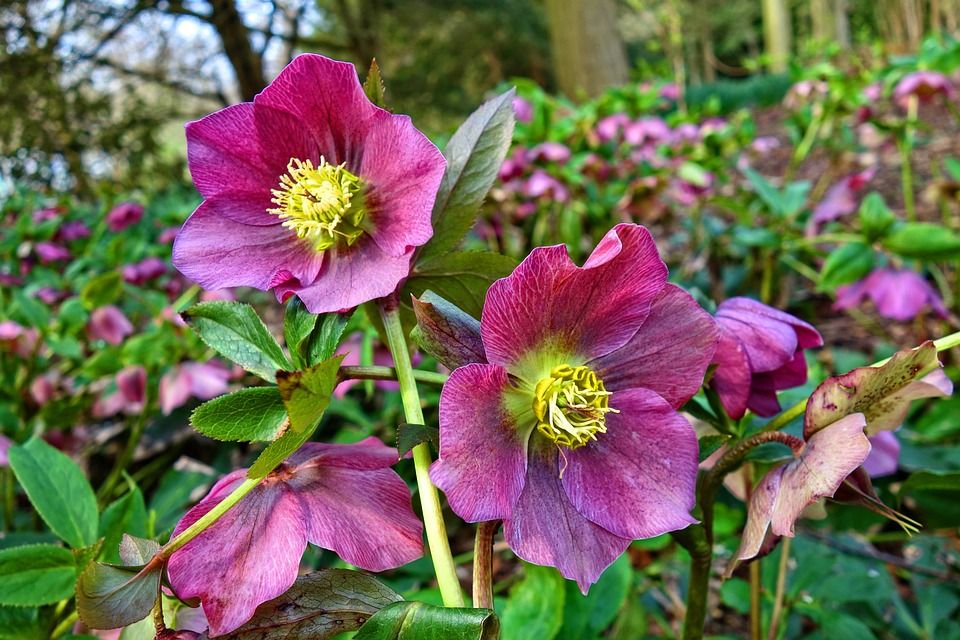
According to various sources, this perennial herbaceous plant has between 14 and 22 varieties. Its height ranges from 20 to 50 cm. In warm regions, cup-shaped flowers appear on stems as early as early winter and continue to form until mid-summer. Petals can be white, inky, pink, yellowish, purple, violet, and even bicolor. They can be double or smooth.
Varieties
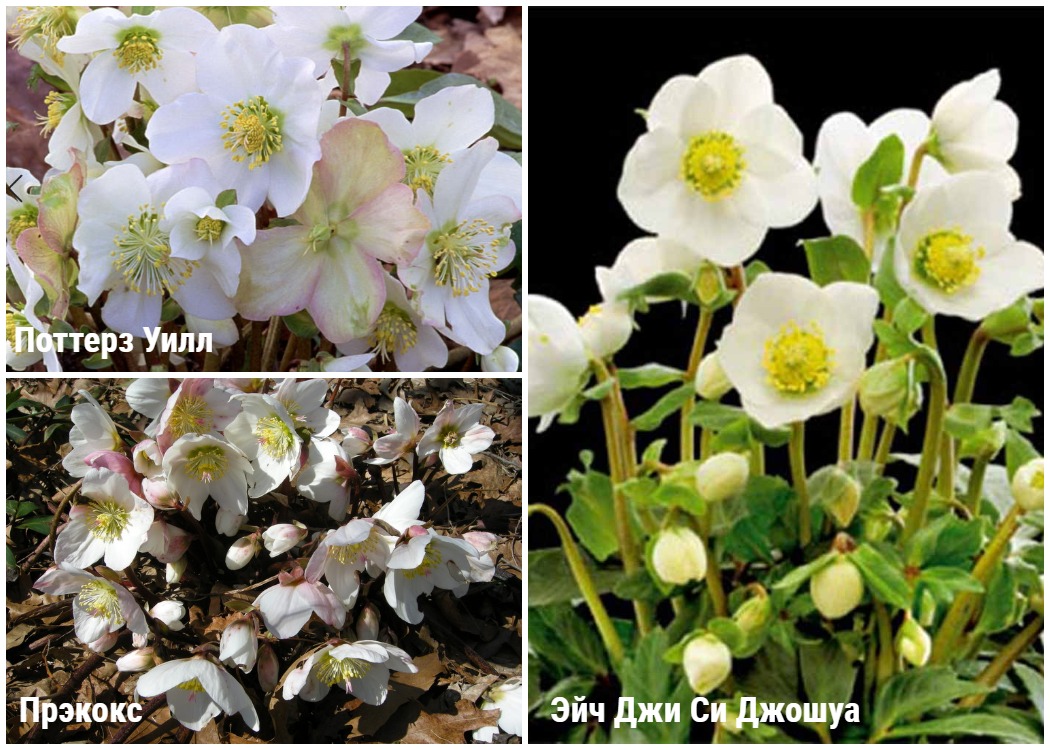
TO black (niger) Hellebore (the name black does not indicate the color) includes the following varieties:
- Potters Wheel – a plant with large flowers with a diameter of 12 cm;
- HGC Joshua – is considered one of the earliest varieties, with flowers blooming already in November;
- Praecox – has pinkish inflorescences that appear in late autumn.
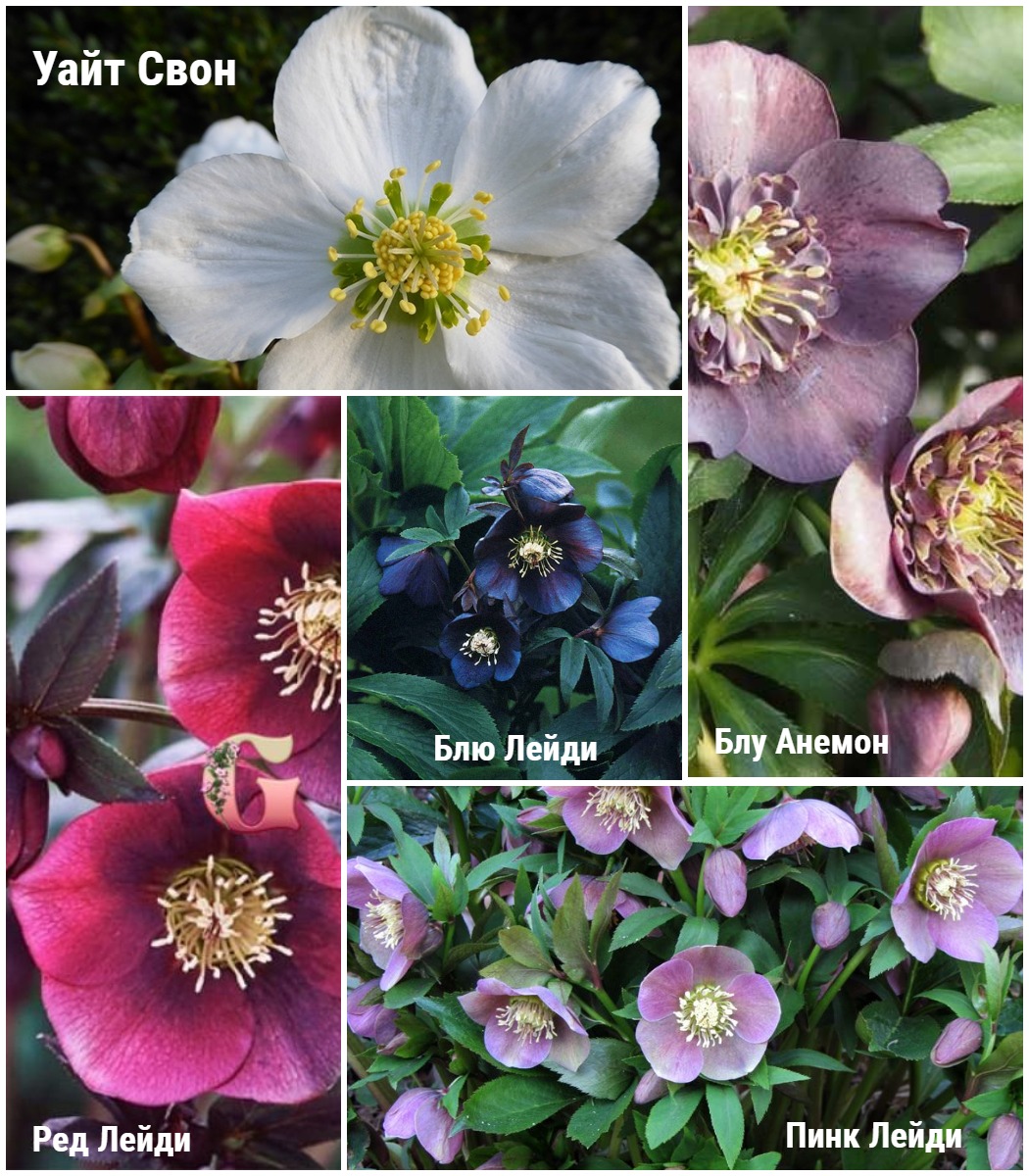
TO eastern (orientalis) hellebore includes:
- White Swan – has flowers with white petals;
- Blue Anemone – dark purple flowers;
- Lady Series – are distinguished by their high growth rate and six petal color options.
Landing
Seeds are planted directly into the soil in pre-dug holes 1.5 cm deep, or placed under snow in pre-prepared boxes. Don't forget to mulch the seeds. If you plan to use your own seeds, they must be fresh. Hellebore seeds dry out very quickly and become unusable. Carefully inspect store-bought seeds – they should be free of mold, stains, or damage, and the ideal size is 4-6 mm.
Seedlings sown in this way can be transplanted only after 2-3 years.
ABOUT hellebore, planting, care, read in a separate article.
Leucanthemum or garden chamomile
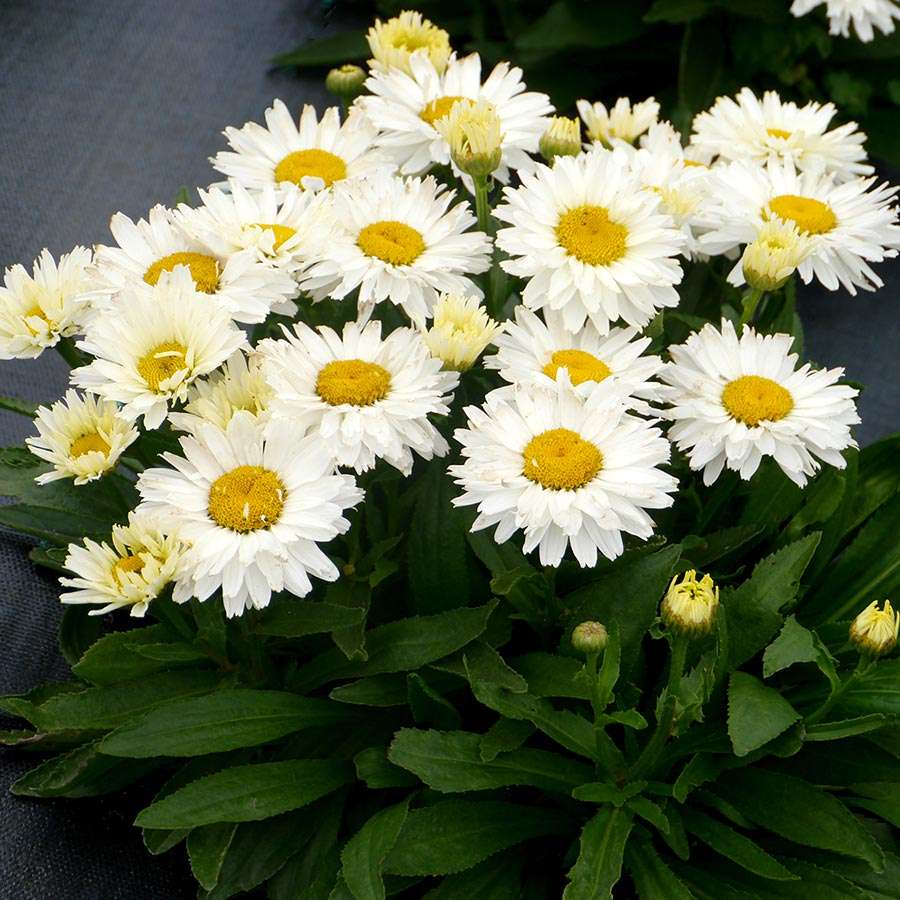
Another name for the daisy is the chamomile plant. This herbaceous perennial grows from 15 to 80 cm in height and has a branched, upright stem. Yellow flowers begin to bloom from May to July, and by late summer, the seed pods ripen.
Varieties
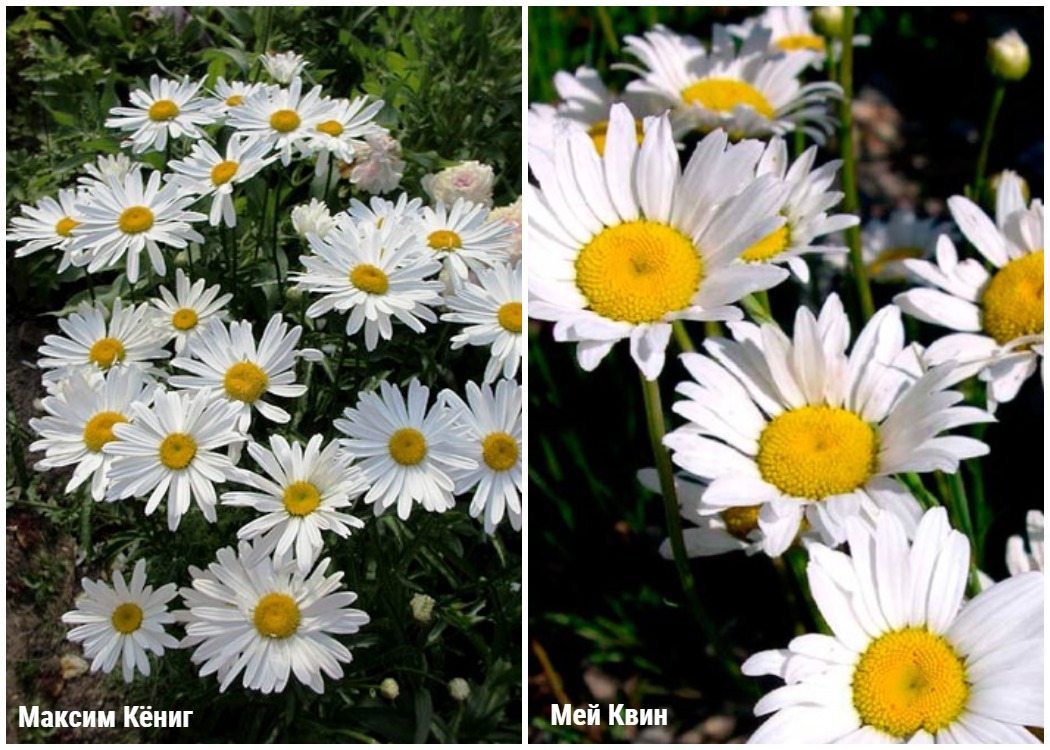
The most popular varieties of popovnik are:
- Maxima Kenig - a tall, elegantly strict bush,
- May Queen – a bright, low-growing plant with shiny, dark green leaf blades.
Landing
You can begin planting seeds in the ground either in spring or late fall to allow them to better adapt and develop resistance. In the first case, flowering will occur within a year; in the second, the following summer.
The seedlings tolerate transplantation well, so there is no need to place them immediately in a permanent location.
More about daisy or garden chamomile.
Aubrieta
This squat plant has two types of stems: creeping vegetative and ascending generative. The bush itself forms hemispherical clumps up to 15 cm tall.
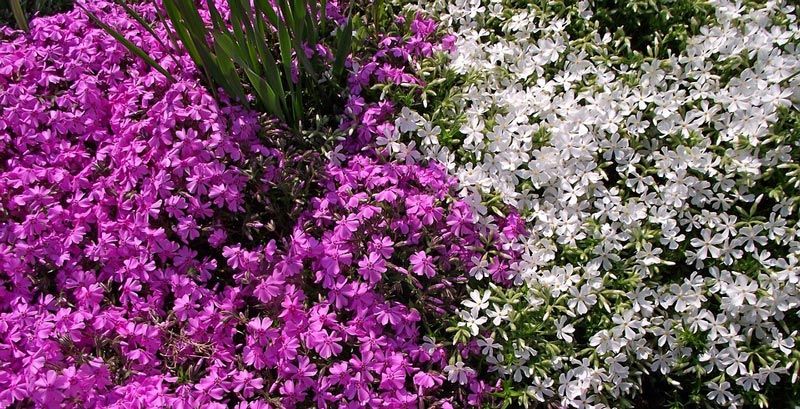
The leaves are small and fairly simple. They can be either smooth or serrated. The flowers are also quite small, no more than 1 cm in diameter. Colors include white, pinkish, red, blue, violet, and purple.
Varieties
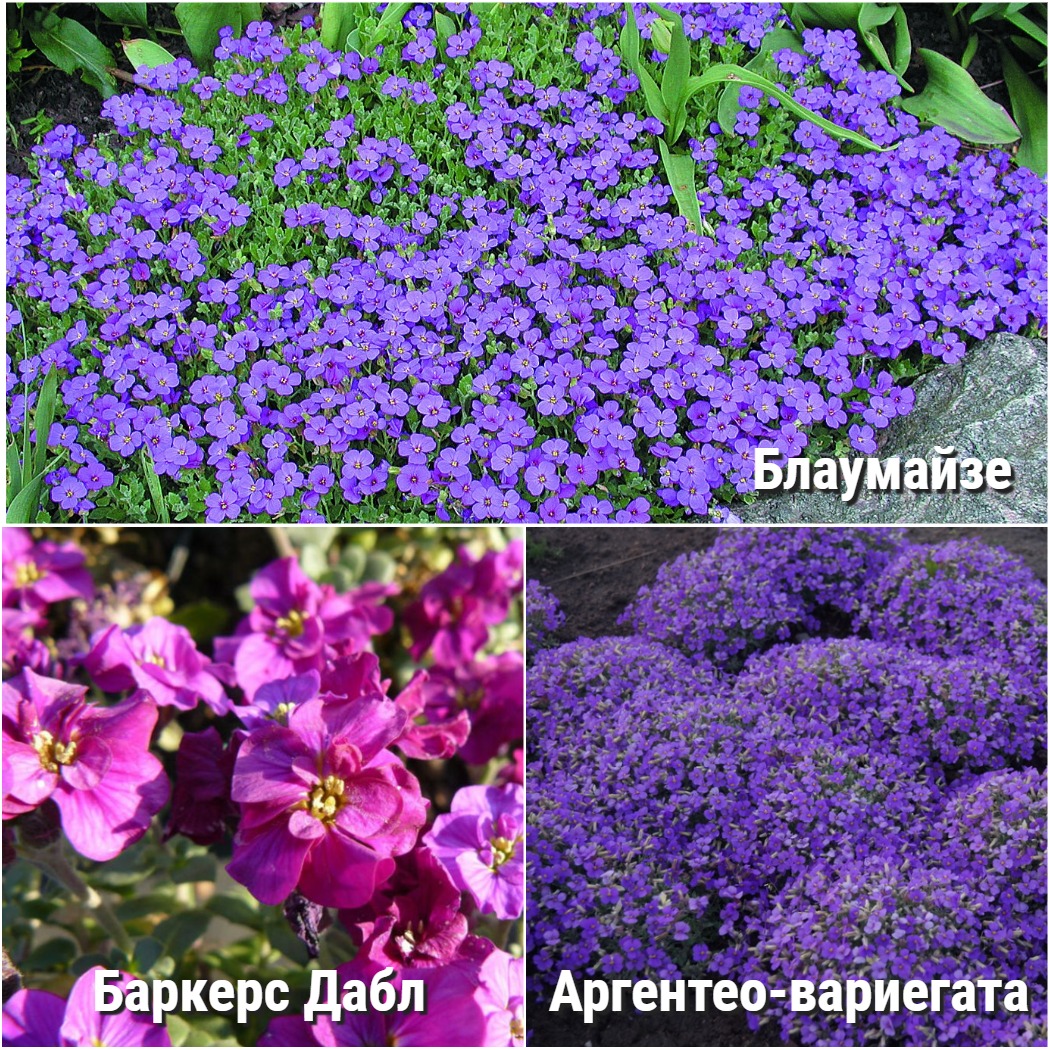
Aubrieta has several varieties that can be grown from seeds:
- Argenteo-variegata – leaves are green with a white border and light specks, flowers are purple.
- Barkers Double – a very dense and compact bush with pink flowers.
- Blaumeise – forms a beautiful lilac carpet, an adult plant is 0.15 m high.
Landing
Seeds should only be sown when temperatures have stabilized below 4°C. If a sudden thaw occurs, they will likely germinate, and the seedlings will die over the winter. These perennials grow best in sunny areas with sandy, dry, and slightly alkaline soil. Avoid planting aubrieta in areas where fertilizer has recently been applied.
The seeds are placed 3 cm apart from each other, without being buried deep in the soil. You can gently compact them with your fingers and sprinkle some sand on top.
ABOUT aubrieta flower (Aubretia) in a separate article.
Primrose (Primula)
Primroses (early flowers) comprise over 500 varieties. They are beloved for their diverse forms, colors, and fragrances. They retain their riot of color for a long time, beginning to bloom in spring and continuing until mid-July. Some hybrids, under favorable conditions, can produce repeat blooms even in the fall.
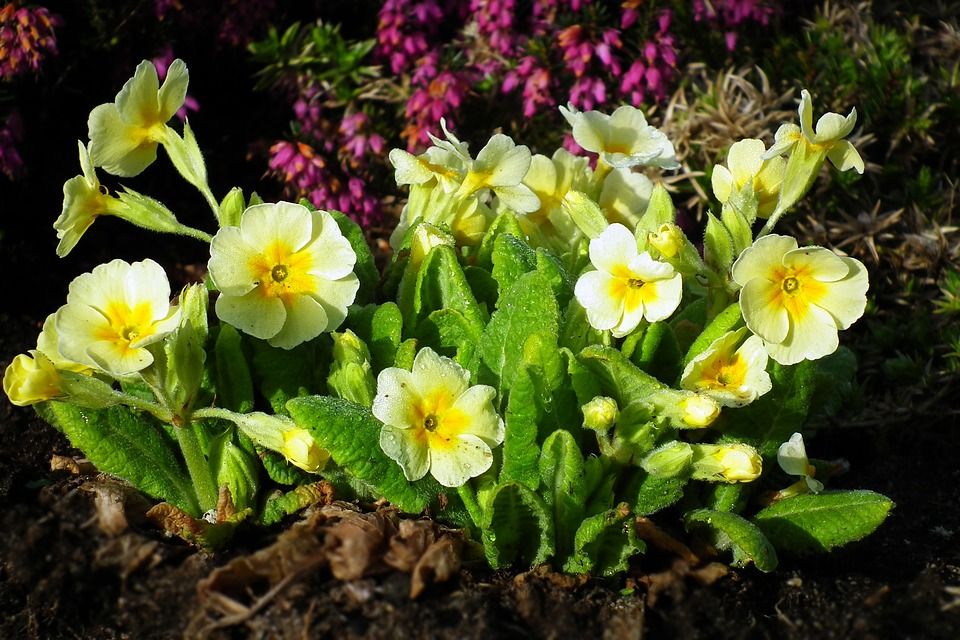
The plant reaches from 10 to 30 cm in height, flowers most often grow singly, but some varieties are characterized by capitate, spherical or umbel-shaped inflorescences.
Varieties
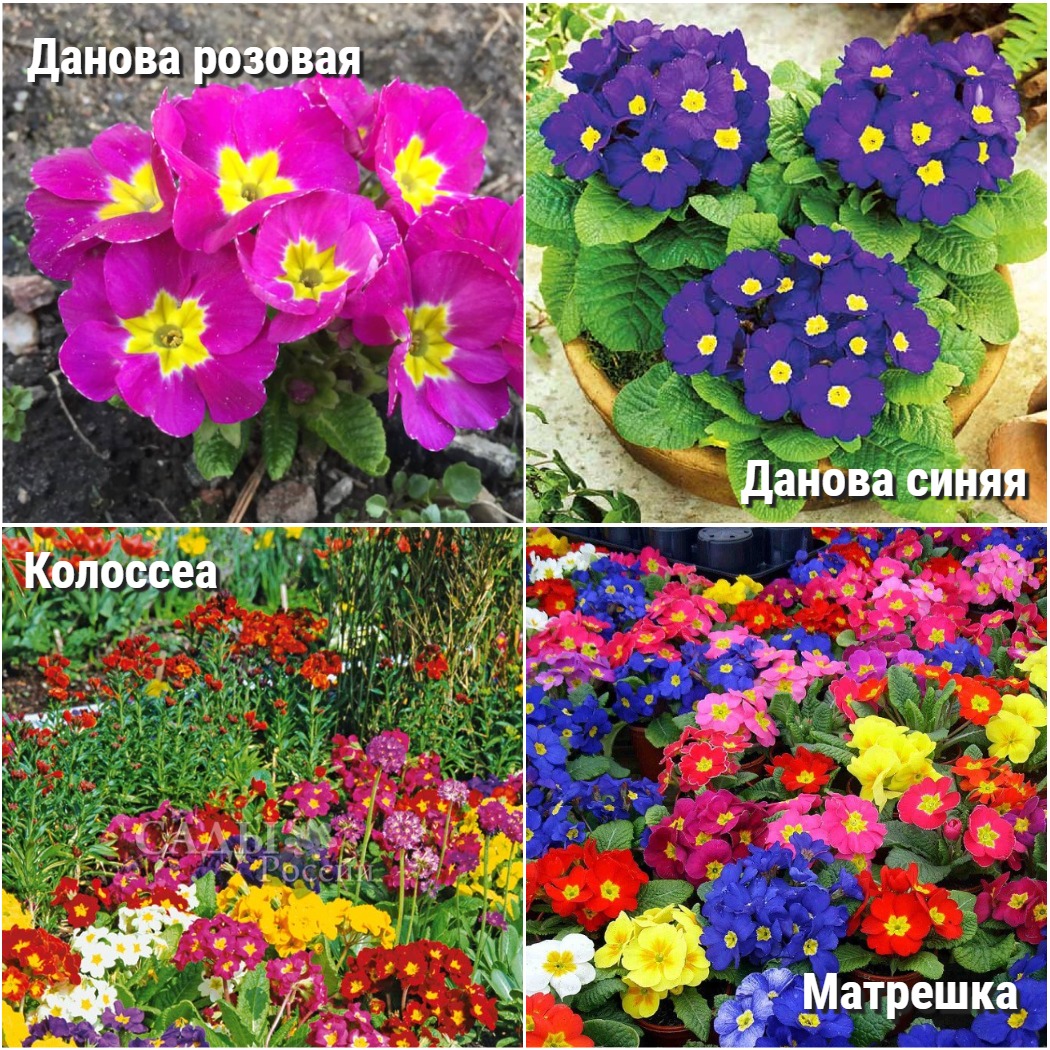
- Matryoshka – blooms very early – in the first weeks of March. It's considered a dwarf plant, barely reaching 20 cm. However, the flowers themselves are very large and lush. They come in a variety of colors: burgundy, blue, purple, yellow, or white.
- Colossea Flowering begins in late April to early May in the second year. The coloring is very similar to the Matryoshka variety, but the stems are slightly taller, reaching up to 30 cm.
- Danova – has a very modest size – up to 14 cm in height, with leaves growing up to 10 cm. The most common petal colors are burgundy, blue, white, pink, or orange. Flowering begins with the onset of the first warm weather of spring.
Landing
Growing primroses from seeds is very difficult. They must be planted only in the fall to allow them to undergo stratification. Furthermore, the seeds themselves are not very viable, so only the freshest seeds should be used. It's best to plant them in a prepared container with loose soil. Store-bought soil with a balanced composition and minimal weeds is best for primroses.
There's no need to plant the seeds deep; just lightly cover them with soil. Place the container in a bright spot, out of direct sunlight, which can burn the tender seedlings in the spring. It's crucial to monitor watering and maintain humidity—primroses don't tolerate drought, but stagnant water is also harmful.
We recommend articles: primrose from seeds at home, indoor primrose, More information on planting and care in open ground.
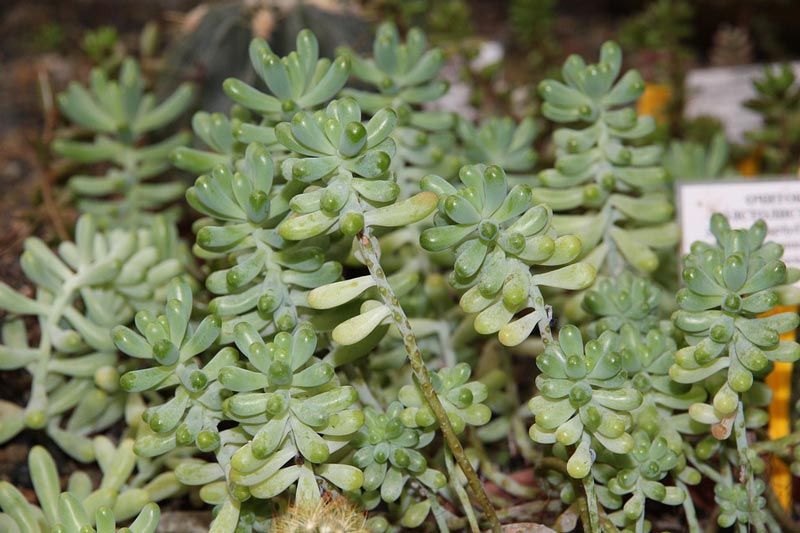
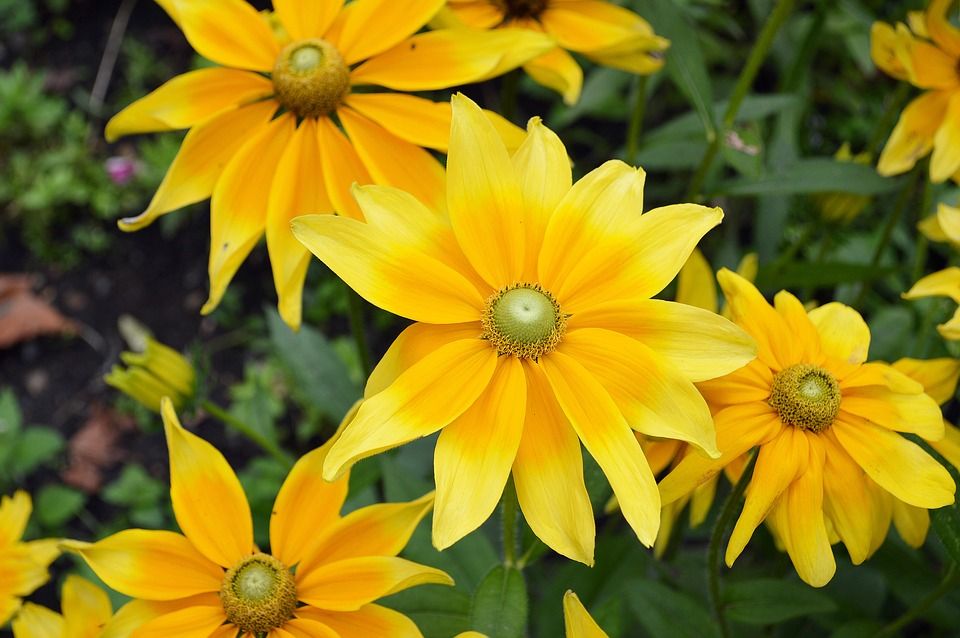
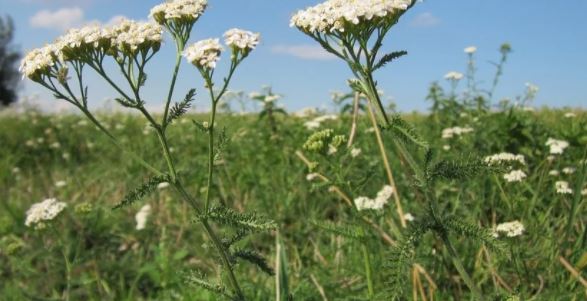
You can also plant perennial flowers in the winter. rudbeckia, sedum, yarrow.
Annual and biennial flowers for planting from seeds in the fall
There are a large number of annual and biennial flowers that can be grown from seed in the fall. It's important to remember that, like perennials, they generally need to be sown in late fall.
Annual aster or Chinese callistephus (Callistephus chinensis)
A relatively easy-to-grow plant that blooms from July until late autumn. Its native land is the southwest of the Far East, China, Mongolia, and Korea.
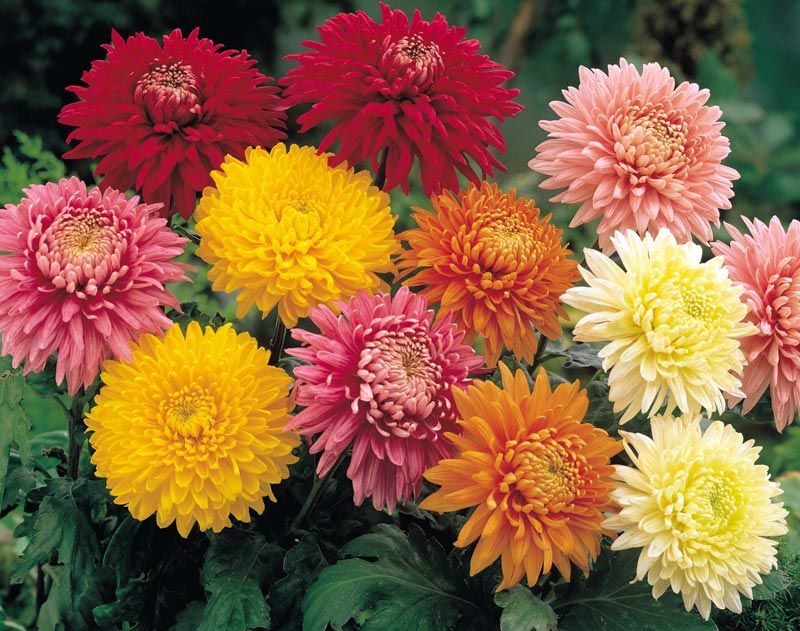
Varieties
Wild annual aster is not particularly decorative, so various hybrids are planted in gardens.
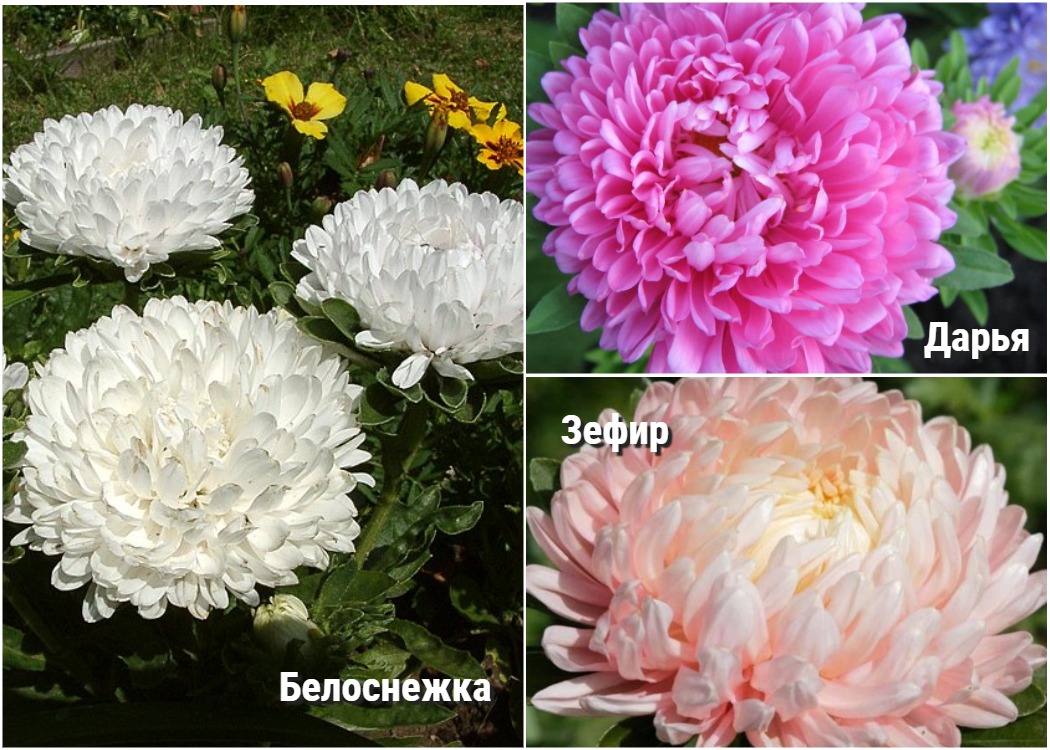
Tall varieties (60-65 cm):
- Snow White - white, columnar.
- Daria - pink with a pearlescent hue.
- Marshmallow - creamy pink.
Low-growing varieties (up to 35 cm):
- Vologda lace - white.
- Autumn Olympics - blue.
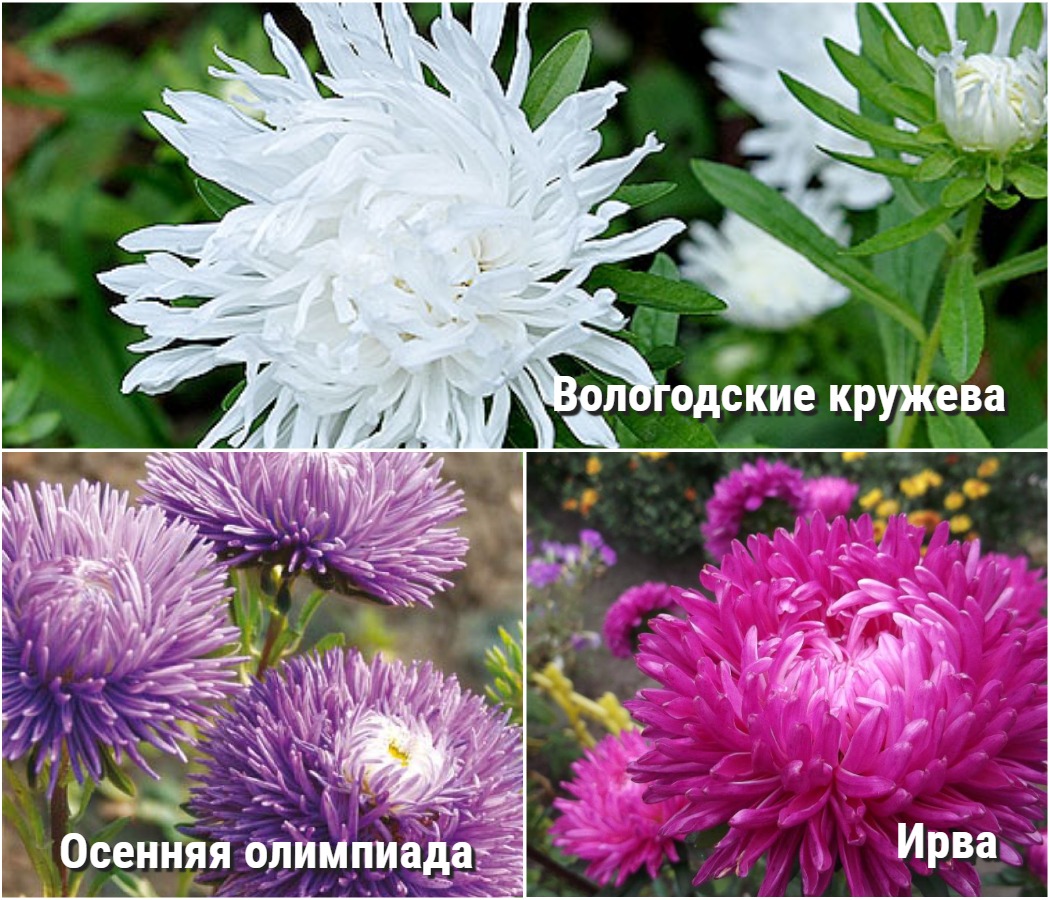
Another beautiful variety of annual aster is Irva, 44 cm high.
Landing
Fall sowing of asters helps reduce the risk of fungus, which often plagues spring plantings. Furthermore, fall asters bloom much earlier.
Choose a well-lit area with loose, neutral soil. Ideally, the flowerbed should have previously grown calendulas or marigolds. Gladioli, asters, and tulips are considered poor predecessors.
It's advisable to raise the bed 20 cm above ground level to prevent water stagnation. Adding manure to the soil is never recommended. It's sufficient to water the prepared furrows with Fitosporin to protect the seeds from fungus.
The fresher the planting material, the more viable it is. Three years is considered the optimal period; planting them any longer is pointless. It's also important to keep in mind that not all of them will germinate, so they should be planted fairly closely together. They should be planted 2 cm deep in the soil and covered with dry soil. It's also recommended to mulch the bed with peat or sawdust.
Alyssum
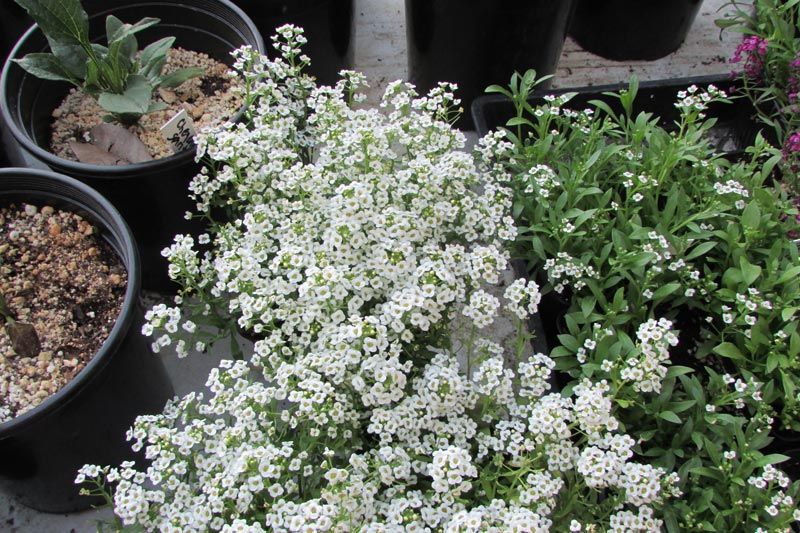
The flower belongs to the Brassicaceae family. The genus comprises 100 species. The plant height ranges from 0.15 to 0.4 m.
Varieties
Several varieties marine (maritima) alyssum:
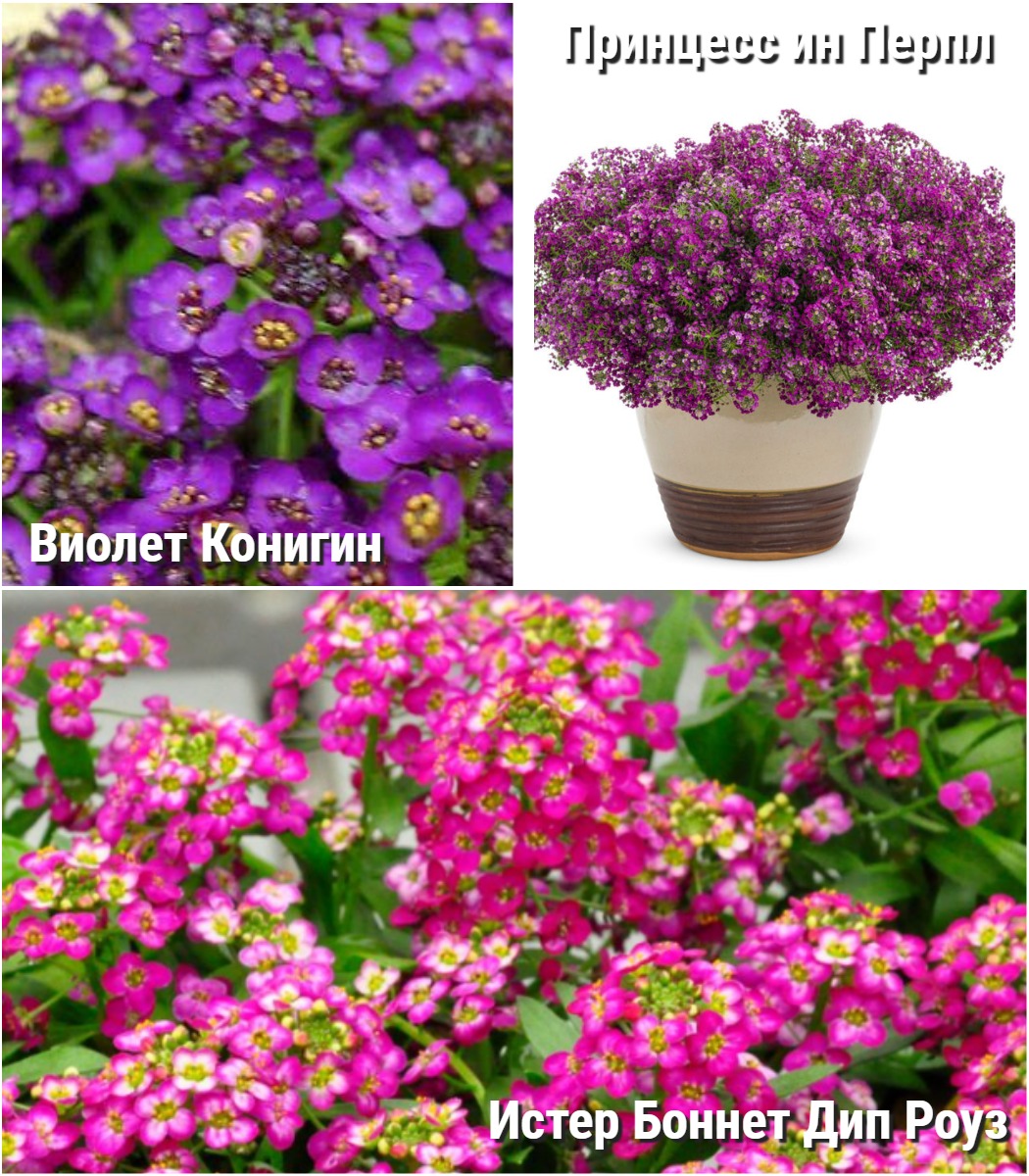
- Easter Bonnet Deep Rose – is distinguished by its flowers of a rich pink color.
- Princess in Purple – pale lilac flowers, the variety is good in hanging pots.
- Violet Konigin – purple flowers, plant up to 15 cm in height.
Landing
Winter sowing helps strengthen the plant's immunity. The soil should be loose and have a low or neutral pH. The sea buckthorn variety, whose varieties we discussed above, has very small seeds, so before planting, they can be mixed with sand and sprinkled into furrows on frozen ground. It's advisable to mulch the bed.
More details about alyssum.
Marigolds (Tagetes)
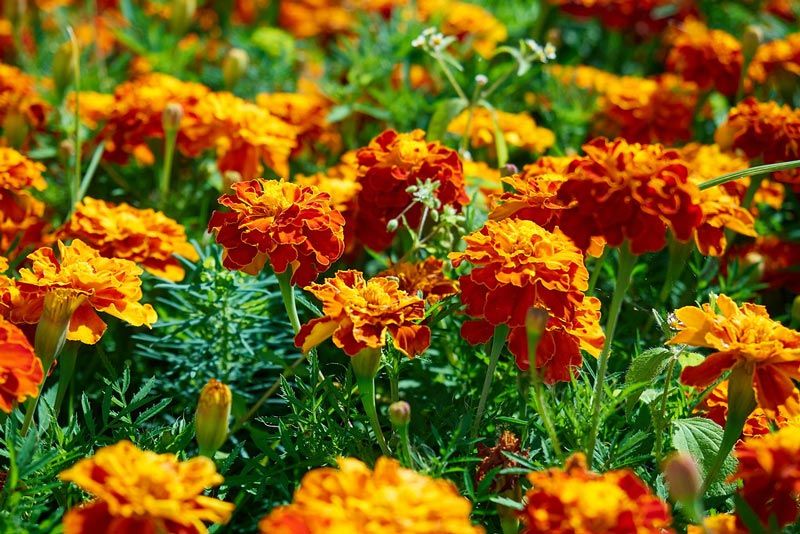
A genus of the Asteraceae family. Their homeland is South and Central America.
Varieties
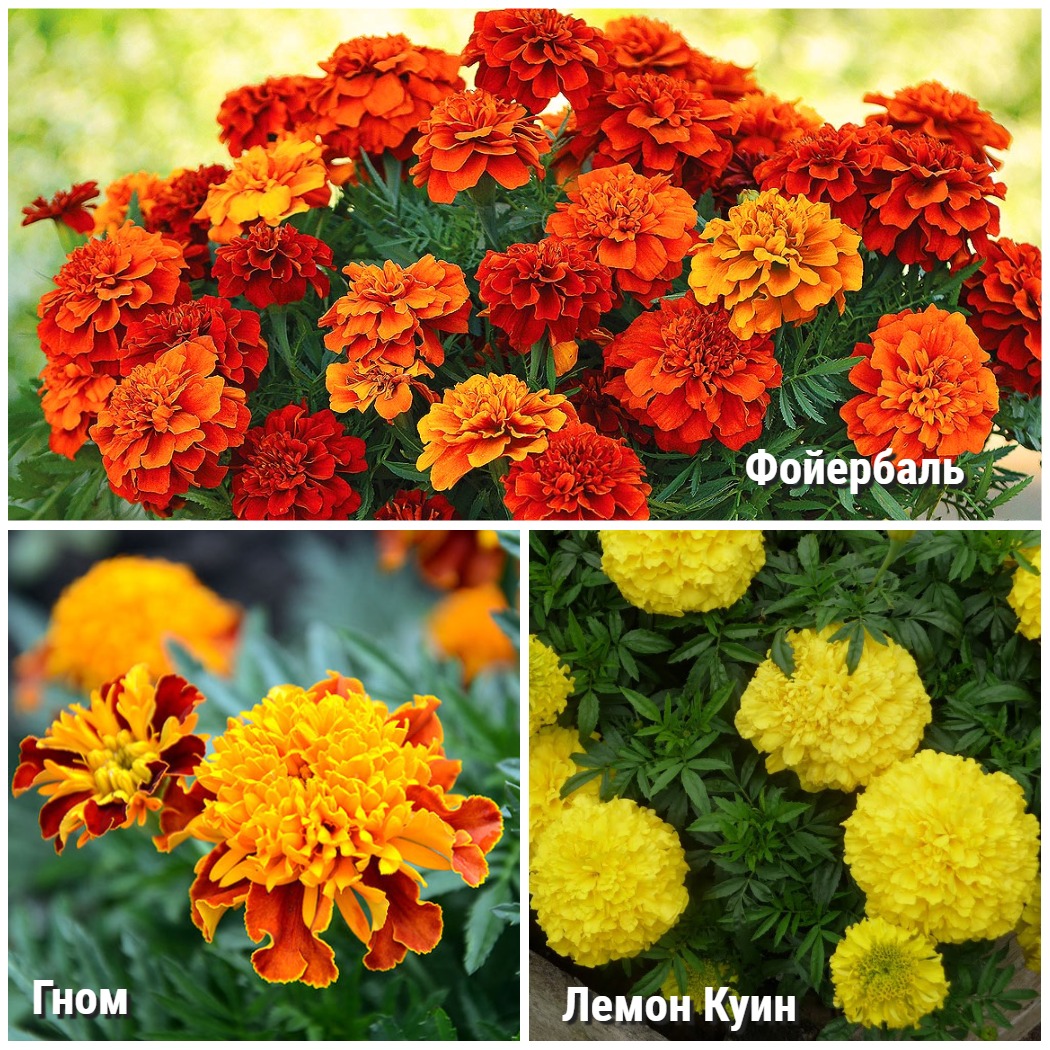
- Lemon Queen – a tall variety with yellow flowers.
- Feuerbal – a medium-sized flower with orange petals and brown tips.
- Gnome – one of the low-growing varieties (no more than 22 cm), small yellow and orange flowers.
Landing
There are several common opinions about sowing marigolds in the winter. The reason is that they require warmth in the spring to germinate. If the snow melts and the soil doesn't have time to warm up in the sun, the seeds will rot in the soil. Therefore, planting them in the fall is recommended only in warm regions with mild and short springs. In temperate and cold climates, marigolds can be sown in a greenhouse, covered with a layer of mulch. However, some believe that sowing marigold seeds on snow during the winter months will ensure the flowers grow beautifully and be healthy.
Read about marigolds on our portal.
Godetia
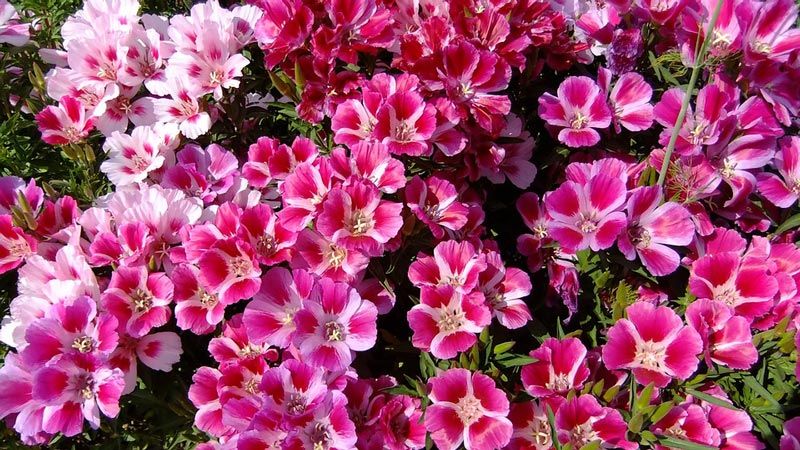
This herbaceous annual plant belongs to the fireweed family. It's native to Southern California. It's perfect for flowerbeds and borders, and looks great in pots on summer verandas.
Varieties
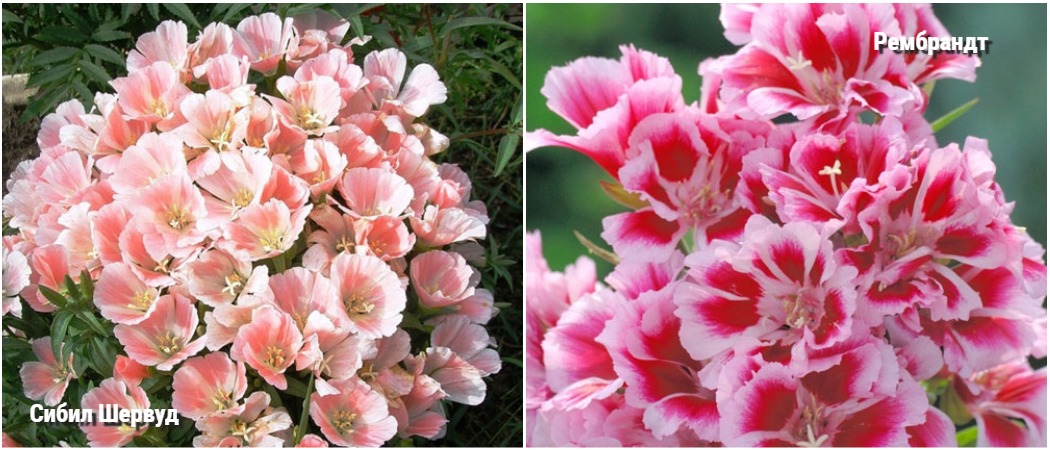
Varieties of double azalea-shaped godetia:
- Sybil Sherwood – bushes up to 40 cm in height, flowers of a very delicate coral color with a yellow center.
- Rembrandt – height 30-35 cm, flowers are pink with a carmine-colored spot.
Landing
Planting seeds in the fall promotes early flowering. This method is best suited for regions with mild winters, abundant snow, and warm springs, although many gardeners report successful results in central Russia as well.
Godetias don't transplant well; it's recommended to transplant them immediately to a temporary location with good lighting and fertile soil. To protect the plantings from frost and retain moisture, they should be mulched.
More useful information about godetia flower.
Iberis
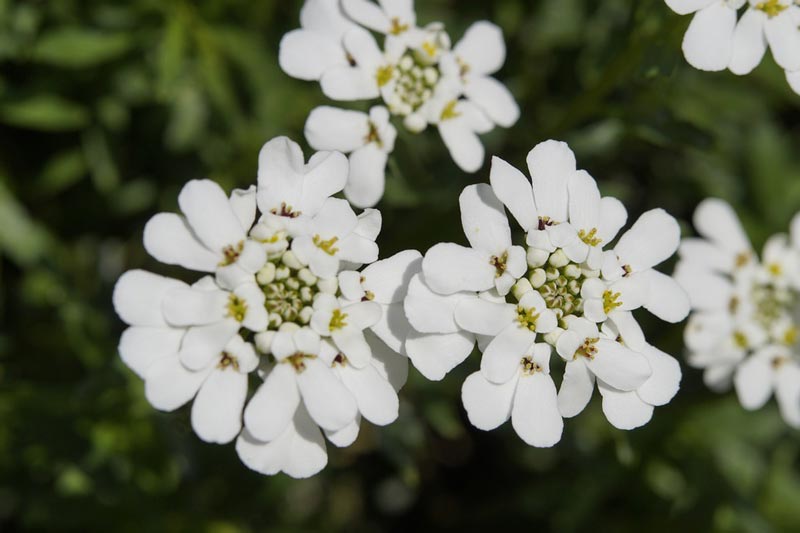
This annual groundcover grows up to 30 cm tall. The flowers are very fragrant and form umbrella-shaped inflorescences.
Varieties
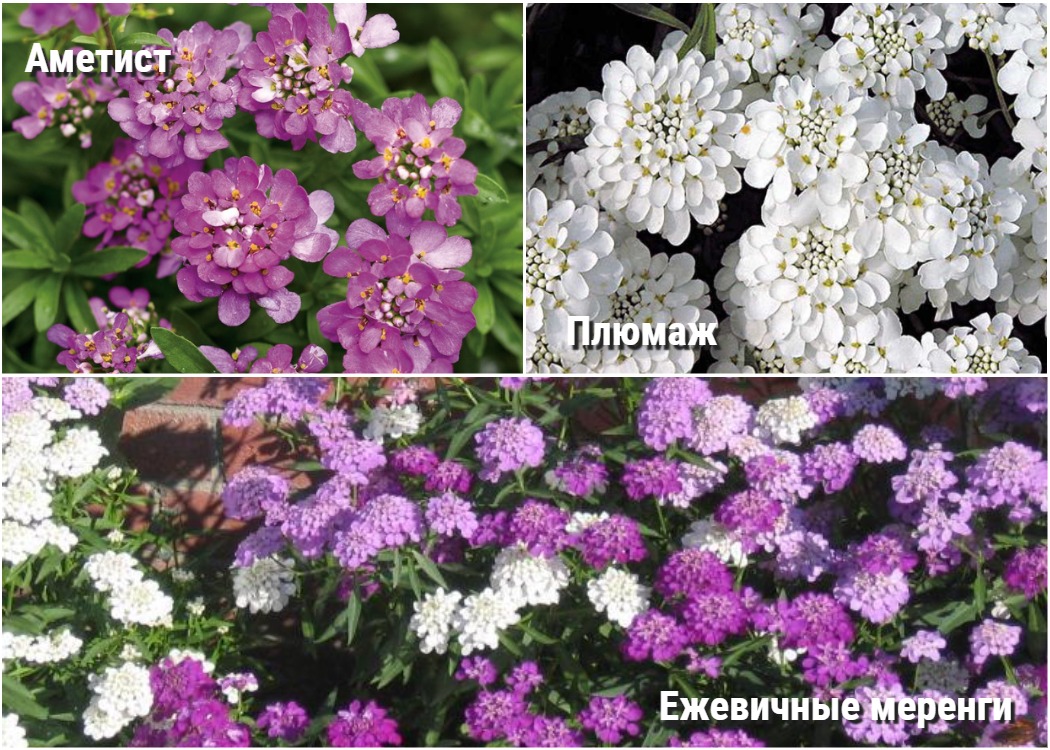
Umbellate (umbellata) view:
- Plume – forms beautiful clumps with a snow-white cap of inflorescences, height 25 cm.
- Blackberry meringues – a mixture of purple-violet and milky-white flowers.
- Amethyst - forms a small bush with caps of umbel-shaped inflorescences of lilac color, 5-6 cm in diameter, consisting of small fragrant flowers.
Landing
Iberis can be sown in the fall when the weather becomes consistently cool. Dry, well-lit areas of the garden are ideal for planting. They look great in the foreground of rock gardens and flower beds.
More about Iberians.
Cosmos
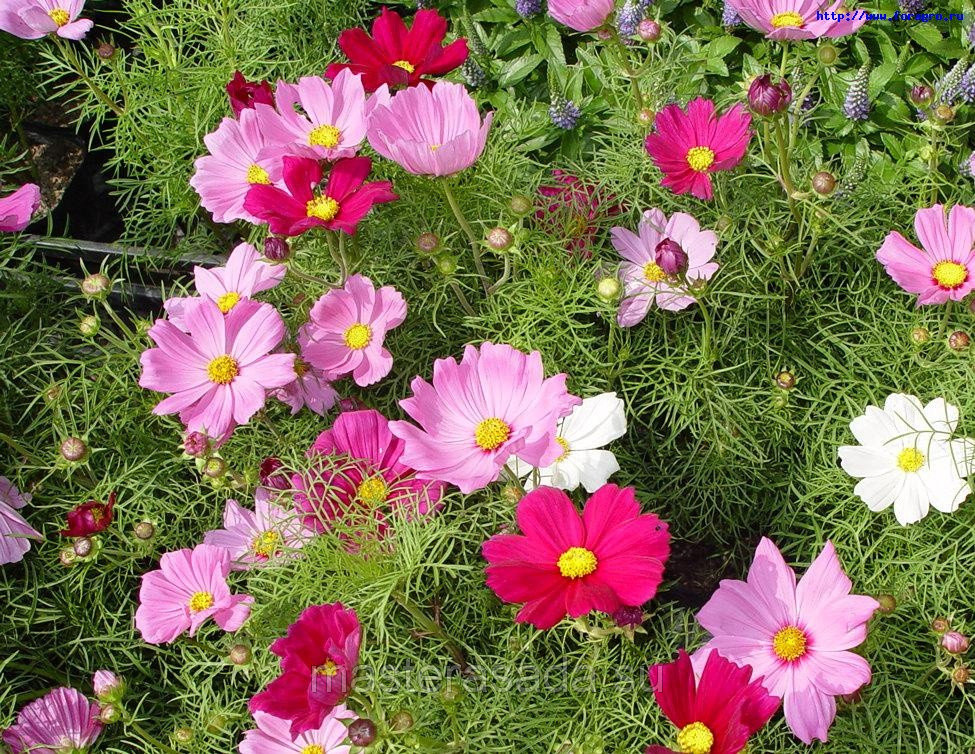
Gardeners love these flowers for their low maintenance and attractive appearance. They easily self-seed and are suitable for fall planting. They produce numerous seedlings, and excess seedlings are removed in the spring. When planting before winter, they require cover, which is removed in the spring only after the threat of frost has passed.
Varieties
Read about the most popular types and varieties of flowers on our website:
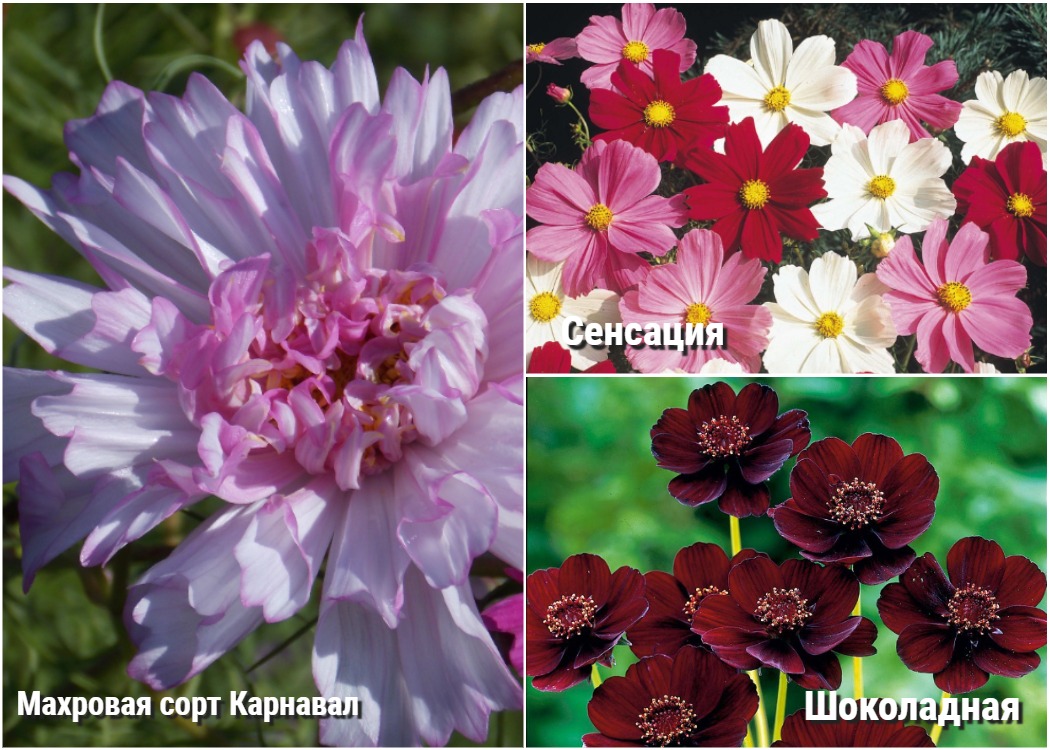
Landing
The plant prefers well-lit areas with loose, well-drained soil. If the soil is rich in nutrients, foliage will begin to grow, but buds will form more slowly. Therefore, it is not recommended to apply large amounts of fertilizer in the spring. It is best to sow the seeds directly in the area where the cosmos will grow permanently.
ABOUT cosmos varieties, planting and careAnd also Learn more about growing flowers from seeds.
Forget-me-not (Myosotis)
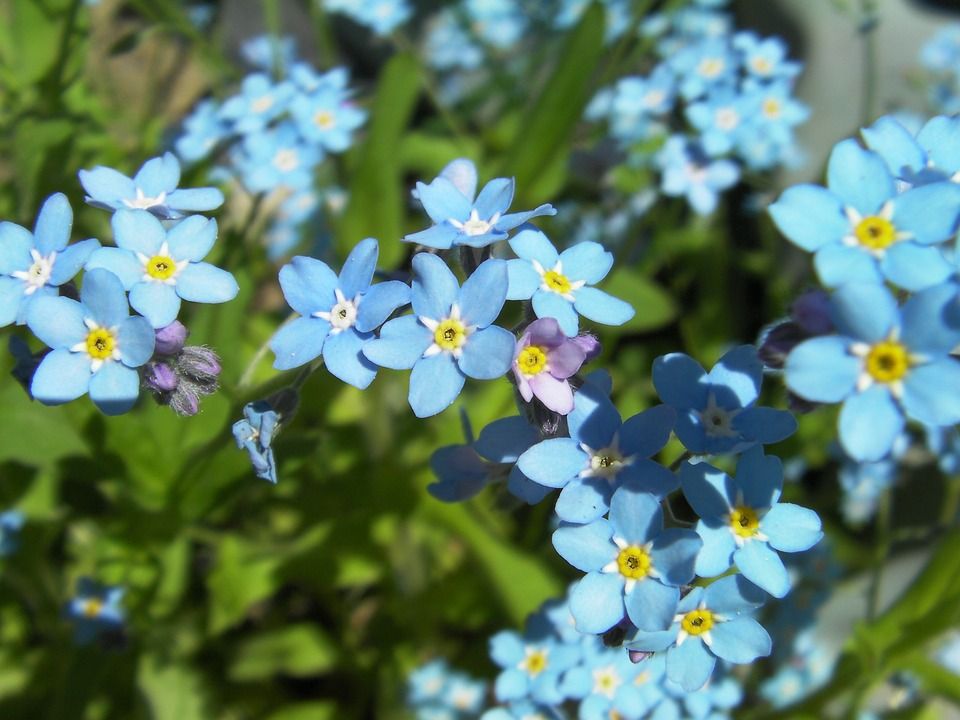
Forget-me-nots begin blooming in late spring and are considered a perennial. However, experienced gardeners know that it's best grown as a biennial. The longer they sit in the flowerbed, the less attractive they become: they stretch, stop blooming, and turn pale.
Varieties
Thanks to breeders, forget-me-nots have a huge number of varieties.
The varieties are very popular garden or alpine (alpestris) Forget-me-nots, which bloom with very bright blue flowers. However, the petal color varies among varieties:
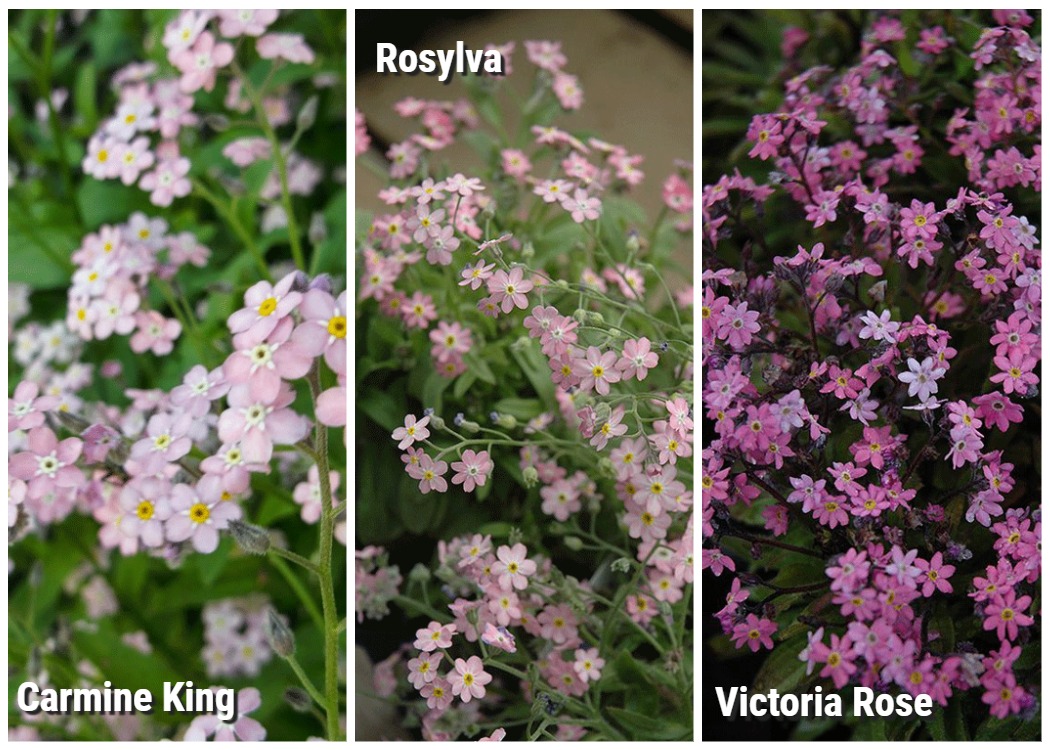
- All shades of pink: Carmine King, Rosylva, Victoria Rose.
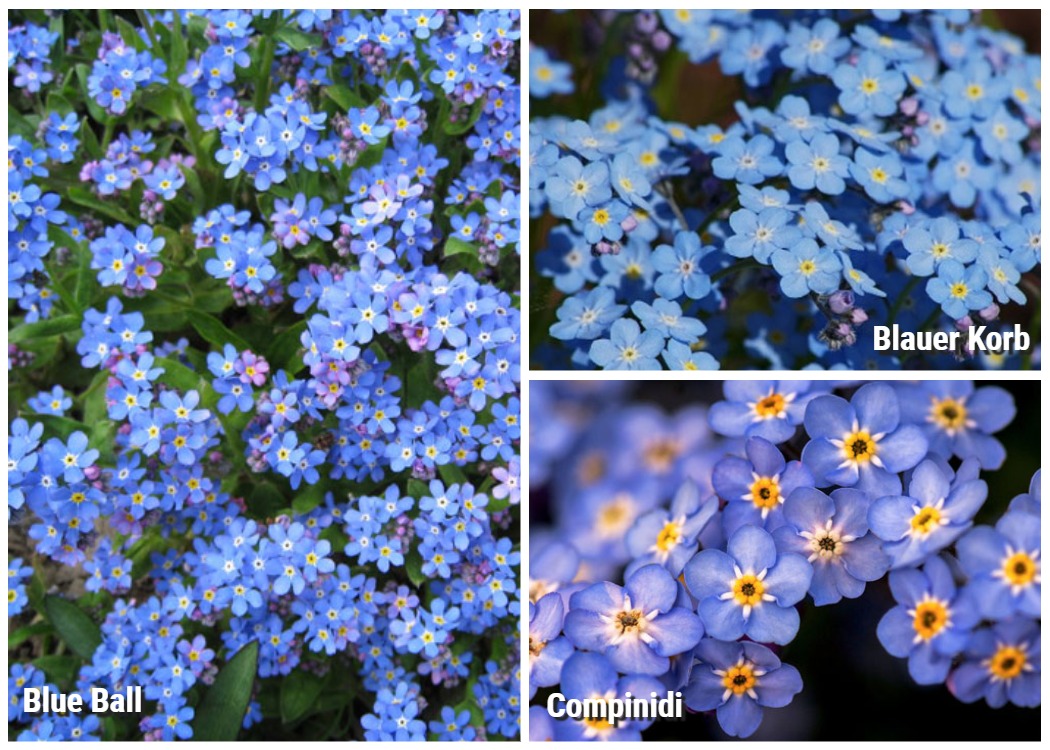
- From light to dark blue: Compinidi, Miro, Blue Bird, Indigo Compacta, Victoria, Music.
- Bright blue: Blauer Korb, Indigo, Amethyst, and also Blue Ball.
Landing
To achieve rich blooms, it's best to plant the flower in partial shade. The seeds are very viable and can be planted directly in open ground. July is considered the optimal time to begin planting; the first buds will open the following year.
Forget-me-nots prefer loose, nutritious soil. It's best to ensure good drainage by digging a few stones 50 cm deep into the flowerbed. Additional fertilizer is unnecessary, as this will encourage active foliage growth, which will adversely affect flower formation. The soil should not become moist, and moderate watering is recommended.
Planting stages:
- Make drainage from stones dug into the ground to a depth of 50 cm.
- Dig up the soil.
- For each square meter of soil, add 5 kg of a mixture of peat and humus.
- Apply diluted nitrophoska at a rate of 1 tbsp per square meter.
- Organize repeated digging and level the ground.
- Make furrows about 1 cm deep at a distance of 10 cm from each other.
- Place the seeds in them, sprinkle with soil and lightly compact them with your palm.
- Cover the plantings with covering material.
The first shoots will emerge in 10-14 days. The cover can be removed. If necessary, thin the plants, leaving the strongest shoots spaced 5 cm apart. With the arrival of autumn, the forget-me-nots can be moved to their permanent flowerbed.
Read more about forget-me-nots and their cultivation.
Turkish sweet (Dianthus barbatus)
Turkish carnation is also known as bearded carnation. This herbaceous perennial grows on very sturdy stems up to 75 cm tall with numerous nodes. Flowers vary in color, size, and shape depending on the variety chosen. They are gathered in a corymbose inflorescence, which in some carnations can reach 12 cm in diameter.
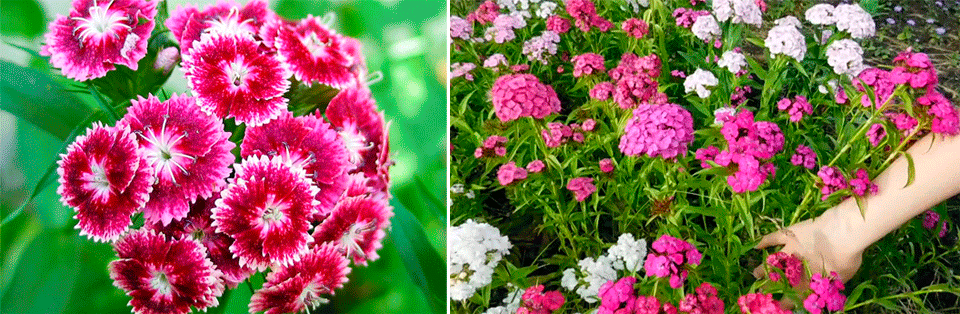
Don't expect Turkish carnations to bloom in their first year—at this stage, their rosette of leaves is just forming. In the second year, beautiful flowers bloom, lasting for a month throughout June. Carnation seeds ripen in the capsule in late summer and remain viable for up to 5 years. Cut flowers have excellent shelf life, lasting up to 14 days.
Varieties
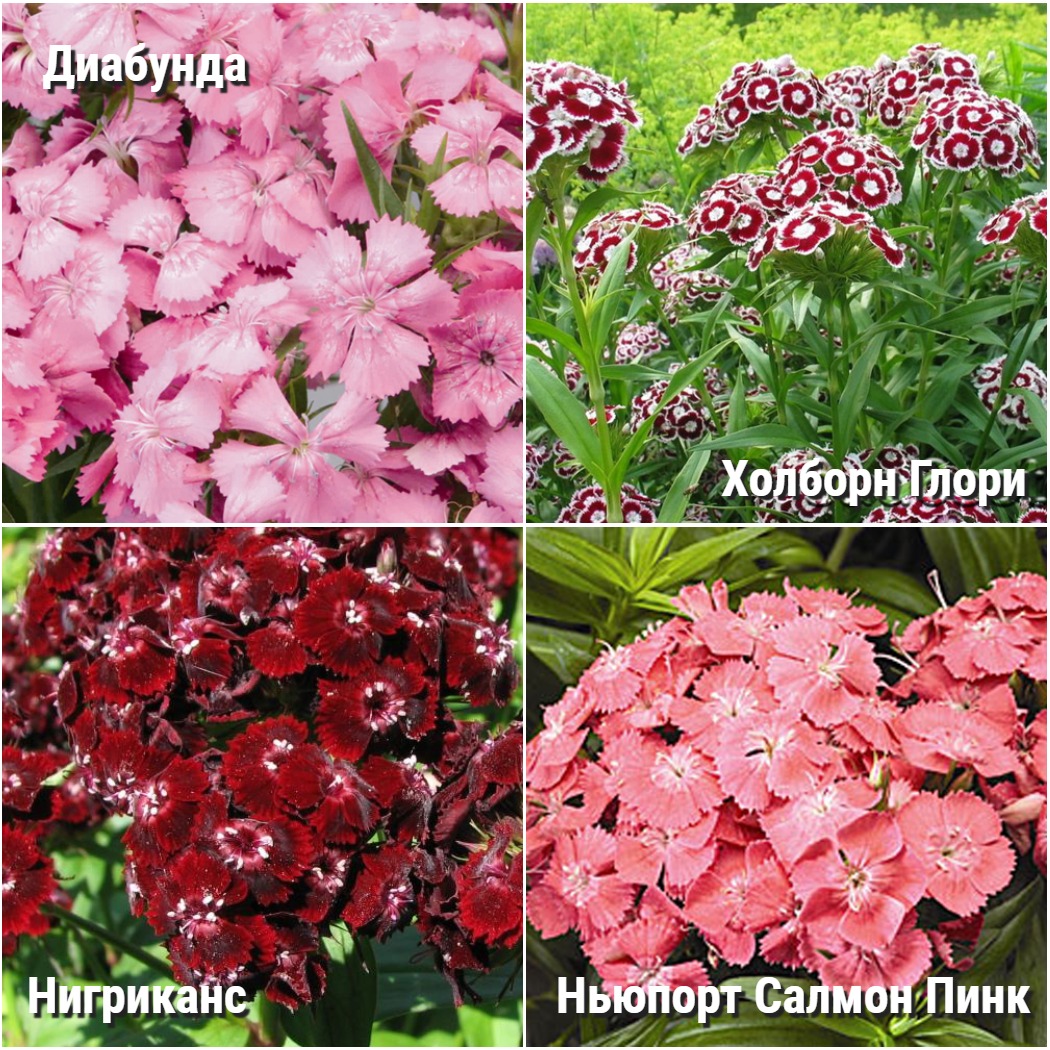
Best varieties:
- Holborn glory.
- Newport Salmon pink.
- Nigrikans.
- Diabunda.
Landing
You can begin sowing as early as October. It's crucial that both the soil and the seeds are completely dry. After sowing, the bed should be mulched with sawdust, peat, or a covering material. This layer should be removed in spring.
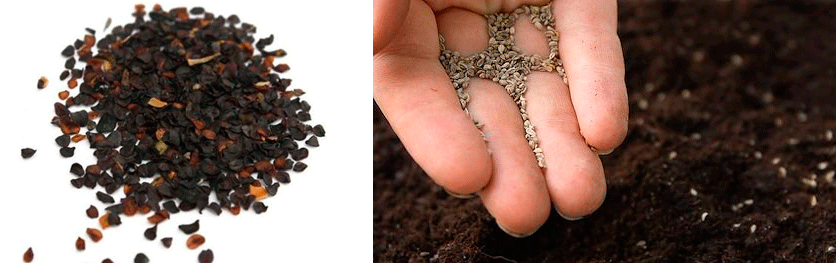
Turkish carnations thrive best in a well-lit area with loamy or sandy loam soil. Prepare the bed in advance by digging it to a depth of a bayonet about 14 days before planting. At this time, add 6 kg of humus or compost per square meter and 300 kg of wood ash per square meter.
Next, cover the soil with plastic film, which can be removed before starting work. Then, make furrows in the soil no deeper than 1.5 cm, spaced 15 cm apart. After this, water them and begin sowing seeds at intervals of 2-3 cm. Once this is done, compact the soil surface slightly and cover the flowerbed with non-woven fabric.
Lavatera
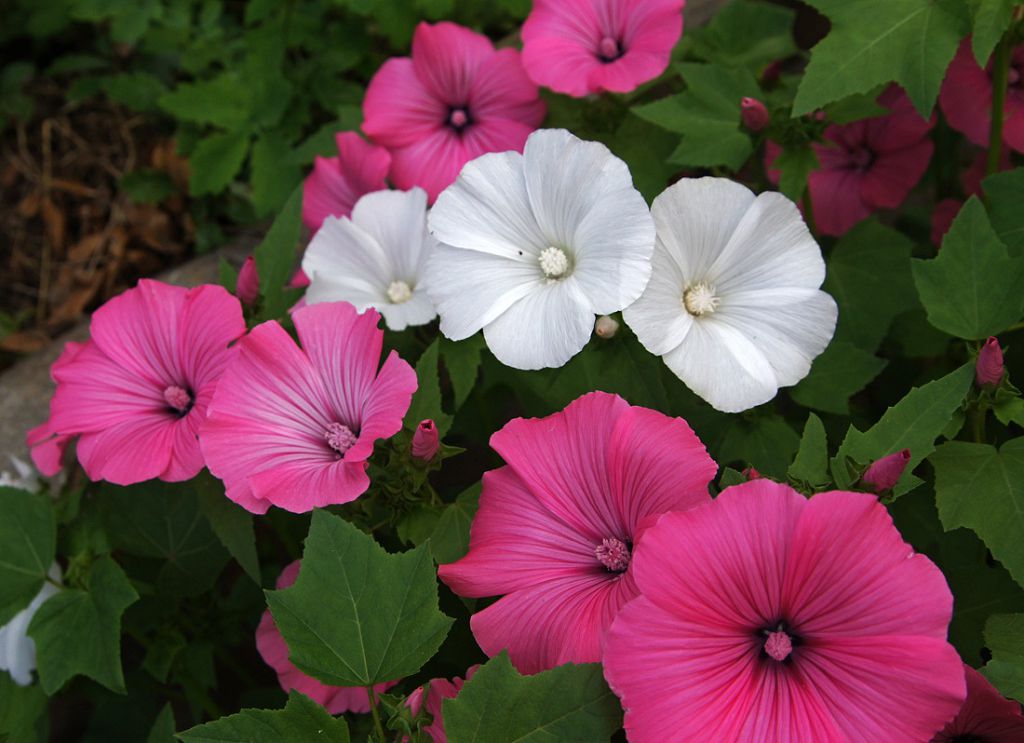
The flower is popularly known as the "wild rose." Unlike the capricious beauties of the same name, the Lavatera requires minimal care. It blooms abundantly in well-lit flowerbeds with loose soil. Fertilizers and fertilizers are not required; they are only needed in very poor soil.
Varieties
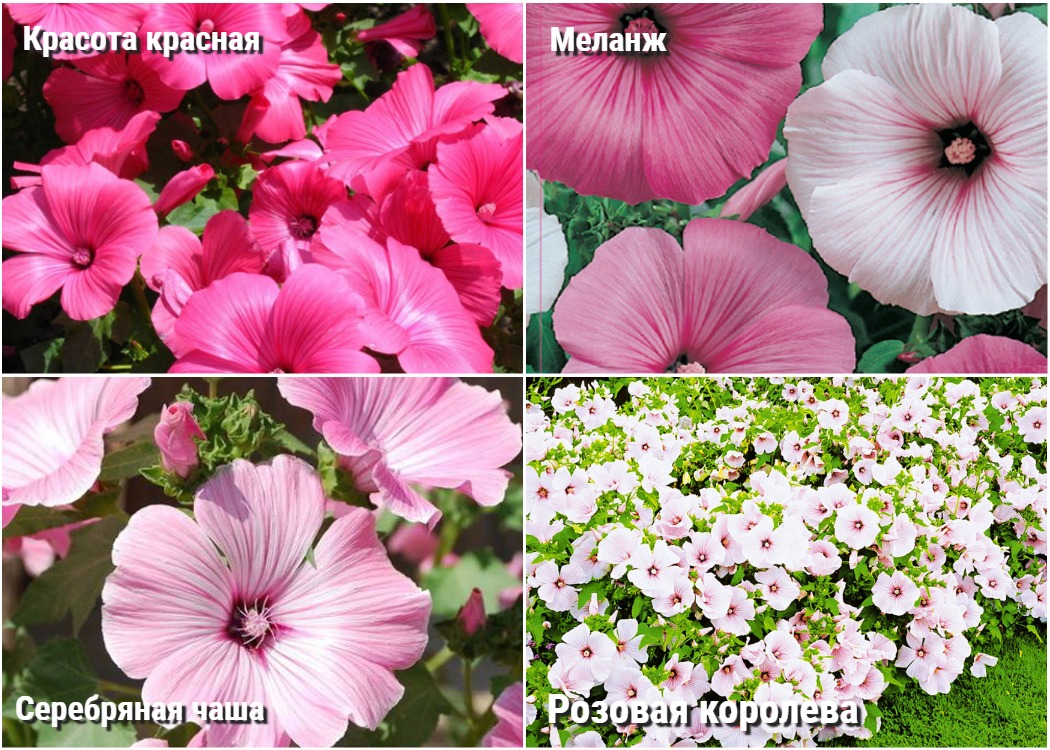
- Red beauty.
- Silver bowl.
- Melange.
- Pink Queen.
Landing
In autumn, the seeds are placed in a permanent location and mulched to prevent freezing in winter.
ABOUT perennial lavatera And annual on our portal.
Malva biennial
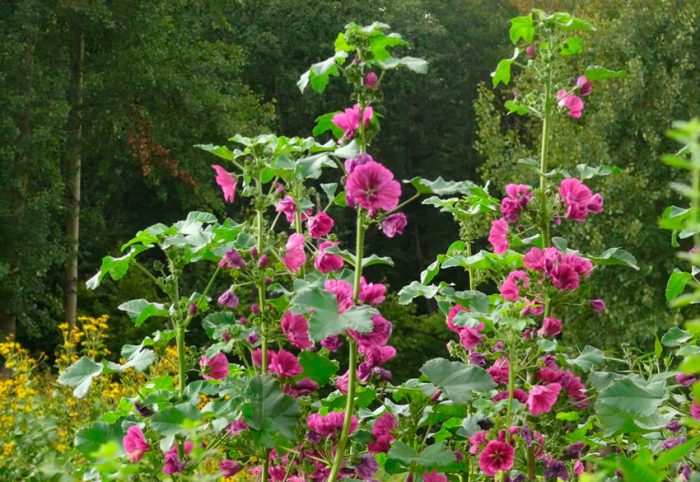
Depending on the species and variety, it can be annual, biennial, or perennial. Mallow is a biennial, but can be grown as an annual. It grows to about 1.2 meters.
Popular varieties:
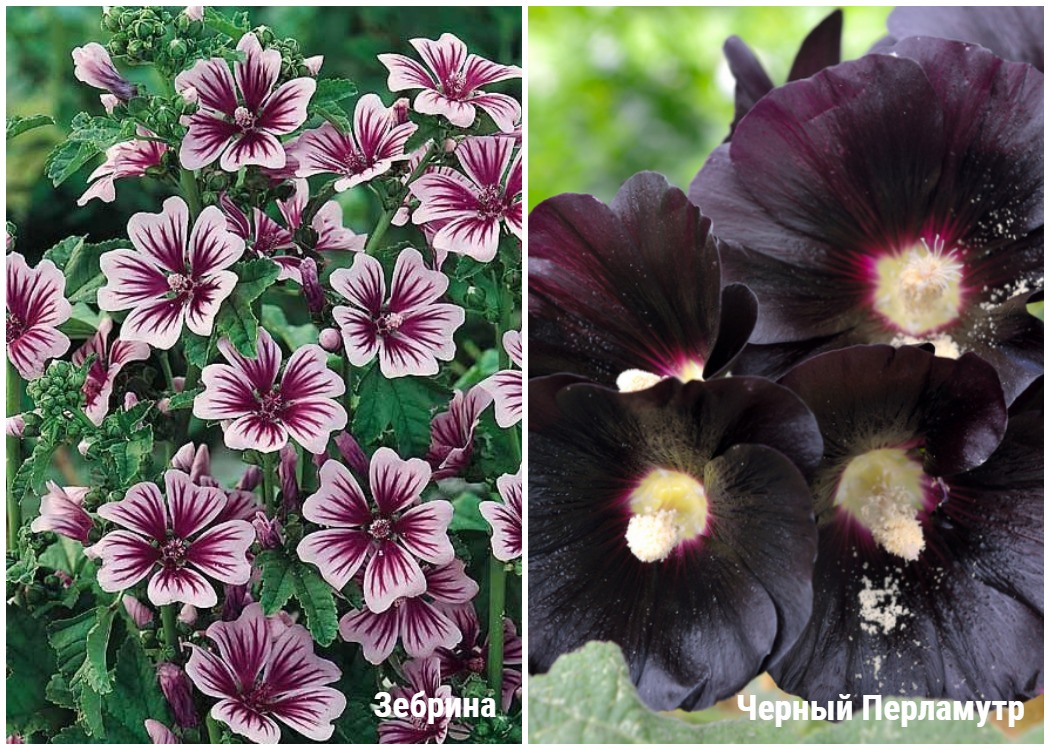
- Zebrina – has large light pink flowers with dark red veins inside.
- Black Mother of Pearl – large dark purple buds have a black center.
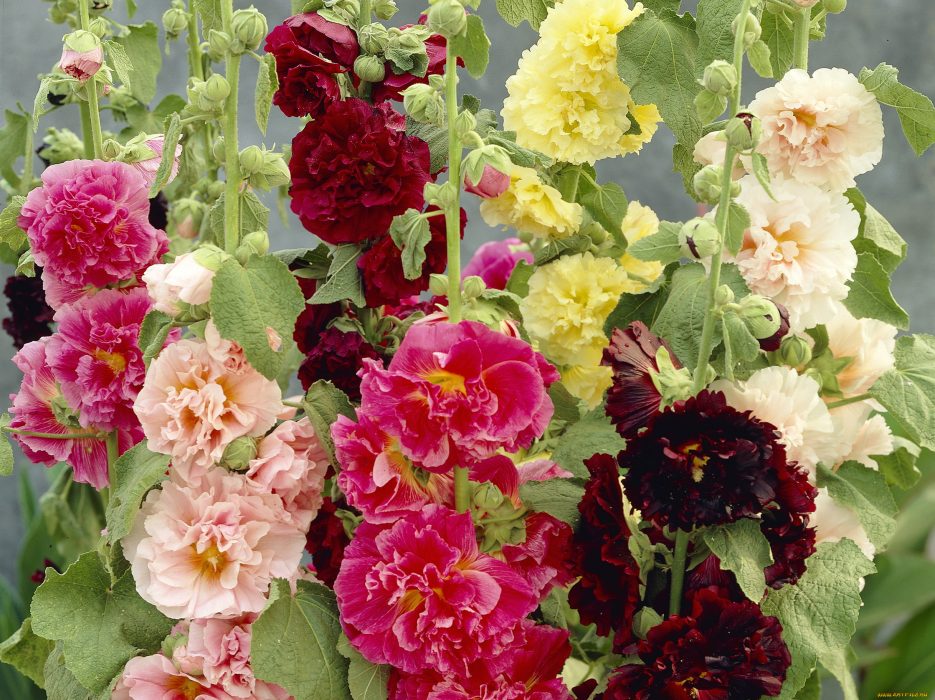
Hybrid varieties can also be considered annuals. The petals of these large flowers vary in shape and color, and can be double or smooth.
Landing
Mallow seeds are most often sown in the ground in early May, when there are no longer any chances of night frost. The winter method is less common, but it is only suitable for warmer regions. To ensure biennial mallow blooms in the first year, seedlings should be planted in mid-winter.
Place 1-2 seeds in 3-cm-deep holes, spaced 30-50 cm apart, and cover with soil. Seedlings will begin to emerge in approximately 14 days. Once the first pair of leaves grows, thinning can begin, leaving the strongest seedlings. Subsequent care is simple: moderate watering once a week and light loosening. Mature plants are recommended to be periodically fed with compost at a rate of 3 kg per square meter.
Interesting question mallow and hollyhock is this one plant?
Daisy
Daisies are usually grown as annuals. In their second year, they become unsightly, bloom poorly, and often freeze over the winter, especially the double varieties, as they are not frost-resistant.
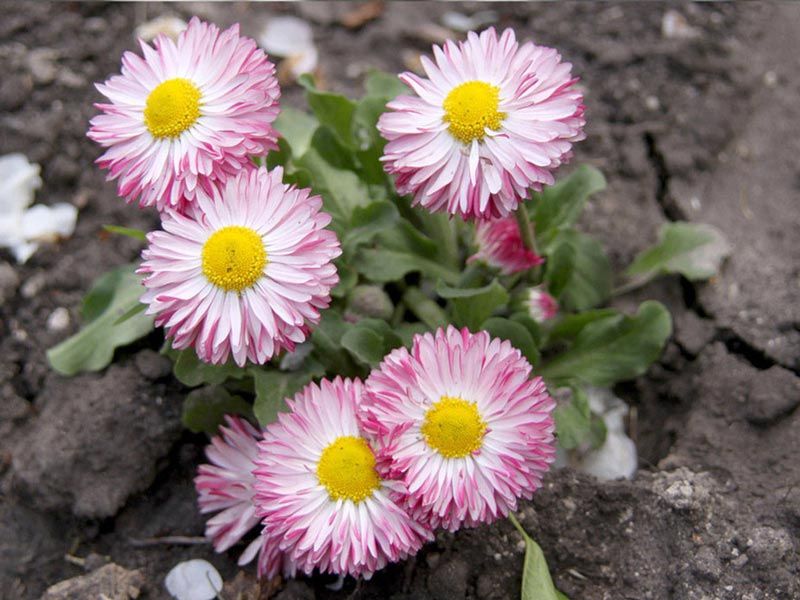
A very popular method for growing low-growing, winter-hardy daisies is in flower beds, used to border a garden plot or along paths. They can be combined with other annuals. Annual thinning will be necessary, as they quickly become overgrown and begin to shrink.
Daisies range in height from 10 to 30 cm and look beautiful alongside daffodils, forget-me-nots, and tulips. Many gardeners use potted daisies to decorate gazebos and summer verandas.
A wide variety of colors are available: blue, salmon, pink, raspberry, white, and carmine. Petals can be smooth or double, ligulate or tubular, and range in size from 1 to 4 cm.
In the central zone, the daisy begins to bloom in May and continues until autumn, peaking in mid-July.
Varieties
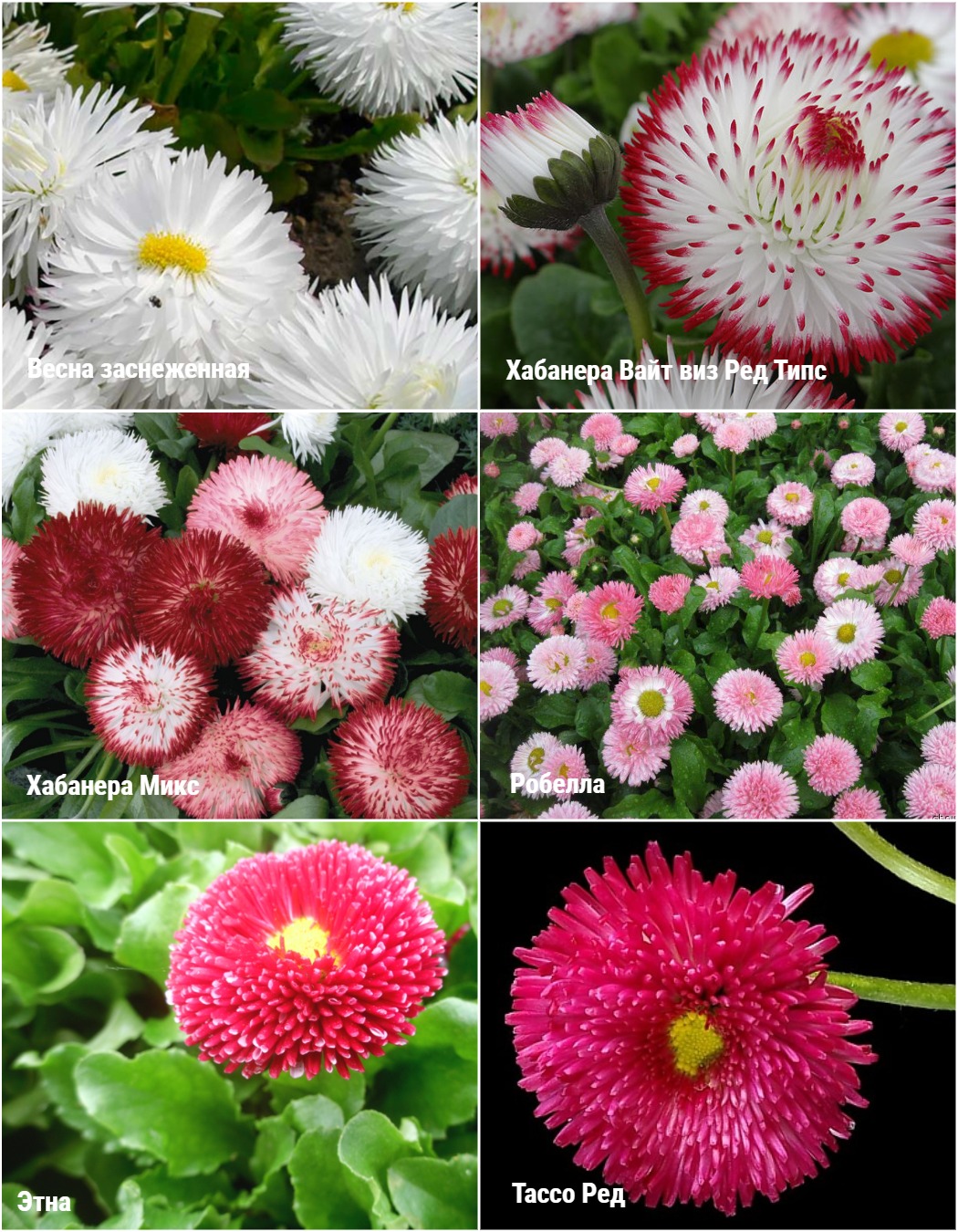
Popular varieties of daisies include the following:
- Snowy spring - pure white.
- Habanera White with Red Tips - white with red ends.
- Habanera Mix - dark red, white and salmon pink.
- Robella - pink with a yellow center.
- Tasso Red – height no more than 12 cm, red flowers 4 cm in diameter.
- Etna – a group of spherical flowers of varying colors.
Landing
The most productive time to plant seeds is the second half of June. Sites with morning light and afternoon shade are best. Leaves and flowers will wilt in constant sun.
Daisies prefer loose, well-drained soil. However, they don't thrive in marshy areas.
Sequence of work for planting seeds:
- Loosen the soil, remove weeds.
- Make furrows no deeper than 1 cm at a distance of 5 cm from each other.
- Moisten the soil.
- Place the seeds in the furrows.
- Sprinkle with soil or sand with humus.
- Spray twice a day.
In about 3-5 days, seedlings will begin to emerge, growing into compact bushes by autumn. Flowering should not be expected for at least a year.
If you want flowering in the first year, you should plant the seeds in winter, but grow them as seedlings indoors.
Read about daisies in a separate article.
Annual phlox (Drummondii)
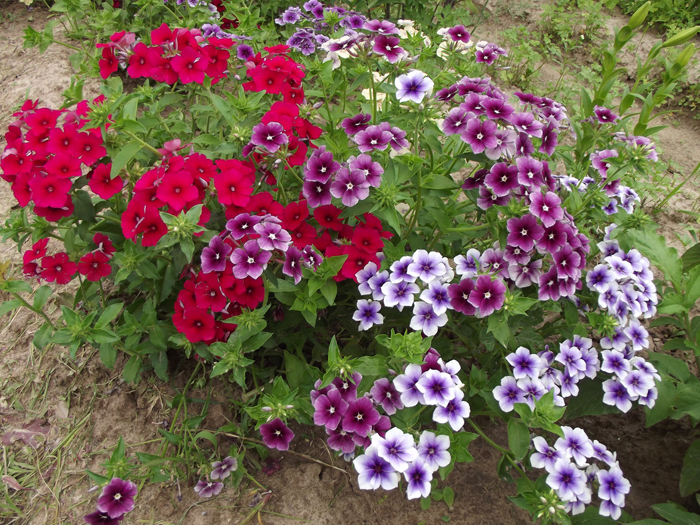
Annual phlox can be safely sown before winter; it's very hardy. If you sow the seeds too early, when daytime thaws are still possible, they will begin to germinate. In this case, the seedlings will die at the first frost. Experienced gardeners recommend covering phlox crops to protect them until spring. This can be done with hoops and plastic, or an upside-down box filled with covering material.
Varieties
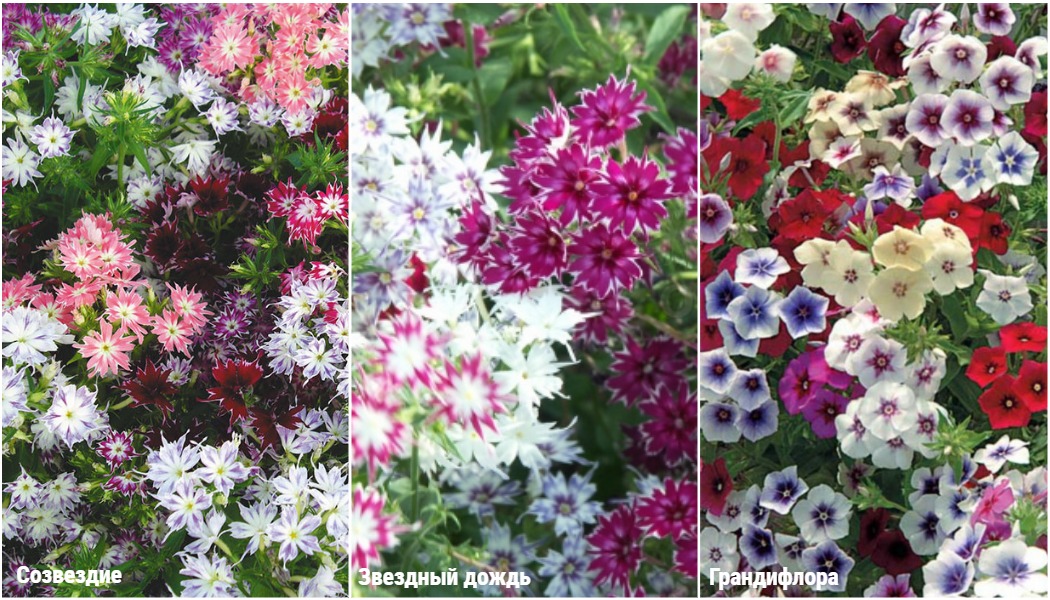
The most popular varieties of annual phlox are the following:
- Constellation - lush bushes with flowers of different shades, have a very pleasant scent.
- Star rain — fairly tall bushes with flowers resembling fragrant stars. The variety is frost- and drought-resistant.
- Grandiflora — height up to 35 cm, flower diameter 2-2.5 cm. Color varies widely. This variety tolerates light frost and rain, but still prefers light and heat.
More about Phlox Drummond.
California poppy (Eschscholzia californica)
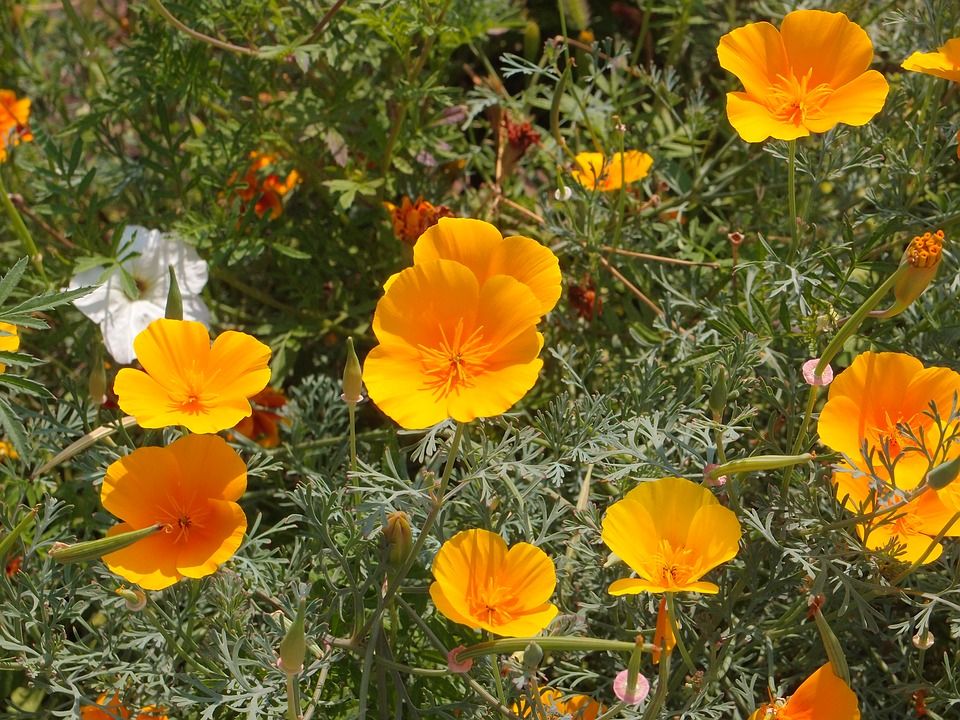
Planting California poppies in the fall is considered the most suitable option. These plants grow and bloom much earlier than spring ones. It's best to sow the seeds directly into a permanent flowerbed, as the flowers do not transplant well. The site should be well-lit, and the soil should be loose and well-aerated. Mulching the seeds is recommended for better survival.
Varieties
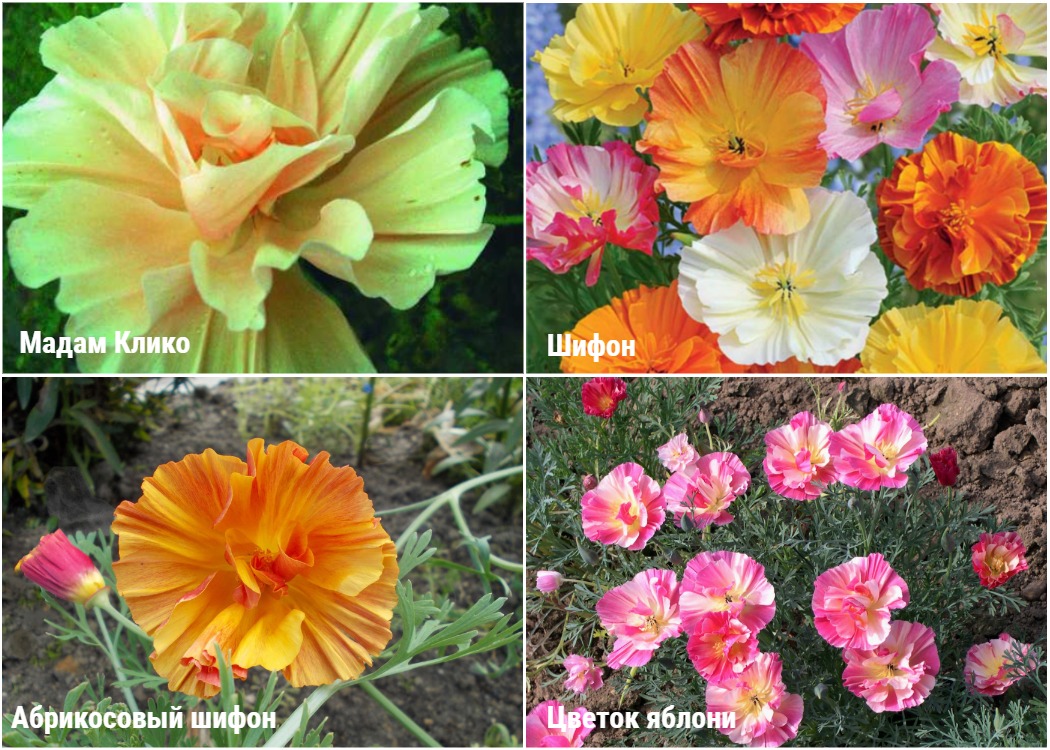
- Madame Clicquot — noble double or semi-double inflorescences of unique coloring, reminiscent of the shimmer of sparkling champagne in the sun. Height 35 cm.
- Chiffon This group is used for flower beds, borders, alpine gardens, and flowering lawns. Height: 20 cm. Double flowers and a compact appearance give this flower its unique character. These varieties tolerate frost well, and their delicate foliage delights until the last months of autumn. They are beautiful in bouquets.
- Apricot chiffon — a pure apricot color of double California poppy. Height 20 cm.
- Apple blossom — an elegant double flower. Height 35 cm.
Read about California poppies and their care.
Calendula
Calendula They are quite easy to grow from seeds in the fall, they are distinguished by good cold resistance and unpretentiousness.
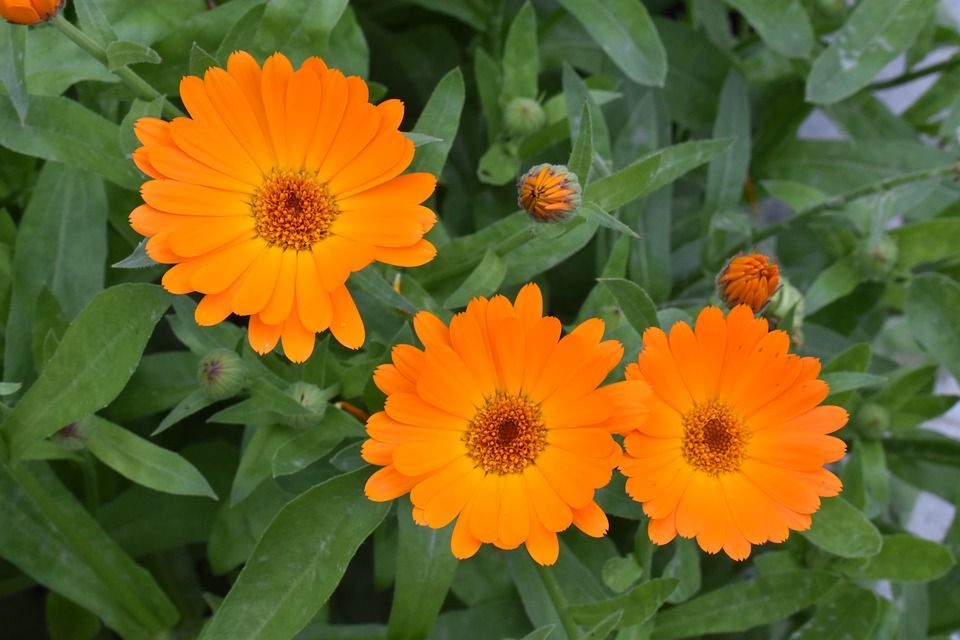
These flowers grow well in almost any soil and tolerate being transplanted easily. They can be grown directly in containers, provided they have adequate drainage.
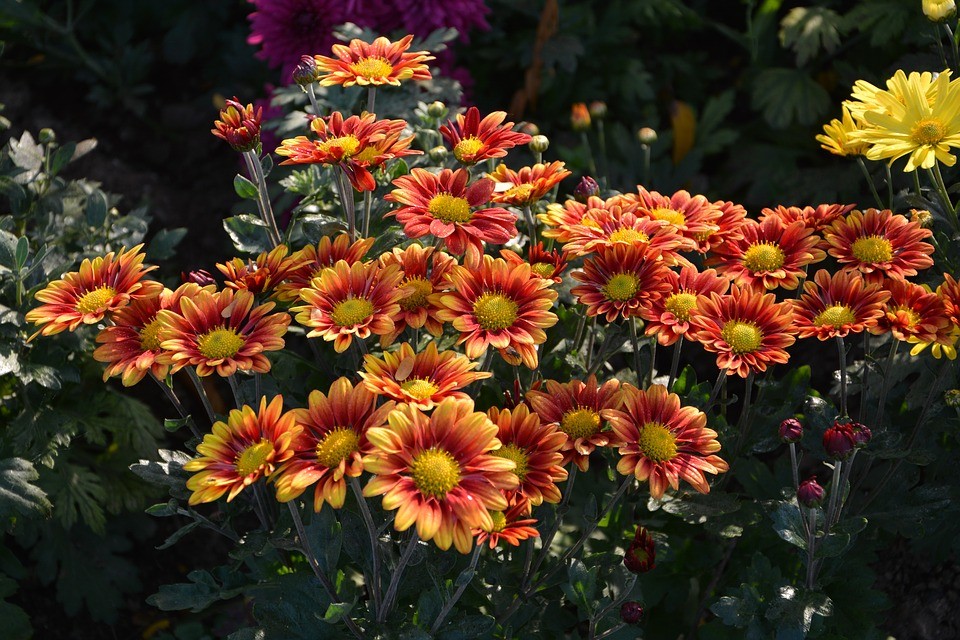
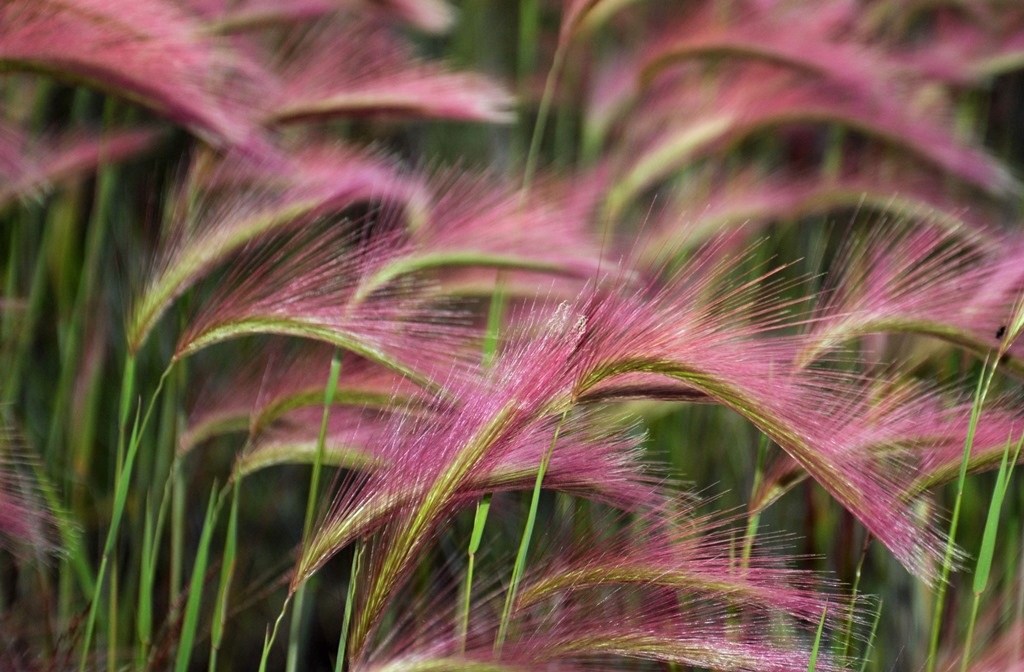
In addition, you can plant in the fall annual chrysanthemum and maned barley.
What bulbous flowers are planted in the fall?
Now let's talk about planting bulbous flowers in the fall. Most are ideal for this time. The key is to choose the optimal moment. If it's still warm enough outside, they may begin to grow. In this case, the flowers won't survive the winter and will die. If you delay planting until frost sets in, they won't have time to root properly and risk failing to germinate in the spring.
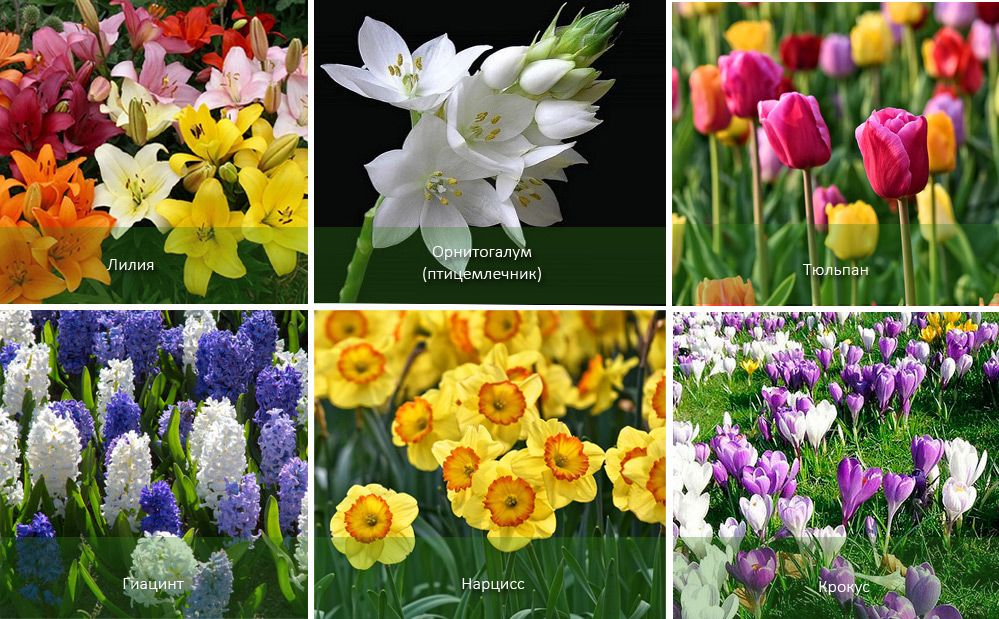
The bulbs should be planted deep into the ground based on the following calculations: the covering layer of soil should be 3 times larger than the bulbs themselves.
We also recommend: Planting bulbous flowers in autumn and spring.
Crocuses
Crocuses are distinguished by their beautiful and vibrant blooms. They grow best in sunny areas, but some shade is tolerated in some cases. The soil should be very loose to ensure good moisture drainage.
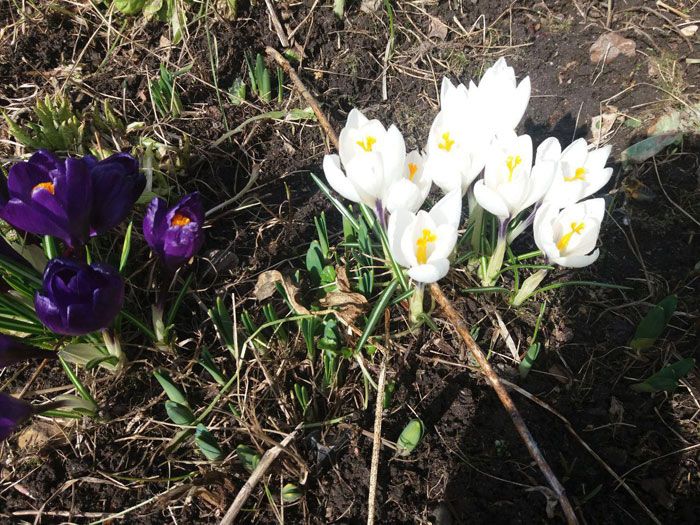
Bulbs crocuses For planting, it is recommended to select dense, unsprouted, and undamaged seeds. They are planted in the first half of autumn. The larger the seedlings, the deeper they should be planted.
Hyacinths
Hyacinth blooms very early, provided it is in a well-lit flowerbed and not exposed to cold winds. Planting bulbs hyacinths It's necessary, depending on the weather. This is usually done in the first half of October.
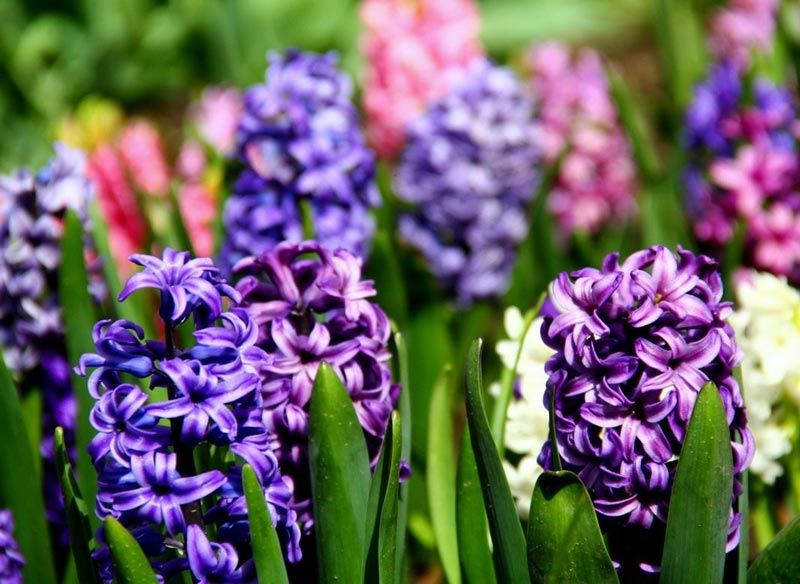
But if the autumn was warm and rainy, and the soil is still very damp, it's best to hold off and postpone planting until the end of the month or even early November. Otherwise, the bulbs risk rotting. Don't wait until the ground freezes, though—the plant simply won't have time to take root.
Tulips
The flower has long since earned the honorary title of "king of spring flowerbeds." Over the course of its existence, it has been possible to breed hundreds of varieties and get over a thousand petal color options.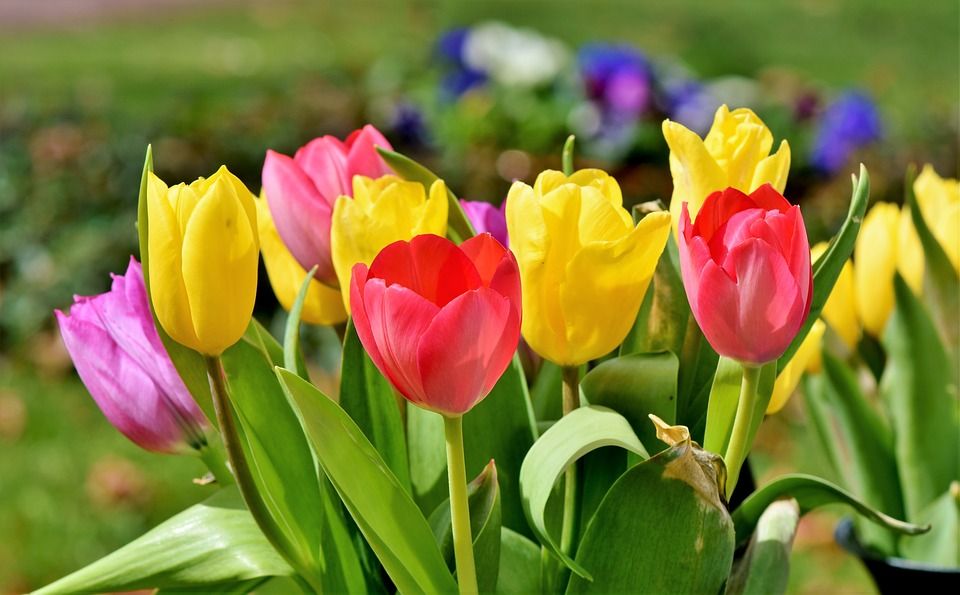
Planting bulbs tulips Planting begins in September or early October, when the air temperature does not rise above 10°C. The flowerbed should be located in a well-lit area with good drainage to prevent water stagnation at the roots. The optimal distance between bulbs is 10 cm, and between rows – 25 cm. In the second half of April to early May, you can enjoy gorgeous flowers; some varieties bloom until June. Many gardeners plant several varieties with different blooming periods next to each other to ensure the flowerbed remains a delight for the eyes for longer.
Daffodils
These flowers love the sun, but don't tolerate drafts and icy winds well. In the central zone, their first blooms can be seen as early as April. Breeders have developed several less demanding varieties. varieties of daffodils, which grow well in the shade. But the most beautiful flowers are still found only on the sunny side.
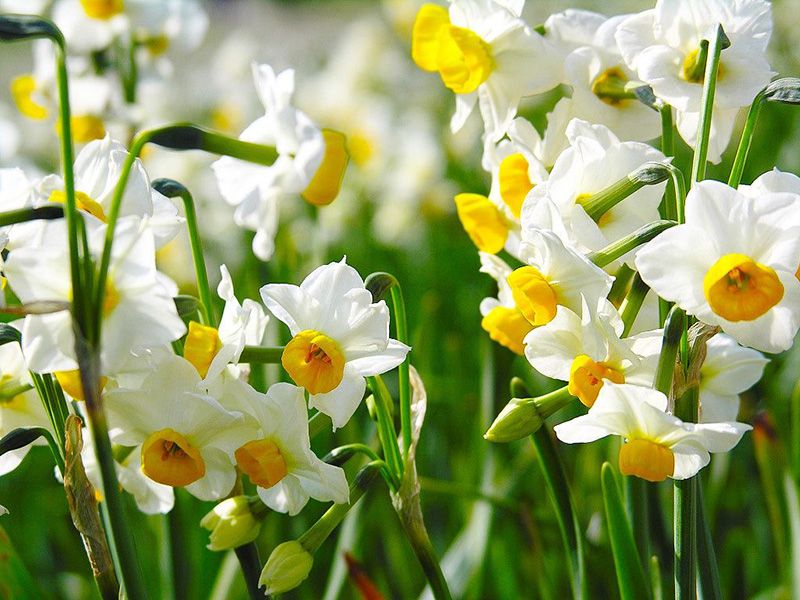
Planting bulbs The planting process begins in September; this should definitely not be done in the spring. They are planted in open ground, spaced 15 cm apart. Loamy soil is ideal for the plants because they love moisture.
Lilies
From mid-September to November you can start planting lilies, if the air temperature does not exceed 10°C. A well-lit location should be selected in advance, and holes with drainage should be prepared. They should be spaced at least 15 cm apart. To prevent rotting, it is recommended to cover the plantings with oak leaves.
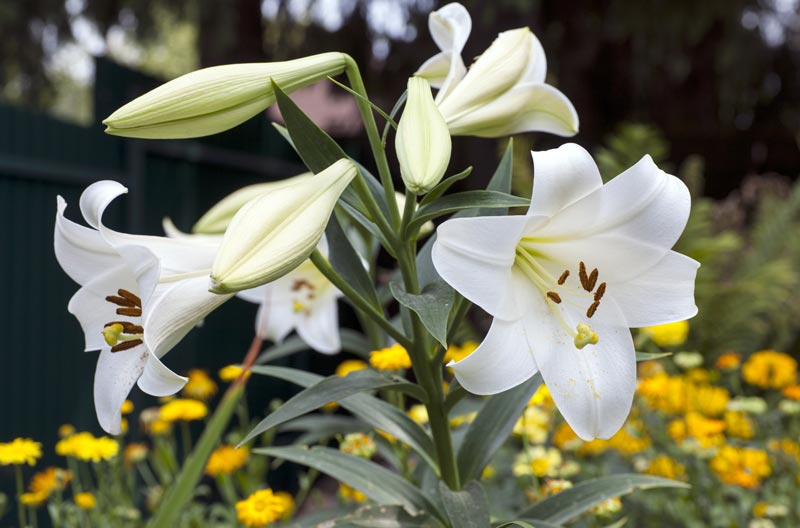
Lilies bloom profusely only in fertile, loose soil, and petal color can vary depending on the variety. Only fresh bulbs, grown indoors from flowers already growing in the garden, are suitable for autumn planting. Store-bought lilies can only be planted in the spring.
Choose yours variety of lily.
Colchicum
Colchicum It grows well in the central part of the country and has a large number of varieties. Gardeners use about 20 varieties for flowerbeds, which begin blooming in the fall.
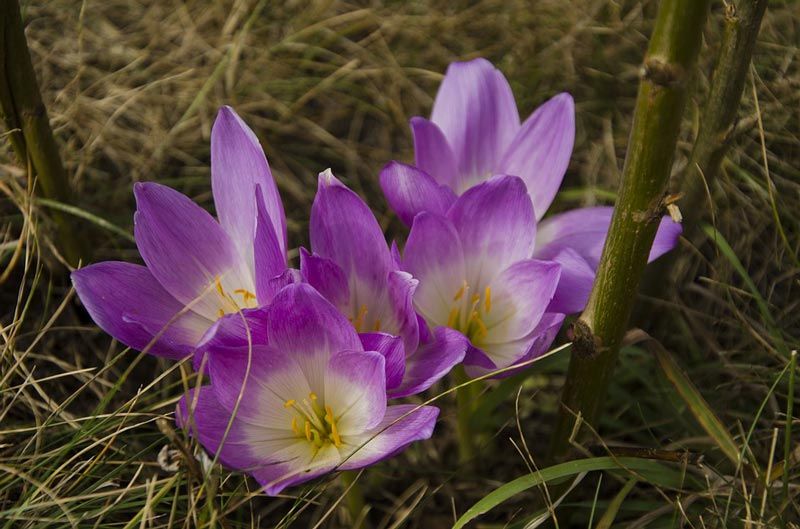
The bulbs are planted in the ground in the first half of September or at the end of August, depending on the weather. They should not be planted more than 10 cm deep. The plant is poisonous and can harm not only insects but also pets and even humans. Therefore, it is not very popular among gardeners.
Iridodictyums or irises
Irises are best planted in the fall, in the second half of September. Don't plant them any earlier to prevent them from starting to grow in the winter. As soon as the snow melts, iris begins to sprout, and after just a couple of weeks the first buds with a divine aroma bloom.
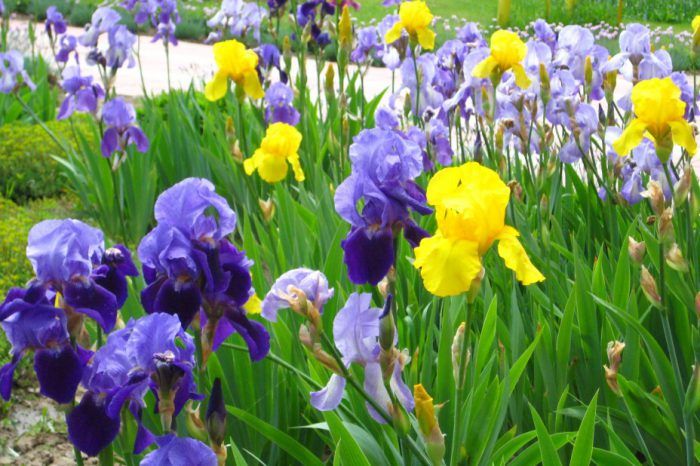
They finish blooming in early summer. The bulbs produce many offspring, which divide easily. Flower color depends on the variety and can range from lilac, blue, speckled yellow, to reddish-purple.
Muscari
This flower has many common names, such as "viper's onion" and "mouse hyacinth." The plant is very easy to grow and thrives in both shade and sun. The only thing it might not tolerate is stagnant water around the roots.
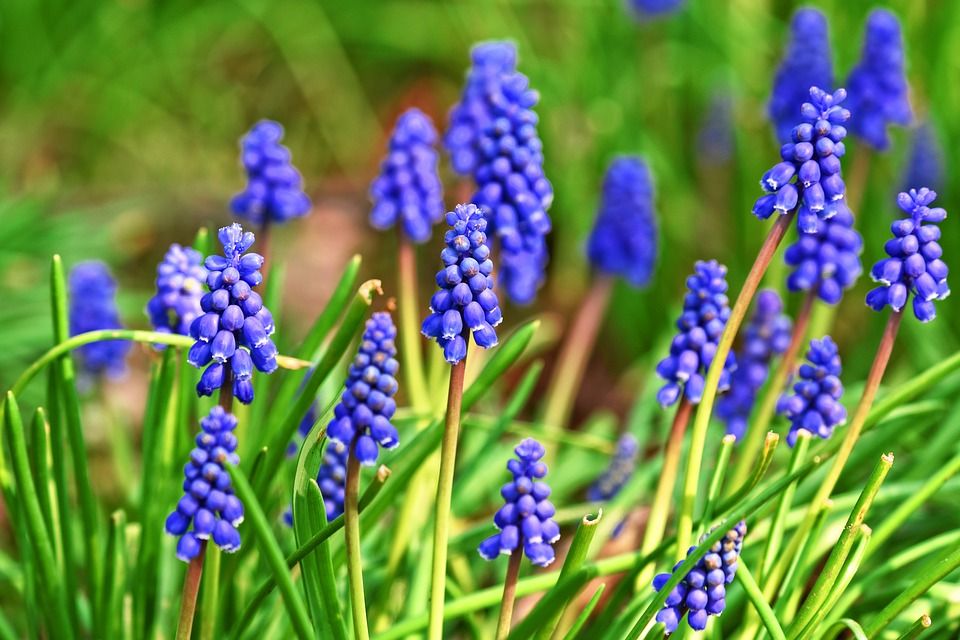
Planting muscari Recommended from the second half of September to early October. Blooming begins in early May, and under favorable conditions, in April. If the spring is cold, the first buds may not appear until early summer.
Pushkinia
Another name is "dwarf hyacinth." It has very delicate flowers with fragile, bluish petals. The first shoots emerge from the ground as early as March, if the snow cover has almost melted by then. Buds begin to form very early, and flowering is complete by May.
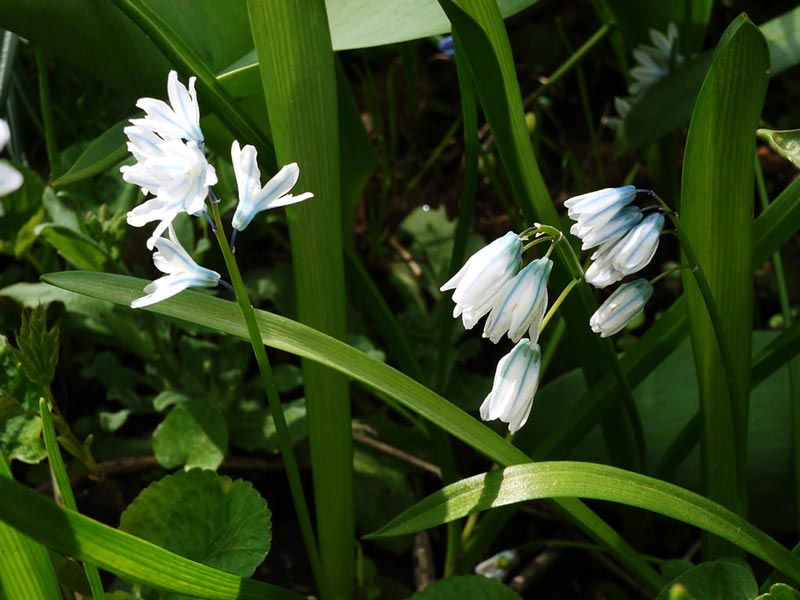
Pushkinia It prefers sunny locations, but only if other plants, not yet emerged, are able to disturb it in early spring, allowing it to gain strength and develop vigorously. It should be planted in loose soil—it doesn't tolerate stagnant water. Before planting, the bed should be prepared by adding ash, humus, manure, and mineral fertilizer. The bulbs themselves can be planted as early as late September. There's no need to plant them deep; just cover them with soil.
Chionodoxa
There are only six species of these low-growing perennials. The plant's popular name is "snow beauty." It was given this name for its very early flowering, which occurs almost simultaneously with snowdrops. hiondoksy To grow well, you should choose sunny, elevated places for them, since the snow melts there first.
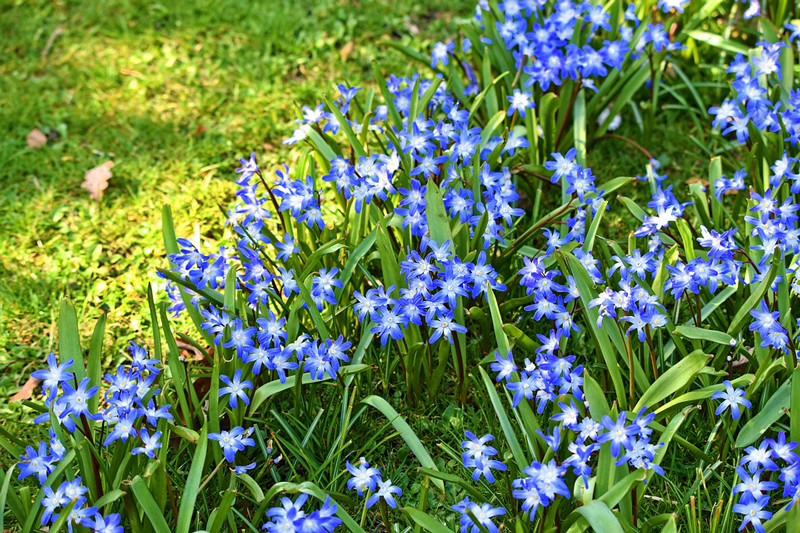
Planting takes place in early autumn, when the bulbs have formed root balls. The larger the bulb, the more soil can be added. Space the bulbs 10 cm apart. The soil should be loose, nutritious, slightly acidic, and well-moistened. It is recommended to add humus and shredded tree bark to the bed.
Grouse
As a rule, hazel grouse They are planted in early September. Autumn planting is recommended, as if planted in the spring, the flowers will miss an entire year of flowering and will only delight you the following season.
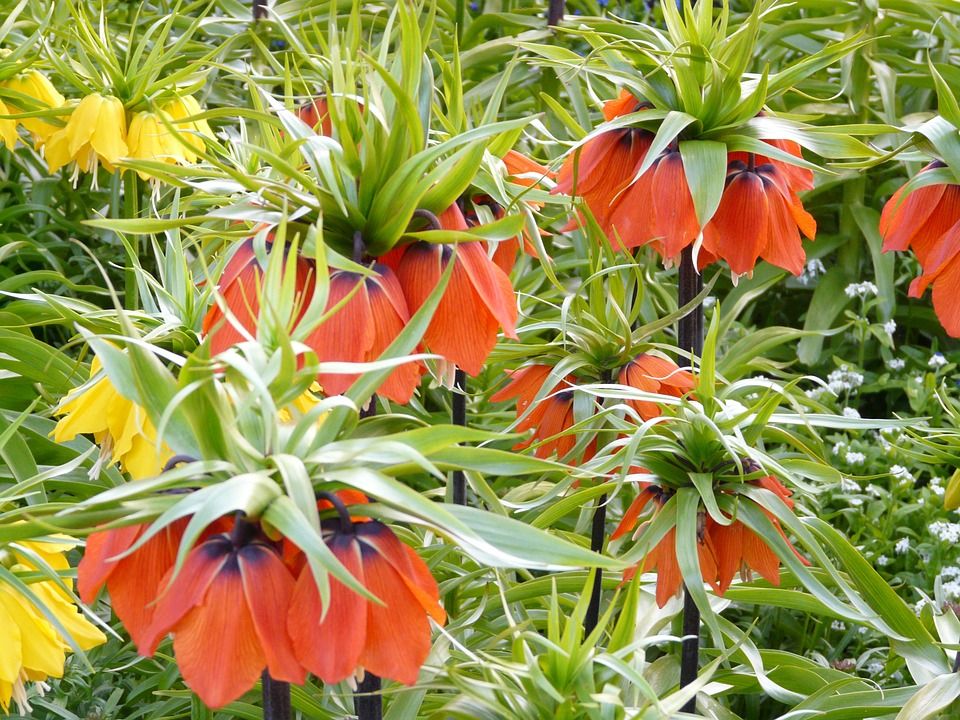
Hazel grouse They prefer to grow in a sunny or partially shaded location. The soil should be fertile and well-drained.
The flower bulbs should be soaked in a fairly strong solution of potassium permanganate for an hour before drying in the shade. Be very careful when handling them, as the scales are delicate and can be easily damaged.
Planting is carried out as follows:
- You need to dig a hole 30 cm deep.
- Pour a 7 cm layer of coarse sand there for drainage.
- Add soil mixed with superphosphate and compost on top of the sand.
- Place the bulbs on their sides, carefully spreading out the roots. Arrange them in a circle or rows, spaced 10-15 cm apart.
- Sprinkle sand and remaining soil on top.
Top.tomathouse.com reminds you: the peculiarities of autumn flower planting
Our portal http://top.tomathouse.com has collected several general tips on planting different flowers in the fall before winter.
Once gardening is complete, a lot of space is freed up, so it's time to plan the future flowerbed, taking crop rotation into account. In central Russia, soil preparation can begin in late September or October; in the Urals and Siberia, it's done a few weeks earlier, taking into account the forecasted weather conditions. In the south, work can begin as early as November.
If soil preparation is carried out exclusively in warm weather, the seeds are planted when the temperature drops. They will begin to grow in the sun and warmth, but in this condition they will certainly not survive the winter frosts.
Once the prepared furrows are lightly frosted, you can sow the seeds. Sow them thickly, as not all plants will survive the frost. Cover them with a layer of prepared soil. No watering is required.
Don't forget to plant bulbous plants in late summer - early autumn (depending on the weather) so that you can enjoy their lush flowering in early spring.
Planting by division in autumn, the best flowers
Perennials can be propagated in the fall by division, saving the expense of purchasing new plants. Divisions planted in September and October survive the winter well and grow vigorously in the spring.
Hosts
Hostas are ideal for shady areas of the garden. They are easy to propagate by dividing the plant, which should be dug up and carefully divided into several parts. The new plant adapts quickly to its new location and, within a couple of years, will look as good as its parent. planting hosts It's important to leave the roots freely spaced, and the soil should be mixed with peat. Hostas thrive in moisture, so newly planted plants should be thoroughly watered.
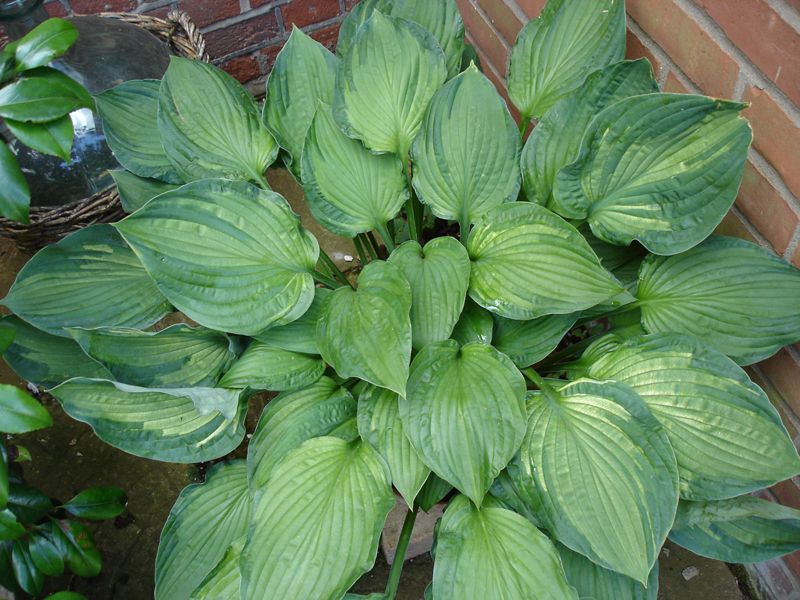
More about different types of hosts on the website Top.tomathouse.com.
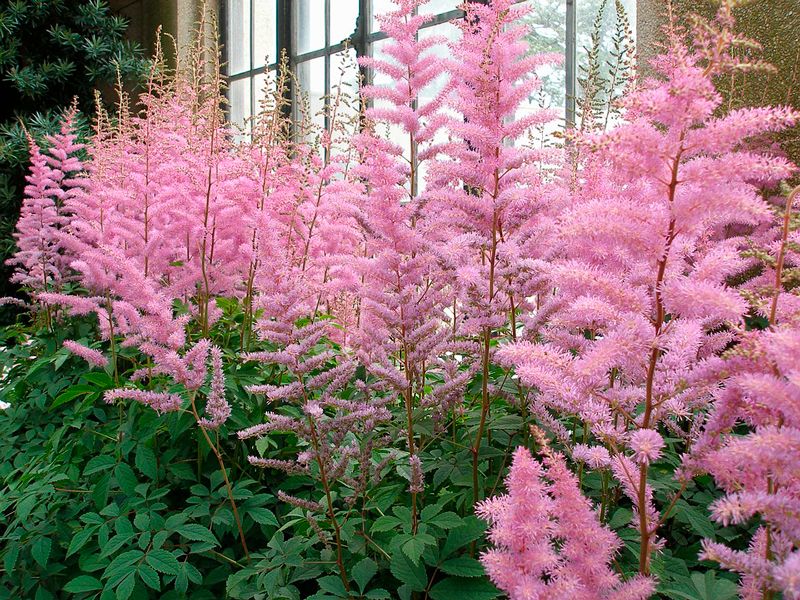
Astilbes
Astilbes are planted in early fall, preferably in September to reduce the risk of frost. If the bush is already mature, there's no need to remove the leaves. However, if you're working with divisions, it's best to trim off the leaf blades. astilbe To survive the winter better after transplantation, the root base must be insulated with compost and litter.
Phloxes
Phloxes easily survive autumn replanting until the first frost. The main thing is to prune the plant. They are fairly easy to divide, and they are likely to bloom profusely in the new season.
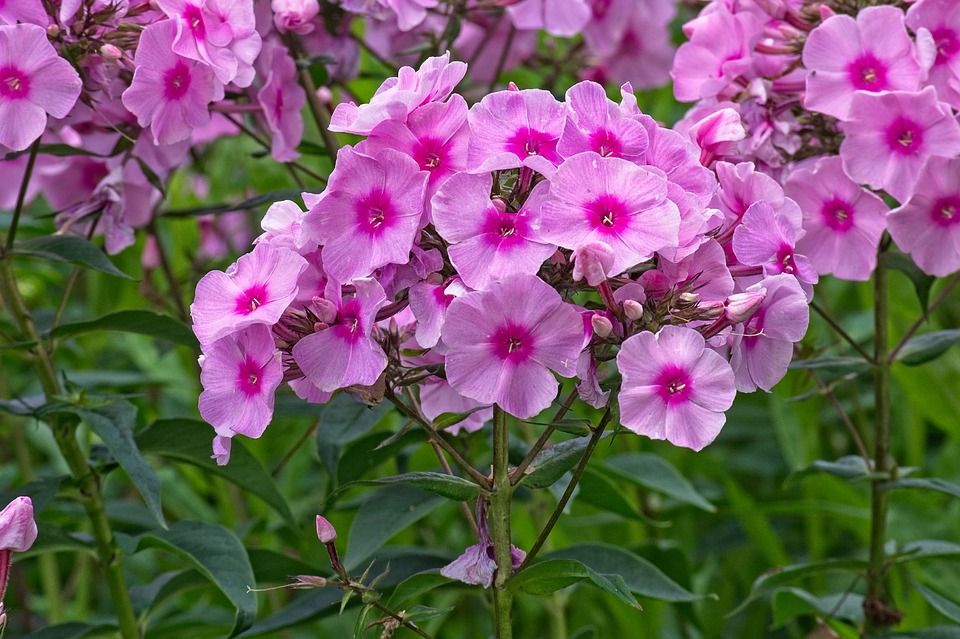
Read more about phlox in the articlePhlox: Planting and care, varieties with photos and names , as well as how to grow them from seeds, and what to do when they appear powdery mildew on phlox.
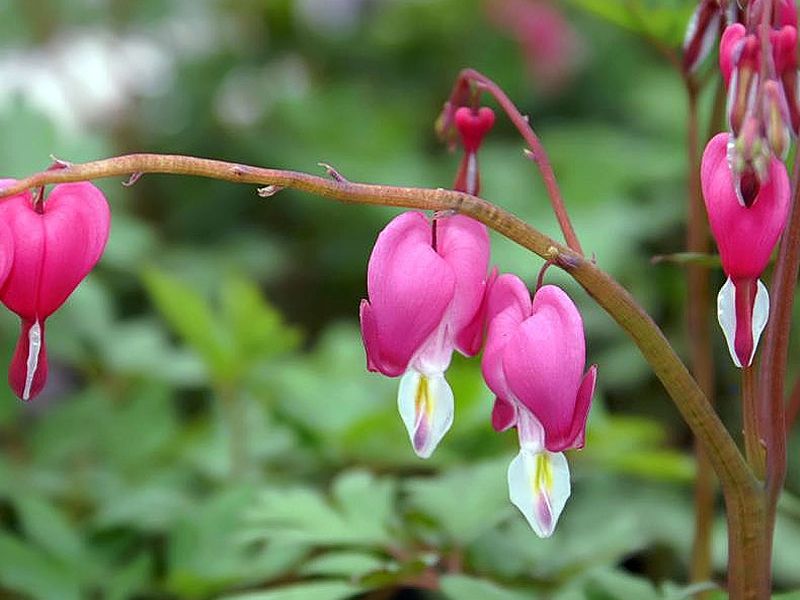
Dicentra
They can also be planted before the first serious cold weather. Before dividing the bush, it is essential to prune it. They grow well. dicentra They thrive in shaded areas of the garden, but do not tolerate planting in dense clay soil. In this case, be sure to add sand to the flowerbed and dust the root cuttings with crushed charcoal to prevent rot.