Crocuses are perennial flowers that grow in virtually all climates. Large bulbs produce a cluster of delicate, bright green leaves and a single, thick stem. Petal color ranges from pure white to deep purple and burgundy. There are two types of crocuses: spring and fall.
Primroses are less demanding and delight the eye as soon as the snow melts. Late-blooming varieties are more demanding in terms of moisture, soil temperature, and fertilizing. Planting and caring for them require specific knowledge and skills. Before introducing crocuses to your garden or property, it's best to thoroughly familiarize yourself with the characteristics of the various subspecies, the intricacies of growing them, and the optimal planting time.
Content
Types and varieties
Not all crocuses bloom in early spring. Some species bloom when the trees have already shed their leaves, and most large herbaceous plants have already faded and withered. A combination of both species can be combined in a single garden. Then, the delicate sepals will welcome the long-awaited spring and then bid farewell to summer.
The most popular varieties among flower growers are listed in the table.
| Flowering time | Name of crocus | Description |
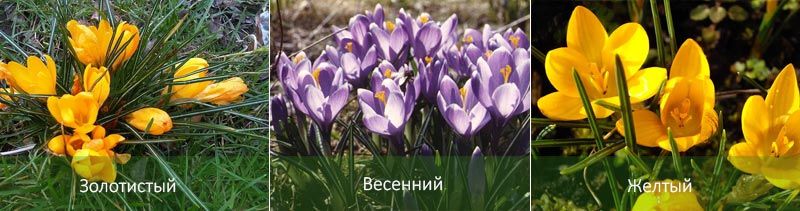
| Spring | Spring | This delicate lilac flower, sometimes with dark veins, is often found wild in the Alps. The most popular subspecies are Nigro Boy, Flower Record, Klaus, and Pickwick. |
| Double-flowered (Scottish) | The colors range from white to blue with dark brown veins. Florists prefer the hybrids Alexandri, Parkinsonii, Dorothy, Albus, and Fairy. | |
| Korolkova | Bright orange petals with red veins distinguish this Central Asian subspecies. Hybrid breeding was actively pursued in the Soviet Union, hence the names: Glory of Samarkand, Kiss of Spring, and Tiger. | |
| Crimean | The petals are pale on the outside, bright white with a yellow center on the inside. | |
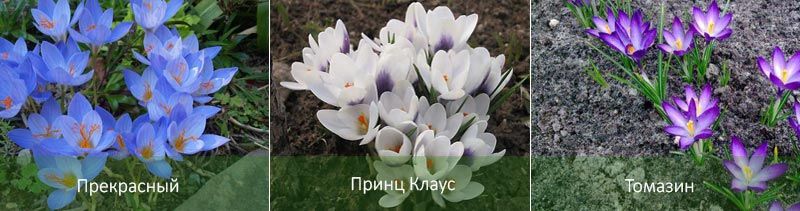
| Zibera | Heat-loving and demanding, these tricolor flowers have an orange center. Breeders distinguish the following varieties: Bowlesis White, Atticus, Tricolor, and Prince. | |
| Adam | Imported from the foothills of the Caucasus, Dagestan, and Iran, it comes in a wide variety of colors. | |
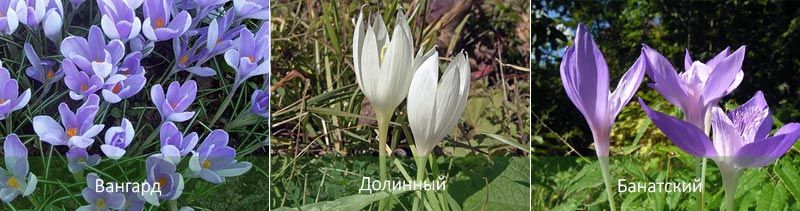
| Tomasini | A wild subspecies, native to Hungary and the lowlands of Yugoslavia. The petals are lilac-pink, and when opened, they take on a star-like appearance. A single bulb can produce up to six flower stalks. The most popular hybrids are Lilac Beauty, Whitewell Purple, and Giant. | |
| Golden | In the wild, these are small, barely developed, thin leaves that barely frame a large yellow inflorescence. It is widespread in Asia and the Balkans. Breeders have developed several hybrids with stunningly beautiful calyx colors: Blue Pearl, Princess Beatrix, Blue Bonnet, Cream Beauty, Marietta, Violet Queen, Schwanenburg Bronze, Bowles, Nanette, and Lady Killer. | |
| Dutch large-flowered | These are true giants of the primrose world. Their vibrant, candy-colored blooms range from lemon yellow to fluorescent purple. Dozens of subspecies of these spring flowers have been bred. The most popular are: Albion, Vanguard, Jubilee, Sniper Banner, Zonatus, and Kathleen Parlow. | |
| Yellow | The flowers are rich orange in color, the leaves are small, and the top of the bulb rises high above the ground. | |
| Autumn | Beautiful | It features long leaves up to 30 centimeters long. The coloring ranges from white to dark blue. Favorite hybrids among gardeners are called Albus and Artabir. |
| Pretty | A frost-resistant subspecies with delicate, large white sepals with dark veins along the outer side of the petals. | |
| Banat | A dark purple variety with sharp, silvery-green leaves. | |
| Pale ocher | Neat, delicate inflorescences, densely located close to the bulb. | |
| Naked-flowered | Rarely beautiful varieties with purple inflorescences. | |
| Longiflorum | A late variety that blooms in late autumn. With a long peduncle, the leaves are small, closely pressed to the bulb. | |
| Smoothed | One of the latest flowering varieties, it opens its petals in early November. | |
| Saffron | One of the most expensive, beautiful, and noble species. Prized for its delicate scent and stamens, which are considered an exotic spice. |
Planting in open ground in autumn
Crocuses are most often planted in prepared open soil in the fall. However, they can also be planted in spring and summer. Depending on the season and flowering time of the variety, it's important to follow the rules for preparing the bulbs and caring for them after rooting.
Selection of seed material
Half the success of growing crocuses is choosing and preparing the right planting material. It's best to purchase bulbs from reputable suppliers, such as large garden centers or nurseries.
Unscrupulous traders at markets and fairs sometimes offer wild small varieties instead of large-flowered hybrids, and autumn-flowering ones instead of primroses.
Visual inspection of the seedlings should reveal no signs of damage, rot, ulcers, or cuts. The bulbs should feel firm to the touch. Large, mature specimens will bloom most beautifully in the first year.
Before planting, the bulbs should be treated with potassium permanganate or liquid fungicides. This will protect the seedlings and fine roots from mold and fungal infections. Simply soak the bulbs in the solution for 15 minutes to half an hour. There is no need to rinse.
Autumn planting dates by region and according to the 2023 Lunar calendar
Planting in flowerbeds is done in the fall, a month before the first frost. Depending on the climate zone, September and October are considered optimal, but for Siberia, late August is best.
Florists recommend following the lunar calendar. In 2023, we'll be choosing the right dates.
| Month | Favorable days | Unfavorable, prohibited days |
| August | 7 (from 09:24)-14 (until 13:35), 19 (from 14:53)-21 | 1,2, 15 (from 12:38 p.m.), 16, 17 (up to 12:38 p.m.), 30,31 |
| September | 1 (until 16:25), 3 (from 18:00)-5 (until 23:05), 8 (from 07:59)-10 (until 19:35), 13, 16-20 (until 17:06), 22 (from 23:00) 21m.)—24 | 1 (from 16:25)-3 (until 18:00), 14, 15,25-26,28, 29,30 |
| October | 1-13 (until 20:55), 16, 20-22 (until 09:06), 30 (until 18:07). | 14,15,28,29 |
Location
Crocuses are most often planted in a sunny, dry location. A flowerbed under small trees is also suitable for spring varieties. This is because their active growing season occurs during the months when the trees don't yet have leaves.
It's important to avoid buildings or decorative structures creating additional shade. Without sufficient sunlight, the buds won't open.
Although these delicate flowers are resilient to cold and snow, they don't tolerate strong winds and drafts. It's best to plant them in quiet, central areas of the garden.
Soil preparation
Crocuses prefer loose, well-drained soil. The flowerbed for these flowers should be thoroughly dug over, adding peat, rotted vegetable compost, and river sand. It's important to keep the pH level within the acidic range. Crocuses die in acidic soil. It's a good idea to add ash to such soils.
Nitrogen fertilizers are not used for feeding crocuses, but potassium and phosphorus are quite appropriate.
Avoid overwatering and waterlogging. Bulbs in soggy soil will rot and become diseased.
After five years, the overgrown bulbs and their offshoots will fill the flowerbed with an even, blooming carpet. If the plants are densely packed, they will need to be replanted. A sure sign that the crocuses need thinning is a reduction in the size of the flower's calyx.

Planting diagram
When planting in open ground, the bulbs are spaced fairly closely. A distance of 3-5 centimeters is sufficient to ensure that the plants do not interfere with each other and produce offspring.
The depth to which the seed is planted depends on its size. Large corms are planted to a depth of 10-15 cm, while smaller corms are planted to a depth of 5-7 cm. On average, the soil depth above the crown should not exceed 2-3 times the length of the corm.
After planting, the area is watered generously. Then, the flowerbed is mulched with sawdust, bark, or dry leaves to prevent the plants from freezing.
In the middle zone, the height of the covering layer should be at least 15 centimeters.
In areas frequented by rodents, it's a good idea to plant crocuses in baskets. Fill the bottom of the basket with drainage material, then add loose soil, and plant the bulbs. They are dug into the holes so that the edges don't rise above the surface of the flowerbed.
Reproduction
Crocuses can be propagated by seed. To do this, the seed pods are carefully cut and dried. This only applies to primroses. Late autumn hybrids do not have time to ripen in temperate climates.
The seeds are stored until February. In the last month of winter, they are planted in pots with loose soil. The seedlings are transferred to open ground in May, after the ground has been frost-free. The new plants will bloom in five years.
Due to the delicate young plants' demands on environmental conditions and care, it is more practical to propagate them vegetatively, using daughter bulbs.
Planting in open ground in spring
In the spring, planting of crocuses that will bloom in the fall, such as saffron (see above), begins.
Spring planting dates by region and according to the 2024 Lunar calendar
For spring planting, wait until the snow has melted and the soil has warmed and dried. The best months are late March and early April, but for northern regions, it's May.
| Month | Favorable days | Unfavorable, prohibited days |
| March | ||
| April | ||
| May |
Spring planting instructions
The bed is prepared before the first frost, with the soil dug thoroughly, fertilized, and drained. In the spring, it's sufficient to thoroughly loosen the soil before rooting the bulbs.
They are planted according to the same pattern: densely clustered, at a depth equal to three times their length. If all conditions are met, the plants will bloom in the year of planting.
Flowers are also planted in the spring months after being forced indoors. Crocus bulbs in a potted plant, planted in January-February, will delight you with delicate blooms for the International Women's Day holiday. This makes a touching and beautiful gift.
In late April or early May, when there's been no frost on the ground, the plant can be transplanted outdoors. There, it will complete its growing cycle and bloom again the following year, in early spring.
Top.tomathouse.com recommends: useful tips for growing crocuses
Experienced gardeners know how to ensure vibrant, large crocus blooms last for years. To ensure the plants thrive, it's important to:
- Fertilize twice a year. In early spring, as soon as the soil becomes exposed, water the flowerbed with a urea or ammonium nitrate solution. Apply a complex potassium-phosphorus fertilizer immediately before or after flowering. Providing additional minerals and microelements is also necessary because after the mother bulb undergoes extensive division, the crocus may not have enough energy to bloom. This is especially true for hybrids that bloom in the fall.
- During the active flowering period, trim off faded buds. New ones will form in their place, meaning the plant will grow longer.
- Carefully inspect the leaves and flowers. The appearance of dark spots and a sticky coating may indicate a thrips infestation. If this occurs, destroy the affected plant and water the soil with a hot solution of potassium permanganate.
- Replanting and cultivating the bulbs should only be done after the leaves have withered and fallen, and the plant has entered a dormant state. Then, dig up the bulbs, dry them, sort them, and treat them for pathogens. They can be replanted in the fall.
- Loosen and weed the flowerbed, while trying not to damage the delicate underground part.
- Water the flowerbed during dry summer months, even after flowering has finished. Avoid overwatering.
To create a colorful carpet of crocuses, flower lovers plant mixes of various hybrids. The calyxes, stems, and leaves of varying sizes create a multi-layered, eye-catching display.