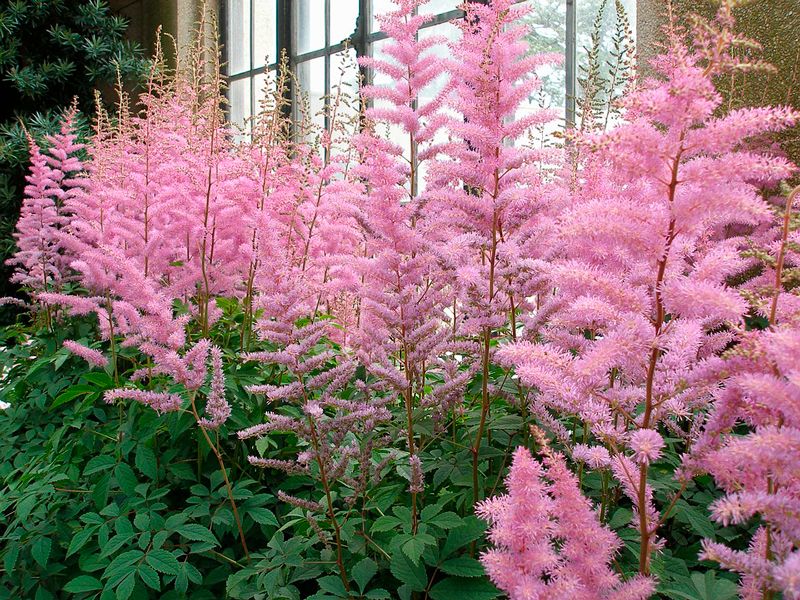
Astilbe is a perennial plant in the Saxifrage family. The species' distinctive feature, the lack of shine in its leaves, is the source of its name.
It has both a declinable form - "astilba", and an indeclinable form - "astilbe" of feminine or neuter gender, depending on the source.
Content
Description of the culture
Native to Japan, Astilbe produces paniculate inflorescences in a variety of shades. Its bush is formed by large, dark green leaves. It grows up to 2 meters tall and has approximately 400 cultivars and 40 species. It produces a seed capsule. It blooms in the summer months, and in cold weather, the surface part dies off, while the root survives the winter. Specimens can have both hard and soft roots. They have a central rhizome from which numerous offshoots emerge. Over time, the lower ones die off, while new ones emerge from the top.
Types of Astilbe
There are 12 widespread species of herbaceous plants, from which about 200 varieties have been bred.
| Group | Description | Varieties, inflorescences |
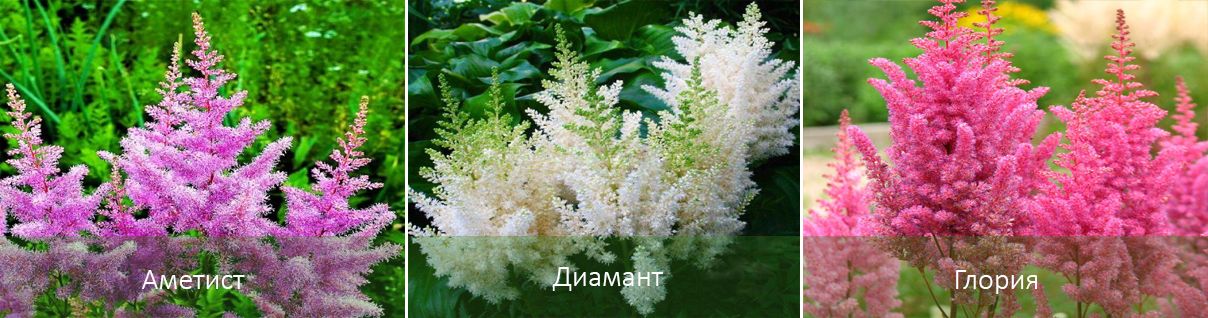
| Arends | It is distinguished by strong, tall bushes, reminiscent of a sphere or pyramid in their geometry. Shades range from white to red. It blooms longer than other groups (30–40 days). |
|
| Chinese | Growing just over a meter tall, it stands out among other plants for its small stem leaves. It is renowned for its dense inflorescences, reaching 30 cm in length. Dwarf varieties with cone-shaped inflorescences are also available. It requires full sun. |
|
| Japanese | A small plant (up to 80 cm), it blooms earlier than other species. It is undemanding and easily established. It exhibits sufficient winter hardiness for temperate climates. |
|
| Simple-leaved | It requires a humid climate and moderate temperatures, and the inflorescences add an airy appearance to small plants (up to 50 cm). |
|
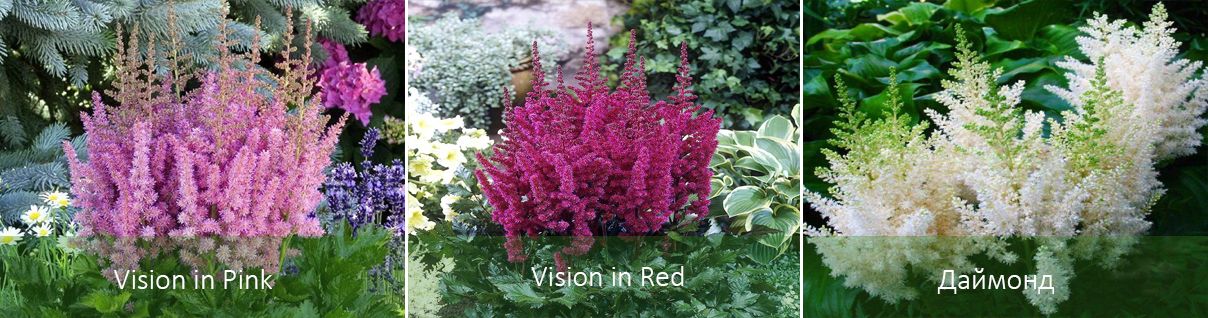
Planting methods and care
Gardeners' needs vary, and so do planting methods. For example, sowing by seed involves many nuances but allows for the development of new varieties, while other options are simple and guarantee rapid growth but require propagation only. However, in any case, the plant is not particularly fussy, and only a few key points will significantly impact its subsequent growth.
Propagation by division of the rhizome
This is the most effective method of propagation and is used more often than others:
- The bush is removed from the soil by pulling it out, capturing a 15–20 cm area in a circle.
- Then they are pulled out and shaken until the roots are significantly exposed.
- After which, the cutting is cut out with a piece of the root so that it has at least 4 buds.
- The dried rhizome is removed.
- Maintain a distance of 30 cm between planted perennials.
In just six months the plant will bloom.
Planting by seeds
This method is suitable for developing new varieties and allows for the cultivation of established ones. Sowing begins in early March with the preparation of a special soil substrate. To do this, mix equal parts peat and sand and place them in a deep container. Cover the mixture with a small amount of snow, and scatter the prepared seeds over the surface. As the snow melts, the soil becomes moist, enriching it with micronutrients, and the seeds will naturally sink into the soil.
Once the snow has completely melted, wrap the container in a plastic bag and refrigerate it for several weeks. Do not remove the seeds until the seedlings emerge. Then, place the seedlings in a warm (18–22°C), well-lit area until three leaves appear, then transplant them separately. Water with a syringe at the roots. Otherwise, there is a risk of damage.
Reproduction by buds
This method yields the fastest results. Begin the procedure no later than April, when new shoots appear. Cut off the buds, including a small amount of rhizome, and then disinfect the cut with charcoal. Next, mix peat moss with gravel in a 3:1 ratio. To create a greenhouse effect, cover the container with plastic. Planting in open ground is not done until September, as the astilbe must first gain strength.
Landing rules
The optimal planting period is late spring to early summer. Avoid planting the plant on a south-facing site; instead, choose a shaded location. Otherwise, the variety will adapt to full sun but will stop blooming sooner. A nearby pond is a plus. Loamy soil with a high water table is suitable. Another important factor is soil acidity, which directly affects fertility. A pH of 7 is considered neutral; anything above is alkaline, and closer to 5 is acidic. A slightly acidic pH (5.5-6.5 pH) is recommended for the plant. Site preparation involves digging and fertilizing. The site is thoroughly weeded, and then the soil is fertilized with manure. Two buckets per square meter is sufficient. Planting holes are dug up to 30 cm deep, each filled with a little wood ash and mineral fertilizer. Before planting, cover the hole with a thin layer of soil to prevent root burn. Water the holes generously. After planting, cover the soil with peat.
Post-planting care
Over time, the rhizome dies from below, growing upward. As a result, the plant is deprived of root nutrition. This is why gardeners approach the hilling process with particular care, while also monitoring the frequency of watering.
Watering
When inflorescences are forming or dry days begin, it is necessary to water abundantly twice a day.
Proper care in open ground guarantees a long lifespan of the plant (approximately 20 years), even without replanting. However, repotting is recommended every 5-7 years.
Fertilizer
In spring apply:
- Saltpeter;
- Urea;
- Manure;
- Litter.
In summer, flowering plants are fed with potassium fertilizers. In the fall, after flowering, phosphorus fertilizers are applied (20 g of superphosphate per plant). Before using purchased fertilizers, it is strongly recommended to read the instructions, as the composition and concentrations vary among manufacturers.
Preparing for winter
To ensure successful overwintering of astilbe, its shoots are pruned back to ground level. The area is covered with a light layer of mulch. This procedure is essential for newly planted bushes, which require dividing the rhizome. The plant is rejuvenated by division, but the root may harden later, making this virtually impossible.
Diseases and pests
In temperate climates, there are relatively few insect species (only three) capable of harming the plant. The remaining pest populations are common in astilbe's native habitat. To prevent these unwanted guests, weed out the plants promptly and avoid dense plantings. If pests cannot be avoided, take immediate measures to eliminate them.
The spittlebug lays its larvae in the leaf axils, where foamy balls soon form. This causes the leaves to wrinkle and become spotted, and eventually the plant itself wilts. Both natural and chemical methods are used to control the spittlebug.
The lumps are sprinkled with wood ash, thus destroying the larvae inside, or they resort to such means as karofos or aktara.
The strawberry nematode damages virtually every part of the plant—buds, leaves, and flowers. These parts subsequently become deformed and develop undesirable brown spots, significantly slowing the growth of the plant.
A sign of the presence of root-knot nematodes is growths on the root surface. These growths are where the pest, often small, lives. During the second growing season, the nematode becomes easily visible. It initially slows the growth of the plant, and after a while, leads to its complete death. As a preventative measure, inspect the plant more frequently; if symptoms of the disease appear, destroy the perennial. Weeding should be done regularly, especially during the first growing season. Treatment with Fitoverm is recommended.
Top.tomathouse.com recommends: using astilbe in garden design
The plant can stand alone and draw attention away from the overall view, or complement part of some composition.
Astilbe is often used to decorate trees and shrubs, placing the perennial in their shade. It will look beautiful and natural near an artificial pond in the garden. It thrives alongside green hostas, creating an aesthetically pleasing installation. Its versatile growth habit makes it a popular choice – shorter specimens are pushed forward, while two-meter-tall varieties and species look great in the background. It often serves as a hedge. It is suitable for borders, and is also often planted in a pot or used to decorate a lawn. Some species are suitable for flowerbeds.
Ferns and geraniums complement astilbe well. There are many other plants that coexist beautifully and complement astilbe beautifully.