Aubrieta is an easy-to-grow groundcover plant that forms a living mat. It grows quickly, making it a favorite among gardeners. It grows up to 20 cm tall with small, drooping, elliptical leaves with serrated edges. It blooms until winter.
Aubrieta delights with its buds twice a year—from late spring to mid-July, and again in September. The four-petaled flowers, blue, lilac, snow-white, and purple in color, are about 10 mm in circumference and are sometimes completely hidden by foliage. The dark brown, almost black seeds ripen in the pod. Aubrieta grows wild in the mountains and along riverbanks in southern France, Italy, Asia Minor, and South America.
Content
- 1 Types and varieties of Aubrieta
- 2 Cultural or hybrid aubration
- 3 How to grow Aubrieta from seeds at home
- 4 How to grow aubrieta from seeds outdoors
- 5 Reproduction of Aubrieta
- 6 Caring for aubrieta in the garden
- 7 Diseases and pests of aubrieta
- 8 Top.tomathouse.com recommends: aubrieta in landscape design
Types and varieties of Aubrieta
There are about 12 varieties in total.
| Types and varieties | Characteristic | Leaves | Flowers/Bracts |
| Deltoid (Aubrieta deltoidea) | Resembles a lilac bush and grows up to 15 cm. | Grey-green, deltoid, with two teeth on both edges. | Lilac or purple-blue, 10 mm in diameter. |
| Graceful (Aubrieta gracilis)Kittie Blue. |
Forms a dense carpet of flowers, reaching 10 cm. | Pale green. | Bright blue, 2 cm with a yellow center. |
|
Kolumka Guss. |
Up to 12 cm, stem is thick, curved, bifurcated, covered with hairs. | Long carved. | Up to 4.5 cm in diameter, pale lilac and pink. |
| Croatian | The leaves are completely different in shape from other varieties. | Juicy green, large, maple- or diamond-shaped. | Blue shades with a dark center - purple or lilac. |
Cultural or hybrid aubration
Aubrieta cultorum. It tolerates winter under snow very well. It grows up to 20 cm. This species can be grown in pots for cutting. The leaves are oblong and serrated. The flowers are single, double, and semi-double.

| Variety | Description | Flowers |
| Cascade | Perennial. The leaves are gray-green, and their color remains the same throughout the year. | Red or blue with a yellow eye. |
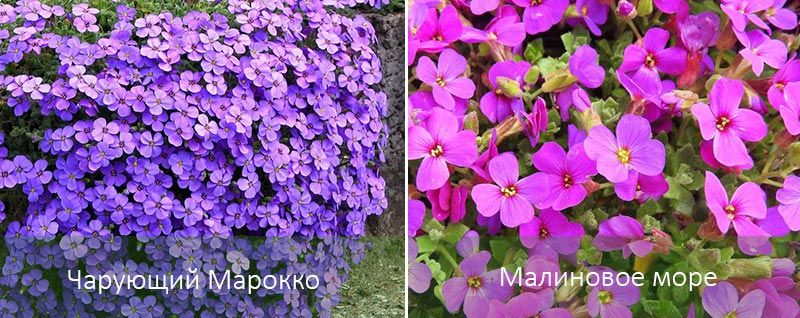
| Enchanting Morocco | A very lush variety. | About 1.5 cm, from blue to red and pink in color. |
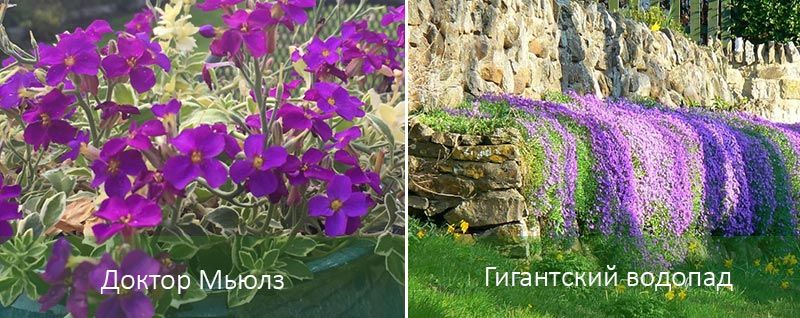
| Dr. Mules | No more than 15 cm in height. | Blue-violet. |
| Borschiz White | Rare variety. | White. |
| Cote d'Azur | It blooms in June-July, and then again in September before the onset of frost. | Sea wave. |
| Giant Waterfall | Winter-hardy variety. Height 15 cm. | Purple, pink, red, lilac shade, up to 1 cm in diameter. |
| The Red King | Up to 10 cm. | Large, up to 5 cm, bright crimson. |
| Raspberry Sea | Blooms profusely for 2 months. | Raspberry. |
How to grow Aubrieta from seeds at home
It is preferable to propagate by seeds, growing seedlings.
Step by step:
- Sow in late winter, preferably in February, in peat-humus pots or peat pellets. There's no need to transplant the seedlings; they're planted directly in open ground at the end of May, when there's no longer any risk of nighttime frost.
- Moisten the soil and place 2-3 seeds, sprinkle with sand, then spray with a spray bottle.
- The crops are covered with a glass jar, cellophane or plastic bottle, and periodically opened for ventilation.
- Leave the plants in a room with an air temperature of +18… +21 °C. As soon as sprouts appear, remove the covering.
- Water carefully so as not to damage the emerging seedlings.
- Before planting in open ground, feed with mineral and organic fertilizers, especially if the plant is not growing very well.
How to grow aubrieta from seeds outdoors
Many gardeners plant seeds directly into open ground in late April or mid-September. First, they dig the soil to a depth of no more than 15 cm, then add ash and mineral fertilizer, after clearing the soil of weeds and small stones.
Choose neutral, acidic soil. Aubrieta dislikes peaty or moist soils.
Place the seeds in a bed, cover with sand or humus, and water gently. It's best to plant them in a sunny spot, as this will result in vibrantly colored flowers and foliage. After 20 days, new shoots will appear, which are thinned out to 7 cm between each seedling.
Reproduction of Aubrieta
Aubrietia can be propagated by cuttings or division of the bush.
Cuttings
After pruning the plant in the spring, you'll be left with numerous cuttings. Choose the strongest ones and plant them in peat-humus pots, covering them with plastic wrap or a jar, and opening them periodically for ventilation.
When the temperature is warm enough, the cover can be removed completely.
By the end of summer, the plant will have strengthened and established itself, its root system will have expanded, and it can be planted outdoors. If winter is expected to be snowless, it's best to overwinter the cuttings in a greenhouse.
Dividing the bush
This method is rarely used for fear of damaging the root system. It's better to propagate by seeds or cuttings.
You need to dig the bush out of the ground and divide it into several parts, trying not to damage the shoots and roots, then plant them in prepared holes at a distance of 10 cm from each other.
Layers
Since the plant forms a creeping, living carpet, the shoots spreading along the ground can be covered with soil or sand, and they will take root. New aubrieta bushes will appear.
Caring for aubrieta in the garden
Plant in late April or early May, when nighttime temperatures don't drop below freezing. In acidic soils in sunny areas, make holes larger than the plant's root system, leaving a distance of up to 10 cm.
If you want to grow a living carpet, you can plant aubrietia closer together or even in different places in the garden.
Only young plants are watered generously, the soil is loosened, and weeds are removed. Established and growing Aubrieta plants are watered sparingly, only during dry summers. Excessive watering promotes foliage growth but inhibits flowering.
Mulching is done by sprinkling the soil with sand about three times per season.
This plant dislikes nitrogen-rich soils and fertilizers, preferring potassium-rich ones (ash), which should be added before flowering and after fall pruning. The latter is done only after spring flowering. The stems are cut back almost to the ground, and not pruned in the fall, so that the aubrieta remains a living carpet through the winter. The next pruning will take place in the spring of next year.
This perennial plant will easily survive a snowy winter, but if it is cold without snow, it is better to cover the aubrietia with spruce branches, sprinkle it with peat or lutrasil.
Diseases and pests of aubrieta
With proper care, Aubrieta is almost never sick.
| Cause/Pest | Signs on leaves and other plant parts | Methods of elimination |
| Overwatering and improper soil. | Dull, lifeless. The root system is rotting. | Stop watering, replant and move to another location. |
| Aphid | A sticky white coating appears, including on the stems. Later, the leaves may have a black coating, and the shoots may appear fuzzy and covered in insects. | Rinse the plant with warm water daily. If aphids aren't detected immediately, it's best to treat them weekly with Fitoverm or Intavir. A soapy solution can also be used. |
| Cruciferous flea beetle | It appears in spring, making holes in the leaves, and the larvae are capable of eating the roots. | Since it doesn't like water, it's important to remove weeds, which are a breeding ground for this pest. Plant garlic, tomatoes, potatoes, calendula, caraway, coriander, marigolds, and nasturtiums nearby; the scent of these plants will repel the insect. Feed with organic fertilizer and saltpeter. |
| Powdery mildew | White coating. | Treat with a fungicide or colloidal sulfur. Destroy in case of severe infestation. |
Top.tomathouse.com recommends: aubrieta in landscape design
It looks beautiful in elevated areas, rock gardens, rockeries, and cracks in walls and stonework, producing a stunning cascade of flowers, especially when combining different varieties.
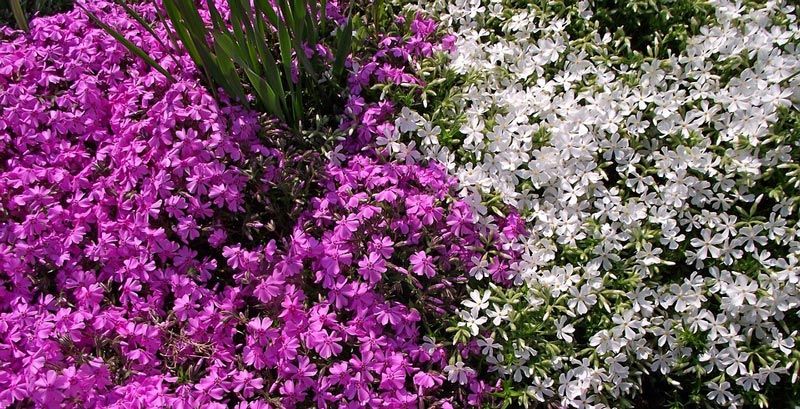
Looks good with phlox, irises, milkweed and others.