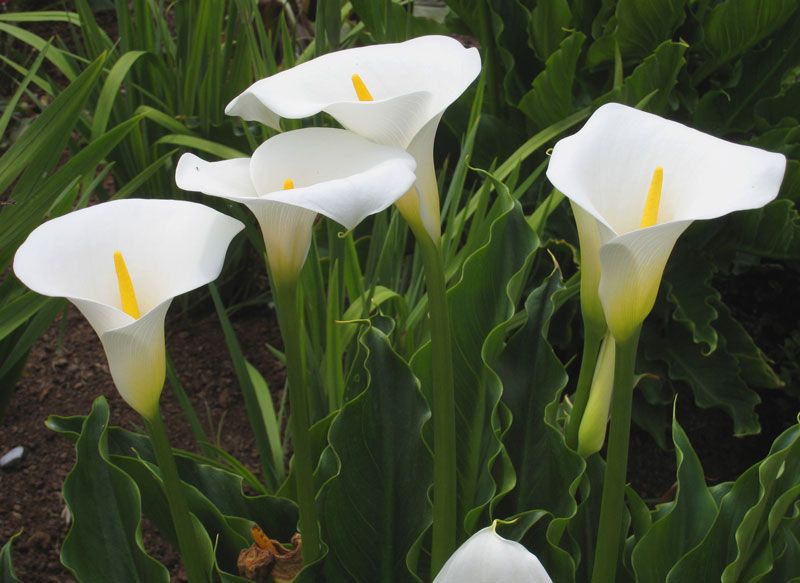
Calla lily (Zantedeschia) is a beautiful plant that grows in gardens and indoors. This flowering perennial belongs to the Araceae family and is native to the tropical regions of South Africa.
Content
Description of calla lily
The plant owes its other name, Zantedeschia, to the Italian botanist of the same name. The plant grows to a height of 30-150 cm. The inconspicuous flowers are borne on a cylindrical spadix.
They have a pleasant vanilla aroma. The spathe surrounds the ear, resembling a flower. As pollination progresses, the color changes from milky white to green.
The flower has a distinctive tubular shape with broad, bright green, arrowhead-shaped leaves. Small, ruby-colored berries ripen on the cob.
Calla lilies, which contain alkaloids and glycosides, are extremely poisonous plants, so planting the crop should be done with protective gloves.
A distinctive feature of the plant is its resistance to fungal diseases. The flowers are not susceptible to pest attacks.
Types of garden calla
The family comprises eight species of rhizomatous and tuberous plants. Three main varieties and a wide variety of selective cultivars are grown in gardens.
| Calla lily species | Description | Growing conditions | Varieties |
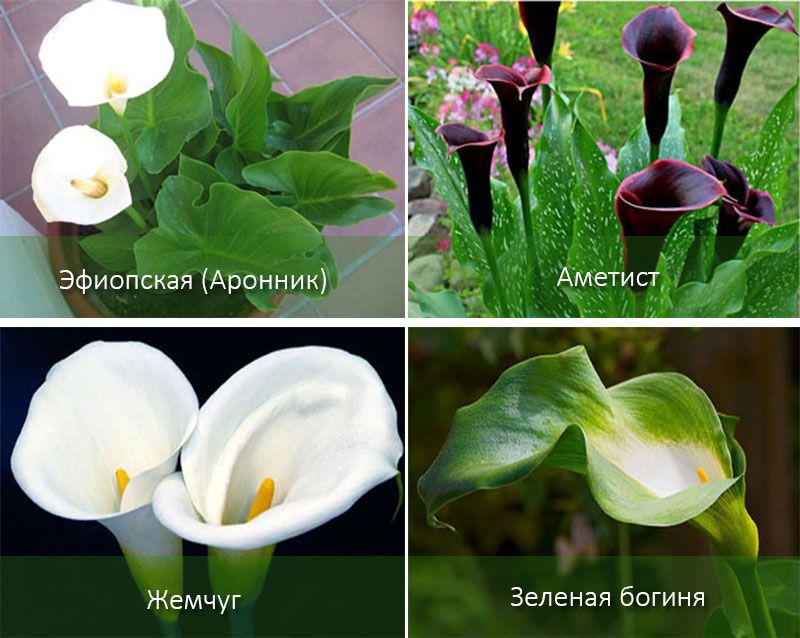
| Ethiopian (Arum) | A tall plant with a snow-white spathe. The underground part is a rhizome. The leaves have a glossy, bright green surface and do not die back during the dormant period. | The active growing season is spring through autumn. The rhizome is dug up in September. Store it, along with the root ball, in a cool, dry place. Water moderately. |
|
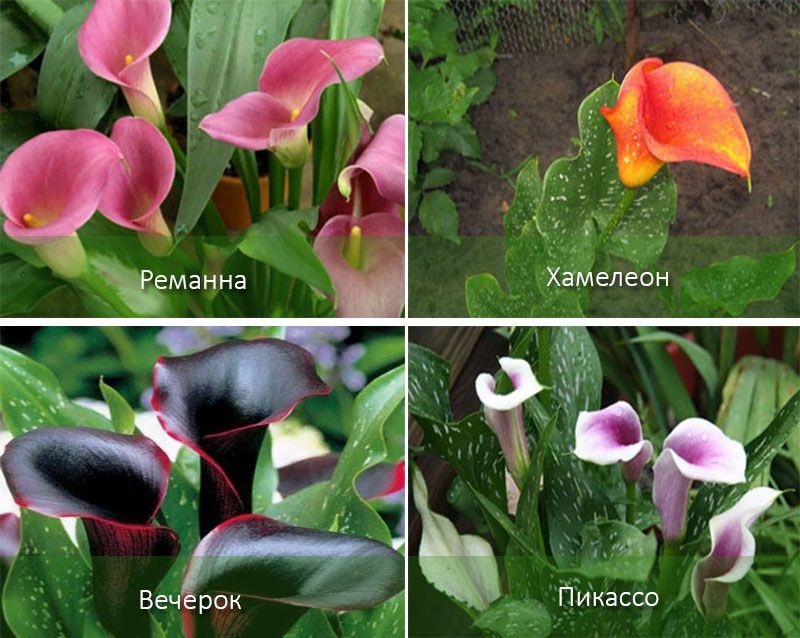
| Remanna | A low-growing flower with narrow leaves. The underground part is a tuber. Flowers come in a variety of colors—pink, lilac, maroon, peach, and purple. | It sheds its leaves in autumn and becomes dormant in winter. Dry sites are preferred for cultivation. |
|
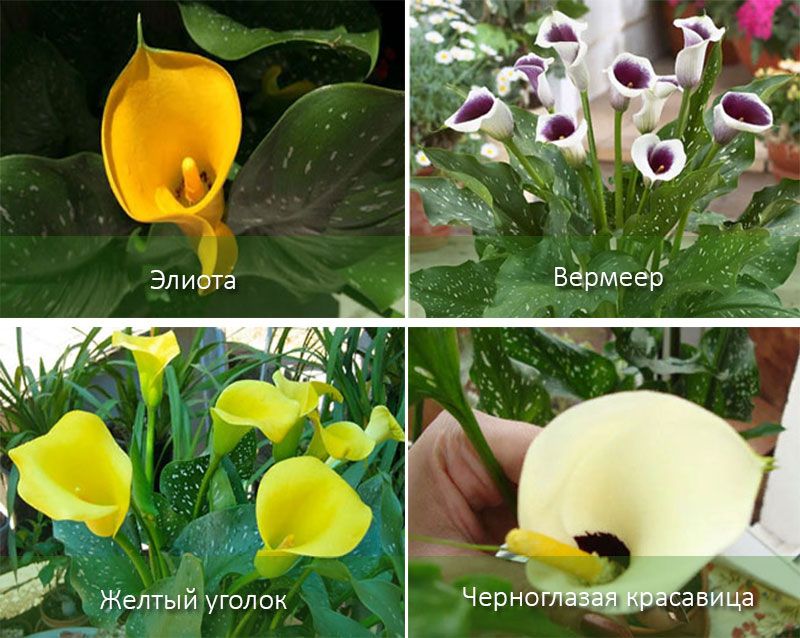
| Eliot | A plant with large, variegated, heart-shaped leaves. It has a slightly wavy spathe: marbled white on the inside, cherry-colored on the outside. Height: 0.5 m. | Prefers slightly acidic, fertile soil. Grow it in full sun. Fertilize weekly. Responds well to organic amendments. |
|
Planting and caring for calla lilies in open ground
To grow calla lilies, select a sunny, spacious spot in the garden. The best option is to plant them near shrubs or large trees. These will provide protection from the scorching sun. Calla lilies do not bloom in the shade.
To obtain a high-quality substrate, mix garden soil, river sand, peat, and humus in equal proportions. A drainage layer is essential. Groundwater levels should be kept too close to the surface.
Selecting planting material
First, you need to select a variety suitable for your growing conditions. The most common are Calla aethiopica and Remanna. While they require minimal care, they offer decorative qualities.
High-quality tubers are large and free of blemishes and dents. When purchasing planting material, carefully inspect each tuber. Quality is guaranteed by specialized flower shops, plant breeding exhibitions, fairs, and nurseries.
The planting material is treated with a fungicide solution for 10-40 minutes. Popular biofungicides include Fitosporin, Gamair, Gliokladin, and Alirin-B.
Landing features
The technology has certain nuances:
- The optimal time for planting in the ground is early May. In some areas, the planting period may be delayed by 7-14 days due to possible frosts.
- On the dug area, holes are made 1 dm deep.
- The tubers are pre-treated with a growth stimulant - potassium nitrate, superphosphate.
- Before planting, seedlings are hardened for 7-10 days.
- A drainage layer is placed at the bottom of the holes - pebbles, expanded clay, broken bricks.
- The distance between adjacent plants is 40 cm.
- When planting, use mineral fertilizer (diammophoska) – 30 g/m2.
- The tubers are placed into the prepared holes.
- The seedlings are covered with soil.
- Water when the first leaves form.
- The holes with seedlings are moistened immediately after planting.
Watering, feeding, fertilizers
After planting the calla lilies in the ground, wait 14 days. Moisten the soil to encourage healthy root development, avoiding direct watering of the tubers. Water again after the first true leaves appear.
The soil is moistened weekly. During drought, the amount of water is increased. After watering, the soil is carefully loosened. Experienced gardeners use earthworms. Watering is adjusted as the soil dries out.
Fertilizing stimulates vigorous foliage growth and the formation of flower stalks. Fertilizer for tuberous plants is applied under each plant 14 days after planting. Monthly, the soil under the calla lilies is watered with a solution of water and acid—acetic, citric, or succinic acid (20 g dissolved in 10 liters of liquid).
Methods for storing tubers
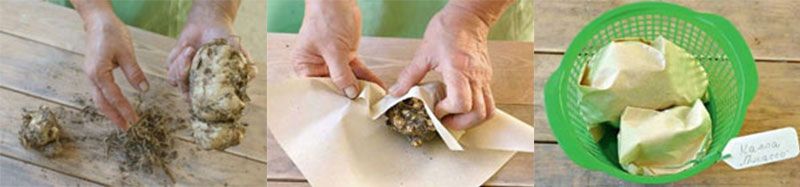
In the fall, calla lilies begin preparing for winter. The tubers are picked from the ground in the third ten days of September, before the onset of frost. They are cleaned of dirt and washed carefully, taking care not to damage the fragile roots. Then they are immersed in a potassium permanganate solution: 5-6 crystals per glass of warm water. The remaining foliage is left on. After half an hour, they are removed and dried in the dark.
Store for two weeks at +5…+15°C. The leaves store nutrients. Trim the thin roots of dried tubers, reserving the roots for spring planting. Disinfect with a solution of potassium permanganate.
They should be stored in paper containers during the winter. At home, they can be kept in the refrigerator and placed in sphagnum moss.
The tubers are checked weekly. When the first buds form, the calla lily is potted and maintained as a houseplant. After the threat of frost has passed, it is placed in the ground.
Propagation of garden calla
Flower cultivation is accessible to every gardener. Here are some methods:
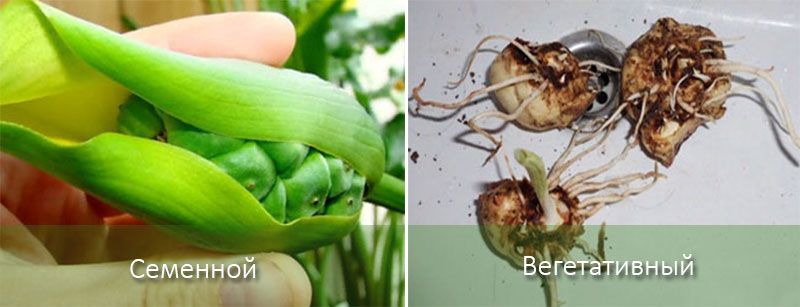
- seminal;
- vegetative – tuber propagation, division of the root, bush.
Seeds
This method of propagation is used to develop new, unusual varieties. A strong, healthy plant is selected as the seed, and the spadix is left. After wilting, the seeds ripen. The inflorescence is cut off and separated into pieces. These pieces contain the seeds. Harvesting is done with extreme care.
The seeds are soaked in Emistim C, a growth stimulator, for six hours. They are germinated for a week in a moistened gauze pad. Then, they are placed in the prepared substrate and kept in a warm place. Once the seedlings have matured, they are planted in the ground. The best time is late May.
Vegetative
Rhizome division is suitable for the Ethiopian calla. This is done in the fall. The plant's crown is separated from the root system. Store in a dark, humid place at 15°C. Healthy roots will form over the winter. At the end of the spring season, the seedlings are ready for planting.
Propagation by tubers is the most accessible method. The growth of healthy planting material is stimulated by special preparations such as Humate, Fumar, and Succinic Acid.
The tubers are placed in containers with high-quality soil. The air temperature is maintained at 25°C. Water as the soil dries. With the arrival of summer, the corms are buried 10 cm deeper into the soil. This method accelerates flowering.
Application in design
As they grow, calla lilies form a lush floral carpet. They are chosen for creating whimsical arrangements. Calla lilies are placed along curbs, border flower beds, and planted near artificial ponds. Tall varieties are used in single arrangements.
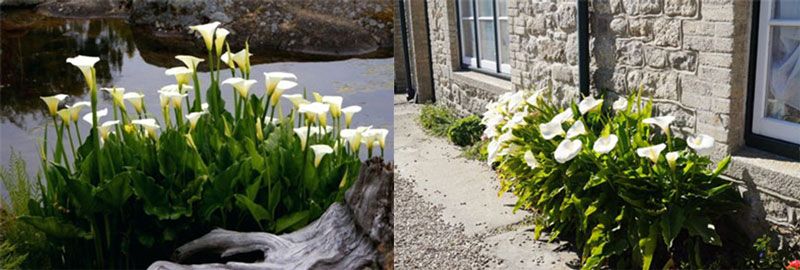
Growing amazing tropical flowers and caring for calla lilies outdoors is a low-cost process. The result will be a vibrant addition to your garden.