The apple tree is a popular fruit tree, delighting with its delicious, nutritious fruit. However, to ensure long-term fruiting, it requires care, which includes not only pruning and protection from diseases and pests, but also fertilizing. Fertilization should be systematic, applying appropriate fertilizers for each season, age, and variety.
Content
The need for additional feeding
Fertilizers are added to the soil for a number of reasons:
- change in soil environment;
- seedling nutrition at the initial stage;
- annual feeding.
Soil for planting
The apple tree prefers light, loose soil with neutral acidity and a low alkaline reaction.
To adjust the composition of the soil, it is necessary:
- To reduce acidity, add wood ash, dolomite flour, chalk, and fertilizers containing lime.
- To reduce the alkaline environment: peat, sawdust.
Fertilizers for young seedlings
When planting a young seedling, fertilizers are also added:
- ash (400 g) or potassium-containing fertilizers (10 g);
- black soil or purchased soils (Aquais, universal biosoil Ecofora);
- superphosphate (20 g);
- soil mixture and humus (equal parts).
Add a complex fertilizer to the top layer of the planting hole, but only when planting the seedling in the spring; do not add any in the fall. Fertilizing should be left until spring: 2 tablespoons of azophoska (scattered around the tree or 30 grams per 10 liters of water and watered in), and possibly decomposed manure.
Annual fertilization
For many years, an apple tree grows in the same spot, drawing all the nutrients from the soil. This depletes the soil. If the loss isn't replenished, the lack of essential elements will lead to reduced yields and affect the tree's health.
For this purpose, a complex of fertilizers is applied every year, and there are specific fertilizers for each age and season of the apple tree's life.
Features of feeding depending on age
Fertilizer concentrations vary depending on whether the tree needs fertilizing: a young sapling or a mature, actively fruiting tree. An apple tree that hasn't reached fruiting (5-8 years old) is considered young. If it's over 10 years old, it's considered mature.
| Age (year) |
Tree trunk circle (m) | Organics (kg) |
Ammonia saltpeter (g) |
Superphosphate (G) |
Sulfate potassium (g) |
| 2 | 2 | 10 | 70 | 200 | 80 |
| 3-4 | 2.5 | 20 | 150 | 250 | 140 |
| 5-6 | 3 | 30 | 210 | 350 | 190 |
| 7-8 | 3.5 | 40 | 280 | 420 | 250 |
| 9-10 | 4.5 | 50 | 500 | 340 |
Methods of fertilizing
Fertilizers are applied using various methods:
- spraying;
- digging;
- hole bookmark.
The method is selected depending on the age of the apple tree, climate conditions, and season.
Important: It's essential to strictly adhere to the recommended dosages. Excessive fertilizer can be just as harmful as too little.
Foliar feeding
This treatment is used to quickly replenish certain nutrients, with results achieved within 3-4 days. Spray the solution onto the crown, trunk, and surrounding soil. For this treatment, use water-soluble fertilizers such as potassium sulfate, superphosphate, and a mineral supplement.
The disadvantage is that it is short-lived; the effect lasts less than a month.
Root feeding
Before applying nutrients this way, be sure to thoroughly water the area around the tree trunk. High concentrations of nutrients can burn the tree's roots.
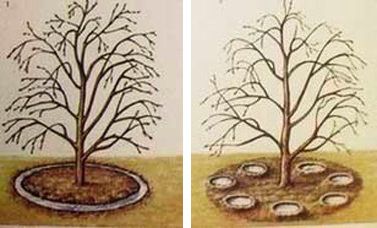
Further, the fertilizer is applied in two ways:
- Fertilizer is scattered around the apple tree, the diameter of the layer being determined by the width of the tree's crown. The area around the tree trunk is dug to a depth of no more than 20 cm. Then, the tree is watered again and mulched (with sawdust, peat, or straw).
- Dig a trench 20 cm deep and approximately 60 cm in diameter from the tree. Add the necessary nutrients mixed with soil and dig. This distance is determined by the approximate location of the main roots that feed the mature plant.
Root feeding should be used very carefully for columnar apple trees, whose roots are located in the surface layer of the soil.
Young seedlings are fed with liquid fertilizers.
Hole method
This method is suitable for actively fruiting trees:
- Dig holes at a distance equal to the location of the main roots (50-60 cm) to a depth of 40 cm.
- A mixture consisting of various fertilizers is introduced.
- They bury, water, and mulch.
Seasonal fertilization
An apple tree needs nutrition all year round; the plant needs to be fed in spring, autumn and summer.
Spring
Nitrogen-containing fertilizers are applied in early spring. For example, one of the following: urea (0.5-0.6 kg), nitroammophoska (40 g), ammonium nitrate (30-40 g), or humus (50 l) per mature tree.
During flowering, add one of the following mixtures per 10 liters of clean water:
- superphosphate (100 g), potassium sulfate (70 g);
- bird droppings (2 l);
- liquid manure (5 l);
- urea (300 g).
4 buckets of the resulting fertilizer are poured onto each apple tree.
When pouring fruits, use the following mixture per 10 liters of water:
- nitrophoska (500 g);
- sodium humate (10 g).
Root feeding is combined with foliar feeding. Once the foliage has matured, the apple tree is sprayed with a urea solution.
Summer
Not only nitrogen-containing fertilizers but also phosphorus and potassium fertilizers are suitable for this period. Fertilizing should be done every two weeks, alternating between applications. Foliar applications are especially beneficial during this period. Urea can be a useful ingredient for this.
If the weather is rainy, fertilizers are scattered in dry form.
Autumn
The main rule for autumn feeding is not to use foliar spraying with nitrogen-containing preparations, otherwise the apple tree will not have time to prepare for frost.
Also, root application is more effective in rainy weather typical of autumn.
During this period, the following compounds are used: potassium (25 g), superphosphate (50 g), dissolved in 10 liters of water; complex fertilizers for apple trees (according to the instructions).