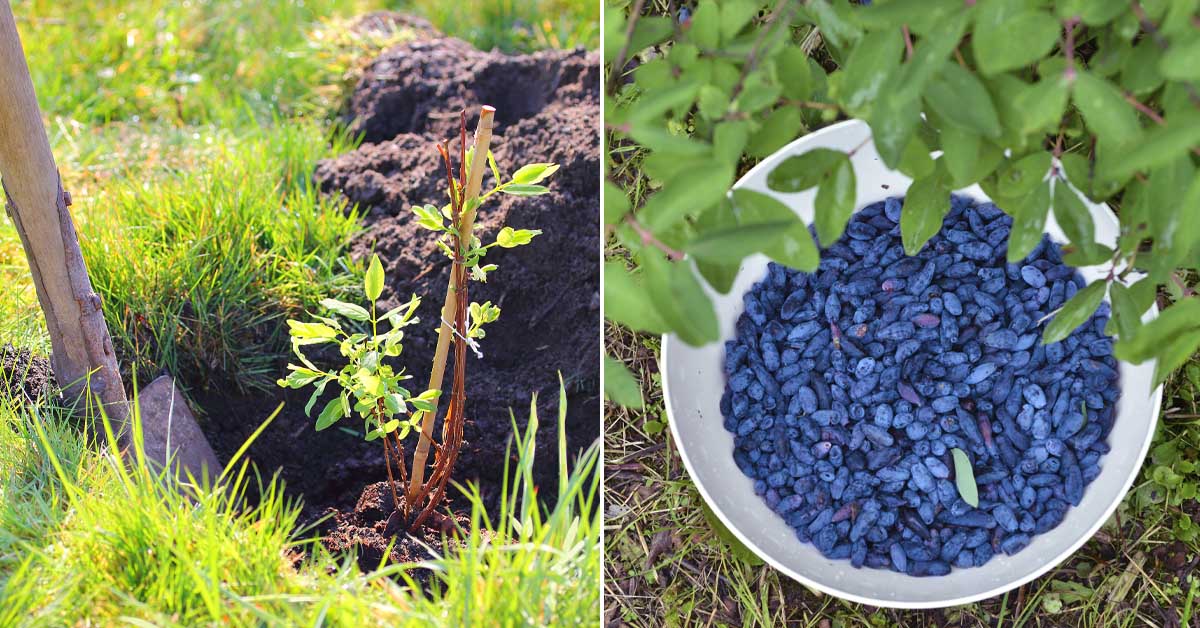
Honeysuckle is an easy-to-grow berry bush that thrives in various regions of the country with proper care. Its berries are not only edible, but also renowned for their excellent flavor and rich nutritional content. In this article, we'll discuss the best time and general guidelines for planting honeysuckle in the fall.
Content
- 1 When to plant honeysuckle: in autumn or spring
- 2 When to plant honeysuckle in autumn: by region, according to the lunar calendar
- 3 How to plant honeysuckle in the fall: step-by-step instructions
- 4 Features of autumn planting of honeysuckle cuttings
- 5 Caring for honeysuckle after planting in autumn
- 6 Top.tomathouse.com Tips: How to Avoid Mistakes When Planting Honeysuckle in the Fall
When to plant honeysuckle: in autumn or spring
Honeysuckle can be planted in the ground in both fall and winter. However, different growing practices will need to be followed at different times.
In spring, the plant adapts more easily, but the difficulty lies in the fact that planting must be done before the buds open. In many regions, the soil doesn't warm up sufficiently by then.
There are no such difficulties in autumn, but it is also important to choose the right timing to begin work so that the seedling not only has time to take root before frost, but also does not begin to develop prematurely if the weather is still warm enough.
Autumn planting has a number of additional advantages over spring planting:
- At the end of the season, a wide selection of different plant varieties is available on the market;
- seedlings take root better and faster;
- During the winter the plant acquires strong immunity.
When to plant honeysuckle in autumn: by region, according to the lunar calendar
It is recommended to plant honeysuckle no later than a month before the onset of stable frosts, so that the bush has time to take root.
Depending on the growing region
In each region of Russia, the favorable period begins at different times:
- In the south – from the second half of October to the first half of November.
- In the central zone (including the Moscow region) – from mid-September to the first ten days of October.
- In the Urals and Siberia – during September (depending on the weather).
When to plant honeysuckle according to the 2024 lunar calendar
For decades, the lunar calendar has been helping gardeners determine favorable days for gardening.
According to his data, in 2024, honeysuckle can be planted on the following days:
- September: 1, 4 (from 19:11)—9 (until 20:25), 12 (from 05:36)—14 (up to 10:52), 16 (from 12:39 p.m.), 24 (from 17:49)-30.
- October: 1 (until 21:49), 3 (from 21:49)-6, 9 (from 12:38)-11 (until 19:31), 13 (from 22:55)-15, 26 (from 18:47)-29 (until 07). 29m.).
- November: 2 (from 15:46)-3 (until 08:19), 5 (from 18:17)-7, 10 (from 06:59)-12 (until 09:25), 14 (from 09:25), 18 (from 11:50)-20 (until 16:49), 23-27.
Unfavorable and prohibited days:
- September: 2,3,4 (until 19:11), 14 (from 10:52 a.m.)-16 (until 12:39 p.m.),17,18.
- October: 1 (from 21:49),2, 3 (from 21:49), 11 (from 19:31 pm)-13 (until 22:55 pm), 16 (from 14:26), 17,18 (until 14:26),31 (from 15:46).
- November: 1,2 (up to 15:46), 8-10 (until 06:59 a.m.), 12 (from 09:25 a.m.)-14 (until 09:25 a.m.), 15,16,30 (from 09:21).
How to plant honeysuckle in the fall: step-by-step instructions
Now let's take a step-by-step look at how to properly plant honeysuckle seedlings in the fall.
Selecting and preparing honeysuckle seedlings for planting
When choosing a seedling, it is necessary to correctly determine the variety, which should be zoned for your region.
Read more about honeysuckle varieties on our website.8 large varieties of honeysuckle
It's best to choose seedlings with a closed root system—they adapt more easily to a new location. Furthermore, container-grown seedlings can be planted at any time from spring to fall.
The optimal age for honeysuckle is 2-3 years. In this case, the first harvest can be obtained within two years.
Before purchasing, carefully inspect the seedlings: the shoots should be free of damage and signs of disease. Don't be alarmed if the bark on the branches peels slightly—this is considered normal for honeysuckle.
The height of the seedling is also important. If it's less than 0.3 m, the root system is still underdeveloped, and the honeysuckle may have trouble establishing itself. If the height is more than 1.5 m, the plant will have difficulty adapting to its new location.
Selecting a location on the site
Honeysuckle is a sun-loving plant. However, it originally grew in forests, where taller plantings protected the bush from the scorching sun. Therefore, it's a good idea to have sunny spots in your garden where fruit trees provide some partial shade. Such a location would be ideal for planting honeysuckle.
If there is not enough sun, the bushes will not produce berries and you may not get a harvest.
Honeysuckle also has special water requirements. Avoid planting it in areas of the garden where water accumulates. Furthermore, if groundwater is close to the soil surface, a raised bed planting is recommended.
Preparing planting holes
It is better to start preparing the planting hole in advance, approximately 15 days before the start of work.
Gardeners recommend making the width and depth the same, which should be approximately 40-50 cm.
If the seedling is growing in a container, the hole should be approximately 2-3 times larger than the container.
The planting hole is filled with the following components:
- Fertile soil layer.
- Humus or compost (1 bucket).
- Soils from coniferous forests together with litter.
- Sand (0.5 bucket). It is added to heavy and clayey soil.
It is recommended to add the following fertilizers:
- 100 g superphosphate,
- 80 g potassium sulfate (or wood ash).
You can purchase any ready-made complex fertilizer, such as Diammophoska. All fertilizers should be thoroughly mixed with the soil to avoid burning the roots.
After all this, all that remains is to water the hole so that the nutrients are distributed and the soil settles.
The distance between holes in a single row should be at least 1.5 m, and the width between rows should be at least 2 m. Bushes grow relatively quickly, and sufficient spacing will prevent competition for light and nutrients.
When planting honeysuckle, it is important to remember that most varieties are cross-pollinated, so at least three different varieties of seedlings should be planted simultaneously.
Direct planting of honeysuckle in autumn
We offer you a step-by-step guide to autumn planting of honeysuckle in open ground:
- Prepare the planting hole in advance according to the scheme described above.
- Fill the remaining space with soil.
- In the center of the hole, build a mound about 10-15 cm high.
- Trim any roots that are too long, leaving them at 30 cm.
- Dip the root system into the clay slurry.
- Place the seedling on a hill.
- Carefully distribute the roots so that they descend evenly down the hill.
- Secure the roots and base with fertile soil.
- Mulch with humus or peat.
If you are planting a seedling from a container, you simply need to move its root system from the container into the hole along with the soil lump.
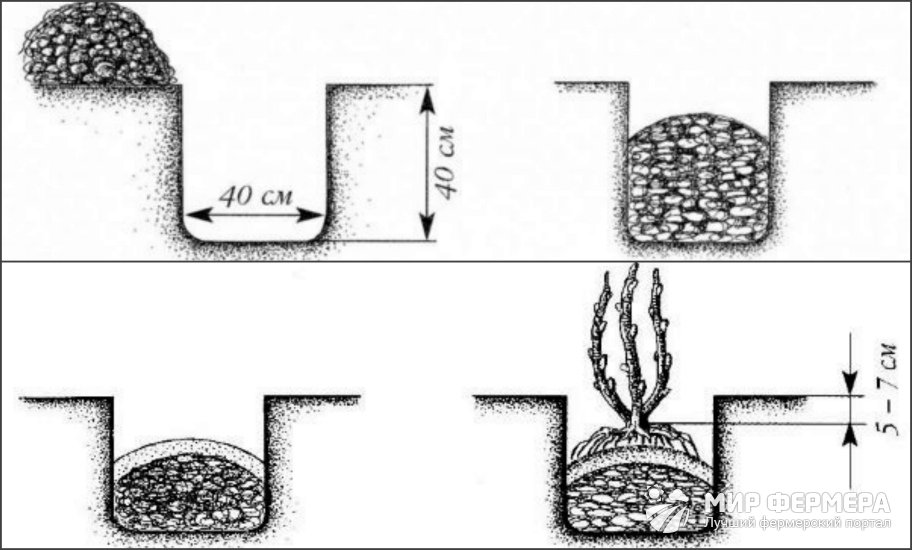
Another important point is that the root collar should not be in the ground deeper than 8 cm for loose soil and 2 cm for clay soil.
For watering, it's best to dig a 5-8 cm deep hole around the seedling and pour a bucket of water into it. Once the soil settles, you'll need to add a little more soil.
Features of autumn planting of honeysuckle cuttings
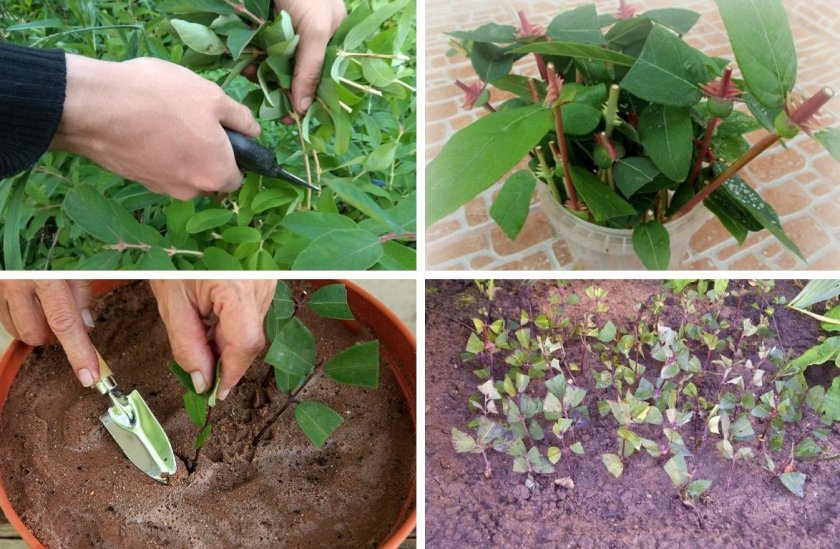
Honeysuckle propagates well from cuttings. It's true that you'll have to wait a long time for a harvest, but while the old trees are bearing fruit, new ones will have time to grow to replace them.
It's best to take cuttings from the very base of the plant. Experienced gardeners recommend preparing cuttings in the spring by cutting 15 cm of green shoot.
Features of rooting and planting honeysuckle cuttings:
- Remove all leaves from the cutting.
- Make a cut at the bottom, immediately below the bottom bud.
- At the top, above the top bud, make a cut, leaving 1 cm.
- Place the cuttings base down in any stimulating solution (Kornevin, Heteroauxin, etc.) for 24 hours.
- Mix peat with sand in a ratio of 1:3, fill containers with the mixture and plant the seedlings there, deepening them by 3-4 cm.
- Cover the cuttings with plastic bottle ends, which will need to be removed after the first leaves appear.
- 14 days before planting, the seedlings need to be hardened off by taking them outside for a couple of hours at first, and then for the whole day.
Planting of the finished seedling is carried out within the timeframes described above. These times depend on the region and weather conditions.
Caring for honeysuckle after planting in autumn
If planted correctly, honeysuckle care will be minimal. First and foremost, watering is essential. If autumn is very warm, water three times a week at a rate of 8-10 liters per plant. However, autumn weather is often characterized by prolonged rains, which means watering the plant is unnecessary.
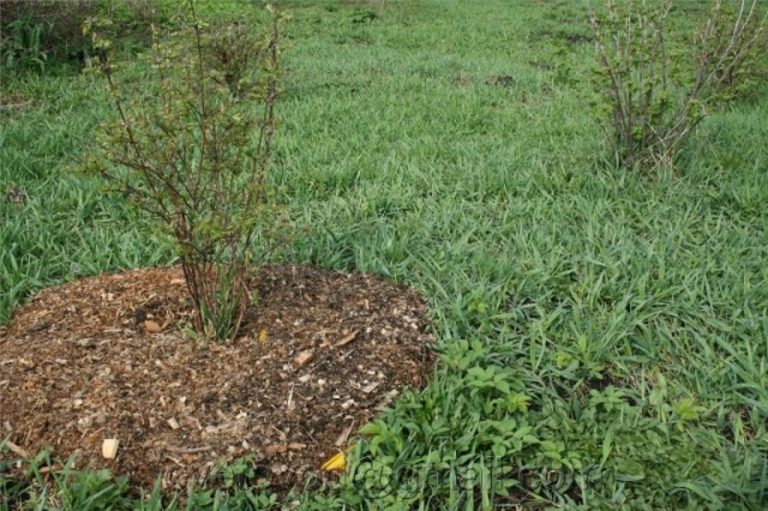
As soon as the air temperature begins to steadily approach zero, it is necessary to add a 5-7 cm layer of mulch, if this was not done immediately after planting.
There is no need to add additional fertilizers under the bush; the fertilizers that were added to the planting hole are sufficient.
Before winter, all that remains is to cover the bush if the air temperature drops below 30 degrees or there is very little snow.
Read the article about honeysuckle, its beneficial properties, and how to care for it in spring, summer, and fall. Honeysuckle: cultivation, useful properties.
Top.tomathouse.com Tips: How to Avoid Mistakes When Planting Honeysuckle in the Fall
Be responsible when choosing seedlings; do not choose dubious retail outlets or weak-looking plants.
Remember: honeysuckle loves light. Without it, the berries will be small, sour, or won't appear at all.
A properly prepared hole is half the key to a successful planting. Don't skip the fertilizing step and follow the recommendations regarding the required acidity.
Always plant several varieties of honeysuckle at the same time, each with the same flowering period.