Yarrow has been known since ancient times; its Latin name, Achillea, is associated with Greek mythology. This herb with feathery leaves and colorful caps can be found throughout Russia.
The medicinal properties of the leaves and flowers have long been recognized by conventional medicine. The plant is used as a food; its bitter spice adds a piquant flavor to dishes. Breeders have developed many ornamental varieties in a variety of colors, which are used in landscape design.
Description of yarrow
A plant from the Asteraceae (composite) family, the Latin name is Achillea millefolium. There are over 20 species, many of them growing wild. The most common is the common yarrow, while the noble or Cantonese yarrow grows in dry soils and the setose yarrow grows in steppe regions. The longitudinal leaves, up to 15 cm long, do not grow wider than 3 cm, are divided into paired segments, are pubescent, and exude essential oils. In spring, the foliage grows in a rosette, from which a stem up to 40 cm long emerges, branching at the top.
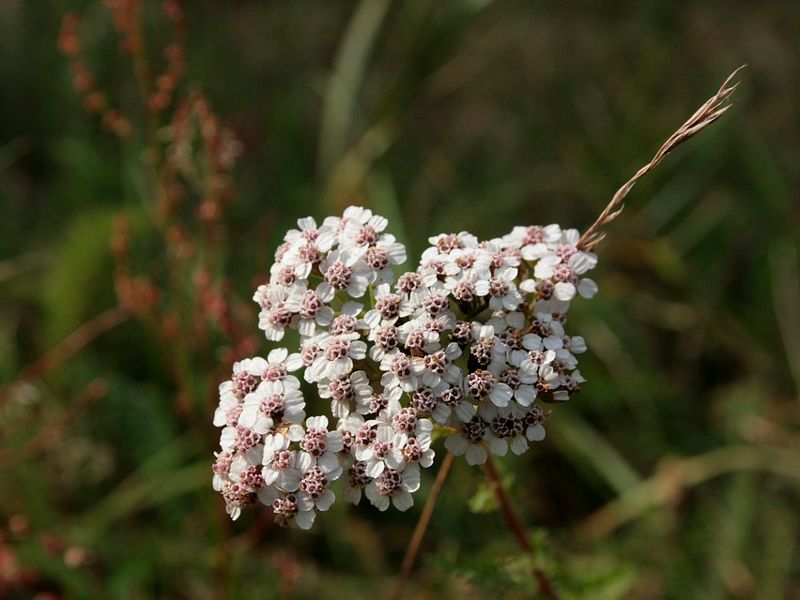
In June, buds begin to form. The flowers are small, milky-white or pinkish, with a single row of petals and a bumpy, loose center. They are collected in heads. They form large, dense caps of inflorescences. Yarrow is pollinated by insects. The seeds are small, ovoid, oblong, 1.5 to 2 mm long, and form in September.
Propagation is vegetative, root, and by seed. The plant thrives in loamy and poor clay soils and adapts to any conditions. The size of the inflorescences depends on the organic content of the soil. Yarrow grows in any open space.
It can be seen:
- on the roadsides;
- dry meadows;
- hay fields;
- cultivated areas;
- forest edges;
- near water bodies;
- in city parks, lawns.
Under favorable conditions, the grass forms a dense carpet. Yarrow blooms profusely throughout the summer.
Cultivation of ornamental varieties begins with sowing seeds for seedlings in February. Planting occurs after the ground has thawed. Yarrow is grown commercially for pharmaceuticals, cosmetics, and essential oil production. It is an excellent honey plant, and beehives are installed near plantations to produce medicinal honey.
How to harvest and store yarrow
The above-ground portion of the plant is harvested during the flowering period. The dried stems and leaves retain their beneficial properties for two years. Harvesting is done in areas away from cities and roads. The plant can accumulate heavy metals and harmful components of industrial emissions and exhaust gases.
Stems are cut with scissors or pruning shears; many use a sharp knife. When harvesting large quantities of raw material, a sickle or a cleaver is used. Grass in meadows and flat areas is mown and then sorted. The shoot is cut at a height of 15 cm from the ground to prevent the hardened part of the stem from contaminating the raw material, as it contains few essential oils, resins, and other valuable substances. Flowers, leaves, and the soft part of the stems are trimmed for drying.
The herbs are formed into bundles or placed on baking sheets or thick paper in a shredded form. Dry the yarrow in a shaded, ventilated area protected from rain and out of direct sunlight. If necessary, shade the collected herbs with old newspapers or thin cloth.
When drying, the plant should retain its natural color. If the raw material turns yellow, it's best to discard it. Store dried yarrow in moderate humidity:
- in cardboard boxes;
- paper bags;
- canvas bags.
Flowers, stems, and leaves have the same properties and do not need to be separated. The plant's juice is harvested and preserved using alcohol and honey.
The use of yarrow in medicine
In addition to essential aromatic components, the plant contains other useful substances:
- vitamins C, P, K1, carotene (provitamin A);
- microelements;
- flavonoids;
- organic acids, including aconitic;
- bitters (terpene hydrocarbons), they are poisonous in large quantities;
- tannins;
- polysaccharides;
- coumarin.
The anti-inflammatory and wound-healing properties of yarrow have long been known. In modern medicine, it is used more widely:
- normalizes blood composition;
- has an antispasmodic effect, calms the nervous system;
- has a diuretic and choleretic effect, eliminates bile stagnation in the ducts;
- lowers blood pressure;
- removes excess salts from cartilage tissue – used externally to treat joints;
- stimulates the production of immune globulins, prescribed for colds and infectious diseases;
- suppresses the growth of pathogenic microorganisms, is included in the therapeutic complex for the treatment of vaginal infections;
- stabilizes the secretion of the gastrointestinal tract, increases appetite, improves food absorption, eliminates flatulence;
- increases sweating;
- lowers body temperature in febrile conditions;
- relieves swelling of the mucous membrane, used for gargling and washing the nasal passages.
Yarrow is an ingredient in many herbal teas, including those for stomach, choleretic, laxative, and hemorrhoidal purposes. It is used to make tinctures, and its juice is used in ointments. Yarrow is prescribed as a standalone ingredient for decoctions and infusions. Externally, it is used to treat skin conditions.
Yarrow has many names, one of which is "women's herb." The plant was used in folk medicine to treat gynecological conditions, such as heavy bleeding and prolonged menstruation. Decoctions were used as vaginal douches for thrush, inflammation of the mucous membrane, and erosive lesions. Nursing women were advised to add decoctions to their drinks to increase lactation. Doses should be small to avoid bitterness in the milk.
Men used yarrow to improve erections and stimulate testosterone production. Powdered yarrow was taken on hunts and firewood collection trips and used to treat wounds. Yarrow has hemostatic and disinfectant properties.
Culinary uses of yarrow
The herb has a distinctive aroma and is used in cooking as a spice. Only the young rosettes are eaten raw. They should not be used as a main ingredient; in high concentrations, the herb is toxic. It is good in small quantities. The plant pairs well with:
- with some types of meat: lamb, beef, game;
- vegetables, leaves in fresh and dried form are added to salads, cold complex appetizers, stews, soups;
- cheese, reveal and emphasize its taste.
Fresh leaves are used to garnish prepared dishes. Dried herbs and flowers are added to compotes, kvass, homemade vegetable preserves, and broths. Yarrow has found use among winemakers and confectioners, who use the decoction to make rich pastries.
Top.tomathouse.com warns: unusual properties and contraindications of yarrow
The plant is used in cosmetology. Lotion for dry, aging skin is made from essential oils and decoctions. The oil improves microcirculation in tissues and restores moisture balance. An infusion effectively relieves allergic rashes and irritations. Regular washing with the decoction gives the face a matte glow, a healthy complexion, and smooth, elastic skin.
The decoction is used to treat bedsores and diaper rash. Applying it to healing tissue reduces scar tissue density and stimulates epidermal cell regeneration.
Like any pharmacological drug, yarrow has a number of contraindications and is not recommended for use:
- for patients with increased blood clotting - vitamin K1 thickens the blood and promotes platelet production;
- for people with low blood pressure, the herb lowers blood pressure;
- people with heart disease;
- pregnant women, during pregnancy the blood thickens;
- children under seven years of age, this is due to the immaturity of the liver and other internal organs of the child;
- for people with increased production of gastric juice - the herb stimulates its production;
- For allergy sufferers, the plant contains camphor and other esters that can cause suffocation;
- patients with gallstone disease.
Before using herbal raw materials, you should consult a doctor.