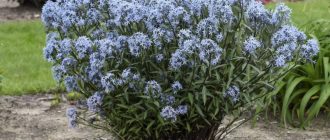
Lupine is a plant in the legume family. It also has another name, derived from the Latin "wolf" (Lupinus). The genus includes about a hundred species, most of which grow in the Mediterranean, African, and American regions. It has been used in agriculture and medicine since ancient times.
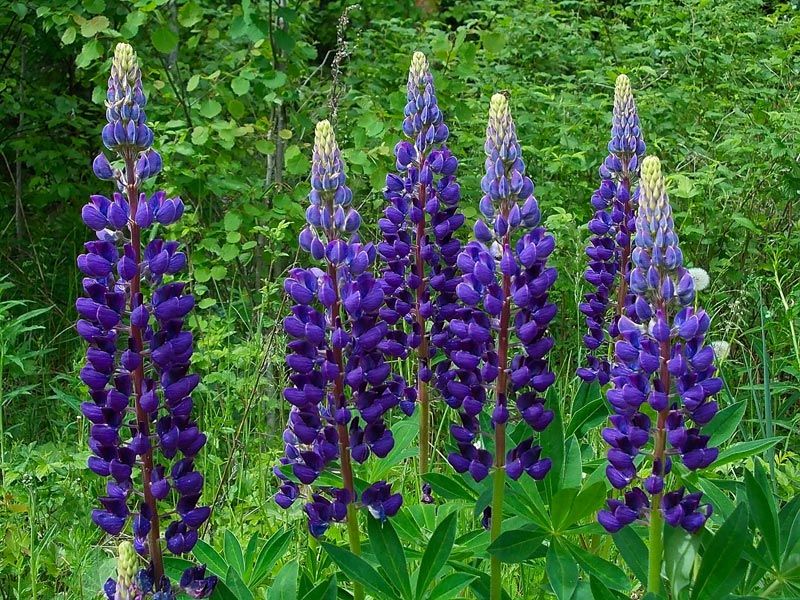
Features of lupine
The root develops as a taproot extending to a depth of 1-2 meters. Another distinctive feature of the plant's structure are small tubers containing colonies of nitrogen-fixing bacteria. These bacteria process nitrogen from the air and enrich the soil.
The stems are herbaceous and can also become woody. They are most often erect, but sometimes they grow as prostrate or branching shrubs and subshrubs. The leaves are palmately compound, double-foliated, and triple-foliated. They are borne on long, even petioles in groups of 5-6. Their shape resembles palm fronds.
The inflorescences are racemes about 0.5-1 m tall, with numerous buds arranged in dense rows of 50-80. The flower stalks are strong and sturdy, withstand rain well, and do not fall off in windy weather.
The most common color is blue. However, other variations also occur: solid colors (cream, red, purple) and variegated.
Average flowering period is 20 days.
The seed has a smooth surface, resembling a bean or pea. The color and shape depend on the lupine species.
The plant is poisonous: the beans contain the highest concentration of hazardous substances—4%—while the roots contain less, about 1%. However, harmless varieties have been bred for agriculture; they are fed to livestock or rabbits.
The flower is considered a honey plant and attracts bees with a large amount of pollen, however, it does not produce nectar.
Types and varieties of lupines
The genus is represented by annual and biennial plants, as well as widely cultivated perennials. To date, both giants, growing up to 200 cm, and miniature specimens with stems no longer than 20 cm have been bred.
The most common are:
| View | Height (cm) | The color and aroma of flowers | Description |
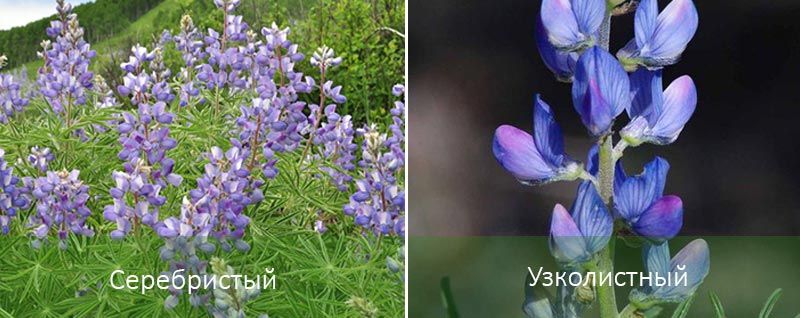
| Silver | 20-60. | Dark blue with a red center. | Silky leaves. |
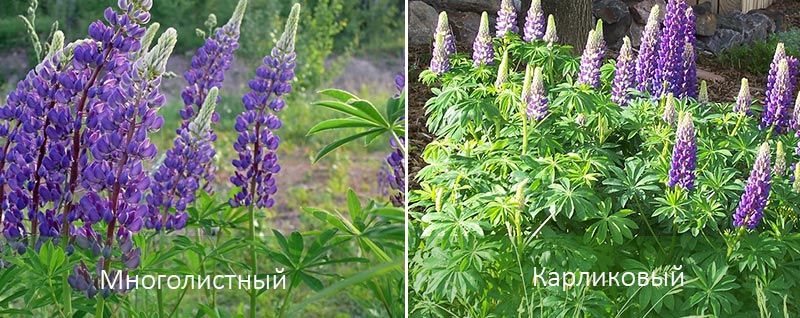
| Dwarf | 20-50. | Blue, white, light blue. | Early flowering, undemanding. Flowers can be cut for bouquets. |
| Narrow-leaved | 80-150. | Pink, purple or white, odorless. | Annual, with an erect stem. |
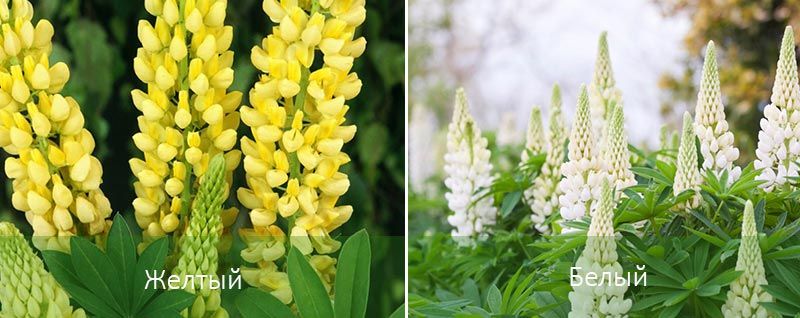
| White | 150-200. | Snow-white, light pink, blue, odorless. | Annual, drought-resistant. Accumulates a lot of nitrogen—2 kg. |
| Yellow | 100. | Yellow or yellow-orange, fragrant. | A heat-loving annual. The stem is pubescent, with few leaves. |
| Multi-leafed | 80-120, brush length 30-35. | Deep blue. | Perennial. Frost-resistant, early maturing. Good rodent repellent. |
Lupine varieties come in a variety of shades and colors, such as 'Abendglut' and 'Rubinkönig'. Many were developed by an English breeder and named after him—Russell hybrids. They are very popular and are planted in groups in gardens and parks, such as 'Burg Fröhlin' and 'Castellan'. Some flowers reach up to 2 cm in diameter.
Widely known varieties of annuals:
- Torch;
- Crystal;
- Reliable;
- Green manure 38.
Lupines with classic colors: blue, light blue, and white, germinate better and require less care than varieties with more spectacular colors.
Because the plant thrives alongside other flowers, it lends itself to a variety of landscape design ideas. Lupine is perfect for gardens with a romantic or English style. It looks beautiful in borders or planted along walls and fences. It also serves as a backdrop for shorter peonies, chrysanthemums, or asters. It pairs harmoniously with cosmos, delphiniums, or bellflowers, and also complements irises, geraniums, or poppies.
Lupine planting times
The timing depends on the chosen method; if you plan to grow seedlings, it is better to do this earlier - in March.
When sowing seeds in open ground, do not rush; the snow needs to melt and the soil needs to warm up well.
The optimal time is mid-spring - April or May.
Another option is to do this in winter; they usually try to choose the end of October; it is important not to forget to add peat to the soil.
Growing lupine from seeds
This growing method is suitable for regions with cold winters and springs. Seeds are sown in trays with loose soil composed of two parts turf, one part peat, and one part sand. This mixture is designed to improve drainage. The seedlings should be planted 2 cm deep into the soil.
To promote the development of nitrogen-containing bacteria, the seeds are pre-mixed with a powder of crushed old lupine roots. To speed up germination, the seed coats can be broken by lightly rubbing them with sandpaper.
Mature lupines often disperse spontaneously. After the pods ripen, their valves open, and the lightweight seeds scatter.
To encourage more sprouts, place the container in a warm place and cover with a damp cloth. Seedlings appear in 18-20 days; the optimal temperature for germination is 20°C.
Planting material has a long shelf life—5 years. Most flowers grown from store-bought seeds develop purple or blue hues the following season. Therefore, some varieties require replanting.
Caring for lupine seedlings and planting them in the ground
A month later, when the first true leaves appear, it's essential to plant the seedlings in the ground. Failure to do so promptly risks damaging the roots, which can lead to the seedlings failing to establish and beginning to wither. For the same reason, transplanting older lupines is also not recommended.
Space the seedlings 30-50 cm apart to allow them to grow wide without crowding each other. A spacious area is ideal.
It's undemanding about substrate. Its soil is slightly acidic, but thanks to soil transformation, it can grow in almost any soil, as it will automatically increase the pH. Within a year or two, it becomes neutral. In acidic soils, lime should be added before planting, 5 liters per 1 m², which will reduce calcium levels. Peat can be added to alkaline soils, 5 kg per 1 m² of soil.
Sowing lupine in open ground
First, you need to prepare the soil, which is best done in the fall. Dig the planned area one spade deep and fertilize with superphosphate and ash.
Sow directly into the ground in spring, in April or May, using pre-loosened soil. Place 5 to 7 seeds per hole, spacing the seeds 6-7 cm apart. Seedlings will emerge in 8-14 days. A well-lit area is best; the plant thrives in full sunlight. Seedlings can be spaced thinly, but their height should not exceed 15 cm. There should be no more than two true leaves, otherwise they will not establish in the new location. When transplanting, provide shade using pots with holes for ventilation.
The downside of planting from seeds is that the flowers on the mature plant may be a completely different color. Purple flowers are common, and white is the rarest.
The last date for sowing seeds is June; the plant will bloom only in the following season.
Caring for lupines
Caring for perennial lupine is quite simple:
- Weeding and loosening the soil.
- In spring, watering should be active, later moderate.
- If the root part is exposed, hilling will help.
- To increase the duration of flowering, it is necessary to remove fading brushes.
- Tall plants sometimes break from strong winds and need to be tied to supports.
- It is optimal to plant lupine at 4-6 years, then replace it with young specimens.
- Fertilizer should be applied the following year after planting. Any complex fertilizer without nitrogen will do. 20 grams per square meter is needed.
Inspection for pests, such as tuber weevils, aphids, and shoot fly larvae, is essential. Disease prevention and insecticide treatments include root rot, gray mold, anthracnose, and rust.
Vegetative propagation of lupine
If lupine is used for decoration, vegetative propagation is used to preserve the mother plant's color. However, only young bushes should be divided; mature plants are much less likely to survive.
When propagating by cuttings in the spring, it's best to use basal rosettes located at the base of the stem. The first inflorescences on the mature plant will form in the fall.
The cutting is taken in the summer after flowering has finished. Root in sandy soil with filtered light or partial shade. Transplant into the flowerbed after 20 days, once roots have formed.
Top.tomathouse.com recommends: lupine – green manure
This is an excellent green manure. Research has shown it to be superior to manure in terms of phosphorus and potassium levels. The plant can accumulate up to 200 kg of nitrogen in the soil. It is excellent for restoring clay, loam, and sandy soils.
Perennials are more commonly used in agriculture. They are low-maintenance and frost-resistant. Annuals also have the advantage of being easier to control.
Two months after planting, when buds begin to appear, the lupines are mown down and incorporated into the soil. To speed up decomposition, they are treated with a bacterial fertilizer such as Baikal or Bokashi. This process usually takes two weeks, after which other crops can be planted.
There's another method, used if subsequent planting isn't planned. The green mass is left on the surface and periodically watered with water and effective microbial preparations (EM).
In autumn, lupines are usually sown in September or October, choosing frost-resistant varieties. They can be planted in August, allowing the lupines time to grow before the cold weather sets in, then mowed and left to rot under the snow. By spring, the fertilizer is ready.
Here are some crops that grow comfortably next to lupine:
- pumpkin;
- cucumber;
- tomato;
- raspberry;
- zucchini;
- potato.
As a green manure, it's best not to plant it near onions, as they will develop and store poorly. Due to the risk of similar diseases, it's also not recommended to plant beds near peas and beans.
Lupine, initially perceived by many as a weed, can also provide significant benefits. It can enrich the soil with nutrients as a fertilizer, provide food for animals and fish, or become a vibrant addition to a flowerbed. Proper planting and care will help ensure a healthy and robust plant.