Chamomile (leucanthemum) belongs to the Asteraceae family, previously classified as a Chrysanthemum. According to various sources, the genus includes between 20 and 70 species. In the wild, it grows in temperate regions of Asia and Europe.
Content
- 1 Description and characteristics of the daisy
- 2 Types of daisy
- 3 When to sow garden chamomile in open ground
- 4 How to grow chamomile seedlings at home and when to plant them
- 5 How to plant daisy
- 6 Propagation by cuttings
- 7 Caring for garden chamomile in open ground
- 8 Control of diseases and pests of daisy
- 9 Garden chamomile in landscape design
Description and characteristics of the daisy
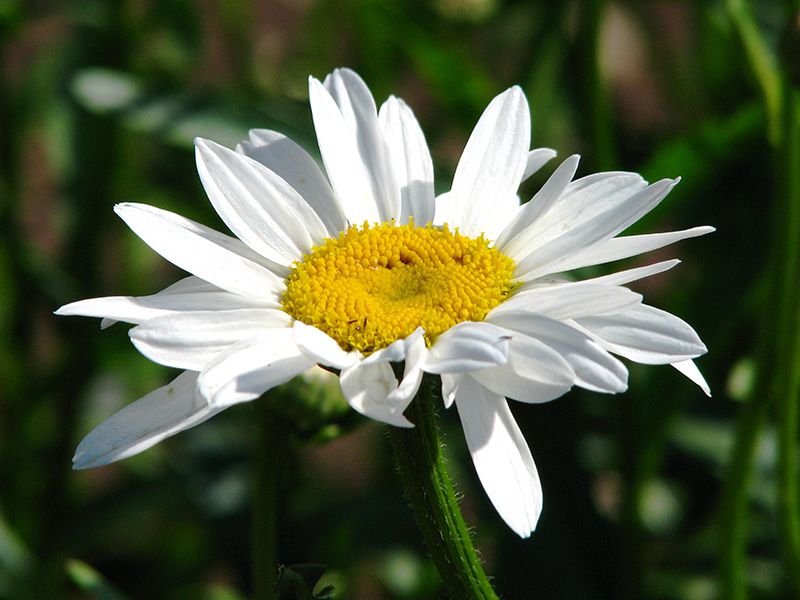
The flower lacks the grayish pubescence of chrysanthemums. It lacks their characteristic scent. Distinguishing features of the daisy:
- height up to 0.6 m;
- superficial rhizome;
- straight trunk with edges;
- basal and stem leaves on elongated petioles;
- bladed or toothed plates;
- inflorescences in the form of a hemisphere, united into shields;
- lemon tubular buds are collected in baskets in the center;
- flowers are developed, false-ligulate, snow-white at the edge.
The daisy blooms twice a year: in May and August. In September, with the onset of frost, the buds wither.
Leucanthemum is a herbaceous plant. All its varieties have unilateral seed capsules. Large-flowered specimens produce seeds with sufficient sun. In shade or partial shade, the seeds fail to develop, and shoots become deformed.
Small-flowered varieties are less sensitive to low light. For vigorous growth, they require loose, neutral or alkaline soil: sandy loam or loamy soil.
Differences between daisy and wild chamomile:
- large buds;
- solid plates in many varieties;
- long, straight trunk without branches;
- there is only one flower on one shoot.
Although the daisy is popularly known as garden chamomile, the plants are only distant relatives.
Types of daisy
Only some varieties of the plant are cultivated:
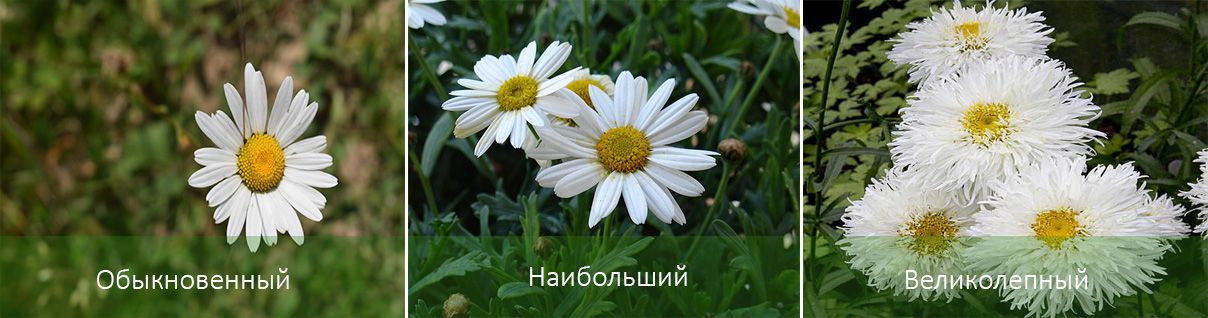
| View | Description | Leaves/Flowers | Varieties | Features of their flowers, the period of bud formation |
| Ordinary | A perennial plant up to 1 m in height. Drought-resistant and shade-tolerant. |
Glossy, with teeth around the perimeter. Simple, with a tubular, yellowish core and snow-white petals in the form of tongues. |
Maxima Koenig. | Diameter 8-12 cm. May-July. |
| May Queen. | Semi-double. Late spring - early August. |
|||
| Sans Souci. | Large, double, lemon in the center. The second decade of summer. |
|||
| The largest | Grows up to 1 m. Distinguishing feature is late flowering. | Basal, dark green, serrated. Large, simple, terry. |
Alaska. | 10 cm. From early July until late autumn. |
| Snow Lady. | With a lush center and wide petals. From the 2nd month of summer until the first frost. |
|||
| Little princess. | Simple. From the end of June to October. |
|||
| Crazy Daisy. | Looks like a chrysanthemum. July-end of September. |
|||
| Broadway Lights. | Simple, soft amber. From the 2nd decade of summer to mid-autumn. |
|||
| Mayfield. | They grow in 2 rows, snow-white, ligulate. July-September. |
|||
| Silver Princess. | Simple. From the end of June to October. |
|||
| Wirral Supreme. | Semi-double. From the beginning of July until frost. |
|||
| Snow White. | Densely double, collected in baskets. From mid-summer until the end of the season. |
|||
| Fabulous | With strong stems, up to 1 m in height. | The leaves are gathered into rosettes at the base. They are long, up to 30 cm. Terry, from yellowish-green to creamy-pink. |
Fiona Goghill. | The petals are light beige. The center is lush, canary-colored. June-July. |
| Spring giant. | Large, simple, snow-white. Midsummer-October. |
|||
| Grand Illusion. | Collected in baskets. June-July. |
When to sow garden chamomile in open ground
If you sow from late March to early May, the seedlings will emerge within two weeks. By late summer, the bushes will have strengthened and will bloom the following season. If you sow chamomile in late autumn, you'll see seedlings emerge in the spring, and flower buds will begin to form in the summer.
Step-by-step sowing:
- Place the seeds into the substrate at a depth of 2 cm.
- Between rows 0.2-0.3 m.
- Water, making sure that liquid does not stagnate.
- After the seedlings emerge, carefully thin out the soil so that 9-15 cm remain between the seedlings.
- If you don't want to throw away the uprooted bushes, replant them. Even small seedlings thrive in moist soil.
- The grown seedlings are planted at a distance of 0.4-0.5 m.
With proper care, daisy grows quickly.
How to grow chamomile seedlings at home and when to plant them
If you don't plant daisy directly in your garden, but rather grow seedlings first, you'll see buds appear as early as the first year. Cultivation begins in late winter or early spring:
- The containers are filled with light, nutritious soil. The seeds are planted a centimeter deep, watered, and covered with plastic or glass to create a greenhouse effect.
- The seedlings are kept at 22°C and provided with diffused light. The cover is removed daily for ventilation and watering.
- After 2-3 weeks, when seedlings appear, remove the glass or plastic. Maintain the same lighting conditions. Lower the temperature to 17–20°C.
- After 3 true leaves appear, the sprouts are planted in separate pots with a soil mixture of sand, peat, and leaf humus in equal quantities.
- Water and keep in bright light.
- Starting in May, the grown bushes are hardened off by taking them outside for 2-3 hours. At first, the pots are placed in a shaded area, protected from strong winds and drafts. Once the shoots have become accustomed, they are moved to the sun. Hardening off the chamomile reduces disease rates.
They are transplanted into open ground at the end of spring, if the ground does not freeze at night.
How to plant daisy
After a few years, the plant forms dense thickets. In May or September, the bush should be divided and replanted:
- Dig carefully so as not to destroy the root ball.
- Divide into equal parts.
- Plant in holes corresponding to the size of the rhizome.
Propagation by cuttings
This method can be carried out from the beginning of June to the end of August:
- Cut off the root area with a small portion of the rhizome. Leave the aboveground portion intact.
- Plant in a permanent location.
- Water generously.
Caring for garden chamomile in open ground
The first 2-3 years the bushes will be small in size.
With comfortable conditions and proper care, the daisy grows quickly: in just a few months it will reach 80 cm in circumference and 1 m in height.
Choosing a landing site
Plant in a well-lit location. Some shade is acceptable. Insufficient light will cause the shoots to grow upward, and the chamomile will lose its decorative appearance.
Priming
Choose light, loose, fertile soil. The bush grows well in black soil and loam with neutral or slightly acidic soil. High pH will kill the chamomile, and clayey or sandy soil will slow its growth.
How to water
Water regularly when the top layer of soil dries out. Be careful not to allow water to stagnate. During severe drought, add 10 liters of water to the roots. To retain moisture, mulch the bush with sawdust, wood chips, or spruce branches.
Top dressing
Fertilize every two weeks. Alternating mineral and organic fertilizers will be beneficial. Missing a fertilizer is fine; chamomile grows well in a garden substrate.
How to prolong flowering
Seed formation drains the plant's energy. If there's no need to harvest the seeds, it's best to cut off the inflorescences immediately after they fade. This also encourages reblooming.
Preparing for winter
After the petals have fallen, prepare the daisy for dormancy. Cut the stems back, leaving 0.1 m of basal leaves.
The plant's distinctive feature is its winter hardiness, but at temperatures below -20°C, the bush should be covered with pine needles, fallen leaves, and peat mulch. Remove the cover in early spring.
Control of diseases and pests of daisy
If care is improper, daisy may become diseased. Common diseases, their symptoms, and treatment and preventative measures include:
| Diseases | Manifestation on leaves | Prevention and corrective measures |
| Mosaic is a viral infection. |
|
|
| Soft bacterial rot (infection occurs through soil or infected plants). |
|
|
| Ramulariasis. |
|
|
| Septoria |
|
|
| Root rot. |
|
Before planting, place in a solution of Trichodermin or Alirin-B. |
| Pests | ||
| Chrysanthemum leaf miners (fly and moth larvae). |
|
|
| Thrips. |
|
|
| Pennitsy. |
|
|
| Aphid. |
|
|
Garden chamomile in landscape design
Breeders have developed daisy hybrids with petals that range from snow-white to bright lemon, canary green, and orange. Combining these varieties can create interesting design solutions.
Low-growing varieties are well suited for alpine gardens and rockeries, such as Little Princess and Snow Lady. They can be combined with daisies and marigolds. Well-groomed and beautiful chamomile bushes can enhance any space.