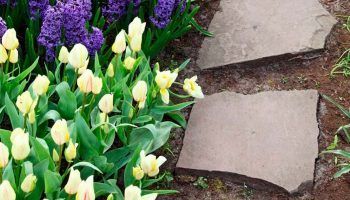
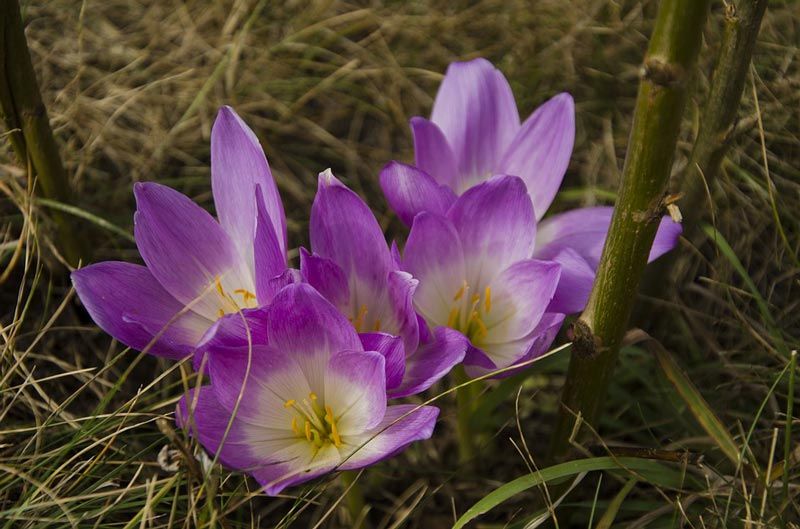
Colchicum (or colchicum) is a plant in the bulbous family. It is also known as autumn crocus, or colchicum. This name comes from the region of Georgia where the flower originates. In Rus', it is known as "autumn crocus," or "winter crocus," while the British call it "naked lady." It grows throughout Europe and Asia. Colchicum is unpretentious and well-known among gardeners.
One ancient Greek legend tells that the flower emerged from drops of blood belonging to Prometheus. Another version holds that the colchicum helped reunite the mother goddess Demeter and her daughter Persephone.
Content
- 1 Colchicum flower - description and characteristics
- 2 The main types and varieties of colchicum
- 3 Planting colchicum in open ground
- 4 Methods of propagation of colchicum
- 5 Caring for colchicum after planting
- 6 Pests and diseases of colchicum
- 7 Top.tomathouse.com recommends: medicinal properties of the plant
Colchicum flower - description and characteristics
Colchicums are herbaceous plants with a short life cycle. They are bulbous plants with large leaves reminiscent of wild garlic or lily of the valley. The flowers are pollinated by insects for two weeks, after which the colchicum dies.
The ripe capsule-shaped fruit forms the following spring, along with the emerging foliage, which reaches 25-30 cm in length. The oval corm is covered with leathery scales, from which several flower stalks develop.
The main types and varieties of colchicum
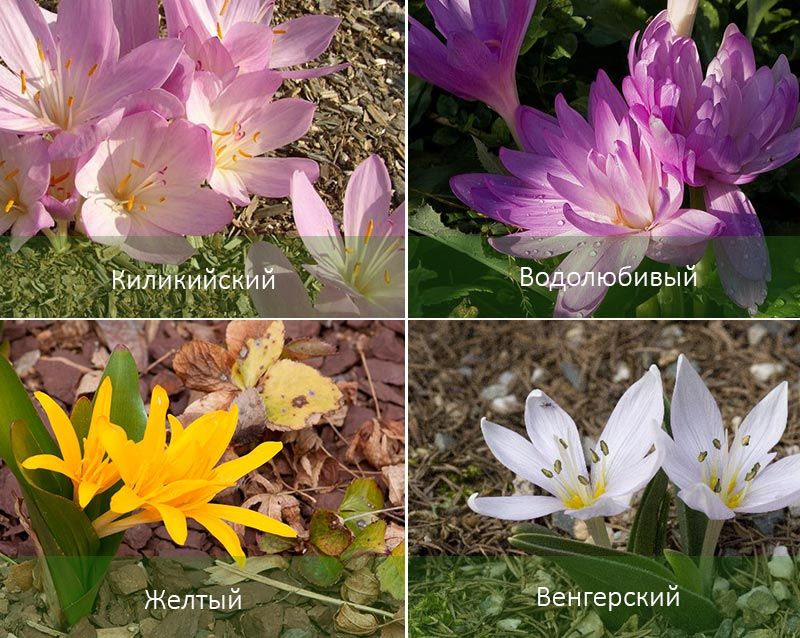
It blooms in spring or autumn with beautiful cup-shaped flowers in a variety of purple and pink shades.
| View | Description/Height, cm | Leaves | Flowers, flowering period | |
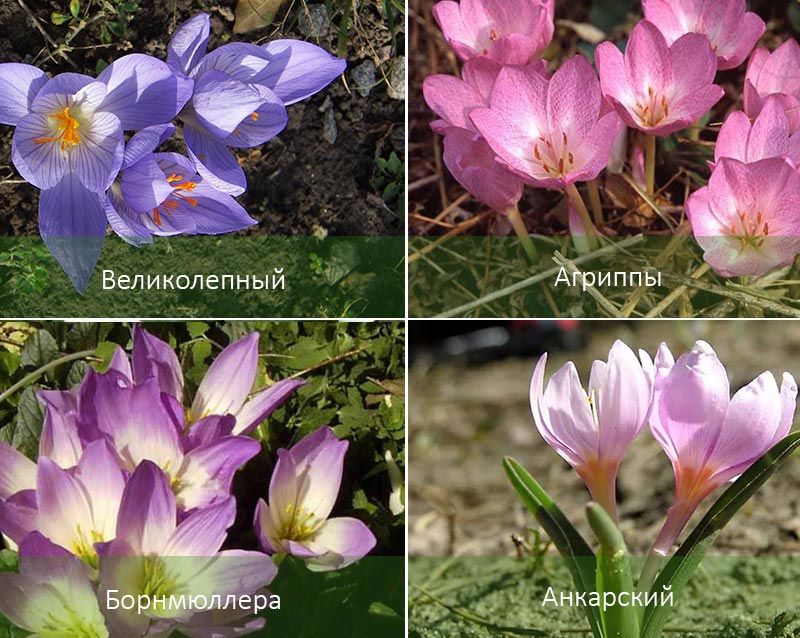
| Ankara (Bieberstein) (Colchicum ancyrense, biebersteimi or triphyllum) | Rare, early flowering. Up to eight buds, each set among three leaves. 10-15. |
Lanceolate, elongated, they emerge at the same time as the flowers and dry up after flowering. | Purple. 10-12 days. | |
| Yellow (Colchicum luteum) | The plant is grass-like, with a short stem and buds 3 cm in diameter. The first description appeared in 1874. | 15 | Green, flat-shaped, they grow at the same time as the flowers. | Yellow. March-early July. |
| Hungarian (Colchicum hungaricum) | The plant resembles a short-stemmed grass. It was first described about 20 years ago. | Dense hairs are located on the surface. They appear and dry up at the same time as the buds. |
White or pinkish-purple with dark red stamens. Velebit Star variety. Pink with golden stamens. |
|
| Water-loving (Colchicum hydrophilum Siehe) | 4-8 buds develop, curved outward, petals 2-3 cm long. 10-12. |
Lanceolate, pointed shape, grows at the same time as the buds. | Pink, violet, purple or pale pink. | |
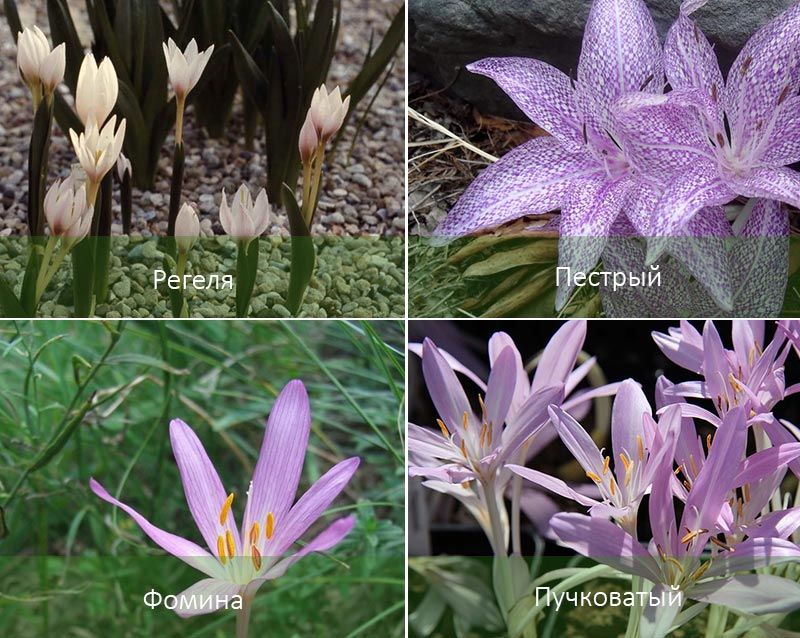
| Colchicum fasciculare |
Flowers form a bunch and grow back simultaneously with the leaves after the snow melts. 10-20. |
Pale pink or white. March-beginning of July. |
||
| Regel (Colchicum regelii, Colchicum kesselringii) | A miniature flower from 1-2 cm to 7-10 cm. It tolerates frosts down to -23°C. 5-10. |
Lanceolate with a rounded tip, narrow, with a groove, carved along the edge. | Snow-white with cherry-colored veins. March-April. | |
Autumn crocus and its species: magnificent and others, varieties
Autumn crocuses are more popular than spring crocuses. Common varieties are largely derived from the Colchicum magnificum species.
| View | Description/Height, cm | Height, cm | Leaves | Flowers |
| Agrippa (variegated) (Colchicum agrippinum) | Up to 3 buds on one stem, 2 cm in diameter. 40. |
Green, lanceolate, with a wavy edge. Appear in spring. | Purple. August-September. | |
| Bornmüller (Colchicum bornmuelleri) | Grows in the wild. It is listed in the Red Book. Up to 6 flowers, 8 cm in diameter.
12-15. |
Light green, grows along with the flowers. | Pink with a purple base. September-October. | |
| Magnificent (Colchicum speciosum) | Known since 1874, it is the origin of most modern varieties. Up to 3 buds per stem.
50. |
Green, 30 cm long, dry up in June. | Alboplenum. Terry, white. | |
| Atrorubens. Purple with a white center. | ||||
| Waterlilies. 9-10 purple double buds. | ||||
| Prime Minister. Pink. | ||||
| Huxley. Changes color from pink to cherry. | ||||
| Byzantine (Colchicum byzantinum) | Known since 1597. Not widely distributed. 12 buds grow on one bulb. |
20-60 |
10-15 cm wide and 30 cm long, lanceolate in shape, grow in spring. | White or purple. August-October. |
| Cilician (Colchicum cilicicum) | Known since 1571. Up to 25 buds grow on one bulb. | Green, lanceolate, they grow back in spring. | Pink-purple with a white base. September-October. | |
| Kotschy (Colchicum kotschy) | Renowned for its exceptional decorative qualities, it features small, numerous buds. 5. |
Short. | Delicately rosy. | |
| Variegated (Colchicum variegatum) | In clearings among stones. Up to 3 buds.
10-30. |
Narrow, lanceolate, glaucous in color, with wavy edges. Can creep. | Pink, cherry, purple, brown stamens. | |
| Autumn (Colchicum autumnale) | Temperate climate. Several buds grow on one bulb.
37. |
They grow back in spring and dry up in summer. | Lilac, white, light pink. 3-4 weeks. | |
| Shadow (Colchicum umbrosum) | Early. 10-15. |
Lanceolate, 15 cm long with a rounded apex. | Purple or pale cherry. Early April. | |
| Fomina (Colchicum Eformnii) | Grows in the wild. Listed in the Red Book. Stem with 7 buds.
20-30. |
Light green in color with fluff. | Lilac, violet. August-October. | |
Planting colchicum in open ground
Choose well-drained, loose, fertile soil. It prefers moist, shaded spots among trees or shrubs, though sun exposure is occasionally possible. It can occupy the same spot for 5-6 years. As it matures, several young bulblets (pupae) appear in the nest, and flowering becomes less profuse. During this period, the plant requires repotting.
Planting dates
Flowers are primarily autumn-blooming and are planted beginning in the second half of August. Some species bloom in the spring and are planted later, in the fall.
Rules for planting colchicum
Prepare the planting bed in advance. Add a bucket of humus and sand (1 bucket per square meter) to the soil, then add superphosphate (100 g/sq.m.) and ash (1 l).
Before this, the bulbs are treated with Maxim: one 4 ml sachet per 2 liters of water. The prepared preparation is sufficient for treating 2 kg of planting material.
Small corms are planted at a depth of 6-8 cm, while larger ones are planted at a depth of 10-15 cm. A layer of sand is added under each corm, spaced 20-30 cm apart. After planting, water the flowerbed thoroughly. The tube growing from the corm should be raised above the surface and should not be torn off.
When working, remember that the flower is poisonous and must be handled with care, protecting your hands from accidental contact with the juice.
Methods of propagation of colchicum
The flower is propagated using young shoots and seeds.
Reproduction by babies
Step by step:
- After the foliage has dried, dig up the bulbs.
- Dry in a shaded, ventilated place for a month.
- Remove any remaining roots and leaves.
- On August 15-25, plant in a flowerbed, deepening by three times the depth.
- Large colchicum bulbs planted on time bloom in the first season.
Growing Colchicum from Seeds
When propagating by seeds, it is worth considering that this method is laborious, so it is rarely used, mainly for propagating rare species, especially spring-flowering ones.
Sow seeds outdoors immediately after harvesting. Pre-soak in a growth stimulant (Zircon or Epin: 40 drops per 1 liter of water). When sowing store-bought seeds, pre-stratify them in a damp cloth in the refrigerator for several days.
Seedlings germinate unevenly, taking several years. Flowering is also slow, taking 6-7 years with good care.
Agricultural technology comes down to timely weeding, loosening and watering.
Caring for colchicum after planting
Caring for the flowers is easy. It's important to monitor soil moisture. Despite their winter hardiness, they can freeze in snowless winters, so it's worth mulching them with suitable materials: dry leaves, humus, or compost to a depth of 10 cm.
Watering
Colchicum doesn't require watering. In spring, the soil is sufficiently moist; in summer, its leaves die back. If moisture is insufficient in the fall, water the plant, being careful not to touch the petals.
Top dressing
If the soil was sufficiently fertilized when the bulbs were planted, subsequent fertilization is only necessary in the spring. The first fertilization is done over snow with ammonium nitrate (10 g/m2). The second fertilization is done in early May with potassium sulfate (15 g/m2).
Transfer
Colchicum is repotted once every 2-5 years. This is indicated by the shrinking and smaller size of the flower buds.
The soil is prepared in advance in June. The soil preparation is the same as for planting young seedlings.
The better the soil is fertilized, the better the bulbs develop and the more beautiful the flowering.
After the leaves have dried at the end of June, the flowers are dug up, sorted, and cleared of any remaining roots. They are then separated and soaked in a potassium permanganate solution for 30 minutes. The planting material is dried and stored in a shaded, ventilated area (temperature no higher than 25°C) until planting in August.
Pests and diseases of colchicum
During prolonged rainy weather, flowers can be damaged by botrytis, a gray mold that affects plants. An outbreak of the disease is also possible if the flower is overwatered or if the groundwater level is high. Dying leaves are usually the first to be affected.
To combat the disease, use one of the following preparations; add to 10 liters of water:
- Topaz 2 ml;
- Cuproxate 50 ml;
- Champion 30 years
Colchium can be damaged by slugs and snails, which enjoy feeding on the leaves. To repel them, sprinkle pebbles, small stones, eggshells, and pine needles under the plants.
It is a good idea to place containers of water around the perimeter of the plantings, which will also prevent them from moving.
Top.tomathouse.com recommends: medicinal properties of the plant
Colchicum is used not only as a flowering plant but also as a medicinal plant. In folk medicine, it is used as a laxative and diuretic. It is used to relieve pain in gout and rheumatism.
The plant is poisonous and should be taken with great caution.
In official medicine, tablets, ointments and tinctures are used to help with oncological and neurological diseases.
This beautiful plant delights the eye after the snow melts. It successfully helps combat complex diseases. It's worth planting in your garden and enjoying it in the spring or fall.