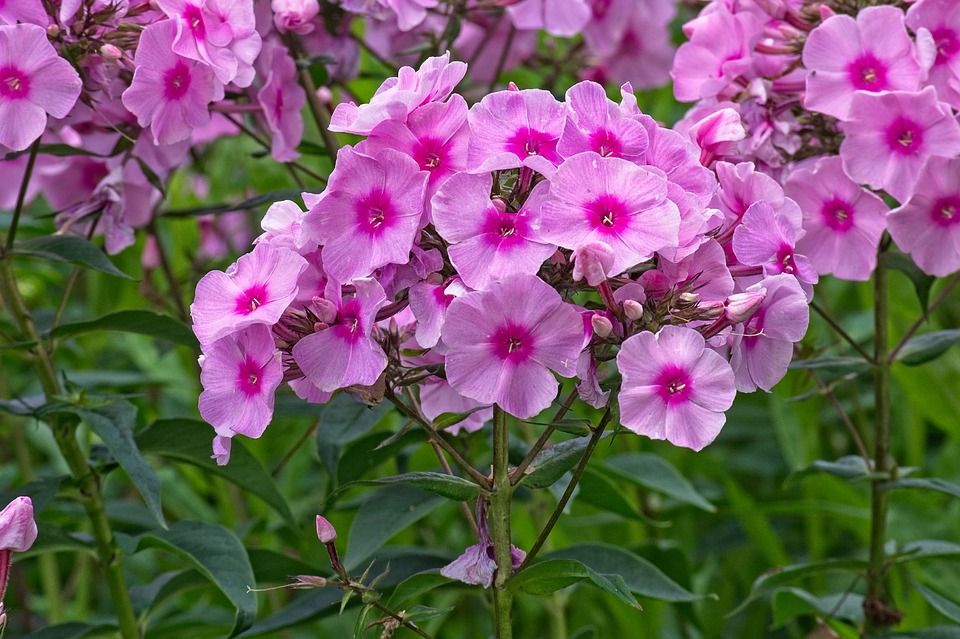
Phlox are flowering herbaceous plants belonging to the Polemonium family. They are native to northern America and Russia.
Content
Description and Features
Phlox from the same species can vary due to climate conditions. For example, high-mountain phlox grow from 5 to 25 cm tall and are mossy. Their trunks are branched and covered with evergreen foliage. In favorable climates, phlox stems become straight, reaching heights from 30 cm to 1.8 m. The leaves are opposite, and their shape is elongated-ovate or lanceolate-oval. The buds are tubular-funnel-shaped, 25-40 mm in diameter.
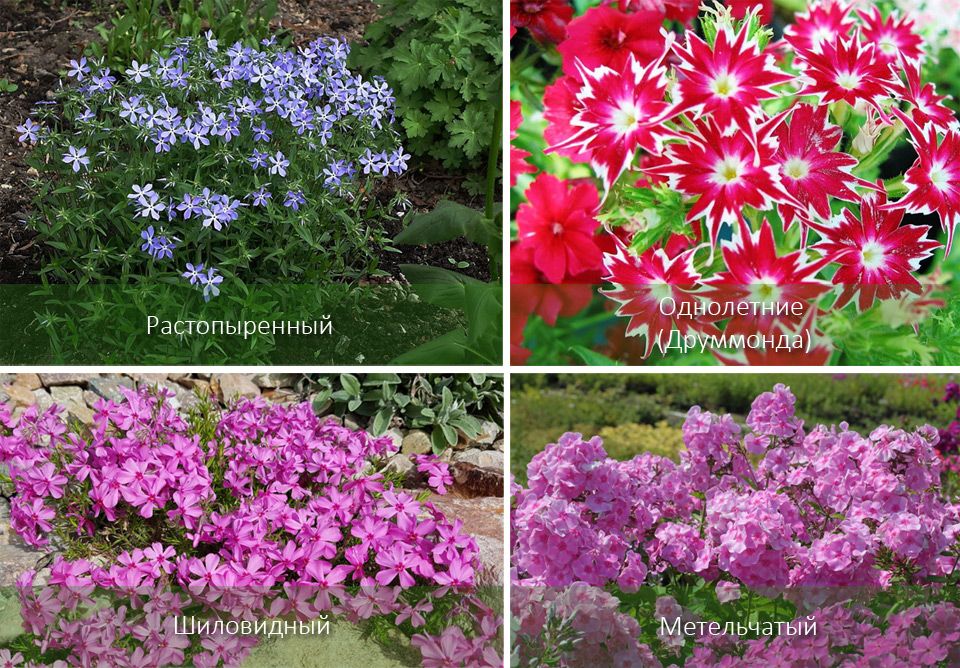
Most species are perennials, but Drummond phlox and its varieties are annuals.
Phlox subulata, paniculate, spreading and annual: description
There are several dozen varieties of phlox, but they are all divided into 4 separate groups:
| View | Description | Peculiarities | Usage |
| Subulate | A perennial with stems reaching 20 cm. Narrow, needle-like foliage up to 20 mm long. Green in color (lasting almost until the first frost). Flower buds are blue, purple, and crimson. Flowering period: from late spring to July. |
Low-growing and groundcover species | They decorate alpine slides and create compositions in rock gardens. |
| Splayed | The trunk is 20 to 40 cm tall. The flowers are small, with wide edges that taper toward the center. The color ranges from white to purple. The foliage is elongated (up to 50 mm long) and stiff. Flowering period: May-June. |
The most unpretentious of all phlox varieties. It has a rich, pleasant aroma. | In the landscape sector. |
| Paniculate | Grows from 40 cm to 1.5 m. The foliage is lanceolate, elongated, and reaches 6-15 cm in length. The trunk is erect. The inflorescences are spherical. Flowering – from mid-summer to September. |
The most popular. It has a wide variety of cultivars and colors. | For decorating home gardens. |
| Annuals (Drummond) | The stem is up to 30 cm. The petals have slightly pointed tips. Flowering period lasts from June until the first frost. |
Grown exclusively from seed. It has a delicate scent. | In rockeries and alpine hills, they decorate flower beds. |
Annual phlox: varieties with photos and names
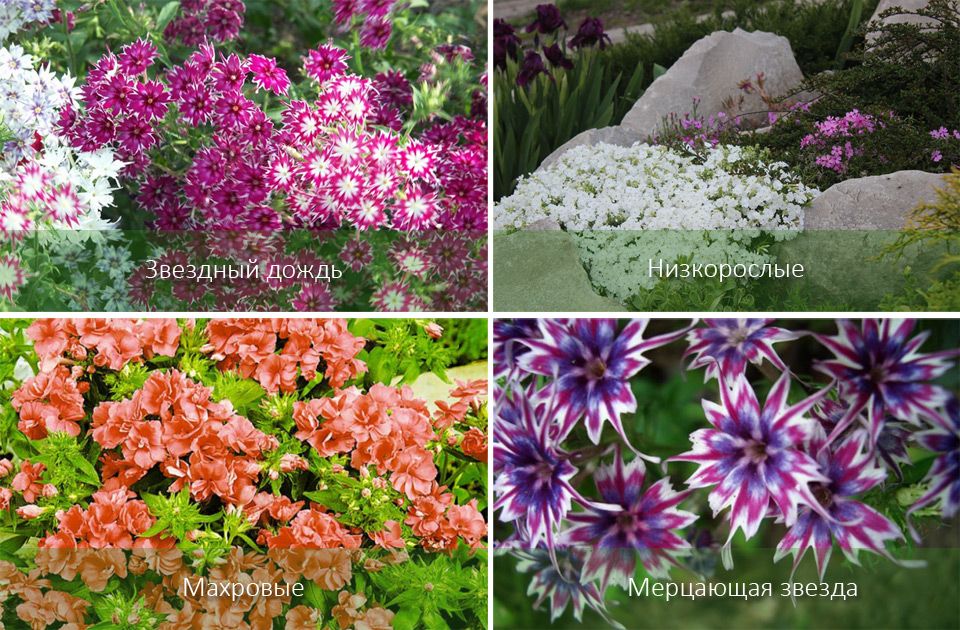
Drummond phloxes became the founders of several unique varieties:
| Variety | Description | Flowers | Bloom |
| Star rain | Resistant to cold and drought. It resembles a shrub, growing to a height of about 50 cm. The stems are straight and lateral. It has a rich, fragrant aroma. Grow only in well-lit areas. | The inflorescences are star-shaped and pink. | From June until the end of summer. |
| Twinkling Star | A miniature variety with a shrub height of up to 25 cm. Often grown in apartments and placed on loggias and balconies. | The petals have sharp ends. | From June to September. |
| Terry | One of the youngest species. Height – up to 30 cm. | Large, double flowers. They form dense inflorescences. Color ranges from cream to deep red. | From late spring to August. |
| Short stature | A young variety reaching 20 cm in height. The bushes are branched. The foliage is drooping. It is often grown on balconies. | Small, beige. | May – June. |
| Constellation | It branches out, forming lush shrubs. It has a fragrant aroma. | Color ranges from white to burgundy. Diameter is approximately 30 mm. | Late spring – August. |
| Promise Pink | A low-growing variety with a trunk reaching 20 cm. It is used for decorating flowerbeds and rock gardens. | Terry, pink. | May – July. |
Subulate phlox: varieties with photos and names
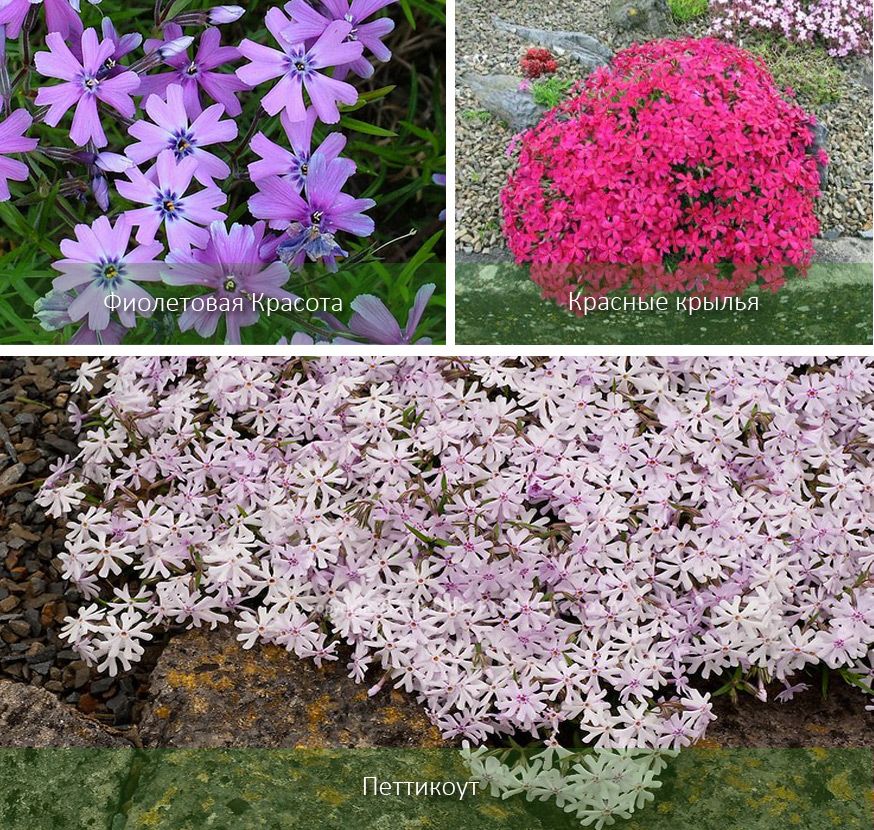
Subulate phlox is also divided into several interesting varieties:
| Variety | Description | Flowers | Bloom |
| Purple Beauty | A perennial plant, planted only in well-lit areas. Height: up to 17 cm. | Colour: from bright lilac to violet. May – June. | When the tops are trimmed, repeated flowering is observed closer to September. |
| Petticoat | The trunk reaches 20 cm. It is planted in well-drained soil filled with sand and small pebbles. It is frost-hardy and thrives in temperatures down to -20°C. | Forked, white. They resemble stars in appearance. The center is blue, violet, or purple. | From late spring to June. |
| Red Wings | The shrub grows up to 20 cm. It is resistant to both high and low temperatures and has a pleasant aroma. | Hot pink. | May – June. With proper care, a second flowering will occur in September. |
Phlox variegata: varieties with photos and names
Spreading phlox is divided into the following varieties:
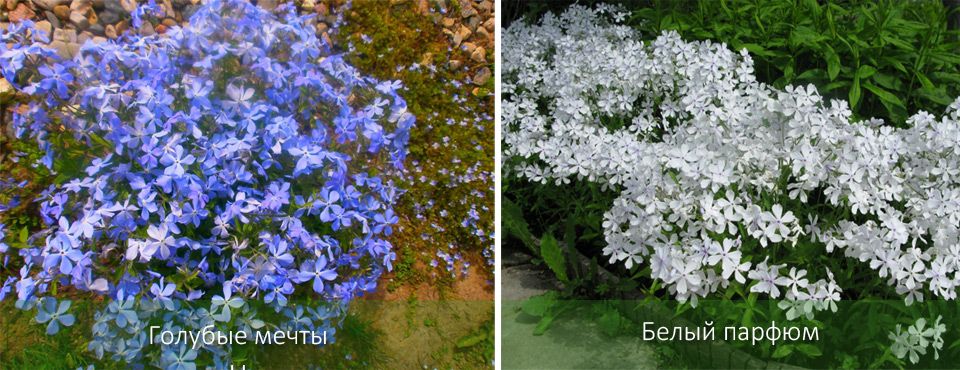
| Variety | Description | Flowers | Bloom |
| Blue dreams | A winter-hardy plant with a rich, pleasant scent. Propagated by lateral shoots. | Small, blue. | From late spring to June. |
| White perfume | The trunk is up to 30 cm tall. It is grown under trees and bushes. Frost-resistant. | Small, snow-white. | May-July. |
Phlox paniculata: varieties with photos and names
Paniculata phlox is the founder of the following varieties:
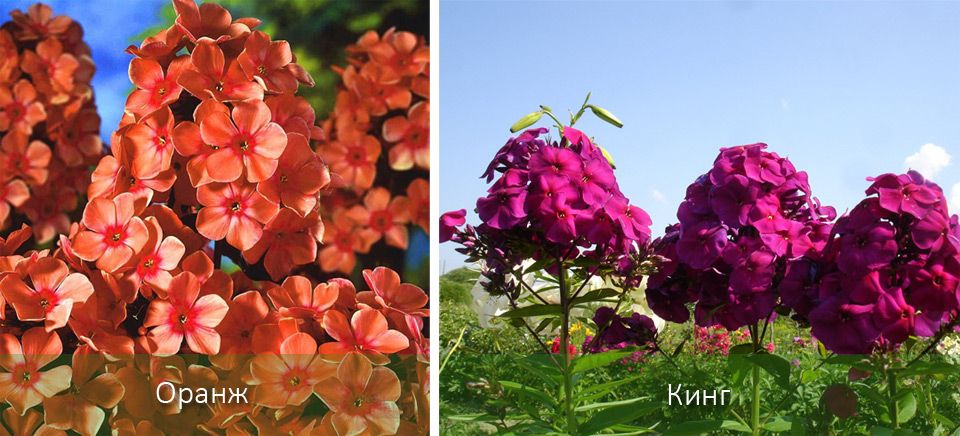
| Variety | Description | Flowers | Bloom |
| Pure Feelings | The trunk height is from 70 to 80 cm. | Double, white with a green stripe down the center. The lower part of the bud has a lilac hue. The petals are elongated and slightly twisted. | July-September. |
| Natural Feelings | The stem reaches 50 cm. | Small, greenish-white-pink. Lilac-shaped. | |
| Orange | The variety is undemanding to care and easy to propagate. | Red-orange. | |
| King | Grows up to 1 m. | Large, about 4 cm in diameter. Color ranges from white to crimson. |
Reproduction
Propagation of these flowers is carried out by green or autumn cuttings, as well as seeds.
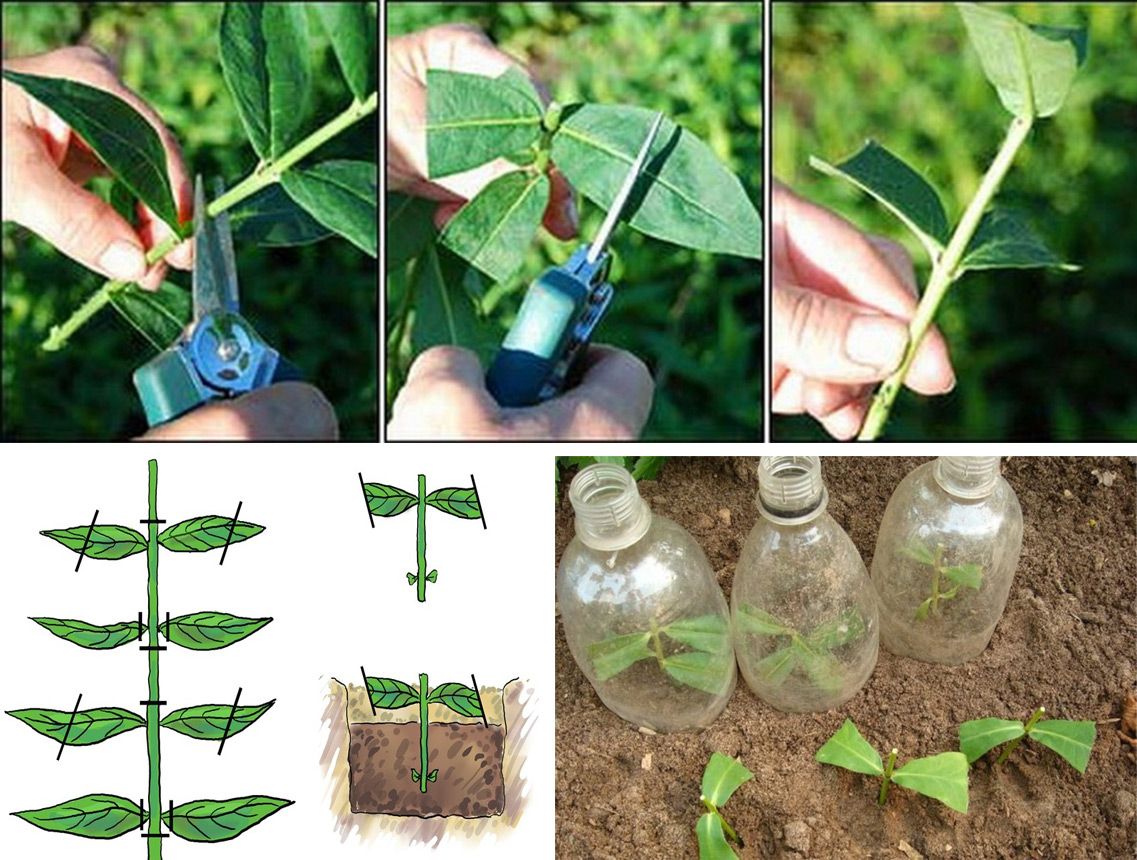
The first type of shoots is harvested in late spring, when the phlox grows to 12-15 cm. The procedure is carried out according to the following plan:
- The shoots are cut off, leaving 2-3 developed buds on the mature bush.
- The cutting is placed in water for 60 minutes. This improves rooting and reduces the risk of the plant wilting.
- The shoot is cleared of underlying foliage, shortened by 50%, and cut below the bud. The final length of the planting material is 6-10 cm.
- Place the seedlings in open ground in a shaded area or in a greenhouse. Plant them 10-15 mm deep and compact the soil slightly. Cover with a layer of damp paper for better rooting.
Autumn cuttings are prepared in late summer or early September. For this, sections of young shoots are cut and prepared in the same way as the previous method. They are placed in heated greenhouses or hotbeds. When transporting to their permanent location, they are planted well deep, ensuring that most of the buds are underground.
Phlox seeds have a high germination rate, so they are sown outdoors in September. They can also be planted in cold weather, using special containers that are then transported to a cold location for stratification. They are then brought into a warmer location to thaw, and the seedlings emerge uniformly.
Differences in planting annual and perennial phlox
Planting phlox, whether annual or perennial, is virtually identical, with just a few nuances. For example, the spacing between annuals should be greater, as they grow larger over the years. Between low-growing varieties, the spacing should be up to 40 cm, between medium-growing varieties – up to 0.5 m, and between tall varieties – at least 0.7 m.
Perennials must be covered with a layer of mulch for the winter, but annuals do not need this.
When planting and caring for these flora representatives, it is recommended to adhere to a number of rules:
- The ideal site for growing phlox should be shaded, level, and have drainage. When planting near trees or shrubs, protect the plant from direct sunlight and hot winds.
- The soil should be loose, nutritious, and well-moistened. Insufficient water leads to increased salt levels in the soil, which causes foliage to brown and wilt. Avoid planting phlox in clay soil.
- The site is prepared in advance; if the planting is in spring, then this is done in September, and vice versa.
Caring for annual phlox
Caring for annual phlox is quite simple. The soil around the flowers is gently loosened and hilled 6 to 8 times per season.
Organic and mineral nutrients are added to the soil. The initial fertilization is done with liquid manure in late spring. The second, in June, is a mixture of superphosphate and compost. The third, in midsummer, is the same fertilizer used in May. The fourth, in August, is a mixture of potassium salt and phosphorus.
Caring for perennial phlox
During flowering, water the plant every 2-3 days. During extremely hot and dry summers, increase the frequency of watering. After each watering, thoroughly loosen the soil.
When the flowers are still young, they are regularly cleared of weeds. This is done after watering, as moist soil is much easier to work with.
Perennials require constant feeding, so in May, nitrogen-based fertilizers are applied to accelerate the process of developing healthy green mass. Then, a potassium and phosphorus fertilizer is applied to ensure abundant flowering.
When caring for phlox in temperate climates, they are protected for the winter. Before frost sets in, the bushes are cut back almost to the rhizome and then mulched with organic matter and straw.
Transplantation is carried out every 6-7 years.
Diseases and pests
Perennial phlox suffer from virtually all the diseases common to other flowering plants. The most common pathologies include the following:
- Phoma blight causes the leaves to turn yellow and curl, and the stems to turn brown and crack. To control the disease, spray with Bordeaux mixture. Repeat the treatment four times, every 10 days.
- Powdery mildew – a white coating appears on the leaves. Treatment is the same as for leaf spot. For prevention, treat phlox shoots with a potassium permanganate solution in the spring.
- Spotting – yellow and brown spots. Treatment is similar to other diseases described above.
The plant is resistant to pest attacks, though slugs can occasionally infest it. If pests are identified and eliminated promptly, phlox will delight you with their healthy appearance and vibrant blooms for a long time.