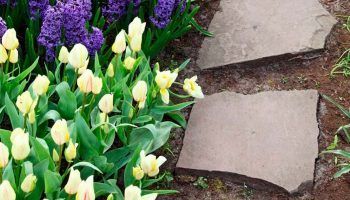
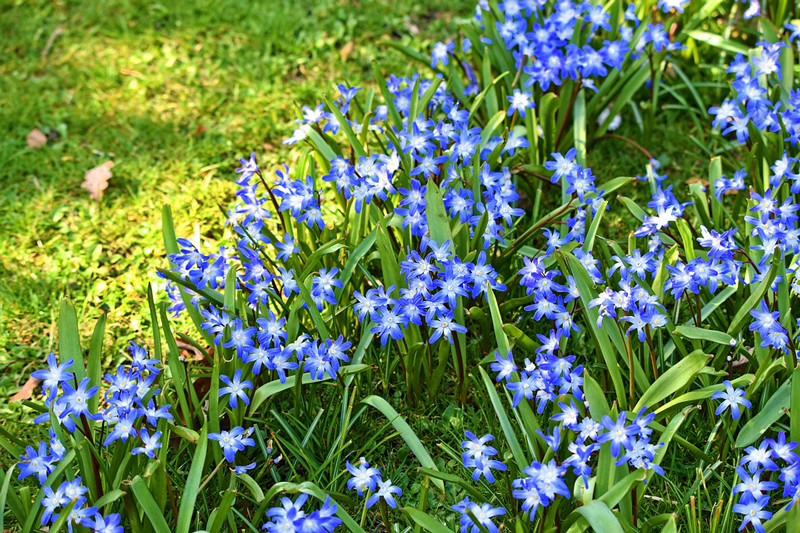
Chionodoxa is a low-growing perennial plant belonging to the Liliaceae family. It is native to Crete and Asia Minor.
Content
- 1 Botanical description
- 2
- 3 Chionodoxa lucilii and other species
- 4 Chionodoxa blue giant and other varieties
- 5 Time for planting in the ground
- 6 Planting Chionodoxa
- 7 Caring for Chionodoxa
- 8 Transplantation and propagation
- 9 Diseases and pests
- 10 Top.tomathouse.com recommends: Chionodoxa in landscape design
Botanical description
A bulbous plant that produces both flower stalks and dark green basal foliage:
- shape – broadly lanceolate or grooved, length – up to 12 cm.
- The buds are bell-shaped, ranging in color from white to blue. The fruit is a juicy capsule containing black seeds.
- The bulbs are ovoid, 30 mm long and 1.7 cm wide. They are covered with small light scales.
Chionodoxa lucilii and other species
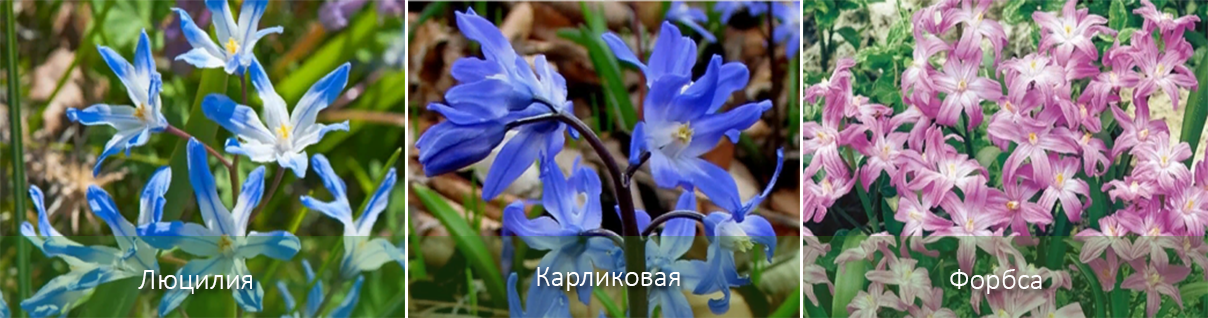
There are 6 varieties of Chionodoxa suitable for home cultivation:
| View | Description | Leaves | Flowers Flowering period |
| Giant (large-flowered) | Native to Asia Minor. An easy-to-grow bulb, it has an oval shape and a diameter of 1 to 3 cm. It is considered the progenitor of varieties with white and blue flowers. | Narrow, basal, length – from 9 to 13 cm. Shape – linear, color – dark green. | Paired, with shortened peduncles. Buds up to 6 cm in diameter, blue or deep lilac, with a pale blue throat. Flowers bloom in March-April, lasting about 3 weeks. |
| Lucilia | A round or elongated bulb, about 2 cm in diameter. It was brought to Europe in 1765. The plant is unpretentious and winter-hardy. | Linear, shortened. | Small, with pointed petals. Color: milky or blue. Flower stalks contain 3 to 5 buds. Blooms early in spring, lasting about 2 weeks. |
| Sardinian (Sardanian) | An early variety. A brown, round bulb, about 2 cm in diameter, covered with scales. | Linear, bright green. | Small, deep blue flowers with a light creamy transition to the throat. Flower stalk up to 15 cm long. Flowers appear in the first ten days of spring, lasting up to 2 weeks. |
| Dwarf | The smallest representative of the genus. Widely used to decorate multi-tiered flowerbeds. | Large, low-growing. Shape: linear. | The buds range in color from light blue to pale pink, with a diameter of up to 2 cm. April-May. |
| White | Brown bulb up to 2 cm in size. Does not tolerate shaded areas. | Linear, dark green. | Medium-sized, flowers range in color from white to lilac-pink. Buds are up to 1 cm in diameter. Early spring, blooming lasts about 2 weeks. |
| Forbes | The most popular variety. Discovered in 1880 in Turkey, it is grown in peaty and well-drained soil. | Linear, shortened. | Blue, white center. Bud diameter: up to 2.5 cm. March. |
Chionodoxa blue giant and other varieties
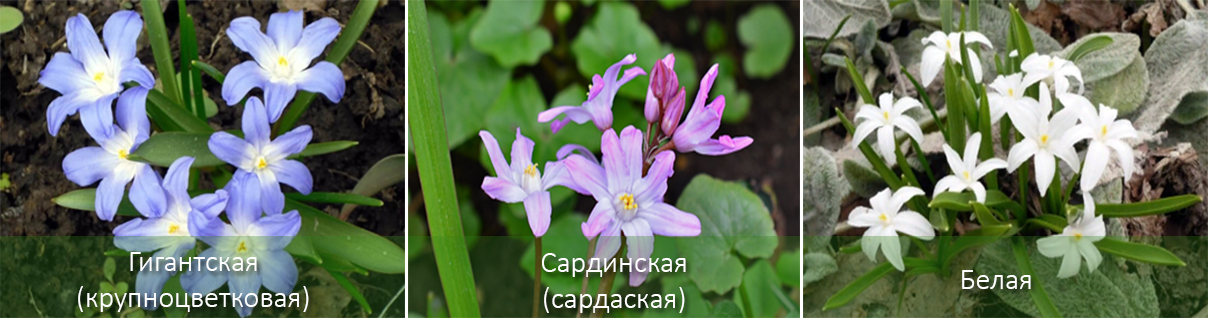
Several original varieties have been developed from these species of Chionodoxa:
| View | Description |
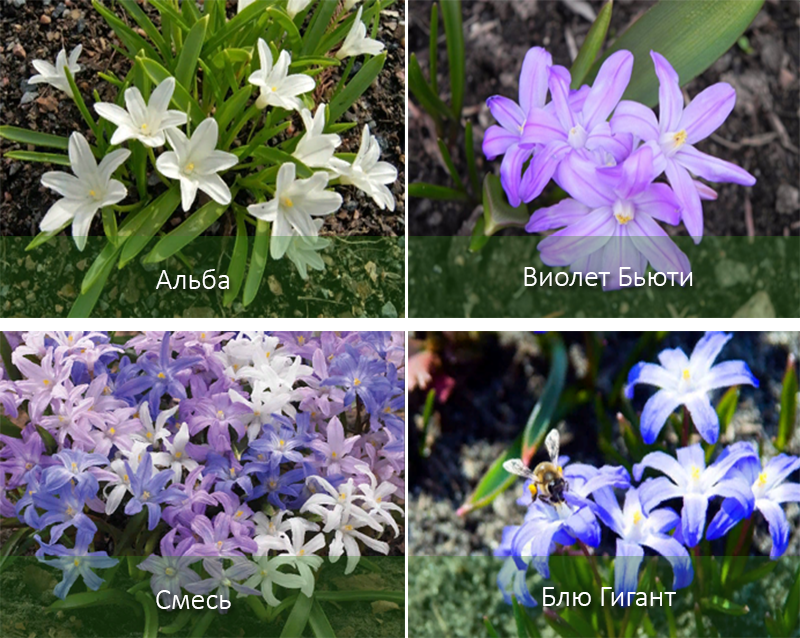
| Violet Beauty | A bulbous perennial with bell-shaped buds. The flowers are purple, with a milky throat. |
| Blue Giant | A perennial with small, bright blue flowers and a white center. The trunk grows up to 15 cm. The foliage is upright. |
| Mixture | A low-growing plant with buds in various shades (from white to deep purple). |
| Alba | Perennial plant up to 14 cm high. Foliage is straight, linear. |
Time for planting in the ground
The optimal time is early autumn, when root-like ridges form on the flower bases. Choose areas with good sun exposure or partial shade.
Planting Chionodoxa
The baby bulbs are placed at a depth of 80 mm, with a distance of about 50 mm between them.
The seeds are sown in pre-made trenches, deepening them by 20 mm (the first flowering is expected only next year).
The plant tolerates transplanting well, so even perennial shrubs can be easily divided. For fall planting, chionodoxa bulbs are removed from the soil in mid-July and stored in a dry, shaded area.
Caring for Chionodoxa
If the planting location is well chosen, the flower does not require special care.
If possible, after the foliage appears, the soil around the flower is carefully loosened and old grass is removed.
Watering is not necessary, especially when planting in central Russia, where the soil is well saturated with moisture at this time. Fertilize with a complex mineral fertilizer, applying it before the foliage begins to yellow.
After the end of the growing season, these plants no longer require care in the open ground.
Transplantation and propagation
The most popular method of propagation is division of the mother bulb; over the summer, about 4 baby bulbs are produced.
Without changing its location, the flower can grow for up to 10 years, but once every five years its nests are torn apart, divided into several parts and replanted.
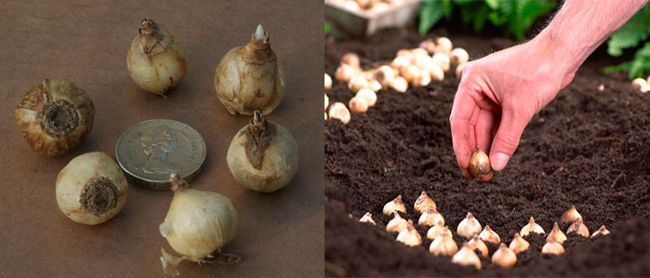
The bulb is removed from the ground in midsummer, when the above-ground portion of the chionodoxa turns yellow and dries out. It is transplanted into the ground in August or September.
Propagating the plant by seed is not the best option, as these flowers effectively increase their numbers by self-seeding: the planting material has a fleshy area that is attractive to ants, who carry it beyond the garden.
Diseases and pests
Since chionodoxa is a bulbous plant, it suffers from the following range of diseases:
- fungus;
- gray and white rot;
- Achelenchoides;
- fusarium.
These diseases directly damage the bulb, and damage is indicated by yellowing and wilting, which is impossible to reverse. Before planting these flowers, the planting material is treated with Fundazo.
They also prevent waterlogging in the soil, as this leads to root rot, which is accompanied by brown necrotic spots. Such plants grow poorly and rarely bloom, and their appearance is unhealthy.
Among pests, rodents and root mite larvae pose a danger.
To get rid of insects, spray the shrub with acaricides such as Akarin, Actellic, or Aktara. Mice and moles are driven away by placing poisoned baits around the area.
Occasionally, chionodoxa is attacked by slugs, which are removed manually.
Top.tomathouse.com recommends: Chionodoxa in landscape design
Its decorative qualities, attractive appearance, ease of care, and long flowering period are the reasons why the plant is widely used in garden decoration.
Natural rockeries and alpine slides help the chionodoxa to reveal its beauty even better, and when planted near a spreading tree, the flower looks especially picturesque.
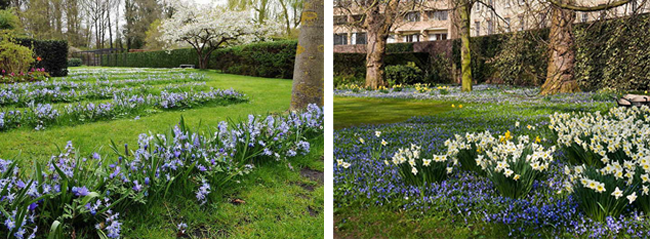
They are used to decorate flowerbeds in combination with other perennials. They are planted next to primroses, liverworts, and hellebores. They are considered quite harmonious when combined with daffodils, dwarf irises, and crocuses.