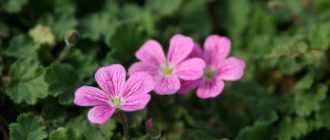
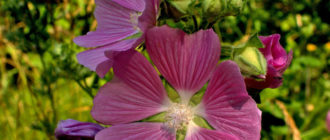
Delphinium (Larkspur, Larkspur) is an annual and perennial plant belonging to the Buttercup family.
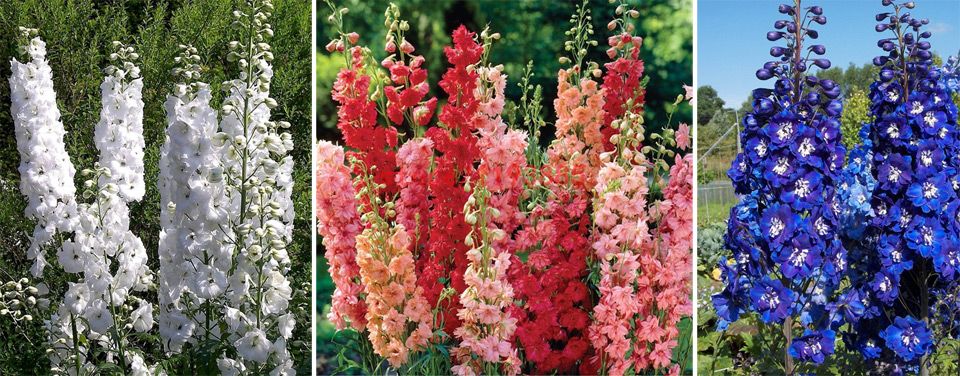
Native to Africa and Asia, there are about 400 species.
Content
Description and characteristics of delphinium
Generally a tall, upright plant with deeply dissected leaves. Only the alpine species are low-growing.
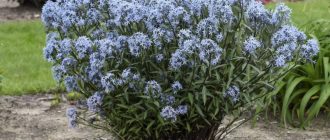
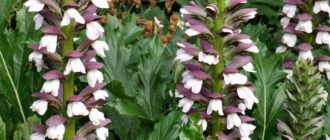
Flowers typically consist of five sepals, one of which is cone-shaped and slightly curved, resembling a spur. In the center is an eye, distinct from the main flower and usually darker. The inflorescences come in all shades.
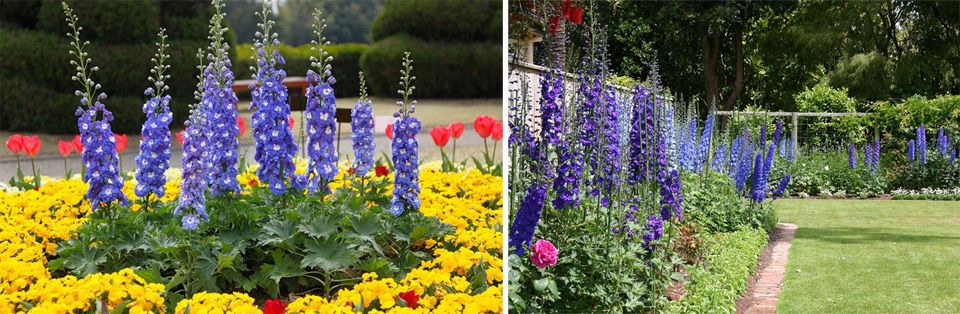
The larkspur's distinctive features are used in landscape design, covering unsightly areas of a plot or in the background of a mixed border. Larkspur also looks magnificent when planted alone, for example, in the center of a lawn.
The main types and varieties of delphinium
There is a wide variety of natural, cultivated, and cultivars of delphinium. They are either annual (about 40 species) or perennial (approximately 300).
Annual delphinium
Annuals bloom much earlier than perennials (July) and continue to bloom until the end of September.
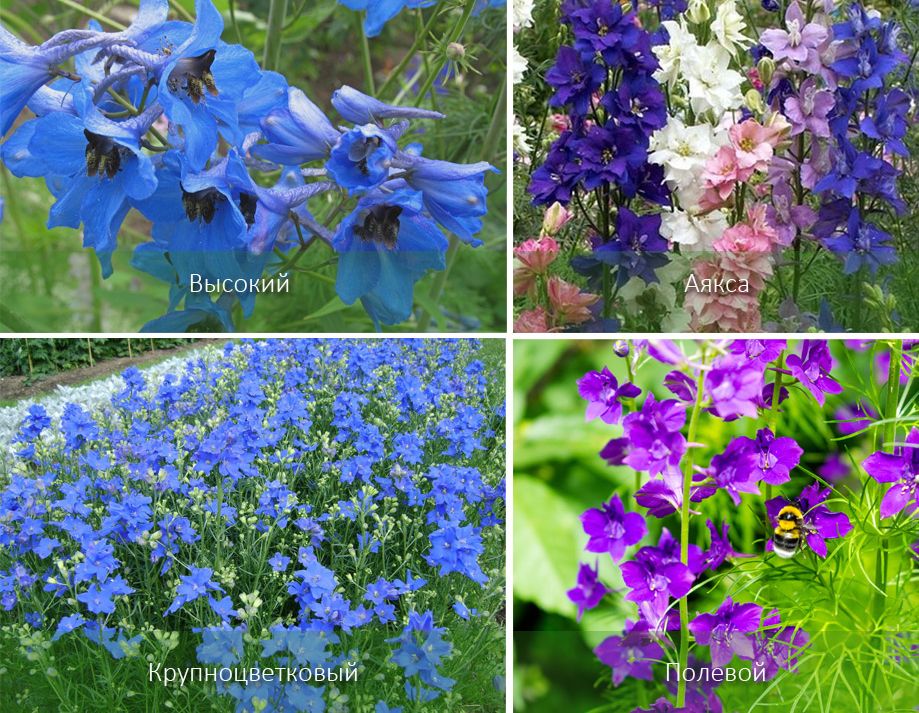
| View | Description | Leaves | Flowers |
| Field | Branched, erect, pubescent, up to 80 cm. | Ternary with linear lobes. | Up to 4 cm in all shades of blue, collected in brushes with curved spurs up to 2.5 cm. |
| High | Up to 3 m, erect, frost-resistant. | Hairy, palmate, green, 15 cm, rounded. | Numerous, ultramarine, up to 60 pieces, with an open corolla. |
| Large-flowered | Branched, erect, pubescent, up to 80 cm. | Ternary with linear lobes. | Up to 4 cm in all shades of blue, collected in brushes with curved spurs up to 2.5 cm. |
| Ajax | Up to 110 cm, straight, branched. | Sessile, deeply dissected. | Various colors. |
Perennial delphinium: New Zealand and others
Perennial delphiniums are hybrids obtained by crossing annual plants. They come in over 800 shades.
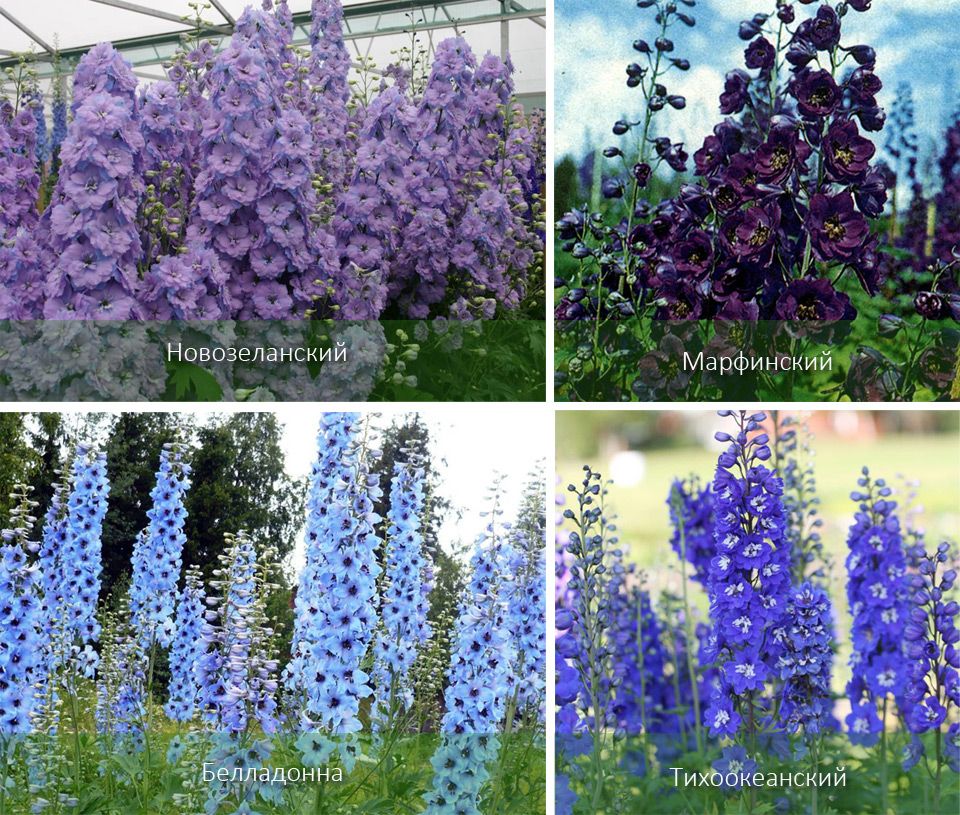
Flowers are double and single, height depends on the variety.
| View | Description | Leaves | Flowers |
| New Zealand | Plants are 2 m tall. Frost- and disease-resistant. Used for cutting. Varieties: Giant, Roksolana. |
Spreading green leaves. | Terry, semi-double (about 9 cm). |
| Belladonna | Height 90 cm. Sometimes blooms twice a year.
Varieties: Piccolo, Balaton, Lord Battler. |
Green, 7 segments. | Blue, purple inflorescences of small 5 cm flowers. |
| Pacific | Tall, herbaceous, up to 150 cm.
Varieties: Lancelot, Blue Jay, Summer Skies. |
Large, heart-shaped, dissected. | 5 sepals, 4 cm, indigo, with a black eye. |
| Scottish | Up to 1.5 m, erect.
Varieties: Flamenco, Moonlight, Crystal Shine. |
Dissected, large. | Super-double, more than 60 petals of all the colors of the rainbow, brushes up to 80 cm. |
| Beautiful | 1.8 m, erect, pubescent, foliated. | Palmate, dissected into 5 parts, serrated. | Blue, petals 2 cm, dense, black center, dense brushes. |
| Marfinsky | Decorative, frost-resistant, tall.
Varieties: Morpheus, Blue Lace, Pink Sunset, Spring Snow. |
Large, dark. | Semi-double, large with a bright core |
Growing delphinium from seeds: when to plant
Delphinium seeds lose their germination capacity very quickly, so store-bought ones sometimes don't germinate at all.
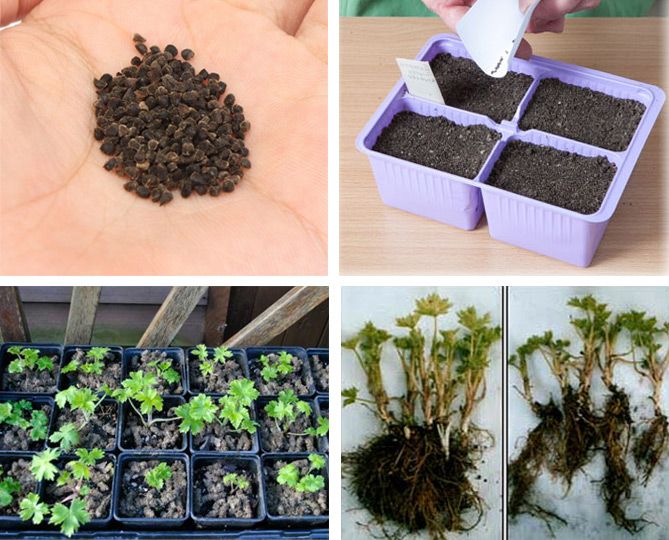
Many gardeners prefer to collect their own seeds and then grow plants from them.
- They are stored in the refrigerator before planting.
- Sowing is carried out in February.
- The planting material is disinfected by placing it in a pink solution of manganese for half an hour or by treating it with a fungicide.
- Rinse with cold water. Treat with a growth stimulant for 24 hours.
- Prepare a soil mixture of peat, garden soil, humus and sand in a ratio of 2:2:2:1.
- They calcine the soil to destroy pathogenic microbes and weed spores.
- The containers are treated against microorganisms with the same means as the seeds and filled with soil.
- Sow delphinium seeds on the surface. Cover with 1.5 centimeters of soil. Firm the soil. Water the plants carefully.
- Cover with polyethylene film, glass or spunbond, and then with a dark covering material that does not allow light to pass through.
- Place the seed boxes on the windowsill. Grow at a temperature of +10…+15 ºC.
- To improve germination, stratify the plants by placing them on a closed balcony for 14 days. The boxes are then returned to the windowsill.
- Inspect the pots periodically. If the soil is dry, spray it. If it's damp, ventilate it to prevent rot.
- After 1-2 weeks, after the first shoots appear, remove the protective materials, giving the plants access to light.
- When three true leaves appear, thin out the seedlings. Replant any remaining plants into 9-cm diameter pots.
- Water once a week or if the soil is dry, avoiding over-watering.
- During seedling growth, root feeding with mineral fertilizers is carried out once every 14 days.
In the first week of May, the plants are moved to the glazed balcony and placed in a bright spot. The balcony is periodically ventilated to acclimate the seedlings to fresh air.
If the flower boxes are already at the dacha, they are placed near a warm wall and covered with spunbond. In late spring, the seedlings are transferred to open ground using a transshipment method to avoid disturbing the root ball.
Planting delphinium in open ground
Before planting, prepare the soil by digging and adding compost or manure. Then, dig planting holes 80 cm apart and add fertilizer, such as ammonium nitrate.
The plants are removed from their pots, taking care not to damage the roots. They are watered, and the soil is mulched with sawdust or dry grass.
For a more secure planting, tie the plants to a support. Three sticks per bush are sharpened and driven into the soil beyond the roots. They are tied with narrow ribbons or fabric.
Wire is not used as it can damage the flower stems.
Delphinium care
Lanceolus is cared for like other flowers. The soil is loosened periodically and weeds are removed. When the plants reach a height of over 30 cm, the bushes are pruned, leaving the strongest stems. Weak stems are discarded, and cuttings are taken from the remaining shoots and grown. Removing weak shoots allows the bush to ventilate, preventing infection by gray mold and fusarium. Next, tie the plants at intervals of 40 cm. Water them weekly, adding three buckets of water. Then, when the soil dries out, hill them up.
Delphiniums are checked periodically for diseases, as powdery mildew may appear during wet summers.
To avoid problems, potassium and phosphorus fertilizers and fungicides are applied.
Delphinium after flowering
To ensure that the plant blooms continuously every year, the plantings are replanted, thinned out and rejuvenated every 3 years.
In the fall, after the leaves turn yellow, the delphinium is cut back, leaving 30 cm of stems. The cut is sealed with clay or ash to prevent water from seeping into the hollow stem tubes. Less cold-hardy varieties should be covered.
Propagation of delphinium
Annual varieties are grown from seedlings. Perennials can be propagated by cuttings or division.
Cuttings
Cuttings are taken from the heel and treated with the growth stimulant Kornevin or Zircon. A mixture of sand and peat is prepared in planting trays. The cuttings are placed at an angle to the soil surface, moistened, and covered with plastic wrap or covering material. The cuttings take up to six weeks to root. Then, wait another 14 days and transplant the sprouted plants into flowerbeds.
Dividing the bush
This is done in August. Four-year-old bushes are selected for division. They are dug up and cut with a sharp knife. The cut is sprinkled with ash or a growth stimulant. Then, the bushes are planted in a permanent location, following the planting instructions.
Top.tomathouse.com warns: delphinium diseases and how to deal with them
With good care and favorable weather conditions, the larkspur delights its owner with lush flowering.
But there are times when yellow leaves or spots appear on the plant, and it dries up. Then the plant is checked for diseases and treated.
- Aster jaundice is spread by insects. Affected plants are removed.
- Ring spot. Leaf dieback and stunted growth are observed. Disease-carrying insects and affected leaves are removed from the bush.
- Black spot develops in cool, damp weather. Diseased parts are destroyed, and debris around the plant is removed in the fall.
- Bacterial wilt causes the lower part of the stem to turn black and form slime. It occurs when seeds are planted incorrectly. Before germination, seeds are soaked in hot water.