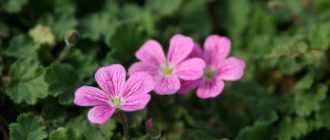
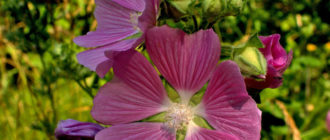
Lychnis is a perennial plant with dense foliage and brightly colored small flowers. It is commonly known as lychnis or adonis. It is a member of the Caryophyllaceae family and is native to southern Europe.
Description of Lychnis
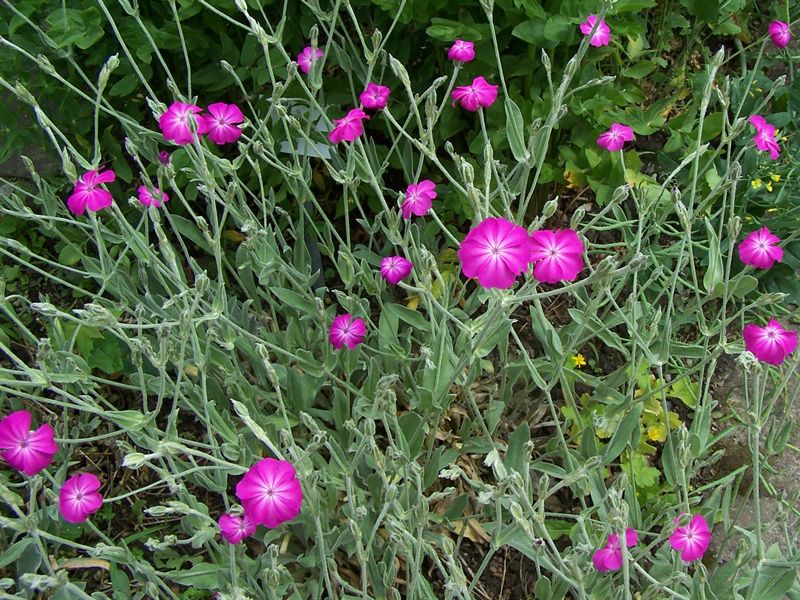
A plant with an erect, reddish or greyish, densely drooping stem, reaching 40-100 cm.
It has a robust root system. The leaves are long, tapering at the edges, and arranged alternately along the stem. They are dark green in color.
The stem ends with an inflorescence of small tubular flowers ranging in color from white to scarlet (pink and purple are common), gathered in heads or corymbs. Flowering can last about a month. Adonis can be grown in a single pot for about five years.
Lychnis coronata, Lychnis chalcedonica and other species
More than 30 varieties of Lychnis have been bred. Only a few are planted in gardens:
| View | Description | Leaves | Flowers
Flowering period |
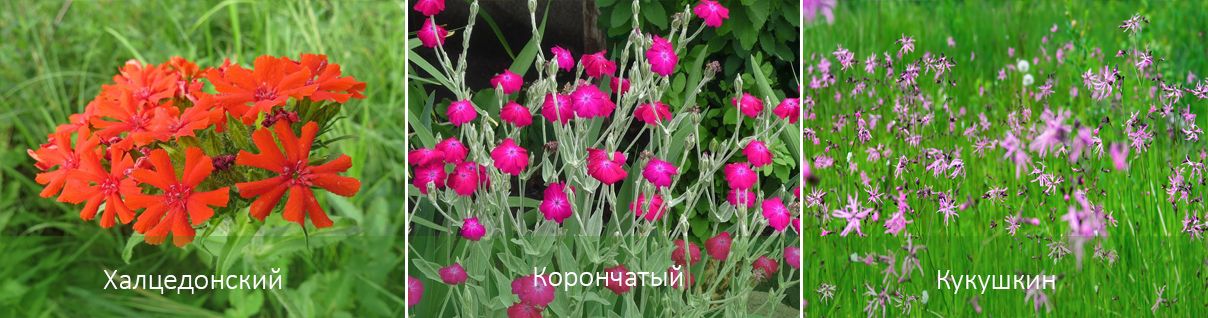
| Chalcedony | Perennial. The stem is tall and erect, growing up to 90 cm. It is resistant to severe frosts. | Wide, oval-shaped, pointed at the end. Arranged in pairs. | The buds are about 9 cm in diameter and come in red or white. Occasionally, pink double petals with a red dot in the center are seen.
About a month, starting in June. |
| Crowned | A bush up to 70-90 cm high. | Oval, medium-sized. Light green. | Single. Color: white, deep pink, crimson.
End of May – end of September. |
| Kukushkin | The trunk reaches 80 cm. It is recommended to plant it along paths, at the edges of a pond, in moist soil. | Oval, shortened. | The buds are about 4 cm in diameter and pink. The petals are divided into four parts, which droop and curl.
May-June. |
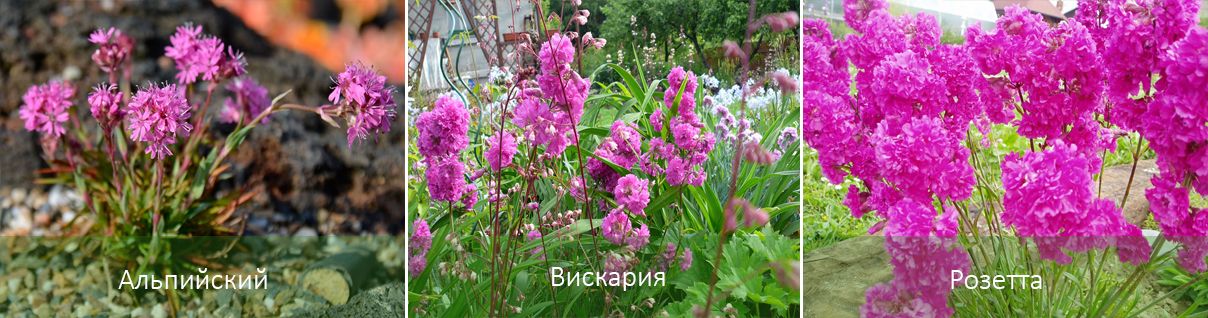
| Alpine | A spreading shrub up to 20 cm in height. Used to decorate alpine gardens. | Light green, elongated. | Dense, pink. End of May – beginning of August. |
| Viscaria
(tar) |
A tall reddish stem up to 1 m in height. At the top of the trunk is a sticky mass. | They have an oval shape. | Paniculate, color - red and white.
End of May – beginning of August. |
| Rosetta | The stem is rough and grows up to 1 meter. Rosetta's seeds do not ripen, and this variety grows for no more than two years. | Narrow, covered with thick short fluff on both sides. | Rich crimson double petals.
May-June. |
| Haage | A herbaceous perennial growing to 45 cm. | Large, heart-shaped. Color – dark green. | Racemose, deep orange in color. Diameter: 5 cm. Petals: soft, carved.
End of June – August. |
| Arkwright | Burgundy stem, grows up to 40 cm. The Vesuvius variety is popular. | Narrow, greenish-bronze. | Single, diameter about 2.7 cm. Color – orange.
End of June – mid-August. |
| Jupiter | A loose, pubescent shrub reaching 80 cm in height. It requires rejuvenation every four years. | Elongated, light green. | Light purple.
End of May – June. |
| Sparkling | Bush 40-60 cm high. | Oval, slightly elongated. |
Shield-shaped, diameter about 5 cm. Color – deep red. May-June. |
Reproduction of Lychnis
Lychnis is propagated by three methods:
- seed;
- cuttings;
- dividing the bush.
When growing from seeds, they are planted in mid-spring, when the air warms up to +18…+20 °C.
The seedlings are placed directly into open soil, at a depth of 1.5 cm. The bed is covered with plastic film, and the seeds will germinate in 2-3 weeks. Once the third leaf forms, the seedlings are transplanted to their permanent locations. Flowering is expected as early as the following summer. This method is not suitable for double-flowered varieties.
Seeds are collected from flowers when their capsules turn dark brown. They are placed in cardboard boxes or canvas bags and stored in a cool, dark place. They remain viable for up to four years.
In northern regions, seeds are sown for seedlings. To do this, at the end of January, the seedlings are placed in a refrigerator for 3-4 weeks to stratify. Then, in March, they are planted in long boxes filled with loose soil. After sowing, the boxes are covered with plastic wrap, but aired daily.
The seeds are kept at a temperature of 20°C, and the substrate is slightly moistened. In winter, the seedlings are provided with supplemental light from a phytolamp. Otherwise, seedling care is the same as sowing seeds in a garden bed.
If the cuttings option is chosen, cuttings from an adult plant are harvested in early summer; their length is approximately 15 cm. The cuttings are sprinkled with crushed charcoal.
The cutting is then inserted into a loose, constantly moistened substrate. By late summer, the root system has formed on the cuttings. In early fall, they are transplanted to their permanent location.
When dividing a bush, remember that shoots emerge from the root of each plant each year. In late spring, the dense bush is dug up. Then, using a sharp shovel, cut it in half; each part will have its own root and at least 3-4 buds. While the rhizomes are still warm, they are placed in soil and watered.
Planting Lychnis in open ground
The flower is unpretentious, but planting and care in open ground require special attention. More abundant and prolonged flowering is expected when planted in a well-lit area.
Lychnis can grow in any soil, but thrives in loose soil. This will allow for earlier flowering and larger flowers.
To plant the adonis, dig a hole 3 times larger than the root system of the adonis.
When planting in clay soil, add a little sand. Although adonis is a moisture-loving plant, standing water is harmful. Therefore, add 1 cm of brick chips or expanded clay to the hole for drainage. This is especially important in waterlogged soil.
Dig a hole the depth of a spade blade. Space the adonis plants about 30 cm apart. Water the seedlings and remove them from the container with soil. Add a small mound of superphosphate mixed with sand to the hole.
Then, place the seedling in the ground and cover it with soil, leaving a 5-6 cm gap to the edge. Firm the soil around the seedling with your palms. Cover the plant to the edge with a layer of sawdust or shredded deciduous bark.
Care and feeding of Lychnis
Adonis can grow in partial shade, but they require full sun for abundant flowering. Only Lychnis coronaria thrives in shade and partial shade.
Water the plant weekly, or every three days during drought. Mist the shrubs daily. Use only warm, well-settled water.
If the soil is fertile, apply ready-made Agricola fertilizer with added superphosphate. Apply it 2-4 times during the summer. If the soil is poor, fertilize it monthly.
Weeds are pulled from under the bushes and the top layer of soil is loosened. To ensure continued blooming, faded inflorescences are removed. New flower stalks will emerge from the pruned areas. In late autumn, when the stem and leaves have darkened and withered, the entire stem is pruned.
The plant can tolerate frost without cover. However, for better wintering, it is best to cover it with dry leaves or pine branches. Double-flowered varieties require cover. If snowfall is light, cover all adonis.
Diseases and pests of lychnis
The flower is resistant to insect attacks and diseases, but if improperly cared for, root rot may occur. Rust and spots may appear on the leaves. To prevent this, thin out the adonis, monitor its watering regime, and treat it with fungicides.
Leaf rollers are a common pest. They feed on the sap of flowers, causing them to wilt. Insecticides are used to control them.
Experienced gardeners use a decoction of tobacco leaves or tomato tops to combat pests such as spider mites, leaf rollers, and aphids. Add a little soap to the solution to speed up adhesion.
Using Lychnis in the Landscape
The bright flowers of Lychnis will decorate any garden; it's no wonder its name means "lamp" in Greek. However, it's still worth following a few recommendations:
- Tall varieties of adonis are planted against walls. Low-growing shrubs up to 50 cm tall are planted along paths.
- Several plants are always planted on the banks of ponds.
- Low-growing varieties of the flower will look spectacular in alpine gardens, mixed borders and rockeries.
- Lychnis benefits from being planted next to daisy, primrose, and bellflowers.
- A flowerbed of different varieties and colors of adonis looks very colorful.
- The plant is grown not only in the garden but also indoors in a flowerpot. It is moved outdoors during the summer months and then brought back indoors in the fall.
Adonis flowers are small but vibrant. With proper care, they will decorate your garden for at least a month.