The ornamental perennial ligularia belongs to the Asteraceae or Compositae family. The plant's second name, ligularia, comes from the Latin ligula ("little tongue"), referring to the appearance of the outermost flowers.
Numerous species of Ligularia thrive in the humid areas of Central, East, and Southeast Asia; it also grows in Northern Asia and Europe. Siberian Ligularia (Ligularia sibirica) is the most common species in Russia.
Perennials grow well on water banks, forest clearings, and wherever conditions are moist enough for comfortable growth.
Content
Description
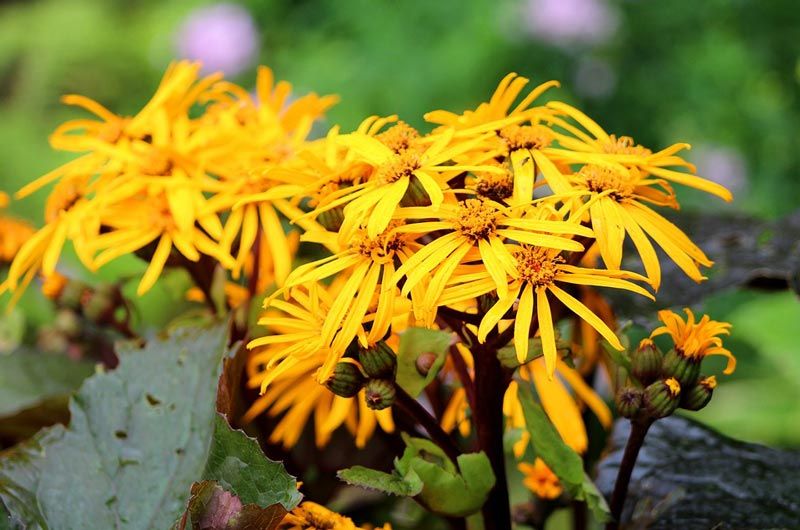
The plant consists of a basal rosette of large leaves on a long, sturdy petiole. Their shape resembles a triangular, carved heart. The leaves range in color from dark green, greenish-purple, to reddish-brown. Double-colored leaves can also occur: the underside is purple, while the upper side is green with a violet tint. You can also see bushes where the stems and veins of the leaves are colored, while the rest remains green. The leaf blades reach 60 cm in size.
Ligularia flowers resemble a basket of tubular and ray flowers. They can reach up to 10 cm in diameter. Blooms gradually, starting from the bottom up the inflorescence, which is represented by a raceme, spike, or panicle.
Flowers come in a variety of shades, from pale yellow to orange. Occasionally, marginal flowers of whitish or reddish tones are found. The plant's petioles are tall, reaching 2 meters. Various Ligularia species begin blooming in June and end in October. Ligularia is an excellent honey plant. Ripe fruits are seed-shaped with a tuft.
In our country, two varieties are widespread: Ligularia dentata and Ligularia przewalskii.
Types and varieties of ligularia with photos and names: Przewalski's, dentate, and others
All varieties and species of Ligularia found in the world have highly decorative value with leaves of various colors.
| View | Description | Height (m) | Leaves |
Varieties |
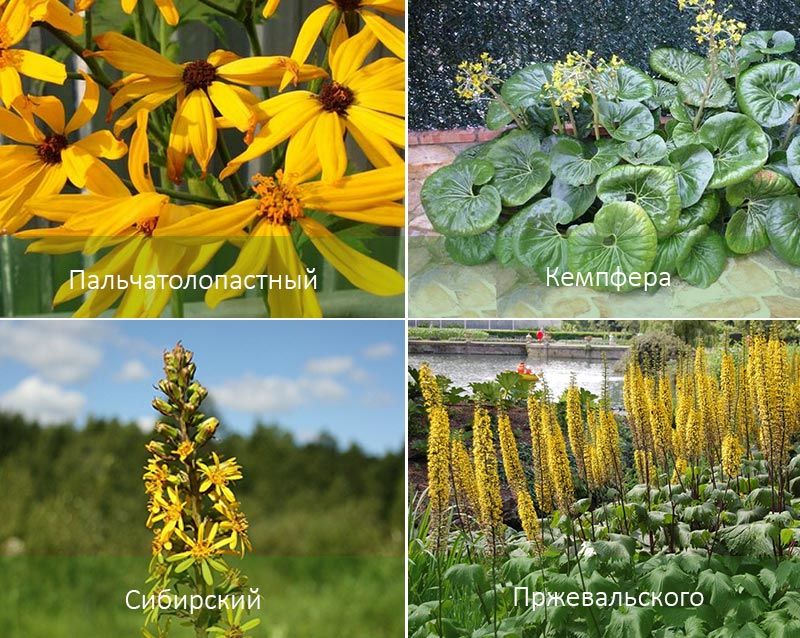
| Przewalski's (Ligularia przewalskii) | Yellow buds form a candle-shaped inflorescence 40-50 cm long. | 1.5-2. | Round, dark green, diameter 30-35 cm. | The Rocket. Golden flowers open from mid-July to late August. The foliage turns from green to purple throughout the summer. |
| Maple-leaved. Leaf diameter 25 cm. Height 1.7 m. | ||||
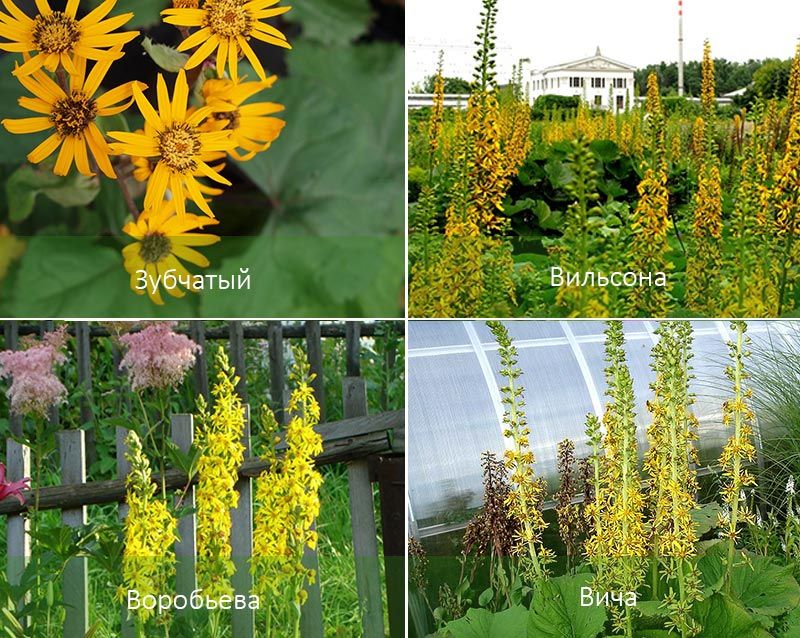
| Toothed (Ligularia dentata) | Flowers range from light brown to yellow. Moderately winter-hardy, best covered. Prefers shade. | 1. | Coffee-green in color, with teeth along the edge, diameter 30-40 cm. | Desdemona (Desdemona). Orange racemes 10-13 cm in diameter, serrated foliage, brownish-purple underneath, light green with bronze above. Blooms from August to October. |
| Othello (Othello). Height 90 cm. Green foliage with a red border along the edge. Orange inflorescence 13 cm in diameter. Blooms in September and October. | ||||
| Osiris Fantasy (Osiris Fantasy). Low growing, up to 50 cm. The upper surface is chocolate-colored, the underside is burgundy. Blooms in July. | ||||
| Wilson's (Ligularia wilsoniana) | The branched stems form a rosette at the base. The flowers are yellow. It tolerates dry conditions. Blooming begins in July and lasts 35-40 days. | 1.5. | Large. | Not highlighted. |
| Vicha (Ligularia veitchiana) | The yellow ear blooms in August. | 2. | Green in color, heart-shaped, 40 cm in diameter. | |
| Vorobiev's (Ligularia vorobievii) | The sunny spike blooms in August-September. The bush grows up to 1.2 m in height. | Hard, dark green, oval-shaped, it feels like thick leather. | ||
| Kaempfera (Ligularia kaempferi) | Canary spike, 5 cm in diameter. Blooms in July. Cover for winter. | 0.5 | Round, jagged, diameter 25 cm. | Aureomarginata. Golden inflorescence, bright green speckled foliage, round shape. Blooms in May. |
| Large-leaved (Ligularia macrophylla) | The brush is yellow in color and blooms in July. | 1.5. | The underside of the oval leaves is glaucous in color, and the petioles are up to 30-45 cm long. | Not highlighted. |
| Palmatiloba (Ligularia x palmatiloba) | Blooms from July. High humidity requirements. | 1.8. | Large, oval, heavily jagged. | |
| Siberian (Ligularia sibirica) | A brush of amber-colored buds. | 1. | Red-green tint. | |
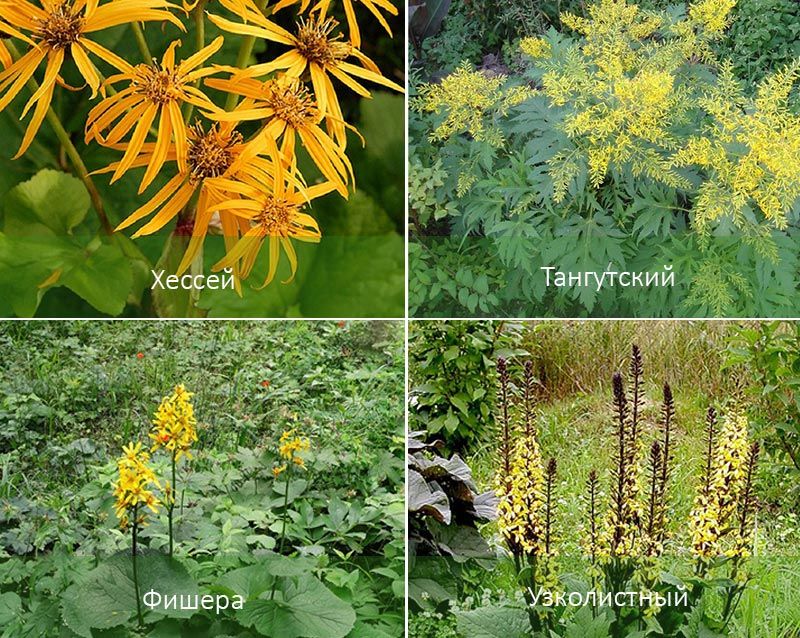
| Tangut (Ligularia tangutica) | A cluster of sunny shades blooms in July-August. Vegetative propagation is by tuberous roots. It prefers shady, clay-covered areas. | 1.5-2. | Openwork, divided into feathers. Length 60-90 cm. | |
| Narrow-leaved (Ligularia stenocephala) | A cluster of yellow flowers. A frost-hardy perennial. | Sharply serrated, oval-shaped, they change color to dark crimson in autumn. | ||
| Fischer's (Ligularia fischeri) | Canary-yellow candle. It blooms in July and continues until August. | 0.3-1.5. | Length 12-23 cm, resembles a heart shape. | |
| Hessei (Ligularia xhessei) | Golden inflorescence, blooms in late summer. | 1.5. | Heart-shaped. |
Planting buzulnik
Ligularia is very easy to plant and care for. In moist, well-drained areas, it can grow for 15-20 years. It is frost-resistant, but Ligularia serratata and Ligularia kaempferiana recommend covering it for the winter. The plant's shallow roots extend far and hold firmly to the soil, making this tall, strong plant resilient.
Propagation is carried out by seeds and vegetatively.
Sowing seeds
Algorithm:
- Sow directly into the ground in spring and autumn. Place the seeds at a depth of 1 cm.
- Ensure the soil remains moist. Protect the seedlings from the sun during midday and evening hours.
- They prefer the autumn method of sowing freshly harvested seeds into the soil, then additional stratification will not be required.
- Self-seeding possible.
- For spring plantings, sow in January-March and plant in open ground in May.
- Flowering begins in the 4th-5th year.
Transplanting and dividing the bush
To maintain its decorative qualities, the flower is divided and replanted once every 5 years.
The best time is considered to be spring, when the divided parts take root well and begin to grow.
For successful propagation, separate only the portion to be replanted. Add compost and water to the hole in the soil. Thoroughly wash the excavated root section and cut it into pieces with a sharp tool, leaving at least one growth bud on each. Sprinkle the separated portions with ash or treat them with a potassium permanganate solution.
For replanting, dig planting holes 40 cm deep. Add two buckets of compost, superphosphate, and ash to each hole. Leave 1-1.5 m between plants.
Ligularias planted in this way will bloom within a year.
Emergency landing
If repotting is necessary at a later time, prepare the bush in a different way. Cut off the entire flower stalk and remove 1/3 of the lower leaves. Then plant in the prepared hole. Protect from direct sunlight at all times, and keep the soil moist. Ligularia takes root and begins growing within 4 weeks.
Features of caring for ligularia
Ligularia prefers shady locations without direct sunlight. Otherwise, it won't develop beautiful, lush foliage. In sunny areas, without watering in hot weather, the plant will wilt and lose its decorative appeal and beauty.
Watering
Ligularia requires constant moisture. The more moisture, the bushier the bush. In dry weather, it is specially misted.
Top dressing
The flower receives initial nutrition by filling the planting hole with organic and mineral fertilizers.
Every year in May-June, an additional ½ bucket of humus or compost is added under each plant.
Garter
Ligularia is a large perennial plant, so it may require staking when planted in well-ventilated areas. The petioles are also secured during blooming to keep the flower stems upright, maintaining a formal appearance.
Post-flowering care
It is worth paying attention to caring for Ligularia after the flowering period has ended.
Trimming
Ligularia doesn't require any special pruning. It looks good in any situation. However, if you don't plan to collect seeds and appearance is important, trim the flower stalks. The magnificent foliage will adorn the garden until late autumn. Before the winter cold sets in, it's best to trim the tops and insulate them with compost, peat, or other similar materials.
Seed collection
When planning to grow a plant from your own seeds, follow these steps: Select a few desired inflorescences and attach cotton bags to them. The remaining spikes are removed along with the petioles. Once the flowers have ripened, the seeds are cut off, the husks are removed, and they are dried indoors.
Wintering
When frost sets in, they are cut back to the base of the leaves and earthed up, topped with humus. Ligularia is a winter-hardy plant, but damage is possible if there is no snow in the winter.
Diseases and pests
Ligularia is rarely susceptible to diseases and pests. Slugs are a frequent threat. Damage from their colonies can be easily prevented by sprinkling granular superphosphate around the plant.
Occasionally susceptible to powdery mildew, it can be treated by spraying with a 1% solution of colloidal sulfur or potassium permanganate (2.5 g per bucket of water).
Top.tomathouse.com recommends: Ligularia in landscape design
Ligularia is planted in shade as a solitary plant. It also looks good with other popular plants: hosta, daylilies, snakeweed, and alchemilla.
Landscape designers recommend creating group plantings of this plant and planting it in gardens to conceal aging tree crowns.
A properly selected Ligularia species will delight you with its colour-changing foliage and sunny inflorescences for many years throughout the season.