Campanula is a genus of trailing plants in the Campanulaceae family. "Campanula" means "bell." According to one legend, church bells got their name from their resemblance to the plant's flower. Its native land is the Mediterranean region. The flower prefers temperate climates and is found in forests, subalpine mountains, and meadows in Europe, the steppes of Asia, and the rocky deserts of North America.
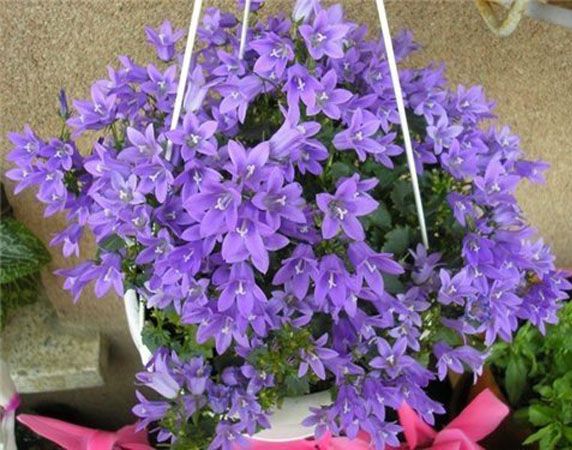
There's a belief that the two-colored plant is a guarantee of family well-being. In the old days, it was given to newlyweds. Another superstition is that if a girl grows campanula, she will soon marry and find true love. Its light green shoots can grow up to 50 cm long, drooping under their own weight.
Content
Description of the bell
Campanula is a trailing plant that has earned the names "bride and groom flower," "indoor bellflower," and "shooting star" for its luxurious snow-blue or blue flowers. It shares some similarities with eustoma, fairy bellflower, mother-in-law's tongue, rubrum lily, salvia, nemesia, monarda, lythium, lavatera, canna, and stinkhorn.
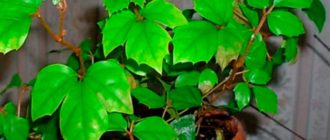
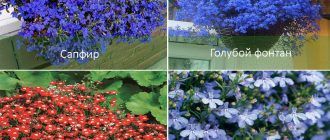
The shoots form a "cushion" about 20 cm high. The leaves are brightly colored and rounded, resembling a heart with serrated edges. The flowers are bell-shaped, up to 5 cm long. Because there are so many of them, they almost completely cover the leaves. Five graceful petals create a star-shaped silhouette, which in turn form inflorescences in shades ranging from white ("brides"), blue ("grooms" or "lovers"), and bright blue to purple, pink, and lilac.
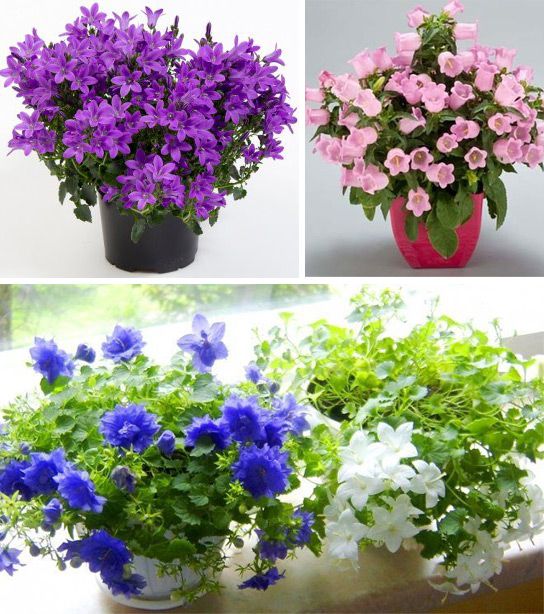
When decorating an interior, a unique combination of different flowers adorns tables and walls. Campanula looks beautiful in boxes or baskets.
To encourage the formation of new buds, old bells should be systematically removed.
The price for campanula is from 1000 to 1700 rubles.
After cutting, the flower is presented as a bouquet, or placed in warm water +38 °C, containing 5% sucrose.
The bellflower is so popular in private flower gardens that the plant's name is used by manufacturers of household appliances, such as the Czech "campanula ravak" bathtub.
Types of bellflower
Campanula varieties are either annual or perennial. Perennials are prone to degeneration. Therefore, the flower is more often grown as an annual. Over 300 species are known, more than 150 of which are found in Russia and the CIS countries.
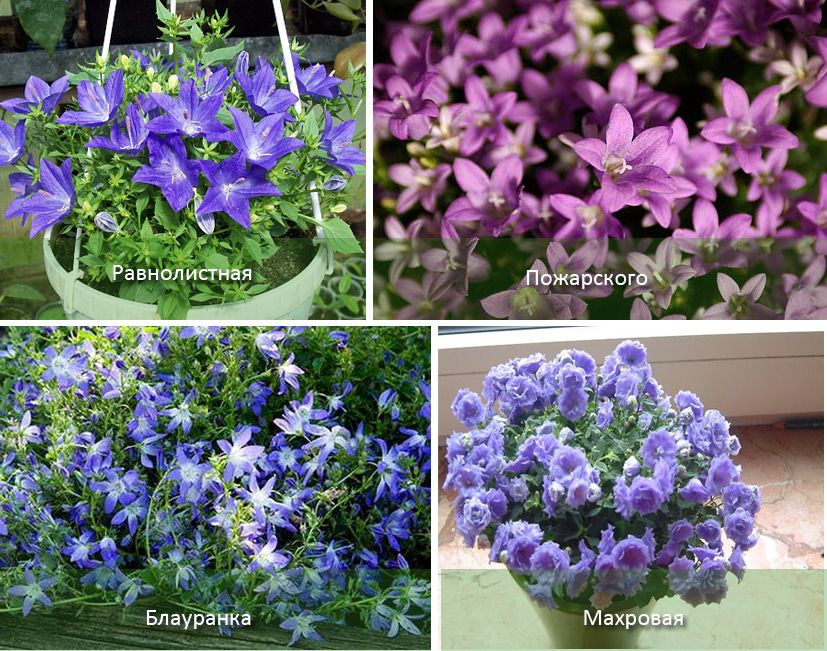
There are 15 species of this plant found in the European part of Russia. Garden perennial campanulas include: nettle-leaved, broadleaf, milky-flowered, and others. The most well-known indoor varieties are Campanula terry, mini-terry, equal-leaved, persicifolia, portneschlaga, Pozharsky, Carpathian (Carpathica), and Blauranka. Some varieties of the Carpathian and persicifolia species can also be grown in the garden.
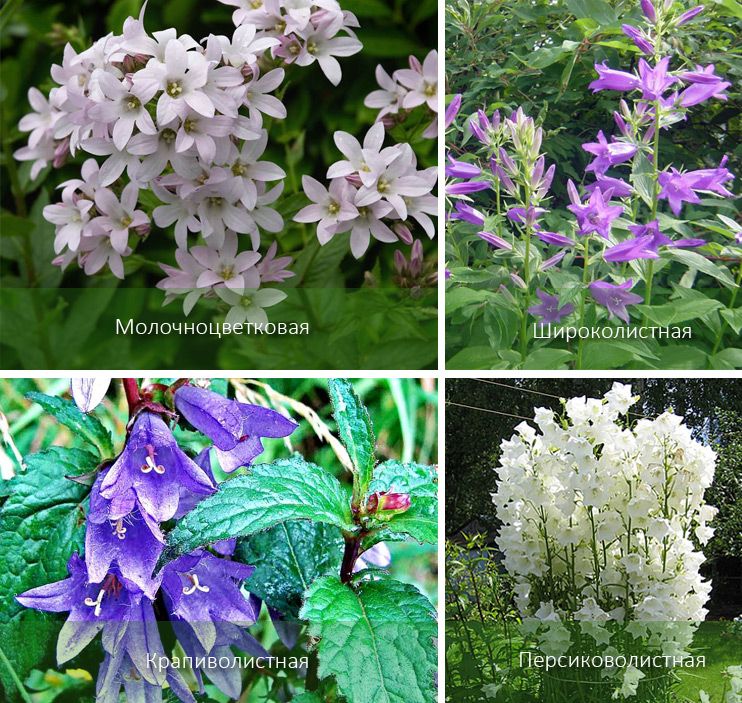
Species such as Campanula glomerata (collective bellflower), Chirillo, Torpedo and Isophylla mix are somewhat less common.
Types of indoor campanula
| Types | Description |
| Equal-leaved | Grows up to 30 cm. The shoots are thin and tend to droop. Ideal for growing in pots. The leaves are green and rounded. The flowers are large, milky and turquoise, up to 4 cm in diameter. Well-known varieties include Maya (the "groom" with turquoise flowers) and Alba (the "bride" with flowers the color of January snow). The Napoli and Atlanta varieties have similar characteristics. |
| Pozharsky | It grows on the rocky cliffs and limestone rocks of the Balkans. It can reach a height of 20 cm. The flowers are snow-white, bluish, or plum-colored. |
| Peach-leaved | It resembles a peach tree. It reaches approximately 50-60 cm in height. It blooms from June to September. The flowers are up to 3 cm in diameter. The bell-shaped flowers are graceful, white or turquoise. |
| Portenschlag (“get mi”) | A perennial with heart-shaped foliage. Dark purple bells. |
| Terry | It resembles a bush covered with multicolored double bell-shaped flowers (ranging from white to purple). The stems are long and flexible. There are many leaves. |
| Mini terry | Reaches 15 cm in height. Double flowers with shades of white and turquoise. The following bicolors are distinguished: blue and white Bali and Wonder. |
| Carpathian (Carpathian) | Reaches 30 cm in length and height. Oval leaves form a basal rosette. The bell-shaped flowers, which come in milky, blue, and purple colors, can reach 5 cm in diameter. Flowering begins in summer and continues for about three months. Varieties: Pearl White and Pearl Blue. |
| Blauranka | A low-growing variety, up to 20 cm tall. Cultivated indoors and outdoors. The flowers are light turquoise. |
Types of garden bellflower
| View | Description |
| Nettle-leaved | A perennial flower, about 1 meter tall. It has a branched root, a hairy, ribbed stem, ovoid-shaped leaves, and white or blue flowers, which can be double. Inflorescences contain two or three flowers. Can be grown in shade. |
| Lactiflora | A light-loving plant, about 90 cm tall. The flowers are white or purple, small, no more than 3 cm in diameter, collected in inflorescences, located on a branched stem. |
| Peach-leaved | In open ground, it reaches 90 cm. The flowers are up to 3 cm in diameter. The bells are graceful, white and blue. The plant is listed in the Red Book. |
| Broadleaf | Height: over 1 meter. Flowers resemble large white or blue funnels, gathered in a spike. Can grow in shaded areas. |
| Carpathian variety – Gnome |
Low-growing – 30-40 cm. Flowers are 5 cm in diameter, blue and white shades. |
Caring for a bellflower
Caring for campanula at home is based on following a few simple rules.
Location, lighting, temperature
The best place for the flower is a lighted windowsill, protected from direct sunlight; it is worth choosing windows facing west and east.
Artificial lighting is helpful in winter. The bellflower grows toward the light source.
To keep the plant looking neat, it's recommended to rotate it weekly in the same direction (clockwise or counterclockwise). The plant doesn't tolerate 180° rotation well. It's best to choose locations with even light.
The air temperature during the warm season should be within the range of +17…+22 °C; campanula survives winter at +5…+10 °C.
High temperatures have a negative impact on the health of the plant – it begins to dry out.
Planting, choosing a flowerpot, soil
The planting soil is prepared from leaf mold, turf, sand, and peat. The resulting mixture is loose, breathable, and slightly alkaline. If needed, planting substrate can be purchased at a store.
The pot for the plant should be wide and large in size, since the root system tends to grow very quickly.
After planting, it is recommended to spray.
Watering and humidity
Bellflower is a moisture-loving plant. However, it does not tolerate excess moisture (waterlogging) or dry soil.
The plant is regularly sprayed. It can be left without water for no more than two weeks.
Watering should be moderately frequent. It's important to monitor the soil. Allow it to dry out slightly before each watering, and don't allow water to accumulate in the tray; discard any runoff.
During warm weather, water once a day; in winter, reduce the frequency to twice a month. Soft, settled water at 22 to 24°C is recommended.
Fertilizers and dressings
Fertilize every 15 days from spring until flowering ends. A complex of floral fertilizers is used.
Fertilize the plant during the active growth, flowering, and budding phases. Focusing on potassium is recommended. Fertilizing is contraindicated during the dormant phase.
Pruning and replanting
Repotting is possible in spring or fall if the campanula is no longer satisfied with the size of its current pot. To preserve the root system, the plant is transplanted with a large lump of soil into a larger pot with prepared soil and a layer of drainage at the bottom.
In spring, dried parts of the plant are trimmed back. To promote bushiness, the tops of the shoots are sometimes pinched.
Tips for caring for garden bellflowers
Let's look at the basic rules that should be taken into account when keeping a plant in open ground:
- The main thing for garden bells is light, and only some of them can grow in partial shade.
- Close proximity to groundwater is undesirable; good drainage is necessary.
- In summer, light but frequent watering is necessary (up to twice a day). In autumn, watering should be reduced. The water should be at room temperature.
- It is important to loosen the soil around the flower to supply oxygen to the roots so that flowering is abundant.
- In October, you need to prune the plant and cover the root area with mulch to protect it from frost.
Propagation of Campanula
The flower is propagated by seeds, cuttings and division of the bush.
Seeds
This is the simplest method. The seeds remain viable for a year. Sow in early spring in cups or bowls filled with prepared, moist soil, then cover the seeds with soil.
Watering is not recommended. Spraying is considered sufficient. Rooting stimulants can be used to speed up the establishment of the plant. After the third leaf appears, the plant should be planted outdoors.
Cuttings
Cut 10 cm long shoots with 2-3 leaves. Soak them in a weak solution of potassium permanganate for 9 hours (some gardeners recommend reducing this time to 30 minutes), then place them in clean water and wait for roots to appear.
Next, plant the campanula in a pot with a mixture of sand and peat moss. Use equal amounts of both ingredients. The cuttings are planted 2.5-3 cm deep. To speed up rooting, cover the campanula with a glass jar, cup, flask, bag, or film. It is recommended to avoid watering at first, limiting the plant to misting.
A seedling can be potted at three months of age. Some gardeners recommend reducing this time to four weeks, once the seedlings have developed roots.
Dividing the bush
This type of propagation is done by transplantation. The step-by-step process is as follows:
- The rhizome is divided into several parts, each of which is planted separately.
- "Wounds" are disinfected with crushed chalk, charcoal, colloidal sulfur or cinnamon.
- After transplanting, the plants should be watered and fertilized after 5-7 days.
Campanula diseases and pests
| Reasons | Manifestations | Recommendations |
| Gray mold | Decreased turgor (leaves begin to wilt). Grayish spots and stripes with fluffy hairs and black dots appear. | Reduce watering frequency and remove affected plant parts. Then use antifungal (fungicide) agents such as Fitosporin, Bordeaux mixture, or Fitolavin. |
| Root rot | Dark brown, wet spots appear on the plant, and an unpleasant, putrid smell emanates from the soil. | Remove affected plant parts. Sprinkle the trimmed parts with charcoal. Then treat with fungicides. |
| Spider mites | The leaves wilt, and webs appear on their undersides. They gradually dry out. | Rinse the plant under a warm shower, wipe with soapy water, and treat with an insecticide, such as Iskra. Increase the frequency of watering. |
| Scale insect | The leaves turn pale and yellow, wither, and fall off. Brown bumps and small insects appear on them. | Use a vacuum cleaner and sticky tape to remove pests. Then treat the plant with insecticides. |
| Whiteflies | Small whitish butterflies appear on the plant. | |
| Aphid | Small dark brown insects stick to young leaves, shoots or buds. | Spray the plant with a soapy solution, remove affected leaves and shoots. Then use insecticides or strong-smelling herbs (onion peels, tobacco crumbs). |
| Excess of light | The leaves turn yellow and lose their brightness. | Move the flower to a shaded place. |
| Lack of light | The stems become elongated and thin. | Move the plant to a new location where it receives more sunlight. |
| Overwatering of the soil | The leaves become wilted. | Reduce the frequency of watering. |