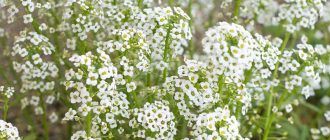
Trailing geraniums (pelargoniums) are a group of perennial plants that can grow both outdoors and indoors. They are native to tropical Africa. They differ from zonal geraniums in the arrangement of their branches, which droop as they grow. One variety, the ivy-leaved geranium (pelargonium), is popular in Russia. It has been cultivated in gardening for over 300 years and is primarily planted in pots.
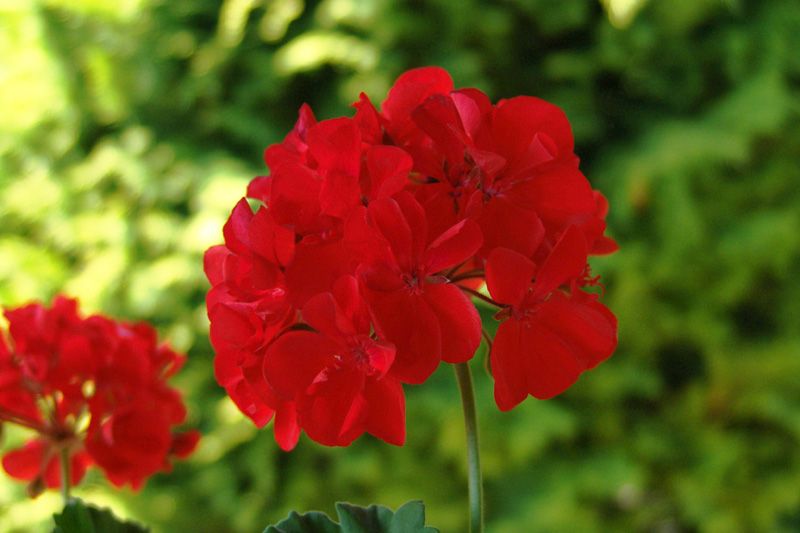
Description of hanging geranium
The plant's shoots twine and can reach 70-100 cm in length. They cling to nearby objects, so geraniums are often planted under a trellis or tied up. The plant also looks good indoors if a decorative trellis is prepared in advance.
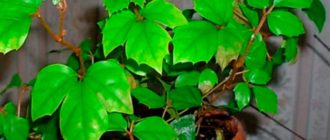
The stiff, dark green leaves of pelargoniums are divided into five sections. They range from 3 to 6 cm in width. Some varieties have light spots on the surface. The leaf blades grow on long petioles.
During flowering, the plant produces numerous umbel-shaped inflorescences, which can reach 8-10 cm in diameter. Each contains numerous buds, the shape of which can range from star-shaped to cactus-like or simple, depending on the variety. Double inflorescences are even common. Up to 50 flowers form on a single stem. They are often colored a single shade: white, purple, red, or pink. There are also multicolored varieties, in which the center of the petal is a single color, while the border and area around the pistil or stamens are contrasting. The stems either rise above the foliage or droop for 10-30 cm.
Varieties of hanging pelargonium
There are 7 different varieties of the flower popular in Russia.
| Variety | Description |
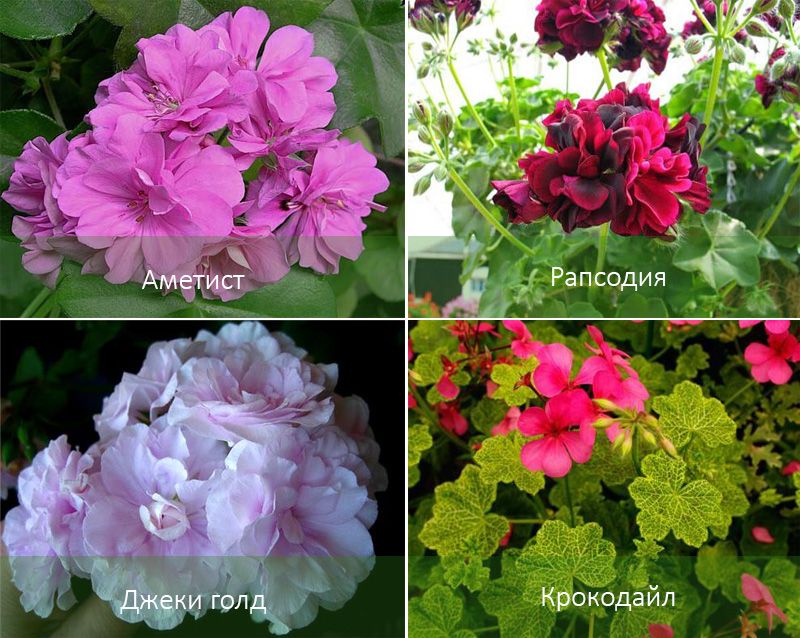
| Amethyst | Double pink buds on long stems. Trailing variety. |
| Rhapsody | The flowers are deep burgundy, richly colored. The bush is lush and drooping. |
| Jackie Gold | During the blooming period, the petals gradually change their color from white to pink or light lilac. |
| Crocodile | The leaf blades are covered with white veins, and the buds are coral. |
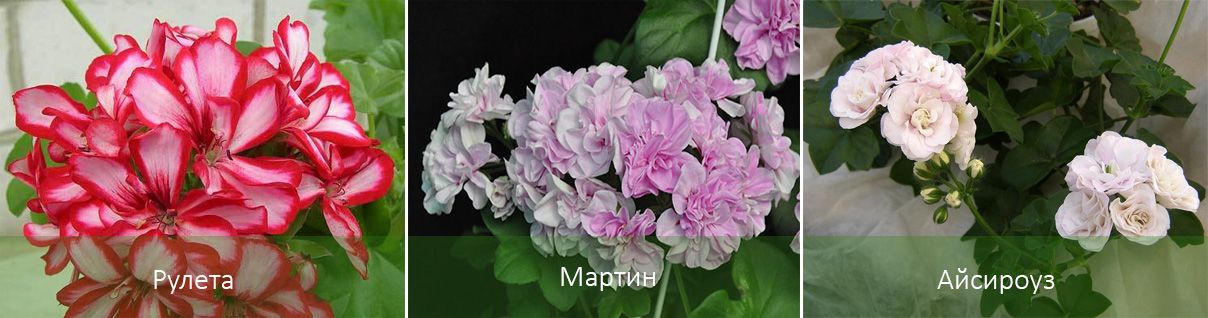
| Roulette | The petals have a red border, and the inflorescences themselves resemble alstroemeria. |
| Martin | Double flowers of lilac hue above a lush bush. |
| Icyrose | The inflorescences look like roses. |
Reproduction
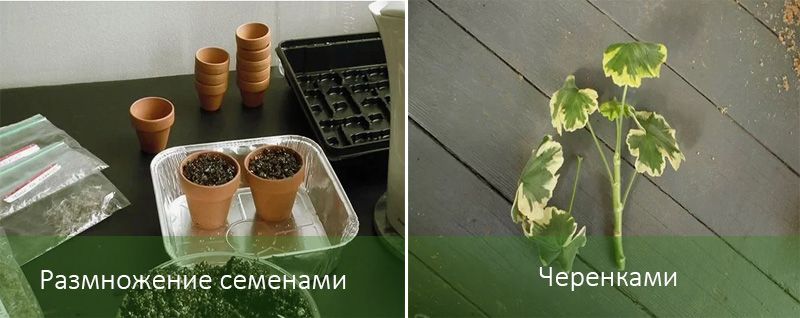
Trailing pelargoniums can be propagated by seeds and cuttings. The former method is more labor-intensive, while the latter is suitable for beginners.
Cuttings should be taken in spring or late fall, when the geraniums are preparing for winter. Several shoots 7 to 10 cm long should be cut. These should have 3-5 leaves. Too many leaves will prevent the plant from rooting, as all the nutrients will be lost to them. If necessary, you can trim off 1-2 leaves.
It's important to prepare cuttings properly. They are very sensitive to moisture and can quickly rot. To prevent this, dry them for 5-6 hours in the sun or under a grow light if the gardener is taking cuttings in late fall. Sprinkle the cut surface with ash or crushed charcoal, and prepare the soil at the same time. The correct composition includes:
- sand;
- turf soil;
- peat.
The ratio is 1:1:1. The soil mixture should be thoroughly mixed, but not compacted too much. It should be loose to prevent moisture from accumulating and causing plant rot.
After drying, the cuttings should be planted in a container with prepared soil and lightly compacted around each sprout to prevent it from leaning. Water carefully as the soil dries. After 2-3 weeks, the cuttings will have developed a strong root system and can be transplanted into individual pots. Pinching is recommended to shape the bush.
Propagation by seed is more complex, labor-intensive, and time-consuming. It should be used only by experienced gardeners. This method is used in landscaping when the goal is to obtain as many seedlings as possible with minimal effort.
Pelargonium seeds are quite hard, with a thick, hard shell. Before planting, which is best done in late February or early March, they need to be prepared:
- Using medium-grit sandpaper or a nail file, file down the peel layer, being careful not to damage the interior. This will allow the sprout to emerge more quickly.
- Leave the seeds in water for 24 hours.
- Disinfect using a solution of potassium permanganate, then dry each specimen.
These steps are not mandatory, but they will increase germination. Not all seeds are of good quality, so gardeners should be prepared for the possibility that some will fail to germinate.
For seeds, prepare the same soil mixture as for cuttings. Plant the seeds in loose, well-moistened soil, planting them just 5 mm deep. Then cover with soil. Place the container under plastic sheeting or in a mini-greenhouse for 10 days, maintaining a temperature of 22-24 degrees Celsius. Once the seedlings emerge, remove the plastic sheeting. During this period, it's important to provide plenty of light. Experienced gardeners recommend supplementing the seedlings with phytolamps. Once each young plant has three true leaves, they can be planted in individual containers.
Conditions for growing hanging geraniums at home
Caring for hanging geraniums is not difficult.
| Factor | Conditions |
| Location/lighting | South-facing windows, with illuminated areas on the street. |
| Soil | Drainage is important, which can be achieved using expanded clay. Dry, clayey soil is acceptable. Periodic loosening of the soil is necessary. |
| Pot | Small diameter, so that the flower is more lush. |
| Watering | As the top layer of soil dries out. Don't let the soil dry out completely, but excessive moisture accumulation can be harmful to the plant. Misting is not necessary. |
| Fertilizer | Every 14 days from spring to late summer. Apply nitrogen during early growth and phosphorus during flowering. Ready-made mineral supplements can be used. No additional feeding is needed in fall or winter. |
| Trimming | Long shoots are pruned every fall. If necessary, elongated branches can be trimmed in the spring to shape the bush. |
| Transfer | Every two years or as the plant grows. The new container should be 1.5-2 cm larger. If the root system hasn't yet grown around the pot, simply change the top layer of soil. |
Top.tomathouse.com informs: wintering features of hanging pelargoniums
In early autumn, watering should be gradually reduced. Pelargoniums grow almost completely in autumn and winter, so fertilizing should be stopped completely. To rejuvenate the plant, long shoots should be pruned. After this, in late November, the wintering period begins. During this time, the pot should be moved to a bright location. If daylight hours are significantly reduced, which is typical in northern regions, it's necessary to purchase a grow light to provide supplemental lighting. It should be turned on for 3-4 hours a day, depending on the daylight hours. Geraniums need plenty of light, otherwise they will quickly fade, become weaker, and grow poorly, even in summer.
It's important to monitor soil moisture levels. In winter, due to lower temperatures, moisture can stagnate in the soil and lead to root rot. Experienced gardeners recommend further reducing the air temperature. The room should be ventilated periodically, but avoid exposing the pot to drafts. This will weaken the plant and lead to disease.
With proper care, trailing pelargoniums will delight the eye with beautiful shoots and lush inflorescences. The plant requires little maintenance, rarely gets sick, and blooms for a long time.