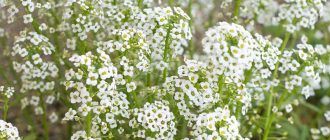
Lobelia dortmanii (L. hanging lobelia) belongs to the Campanulaceae family. The genus includes over 300 species, most of which grow in subtropical and temperate climates. In Russia, Lobelia dortmanii (L. sessilifolia) can be found in the wild. In the temperate climate of our country, the flower is grown as an annual. It has earned a reputation among gardeners for its attractive appearance and long flowering period. It is widely used in landscape design, decorating balconies and gardens, summer cottages, alleys, and parks, planted in hanging pots.
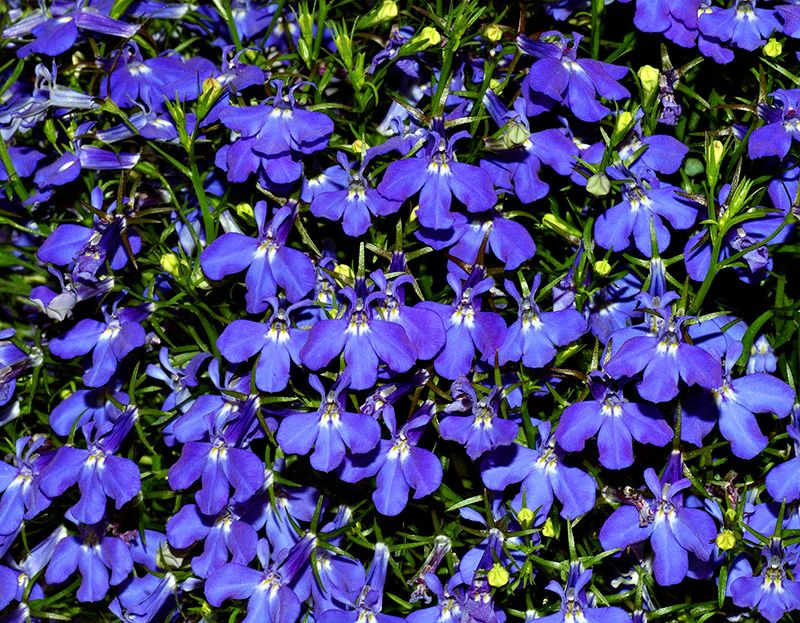
Description of Lobelia ampelosa
The plant is named after the 16th-17th-century scientist Matthias de L'Obel, who served as court physician and botanist to King James I of England.
In its natural habitat, it is a tropical perennial plant. The leaves are small, arranged alternately on drooping shoots. The blades are lanceolate, most often dark emerald in color.
Compact in size, but blooms profusely. The flowers are bisexual, so artificial pollination is not necessary. The buds grow densely, along the entire length of the stems. The colors range from bright to pastel.
Trailing lobelia can be planted alone or in a composition with other plants. It tolerates any placement and makes a beautiful addition to any flower arrangement.
Popular varieties
There are many species, but only a few are cultivated. Almost all of them are hybrids of Lobelia erinus or Lobelia gardeniana. Some of the most beautiful varieties grown in artificial conditions are:
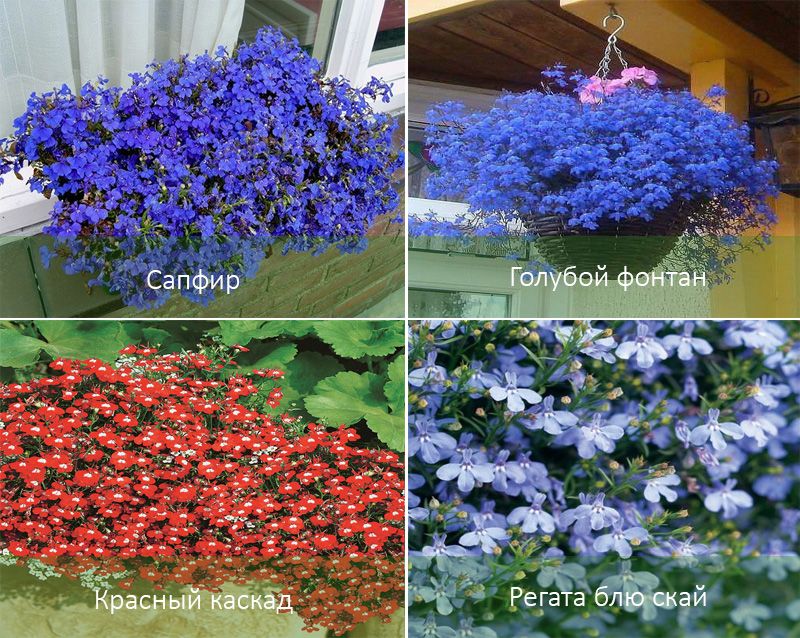
| Name | Description | Flowers |
| Sapphire | With hanging branches, up to 35 cm in length. | Small, sapphire with light spots. |
| Blue Fountain | It has 6-8 drooping branches with inflorescences, up to 30 cm in length. | Sky blue with a white spot in the middle. |
| Red Cascade | With strong, well-developed lateral branches reaching 35 cm. | Dark pink or crimson. Blooming is profuse and long-lasting. |
| Blue Sky Regatta |
An early variety. Shoots reach 20-25 cm in length. The stems reach 25-30 cm. At first they grow upward and then droop. |
Small, gathered in multiple inflorescences. Petals are cornflower blue with an amethyst sheen. Specimens with light blue and blue buds are also found. |
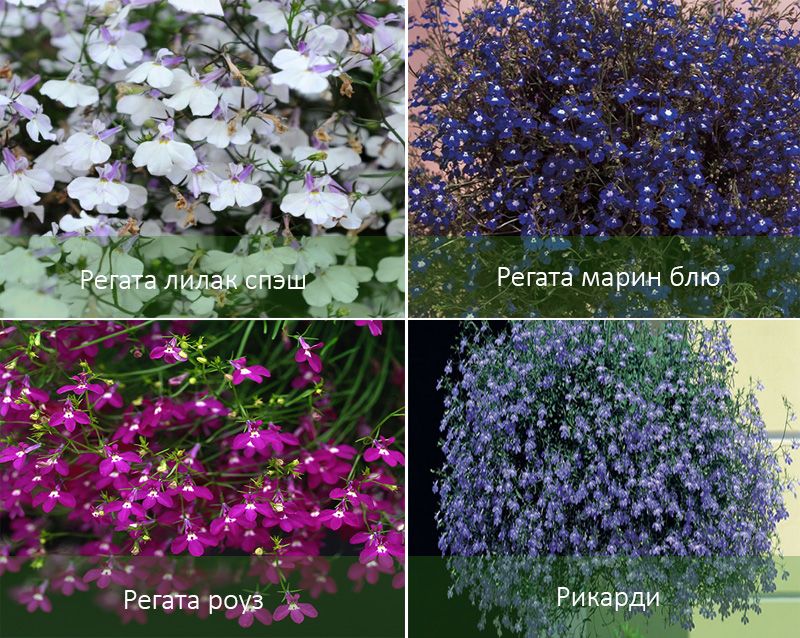
| Regatta Lilac Spash | Lilac-snow-white. | |
| Marine Blue Regatta | It's low-maintenance. The key is to avoid over-saturating the soil with moisture and minerals. | Rich blue tone. |
| Rose Regatta | An early variety, vegetation begins 4 weeks earlier than other species. | Pink with a beige center. |
| Ricciardi | Hybrid. Propagation occurs not by seeds, but by cuttings. The shoots are long and strong. | Of various colors. |
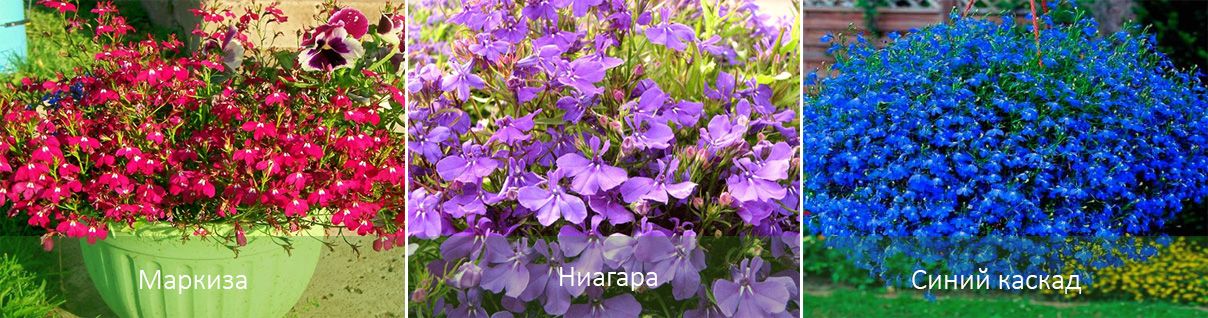
| Marquise | A cascading shrub with a dense crown. The stems are pendulous, well-branched immediately at the base, and leafy. They reach a length of up to 40 cm. The leaves are dense, oblong, glossy, and small. They are arranged alternately on the shoots. | Purple-scarlet, they have two lips and reach 2 cm in circumference. With proper care, they bloom until the first frost. |
| Niagara | The branches of this dense, cascading bush reach 35-40 cm. The foliage is fine and bright malachite-colored. It grows along the entire stem. | Small, two-lipped, dark blue or violet, they begin to form in June. |
| Blue Cascade | Shoots up to 30-35 cm, heavily branched, with developed green mass. The blades are glossy and compacted. | Bright sapphire, small. The inflorescences are located close to each other, giving the bush volume. |
Growing Lobelia from Seeds
Germination takes a very long time, about 80-90 days. Therefore, seeds should be sown in late winter or early spring. In the former case, they must be germinated under fluorescent lamps, as natural light is insufficient. If sown in March, they will germinate without any additional assistance.
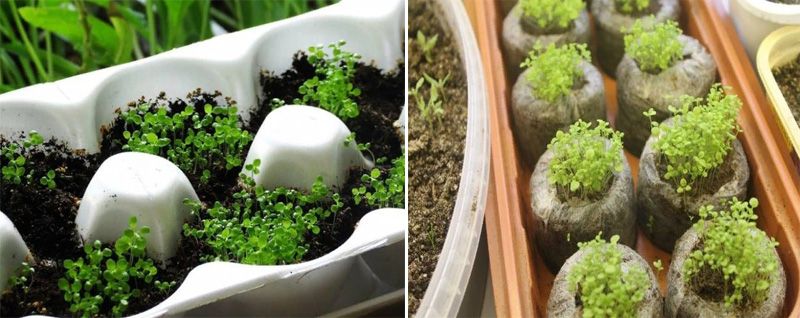
Lobelia seeds are microscopic, so they are sown in groups in wide containers, plates, and peat pots. For planting, use:
- garden and peat soil in equal quantities;
- store-bought soil mixture.
Before sowing, the soil must be disinfected. This can be done in two ways:
- soak in a solution of potassium permanganate;
- warm in the oven.
Growing from seeds step by step:
- Mix the prepared substrate with the same amount of sand.
- Lay out a drainage layer of broken brick or expanded clay.
- Sprinkle moist soil on top.
- Scatter the seeds in small groups.
- Spray with a solution of potassium permanganate or soft, warm water from a spray bottle. No need to cover with soil.
- Cover with glass or film to create greenhouse conditions.
- Place the container in a room with room temperature until seedlings appear.
The seeds are sown directly into a permanent location. This method is known among gardeners as "lazy." With this method, flowering can be expected only in mid-August. Germination rates will be low.
Sowing occurs in late spring. The seeds are mixed with sand and spread over moistened soil. Subsequent care is the same as for indoor planting.
How to care for seedlings
Growing seedlings from seeds is quite difficult. You need to constantly monitor the growth process:
| Care | Recommendations |
| Shelter | Remove the cover to eliminate evaporation from the walls. Keep the seedlings uncovered for 15 minutes twice a day. Once the first shoots appear, remove the cover. Do this gradually, increasing the ventilation time by several hours each day. This will strengthen the immunity of the young plants. |
| Watering | Regular and abundant watering is essential, as lobelia has a poorly developed root system. Avoid allowing the soil to dry out. Water the soil using a spray bottle or a tray. Avoid standing water, as this can lead to root rot. |
| Ventilation | When the temperature outside is above 10°C, take the plants out onto the balcony, loggia, or terrace. Gradually increase the time spent outside, and after a week, leave them outdoors for the entire evening and night. Provide shade for young plants; direct sunlight can cause burns and death. |
| Top dressing | One time, 30-40 days after sowing. It's best to use store-bought mineral fertilizers. They should be diluted with water to the concentration indicated on the packaging. Then, spray the bush with the solution. |
| Dive | This is only necessary if the seeds are scattered haphazardly throughout the container. Transplanting can begin when the seedlings have 2-3 true leaves. Pricking out is done in groups of 4-8 plants. Lobelia's root system is capable of rapid recovery. Therefore, to transplant the seedlings, you can cut the soil into squares with a blade. Transfer the soil pieces to larger containers. |
| Trimming | To prevent the bushes from becoming too tall, trim shoots that reach 5-6 cm. If the goal is to achieve long, drooping shoots, pinching is not necessary. After flowering, faded flower stalks should be cut back. This encourages lush, recurring bud formation. A second pruning is performed in August. If you plan to collect seeds, this is not necessary (the seeds should be ripe before the first frost). |
Planting and caring for ampelous lobelia
Planting and caring for this flower must be done according to certain rules. Only then will the plant grow quickly, bloom, and retain its decorative appeal.
Lobelia pots should be hung in partial shade to avoid direct UV rays. The soil should be neutral, with a pH of 6 being ideal. Planting lobelia bushes in soil rich in organic matter is not recommended. This will cause the plants to quickly gain mass, but the flowers will be inconspicuous and very small.
The shoots are planted 30 cm apart. The bushes quickly grow in width and will soon form decorative thickets.
The flower requires constant care:
- regular watering (do not allow the soil mixture to dry out);
- application of fertilizer (potassium mixtures without nitrogen content);
- shortening the shoots in mid-July (in just 2 weeks they will grow again and begin to intensively form inflorescences);
- pruning yellowed and wilted leaves;
- periodic loosening of the soil with a wooden peg (this promotes better oxygen penetration and prevents the soil from becoming acidic).
Trailing lobelia is a robust plant with good immunity. If you cultivate it correctly, it will resist various diseases. If you follow all the rules, you can see it bloom several times a season.
Top.tomathouse.com advises: how to preserve lobelia for next year
Trailing lobelia is a heat-loving plant and doesn't tolerate cold at all. It dies at the first frost. That's why in Russia it's grown as an annual.
However, the flower can also be grown as a perennial plant:
- Carefully dig up the bush for the winter.
- Transplant into a pot and bring to a warm place.
- After the soil has warmed up, separate the cuttings.
- Root them in nutritious soil.
- When the shoots become stronger, plant them in a permanent location, following the recommendations given in the chapter “Planting and caring for ampelous lobelia.”
In southern regions of Russia, the plant can overwinter outdoors, provided the air temperature does not drop below freezing. To prevent freezing after the growing season, it is advisable to mulch the area around the trunk with peat, spruce branches, wood chips, or straw.