The garden carnation is beloved in many countries around the world. From the 16th century to the present day, its bright, large blooms have delighted gardeners. Its pleasant aroma is reminiscent of the popular spice. The name translates as "Flower of Zeus," sometimes translated as "Divine Flower."
Description of the plant
One of the most well-known crops, it blooms from early summer for a month or two, depending on the variety. It's planted directly into the ground; a few growers prepare seedlings.
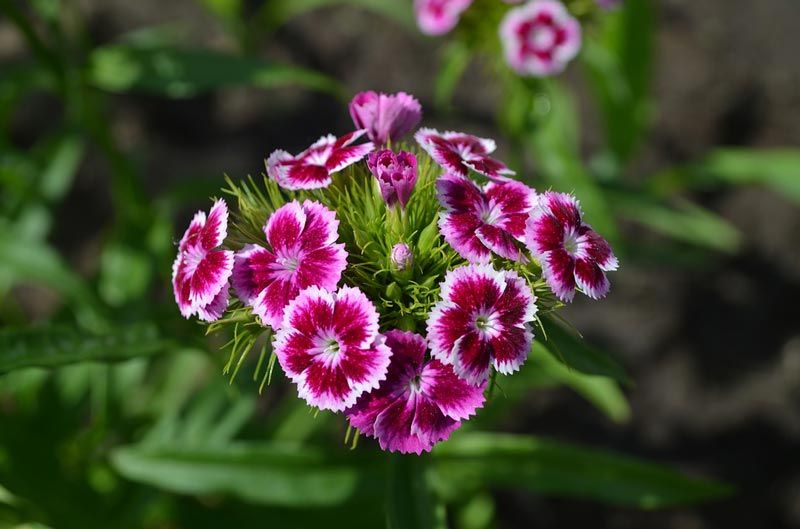
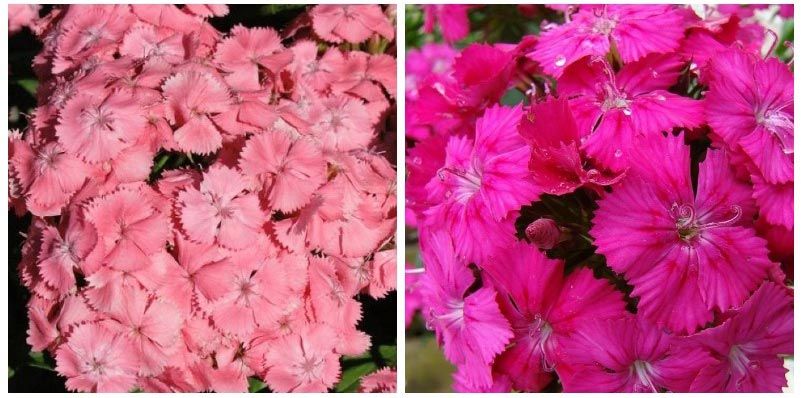
The plant boasts a wide variety of species and colors. The spreading bush spreads along the ground, sending up dense flower stalks that reach 0.5 m in height when in bloom. The characteristic, bumpy shoots with narrow, small leaves are colored in glaucous-gray, brown, or bright green tones. The carnation umbel consists of numerous small flowers up to 2 cm in diameter. The petals can be single-colored, multi-colored, with intricate patterns, or with a distinct border—each species has its own characteristics and color structure. Double varieties are especially beautiful.
Varieties of Turkish carnation
This garden plant is distinguished not only by its variety of colors but also by the size of its bush. There are three types by height:
- low-growing, produces a peduncle up to 25 cm high;
- medium-sized, up to 40;
- high up to 60.
Let's look at the features in the table:
|
Name |
Flower size / Inflorescence size (cm) | Colors |
Peculiarities |
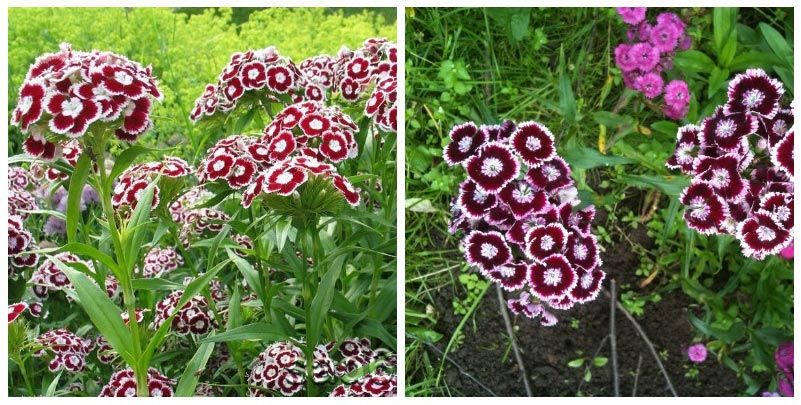
| Holborn Glory | High. 2. 12. |
Burgundy, with a bright white border and center. | Unpretentious.
Tolerates partial shade. Blooms for up to 2 months. |
| Newport Salmon Pink | Medium height.
1.5. 10. |
Pink color, petal edge finely serrated. |
Early variety. Blooms during the first month of summer. |
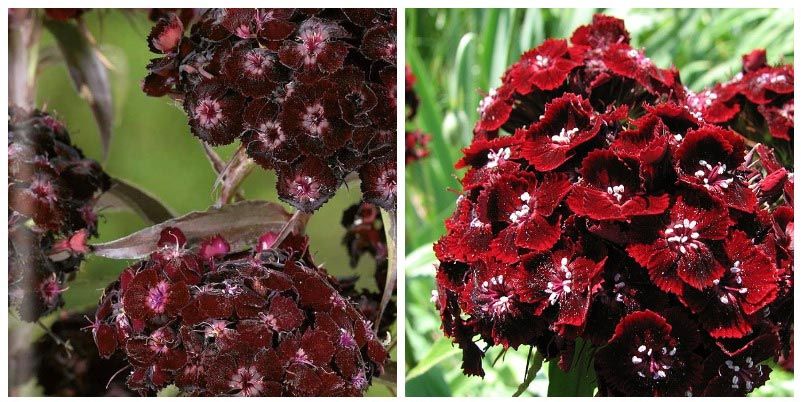
| Nigricans | Purple, the edge of the flower is figured, with white inclusions in the center. | Velvet flowers. Blooms in June and July. Not afraid of windy weather. |
|
| Diabunda F1 | Low-growing.
2.5. 10. |
The edge is serrated, the petal resembles satin. |
Abundant flowering for 2 months. Convenient for planting in pots. |
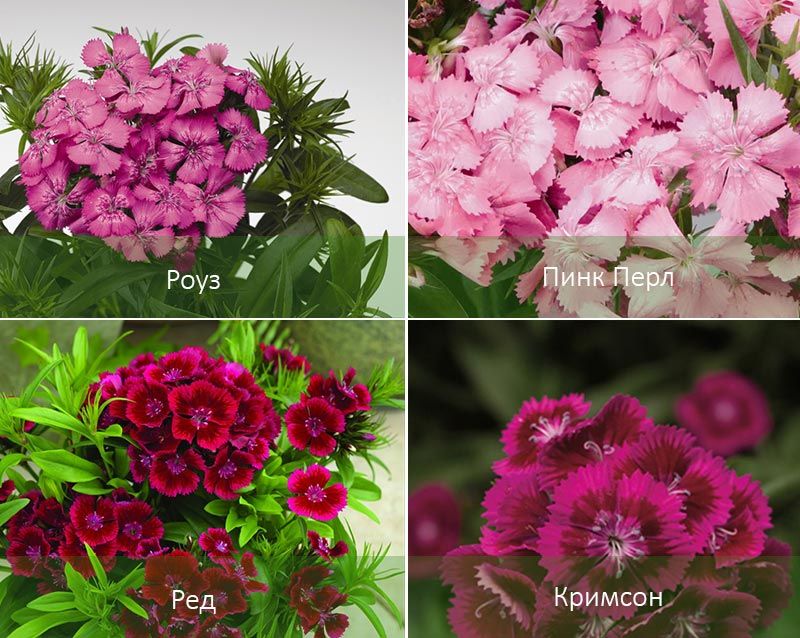
Diabunda F1 has several subspecies of different shades:
|
Name of the variety |
Color |
| Red | Bright red. |
| Crimson | Blood-red, pollen leaflets white. |
| Rose | Rich pink. |
| Pink Pearl | Light pink. |
| Red Picotee | White outline with burgundy center. |
| Purple Picotee | Cyclamen with white edging. |
| Purple | Rich purple. |
The variety of varieties makes carnations suitable for use in landscape design. The plant looks especially beautiful against a stone backdrop.
Landing
Turkish carnation is cold-resistant, so it's sown outdoors in spring. There are also cases of using seedlings as seedlings. Greenhouse-grown young plants establish themselves more quickly and bloom earlier. The planting method is standard, with no significant changes.
Growing from seeds
Gardeners who prefer to grow carnations from seedlings begin preparing the young plants as early as the first month of spring. The container is thoroughly washed with boiling water and baking soda; long balcony pots or regular boxes can be used. Drainage is placed at the bottom of the container, and a soil mixture consisting of sand and leaf mold in a 1:1 ratio is placed on top.
The soil for sowing should be moistened thoroughly, but not excessively. You can water the area a day in advance. The moisture concentration will reach the required level by the following day. Plant at a depth of no more than 1 cm, spacing the seeds up to 3 cm apart.
Cover the box with regular paper (writing or newspaper), periodically moisten the soil with a spray bottle, and maintain an average room temperature of 16–18 ºC. This regime is maintained until seedlings emerge.
Sowing in open ground
As soon as the soil warms up, in late May or early June, sow the "divine flower." Some gardeners prefer to plant in the fall; the seeds and soil should be dry by October. Cover the holes with sawdust for the winter, and remove the covering in the spring.
Carnations thrive in bright sunlight; choose a well-lit area with fertile sandy or loamy soil for the flowerbed. Ten to fourteen days before planting, till the soil with organic fertilizer and cover with plastic wrap.
When sowing, make furrows 1.5 cm deep and spaced 15 cm apart. Moisten the soil and distribute the pre-soaked seeds evenly, spacing them at intervals of up to 3 cm. Cover the bed with soil, lightly compacting the top layer, and then cover with plastic wrap to encourage the first sprouts to emerge.
Caring for carnations in open ground
The main rule for gardening is regularity. The plant requires ample watering every 3-4 days. During particularly hot periods, watering can be increased, but be careful not to overwater the plant to avoid sunburn. Water should be applied carefully to the root zone. When planting in low-lying areas, caution should be exercised; overwatering can cause root rot.
The need for irrigation arises when the soil surface is completely dry and there is no excess moisture at a depth of 5-10 cm.
Carnations need to be fed three times during the entire period:
- When the sprouts rise from the ground by at least 10 cm, the first solution is added, including Agricola and Nitrophoska preparations at the rate of 1 tbsp per 10 liters of water.
- During the formation of the first buds, the bush is watered with a mixture of a bucket of water with the addition of 15 ml of superphosphate and potassium sulfate.
- During flowering, carnations are fertilized with a solution of Agricola, prepared according to the formula of 15 ml of chemical per 10 liters of water.
This nutrition is sufficient for the health and beauty of the plant, lush color and the formation of full-fledged seed pods.
After watering or rain, be sure to loosen the soil, removing weeds and dried inflorescences.
Experienced gardeners recommend pruning shoots to a height of 12 cm. With this care, carnations will bloom again in the fall if the weather is favorable. The plant can be preserved for the following season under a thick layer of peat (at least 15 cm).
Home care
Growing Turkish carnations at home begins with soil preparation. A disinfected pot is filled with drainage, then topped with a mixture of leaf mold, sand, peat, and turf soil in a 1:1:1:2 ratio. Commercial soil with a pH of no more than 6.0 can be used.
Before planting, it is recommended to disinfect the homemade soil mixture with a weak solution of potassium permanganate.
The finished seedlings are transplanted into the soil, leaving the plant's neck above the surface. As soon as the sixth pair of leaves appears, the plant is pinched to create a lush bush.
The north side is not a contraindication for planting carnations; they easily tolerate partial shade without losing their decorative qualities.
The optimal temperature for keeping is +15 °C…+18 °C.
Generous watering is necessary. It's best to let the water settle beforehand to reduce its hardness. During hot periods, watering is recommended after sunset.
The first feeding with complex mineral fertilizers is done one month after planting and continues regularly every 10 days. In October, stop fertilizing and leave the plant undisturbed for the winter.
Diseases of Turkish carnation
With proper care, the Divine Flower remains disease-free and pest-free. In urban areas, the plant sometimes suffers from an excess of heavy metals in the air.
In rare cases where a disease does affect a flower, you need to know what measures to take:
|
Disease/pest |
Manifestations |
Elimination measures |
| Fusarium (fungal disease) | The leaves turn yellow but do not fall. The color of the stem changes to reddish or brown. The flowers become smaller and do not bloom. The root system is rotting. |
Diseased plants are destroyed. The bushes and the soil around healthy ones are treated with a fungicide twice, with a 2-week break. |
| Rust (fungal disease) | The leaves, petioles and stems become covered with brown growths with yellow spots.
The disease progresses with increased soil moisture and a lack of nutrients. |
Treatment is carried out with a fungicide, one percent Bordeaux mixture, and a solution of the HOM preparation. |
| Mottle (viral disease) | It appears in the spring as spots of indefinite shape on the leaves.
Flowers are deformed. |
There is no cure; all infected plants are destroyed. |
| Mole crickets (pest) | They eat the roots and young shoots of the plant. | In the fall, dig up the soil and create a trap—a pit filled with manure. The larvae migrate there to spend the winter and can be destroyed in the spring. |
| Earwigs (pest) | They damage flowers, seedlings and young shoots of plants. | Insect traps are made from wet grass covered with small boards. The pests hide from the summer heat during the day, and the traps are assembled in the evening. |
Turkish Carnation is an easy-to-grow plant with good immunity and cold tolerance. Cultivation is accessible to both novice and amateur gardeners.
Top.tomathouse.com warns: mistakes when growing Turkish carnations
Florists sometimes make mistakes that prevent plants from revealing their full beauty.
The Divine Flower is a hassle-free plant, easy to care for, and requires little attention during planting season, but there are still some subtleties you need to know:
- Excessive use of nitrogen fertilizers leads to rapid growth of greenery at the expense of flowering.
- When planting, do not plant the seeds deeper than the recommended depth (1.5 cm). Covering the seedlings with a thicker layer of soil will prevent the plants from emerging.
- Wintering under snow cover will be successful if you don't overdo it with mulching. A thin layer of peat is sufficient. Thicker coverings are used in northern regions, where the ground freezes to a greater depth.