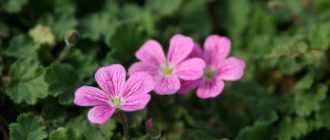
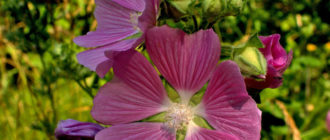
Aquilegia is a herbaceous perennial plant in the Ranunculaceae family. It is native exclusively to the Northern Hemisphere.
Content
Description and Features
From 60 to 120 species have been described, 35 of which are cultivated, that is, hybrid-created varieties, since wild varieties, as a rule, do not take root in garden conditions.
The name, translated from Latin, can be interpreted in two ways:
- Collecting water – catchment area (Russian).
- Related to the word "eagle." In some areas, the name "orliky" is also found.
This plant is one of the few that possesses the "lotus effect"—the ability to resist water. When moisture hits the leaf surface, it forms droplets and collects at the edges or center.
Lotus, reed, nasturtium, and other plants possess this property. The wings of many Lepidoptera—butterflies—are constructed on a similar principle.
During one annual cycle, foliage and shoots undergo two phases of vegetation. During the first phase, a cluster of leaves forms at the base of the flower stalk after flowering, close to the roots.
In winter they remain green and die off only in spring, in their place new dissected trifoliate leaves are formed on raised petioles and then tall peduncles.
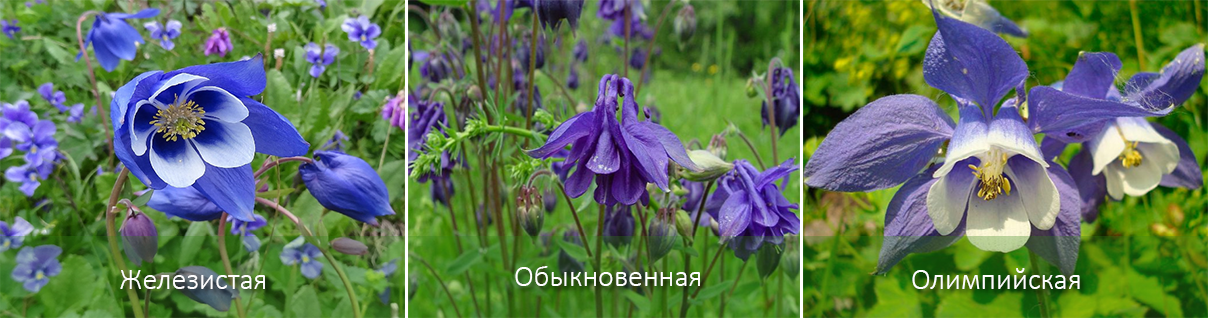
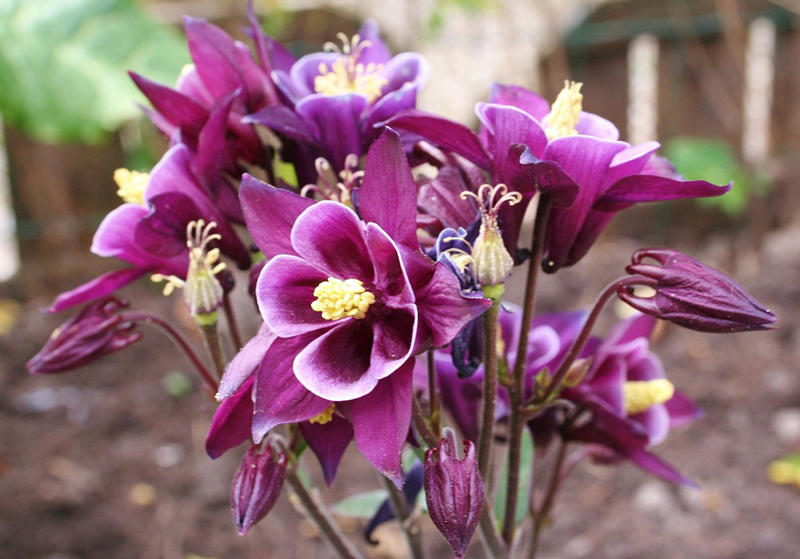
The flowers of the columbine are drooping, borne solitarily, and feature five funnel-shaped petals edged with spurs, the length of which varies among species. Their presence or absence is the main distinguishing factor among columbine species—their size, length, and upward curvature.
The buds come in a variety of colors: blue, yellow, and red. Bicolor and double-flowered varieties have been described in nature. Hybrid forms exhibit a wide variety of blooms.
It is a honey plant. The seeds are small, shiny, dark, and poisonous.
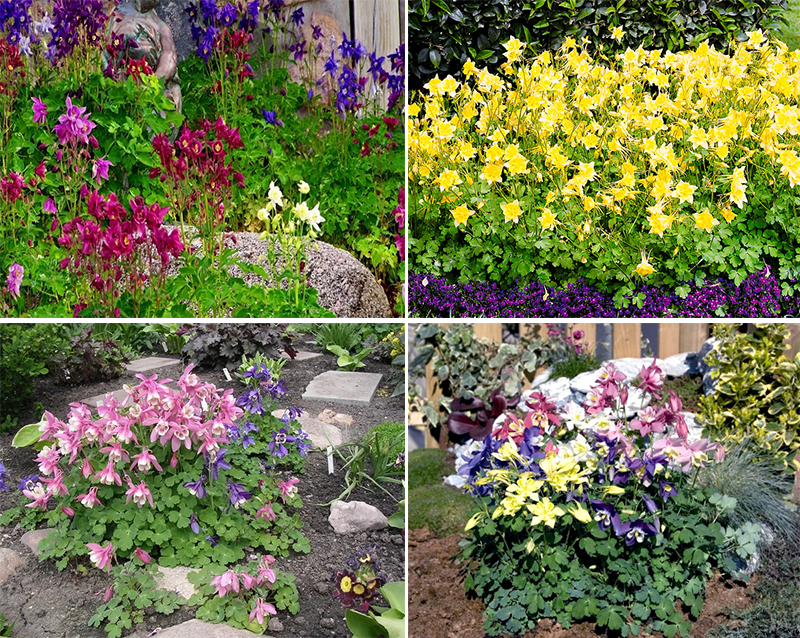
Aquilegia is a plant used in landscape design only in its hybrid form. Wild species are not grown in gardens. Aquilegia bushes retain their decorative appearance for up to five years, after which they need to be replaced.
Aquilegia flowers resemble orchids from certain angles. The intricately curved shape of their petals has been compared to elf slippers.
Recently, columbine has become increasingly popular. It enhances the landscapes of parks and gardens, especially where there are ornamental ponds.
Types of Aquilegia
| View | Origin | Description | Flowers | Flowering period |
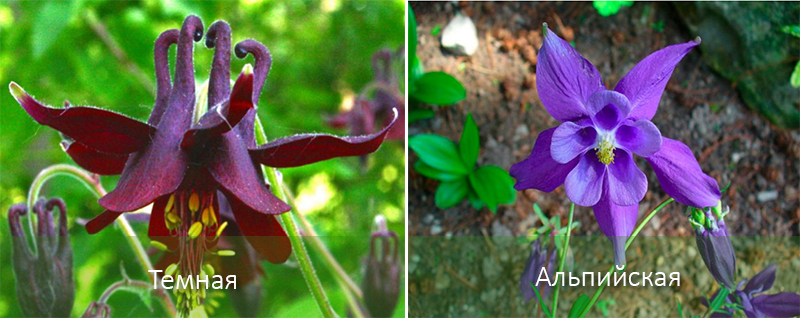
| Alpine | European | The stem is bare, 30-40 cm, sticky at the top. The leaves are dissected and small. |
Bright blue, 1 to 5 per inflorescence. | July-August |
| Glandular | 15-60 cm with a straight stem, pubescent at the top. | Cornflower blue, less often whitish or yellowish, up to 3 pieces on a peduncle. | June – mid-August | |
| Ordinary | The stem is branched, 30-70 cm tall. The leaves are light green above, glaucous below. The plant is poisonous. | Shades of blue, purple, red, and pink. Occasionally white. | June-July | |
| Olympic | The stem is sticky and branched at the top. The leaves are elliptical, silvery on the back. | Second half of May – beginning of June | ||
| Dark | The bush is 30-80 cm high. The leaves are glaucous. | Dark purple. With short spurs. Decorative. | End of May - beginning of June. | |
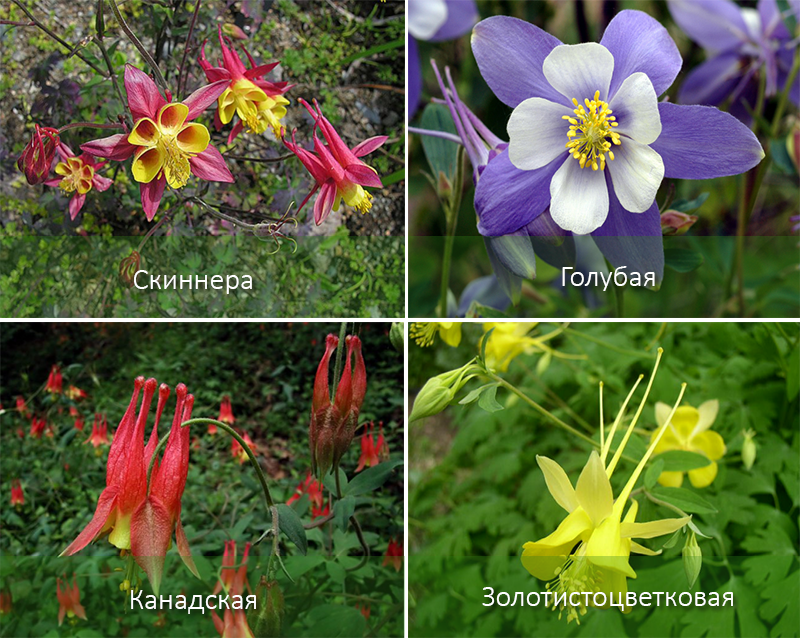
| Blue | American | The stems are branched at the top and spreading. The bush is up to 50 cm wide and up to 70 cm tall. The leaves are glaucous-green and large – 6 cm. | Semi-double, from white to blue and lilac shades. Large. | 25-30 days in May |
| Canadian | Dark, serrated leaves and a brown stem. Prefers shade and moist areas. | Large, with large, thick spurs. Carmine-red hue. Lemon-yellow core. | June | |
| Golden | A vigorous plant. Still rare in our latitudes. Drought- and winter-resistant. | Large, upright, golden. | June-July | |
| Skinner | The stem is erect, reaching up to a meter in height in the wild. The leaves are small, on short petioles, and pubescent beneath. | Painted in different colors at the same time - scarlet, yellow and green. | Flowering lasts 25-50 days. | |
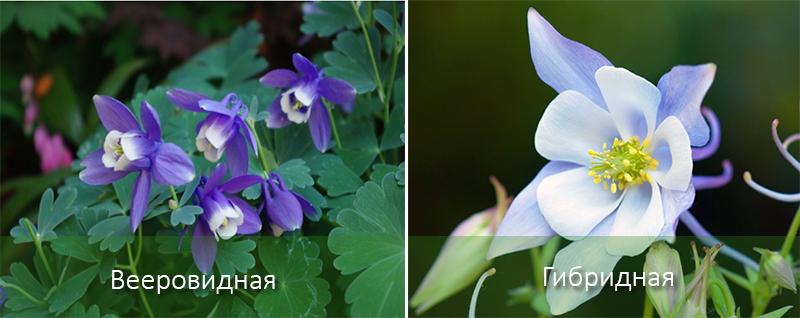
| Fan-shaped | Japanese | Tall plant with trifoliate leaves on long petioles. | It has a very beautiful transition in color from deep blue, through sky blue to white. | Second ten days of May. |
| Hybrid | It originated from crossing European and American species. | Height from 0.5 to 1 meter. | The flowers are large, sometimes without spurs at all. The colors are very diverse. | Depends on the variety. |
Growing columbine from seeds
In the fall, after the seeds have ripened, they can be planted directly in open ground. These plants reproduce well by self-seeding. Young shoots are usually weeded out. However, if necessary, they can be left as seedlings for subsequent replanting in place of dead or overgrown bushes.
When grown from seed, columbine will bloom in the second year. It's important to note that seeds lose viability after one year.
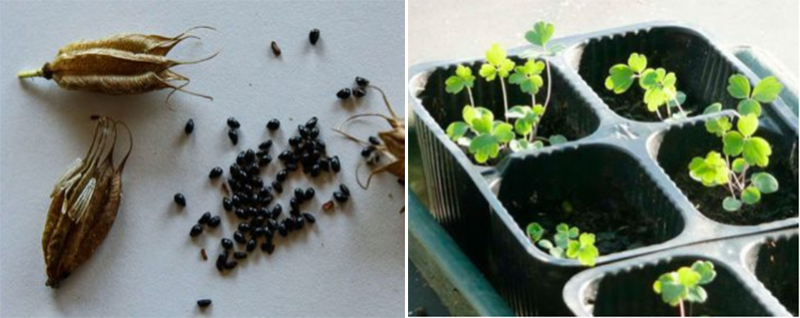
Planting columbine
It's permissible to sow seeds in the spring. Planting material collected no earlier than the previous fall must be pre-frozen—stratified outside in the snow or in the refrigerator at home.
Aquilegia is sown in spacious trays in pre-prepared soil. The mixture is made from equal parts of river sand, well-rotted compost, and garden soil. The soil is moistened and lightly compacted. Scatter the seeds as evenly as possible and cover with a thin layer (3 mm) of soil.
Cover the top of the planting with thick natural fabric or newspaper and put it in a cool place (+16…+18 0WITH).
The sprouts will emerge in approximately 2-3 weeks. At the "two full leaves" stage, the seedlings are pricked out.
What time to plant?
For further growth in open ground, mature plants are planted in June. Columbine grows well from seed, allowing the grower to choose a convenient time for planting. Winter sowing is done in October, and seedlings are sown in April.
How to plant
The best location for columbine is partial shade. It thrives in moderately moist, loose, fertile soils. At 1 m2 have 10-12 plants.
It also survives in sunny flowerbeds, but the duration of the aquilegia's flowering and the number of buds will be shorter.
Caring for columbine
Aquilegia is easy to plant, grow, and care for. Watering, weeding, loosening the soil, and fertilizing are all routine, without any particular complications.
It tolerates moderate drought and frosts typical for the climate zone of growth equally well.
This is facilitated by a well-developed and deeply penetrating root system of the catchment area.
Fertilizing columbine
Aquilegia is fed twice a season. It requires mineral fertilizers: superphosphate, saltpeter, potassium salt (50, 25, 15 g), and watering with a weak infusion of mullein or bird droppings.
Aquilegia after flowering
After flowering, columbine loses its ornamental value. To preserve its vitality for the next cycle, the above-ground parts are cut off. If seeds are needed, the stems with the developed multi-leafed fruits are left until ripening.
It is important to cut the fruit stalks before the pods open and their contents spill out onto the ground.
Wintering
The plant is frost-resistant and overwinters well even in northern taiga conditions. No special winter protection is required. An exception applies to older bushes aged 4-5 years.
They are either removed and replaced with young ones, or, if for some reason the specimen needs to be preserved, it is covered with a layer of humus, which will help protect the roots from frost.
Aquilegia is suitable for forcing. It will bloom indoors as early as April if you dig up the rhizomes in the fall, plant them in large, tall flowerpots, and overwinter them in a cool, unheated room until the end of January.
For example, in a basement, garage, closet, or veranda. Then remove and place in a well-lit area at a temperature of +12…+16 0C. A window sill is ideal for these purposes.
Propagation of columbine
Propagated by seeds, cuttings and division of the bush.
For cuttings, take early spring shoots, before the leaves have fully unfurled. The cuttings should have at least one internode, from which new shoots will form.
Rooting is done in the usual way. Choose loose soil and add plenty of washed river sand. The cuttings are soaked in Kornevin and planted in boxes under plastic wrap or covered with a cut-down plastic bottle. Watering and ventilation are moderate.
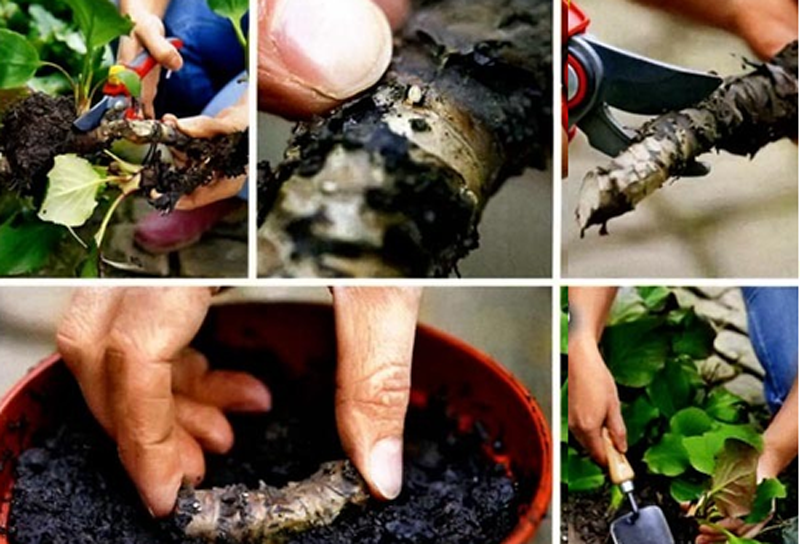
Once the plants have established themselves, they are planted in their permanent location. Low-growing hybrids should be planted 25 cm apart, while taller hybrids should be planted 40 cm apart.
Aquilegia is propagated by division only when absolutely necessary and with extreme caution. For example, when a rare variety needs to be urgently replanted or transported to another location.
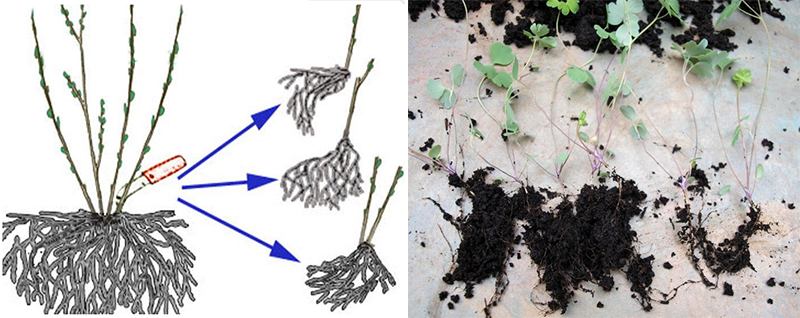
The deep roots of a mature bush are very difficult to divide without damaging them. To do this, dig up the entire bush, wash the roots thoroughly, let them dry slightly, and remove almost all the leaves and stems, leaving 2-3 growing points per intended division. Cut the root with a sharp garden knife, being careful not to damage the leaf buds or roots.
The cut site is sprinkled with charcoal and carefully planted in prepared, watered holes, spreading the roots. The columbine will take a long time to "rest."
Diseases and pests
| Diseases/Pests | Symptoms | Elimination measures |
| Powdery mildew | White, rusty or brown coating on leaves, darkening and death of the above-ground parts. | Infected parts are removed and sprayed with a solution of laundry soap and copper sulfate or sulfur-containing antifungal preparations. |
| Rust | ||
| Gray mold | ||
| Aphid | Small green insects with a sticky coating. | Undamaged bushes are treated with Actellic, Karbofos, and yarrow paste. Application and precautions are as per instructions. |
| Spider mite | Cobwebs, insects on leaves. |