Dicentra is a herbaceous plant belonging to the poppy family. It is native to eastern Asia and northern America.
Content
Features of dicentra
A shrubby plant with a fleshy root system. Stem height ranges from 30 cm to 1 m. Purple shoots are present above ground. The foliage is pinnately dissected, light green with a glaucous tint.
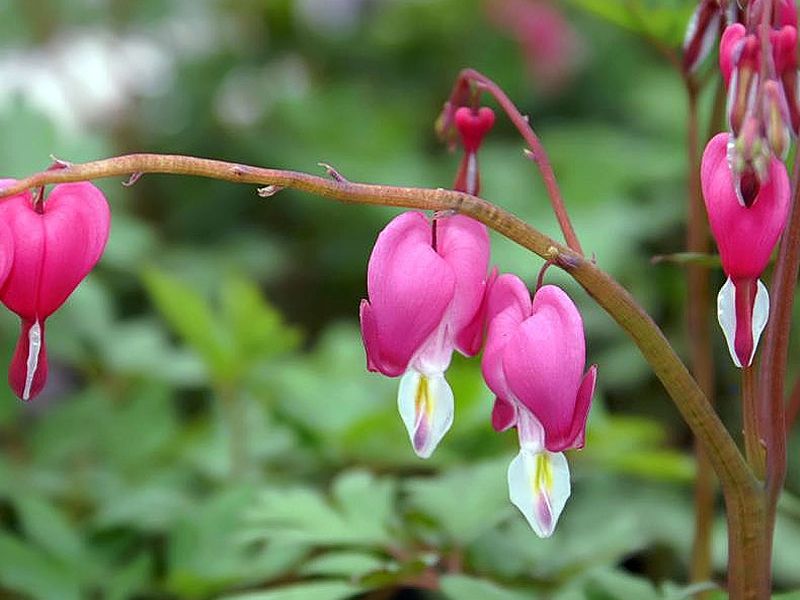
The buds are heart-shaped. Color ranges from white to red. Diameter: up to 2 cm.
After flowering, black seed pods appear; if they are collected in a timely manner, the planting material retains its germination capacity for 2 years.
Types and varieties of dicentra: photos with names
The following types of dicentra are suitable for growing in garden plots:
| View | Description | Flowers | Care Features |
| Beautiful | Native to the northern regions of America, it has been used to decorate gardens since the 19th century. A perennial plant with a stem 30-40 cm tall. The shoots are elastic, the leaves are green, and are located on elongated petioles. |
The color ranges from soft silver to deep red. The inflorescences are racemose. | The species is unpretentious and tolerates frost well. |
| Aurora | The shrub reaches a height of 35 cm and can be grown in the same location for up to 8 years. The foliage is pinnately dissected and grayish-green. | Heart-shaped, color - white. | At temperatures below -30°C, additional cover is required. The root system extends deep into the soil to seek moisture, so the plant requires little or no watering. |
| Bakchanal (Bekkanal) | A herbaceous perennial plant up to 80 cm tall. The leaves are carved and glaucous-green. | They are shaped like a heart pierced by an arrow. The buds are pink or dark red, with a white border around the edges. They are about 2 cm in diameter. | Unpretentious, planted in partial shade. Frost-resistant. |
| Luxury Sharient | A perennial plant that grows up to 35 cm. The leaves are lacy, carved, and silvery-green in color. | Heart-shaped buds. Fuchsia color. | Planting is carried out in partial shade. |
| King of Hearts | It is one of the most popular varieties of dicentra, reaching a height of 25 cm. The foliage forms a basal rosette, the outer side is green, the inner side is glaucous. Used in landscape design. |
Heart-shaped, purple or pink in color. | Place in open or shaded areas. Repot every six years. |
| Magnificent | It reaches 1 m in height. Its homeland is China. | Heart-shaped. Pink in color. | In case of severe frosts, additional cover is provided. |
| Alba | The height of the bush is up to 1 m. | White. | To improve flowering, place the plant in nutritious soil that is regularly fertilized. In the fall, remove all shoots, leaving only 5 cm, and cover with spruce branches. |
| Dicentra Spectabilis | The bush is about 60 cm high. The leaves are large and dissected. | The inflorescences are racemose. The color is soft pink, with a white border at the tips. | The species is unpretentious, but in case of severe frosts it is necessary to provide shelter. |
| Dicentra Eximia | Native to North America, it has thick, elongated shoots. | Purple. Peduncle – arched. | The plant is frost-resistant, but in cold latitudes it is covered with peat and spruce branches. |
| Graceful | In appearance it looks like a fern. | Pink. | Plant in partial shade, water twice a week. |
| Golden Tears | A shrub up to 2 m tall. The shoots are strong but flexible. The foliage is small and oval. | Heart-shaped, rich yellow. | They install a support and tie the plant to it. |
| Golden Vine | Perennial plant up to 2.5 m tall. Leaves are small, light green. | Large, sunny. | To ensure normal growth of the flower, a support is installed. |
| Glomerulose | A dwarf variety, reaching 15 cm in height. The foliage is poisonous, so gloves are recommended when handling the plant. The flower is widely used in the pharmaceutical industry. | Pink or white. | Plant in partial shade, water once a week, and prune in a timely manner. |
| Goldenflower | Native to Mexico and California, it is considered one of the largest species, reaching 1.5 m in height. | Golden, have curved petals. | One of the most capricious species, therefore it is watered 2-3 times a week, constantly protected from direct sunlight, and disease and insect prevention is carried out. |
| One-flowered (Ox's head) | Grows up to 1 m. Native to Idaho and Utah. The flower stalk is up to 10 cm long. | Single, white with a pinkish tint. Petals are curved. | The plant requires care, so regular watering, loosening, and fertilizing are required. |
| Canadian | Grows up to 30 cm. Foliage is grey-green. | Snow-white. | Undemanding, tolerates drought well. |
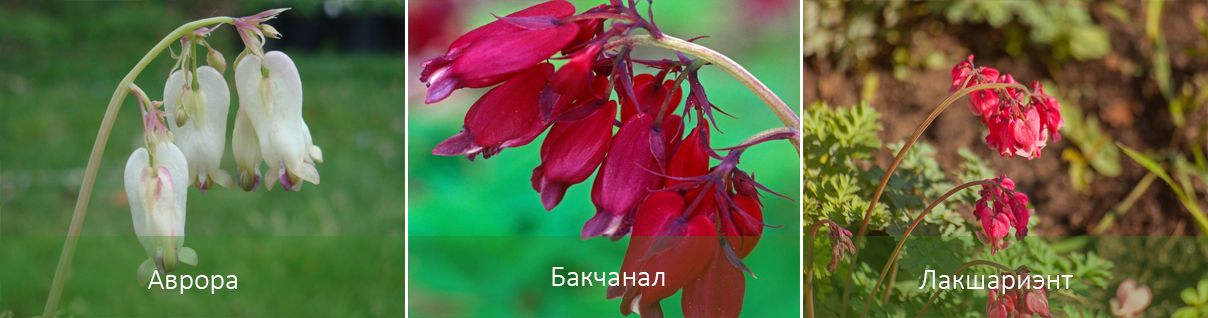
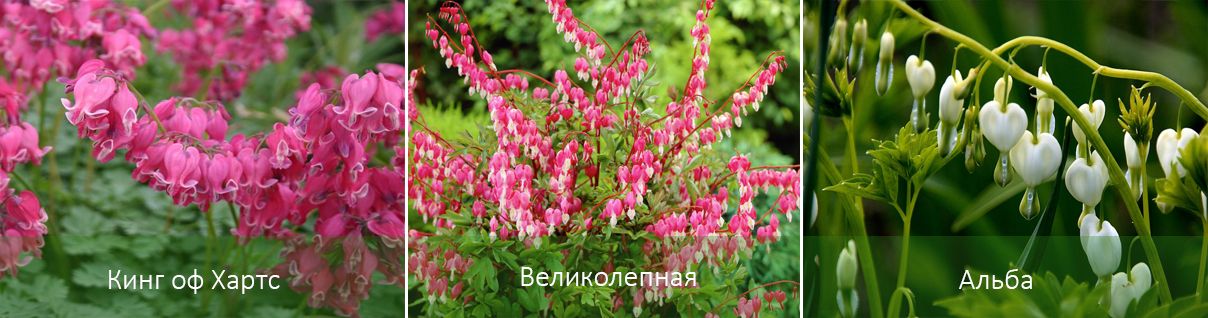
Of the varieties listed, there are about 20 cultivars that delight with their flowering in spring, summer and autumn.
Planting dicentra in open ground
When growing plants in open soil, it is essential to control the planting time and follow the technology.
Planting dates
The flower is placed in the ground in mid-spring, or occasionally in early fall. However, when planting in September, be sure to allow the root system to establish before the onset of frost. Choose a well-lit or partially shaded site.
How to plant correctly
Any soil is suitable for growing dicentra, but light, well-drained, moderately moist, and nutrient-rich soil is preferred. The planting site is prepared in advance by digging the soil to the depth of one spade, adding humus (3-4 kg of fertilizer per square meter), and watering with a nutrient solution.
Immediately before planting, dig holes for the flowers. The diameter and depth are 40 cm, with a 50 cm spacing between the shrubs. Place a drainage layer of crushed stone or brick chips at the bottom. Add a small amount of garden soil, mixed with compost. Place the plant in the hole and cover with soil. If the soil is heavy, combine it with sand.
Features of dicentra care
If the site was chosen correctly and planting was done correctly, there won't be any problems growing dicentra. However, care should be taken once the first shoots appear, loosening the soil immediately to allow oxygen to reach the root system.
Watering, loosening, mulching
The frequency and amount of water applied to the soil depend on the temperature. During the warm season, watering should be done twice every seven days, and once a week during the fall and winter. The soil should not be too wet, as this can cause root rot.
Regular weeding around the dicentra is recommended, along with pruning of withered and dried branches and foliage. After flowering, remove all trunks at the root, leaving only small stumps.
To protect the plant from frost, mulch it. After pruning, cover the remaining parts of the plant with a layer of peat and sprinkle with pine needles. The protection is removed only in the spring.
Top dressing
The plant is fed 3 times:
- after emergence – nitrogen-containing agents;
- during bud formation – superphosphate;
- end of flowering period – mullein infusion.
Reproduction of Dicentra
Dicentra is sometimes propagated by seed, but this method is labor-intensive and unreliable. Germination rates are low, and often nonexistent. Another drawback of this method is its length: growth is slow, and flowering is not expected for at least 3-4 years. Sowing is done in late September, covered with plastic for the winter, and then with straw or leaves.
Many novice gardeners germinate the plant's seeds indoors. They place them in special containers with soil, cover them with plastic, and transport them to a warm room. The first sprouts appear within 30 to 35 days. When the flowers develop four true leaves, they are pricked out into open soil. Before repotting, the plant is hardened off by placing the pots outside for several hours daily.
The main methods of dicentra breeding are considered to be the following:
- Dividing the shrub. This is done every 3-4 years, in early autumn, immediately after flowering. Each divided section contains 3-4 buds. The cuts are sprinkled with wood ash, and the new plants are placed in pre-prepared holes. Failure to divide the root system will result in rot.
- Propagation by cuttings is carried out in the spring. The resulting shoots, up to 15 cm long, are placed in a growth stimulator, then in containers with light soil. The cuttings are covered with plastic cups and transported to any warm room. They are planted in open ground only in mid-spring of the following year.
Diseases and pests
The plant is highly disease-resistant, but occasionally suffers from ringspot or tobacco mosaic. Infected dicentra plants develop spots or stripes on their leaves, while mature plants develop pale, elongated rings. Rarely, signs of mycoplasma disease appear: flower stalks are distorted, growth is slow, and the foliage turns yellow.
To prevent such damage, it is recommended to water the dicentra properly, as excess moisture weakens its immune system. The soil is treated with a formalin solution.
Of the insects, aphids are the only danger. To eliminate them, spray the shrub with Antitlin or Biotlin. Sometimes, wipe the leaves with a soapy solution.
Top.tomathouse.com recommends: Dicentra in landscape design
The plant is used in individual or group plantings, to decorate flower arrangements and holiday bouquets. Its heart-shaped form makes it a key element in flowerbeds and rock gardens.
If dicentra is provided with favorable conditions for growth, it will delight you with its flowering and healthy appearance for many years.