Muscari (Armenian Viper's Onion) is a flower from the Asparagus family (formerly liliaceae). It is also known as snake onion or grape hyacinth. It is found near shrubs, on plains, forest edges, and mountain slopes. Its distribution range includes the Caucasus, Crimea, Europe, Western Asia, and the Mediterranean. It is cultivated as an ornamental flower, grown in lawns, rock gardens, and borders. The plant is classified as an ephemerophyte, meaning it has a short growing season.
Content
Description of Muscari
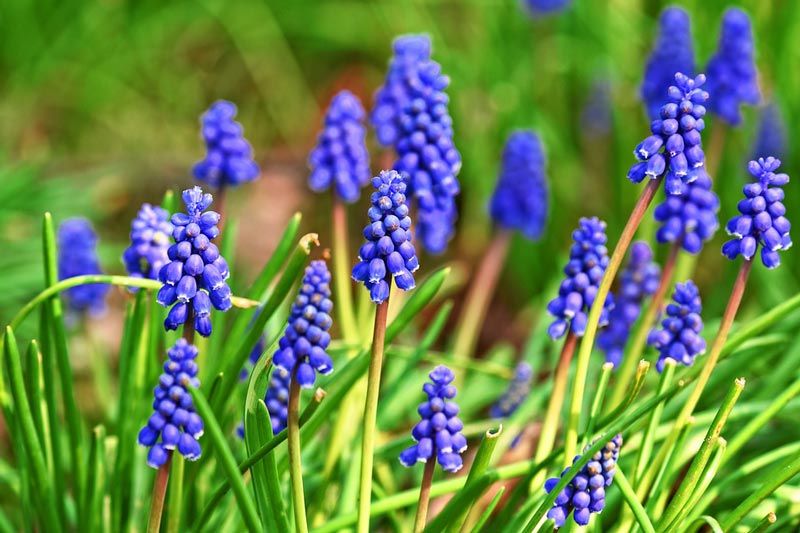
This perennial flower has cylindrical, oblong, or barrel-shaped perianths. It blooms in April and May for 20 days. The flowers, with six fused petals, are gathered in a raceme on a tall stalk. They come in shades of blue, white, light blue, azure, and cornflower. They have a subtle, pleasant fragrance. The basal, pointed leaves with parallel veins form rosettes up to 17 cm long. The oval bulbs with light-colored outer scales are 20 mm in diameter and 15-25 cm long.
Types and varieties of muscari
The most common of the 60 species:
Armenian (Colchian) – distinguished by its two-colored, fragrant petals on a spherical inflorescence. The top is dark blue with a white border, while the bottom is lighter. The leaves are linear and tapering, and blooms in late May for 20 days. It grows in the Transcaucasus and is also found in Turkey. An easy-to-grow, winter-hardy variety.
Its varieties:
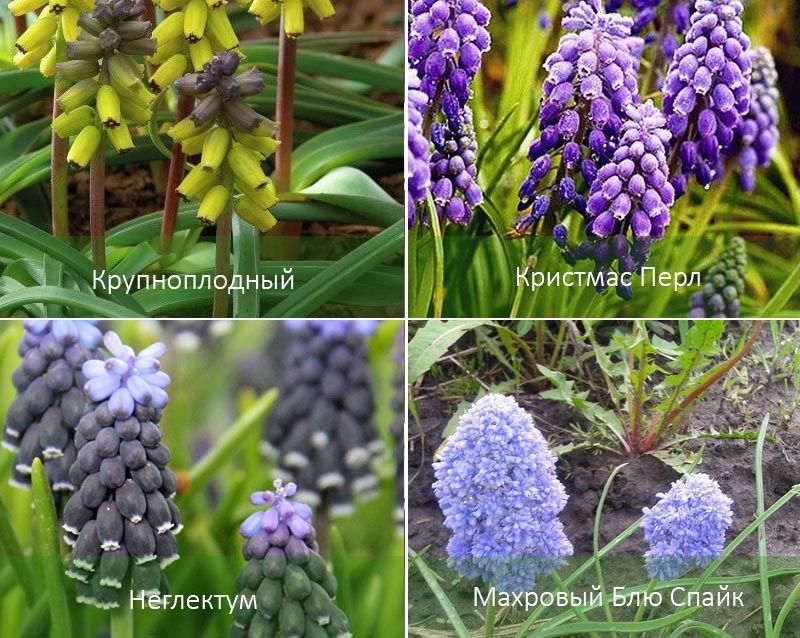
- Double Blue Spike – a cornflower-blue cluster-shaped inflorescence with up to 180 flowers. It blooms two weeks later than other varieties and does not bear fruit. Its appearance is enjoyed for three weeks, and it is grown in gardens and used in flower arrangements.
- Christmas Pearl – dark purple flowers with a musky scent.
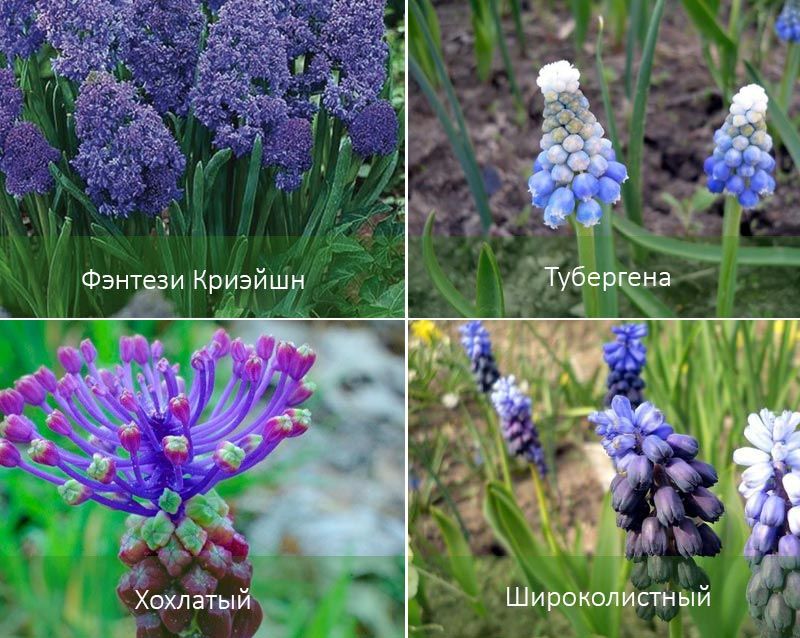
- Fantasy Creation – is distinguished by its changing color from green to blue.
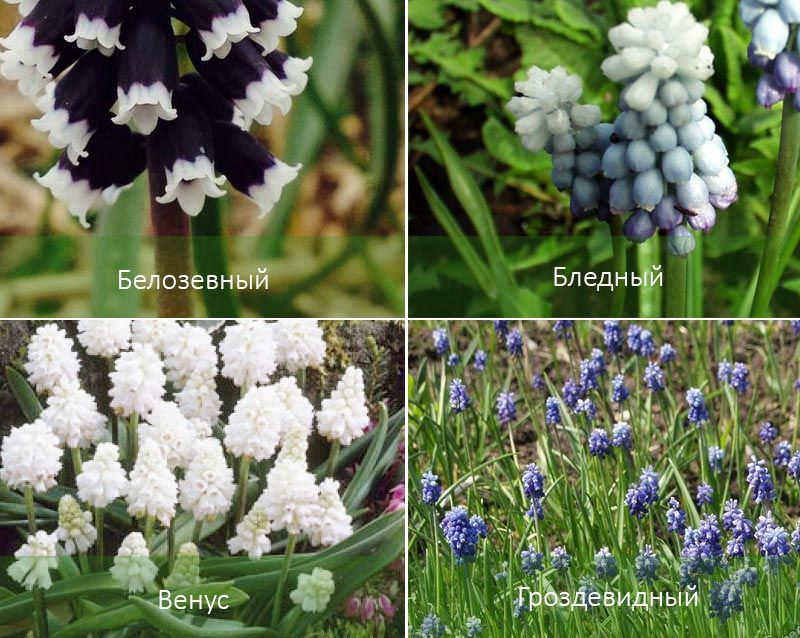
- Venus is a new variety, translated as Venus, it has white flowers with a purple tint.
- The grape-shaped variety has small, sky-blue, blue-violet, and white flowers. It has two varieties: Album, which resembles a pearl, and Corneum, which resembles a pink cloud. It grows in central and southern Europe.
- Broadleaf – the leaves are similar to those of the tulip, wider than those of other tulips. The inflorescences are cylindrical and dark blue. Several flower stalks arise from a single bulb. It is found in Asia Minor.
- Pale – short, light blue flowers resembling a bell. It grows in the meadows of the Caucasus. It is the origin of the popular White Rose (pink).
- Crested – distinguished by bright purple flowers gathered in a tuft, the plant height is up to 70 cm. The most famous of this species is Plumosum, which grows in Europe and North Africa.
- Tubergena (Oshe) – sickle-shaped leaves, azure flowers up to 18 cm long, serrated at the edges, with white buds on top. Found in Iran.
- Large-fruited – blue, yellow, and brown flowers are larger than other varieties. Native to Greece and western Türkiye.
- Neglectum (unnoticed) - purple petals with a white border at the base and sky-blue at the top.
- Belozevny – an ultramarine inflorescence (contains forty flowers), the petals edged with white teeth. Native to the Black Sea region and Iran.
Planting muscari in open ground
This involves choosing a location, preparing the soil, and applying fertilizer. The plant prefers sunny areas, but also grows in shade, and requires no winter cover. The flower isn't picky about soil, preferring light to medium, slightly acidic soil, which produces very attractive flowers.
Plant in the fall (September – October) to allow the plant to establish itself before flowering. Before planting, inspect each bulb, removing any rotted or damaged ones. Treat them with Fitosporin (or a 2% malathion solution, then potassium permanganate). Large bulbs are planted at a depth of up to 8 cm, and small bulbs at a depth of 3 cm, leaving 5 to 10 cm between them. First, dig the soil, water it thoroughly, and add sand to the holes.
If you weren't able to plant the flower in the fall, do so in the spring. Once the snow melts, the purchased bulbs are divided and planted in the same way. They will bloom the following year.
Features of caring for muscari in open ground
Viper's onion requires moist soil; if there's no rain, water it in the morning. Avoid planting it in an open area exposed to direct sunlight; instead, shade it with taller neighbors. Fertilize with humus in the spring (5 kg per square meter), when sprouts appear and buds begin to form. When grown in a lawn, don't mow it until the leaves have dried.
Flowering and replanting
In early spring, during flowering, loosen and weed the soil regularly. This period lasts 3-4 weeks. Repotting is necessary every 3-5 years or if the flowers become unsightly.
After flowering
When the mouse hyacinth finishes blooming, remove the flower stalks and apply a liquid mixture containing potassium and phosphorus to the roots. In the fall, water the plant sparingly. Use peat as a mulch for the winter.
Preparing for winter, storing muscari bulbs
For winter, the bulbs are usually not dug up, only humus is added, the bunches are cut off, and the leaves are not torn off.
If the bulbs need to be dug up, they should be done only after the leaves have dried and stored under certain conditions:
- They dry it.
- They are buried in peat or sand.
- Inspect regularly and remove rotten ones.
- Store at +17 °C and 70% humidity.
Reproduction of muscari
Muscari is propagated by bulblets (about 30 bulblets are formed) – carefully separated from the mother plant along with the soil and replanted in the usual manner. Flowering begins in the second year.
By seed (this is what breeders do) – seeds are collected from the lower part of the shoots, sown in the fall, and the bulbs form in the spring. Flowers will appear after three years. Some varieties are sterile and cannot be propagated this way.
Diseases and pests affecting muscari
Muscari are sometimes affected by viral mosaics:
- Onion - leaves are narrowed, growth slows down.
- Cucumber - pale green stripes and spots on the leaves, they become deformed.
When mosaic is detected, the affected hyacinths are dug up and destroyed immediately.
The flower is rarely attacked by pests:
- Spider mites - use chemicals: Vermitek, Akorin.
- The vector of mosaic is aphid; as soon as it appears, flowers are immediately sprayed with a soap solution.
- Rust - brown spots on the leaves on both sides, spray with preparations: Ditan, Bayleton.
Mice can cause damage to flowers; they can be controlled with repellents.
Growing Muscari at Home
Muscari is often grown indoors. Prepare the bulbs:
- They are stored for three months at +5°C.
- Then at +9 °C for more than 30 days.
- Plant in a container with drainage (soil made of sand, peat, compost) to a depth of 2 cm.
- Keep at +5°C for two weeks.
- Then they are placed in the light, where it is + 10 °C.
- After three days, increase to +15 °C.
High temperatures shorten the flowering period. Water moderately with soft water; flowering occurs within 14 days.
It prefers bright lighting and high humidity, and is placed on eastern and western windowsills.
Muscari in landscape design
The flower is widely used by landscape designers, creating alpine gardens, vibrant flowerbeds with a variety of flowers, borders, flower beds, and fences, along paths, and under ornamental shrubs and trees. Potted plants are also placed on terraces and verandas.
Medicinal properties
Muscari petals have beneficial properties – they contain esters, flavonoids, organic acids, and ascorbic acid.
The plant is used as a wound-healing, antibacterial, and aphrodisiac agent. Traditional Asian medicine uses the essential oil to treat bronchitis, massage, aromatherapy, colds, and insomnia.
The perfume industry has also not ignored this fragrant flower; its notes create the aroma of perfumes and are used in cosmetology.
Bouquets of mouse hyacinths are placed in homes not only for beauty: the plant repels flies, mosquitoes, and midges. It should not be consumed, as the plant is poisonous.