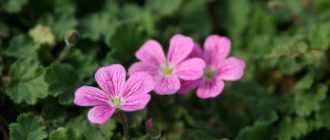
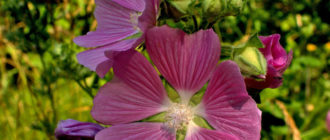
Arabis (Latin: Arabis), or rock cress, is a herbaceous perennial plant in the Brassicaceae or Brassicaceae family. The origin of the name stems from the meanings "Arabia" or "Arabia," while other sources suggest the Greek "arabos," which translates as "gnashing."
The homeland of the rock cress is considered to be the mountainous regions of Europe, Central Asia, and East Asia. It also grows in the tropics of mountainous Africa and in cool climates. The flower's second name, rock cress, refers to the stiff hairs that cover its green leaves, which can irritate sensitive skin.
It's planted everywhere in various flowerbeds. The flower is grown both as an annual and a perennial.
Content
Description and characteristics of Arabis
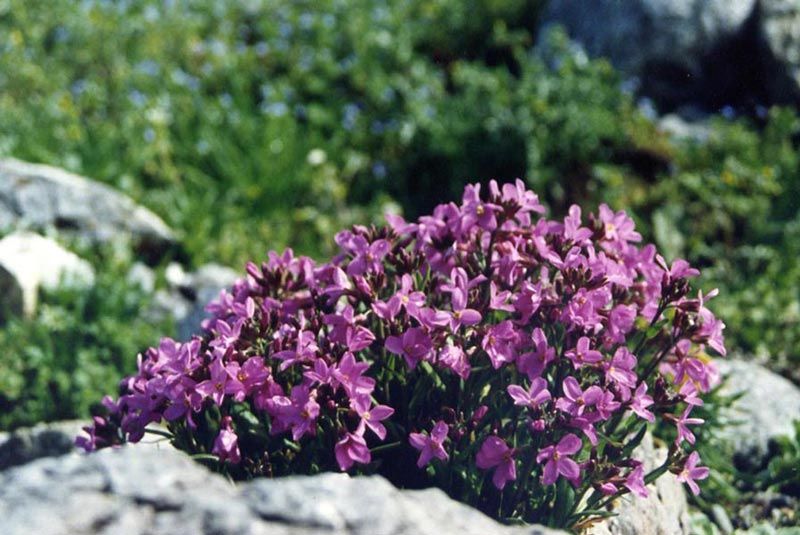
In appearance, it is a creeping herb, reaching a height of up to 30 cm. Heart-shaped leaves are located on the easily established groundcover stems. Small flowers are gathered in neat, compact, tassel-like inflorescences.
The flowers come in a variety of colors: pink, white, purple, and yellow. They bloom long and profusely, exuding a fragrance that attracts countless insects. Like all cruciferous plants, after flowering, a pod-shaped fruit forms. The seeds are flat; in some Arabis species, they are winged.
The plant's growing conditions are absolutely simple, which is why it is very popular among gardeners for use in decorating flower beds.
Types and varieties of Arabis: Caucasian, Alpine and others
In floriculture, various types of flowers are used, some of which have varieties.
| View | Description | Height,
cm |
Varieties | Leaves |
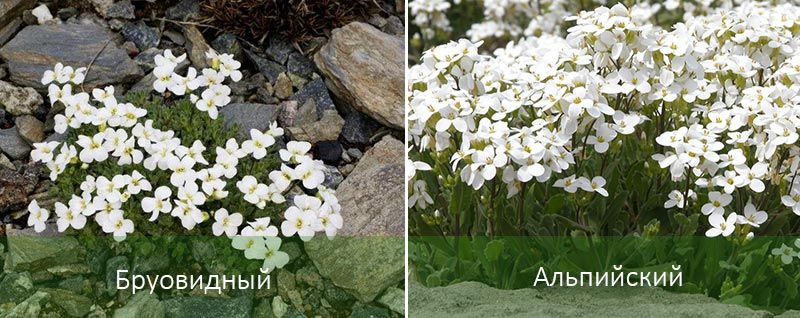
| Alpine (Arabis alpina — Arabis flaviflora) | It is widespread in the Far East, northern Scandinavia, the Polar Urals, and the highlands of North America and Western Europe. The reproductive branches end in loops that cling to the soil. | 35 | Schneeshaube. Flowers in shades of white. Height up to 25 cm, 2 cm in diameter. Flower cluster length – 15 cm. | The basal leaves are oval in shape and end in arrow-shaped, cordate stem leaves. |
| Double. The racemes are large, reminiscent of stocks. They reach 20 cm in height and 2 cm in diameter. The flower raceme is 12 cm long. | ||||
| Pink. Flowers in shades of pink. Up to 35 cm. | ||||
| Sunny Bunny. Silvery-white leaves, fragrant flowers in snow-white shades. Propagated by seed. | ||||
| Arabis bryoides | Highland regions of Albania, Greece, and Bulgaria. Perennial, white flowers, 3-6 of which form a loose, corymbose raceme. | 10 | They do not stand out. | Small, ovoid, with felt-like fluffy hairs collected in rosettes. |
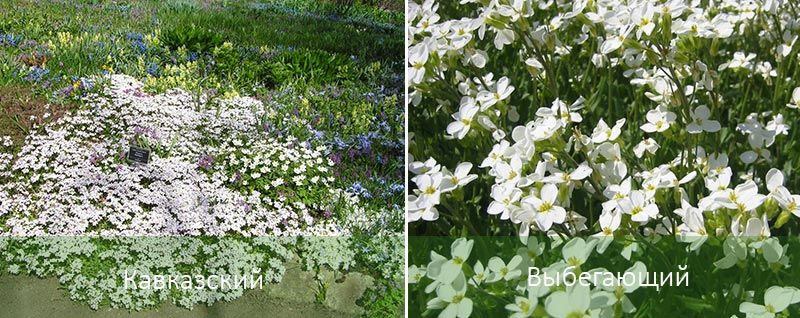
| Caucasian (Arabis caucasica) | A perennial plant, known since 1800. It is widespread in the Caucasus, Crimea, the Mediterranean, Central Asia, and Asia Minor. The flowers are white, up to 1.5 cm in diameter, with a flower cluster up to 8 cm long. It blooms gradually from early June, some until late August. The fruit is a long, narrow cone. | 30 | Flore-pleno. Blooms profusely, with double white flowers on elongated tassels. | Small, grey-green in colour, elongated in shape, coarsely serrated at the edge, covered in dense silvery pubescence. |
| Variegata. Leaves have a yellow edge, flowers are white. | ||||
| Rosabella. Flowers in shades of pink. | ||||
| Grandiflorose. Flowers are pinkish in tone, with lush racemes. | ||||
| Schneehaube. A low bush with white, double flowers. | ||||
| Runaway (Arabis procurrens) | Common in the Balkans. Flowers are pale. It is used to stabilize collapsing slopes. It is a frost-hardy, undemanding perennial, but requires shelter. | 12 | Variegata. Flowers are cluster-shaped and gradually become lighter. | Small, rosette-shaped. Green in color with a wide white border around the edges. |
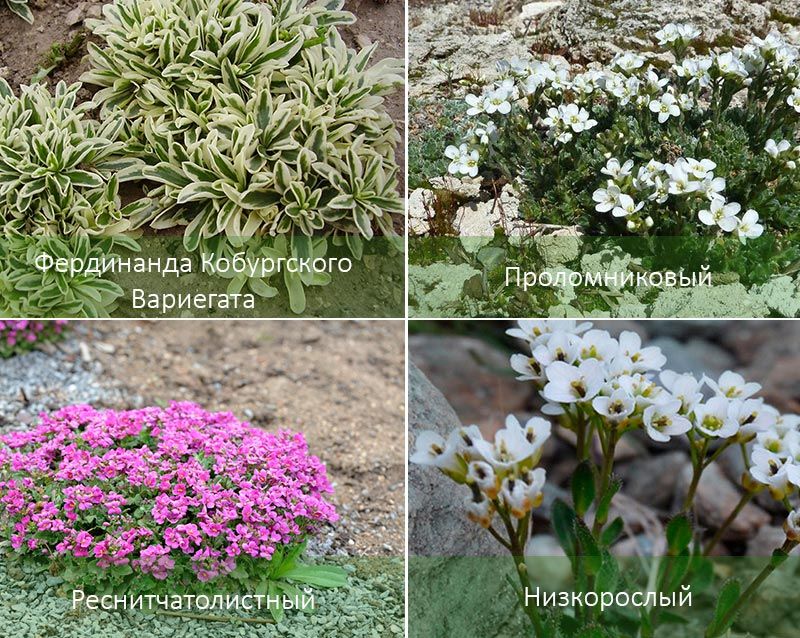
| Low-growing (Arabis pumila) | It is common in the Apennines and the Alps. The flowers are white, inconspicuous, and lack ornamental appeal. They bloom in May or June. Seeds are used for propagation. | 5-15 | They do not stand out. | Simple, small, oval-elongated, grassy in color. |
| Arabis androsacea | Found in the mountains of Turkey at altitudes of up to 2,300 m. Flowers are white. The raceme is a loose corymb. | 5-10 | Small, rounded, with a pointed tip, forming rosettes. | |
| Ciliate-leaved (Arabis blepharophylla) | Grows in the Californian hills at altitudes of up to 500 m. Groundcover bush up to 25 cm in diameter. Flowers are dark pink. | 8 | Route Sensation. Elongated leaves, bright pink flowers. | Gray-green color. |
| Frühlingshaber. Small leaves, pink flowers. | ||||
| Ferdinand of Coburg Variegata (Arabis ferdinandi-coburgii Variegata) | A semi-evergreen shrub, up to 30 cm in diameter. Flowers are white. Long-blooming. Tolerates low temperatures with adequate drainage. | 5 | They do not stand out. | Light green shades edged with white, yellow, or pink. The rosettes, shaped like voluminous cushions, are prized. |
| Arends (Arabis x arendsii) | A hybrid obtained by crossing Caucasian and Obrietziform Arabis at the beginning of the 20th century. | 10-20 | Freshness. Voluminous inflorescences, flowers ranging from light to dark pink. | Grayish-green, densely pubescent, in the shape of an elongated heart. |
| Frosty Rose. Flowers are crimson with a blue tint. | ||||
| Companions. Flowers in bright colors. | ||||
| Rosabella. Bright green leaves combined with light cream flower clusters. |
Planting and care
Arabis cultivation techniques are not complicated, but you should keep in mind a few nuances.
Growing Arabis from Seeds
Cress is usually propagated by seed. The optimal method is to sow directly into the ground in late autumn. In early spring, sowing is done in specially prepared seedling containers filled with soil mixed with sand or pebbles for drainage. Each seed is placed at a depth of 0.5 cm.
The seedlings are kept indoors at a temperature of +20°C, covered to maintain humidity. After the first leaves emerge, the cover is removed. Further care for the seedlings requires a warm, well-lit location.
Never allow the soil surface to dry out. This is achieved by watering regularly and carefully loosening the soil.
For subsequent cultivation as individual plants, transplanted seedlings into prepared pots. For groundcover, transplant them directly into the soil at a distance of 30 cm. Before planting outdoors, seedlings require preparation. Harden them off for 10-12 days, then leave them outside for 1-2 hours in the morning, avoiding drafts.
Planting Arabis in open ground
Flowers are planted in the garden when the third pair of leaves appears. This is usually in late May or early June. A sunny, well-ventilated location is preferred. Fluffy, sandy soil with some amendments for better drainage is suitable.
To ensure good growth and the best decorative qualities, the soil must be enriched with organic and mineral nutrients. Cressus does not thrive in acidic soil and produces few shoots.
Arabis seedlings thrive between rocks in rock gardens. The planting pattern is 40x40 cm. For abundant tillering, place 3-4 plants per hole. Arabis begins to bloom in its second year.
Arabis is easily damaged during transplantation. Therefore, a few rules should be followed:
- dig holes for planting 25 cm deep;
- water the soil with the bush until it is moderately moistened;
- loosen the soil and knock out the plant with the entire lump;
- place in a hole, sprinkle with soil, press down and water.
Caring for Arabis in the Garden
Fertilizers are applied once a year at the beginning of the growing season. Mineral fertilizers are used. Well-rotted compost or manure can also be added. Fertilizer is also applied to the root zone before flowering.
During the season, pinch the bushes to create a beautiful shape. At the beginning of the growing season, remove old branches and trim long ones. As new shoots grow, a second bloom is possible.
Trimmed long shoots are often used for subsequent propagation of plants.
Arabis propagation methods
The remaining 10 cm long cuttings are cleared of low leaves after pruning. They are then planted at a 45° angle in sandy soil. For 20 days, while the roots grow, maintain a regular watering and misting regimen.
Cress is also propagated by layering. Pinch off the growing point of the stem, press it down to ground level, and water it throughout the summer. In the fall, separate the good seedling from the mother plant.
Arabis after flowering
Arabis blooms for 15-30 days in early spring. Even after flowering, the plant retains its attractive appearance. During the summer, Arabis should be watered moderately during dry weather. In September, reblooming may occur on newly grown shoots.
At the end of August, the ripe seeds are harvested. Full flower clusters are cut off and left to ripen in a shaded area at a temperature of 20 to 23°C. When completely dry, the seeds are threshed. Store in a dry, dark place.
Preparing for winter
The plant is winter-hardy, but only thrives in mild winters. Therefore, it requires special care to preserve its decorative qualities. Bushes are cut back to a height of 3-4 cm and covered with fallen leaves or other similar materials.
Diseases and pests of thale cress
Like all flowering plants, thale cress is susceptible to diseases and is attacked by pests.
| Disease/pest | Signs | Control measures |
| Viral mosaic | Dark, growing spots on the leaves. | There is no cure. Dig up and destroy the bush. |
| Cruciferous flea beetle | The appearance of holes in the leaves. |
Treat with insecticides:
|
Top.tomathouse.com recommends: Arabis in landscape design
This modest plant is popular for its versatile use. This groundcover shrub is easy to maintain and grows quickly, quickly creating green spaces where many other plants fail. It thrives in flowerbeds and among trees and shrubs in the garden. Not only are its flower clusters striking, but also its scalloped, downy foliage.
Arabis is often used in rock gardens, where it thrives among rocks. Its strong roots penetrate deep into the soil, and planted in a dry spot, Arabis can beautify the garden.
When planting, remember that rock cress loves sun and light. In a sunny spot, the bushes are more decorative and the blooms are more vibrant. In shade, the plant becomes noticeably elongated. When planting in flowerbeds, keep in mind that rock cress looks good in group plantings among low-growing perennials, as well as marigolds, calendula, nasturtiums, and alyssum.