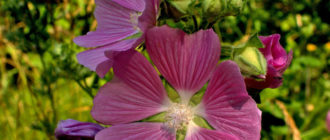
Mallow (or mallow) is an annual, or rarely biennial, plant native to tropical and subtropical regions of Africa, Europe, Asia, and the Americas. Hollyhock, another member of the Malvaceae family, is often referred to by the term mallow. However, while they are related, they are different flowers. The latter is a biennial or perennial, and it is the one we grow in our gardens.
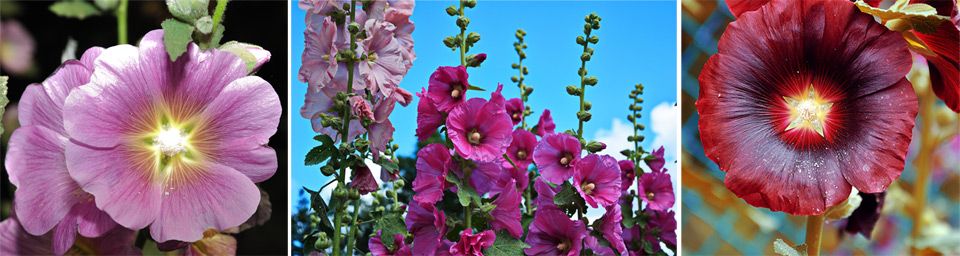
Description of mallow
There are 29 species of mallow. The calyxes are large. Pink, yellow, red, purple, and white flowers are common. Stem height varies by variety and ranges from 30 to 120 cm.
Description of hollyhock
As we've already mentioned, hollyhock is a perennial plant. There are about 80 species. It's taller than mallow, growing from 1.5 to 2.5 meters. Therefore, this flower is often used to decorate flowerbeds near fences and house walls.
The plant is easy to care for and requires little maintenance. When sown outdoors, it blooms the following year, and if seedlings are grown in advance, it will bloom the same year. Blooming is long-lasting and can continue until frost. After flowering, the hollyhock produces a seed pod, ready for harvesting and further cultivation.
Annual and perennial mallow, varieties with descriptions
As we've said, mallow is only an annual plant, occasionally growing for two years. What we grow at our dacha is hollyhock. However, since gardeners and nursery sellers often use these two terms interchangeably, we'll stop here and, for simplicity, refer to hollyhock as mallow throughout the article.
| View | Description | Variety |
Description of the variety Flowers |
| Annuals | |||
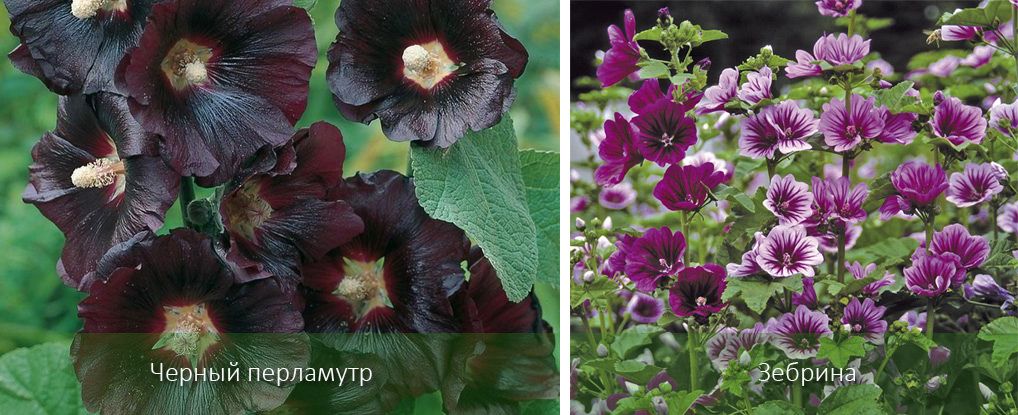
| Forest | An easy-to-grow biennial plant, it is grown as an annual in gardens. Stems reach 120 cm in height and have a long flowering period. All parts of the plant have medicinal properties. | Zebrina | Large, pale pink, with bright red veins. |
| Black mother-of-pearl | Large purple inflorescences with black veins. | ||
| Perennials | |||
| Musk | Plants grow to about 1 m tall, with white or pink flowers. Of all mallow varieties, they are the most frost-resistant and cold-winter-resistant, and tolerate rainy weather well. | Pink Tower | The inflorescences are large and rich pink. It is distinguished by its long flowering period. |
| White Tower |
Stems up to 70 cm high. White, without admixtures of other shades. |
||
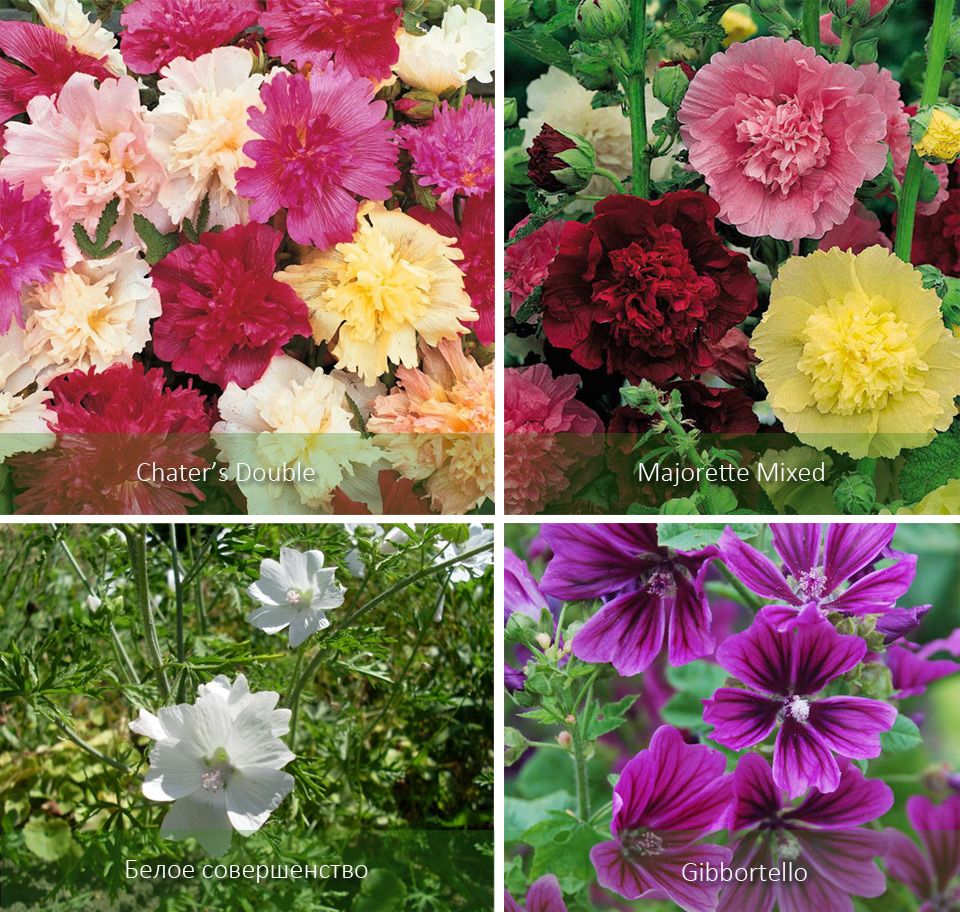
| White perfection | The bushes are medium-sized, with a large number of snow-white inflorescences. | ||
| Sudanese | Another name for this plant is Hibiscus sabdariffa. It has pronounced medicinal properties and is widely used in folk medicine. | Malva sabdariffa var. Altissima | A tall shrubby plant with yellow, red or green inflorescences. |
| Wrinkled | In the wild, the flowers are yellow and bloom in late summer. Bred ornamental cultivars offer a variety of colors, long-blooming seasons, and are tolerant of dry and hot weather. The species gets its name from the textured leaves. | Chater's Double Strain | The stems are tall, topped with lush double flowers. |
| Powder Puffs Mixed | Stems up to 2 m high. Often used to decorate hedges. | ||
| Majorette Mixed | Small bushes, abundantly covered with semi-double inflorescences. | ||
| Hybrid | Tall varieties of hollyhock with a long flowering period. | Chaters Double Pink | The stems reach a height of 2 m. The flowers are double, light pink in color. |
| Chaters Double Salmon | Delicate peach blossoms. Widely used in garden design. | ||
| Gibbortello | Dark inflorescences of rich purple shades. | ||
Planting mallow in open ground, growing from seeds
Mallow is grown from seeds using seedlings or planted directly into the ground.
To ensure that the plant produces abundant flowers this year, the seeds are germinated using the seedling method.
| Stage | Description |
| Selecting a site for planting. | Choose bright locations with some shade to help protect the leaves from scorching on particularly hot days. Avoid areas with damp soil, low-lying areas, or areas where rainwater collects. |
| Preparing the soil. | The soil is loosened in advance, depending on the month of planting. If the seeds are sown in May, the soil is loosened in April. If sowing in October, the soil is prepared in September. To improve the soil's nutritional value, it is fertilized with manure. |
| Seed preparation. | Soak the seeds in warm, but not hot, water for 12 hours before planting. This weeds out any seeds that are unable to germinate. |
| Fertilizers for the planting site. | The soil is fertilized with humus for neutralization. |
| Planting month. | If flowers are grown from seedlings, the seeds are planted in the second half of winter, and the seedlings are transplanted into open ground in May. Seeds are planted directly into flowerbeds in May or October. |
| Watering crops | Maintain moderate humidity, avoiding water accumulation in the soil. |
To propagate perennial mallow, the cutting method is used.
Top.tomathouse.com: Tips for growing mallow
Mallow is unpretentious, but to ensure that it blooms throughout the season, follow these simple rules:
- Perennial varieties are planted in the fall.
- Seeds for seedlings are sown in peat tablets, since mallow does not tolerate picking well.
- The shelf life of seeds is no more than 2-3 years.
- Double-flowered varieties grown from collected seeds usually don't retain the cultivar's characteristics. To ensure the new flowers retain the qualities of the mother plant, they are propagated vegetatively.
- Due to its tall stems and increased fragility, mallow is not planted in open, windy areas.
Perennial hollyhocks are more suitable for growing in southern latitudes. In regions with cold winters, perennial varieties are typically grown as biennials.
Rules for caring for mallow
During the flowering period, mallow requires simple but regular care to prevent leaf rot and rapid flower shedding.
| Action | Description |
| Watering | Moderate watering, with a small amount of water, once a week. Afterward, loosen the soil. In hot, dry summers, do this more frequently – every two days. Over-watering the soil can lead to disease and fungal growth. |
| Weeding | Once every two weeks. |
| Top dressing | Not required, but for longer flowering, fertilize with a phosphorus-potassium mixture once every three weeks. |
| Garter | They are tied to increase the stem's resistance to strong winds. The stake should be at least 1.5 m high. |
| Trimming | All wilted flowers are cut off immediately, otherwise flowering will be short-lived. |
| Diseases | It suffers from fungal diseases if not properly cared for. Common diseases include powdery mildew and rust. Fungicides are used to combat these. |
Propagation of mallow
Mallow is propagated by seeds and cuttings.
- Seed propagation is primarily used. Cuttings are used to preserve the varietal characteristics of the flower. This process is performed in spring or summer. The cutting is taken close to the root in early spring or from the stem in summer. The charcoal-treated cutting is planted in a prepared pot with substrate.
- The cutting method is very painstaking, as taking cuttings can destroy the plant. Therefore, only experienced gardeners use this method.
Mallow in the landscape
It's often used in garden design. To create a rustic-style space, hollyhocks are planted near a fence or wall, combined with delphiniums and golden balls. The middle level of the flowerbed is decorated with bellflowers, calendula, and lavatera, while daisies are planted at the front.
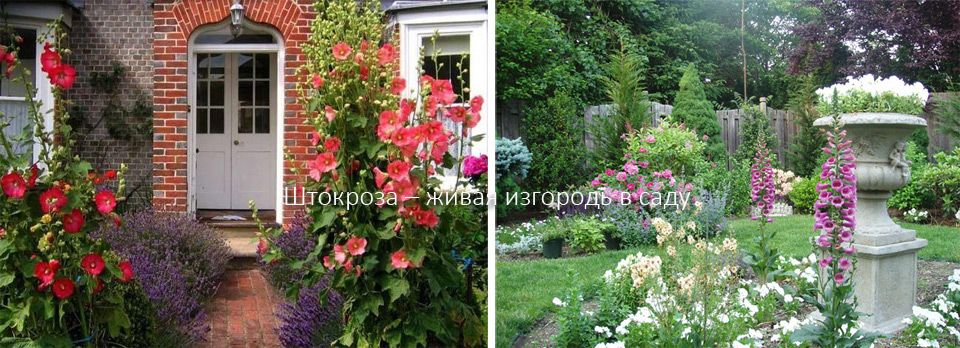
It's also used to camouflage cracked walls or old fences. Tall, vibrant plants effectively conceal design flaws, creating a colorful hedge.
These flowers are perfect for decorating the far corners of large gardens. They break up the greenery and liven up otherwise inconspicuous areas of the garden.
Top.tomathouse.com recommends: the healing properties of mallows
Since ancient times, flowers belonging to the Malvaceae family have been known to possess healing properties. They are widely used in folk medicine, as they contain a large number of beneficial microelements and vitamins:
- Iron;
- Cadmium;
- Starch;
- Tannins;
- Vitamin A;
- Vitamin C;
- Nicotinic acid;
- Essential oil.
Mallow, not hollyhock, is used medicinally, with both the flowers and other parts of the plant used. Mallow seeds are rich in fatty oils. Adding a small amount of seeds to coffee or tea improves health and helps saturate the body with nutrients. This drink combats swelling, cystitis, and heart disease. Decoctions and infusions are used both internally and externally.
An infusion of mallow leaves helps relieve coughs and promotes rapid recovery from bronchitis. It also reduces sore throat pain. The leaves are also used for digestive problems. Washing the eyes with an infusion of the leaves helps with conjunctivitis.
Mallow is used in cosmetology and dermatology. The mucilage contained in the plant promotes the rapid healing of minor wounds, burns, and cracks. An infusion of the root soothes skin inflammation, helps fight acne, and accelerates cell regeneration. Rubbing the decoction onto the skin reduces redness and leaves the complexion feeling refreshed.
An infusion of mallow is prepared by mixing 1 tablespoon of crushed and dried plant parts with 200 ml of boiling water. Let it steep for two hours, then strain and cool. For cosmetic purposes, steam 2 tablespoons.
It is an ingredient in many herbal teas prescribed for sore throats, urinary tract disorders, and spleen problems. A tea made from the leaves helps boost immunity. The plant's root is successfully used to combat anemia, fatigue, and low energy.
Mallow is safe to use—research has revealed no potential contraindications. The plant is included in some medications and is prescribed by medical professionals.