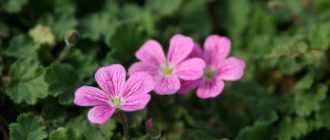
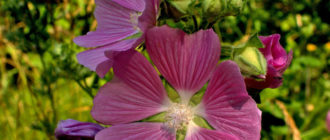
Iberis is a plant in the Cruciferae family, native to Spain. It is found in temperate climates of Europe, Asia Minor, the Caucasus, Crimea, and the lower reaches of the Don River. Several dozen varieties have been developed. Plants include annuals and perennials. Plants can be herbaceous or subshrubs. Annuals prefer warm climates, while perennials tolerate frost well.
Content
Description of Iberis
Iberis (iberis) is also known as wallflower, beris, and iberis. Its stems are erect and branched, growing up to 30 cm, while some varieties are prostrate. The leaf blades are elongated, smooth, glossy, dark green or bright green, 4-7 cm long, and arranged alternately. The leaves are oblong or pinnately dissected, with rounded margins.
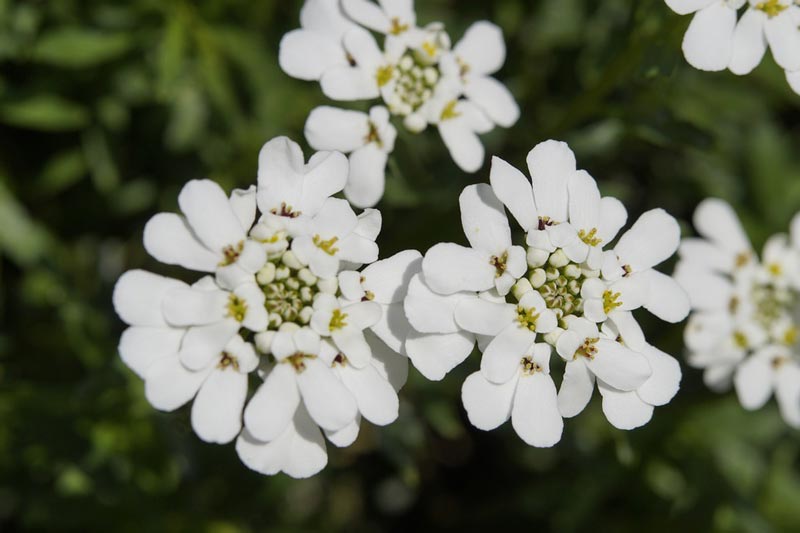
During flowering, the umbel-shaped inflorescences form a snow-white cap, obscuring the foliage and exuding a pleasant, rich fragrance. The petals are predominantly white, but pink, lilac, and purple are also found. They bloom in May, then again in August, and last for two months; annuals last longer. During flowering, the bush is 80-100 cm in diameter. Afterward, a pod containing small seeds forms.
The plant has a taproot system, consisting of a main root and lateral roots. Because of this, it doesn't like being repotted.
Popular types of Iberis
There are about forty varieties.
| Group | Types | Description | Varieties |
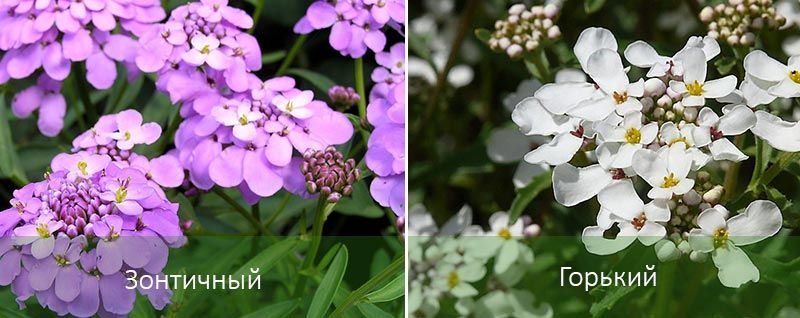
| Annuals | Bitter | From the Mediterranean. Reaches 30 cm, with branched shoots pubescent. The leaves are oblanceolate, triangular at the margins, and arranged alternately. The inflorescences are columnar, gathered in racemes, and bloom in a palette of white and lilac. It blooms throughout the summer months. |
|
| Umbrella | From Southern Europe. Reaches 40 cm, with smooth, branched shoots. The leaves are sparse, lanceolate, and dark green. The inflorescences are corymbose, 5-6 cm in diameter. The white and purple petals remain intact for two months. |
|
|
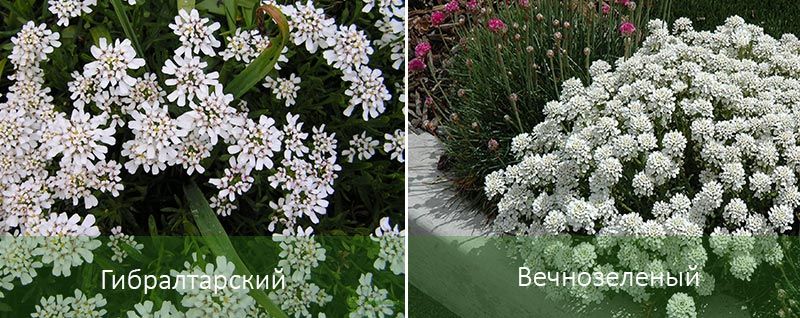
| Perennials | Evergreen | A subshrub native to Asia Minor. Up to 40 cm tall, with dark green, oblong, and glossy leaves. The inflorescences are umbel-shaped, up to 5 cm in diameter, and the white flowers bloom twice a season. |
|
| Gibraltar | From Spain. Semi-evergreen, up to 25 cm, lives for 2 years. Small, pink and lilac-colored umbel-shaped inflorescences. |
|
|
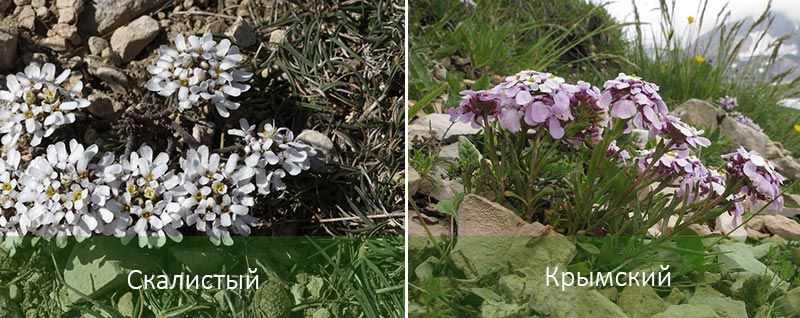
| Crimean | Common on the Crimean Peninsula. Up to 5-10 cm tall, it has gray-green, pubescent, spatulate leaves and creeping shoots. Lilac buds open white. Prefers calcium-rich soil. | ||
| Rocky | Native to the rocky regions of southern Europe, it grows up to 15 cm, forming a dense cushion of snow-white petals during flowering, resembling snowflakes. It is frost-intolerant and requires shelter. However, it is undemanding of soil and moisture. | ||
Growing Iberis from seeds
The most common method of growing from seeds is that they are easily purchased in a store or can be collected independently.
Seeds are sown directly into open ground in April, sometimes twice, 15-20 days apart, for flowering in summer and fall. The soil is weeded, dug, and leveled. Furrows are made, and the seeds are spaced 5 cm apart. After the seedlings emerge, two weeks later, they are thinned out to 12-15 cm apart.
If it is still cold at night, make a small greenhouse and cover the area with film.
Sprouts appear in 10-15 days.
Sowing and seedlings
Seeds for seedlings are sown in February to early March in containers with peat, sawdust, and sand, or in individual peat tablets, dropping one seed at a time. Loose soil is first disinfected with potassium permanganate or boiling water. The seeds are evenly distributed to a depth of 1 mm, lightly sprinkled with river sand, and moistened with a spray bottle. Cover with glass or plastic wrap and place in a warm place with diffused light. As the soil dries, mist the soil. After seedlings emerge, do not transplant. Before planting in a flowerbed, harden off the seeds by placing them outside for 10 days.
Sometimes, sowing is done in late autumn, when cool weather sets in, to prevent seedlings from appearing before spring. They will emerge in late April or early May.
Planting in open ground
Plants can be planted in open ground when the weather gets warmer, but follow certain rules.
Landing time
Seedlings are usually planted in a flowerbed in May, after the last frost has passed. The site should be well-lit, with loamy, sandy, or rocky soil, and free from stagnant moisture. Iberis will not bloom as profusely in partial shade. In the fall, add manure to the site.
Landing rules
When planting, carefully remove the seedlings along with the soil by transshipping them, so as not to disturb the root system. Leave a distance of 12-15 cm between the plants. Compact the soil around the plants and water.
When planting different plant varieties, you need to leave a larger distance between them to prevent cross-pollination.
After flowering
Annual crops are dug up. Withered flowers are removed from perennials, and shoots are trimmed back by 1/3 to give the plant a beautiful appearance.
Seed collection
The seeds in the pods ripen over the summer. The pods are collected several times, dried, and the seeds are extracted. Stored in a cool, dark place in cloth bags, the seeds remain viable for up to four years. Iberis also reproduces by self-seeding; simply thin out the emerging seedlings in the spring.
Wintering
The above-ground part is pruned for the winter. In warm climates, the perennial flower survives the winter well. In colder regions, plants are pruned and covered with fallen leaves and spruce branches, especially if the winter is frosty and snowless.
Features of Iberis care
The plant is easy to maintain and requires minimal care. During drought, water sparingly and can survive without fertilizer. However, to ensure abundant blooms, it's best to apply a comprehensive fertilizer mixture once a season. Also, loosen the soil and weed. Remove dried shoots.
Plants that reach five years of age lose their decorative appeal, and their flowers become very small. They need to be repotted.
Diseases and pests
Iberis is resistant to diseases and pests. To prevent fungal infections, spray the area with fungicides before planting. Affected plants include:
- Clubroot causes root deformities. The plant is destroyed and the affected area is treated with lime.
- Black scab (Rhizoctonia) is caused by cold and damp weather. Gray and brown spots appear on the plant. After digging up and burning the affected bush, the soil is treated with copper oxychloride.
Iberis is also attacked by pests:
- Mealybugs appear as white coatings on shoots. Treat with garlic infusion, Mospilan, and Aktara.
- Cabbage aphids – leaves wilt, turn yellow, flowers fall off. Use liquid potassium soap or Actellic or Neoron.
- Green flea beetles are small black bugs that eat away at leaves, causing holes. Keep the soil around the bush moist, as the insects dislike moisture. A dry mixture of ash and tobacco dust, or a vinegar solution, can help.
Reproduction
There are two more ways to propagate Iberis: by cuttings and by dividing the bush.
When propagating by cuttings after flowering at the end of summer, the shoots are cut into pieces up to 10 cm long, placed in pots of 3-4 pieces, placed in a greenhouse for rooting, and the following year planted in a permanent location.
The bush is propagated by division in the spring; strong, lush specimens are selected, the divided plants are planted in holes with drained soil, shortening them by 1/3.
Iberis in landscape design
The beautiful appearance of Iberis creates a beautiful landscape design in gardens and flowerbeds. Low-growing varieties are used in rock gardens, lawns, and borders. It is planted alongside phlox, petunias, alyssum, saxifrage, night violets, milkweed, marigolds, tulips, and sedum. It also thrives alongside cypress, juniper, and dwarf pine.
Iberis is grown in containers on terraces and loggias and used for wedding bouquets.
Top.tomathouse.com informs: the medicinal properties of Iberis and its use in medicine
Iberis has medicinal properties. It contains alkaloids, flavonoids, bitters, glycosides, and esters. The plant's beneficial properties are used in cardiology.
An infusion of the Bitter variety is used as a choleretic, anti-inflammatory, and for healing minor wounds and abrasions. Iberis helps with circulatory disorders, gastrointestinal disorders, gynecological problems in women, and urological problems in men. It is also used for liver problems, colds, bronchitis, tonsillitis, and joint pain.
It's important to remember that the plant is poisonous, so it's best to consult a doctor before using it. Iberis is contraindicated for pregnant and nursing women, children, and those prone to allergies.