An inconspicuous flower with heavenly blue petals, the forget-me-not is called Myosotis in Latin, which means “mouse ear”.
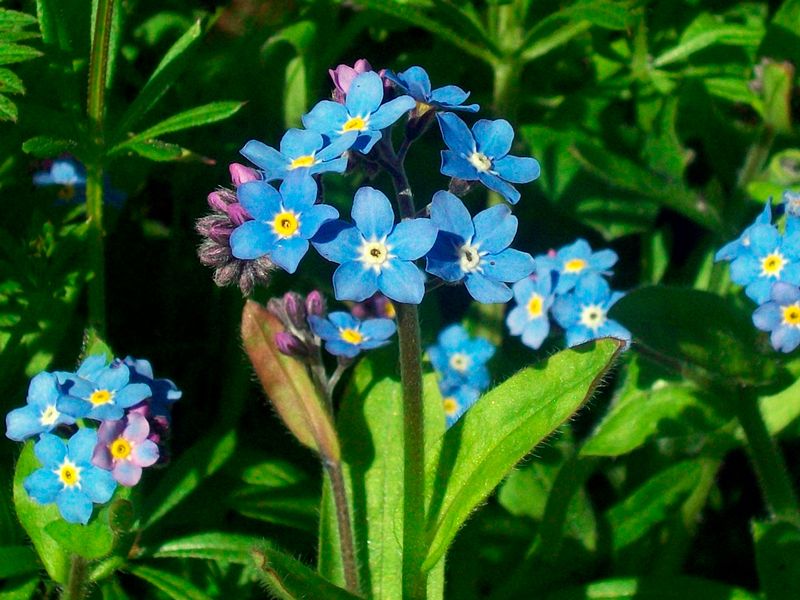
Numerous legends and folk beliefs are associated with it in most countries around the world. They share a common meaning: since ancient times, the plant has been considered a symbol of fidelity and good memory.
Content
Alpine forget-me-not and other species
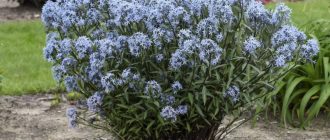
The flower is also commonly known as "prigozhitsa" or "grolyanka." It has an unassuming appearance: bushes 10 to 40 cm tall with highly branched stems and numerous sessile leaves topped with small corymbose inflorescences. The flowers of garden varieties are small (but significantly larger than wild varieties), typically 5-7 mm in diameter, blue, pink, or white with a bright, sun-like yellow center.
Flowering begins in the first third of summer and ends in July. Uncultivated varieties continue to open buds until frost sets in.
This member of the Borage family is grown as an annual, biennial, or perennial. However, by the end of the third season, the plant's stems become excessively elongated, and the number of flowers decreases. Plantings are rejuvenated by removing old stems and sowing a new generation.
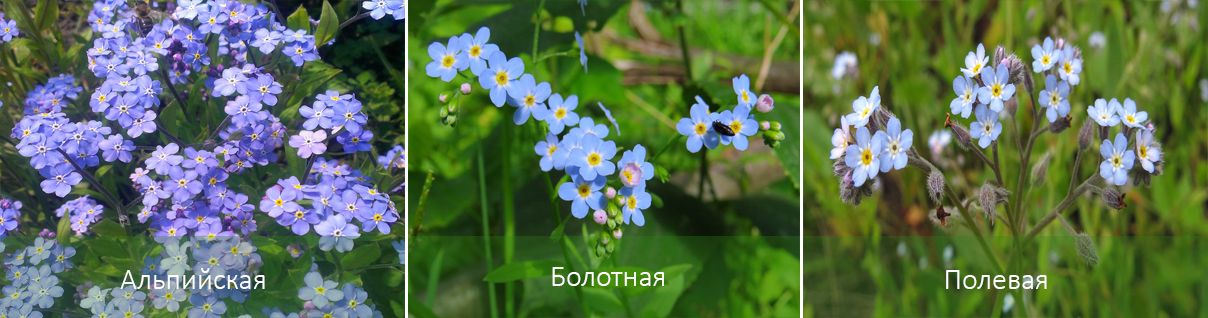
Scientists have identified over 50 species of forget-me-not, growing in all corners of the Earth where there's plenty of moisture, sometimes in swamps. The most common among gardeners are:
- Alpine, native to the mid-mountain regions of the Caucasus, the Carpathians, the Alps, Altai, and the southern Urals. The plant grows to a height of about 15 cm, with rich dark blue petals and light green leaves. In bright light, flowering lasts about two months. A specially bred garden variety is grown in the gardens of the lowlands of Russia. Popular varieties include the tall, dark blue Music, the 15-centimeter Indigo, the dwarf pink Rosilva, and the soft blue, lush Victoria.
- Marsh lily, which grows wild along the edges of swamps and ponds. This species is distinguished by its large flowers—up to 12 mm in diameter—and very long stems. The corolla is blue or pink. The Thuringian variety is prized for its dark blue, almost blue, flowers.
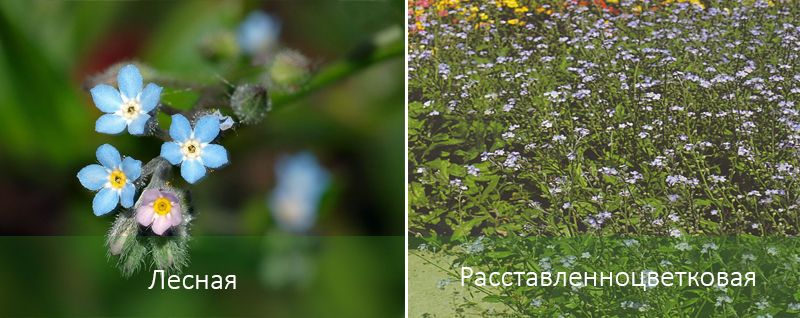
- A wild plant that grows in almost any open area where the soil retains moisture for a long time. The stems are medium-tall, and the petals are small and blue.
- A forest plant that thrives in shady areas. This tall plant produces profuse pink, blue, or light blue flowers. Popular varieties include Miro, Roggli, and the Magnum series.
- A spreading-flowered variety native to Switzerland, its large corollas bloom profusely on 30-centimeter-long, spreading stems. The 'Blau Grasmuck' variety is popular among Russian gardeners.
In gardens, one can also find cultivated forms of the fragrant forget-me-not, Sakhalin forget-me-not, Lazistan forget-me-not, pleasant forget-me-not and some other species.
Hybrid varieties are the result of the work of breeders. Petal color varies from delicate to deep blue, depending on the variety.
Planting forget-me-nots
Most varieties of primrose prefer partially shaded areas, while some prefer full shade. The exceptions are field and alpine varieties, which bloom vigorously only in well-lit areas.
Forget-me-nots don't have any particular soil requirements: moderately fertile, well-aerated soil is preferred; standing water is undesirable. Forget-me-nots are planted in the garden in one of two ways: directly from seeds in a flowerbed or from seedlings.
Spring sowing of seeds in open ground
Once the soil has warmed up well, loosen it and add peat or humus. After 2-3 weeks, dig it over again and level it.
Small holes are prepared for sowing, spaced 10 cm apart. The sown seeds are covered with a thin layer of soil and covered with plastic. Seedlings emerge within two weeks. Thin the seedlings to ensure comfortable growing conditions.
Autumn sowing for seedlings
This is done at the very beginning of winter. Seed trays are filled with a substrate consisting of one-third washed river sand and two-thirds disinfected turf soil. The seeds are scattered over the soil surface, pressed lightly, and lightly covered with soil.
The seedlings are then moistened with a spray bottle. The first shoots appear by the end of the first week. When the first 2-3 true leaves have formed, the seedlings are transplanted into individual cups and placed in an unheated greenhouse until spring. Once the snow melts, the cups with the seedlings are moved to a moderately warm room. The seedlings are planted in flowerbeds in April. By this time, most plants have already formed buds.
Growing conditions for forget-me-nots
The grolyanka is easy to grow and doesn't require any special conditions. Adequate light and shade, moderate watering, occasional fertilizing, and pest and disease control measures are quick and easy to maintain for novice gardeners.
Watering
Flowers growing in open, sunny areas and rock gardens require watering twice a week. Those growing in shady areas should be watered once a week, provided there is no natural rainfall.
To reduce the hassle, forget-me-nots are usually planted in the company of garden plants that reliably shade the soil.
Top dressing
In overly fertile soil, the rhododendron begins to overgrow, producing only foliage. Therefore, fertilization should be handled with extreme caution. It's sufficient to apply peat or compost twice a season—in spring and fall—and water with liquid mineral fertilizers immediately after flowering.
Other care activities
Experienced gardeners recommend loosening the soil regularly, at least once every 10-15 days, to ensure that nutrients and oxygen can reach the roots without hindrance.
Flowers do not need weeding – their powerful root system suppresses weeds trying to get out of the ground.
There's no need to prepare flowers for winter. The roots easily withstand severe frosts, even without snow cover. Sometimes gardeners simply mulch their plantings with a thin layer of dry leaves.
Reproduction of forget-me-not
All traditional methods are suitable for propagation: using seeds, cuttings, dividing the bush.
Seeds
Harvest as they ripen. After drying, place them in a cloth bag and store until ready to sow, but no more than three years. Fresh seeds can be sown directly into flowerbeds and flower gardens. However, it's important to remember that hybrid forget-me-nots do not transmit varietal traits when propagated this way.
Sometimes gardeners don't even bother collecting seeds—the rhododendron spp. self-sows easily. In the spring, the young bushes are carefully dug up and planted in the desired location.
Dividing the bush
The optimal way to increase the number of hybrid forms. This procedure can be performed at any warm time of year; the hardy root system tolerates division without damage and easily establishes in a new location.
The bushes are dug up and carefully divided into several parts. Each division is planted in a prepared hole.
Cuttings
It is also used to propagate hybrid and varietal, highly ornamental forget-me-nots. After flowering, the apical shoots are cut with a sharp, disinfected knife. They are planted immediately and covered with plastic or a transparent glass container. Water very carefully: water on the leaves is extremely harmful to the cuttings. To encourage branching, the bushes are pinched back by 1-2 cm.
With this propagation method, the grolankas bloom the same year. However, they need to be covered with spruce branches or agrofibre for the winter.
Pests and diseases of forget-me-not
The flowers are highly resistant to disease. The only possible cause of damage is overwatering.
Waterlogged soil is a favorable environment for the development of fungal infections, such as powdery mildew, root rot, and gray mold. If signs of disease appear on leaves and stems, treat with any fungicide (copper sulfate, HOM, Skor, Fitosporin, etc.).
To prevent an outbreak, maintain planting density and thin out plants promptly. Avoid allowing the soil to dry out or allowing water to stagnate under the flowers for long periods.
Pests also don't actively attack forget-me-nots, making their care much easier. Insecticides are used only when pests are detected or in the event of a massive infestation.
Top.tomathouse.com informs: Forget-me-not is a healer of the respiratory tract
Besides its unpretentious ornamental qualities, the primrose is prized for its medicinal properties, known since ancient times. Folk medicine uses the plant as a hemostatic, anti-inflammatory, and expectorant. This humble flower effectively complements the treatment of bronchitis, some forms of tuberculosis, and lung diseases.
The raw materials for medicinal infusions are prepared during flowering. All above-ground parts—stems, leaves, and inflorescences—are used. Drying is done in the shade in a ventilated area or under a draft-free canopy. The raw materials are then crushed and stored for up to a year in glass, ceramic, or paper bags.
When harvesting forget-me-not flowers for medicinal purposes, keep in mind that varietal and hybrid forms are not suitable for these purposes.
Field and forest species are considered the best raw materials, ideally wild-growing. Some folk recipes using forget-me-not herb:
- For bronchitis, residual cough, and fever, pour 3 tablespoons of dried herb into a glass of boiling water. Let it steep for an hour, then strain. Drink one tablespoon three times daily after meals.
- Tea brewed with the addition of forget-me-not (1:1) helps with asthma, stomach or intestinal disorders, and kidney disease.
- A decoction of two teaspoons of dried herb in a glass of water helps with impotence.
- Fresh juice from the leaves and stems is used as an adjuvant in the treatment of malignant lesions of the oral cavity.
- The green parts, chopped into a pulp, are an excellent hemostatic and wound-healing agent. The paste is applied to open wounds, burns, and frostbite.
Scientists have found no contraindications to the use of medicinal forget-me-not decoctions and infusions. However, pregnant or breastfeeding women, as well as those with allergies, should consult a doctor first.
Some housewives use the delicate flowers for culinary purposes. For example, they candied them and used them to decorate baked goods like cakes and pastries. Or they froze them in water to garnish cocktails.